The Iron Inheritor: A Study of Old Calibers and the Weight of Unfinished Business
CHAPTER 1: THE COUNTERCURRENT
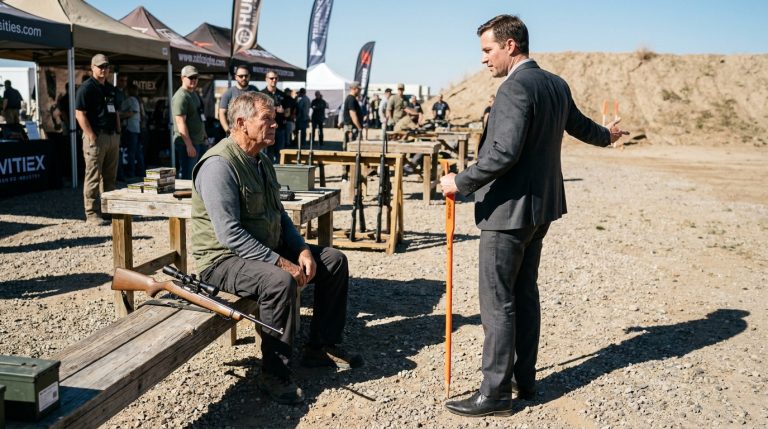
Tyler held the Colt with the casual disrespect of someone who had never felt the kick of a true .45 ACP. His thumb grazed the slide, the movement smooth, efficient, and entirely wrong. Gordon watched the way the fluorescent overhead light caught the dust motes dancing between them—a suspended, chaotic curtain.
“It’s a relic, pops,” Tyler said, his voice dropping into that condescending, sing-song lilt people saved for the elderly. “These springs? They’re bound to be brittle. You want something reliable. A polymer frame. Doesn’t jam, doesn’t need a degree in mechanical engineering to strip down. You carry this, you’re just carrying a paperweight that might decide to fail the moment you need it.”
Gordon leaned into the counter. He felt the cold glass press against his forearms. His knuckles were mapped with veins that stood out like riverbeds during a drought. He didn’t look at the other customers lingering by the rifle racks; he didn’t look at the neon signs flickering in the window. He looked at the serial number etched into the frame of his weapon. The numbers were worn, smoothed by decades of palm sweat, yet still legible—a cipher of a life spent in the shadows of things he’d sworn to bury.
“I don’t need reliability, son,” Gordon said, his voice a low, dry rasp. “I need accuracy.”
“Accuracy is a software issue in modern pistols,” Tyler retorted, sliding the 1911 back toward Gordon. The metal clicked against the glass, a sharp, jarring sound that echoed in the quiet space between them.
Gordon reached out, his hand steady, his fingers wrapping around the grip with an intimacy that made Tyler blink. It wasn’t just a grip; it was a reunion. As his skin met the worn checkering, Gordon noticed the discrepancy. The small, triangular notch he had filed into the base of the magazine well during the winter of ’68 was gone. It had been filled, smoothed over by a master gunsmith he hadn’t visited in decades.
His heart hammered a slow, rhythmic beat against his ribs. Who had touched this weapon?
He looked up, meeting Tyler’s gaze. The kid’s eyes were a familiar shade of hazel—the same eyes that had looked up at him from a crib he hadn’t seen in over half a century. The air in the shop suddenly felt heavy, charged with a magnetic, impossible tension.
“You like that one so much,” Gordon said, his heart skipping a beat as he caught a fleeting, haunting resemblance in the curve of the boy’s jaw. “Where did you learn to handle a frame like that?”
Tyler shrugged, unfazed. “Just a hobby, pops. My grandfather used to tinker with the old stuff before he passed. Left me the workbench. Guess it rubbed off.”
Gordon’s hand tightened on the grip, the cold steel biting into his palm. The world sharpened. He wasn’t just in a gun shop anymore; he was standing at the edge of an abyss he thought he had closed years ago. And the boy, this unwitting child of his own history, was holding the shovel.
CHAPTER 2: THE FRICTION OF MEMORY
The bell above the shop door chimed—a thin, tinny sound that vibrated against the back of Gordon’s teeth. He didn’t turn back. He tucked the 1911 into the small of his back, the worn leather of his holster groaning in protest against the movement. The air outside was humid, thick with the smell of wet asphalt and cooling engines, a sharp contrast to the antiseptic, oil-scented artificiality of the store.
Gordon walked toward his truck, a battered Ford that had survived more winters than the city planners had survived mayors. Every step was a calculation. His knee, a joint held together by scar tissue and sheer stubbornness, clicked with a rhythmic, dull throb. He focused on it, using the sensation to ground himself. The boy, Tyler—that was the name tag, pinned crookedly to a blue vest—had looked at him with the same vacant, hazel-eyed intensity that had haunted Gordon’s nightmares for fifty years.
He reached for the door handle, but his thumb slipped. A sudden, sharp snap emanated from the door mechanism. The handle went limp, rotating uselessly against the rusted paneling.
Friction, Gordon thought, his jaw tightening. Everything eventually stops moving the way it’s supposed to.
He didn’t curse. Cursing required an energy he couldn’t afford to waste. He pulled a multi-tool from his pocket, the metal casing scarred and oxidized, and began to work on the door frame. The screws were stubborn, seized by decades of oxidation, refusing to yield to the pressure of his hands. He leaned his weight against the truck, the rough metal biting into his shoulder, and felt the familiar, grounding heat of physical resistance.
He needed to get home. He needed to compare the serial numbers in his logbook, the handwritten record he had kept in a fireproof box beneath his floorboards since 1968. If Tyler’s grandfather—the man he’d known as Elias—had truly been the one to tinker with that 1911, then the life he’d built in this quiet, dusty town was a house of cards waiting for the wind to change.
The screw finally gave, spinning free with a metallic shriek that sounded like a cry of protest. He pried the panel back, his fingers tracing the internal lock mechanism. It was a tangle of rusted wires and oxidized steel, a labyrinth of metal that required delicate, precise manipulation. He had to be surgical. If he forced it, the linkage would snap, and he’d be stranded in the middle of this strip-mall purgatory.
His mind flickered back to the shop, to the way the fluorescent light had caught the boy’s face. Tyler was young—barely old enough to understand the gravity of the equipment he sold, let alone the history it carried. But the eyes were undeniable. They were the eyes of the woman who had died in the rain, the woman whose name Gordon still whispered when he thought no one was listening. The connection was an impossibility, a statistical outlier that defied the logic of his carefully curated seclusion.
Unless.
The word hung in his mind, dark and heavy as a storm front. Unless this wasn’t an accident. Unless the past had finally stopped waiting in the shadows and had decided to come knocking.
He manipulated the lever. With a soft, mechanical click, the door swung open.
Gordon didn’t climb in immediately. He stood there, watching the reflections in the dusty window of the store across the street. He looked at his own reflection—a silhouette of a man who had worn down the edges of his soul to survive, a man who had traded his conscience for silence. He looked at the 1911 resting against his spine, a heavy, cold weight of accountability.
He didn’t just have to get home. He had to prepare. If the legacy of the past had arrived in the form of a kid behind a counter, then the restitution he had planned wasn’t just a mission anymore. It was an inevitability.
He slid into the driver’s seat, the springs of the bench seat biting into his hips. The engine turned over on the third try, coughing a cloud of blue exhaust into the heavy, humid air. He shifted into gear and pulled away, his eyes constantly flicking to the rearview mirror. He wasn’t looking for traffic. He was looking for a shadow that might follow, a sign that the silence he had purchased with his life was finally coming due.
The road ahead was narrow, flanked by overgrown oaks that looked like skeletal fingers reaching out of the dark earth. He drove with the steady, practiced rhythm of a man who knew exactly where the hazards were hidden. Every bump in the road was a reminder of the terrain he had crossed, the mistakes he had buried, and the iron-clad truth that nothing, no matter how deeply it was hidden in the rust and the dust, ever truly stayed lost.
As he reached the edge of town, the streetlights began to flicker, dying one by one in the distance. Gordon accelerated, the tires gripping the road with a frantic, desperate tenacity. He wasn’t running away. He was heading toward the only place where the ghosts still kept their original names.
CHAPTER 3: THE AUDIT
The driveway was a ribbon of cracked gravel that crunched rhythmically under the Ford’s tires, a sound that usually brought Gordon a sense of profound, singular peace. Tonight, however, the noise was an intrusion, a violent scraping against the quiet isolation of his property. He killed the engine, but the silence that followed didn’t settle. It hung suspended, heavy and expectant, waiting for him to break it.
He stepped out of the truck, the cold air biting at his face. His joints protested the transition from the cab’s warmth to the damp night, a reminder of the long, uneven decades he had spent hardening himself against the world. He walked toward the cabin—a structure of weathered cedar and fieldstone that looked as though it had grown directly out of the hillside.
He didn’t head for the front door. Instead, he skirted the perimeter, his boots finding the familiar soft patches of earth where he had buried his life’s true foundation. He reached the rear of the cabin, where the foundation boards met the ground in a jagged line of rot and shadow. He knelt, his knees sinking into the damp soil, and began to claw away the layer of dead leaves and debris that protected the corner of the structure.
He found the loose board—a piece of oak he had hammered into place in the summer of ’74. It pulled away with a groan of protesting nails. Behind it lay the hollowed-out space that held his life’s ledger: the fireproof, rusted steel box.
He pulled it out, the weight of it familiar and grounding. He sat there on the wet ground, the smell of damp pine needles and earth thick in his lungs, and keyed the lock. It clicked, a sharp, precise sound that sliced through the rustle of the wind in the trees. Inside, layered in oil-cloth, were the documents he had spent half a century collecting. His hands were steady as he unwrapped the contents, but his heartbeat was a rapid-fire drum against his ribs.
He was looking for the schematics. Not of the weapon—he knew every spring, pin, and sear of that 1911 by heart—but of the modifications. He leafed through the yellowing pages of his logbook, his eyes scanning the precise, spidery handwriting he had committed to paper after the incident in the rain.
1968, November 14th.
He found the entry. He had documented every alteration he’d made to the internal hammer, every subtle adjustment to the trigger pull. He compared his notes to the physical memory of the pistol he had held in the shop earlier. He remembered the feel of the magazine well, the way his custom notch had been filled.
His eyes narrowed as he traced the ink on the page. He hadn’t just filed a notch; he had created a specific, asymmetrical wear pattern on the frame—a thumbprint of steel. If the weapon he held today didn’t bear that mark, it meant someone had not only worked on it but had replaced the original frame entirely.
He sat back on his heels, the cold seeping through his trousers. A wave of vertigo washed over him, not from the cold, but from the implications. If the frame had been swapped, it meant the weapon he’d carried all these years was no longer his own. It was a replica, a perfectly crafted decoy designed to mirror his past while stripping him of his leverage.
He reached into his jacket and pulled out the 1911. In the dim moonlight, he examined the frame again. It was perfect. Too perfect. The subtle, microscopic flaws he had meticulously introduced to make the weapon “his” were gone, replaced by a smooth, factory-grade finish that defied the years of abuse he had inflicted upon it.
He felt a cold, hollow ache in his chest. He hadn’t been carrying his past; he had been carrying a souvenir.
The revelation was a hammer blow to his logic. He had trusted his senses, his muscle memory, the weight of the steel in his hand for decades. And all that time, someone—or something—had been slowly replacing the pieces of his life, substituting his reality with an imitation that looked and felt close enough to keep him from looking too closely.
He needed to understand the scope of the deception. He stood, his movements stiff and deliberate, and carried the box into the cabin. The interior was sparse, a study in pragmatism: a wood-burning stove, a sturdy table, and a wall of shelves filled with technical manuals that most people wouldn’t dream of opening. He set the box on the table and flicked on the lantern.
The light revealed a small, dusty photograph tucked into the back of his logbook—the only one he had kept. It showed two men standing in front of a rusted shopfront in 1968, both of them young, both of them holding tools, both of them smiling at something off-camera. Gordon’s finger brushed the face of the man next to him.
Elias.
The realization hit him with the force of a landslide. If the kid—the boy with the hazel eyes—was indeed Elias’s grandson, then the “hobbyist” claims were a lie. The boy was part of a lineage that had been tracking him, observing him, and perhaps even guiding him, all while he thought he was the one in control.
He looked at the 1911 on the table, the light glinting off its polished surface. It was a beautiful, dangerous thing. But it wasn’t a weapon of restitution anymore. It was a lure. He had walked right into their shop, into their conversation, and had practically announced his presence to the very people he had spent his life trying to outrun.
Gordon walked to the window and looked out into the darkness. The trees were black pillars against the night sky, standing like silent sentinels. He knew now that the audit of his own life was incomplete, and the consequences of the missing pieces were starting to stack up. He had to go back. Not to the shop, but to the source. He had to find out if the boy knew the truth about the man in the photograph, or if he was just another cog in a machine that had been turning long before Gordon ever thought he could stop it.
He began to pack his bag, his movements fluid and efficient. He didn’t take much—only the essentials, the tools of a trade he had hoped to retire from. As he zipped the bag shut, he caught sight of his reflection in the dark glass of the window. He looked older, tired, but for the first time in years, the fog in his head had cleared, replaced by a cold, sharp, and absolute clarity.
The hunt was no longer for the past. It was for the future. And he was the only one who knew the terrain.
CHAPTER 4: THE GHOST IN THE MIRROR
The cabin felt smaller tonight, its walls closing in with the weight of decades. Gordon stood by the table, the lantern light casting long, distorted shadows that danced across his technical manuals and the open logbook. His hand hovered over the photograph of Elias, the paper brittle and yellowed at the edges. A draft snaked through the floorboards, cold and smelling of wet soil, and suddenly, the smell shifted. It wasn’t just dirt. It was ozone and heavy, driving rain—the scent of a November night fifty years ago.
He squeezed his eyes shut, but the memory forced its way in. The sound of tires spinning on slick mud. The frantic, high-pitched shout of a woman he had promised to protect. The metallic, wet thud of the 1911 hitting the ground. He had stood there for an hour, paralyzed, waiting for the sirens that never came. He hadn’t been the hunter that night; he had been the casualty.
He opened his eyes, forcing the phantom sensation away. He was not that man anymore. He gripped the edge of the table until his knuckles turned white, grounding himself in the present. The cabin was real. The gun was real. And the boy—Tyler—was an active, breathing variables in an equation he had assumed was solved.
He grabbed the bag and stepped out into the night. The journey from the cabin to the truck was a gauntlet of familiar shadows, but each tree looked like a witness, each gust of wind a whisper from the dead. He climbed into the Ford, the seat springs complaining, and turned the key. The engine roared to life, a guttural, uneven sound that echoed off the hills. He didn’t head straight for the main road; he took the long way, the logging track that wound through the dense brush behind the property line.
He needed to see if he was being watched. He killed the headlights, letting his eyes adjust to the oppressive darkness. He drove by feel and memory, navigating the ruts and dips of the overgrown track with a precision that bordered on the psychic.
His mind was an engine, stripping down every interaction he’d had with Tyler, looking for the tell-tale wear patterns of a setup. If the boy was indeed a descendant of Elias, then the “hobbyist” act was a masterclass in misdirection. Elias had been a man of meticulous detail, a man who saw the world as a series of interconnected gears. If he had trained his bloodline to continue his work, they wouldn’t just be watching Gordon; they would be manipulating the environment around him to force him into a specific, predetermined outcome.
He rounded a bend, the truck’s tires spinning on a patch of wet clay, and he caught a flicker of light in the distance. It wasn’t the steady, yellow glow of a streetlamp. It was a rhythmic, pulsing blue—a signal.
He slowed, pulling the truck into the thick cover of a pine grove. He cut the engine, the sudden silence rushing into the cab like water. He leaned forward, squinting through the windshield. Two figures stood near the intersection of the logging road and the county highway. One was tall, gaunt, and carried himself with the stiff, practiced posture of a man who spent his life behind a desk. The other was shorter, younger—Tyler.
Gordon reached for the 1911 in his shoulder holster, checking the chamber by feel. The metal was cold, unyielding. He didn’t approach them. He stayed in the shadows, his breathing shallow and measured.
The taller man was speaking, his gestures sharp and emphatic. Tyler stood with his hands in his pockets, his head tilted in a way that Gordon recognized instantly—a posture of respectful, yet calculated, defiance.
Elias, Gordon thought, his blood running cold.
It wasn’t Elias. Elias would be well into his eighties, if he were still alive. But the man was an echo—a younger, sharper, and far more dangerous version of the man he’d known. This was the next generation of the debt. They hadn’t come for an apology, and they hadn’t come for mercy. They were finishing the job their grandfather had left on the workbench.
Gordon watched as the older man reached into his jacket and pulled out a small, metallic object, handing it to Tyler. Even from this distance, Gordon recognized the silhouette. It was a magazine—a custom, extended-capacity magazine for a 1911.
The friction in the air was palpable, a static charge that made the hair on his arms stand up. The boy didn’t just have a hobby; he was being re-tooled. They were upgrading his kit, preparing him for a confrontation that Gordon had been trying to avoid for half a century.
Gordon shifted his grip on the steering wheel, his knuckles aching. The logic of the situation settled into his bones like lead. He had come here to find the truth about the past, but the truth was already standing at the edge of the highway, loading his own history into a weapon that wasn’t designed to defend, but to end.
He didn’t wait to see what they did next. He shifted the truck into reverse, moving with agonizing care to avoid the dry brush that would snap like a warning shot in the night. He had the advantage of the shadows, for now. He knew where they were, and he knew who they were. That, in this new, complicated geometry of his life, was the only leverage he had left.
As he retreated, he realized the ultimate, brutal irony: he had spent his life protecting the secret of what happened that night, only to have the descendants of that secret become the very threat he had feared most. He was the architect of his own closing circle, and the walls were finally beginning to touch.