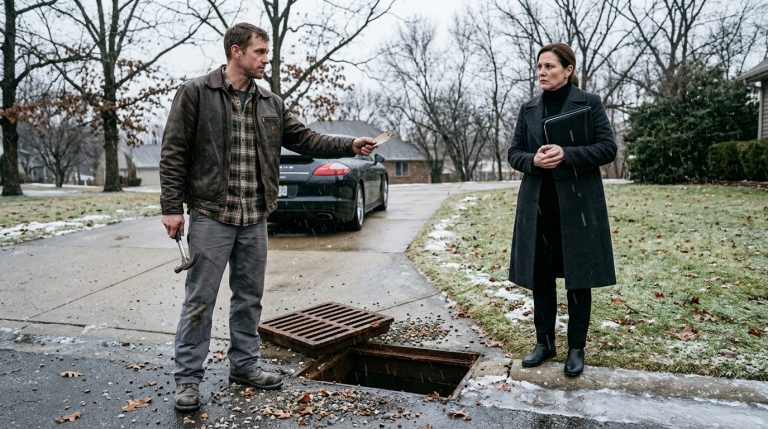
The Concrete Ledger: A Veteran’s Cold Campaign Against the Suburban Cartel
CHAPTER 1: THE ASH THE CALIPER
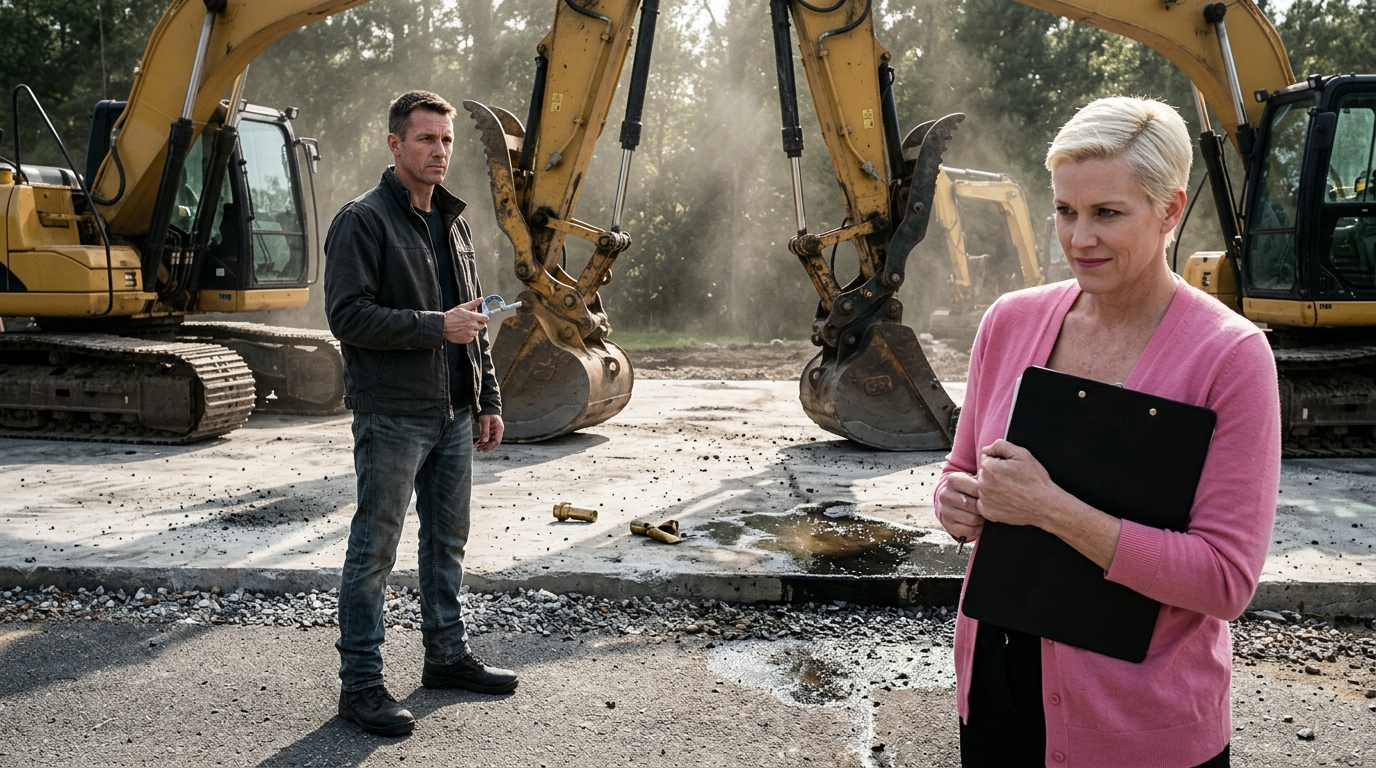
The diesel exhaust reeked of unburnt kerosene. Three excavators sat idling on the crushed aggregate of my driveway, their yellow steel booms dripping hydraulic fluid onto the fresh treads.
Where my workshop had stood five hours ago, there was only a naked gray slab.
I dropped the canvas duffel. The canvas hit the dirt with a dull thud. My boots stayed locked to the asphalt. Jet fuel still coated the back of my throat from the transport flight out of Ramstein, but the air here smelled like pulverized pine, wet drywall, and oil. Five years of hand-milled oak rafters, gone. My tool chests—chewed into twisted ribbons of powder-coated steel sticking out of a dumpster at the curb.
I didn’t yell. I reached into my right jacket pocket, my thumb finding the knurled adjustment thimble of my stainless steel micrometer. Spin. Click. Measure. Zero point zero five millimeters. Cold steel against a calloused thumb.
“You’re back early.”
The heels clicked on the sidewalk before she spoke. Rhythmic. Shallow.
Harriet Thompson stopped two feet short of the oil slick on my drive. Bleach-blonde hair cut into a hard, rigid line. Pink cardigan draped over her shoulders. She held a heavy black clipboard against her ribs like a tactical shield.
“Where is the building, Harriet?”
My voice sounded flat, even to me. No rise in pitch. No tremor.
“Oh, that old thing?” Her mouth curved, but her eyes remained cold, pale blue beads scanning my tactical boots, my faded jeans, my haircut. “We had it removed on Friday. It was in direct violation of community architectural standards.”
“It was a permitted structure,” I said. My thumb spun the micrometer’s thimble. Click. Click. “City permit recorded five years ago. Placed four feet back from the utility easement.”
“The city isn’t the board, Mr. Vance.” She tapped the top of her clipboard with a manicured nail. “You failed to respond to three formal notices regarding the setback amendments under Code 109-B. We sent them by certified mail.”
“I was deployed.”
“Yes, well.” Harriet adjusted her cardigan, her smile widening into a sharp, bloodless line. “An absence doesn’t freeze community governance. The board voted unanimously. We brought in a private contractor to remediate the eye-sore before property values suffered.”
I stepped forward. Just four inches.
Harriet didn’t flinch, but her grip on the clipboard tightened until her knuckles turned yellow. She liked power. She fed on the hesitation of people who had something to lose.
“Who was the contractor?” I asked.
“Silver Pines Property Services,” she said smoothly, reading off a slip clipped to the masonite. “A fully vetted vendor. The removal costs have already been assessed against your lot balance. You’ll receive the invoice by Friday.”
I looked past her, down to the edge of the slab. A brass ground-rod had been sheared off at the concrete line. The cut wasn’t made by a wrecking saw—it was notched and snapped with a breaker bar. Lazy. Fast. Expensive.
“You tore down a forty-thousand-dollar structure without a court order,” I said softly.
“It wasn’t illegal,” Harriet replied, her tone dripping with fake sympathy. “It was board action. If you have concerns, the next open forum is in three weeks. Provided your account is brought current.”
She turned on her heel, her pink cardigan fluttering as she walked away.
I didn’t follow her. I knelt by the corner of the slab. Among the gray dust and pulverized cinderblock, something glinted. A crushed brass fitting from my air compressor line, stamped with a serial code that didn’t match my inventory.
They hadn’t just demolished the building. They had cleared it out before the track-hoes hit the walls.
My thumb turned the thimble of the micrometer, checking the thickness of the brass scrap.
Three millimeters.
The war wasn’t in a desert anymore. It was on this slab.
CHAPTER 2: PAPERWORK WARFARE
The edges of the crushed brass fitting bit into the skin of my palm. I stayed down on one knee for twenty seconds after Harriet’s heels stopped clicking against the concrete.
The silence that settled over the cul-de-sac wasn’t peaceful. It was the heavy, artificial calm of a perimeter before an artillery strike. I closed my fingers over the scrap of metal, pushed off the raw concrete edge, and stood up. The air carried the faint, bitter scent of sheared pine and pulverized cinderblock—five years of my life reduced to fine dust settling on the hood of my truck.
I didn’t head inside to unpack. I walked the perimeter of the slab, my eyes tracing the ground.
At the far rear corner, where the workshop’s power drop had tied into the main line, the heavy conduit had been hacked through with a fast, jagged stroke of an angle grinder. Copper wire ends poked out of the dirt, bright and untarnished. They hadn’t even bothered to flip the breaker inside my main panel first; the arc marks were burned black into the PVC sheath. They’d worked in a hurry, pushing the equipment to its absolute limit to clear the lot before my leave orders expired.
A low rumble hummed down the block.
I didn’t turn my head immediately. I used the side mirror of my parked Ford F-250 to track the visual. A white Ford Transit van with tinted rear windows and no commercial decals had pulled up to the curb three houses down. It sat idling, its exhaust pipe puffing thin white rings into the afternoon humidity.
Observation team.
They weren’t trying to hide. They wanted to see if I’d lose my temper. A military veteran coming off a deployment, finding his property flattened—they were betting on a public blowup. An altercation on the sidewalk would give Harriet all the legal leverage she needed to slap a restraining order on me and lock me out of my own property entirely.
My thumb found the micrometer in my pocket. Spin. Click. I let the tension bleed off into the steel thimble.
I walked up the front steps, picked up my duffel, and went inside.
The house smelled stale, like trapped dust and cold air conditioning. I dropped the bag on the entryway tile, walked straight to the kitchen window, and looked through the blinds. The white van was still there, sitting under the shadow of a municipal oak.
A sharp tap echoed against the front door glass.
I didn’t jump. I walked back to the door and pulled it open, keeping my body framed solidly in the entryway.
It wasn’t Harriet. It was Lewis.
He lived two doors down—a retired machinist with arthritis in his knuckles and a yard he manicured with a hand-reel mower. He wore a faded flannel shirt and held a white paper envelope in his liver-spotted hand.
“They did it while you were over the water, Vance,” Lewis said, his voice dropping to a low raspy gravel. He didn’t look at my face; his eyes were fixed on the empty space behind my house where the roofline used to sit. “Three days ago. Big rigs. High-intensity floodlights at night. They didn’t stop until the slab was bare.”
“Who signed the work order, Lewis?”
“Harriet,” he spat out, the name sour in his mouth. “She called an emergency session of the board last Tuesday. No public notice on the clubhouse board. No seventy-two-hour email drop. Just her, Ron, and Marsha sitting in a dark room.” He held out the envelope. “This was in my box this morning. They’re ramping up.”
I took the envelope. It was an official Notice of Non-Compliance from the Oakridge Homeowners Association, printed on heavy bond paper.
Violation: Excessive turf height (1.5 inches over maximum limit). Fine: $150. Immediate cure required within 24 hours.
“They sent you one, too?” I asked.
“Third one this month,” Lewis grunted. He reached into his pocket and pulled out a small, brass-plated cabinet hinge, passing it to me. “They claimed my shed doors didn’t match the architectural palette under Code 109-B. I’ve had that shed since ninety-eight. She wants us out, Vance. She’s squeezing the older lots.”
I examined the white envelope. Below the HOA seal, in small black type, was the processing clearinghouse name: Vanguard Reserve Management Solutions.
I didn’t tear the paper. I folded it once, neatly, and slipped it into my back pocket alongside the brass fitting.
“Who’s in the van down the street?” I asked softly.
Lewis shifted his weight, his worn leather shoes squeaking against the porch wood. “Spotters for the maintenance contractor. They started showing up two weeks before the dozers arrived. Every time somebody leaves for work, they pull up and log the driveways.”
“Silver Pines,” I said.
“That’s them,” Lewis confirmed, nodding grimly. “Harriet’s nephew runs the crew. Kid named Tyler. Drives a brand-new seventy-thousand-dollar dually paid for with ’emergency maintenance’ assessments.”
A second white envelope sat tucked into my own door frame, pinned behind the screen. I pulled it free.
Violation: Unauthorized vehicle placement. Fine: $200. Note: F-250 front bumper extends 2.5 inches beyond the designated driveway boundary line.
They were trying to build a paper trail of habitual delinquency to justify a lien. Standard operating procedure for a land grab: overwhelm the target with small, defensible micro-fines, force them into administrative exhaustion, and strike with a foreclosure motion while they’re looking the wrong way.
“Keep your head down, Lewis,” I said, my voice dropping an octave. “Don’t pay the hinge fine.”
“They’ll put a lien on the house, Vance. I can’t afford a legal fight on a fixed pension.”
“Don’t pay it,” I repeated, looking past his shoulder at the white Transit van down the block. “Give me forty-eight hours.”
I closed the door, locked the deadbolt, and walked into the kitchen. I laid the crushed compressor fitting, the brass hinge from Lewis, and both white envelopes side-by-side on the laminate counter.
The strategy was obvious. They wanted a fight in the street, but a tactical assault against a fortified position is suicide if you don’t map the supply lines first. Harriet’s authority didn’t come from her clipboard—it came from the bank account backing those paper notices.
I pulled out my phone, scrolled through my secure contacts, and tapped the entry for Amanda Greer.
The line rang twice before a crisp, sharp voice answered.
“Vance. I saw the flight manifest cleared. Are you home?”
“I’m on my property, Amanda,” I said, staring through the blinds as the white van finally shifted into gear and rolled slowly past my driveway. “Or what’s left of it. We need to audit the reserve account.”
CHAPTER 3: THE SHELL COMPANY PAPER TRAIL
The line hummed with low static before Amanda spoke again.
“I’m looking at the county land registry right now, Vance,” she said. Her keyboard keys clicked in steady, rapid bursts. “I saw the notice of board election filed three months ago, but there’s no record of a demolition order registered with the municipal building department.”
“They didn’t pull a permit,” I said, setting the micrometer down on the laminate counter next to the crushed brass fitting. “They brought in heavy machinery on a Friday morning, smashed the structure, hauled the debris, and left the slab. The whole operation took less than six hours.”
“That’s not an abatement,” Amanda replied flatly. “That’s unpermitted destruction of real property. Who signed the contractor invoice?”
“Harriet claims it was Silver Pines Property Services. She called it an emergency assessment under Code 109-B.”
A pause stretched across the line. The keyboard clicks stopped abruptly.
“Silver Pines,” Amanda repeated. Her tone shifted from brisk professional counsel to the sharp, focused register of a prosecutor hitting an anomaly. “Hold on.”
I didn’t interrupt. I picked up the white envelope Lewis had brought over, smoothing the heavy bond paper against the counter. My thumb traced the small printed line at the bottom: Processed by Vanguard Reserve Management Solutions.
“Got it,” Amanda said, her voice dropping an octave. “Silver Pines Property Services LLC was registered with the Secretary of State exactly eighty-two days ago. Single-member entity. The registered agent address is a UPS Store box in town, but the principal owner listed on the initial tax filing is Tyler Thompson.”
“Harriet’s nephew,” I said.
“Her sister’s kid,” Amanda confirmed. “And here’s the detail that’s going to make a judge very unhappy: the corporate filing fee was paid via an online transfer from a commercial account held under the name Vanguard Reserve.”
“Which processes the HOA dues,” I said.
“Which manages the entire neighborhood reserve account,” Amanda corrected. “Vance, if Harriet used reserve capital to capitalize her nephew’s private LLC, then turned around and awarded that same LLC an unitemized contract for an ’emergency’ demolition on your parcel, that isn’t just a violation of bylaws. That’s self-dealing and misapplication of trust funds.”
“I need the line-item ledger,” I said. “Not the summary report they hand out at the annual meeting. I want the raw bank statements for the last six months.”
“As a property owner in good standing, you have a statutory right under state law to inspect the association’s books within ten business days of a written request,” Amanda said. “I’ll draft a formal Demand for Inspection right now. I’ll process it under emergency status citing active property conversion.”
“She won’t open the ledger voluntarily,” I said. My gaze drifted to the window. Across the street, two doors down, Lewis was standing on his front porch, holding his reel mower handle, looking at the street with quiet hesitation. “She thinks she’s untouchable because nobody here has the cash to retain counsel.”
“She hasn’t dealt with a formal litigation hold,” Amanda said crisp. “I’m sending the letter via process server to her home address and to the board secretary by four o’clock today. Once that notice hits her hand, any document she shreds or file she deletes becomes a felony charge for spoliation of evidence.”
“Send it,” I said. “And add a line item requesting all vendor disbursements paid to Silver Pines since their incorporation date.”
“Consider it done. Vance—don’t cross her property line, don’t engage her on the sidewalk, and don’t touch that white van if it comes back. Let the paper do the cutting.”
“I know how to isolate a target, Amanda,” I said softly.
I ended the call, set the phone beside my duffel, and walked back out onto the back porch.
The sun was dropping below the tree line, casting long, orange shadows across the naked concrete slab. Without the workshop walls to block the wind, dust blew across the smooth finish, collecting in tiny gray drifts along the perimeter footing.
I walked down the steps, pulled a small steel scraper from my pocket, and knelt by the sheared anchor bolts where my main workbench had been bolted down. I scraped away a layer of pulverized concrete dust, revealing a neat, dark blue chalk line I had struck five years ago when laying out the frame.
The layout was still there. The foundation hadn’t moved an inch.
Harriet Thompson had the clipboard, the board votes, and her nephew’s excavators. But she had left her name on the bank paper. And in a legal campaign, paper leaves a trail far deeper than tracks in the dirt.
CHAPTER 4: THE LEDGER BREAKS
The steel scraper stopped against the aggregate.
A shadow lengthened across the blue chalk line before the footsteps reached the edge of the slab. I didn’t reach for a weapon. I stood up slowly, wiping grit from my thumb onto my denim thigh.
Marcy stood four feet away, a thick black vinyl three-ring binder clamped against her chest. She lived four doors down—a retired postal clerk with tired eyes and a spine like a steel fence post. Her knuckles were white where they gripped the plastic cover.
“You’re back, Vance,” she said. Her voice didn’t waver, but her thumb tapped a nervous, irregular rhythm against the binder’s spine.
“I’m back, Marcy.”
“I saw Harriet’s process server hit her front porch twenty minutes ago,” she said, nodding toward the end of the street. “She threw the envelope on her entryway bench and slammed the door hard enough to rattle her porch lights. I brought you this.”
She held out the binder. The weight of it pulled her shoulder down as I took it.
“What is it?”
“Four years of paper,” Marcy said quietly, stepping onto the edge of the slab. Her sneakers left small, dusty ovals on the raw concrete. “Every fine, every architectural denial, every notice slapped on a screen door in this cul-de-sac. When my husband passed three years ago, Harriet sent a crew to trim my maple tree because she claimed it overhung the sidewalk. Charged me eight hundred dollars under Code 109-B. The check cleared to Vanguard Reserve.”
I flipped the binder open against the hood of my truck.
Page after page of formal notices, bank receipts, and certified mail slips lay neatly sleeves in plastic sheets. I turned past the individual fines to the back section, where Marcy had compiled financial summary pages distributed at the last three annual meetings.
“Look at the quarterly line items,” Marcy pointed with a worn fingernail. “Page fourteen.”
My eyes scanned down the columns. Under operational maintenance, a recurring transfer appeared every ninety days: Vanguard Reserve Holding Acct – Capital Improvement Reserve.
“She tells the neighborhood it’s an escrow fund for road paving,” Marcy whispered. “But when Miller tried to sell his place last fall, the title company flagged a secondary encumbrance. A master lien held under a commercial entity.”
I turned the page. A copy of a county lien release form sat inside the plastic sleeve. The lender listed on the secondary instrument wasn’t a bank. It was an off-books commercial entity operating under the registration name Vanguard Reserve Management Solutions.
My micrometer sat in my pocket. My thumb didn’t need to turn the thimble; my mind cleared the noise instantly.
The demolition of my workshop wasn’t an act of personal spite. It was a calculated test of force. Harriet was systematically manufacturing artificial defaults and unpayable repair assessments across targeted lots. Once the fines stacked high enough, the secondary encumbrances triggered automatically—giving Vanguard Reserve first right of refusal on delinquent parcels before they ever hit the open market.
“She isn’t just skimming maintenance funds, Marcy,” I said, my voice dropping into a razor-thin calm. “She’s using the HOA’s reserve capital to buy up the underlying land rights under our feet.”
“Is it legal?” Marcy asked, her chin trembling slightly despite her steady gaze.
“It’s wire fraud,” I said, closing the binder with a sharp thwack that echoed off the house next door. “And she just filed a fraudulent emergency invoice with my name on it.”
A black sedan rolled slowly past the front driveway, its tires crunching on the loose gravel near the curb. The driver didn’t look over, but the slow, deliberate pace confirmed what I already knew.
The perimeter was closing in. Harriet knew the process server had delivered the litigation hold. Her time to clear the accounts was dropping down to hours, not days.
“Take the binder inside, Vance,” Marcy said, her voice turning hard. “Lewis and I talked to Miller and the family on the corner. We’ve got eight households ready to sign affidavits before Saturday.”
“Keep them indoors, Marcy,” I said, holding her gaze. “Saturday’s meeting isn’t a discussion. It’s an ambush.”
CHAPTER 5: CHECKMATE AT THE CLUBHOUSE
The heavy oak doors of the Oakridge Community Clubhouse swung shut behind me with a solid, echoing thud.
The air inside smelled of stale floor wax, industrial lemon cleaner, and the nervous sweat of forty neighbors crammed into metal folding chairs. At the front of the room, behind a long folding table, sat Harriet Thompson.
She wore a dark blue blazer today, her blonde hair sprayed into a rigid helmet. To her left sat Ron; to her right, Marsha. In front of Harriet lay her usual black clipboard, flanked by a pristine glass of iced water.
When I walked down the center aisle, her eyes locked onto mine. Her jaw tightened, but she forced a cold, practiced smile.
“This meeting is called to order,” Harriet said, her voice amplified by a portable PA speaker. “Before we open the floor to general maintenance items, the board has an administrative statement regarding lot enforcement under Code 109-B.”
I didn’t take a seat. I stood in the center aisle, three feet from the front row, holding a manila accordion folder in my left hand. Lewis sat to my right; Marcy sat to my left. Behind us, thirty-eight home owners sat in complete, suffocating silence.
“Mr. Vance,” Harriet said, tapping her microphone. “If you are here to raise grievances regarding the recent abatement on your parcel, I must remind you that formal appeals require a fourteen-day filing window. You are out of order.”
“I’m not here to appeal, Harriet,” I said. My voice didn’t rise, but without a microphone, it cut straight through the hum of the overhead fluorescents.
I stepped forward and placed the manila folder on the table right next to her iced water.
“What is this?” Ron asked, leaning back, his hand instinctively covering his name placard.
“That is a certified copy of the bank ledger for Vanguard Reserve Management Solutions,” I said. “Spanning the last twenty-four months.”
Harriet’s hand moved. It was a swift, involuntary twitch—her fingers clawing at the edge of her clipboard before she managed to flatten her palm against the wood.
“This meeting is for association business only,” Harriet said, her tone sharpening into an edge of raw glass. “Private financial records are confidential under board governance.”
“They were confidential,” I replied, “until a county deputy served your registered agent with a subpoena at three o’clock yesterday afternoon.”
A sharp murmur rippled through the rows behind me. Chairs scraped against the linoleum.
“Look at page twelve, Ron,” I said, pointing at the folder. “Line item forty-four. A thirty-two thousand dollar transfer from the community capital reserve directly into an operating account for Silver Pines Property Services. Signed by Harriet Thompson. Co-signed by Marsha Vance.”
Marsha went pale. Her mouth opened, but no sound came out. Her eyes darted toward the side exit.
“Silver Pines is a licensed vendor—” Harriet started, her voice rising an octave.
“Silver Pines is a single-member LLC registered to your nephew, Tyler,” I cut her off, my words hitting like steady hammer strikes. “Incorporated eighty-two days ago using an online fee drawn directly from the Vanguard Reserve reserve account. The same company you hired to level a permitted structure on my lot without a board vote, without a permit, and without a line-item invoice.”
“You have no authority to inspect those files!” Harriet slammed her hand down on the table, the glass of water sloshing over the rim onto her papers. “You are in default of your HOA assessments! You have no standing!”
“He has standing,” a voice called out from the back.
Detective Carla Nunez stepped into the doorway from the rear foyer, accompanied by two uniformed sheriff’s deputies. She wore a dark gray suit, a silver shield pinned to her belt, and held a thick white envelope in her gloved hand.
The room went dead silent. The only sound was the rattle of the clubhouse air conditioning unit kicking on overhead.
“Harriet Thompson,” Detective Nunez said, walking down the aisle with unhurried, measured steps. “I have a warrant issued by the Circuit Court to seize all physical and digital records associated with Oakridge HOA, Vanguard Reserve, and Silver Pines Property Services.”
Harriet stood up so fast her folding chair tipped backward, striking the drywall with a hollow crack.
“This is a civil matter!” her voice cracked, the composure finally shattering into raw, jagged panic. “You can’t do this! Ron, call the corporate attorney! Call him now!”
Ron didn’t reach for his phone. He looked at the paper ledger sitting on the table, then at the deputies, and slowly raised both hands, palm out, completely distancing himself from the woman standing beside him.
“The wire transfers crossed state lines, Ms. Thompson,” Detective Nunez said calmly, stepping up to the board table. “That makes it a federal financial investigation. Please step away from the table.”
Harriet’s eyes locked onto mine. Her face was flushed red, her fingers trembling as she clutched her clipboard like a drowning person holding a piece of driftwood.
“You ruined this community,” she hissed at me, her voice a low, bitter whisper. “We had order before you came back.”
“You had a captive market, Harriet,” I said quietly, taking one step back to clear the path for the deputies. “Now you have a trial.”
CHAPTER 6: RECLAIMED GROUND
The metallic click of the deputy’s handcuffs echoing across the clubhouse linoleum sounded like a deadbolt sliding shut on a ten-year regime.
Harriet didn’t go quietly. As Deputy Martinez took her left wrist, she lunged sideways, her heel catching the leg of the folding table and sending her glass of water crashing to the floor. Shards of glass and wet paper spread across the tile.
“This is an illegal seizure!” she screamed, her voice cracking into a high, shrill pitch that vibrated against the fluorescent light fixtures. “Ron! Call the state attorney! Tell them it’s a rogue operation! Tell them Vance staged this!”
Ron didn’t move a muscle. He stood pressed against the rear wall, his knuckles white against his belt, his eyes fixed on Detective Nunez’s badge. Marsha had already dropped into her chair, covering her face with both hands, weeping silently into her cardigan.
“You have the right to remain silent, Ms. Thompson,” Deputy Martinez said smoothly, pulling her arms behind her back and securing the second ratchet. “Anything you say can and will be used against you in a court of law.”
Detective Nunez picked up Harriet’s black clipboard from the wet floor, along with the manila folder I had laid down. She met my gaze across the table, giving a single, tight nod.
“The federal prosecutor’s office froze the Vanguard Reserve clearinghouse accounts twenty minutes ago, Mr. Vance,” Nunez said, her voice carrying clearly through the stunned room. “The paper trail for Silver Pines Property Services leads directly to three out-of-state holding accounts. Wire fraud, bank fraud, and grand larceny. The state Attorney General is taking primary jurisdiction on the land-encumbrance filings.”
Harriet was escorted down the central aisle, her head thrashing as she tried to lock eyes with the residents sitting in the folding chairs. But no one looked at her with fear anymore. Lewis stood tall in the third row, his arms crossed over his flannel shirt. Marcy sat beside him, holding her black binder flat on her lap like a shield that had finally served its purpose.
As the heavy oak doors shut behind the officers and Harriet’s muffled shouts faded down the exterior hallway, a deep, collective exhale washed over the room.
The silence that followed wasn’t tense. It was clean.
The match cut of time compressed three weeks of bureaucratic liquidation into a blur of certified mail, court filings, and county clerk stamps.
By the second week of June, the preliminary injunctions cleared. Under Amanda Greer’s supervision, the court-appointed receiver dismantled Vanguard Reserve’s management contract entirely. Every fraudulent fine issued under Code 109-B was struck from the municipal land records. Marcy’s tree assessment was refunded with interest. Lewis received a formal release of all encumbrances on his deed.
And on a bright Tuesday morning, a flatbed trailer from the regional lumber yard backed slowly down my driveway, its air brakes hissing in the summer heat.
I stood at the edge of the slab. The pulverized concrete dust was gone, scrubbed clean by three days of rain and a stiff-bristled broom. The blue chalk lines I had struck five years ago were still visible, tracing the exact perimeter of the foundation.
“Where do you want the four-by-eight framing timber, Jax?”
It was Tyler’s old crew foreman, now working independently under a court-monitored contractor license. He leaned out the cab window of the flatbed, his thumb pointed toward the rear lot.
“Right along the south edge,” I called back. “Keep it clear of the anchor bolts.”
Lewis walked down the sidewalk, carrying a heavy red metal toolbox by the handle. He set it down on the edge of the slab with a solid, metallic clink.
“Brought the heavy socket set, Vance,” Lewis said, wiping his brow with the back of his forearm. “And the torque wrench. Figure we can get the bottom plates bolted down before the heat hits noon.”
“We’ve got four hours of shade,” I said.
I reached into my right jacket pocket and pulled out the stainless steel micrometer. I held it up to the morning sun. The knurled thimble turned smoothly under my thumb. Spin. Click. Zero point zero zero. True.
I looked down at the brass compressor fitting I’d salvaged from the wreckage three weeks ago. I placed it on the fresh wooden workbench frame Lewis and I had hoisted onto the corner footing, setting it right beside the blue chalk line.
A shadow fell across the concrete, but it wasn’t a watcher in a white van. It was Marcy, carrying a plastic tray with three sweat-beaded glasses of cold lemonade.
“New board election is set for the fifteenth,” Marcy said, handing a glass to Lewis and one to me. “We’ve got seven nominees. All local lot owners. Full monthly ledger access posted on the community board every first Friday.”
“No emergency assessments?” Lewis asked, taking a long drink.
“Not unless the sky falls,” Marcy smiled, her shoulders relaxed for the first time since I’d returned from Germany.
I looked past her, down the length of the cul-de-sac. The white Transit van was long gone, impounded in a federal evidence lot three counties over. Kids were riding bicycles down the middle of the street, their laughter echoing through the open windows of homes that were no longer under threat of foreclosure.
I turned back to the slab, set my glass down on the timber, and picked up the framing hammer.
The foundation was solid. The steel was true. And this time, what we built on this ground was going to stay.