The Weight of the Soil: A Veteran Prober’s Final Legacy in the Quiet Missouri Bottomlands
CHAPTER 1: The Resistance of the Ground
The air in the Missouri bottomlands hung heavy, still damp from the overnight deluge. It smelled of iron and wet, upturned earth—the scent of a battlefield, even in the middle of a training cycle.
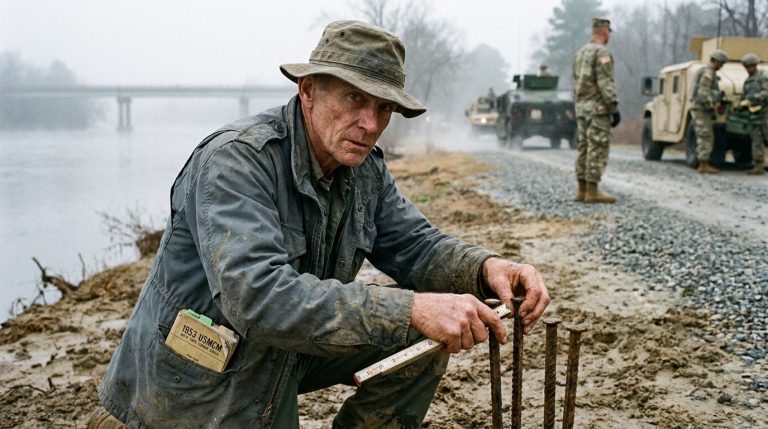
Clarence Briggs didn’t look at the officers. He didn’t look at the $85,000 Vallon detectors that had just failed to catch the three simulated threats. He looked at the tip of his wooden-gripped probe, the walnut sleeve worn glassy-smooth by five decades of friction. He felt the resistance of the soil not in his fingertips, but in his marrow.
Captain Alderman stood a few feet away. The silence between them was not empty; it was pressurized. Alderman’s boots were polished, a stark, clean contrast to the mud-caked perimeter of the lane. He was a man who lived by the rule of the machine, and the machine had just lied to him.
“It isn’t about the sensitivity,” Briggs said. His voice was a low grind, like pebbles shifting under a boot. “You’re looking for a signal. You should be looking for the disturbance.”
Alderman didn’t answer. He stared at the red flag marking the third device, his brow furrowed in a way that signaled not anger, but a frantic, internal recalculation. He wasn’t a fool; he was a man who had built a kingdom on the assumption that the world could be scanned, digitized, and rendered safe. The flags, fluttering in a light breeze, were a testament to the fact that his kingdom had just suffered a breach.
Briggs knelt again. He reached out and brushed the surface of the soil at the edge of the flag. There was a faint, almost imperceptible difference in the way the light caught the grain of the dirt here—a slight sagging, a subtle alteration in the way the clay held the lingering moisture.
“The ground remembers,” Briggs murmured, mostly to himself. “You just have to be quiet enough to let it tell you.”
Alderman stepped closer, his posture rigid. He was still processing the failure, but beneath that, there was something else—a dawning, uncomfortable realization that the “redundant” manual he had cited but never read held a truth he couldn’t afford to ignore. He reached down, as if to touch the dirt himself, then pulled his hand back, his fingers twitching in the damp air.
“Why didn’t you say anything sooner?” Alderman asked, the question sharp, stripped of its professional veneer. “If you knew the rubric was flawed, why wait for a failure?”
Briggs looked up. His eyes were pale, heavy with the weight of fifty years of lanes and the men who had walked them. He held the probe rod out, not as a weapon, but as a bridge.
“Because nobody,” Briggs replied, his voice hardening, “wants to hear that the machine is blind until it lets them down.”
Across the field, Lieutenant Garner took a hesitant step forward, his eyes locked on the flags. He looked as if he were trying to see through the dirt, trying to find the secret rhythm that Briggs seemed to move to.
Suddenly, a sharp, metallic clack echoed from the far side of the equipment table. Riley had set the laminated 1978 bulletin down with more force than necessary. The sound cut through the silence like a gunshot, and for the first time, Briggs saw a flicker of genuine, pale-faced panic cross Alderman’s eyes. It wasn’t the panic of a man who had failed a test; it was the panic of a man who realized he had been holding a faulty compass in the middle of a desert.
CHAPTER 2: The Geometry of Silence
The bulletin sat on the table between them—a laminated relic of 1978, its edges fraying, its surface scarred by decades of environmental exposure. It felt heavier than it looked. Alderman kept his eyes fixed on it, his posture rigid, his shoulders pulled back with a military discipline that seemed to be actively working to hold his composure together.
Briggs didn’t look at the document. He didn’t look at Alderman. He moved to the edge of the equipment table, his movements slow and deliberate, the ritual of maintenance filling the void left by the sudden cessation of the exercise. He picked up his linseed cloth, a piece of fabric so saturated with years of oil that it felt like leather, and began to work the wood of the probe’s handle.
The silence stretched, not empty, but thick with the friction of two men standing on opposite sides of a shifting reality. Outside, the Missouri wind began to pick up, a low whistle through the dry grass bordering the lane, carrying the scent of dust and coming change.
“You didn’t answer,” Alderman said. His voice was quieter now, stripped of the professional cadence he’d used during the briefing. It was the voice of a man who had spent years building a house of cards and had just realized the foundation was made of sand. “Why not fight it? You saw the update. You saw the manual change in ’91. Why just… disappear?”
Briggs stopped his motions, the cloth pressed against the walnut sleeve. He stared at the far horizon, where the treeline blurred into the gray sky. “Because the Army doesn’t work for the person who sees the ground. It works for the person who writes the report. Once the decision was made that the machine was sufficient, there wasn’t a seat at the table for anyone holding a wooden stick.”
He resumed his cleaning, his fingers moving with a rhythmic, almost meditative pressure. “You think you’re here to clear lanes, Captain. You’re actually here to manage liability. That’s the difference between us. You see a protocol; I see a history of what happens when the protocol stops paying attention to the earth.”
Alderman shifted his weight, his boots crunching slightly on the gravel. He reached out, his hand hovering over the bulletin, but he didn’t pick it up. He seemed paralyzed by the proximity of the truth he had spent his entire career successfully avoiding. “Garner,” he started, then cut himself off, his jaw tightening. “The student officer you saw yesterday. The one you were watching.”
“He’s got eyes,” Briggs said, finally meeting Alderman’s gaze. “He just hasn’t been taught how to use them yet. He’s trying to find the answer in the display because that’s what you told him to do. If he fails, it isn’t because he’s incompetent. It’s because he’s obedient.”
The implication hung in the air, sharp and unsparing. Alderman’s gaze flickered back to the field, to the three flags still standing at the lane’s edge. He knew what the warrants and the command staff would say if he tried to bring this up. They would cite the cost of the equipment, the reliability stats, the years of standard operating procedures that formed the backbone of the base’s current training rubric. They wouldn’t care that the ground—wet, unforgiving, and ancient—was the only authority that mattered.
“I need to know,” Alderman said, his voice dropping to a near-whisper. “How many more like this are there? How many failures have we smoothed over because the machine didn’t report them?”
Briggs didn’t answer immediately. He tucked the linseed cloth into his pocket and placed the probe rod back on the table with a soft, authoritative thud. The sound seemed to reset the atmosphere.
“Every lane is different,” Briggs said, his tone clinical. “The soil is a record. If you walk it like a machine, you get machine-read results. If you walk it like a person, you see the story. You want the truth, Captain? Start by walking the lane when it’s raining, and leave the sensors in the truck. Then, you’ll start to see what the ground is actually telling you.”
He turned away, his gait steady, the movement of a man who had long ago accepted that some truths were too heavy to carry for anyone who hadn’t learned how to balance the load. He walked past the equipment table, leaving Alderman alone with the 1978 bulletin.
Alderman stood there for a long moment, the wind tugging at his sleeves. He looked at the bulletin, then at the lane, then at the empty space where the old contractor had stood. His hands were tucked deep into his pockets, his posture slumped, the picture of a man who had just begun to understand the sheer, terrifying scale of his own professional blind spot.
He didn’t move to follow. He stood still, watching the way the light shifted across the disturbed earth where the flags remained, a quiet, rusted monument to a reality that refused to be digitized. He was, for the first time in his career, truly, utterly alone with the ground.
CHAPTER 3: The Ritual of the Bench
Alderman watched the screen door of the range safety office swing shut, the sound of the latch clicking into place echoing with an unforgiving finality. He didn’t turn around. He stayed there, his hands still deep in his pockets, staring at the empty patch of ground where Clarence Briggs had been standing only moments before. The red flags remained, three small, stubborn splashes of color against the drab, damp Missouri earth. They were markers now—not just for inert training devices, but for the fundamental failure of his entire rubric.
He turned slowly toward the equipment table. The 1978 bulletin lay there, its laminated surface dulling in the overcast light. He reached out, his fingertips brushing the textured edge of the paper. It felt like handling a volatile explosive. He didn’t pick it up yet; he simply stood there, absorbing the weight of the document’s existence.
He walked to the range safety office, his movements stripped of the brisk, high-efficiency energy he usually carried. When he stepped inside, the air was warmer, smelling faintly of coffee and floor wax. Frank Riley was at his desk, his back to the door, hunched over a logbook. He didn’t look up when the door opened.
“You’re still here, Captain,” Riley said, his voice flat, devoid of surprise.
“The bulletin,” Alderman started, then paused, finding it difficult to articulate the friction in his chest. “You’ve known about this for eleven years, Riley. Since you took over as director.”
Riley finally turned his chair. He was a man composed of hard angles and tired eyes, the kind of person who had seen enough administrative shuffles to know that nothing ever really changed; it only got renamed. He looked at Alderman with a gaze that held no malice, only a weary, pragmatic pity. “Clarence asked me to keep it quiet. He’s not a man who likes to be noticed, Alderman. He’s a man who likes to see the job get done.”
“The job?” Alderman’s voice rose, the professional detachment slipping. “The job is broken. We’re sending officers out there with technology that can’t read the environment, and we’re teaching them that the machine is the final authority. We’re training them to fail.”
Riley leaned back, his chair creaking. “I’ve seen fourteen years of lane reports. Most of them are clean. The machines work most of the time. But you’re right—it’s not about the machine. It’s about the fact that nobody wants to admit that sometimes, the most expensive equipment in the world is less effective than a piece of wood held by an old man who knows how to listen to the dirt.”
Alderman looked at the wall, at the framed certificates and the neat rows of training manuals. They suddenly looked like paper thin barriers, easily dismantled by the reality of the lane outside. “I need to go to his place.”
Riley sighed, a long, rasping sound. “He’s at the workshop. He’s always at the workshop this time of day. But don’t go there looking for a miracle, Captain. You’re looking for a lesson. There’s a difference.”
Alderman left without another word. The drive to Briggs’ property took him past the familiar landmarks of the bottomlands—the grain elevator, the silent diner, the flat, stretching fields that all seemed to be holding their breath. When he pulled into the gravel driveway, he saw the small, detached building at the rear of the four-acre lot. The workshop. It was built of cinderblock, the mortar lines weathered and dark, a structure that looked like it had grown out of the earth itself.
The door was ajar. Alderman stepped inside. The air was cool and smelled of linseed oil and aged wood. It was a space designed for precision. The workbench along the north wall was immaculate, a collection of tools arranged with the same obsessive care that Briggs brought to the lane.
Briggs was there, his back to the door, hunched over the bench. He was cleaning the aluminum mine probe, his movements identical to the ones he had used earlier: short, measured strokes toward the tip. He didn’t turn when Alderman entered. He didn’t even stop what he was doing.
“You’re early,” Briggs said, his voice echoing in the small room.
“I’m here to understand,” Alderman replied, stepping into the dim light of the workbench.
Briggs laid the probe down on a piece of clean cloth. Beside it sat the 1952 USMC probe, the walnut grip sleeve catching the light. He turned then, his face etched with the weariness of a man who had seen too many versions of this conversation before. His eyes scanned Alderman, assessing not his rank or his intentions, but his willingness to actually learn how to see.
“Understanding isn’t found in a manual,” Briggs said, gesturing toward a stool in the corner. “It’s found in the process. You want to see what I see? Then you stop treating the field like a target. You start treating it like a surface.”
He picked up a small, weathered container of oil and a fresh cloth. “You asked why I kept the bulletin face down? Because as long as it was down, I could pretend the knowledge was safe. But the moment you brought it back into the light, you made it a problem. You’re not just trying to fix a rubric, Captain. You’re trying to force an institution to admit it made a mistake. Do you have any idea how much pressure that’s going to put on the structure of your career?”
Alderman sat on the stool, the hard wood digging into his legs. He looked at the tools, then at the man. “I don’t care about the career. I care about the fact that if we don’t fix this, the next Garner won’t just fail a lane. He’ll walk into a field in the wrong country and pay the price for our blindness.”
Briggs looked at him for a long, silent moment. Then, he pushed the oil and the cloth across the bench toward the younger man. “Then start by learning how to clean the tools. If you can’t appreciate the weight of the equipment, you’ll never appreciate the weight of the life you’re trying to save.”
As Alderman reached for the cloth, he noticed something on the corner of the bench—a small, seemingly insignificant detail that had escaped his notice: a set of hand-drawn diagrams, tucked beneath a heavy brass weight, detailing soil saturation levels and pressure displacement. It was a secondary, private study, far more advanced than anything the Army had ever issued. It was a hidden, shifting map of every single training lane on the base, documented over decades of rain, drought, and seasonal change.
He looked at Briggs, who had turned back to his work, his silhouette framed by the tools of a trade he had perfected in the shadows. Alderman realized then that the “redundant” manual was the least of the secrets kept in this room. The real truth wasn’t just about the failed detectors—it was about the fact that for forty-one years, one man had been quietly mapping the mortality of the entire post, one inch of soil at a time.
CHAPTER 4: The Shadow Archive
Alderman’s hands moved with an awkward, unpracticed rhythm, trying to mirror the fluid efficiency of the older man. The oil, thick and pungent, stained his skin, a stark reminder that the clean, sanitized world of his digital rubrics was failing to protect him from the messier reality of the work. Briggs watched him for a long moment, not with judgment, but with the quiet, expectant patience of a teacher who knows exactly when a student is starting to feel the resistance of the truth.
“You’re rushing it,” Briggs said, his voice low. “The wood doesn’t care about your schedule. If you don’t take the time to feel the grain, you’ll never feel the stress fractures.”
Alderman paused, his breath hitching. He looked down at the probe rod. Under the thin sheen of oil, he saw the faint, hair-line fissures in the walnut—tiny, accumulated traumas of fifty years of probing, each one a testament to a moment of danger that had been successfully navigated outside the view of any official report. It was a physical map of survival, and it was entirely missing from any database he had ever accessed.
“The bulletin,” Alderman said, his gaze shifting to the corner of the bench where the hand-drawn diagrams lay beneath the brass weight. “The Corps of Engineers… they didn’t just ‘update’ the manual, did they? They redacted it.”
Briggs didn’t answer directly. He moved to a heavy, steel filing cabinet tucked into the far corner of the workshop—a piece of furniture that looked like a relic from another era. He pulled a key from a leather lanyard around his neck, the metal grating against the lock with a sound that seemed to vibrate in the silence of the room. He opened the drawer and pulled out a stack of manila folders, their edges yellowed and frayed.
“They didn’t call it a redaction,” Briggs said, setting the stack on the workbench. “They called it ‘optimization.’ In 1991, the push for automated, high-speed detection became the priority. The manufacturers of the sensors—the ones that donated to the research funds and built the prototypes the Army desperately wanted to adopt—they argued that ‘manual intuition’ was an unpredictable variable. It hindered the speed of the sweep. It wasn’t ‘standardizable’.”
Alderman flipped through the documents. They were internal memos, budgetary projections, and scathing assessments of the ‘redundancy’ of human field operators. One document in particular caught his eye: a cost-benefit analysis that explicitly calculated the acceptable rate of failure for automated lanes, weighed against the cost of training operators to the level of detail Briggs had practiced. The failure rate wasn’t an oversight; it was a line item.
“They sold the solution,” Alderman whispered, the horror of the realization settling in his chest like cold lead. “And in doing so, they decided that the human variable was the problem, not the failure of the sensor.”
“Exactly,” Briggs said, his voice hardening. “I filed an objection. I brought them proof from the field. I showed them what happens when you prioritize the machine over the terrain. And for my trouble, they moved me from the training cadre to the contractor pool. They didn’t fire me—they couldn’t, not with my record—but they sidelined me. And then they buried the bulletin under a pile of ‘modernized’ protocols.”
A sudden, sharp memory flickered in Alderman’s mind—a deployment years ago, a squad he had lost to an IED that his own equipment had failed to register. He had spent years blaming himself, wondering what he had missed in the calibration, what he had done wrong in the briefing. Now, the weight of that failure felt different. It wasn’t his error. It was a design flaw, baked into the very foundation of the systems he had spent his life defending. The phantom of that lost squad seemed to loom in the corners of the workshop, the shadows of the tools casting long, accusing fingers across the workbench.
“I need to take these,” Alderman said, his voice steadying, the pragmatism of a commander finally replacing the confusion of a subordinate. “I need to bring this to the course director, to the base commander. I need to show them that we’re operating on a lie.”
Briggs reached out and placed a hand on the folders. He didn’t pull them away, but his grip was firm. “If you take these, you don’t just change a rubric, Captain. You threaten the supply chain. You threaten the contracts. You threaten the reputation of every person who signed off on the 1991 update. Do you really think they’re going to thank you for pointing out that their ‘optimization’ was just a way to save money by sacrificing the safety of the troops?”
“I don’t care about their thanks,” Alderman replied, his jaw set in a line of cold, hard resolve. “I care about the fact that this manual exists, that it works, and that it has been suppressed for profit. That is an order of magnitude worse than a failure of training.”
Briggs looked at him, searching his face for a tremor of hesitation, a hint of the fear that usually stopped men in his position from moving forward. He found none. He slowly slid the folders across the bench toward the younger man.
“The truth is a heavy load,” Briggs said, his voice tinged with a faint, weary pride. “But it’s the only thing that doesn’t rust. Just remember—once you walk out that door with these, there is no way to walk back in. You’ll be the variable they can’t optimize.”
Alderman took the folders. They felt like a stack of bricks. He walked toward the door, the cool air of the evening waiting for him outside. As he stepped over the threshold, he looked back. Briggs had already returned to the bench, his movements returning to that familiar, rhythmic pulse of maintenance. He wasn’t looking at Alderman. He was looking at the ground, and in that silence, Alderman understood: the war wasn’t fought on the lanes. It was fought in the pages of the manuals, and he had just officially declared his side.
CHAPTER 5: The Weight of the Evidence
Alderman walked back through the twilight, the gravel of the driveway crunching under his boots with a sound that felt entirely too loud in the stillness of the Missouri countryside. The folders tucked under his arm were no longer just paper; they felt like a live explosive, volatile and capable of leveling his entire world. He didn’t head straight for the command center. He knew, with the cold, calculated instinct of a man trained in threat analysis, that a direct approach would only give the administration the time to prepare a containment strategy.
He drove, his eyes scanning the rear-view mirror with an intensity that bordered on paranoia. The darkness of the bottomlands swallowed the road, the headlights cutting a narrow, flickering path through the gloom. As he passed the grain elevator, the engine of his truck gave a sudden, shuddering cough—a fuel line rattle he’d ignored for months. It died two miles from the main gate, leaving him stranded on the dark, narrow shoulder of the access road.
He climbed out into the cooling air, the scent of damp earth and diesel thick in the night. The silence was absolute. He checked the engine, the metal of the hood radiating a faint, residual heat against his palms. A broken fuel pump. An inconvenient, mundane failure—the kind of physical contingency the military’s manuals never accounted for. He stood by the side of the road, the folders pressed to his chest, realizing that he was now forced to navigate the last two miles on foot, in the dark, with the weight of the evidence slowing his every step. It was a detail he hadn’t planned for, a physical hurdle that turned his mission into a grueling, tactical exercise in endurance.
He started walking. The asphalt was cold through his boot soles. Every passing set of headlights, even from a distance, forced him to drop into the ditch, the mud soaking into his uniform, the grit of the embankment pressing against his face. He felt the irony of it: a man who had spent his career teaching students how to move invisibly through hazardous terrain was now using those exact skills to hide from his own command.
When he reached the perimeter of the base, the security lights turned the sky a sickly, artificial orange. He didn’t approach the main gate. He navigated the drainage culverts, the concrete slick with slime and overgrown with thick, clinging brush. His hands were raw, the folder edges biting into his palms, but the pain helped keep his focus sharp. He was no longer thinking about the rubric or the protocols; he was thinking about the trajectory of the information he carried. If he could get this to the right hands—or at least, leak it where the bureaucracy couldn’t simply shred it—the shift in the training rubric would be inevitable.
He reached the maintenance access point behind the training compound—a secondary, rarely used gate. He held his breath, listening. The rhythmic, low-frequency hum of the base’s perimeter defense system sounded like a warning. He checked his watch; he had exactly twenty minutes before the next patrol cycle.
His phone buzzed in his pocket—a text from Garner. The course director is asking why I haven’t turned in my remedial packets. He’s pushing for a final decision on my status tomorrow morning.
Alderman stared at the screen, the blue light illuminating the grime on his face. Garner didn’t know about the documents, but he was the living proof of their necessity. If Alderman didn’t make his move tonight, Garner would be remediated out of the service by sunrise, a casualty of the very system Alderman was currently holding the evidence to dismantle.
The weight of the documents wasn’t just administrative anymore; it was personal. He pushed his back against the cool, rusted chain-link of the gate, listening to the patrol vehicle’s tires approaching on the distant access road. He was tired, his muscles aching from the forced march, but the apathy that had defined his career was gone, replaced by a cold, sharpened focus. He wasn’t just a commander anymore; he was a liability, and for the first time in his life, that made him dangerous.
He stepped back into the shadows as the patrol vehicle rolled past, the spotlight sweeping the fence line inches above his head. He watched the light pass, his pulse steady, his mind already calculating the path to the director’s office. He wasn’t going to follow the protocols tonight. He was going to break them.
CHAPTER 6: The Field Test
The hallway leading to the course director’s office was lined with portraits of previous commanders, their faces rendered in stiff, high-resolution color that felt at odds with the grit clinging to Alderman’s uniform. He was breathing heavily, his lungs burning from the dash through the service corridors, but he forced his movements to remain methodical. He pulled the folders from under his jacket, the manila paper damp with his sweat. He didn’t look back at the service exit. He turned the corner and stopped dead.
Lieutenant Garner was sitting on a bench outside the director’s office, his head buried in his hands. He looked ragged—a young man who had clearly spent the last few hours oscillating between exhaustion and despair. He didn’t hear Alderman approach until the heavy thud of boots on the polished linoleum broke the silence. Garner looked up, his eyes widening as he took in Alderman’s mud-stained tactical gear and the desperate, manic set of his jaw.
“Captain?” Garner’s voice cracked. “What happened? I thought… I thought you were with the safety team.”
Alderman didn’t answer immediately. He looked at the closed door of the director’s office, then back at Garner. The lieutenant was the collateral damage of this entire operation. “Garner, what did you see on the lane this morning? Before I called it off. Before the flags went down.”
Garner hesitated, his gaze dropping to the floor. “I saw… I don’t know, sir. I saw the Vallon display. It was empty. But when I looked at the ground, like the old man was doing, I thought I saw a shift. A slight discoloration in the soil. But I told myself it was just a shadow. I’ve been wrong so many times, I’ve stopped trusting what I’m actually seeing.”
“It wasn’t a shadow,” Alderman said, his voice hard. “It was the truth. You’ve been failing because you’re looking at the machine, and the machine is designed to lie to you when the conditions don’t match the software.”
Garner stood up, his face pale. “Sir, I don’t understand.”
“You don’t need to understand yet,” Alderman replied, thrusting the folders into Garner’s hands. “Take these. Get them to the base inspector general, through the secure server in the logistics hub. Don’t go through the director. Don’t send a digital copy through the network. Go there yourself. Do it now.”
“Sir, this is insubordination,” Garner stammered, clutching the folders to his chest as if they were burning him. “If I do this, I’m finished.”
“If you don’t do this, you’re finished anyway,” Alderman countered, his voice a low, dangerous rasp. “The director is ready to cut you loose tomorrow morning. This is the only leverage you have. And it’s not just for you—it’s for everyone else who’s going to walk these lanes.”
Garner looked at the documents, then at the locked door, then back at Alderman. The fear was still there, but beneath it, a new, sharper realization began to take root. He stood taller, his shoulders losing their defeated slump. He tucked the folders deep inside his uniform jacket and nodded once.
“I’ll get them there,” Garner whispered.
As Garner turned and sprinted toward the far exit, Alderman faced the office door. He wasn’t sure if he was being watched, if the security cameras tracking the hall had already flagged his unauthorized presence. He didn’t care. He knocked on the door—a sharp, aggressive rap that invited no delay.
The door opened, and the course director, Colonel Vance, stood there, a look of profound annoyance on his face that quickly dissolved into something colder when he saw the mud on Alderman’s boots. “Alderman. You’re supposed to be in the field wrap-up. What is the meaning of this?”
“We have a problem with the training rubric, Colonel,” Alderman said, walking past him into the office without an invitation. “And we have a problem with the integrity of the safety data.”
Vance closed the door behind him, the lock clicking with a heavy, final sound. He didn’t offer a seat. He stayed by the door, his eyes narrowing. “You’re off-book, Captain. You’re exhausted, you’re covered in filth, and you’re talking about things you don’t understand. If you’ve come here to lodge a complaint about the contractors, forget it. The decision on Briggs was made years ago.”
“It’s not about Briggs,” Alderman said, his voice dropping to a low, steady tone. “It’s about the fact that I’ve spent the last six hours reviewing the 1978 Corps of Engineers bulletin, and I’ve realized that the entire basis for our current sweep protocol is a calculated, institutional fraud.”
Vance’s expression didn’t change, but his jaw tightened. He walked to his desk and sat down, his movements slow and deliberate. “A fraud? That’s a dangerous word, Alderman. Especially when you’re talking about a system that has been standard across the service for over three decades.”
“Danger is the point,” Alderman replied, leaning over the desk, his eyes locked on the Colonel’s. “We’ve been trading lives for speed. We’ve been training our officers to ignore their own eyes and trust a sensor that has been proven, by our own research, to fail in exactly the conditions we’re currently facing. I’ve seen the reports, Colonel. I’ve seen the line items.”
Vance leaned back, a faint, humorless smile touching his lips. “You think you’ve stumbled onto a conspiracy, don’t you? You think you’re the hero who found the hidden truth. But you’re just a man who’s let the fatigue get to him. There is no conspiracy here, Alderman. There is only the mission. And the mission requires us to trust the tools we’ve been given, not the ghosts of the past.”
Alderman felt the floor beneath him shift. The Colonel wasn’t surprised. He wasn’t defensive. He was simply dismissing him, as if Alderman were a malfunctioning piece of equipment that simply needed to be cleared from the system. The realization hit him then: the institution wasn’t just hiding the truth—it had already fully integrated the lie, and it was perfectly prepared to eliminate anything that threatened that equilibrium.
CHAPTER 7: The Institutional Breach
The office felt smaller than it had seconds ago. Vance’s dismissal wasn’t just a refusal to engage; it was a deliberate act of erasure, a chillingly professional attempt to wall off the breach Alderman had created. Alderman stared at the Colonel—a man whose existence was tied to the very rubric that allowed for the failure of his soldiers.
“You’re not dismissing a fatigue-driven hallucination, Colonel,” Alderman said, his voice dropping into the steady, controlled cadence of a man who had moved past the need for persuasion. “You’re dismissing the documented reality of every post-rain failure I’ve recorded in this command. I know about the 1991 purge. I know that the ‘modernized’ protocol was a procurement choice, not a safety one. And I know you were the lead instructor on the board that signed the final implementation.”
Vance’s face darkened, the mask of administrative indifference slipping to reveal a sharp, predatory focus. He stood up slowly, the leather of his chair creaking. “You’re wading into waters you don’t understand, Alderman. This isn’t just about a manual. It’s about the credibility of the entire command structure. If I open that door, I don’t just fix a training issue; I invite a top-down investigation that will gut this base. Do you really think the Pentagon is going to thank you for bringing down the lead training facility in the region because a few inert devices were missed in the rain?”
“I don’t need them to thank me,” Alderman retorted. “I need them to stop treating the lives of my officers as a calculated risk.”
Vance didn’t answer. Instead, he reached for his phone, his fingers hovering over the screen. He didn’t dial; he simply stared at it, a silent, implicit threat. “You think you’ve won because you have a copy of a bulletin. But you forget who I am, Alderman. I’m the man who writes the evaluation criteria. I’m the man who determines the future of every officer in this course. You aren’t a whistleblower; you’re a liability.”
The realization hit Alderman with the force of a physical blow. He had expected an argument, a debate about field mechanics, or at least a tactical defense of the rubric. He hadn’t expected the total, cold negation of his role. He wasn’t being treated as an officer anymore; he was being treated as a threat to be neutralized.
A sudden, jarring vibration in his pocket broke the tension. His phone. A message from Garner: The IG server is locked. I’m at the hub. There’s a security lockdown on all external transmission logs. They know, Captain. They know.
Alderman felt a cold shiver trace the line of his spine—a phantom sensation, like the feeling of walking into an ambush. He looked at Vance, who was watching him with a smug, knowing intensity. The Colonel hadn’t been idle. He had been tracking the information flow from the moment Alderman left the workshop.
“The information has a way of finding its own level,” Vance said, his voice dropping to a dangerous, low hum. “You’ve spent your career teaching your students to be prepared for the worst-case scenario. You should have realized that you were the worst-case scenario.”
Alderman didn’t wait. He turned and bolted for the door, the urgency of his mission overriding the physical exhaustion of the night. He hit the hallway, the sound of his boots echoing like gunfire against the sterile white walls. He had to get to Garner. He had to get to the hardware; the physical archive was the only thing that couldn’t be wiped from a server.
He reached the stairwell, his pulse hammering in his ears, a chaotic rhythm that blurred his perception. He heard the heavy clatter of boots behind him—the base quick-reaction force, alerted by Vance’s silent alarm. He descended the stairs in a series of frantic, sliding leaps, his hands grazing the rusted handrail. He needed to reach the maintenance hub, to intercept Garner before the security detail caught them.
The air in the stairwell was stagnant, filled with the smell of iron and cleaning chemicals—a sensory echo of the workshop. For a fleeting second, he saw the face of the man who hadn’t come back in Korea—the phantom of his own past failure, staring at him from the shadows of the stairwell landing. He shook his head, the image dissolving into the reality of the cold, concrete stairs. He wasn’t the man in 1955 anymore. He was the man who had the truth in his hands, and he would not let it be buried a second time.
He burst out of the stairwell and into the main logistics corridor, the sudden light blinding him. He saw Garner, twenty yards ahead, being crowded by two security guards near the maintenance terminal. The lieutenant was struggling, the folders slipping from his grasp. Alderman didn’t hesitate. He surged forward, his boots skidding on the linoleum, the weight of his conviction pushing him toward the center of the fray. He didn’t have a plan, only the necessity of the moment—the imperative to ensure that the ground, and the truth it held, would finally be heard.
CHAPTER 8: The Final Settlement
Alderman lunged, not at the guards, but at the gap between them. He hit the terminal desk with his shoulder, the impact jarring his collarbone, and slammed his hand onto the interface. He didn’t have the administrative overrides, but he had the physical leverage of a man who had nothing left to lose. He reached down, grabbed the hard-line ethernet cable—the vein of the base’s secure network—and jerked it free from the port. The monitor flickered, a burst of static washing across the screen as the connection to the external server severed.
The guards were on him in a second, their hands grappling for his arms, but he didn’t fight back. He went limp, letting his weight pull them down toward the floor, using the momentum to force them into a stalemate against the desk. Garner had the folders. That was the only thing that mattered.
“Get them out!” Alderman shouted, his voice hoarse. “Garner, leave the terminal! Run!”
Garner, hesitation etched into his face, looked at the fallen folders, snatched them from the linoleum, and bolted toward the service door. The guards, realizing the tactical priority had shifted, released Alderman and turned, but it was too late. The door clicked shut, the heavy electronic seal engaging from the outside—a legacy security feature Garner had learned to override from the very manual he had been failing to study.
Alderman was hauled to his feet, his uniform torn, his breath coming in ragged gasps. He didn’t struggle. He leaned against the terminal, his chest heaving, and looked up to see Colonel Vance standing at the end of the hall, flanked by two more security personnel. Vance wasn’t angry anymore. He looked tired. He looked at Alderman with the detached, analytical gaze of a man watching a failed experiment.
“You think you’ve won,” Vance said, his voice flat. “You think that if you leak that report, you’ll change the system. But you’ve only guaranteed your own discharge. And Garner? He’ll be lucky if he’s simply court-martialed for unauthorized access.”
“Maybe,” Alderman said, wiping a smear of grease and blood from his forehead. “But they’ll have to read it first. The inspector general will have to account for it. And for the first time in thirty years, the protocol will be on trial, not the operators.”
Vance stepped closer, his face inches from Alderman’s. “You destroyed the connection, Captain. But you didn’t destroy the infrastructure. The system is bigger than you, bigger than Briggs, and certainly bigger than a piece of laminated paper from 1978. It will swallow you whole.”
Vance motioned for the guards to lead him away. As they walked him down the corridor, the silence of the base felt absolute. There was no fanfare, no dramatic revelation that brought the building down around them. Just the slow, grinding reality of institutional inertia. But as they passed the courtyard, Alderman looked out the window. He saw the training lanes, bathed in the pale, pre-dawn light. He saw the flags, still standing, and he saw, in the distance, a figure—Clarence Briggs—walking the perimeter, his pace steady, his eyes on the ground.
The weeks that followed were a blur of depositions, internal reviews, and the quiet, crushing weight of isolation. The investigation was not the public spectacle Alderman had hoped for; it was a slow, deliberate drowning in bureaucracy. But the report did its work. It didn’t destroy the system, but it forced a crack in the foundation. The 1991 rubric was suspended pending a “comprehensive review,” and the reliance on the Vallon detectors was, for the first time in decades, openly questioned in the officer evaluation reports.
Alderman was moved to an administrative post in a different district—a quiet, bureaucratic exile. He spent his days filing reports, his life stripped of the high-stakes pressure of the lanes. But he wasn’t broken. He found peace in the small things: the way the light hit his desk in the morning, the feel of a fountain pen against paper, the quiet routine of a life lived without the burden of maintaining a lie.
One afternoon, a package arrived at his office. There was no return address. Inside was a piece of walnut wood—the grip sleeve from the 1952 USMC probe, polished until it glowed like glass. Beneath it was a short, handwritten note on a scrap of paper: The ground eventually gives up what is hidden. The rest is just maintenance.
Alderman ran his thumb over the wood. It was smooth, worn, and warm—a physical record of 30,000 individual acts of truth. He walked to the window and looked out at the rolling, gray horizon of his new assignment. He picked up his pen and began to write. He wasn’t writing a report or a complaint; he was writing a guide—a manual for those who were willing to look at the ground and actually see what was there.
The weight of the past was gone, replaced by the steady, rhythmic pulse of a life lived in alignment with the truth. He looked at the walnut grip, then back at the horizon. The work wasn’t finished—it would never be finished—but for the first time in his career, he understood that the goal wasn’t to win the battle against the system. The goal was to endure, to maintain the knowledge, and to ensure that when the next generation came along, they would have the tools they needed to finally start listening to the soil. He set the grip on his desk, picked up his pen, and began to write, the steady, rhythmic sound of the nib against the paper the only thing in the room.