The Price of Rusted Ground: High-Voltage Revenge on the Cul-de-Sac
CHAPTER 1: Ground State Zero
The concrete floor beneath my workboots held the cold of a dead winter ground.
2:14 AM.
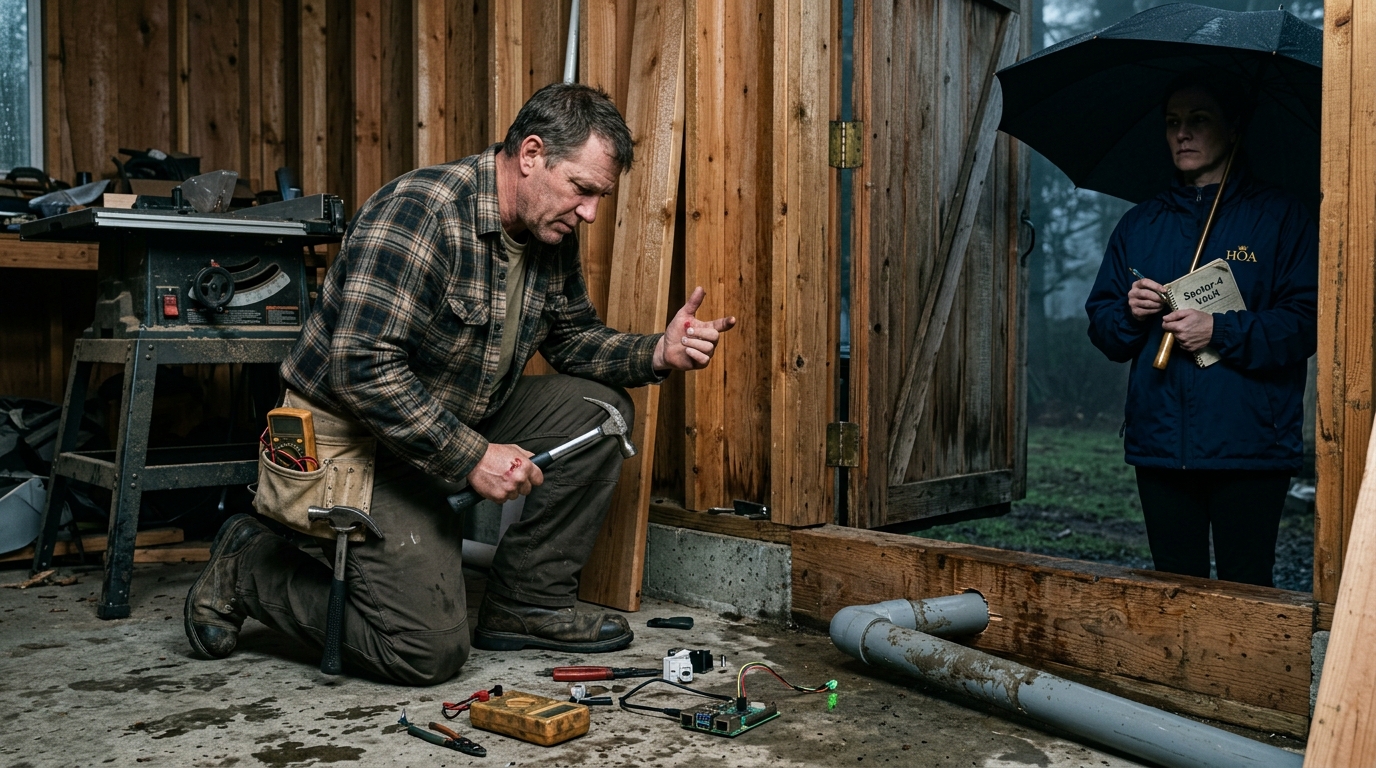
The brass housing of my Fluke multimeter was scarred near the lead inputs—scratches from two decades in defense test bays. I clicked the selector dial three notches right. AC Volts. The mechanical switch dropped into place with a dry, metallic snap.
The wall studs in the back corner of the shed didn’t rumble. They buzzed. It wasn’t the steady, low-frequency breath of a standard 120-volt line feeding a single LED fixture. It was a secondary harmonic—a heavy, strained drag that pulled the ambient voltage on my main panel down by four full units every time the circuit closed.
I pressed the red probe against the ground wire of the junction box. The rubber boot on the lead flexed under my thumb.
Zero volts to ground. Standard. But the wire itself was warm. Copper doesn’t retain heat unless it’s bleeding current continuously.
Through the cracked timber slats of the shed door, light caught the dew on the grass. A shadow cut through the pale yellow haze of the streetlamp at the end of the cul-de-sac.
No footsteps. Just the dry, rhythmic swish of nylon bathrobe fabric scraping against wet lawn blades.
I backed into the gap between the cast-iron table saw and the wall studs, holding my breath. My thumb rubbed the raw blister on the inside of my palm—a gift from clearing brush along the east fence line yesterday.
The shed latch lifted. The galvanized iron bar groaned against the striker plate.
Karen didn’t look at the dark corners. She didn’t look at the workbench. Her eyes stayed locked on the heavy orange extension cord slung over her left shoulder like a coiled snake. Her slippers were soaked through, dark water line cutting across the cheap pink fleece.
She reached for the lower outlet. The plastic faceplate was cracked, held together by a single rusted screw.
Snap.
The male end of her industrial cord bit into the receptacle.
Across the yard, forty feet away, the gold trim on the white golf cart glinted in the dark. The custom badge on the front cowl—KWEN1—sat crooked in the mounting bracket.
A heavy, mechanical click resonated from the main breaker box mounted high on the cedar post beside my shoulder.
She didn’t hear it. She just whistled—three flat, off-key notes of a church hymn—and turned her back, her shoulder bumping the door frame as she waddled back toward the property line.
I stayed motionless until the swish of nylon faded into the sound of the neighbor’s irrigation timer kicking on.
I stepped out from the shadows. The multimeter dial clicked once. I touched the black probe to the neutral bar inside the open junction box.
The digital readout flickered, stabilized, then locked.
23.4 Amps.
A golf cart charger pulls twelve. Maximum.
I looked down at the floorboards near the base of the wall. Beneath a coat of sawdust and dried tractor grease, a freshly pulled black conduit tube disappeared straight down through a hand-drilled hole in the rim joist.
She wasn’t just charging a battery. She was pulling enough juice to run a small forge.
I reached into my pocket, pulled out the Raspberry Pi board, and laid it flat on the workbench. The green circuit card was tiny against the dark, oil-stained pine.
I picked up a wire stripper. The steel blades bit into the insulation of my master feed line with a sharp, clean crunch.
“Three seconds,” I muttered to the empty shed. “Then the relay drops.”
CHAPTER 2: Three Seconds of Power
The copper strands bit into the pad of my thumb as I twisted the copper leads into the relay terminal.
2:18 AM.
The Raspberry Pi blinked twice—a sharp, green heartbeat against the cedar stud. The tiny mechanical relay sat mounted below it, its plastic casing clear enough to see the copper contact arm hanging a fraction of a millimeter above the secondary terminal.
I tightened the brass screw on the terminal block until the wire flattened out.
3.00 SEC
That was the hardcode in the Python script running off the Pi’s micro-SD card. The loop was simple. When a draw exceeding fifteen amps hit the sensor, the relay pulled closed. Three seconds of solid, clean current. Then the circuit opened. The pi would hold the line dead for forty-five seconds before resetting the loop.
To anyone sitting in the driver’s seat of an electric vehicle, it looked like a loose ground, a faulty battery management board, or a fried onboard charger. It didn’t look like a wall.
I picked up the brass multimeter, clicked the dial to test the bridge, and touched the probes to the relay inputs. A faint, hollow clack echoed through the dark shed. The contact arm dropped, held for three beats, and snapped back up.
Outside, the neighborhood was dead quiet. The damp night air smelled of stale fertilizer and wet turf.
I pushed the heavy cedar door shut, locked the iron bar in place, and walked across the grass toward the back porch. My boots left dark, pressed tracks in the dew.
In the kitchen, the linoleum was cold through my wool socks. I didn’t turn on the overhead light. I sat at the laminate table, poured two fingers of room-temperature scotch into a heavy tumbler, and set the Fluke multimeter right beside the glass.
The digital readout on my tablet sat on the table, displaying the live feed from the camera mounted under the shed eave.
2:42 AM.
A shadow moved along the concrete curbing of the cul-de-sac.
Karen didn’t bring the bathrobe this time. She wore a heavy nylon windbreaker—the dark blue one with the small gold HOA emblem stitched over the left pocket. She walked with her head down, her hands tucked deep into her pockets, straight toward the side aisle between my garage and the property line fence.
She didn’t use a flashlight. She knew every fence board, every flagstone, every gap in the hedge by heart.
The camera angle showed her reaching the shed door. She didn’t hesitate. Her hand went straight for the latch, lifted the iron bar with a familiar, metallic scrape, and slipped inside.
Three seconds passed.
Through the quiet of the cul-de-sac, a sharp, metallic pop carried across the lawn—the sound of an electrical arc dying inside a sealed junction.
A second later, Karen stepped out of the shed. She turned back, slapped her hand against the cedar siding near the frame, and reached in to pull the plug. She shoved it back into the faceplate.
Pop.
She pulled it again. This time she bent down, squinting into the dark opening of the receptacle. She rubbed the rubber head of her extension cord against her windbreaker sleeve, as if dust on the prongs was the issue, and rammed it back into the wall.
Three seconds of current. Then cold air.
She stood frozen in the doorway for a full minute, her shoulders rigid under the nylon shell. The streetlamp light caught the side of her face—teeth clenched, eyes narrowed into tight slits as she glared at the dark shed wall.
She didn’t scream. She didn’t stomp. She simply pulled her cord free, coiled it over her elbow with sharp, violent jerks, and backed out into the yard.
Before she reached the fence line, she paused. She turned toward the main house, her eyes sweeping over the dark kitchen window where I sat in the shadow of the refrigerator.
She reached into her windbreaker pocket, pulled out a small black notebook, and wrote something down using a stubby pen. On the cover of the notebook, printed in faded block letters, was a code label: Sector-4 Vault.
She snapped the notebook shut, slipped it back into her pocket, and walked briskly down the driveway toward her house.
I took a sip of the scotch. The burn hit the back of my throat, slow and rough.
I leaned forward, tapping the tablet screen to bring up the local load logs from the Pi. The circuit had tripped three times in two minutes. But beneath the main line graph, a tiny secondary spike remained—a ghost draw of two amps that hadn’t cleared even when the main relay opened.
I picked up the brass multimeter and rolled the rubber boot between my fingers. The line under the shed floor wasn’t just feeding a charger. Something down in the dirt was still breathing.
CHAPTER 3: The Subterranean Trace
The brass multimeter felt heavy and ice-cold in my right hand.
2:50 AM.
On the kitchen table, the tablet screen flickered once. The green signal line representing the shed’s power draw dipped, spiked, and then flattened into a steady, unbroken baseline.
2.15 Amps.
The main relay was wide open. The circuit to the wall receptacle was dead. Yet two amps were still bleeding straight out of my panel, vanishing into the dirt beneath the shed rim joist.
I set the tumbler of scotch down with a slow, deliberate clink. My left thumb rubbed the raw blister on my palm, tracing the stiff edge of the canvas work glove hanging from my belt loop.
I didn’t wait for sunrise.
I grabbed my heavy steel-toed boots, snapped the brass multimeter into its leather holster, and took a short claw hammer from the rack by the back door. The screen door clicked softly into the strike plate as I stepped into the dark yard.
The air had turned cold and thick with mist. A slow, steady drizzle was softening the clay soil along the northern property boundary. Every step I took toward the shed left deep, sucking impressions in the grass.
I crouched beside the shed’s rear foundation beam. The cedar siding ended three inches above a poured concrete pad, but the gap below the joist was packed with loose river rock and wet mulch.
I set the hammer claw into the gravel and pulled.
The rocks yielded with a wet, heavy scrape. Beneath the top layer of cedar chips, the soil wasn’t dark brown like the surrounding lawn; it was gray, packed hard, and bore the fresh, sharp scent of freshly turned gravel.
I pulled out my penlight, pressing the rubber tail-cap with my thumb.
A gray PVC pipe—two inches thick, heavy-walled, and coated in wet silt—disappeared straight down through a hand-augered shaft beneath the joist. It didn’t belong to my house. The city code required rigid iron conduit for sub-panel feeds, and my original electrical permits never crossed this corner of the lot.
I wedged the claw of the hammer under the pipe, leveraging my forearm against the cedar sill. The wood groaned under the pressure. The pipe didn’t budge. It was anchored deep, running in a straight, level trench toward the drainage swale at the back fence.
“The Conduit,” I muttered, the words barely louder than the patter of rain against my coat hood.
I stood up, adjusting my grip on the hammer handle.
The swale was a low ditch lined with heavy granite riprap, designed thirty years ago to carry storm runoff away from the cul-de-sac. Beyond the cedar fence line lay the HOA communal easement—a patch of unlit scrub pine and overgrown pampas grass surrounding the neighborhood’s old concrete pumphouse.
I followed the alignment of the buried pipe, step by step, testing the soil density with the heel of my boot.
Every three feet, the turf gave way slightly—a soft, sunken line in the grass where someone had used a trenching spade, laid the pipe, and packed the sod back down by hand.
When I reached the rear fence, I looked through the gap between the pickets.
Fifty yards out into the dark communal lot stood the pumphouse. It was a windowless cinderblock box with a rusted steel door and a padlocked electrical box mounted to its exterior wall. A metal identification plate, corroded green at the corners, was riveted right above the handle: PROPERTY OF OAKRIDGE HOA – UTILITY SECTOR-4.
Through the rain, a faint, high-pitched whine drifted from inside the concrete block structure. It wasn’t the throaty hum of a water pump or a drainage impeller. It sounded like dozens of tiny, high-RPM cooling fans screaming in unison behind six inches of solid masonry.
I reached over the fence, touched the top strand of the secondary ground wire running along the bottom rail, and clipped my multimeter lead to the exposed steel frame.
The digital display flared in the dark.
118.6 Volts AC. Delta Load: Active.
My shed was powering the pumphouse. Karen hadn’t just stolen electricity for a golf cart; she had tapped my breaker as the primary bypass for an off-grid node hidden deep inside community property.
Behind me, the wet crunch of gravel broke the silence.
I didn’t turn around quickly. I slowly unclipped the probe, slid the multimeter into my pocket, and turned my head just enough to catch the movement in my side vision.
Karen stood under the drip line of her garage eaves, thirty yards up the incline. She held a heavy golf umbrella in one hand and her stubby stub-bound notebook in the other.
She didn’t come closer. She just stood there in the dark, her face entirely hidden by the shadow of the umbrella canopy, watching me crouch beside the exposed conduit.
“You’re trespassing on easement boundary, Frank,” her voice carried flat across the wet lawn, cold and devoid of her usual suburban screech. “That fence line is subject to board inspection.”
I stood up straight, wiping the wet clay from my knuckles onto my jeans.
“The line is on my land, Karen,” I said, keeping my voice level, stripped of anger. “And every amp running through it has my name on the bill.”
She lifted the notebook slightly, tapping the edge against the brass handle of her umbrella.
“We’ll see what the board has to say about unauthorized modifications at eight o’clock tomorrow morning.” She turned and stepped back toward her house, her boots leaving sharp, shallow cuts in the soft turf. “Bring your checkbook.”
I looked down at the exposed gray pipe at my feet, then back toward the silent cinderblock pumphouse.
The trap was laid, but the jaws weren’t closing on a petty thief. I was staring at a systemic siphon, and the board meeting in five hours was going to be the arena.
CHAPTER 4: The Boardroom Standoff
The oak table in the clubhouse was polished so bright it mirrored the harsh grid of fluorescent tubes overhead.
8:02 AM.
I sat in the back row of folding chairs, my wet boots resting on the low-pile commercial carpet. The brass multimeter sat heavy inside its leather holster on my belt, the scarred metal housing resting flat against my hipbone.
At the front of the room, Karen sat behind a raised dais. To her right was Miller—a retired accountant with thin wire-frame glasses and a faded blue cardigan—and on her left, Vance, a man who owned three franchise gyms and never wore anything without a collar.
Karen didn’t look at me when she tapped her wooden gavel twice against a felt pad.
“Item three on the emergency agenda,” Karen said, her voice clear, sharp, and entirely free of the raspy fatigue from four hours ago. “Property violation and harassment claim filed by the board executive against Lot 114.”
Miller flipped open a manila folder. He didn’t look up from the top sheet. “The respondent, Mr. Frank Carver, has engaged in unpermitted electrical modifications along the easement perimeter, resulting in potential hazard conditions to communal infrastructure.”
“It’s a fineable offense,” Vance added, crossing his arms. His gold watch caught the glare of the ceiling lights. “Five hundred for the unapproved wiring. Another two-fifty for obstruction of board oversight during a perimeter check.”
I didn’t stand up. I didn’t raise my hand. I reached down, unclipped the brass Fluke meter from my belt, and set it flat on the laminate surface of the chair next to me.
Snap.
The mechanical switch clicked once as I turned the dial to Frequency / Hz.
“Page four of the 1994 covenants,” I said. My voice was low, staying underneath the hum of the central air conditioner. “Section B, paragraph twelve. No board member may issue a citation regarding an easement boundary without a certified utility audit signed by a licensed field engineer.”
Karen’s eyes narrowed slightly. Her right hand tightened around a plastic pen, the barrel flexing under her thumb until the seam turned white.
“The board has discretionary authority under emergency protocols, Frank,” she said, leaning forward. “We have a duty to protect neighborhood assets.”
“You have a duty to pay your power bill,” I replied.
A quiet rustle went through the six neighbors sitting two rows ahead of me. Mrs. Gable, who lived at the mouth of the cul-de-sac, turned her head just far enough to catch my profile.
Miller cleared his throat, his eyes scanning the paper in front of him. “Mr. Carver, the utility records show an anomalous grid variance for the entire sector over the last quarter. We are currently investigating an illegal draw from the primary transformer.”
“You don’t need an investigation,” I said. I pulled a folded sheet of grid paper from my jacket pocket—the raw load log I’d printed from the Raspberry Pi at 4:00 AM—and tossed it onto the polished oak table. It slid six feet across the veneer, stopping right against Miller’s coffee cup. “You need a shovel.”
Karen reached out, her fingers catching the corner of the paper before Miller could touch it. She didn’t read the numbers. She crumpled the sheet into a tight ball within her palm and dropped it into the wastebasket beside her chair.
“This meeting is for formal board proceedings, not unverified personal notes,” Karen said, her tone dropping an octave into a cold, flat monotone. “The fine stands. You have fourteen days to clear the obstruction from the shed boundary, or the HOA will contract an excavation team at your expense.”
“Try it,” I said softly.
I reached out, picked up the multimeter, and clicked the dial back to zero. The sound was small, but in the silent room, it carried all the way to the back wall.
“The conduit doesn’t end at my fence line, Karen,” I said, looking straight past her to the padlocked door of the management office behind the dais. On the door’s frosted glass panel, painted in thin black lettering, was the index code: Vault-7 Ledger. “It runs straight through the swale into Sector-4. And if an excavator digs up that dirt, they aren’t going to find an unapproved lawn outlet. They’re going to find a three-phase bypass.”
Miller paused, his hand hovering over his folder. He looked at Karen, his eyebrows pulling together behind his wire-rimmed glasses. “What bypass?”
Karen didn’t look back at him. She stood up slowly, smoothing the front of her navy blazer with both hands.
“Meeting adjourned,” she said.
CHAPTER 5: The Conduit Break
The wooden gavel hit the felt pad with a flat, hollow thud.
8:05 AM.
I didn’t wait for Miller to close his manila folder, nor did I watch Vance shift his bulk out of his executive chair. I picked up the brass Fluke multimeter by its rubber boot, shoved it into my jacket pocket, and turned on my heel. My workboots left a faint trail of dried mud across the clubhouse carpet as I pushed through the double glass doors into the morning chill.
Rain was still falling in a needle-fine mist.
I didn’t head back toward my driveway. I walked straight down the center of the asphalt cul-de-sac, past the manicured lawns and identical brick mailboxes, tracking the drainage swale until the gravel gave way to the unpaved communal easement.
My thumb rubbed the raw blister on my palm, feeling the coarse grain of the heavy steel prybar I’d pulled from the bed of my truck before the meeting. The iron was cold, thick, and six pounds of dead weight.
Behind me, the wet slap of rubber soles on pavement broke the quiet.
It wasn’t Karen. It was Miller. The old accountant had his cardigan buttoned wrong, his wire-rimmed glasses slick with mist as he labored to keep pace, clutching a thick leather-bound binder against his ribs.
“Frank,” Miller panted, stopping six feet short of the drainage ditch. “What did you mean back there? What three-phase bypass?”
“Look at your quarterly reports, Miller,” I said, without breaking stride as I stepped down into the mud of the swale. “Line seven. Infrastructure maintenance. Compare the kilowatt draw against the municipal pump schedule.”
Miller stood at the edge of the embankment, his thumb nervously tracing the brass spine of his binder—the stencil on the leather read Vault-7 Ledger. “The ledger balances. Karen handles the utility distribution filings herself under Sector-4 Vault reserves.”
“She handles the cover-up,” I said.
I reached the rusted steel door of the pumphouse. The heavy padlock securing the latch was new, its chrome shackle unmarred by weather. Above the handle, the riveted tag—PROPERTY OF OAKRIDGE HOA – UTILITY SECTOR-4—stared back at us.
I wedged the flat edge of the steel prybar into the gap between the iron latch and the cinderblock frame.
“Frank, you can’t break into board structures,” Miller called out, his voice cracking slightly. “That’s a criminal property violation!”
I leaned my full weight onto the bar.
SCREECH.
The galvanized frame buckled. The mounting bolts sheared out of the wet mortar with a spray of gray dust, and the heavy door swung open, hitting the interior wall with a dull boom.
A wave of dry, scorching heat hit my face, smelling of warm copper, scorched fiberglass, and ozone.
The noise inside was deafening—a high-pitched, mechanical scream of thirty miniature cooling fans spinning at full throttle.
Miller stumbled down the mud slope, peering over my shoulder. His jaw went slack. The leather binder slipped an inch in his grip.
Inside the windowless six-by-eight cinderblock cell, there were no water pumps. No pressure tanks. No municipal valves.
Mounted to industrial aluminum racking along all three walls sat eight black server chassis, their LED indicator banks blinking in a frenzied, chaotic pattern of green and yellow. Thick, black power cables snake down from the ceiling, bundling together into a heavy gray line that disappeared straight down through a newly cut hole in the concrete floor—The Conduit.
“What is this?” Miller whispered, reaching out with a trembling hand, his finger stopping inches short of a red-hot heat-sink. “This isn’t water management.”
“It’s a processing rig,” I said. I pulled the brass multimeter from my pocket, switched the dial to AC Amps, and clamped the inductive jaw around the main feed bundle. “She’s running a multi-node crypto-mining farm off an unmetered line. And every time the power draw threatened to trip the neighborhood transformer, she bridged the secondary breaker to my shed.”
Miller’s face went completely drain-white. “The escrow account… the capital improvement reserve… she said the money was locked in low-yield treasuries…”
“The money is gone, Miller,” I said, watching the multimeter display lock onto a massive, continuous thirty-eight amp load. “She emptied the reserve to buy these units, then used my property to hide the electrical footprint so the municipal auditors wouldn’t catch the spike on the communal account.”
“Mr. Carver.”
The voice came from behind us, cold, dry, and sharp as broken glass.
Karen stood at the crest of the swale, holding her umbrella low. In her right hand, she didn’t have her small notebook. She held a heavy steel breaker key and a printed police dispatch notice.
“You’ve forced a forced entry onto private corporate assets,” she said, her voice completely steady, her eyes vacant of any panic. “The officers are already at the entrance of the cul-de-sac. You have thirty seconds to step out of that structure before I press full felony charges.”
CHAPTER 6: Checkmate on Gray Gravel
Karen didn’t flinch as the rain dripped from the ribs of her umbrella. Her grip on the steel breaker key was white-knuckled, her boots firmly planted on the crest of the embankment above the open doorway.
“Thirty seconds, Frank,” she repeated, her voice cutting through the mechanical hum of the server rack. “You’re in an unauthorized municipal enclosure. You break the latch, you pay the state penal code.”
Inside the doorway, Miller didn’t look at Karen. His fingers squeezed the leather spine of the binder so hard the cardboard covers bent under his palms.
“She used the reserve,” Miller murmured, his eyes fixed on the array of green LED lights flashing across the black server chassis. “The Vault-7 Ledger… every line item for public works maintenance over four years. She didn’t buy transformers. She bought hardware.”
“It’s board property,” Karen snapped, stepping down one notch on the mud slope. “Everything inside Sector-4 Vault was authorized under emergency capital allocations. The board voted.”
“You voted alone,” Miller said, his voice suddenly losing its nervous tremor. He opened the binder, his thumb running down a column of audited figures stamped in red ink. “You signed for the sub-panel drop under the communal drainage budget. You routed The Conduit straight through Frank’s lot boundary to bypass the secondary municipal meter.”
Karen’s gaze flicked to Miller, her jaw tightening until the muscles along her neck turned corded and rigid. “Shut the book, Miller. You don’t know how to read a balance sheet.”
I didn’t argue. I stepped out of the pumphouse doorway, my boots sinking two inches into the wet clay of the ditch. The six-pound iron prybar hung loose in my right hand, its tip resting against the stone riprap.
“She doesn’t need to read the sheet,” I said, looking up at her. “The power company will read the inductive clamp.”
I reached into my pocket, pulled out my phone, and tapped the screen twice. The Raspberry Pi log interface lit up, displaying the real-time amperage graph from my shed junction box alongside the direct line telemetry from the main transformer pole.
“I didn’t just wire a relay to my breaker, Karen,” I said, my voice low and flat. “I bridged the logging node directly to the regional utility fraud division at six this morning. Every time your rig drew more than twenty amps, the Pi logged the phase variance and sent the timestamp straight to the municipal auditor.”
Through the thin mist hanging over the cul-de-sac, two amber strobes broke the gray light.
A white utility truck with a county seal painted on the door pulled onto the gravel shoulder near my driveway, followed closely by a township cruiser with its lights running silent.
Karen’s umbrella tilted back an inch. Her eyes darted from the cruiser’s windshield toward the open door of the pumphouse behind me, where the cooling fans were still screaming under thirty-eight amps of continuous draw.
“You ruined the neighborhood,” she said, her voice dropping into a razor-thin whisper. “You moved in here with your tools and your arrogance, picking at every rule, destroying seven years of order.”
“I picked at a wire,” I said, stepping past her up the slope. “You built a thief’s nest in the dirt.”
Miller stepped out into the rain, holding the Vault-7 Ledger open against the front of his jacket so the wet pages wouldn’t run. When the county officer cleared the crest of the swale, Miller didn’t wait for a prompt. He handed the leather book straight over, pointing his finger down into the concrete trench where the gray PVC conduit disappeared under my fence line.
Karen stood motionless on the embankment as the officer stepped past her. She didn’t yell. She didn’t cite an HOA covenant. Her hand slowly unclasped, and the steel breaker key dropped from her fingers, sinking quietly into the soft, gray mud at her boots.
Two hours later, the rain stopped.
The utility crew had cut the master line at the primary pole, killing the hum inside the pumphouse completely. The heavy gray conduit beneath my shed was capped, locked with a red steel tag, and flagged for county evidence removal.
I stood inside my shed. The air smelled of old motor oil, damp cedar, and cold air.
On the workbench sat the Fluke multimeter. The brass housing was wiped clean of mud, its selector dial turned back to the off position. Beside it, the tiny Raspberry Pi sat disconnected, its green indicator light dark.
I picked up a flathead screwdriver and slowly unthreaded the brass screws securing the custom relay block from the wall stud. One by one, I pulled the jumper wires free, neatly coiling the 12-gauge copper lead and laying it in my steel toolbox.
The door latch creaked open.
Miller leaned against the doorframe, a brown paper bag under his arm. He looked tired, his cardigan damp at the shoulders, but the nervous twitch in his fingers was gone.
“The board called an emergency quorum for next Tuesday,” Miller said, setting the paper bag on the corner of the saw table. “Vance resigned ten minutes ago. Karen’s lawyer is already at the municipal building.”
I didn’t look up from the toolbox. “Who’s taking the ledger?”
“I am,” Miller said quietly. “We’re issuing a refund credit on your utility assessment starting from the first quarter.”
He reached into the paper bag and pulled out a heavy glass bottle of scotch—eighteen-year single malt, the label dry and crisp—along with a fresh box of galvanized screws for my shed latch.
“Thanks for checking the voltage, Frank,” he added.
“It was just a ghost draw,” I said, tightening the last latch on my toolbox with a firm, solid snap. “Line’s clean now.”
Miller nodded, turned, and walked back up the gravel path toward the cul-de-sac.
I picked up the Fluke meter, slid it into its leather holster, and looked at the dark faceplate on the wall. The shed was quiet—no hum, no vibration, just the steady drop of rainwater falling off the cedar eaves onto the stone below.
I closed the iron door, dropped the galvanized bar into place, and walked home.