A Quiet Echo Across the Berm: Finding the Wind Before the Shadows of Change Take Hold
CHAPTER 1: The Last Chime
The gravel beneath Hank’s boots crunched with the familiar, rhythmic apathy of a thousand Friday afternoons. He stood by the shooting bench, the Ruger 10/22 held loosely at his side, its barrel still radiating a faint, dissipating heat. The expo floor, usually a cacophony of marketing pitches and synthetic optimism, felt strangely compressed, the air thinned by the silence that had followed his shot.
He didn’t look at Derek. He didn’t look at the crowd, though he felt their eyes—a mixture of confusion, awe, and that rare, flickering spark of reverence he hadn’t seen in decades. His focus was entirely on Tyler, his grandson, who stood rigid, hands pressed white-knuckled against his jeans.
“Grandpa,” Tyler breathed, his voice barely audible over the distant hum of traffic on the Ohio highway. “Did you really—”
“I did,” Hank murmured, his gaze drifting past the young man to the target, now a distant, featureless silver dot in the haze. He felt the weight of the rifle—an honest tool, stripped of the vanity that currently choked the rest of the range.
A shadow fell over them. It wasn’t the shadow of a man, but the encroaching silhouette of the late afternoon sun dipping behind the trees. Hank felt the temperature shift. It was a subtle thing—the air losing its midday clarity, turning into the brittle, bruised violet of dusk. He noticed the frayed stitching on his cap, a loose thread catching a sliver of golden light. It felt symbolic, that thread. Something fraying, something giving way.
“Mr. Mueller?”
The voice was crisp, lacking the gravel-throated camaraderie of the shooters. Hank turned. A man in a tailored charcoal suit—an absurdity on a gravel range—approached with a leather folio tucked under his arm. He didn’t look at the rifle. He looked at the land, his eyes scanning the berms with the calculating boredom of a man measuring square footage.
“I’m Silas Vane,” the man said, offering a hand that looked like it had never known the bite of iron or the stain of oil. “That was… a remarkable display. Truly.”
Hank didn’t reach for the hand. He rested the Ruger on the bench, the cold wood meeting the splintered wood. “You’re not here for the shooting, Mr. Vane.”
Vane chuckled, a sound as sharp and artificial as a plastic trigger guard. He reached into his pocket and produced a small, bright orange surveyor’s stake. He didn’t plant it, just held it like a weapon. “I’m here for the potential. This range is a legacy, certainly. But legacies are heavy, Mr. Mueller. Sometimes they’re just anchors.”
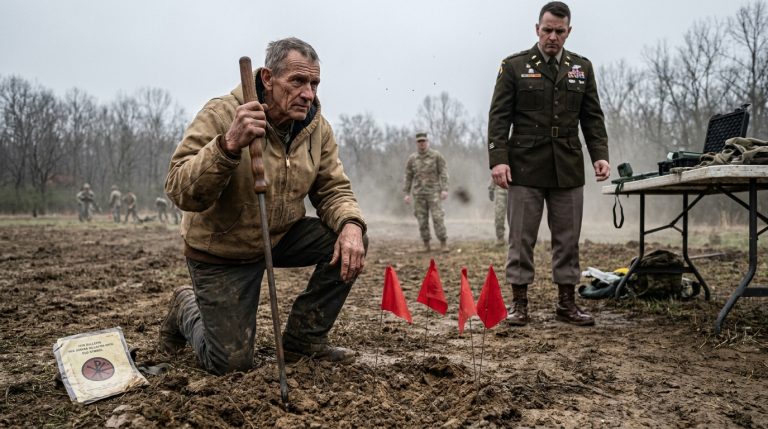
Hank felt a coldness settle in his chest, one that had nothing to do with the wind. He looked down at the gravel. There, tucked behind a cluster of wild grass near the base of the primary berm, was a glint of something metallic. A second stake, already driven deep into the earth. A physical discrepancy that shouldn’t have been there.
“The wind is shifting, Mr. Vane,” Hank said softly, his voice a low, steady rumble that seemed to stop the developer in his tracks.
“I beg your pardon?” Vane asked, his composure flickering for the first time.
“I said the wind,” Hank repeated, looking him dead in the eye. “It’s going to rain before the night is out. You might want to get those stakes out of the mud before the ground softens and they disappear.”
Vane frowned, glancing down at the orange marker. When he looked back up, Hank was already moving, his hand firm on Tyler’s shoulder, guiding him away from the booth.
But as they walked, Hank saw it—a second orange stake, barely visible, hammered into the soft earth at the very edge of the training berm. Someone had been working while he was shooting. Someone had been marking the boundaries of his world while he was busy proving he could still hit a target.
“Grandpa?” Tyler whispered, pulling away just enough to look at him. “What was that about?”
Hank didn’t answer immediately. He looked back at the range, at the fading light caught in the tall, dry grass. The silence he had earned with that shot was already being chipped away.
“It’s about the wind, Tyler,” Hank said, the phrase heavy with a meaning he hadn’t yet been able to fully articulate. “And some men, they think they can own the direction it blows.”
He stopped, his boot hovering over a patch of dirt where the ground was disturbed, fresh. He realized then, with a sinking, familiar dread, that the challenge booth hadn’t been the only thing at stake today. The very earth they stood on was being measured for a funeral.
CHAPTER 2: Shadows in the Workshop
The truck ride back to the cabin was defined by a silence so heavy it felt like atmospheric pressure. Tyler kept his hands off the dash, his fingers drumming a nervous, irregular rhythm against his knees. Hank gripped the wheel, his knuckles pale and rigid, feeling every bump in the gravel road vibrate through the steering column. The orange stake back at the range—that bright, synthetic wound in the earth—seemed to burn in his peripheral vision, a persistent, blinking threat.
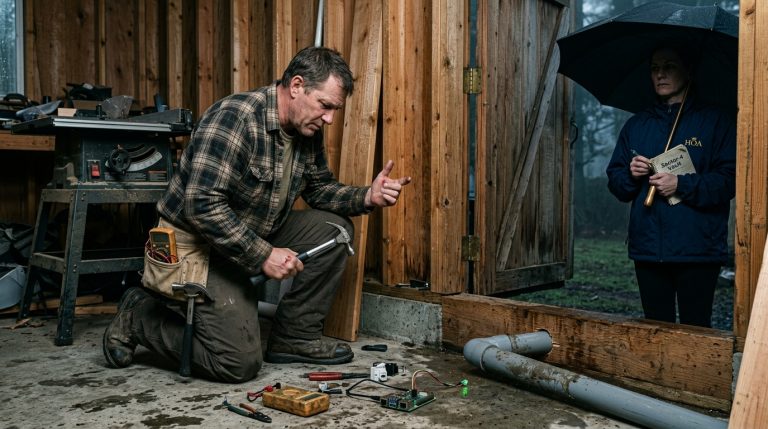
He parked the truck in the lean-to shed behind his home. The smell here was the familiar, grounding scent of his life: aged gun oil, cold steel, and the sweet, dry rot of pine sawdust. It was a place of maintenance, a sanctuary where things were kept in working order. But as he stepped out, the air felt thinner, tainted by the lingering, metallic tang of the expo’s high-pressure environment.
“Grandpa,” Tyler said, closing the truck door with a soft click. “That guy… Vane. He wasn’t just there to look at the gear, was he?”
Hank walked toward the workbench, his boots finding the worn grooves in the floorboards. He reached for a rag, his hands moving with the automatic, practiced grace of a man who had cleaned rifles for over half a century. He began wiping down the Ruger 10/22, the metal cold and unyielding under the rough fabric. The repetition usually quieted the static in his mind, but tonight, it only sharpened it.
“He’s looking for something, Tyler,” Hank replied, his voice raspy, echoing slightly against the plywood walls. “He’s looking for a way to turn that range into something else. Something that doesn’t belong to the people who use it.”
“But it’s just dirt,” Tyler said, leaning against the doorframe. The late afternoon light spilled in, illuminating the dust motes dancing in the air—faded, golden flecks that looked like embers from a fire long extinguished. “Why would he care about a bit of dirt in Ohio?”
Hank stopped wiping the action. He stared at a shelf filled with manila folders, their edges curled and yellowed by time. One of them—a report from Fort Benning, 1969—sat partially pulled from its resting place. It wasn’t the report itself that mattered, but the memory it guarded. A sudden, sharp image flickered behind his eyes: the way the grass had looked at the range back then, the way the instructors had stood, silent and imposing, watching them struggle for the prize of competence. It was a memory of a time when honor was earned in the mud, not marketed on an expo floor.
He felt a ghost of a phantom weight in his hands, the memory of a weapon he’d held when the world was younger and far more dangerous. The contrast was visceral—the soft, synthetic feel of the developer’s suit versus the gritty, honest reality of the steel he’d held for decades.
“It’s not just dirt,” Hank said, the words heavy and deliberate. He set the rifle down on the bench with a soft, final thud. “It’s a foundation. Vane isn’t just buying land; he’s trying to overwrite the history of it. He wants to pave over the things he doesn’t understand.”
Tyler moved closer, his youthful face shadowed by the dim light of the workshop. “Are you going to talk to Sergeant Major Ritter? You two were… you guys were talking out there like you shared the same language.”
Hank’s gaze remained fixed on the workbench. He picked up a small screwdriver, checking the tension on the stock screws. It was an excuse to stay focused on the physical, to avoid the emotional complexity of the question. He knew what a call to Ritter would mean. It would mean pulling men out of their quiet, settled lives, dragging them back into a conflict they’d long ago put behind them.
“Ritter understands the wind,” Hank said quietly. “But this wind isn’t blowing from the North, Tyler. It’s coming from inside the boardroom.”
He looked at his grandson, really looked at him. Tyler was the future, the one who had felt the chime of the shot vibrate in his own bones. If Hank failed, it wasn’t just the land that would be lost; it was the ability to pass on the silence, the ability to teach the next generation how to find the target when the world was screaming in their ears.
“Go inside,” Hank said gently. “Heat up the coffee. I need to finish this.”
Tyler hesitated, his gaze lingering on the rifle, then on the old folders on the shelf. He nodded, sensing the boundary Hank had drawn—not out of secrecy, but out of a sudden, overwhelming need to preserve what remained of their peace.
Once the door clicked shut, Hank walked over to the shelf. He pulled the 1969 report all the way out. He didn’t open it. He simply held it, the paper brittle and dry, like dead leaves. He could hear the wind outside, gusting against the shed, testing the boards, searching for a gap. Vane thought he was measuring land, but he had no idea what was buried in the topsoil—the intangible, silent weight of what had been taught on those grounds.
Hank leaned his forehead against the cool, rough grain of the workbench. He was 73. His knees ached with the humidity. The world felt like it was moving too fast, a blurring, neon-lit cycle that demanded noise, demand speed, demanded a surface-level victory. But he was a man of the quiet. And he knew, with the bone-deep certainty of a veteran, that you couldn’t build anything lasting on a foundation you didn’t respect.
He reached for the telephone hanging on the wall, its cord coiled like a snake. He didn’t dial yet. He just stood there, the receiver cold in his hand, listening to the dial tone—a steady, unwavering hum that, for the first time in twenty years, sounded less like an idle machine and more like a warning.
CHAPTER 3: The Notice
The dial tone didn’t turn into a voice. It remained a flat, unwavering vibration, a reminder that the world outside this room was continuing its frantic, indifferent pace while Hank stood suspended in the quiet of his own making. He lowered the receiver into its cradle, the plastic cold against his palm. The workshop seemed smaller than it had ten minutes ago, the shadows stretching out from the corners like ink spilling across a page.
He stepped back from the workbench. His movements were slow, deliberate, the joints of his knees protesting the damp chill of the evening air. He looked at the orange stake he had retrieved from his pocket—he hadn’t realized he’d brought it in—and set it on the anvil. It looked out of place, a gaudy, synthetic intrusion among the honest, heavy tools of his trade.
The door to the workshop groaned on its hinges. Tyler stood there, silhouetted against the dim, bruised purple of the twilight. He held a ceramic mug, steam rising from it in a thin, fragile ribbon.
“Coffee’s ready,” Tyler said. He looked at the stake, his eyes widening. “You kept that?”
“I wanted to see it up close,” Hank said. He walked over and took the mug. The warmth seeped into his fingers, a welcome contrast to the metallic chill of the day. “Everything looks different under a shop light, doesn’t it?”
“It’s just a piece of plastic, Grandpa.”
“Is it?” Hank took a sip, the bitter heat grounding him. “Plastic is cheap. But the intent behind it? That’s something else entirely. People like Vane, they don’t stake land just to measure it. They stake it to claim it. They start by marking the boundaries, and they finish by erasing what’s inside.”
Tyler moved into the room, his footsteps muffled by the dust on the floorboards. “What did Ritter say? You were going to call him.”
Hank looked at the phone. “I didn’t call yet. I wanted to see if the world was still spinning the same way it was when I walked out of that expo.” He gestured toward the window. Beyond the glass, the Creekside Range was a dark, rolling expanse. He had spent his retirement years watching those hills, observing how the light changed the character of the soil, how the wind danced off the berms. It was a language he knew by heart. Now, it felt as though he were reading a familiar book only to find that the pages had been rewritten in a tongue he couldn’t speak.
“I need you to do something for me, Tyler,” Hank said, his voice dropping to a low, measured tone. “Go to the front gate. Check the fence line. There’s a red reflector on the third post from the access road. If it’s gone, or if it’s been moved, I need you to tell me.”
Tyler frowned. “The fence line? It’s almost dark, Grandpa.”
“That’s exactly why.” Hank saw the hesitation in his grandson’s eyes. It was the natural, human instinct to shy away from the dark, to prefer the safety of the known. But in this life, safety was a luxury you had to earn. “If Vane is moving, he’s moving while the rest of the world is busy looking at their phones or worrying about their next sale. If he thinks he can take this place, he’s going to start by testing the perimeter.”
Tyler nodded, his posture straightening. He didn’t ask why—a small, proud realization bloomed in Hank’s chest. Tyler was beginning to understand that the “quiet” wasn’t just about silence; it was about observation. It was about knowing what was happening before it arrived at your door.
As Tyler slipped out into the deepening gloom, Hank turned back to the workshop. He felt a sudden, sharp tremor in his hands. It wasn’t fear—he was far too old for that—it was the familiar, cold clarity of preparation. He went to the wall cabinet, reached behind a stack of weathered cleaning kits, and pulled out a heavy, leather-bound logbook.
It was a record of every shooting day at Creekside, dates and weather conditions meticulously noted in fountain pen. He flipped through the pages, the paper dry and rustling like dead leaves. He stopped at a page from three years ago. The ink was faded, but the entry was clear: Fence line maintenance. Third post.
He realized with a sinking, hollow sensation that he hadn’t checked that perimeter in weeks. He had been too focused on the expo, too focused on his grandson, too focused on the comfort of the routine. He had left a gap. A small, seemingly insignificant lapse in attention—and now, the stakes were being hammered into the very heart of his history.
The shop light buzzed overhead, the flickering frequency adding to the sense of unreality. Hank stared at the logbook. He was a man who prided himself on his precision, on his ability to read the wind and make the impossible shot. And yet, he had been blind to the shifting terrain of his own backyard.
He heard the crunch of gravel outside—Tyler’s footsteps, hurried and irregular. The door pushed open, and Tyler stepped in, his face pale, his breath coming in short, quick bursts.
“Grandpa,” Tyler said, his voice tight. “The reflector. It’s not just moved. It’s gone. And there’s a vehicle parked by the access road. A black SUV. The lights are off, but I think someone’s inside.”
Hank set his coffee down. It was still warm, but the sudden cold in his marrow made it feel like ash. He picked up his cap, pulling the worn brim low. The silence of the workshop was no longer a sanctuary; it was a front line.
“Stay here,” Hank said, his voice as steady as the strike of a hammer. “And lock the door.”
He stepped out into the night, the darkness hitting him like a physical weight. The air was cool, smelling of damp earth and coming rain. He moved not with the hesitation of a man who was surprised, but with the measured, rhythmic stride of a man who was walking into a target zone he had already mapped.
CHAPTER 4: Reading the Mirages
The night air was a sharp, biting thing, filled with the promise of rain and the heavy, musky scent of wet limestone. Hank stood in the shadow of the shed, his stillness absolute. He didn’t move; he didn’t even shift his weight. He had spent years in places where the slightest movement could mean the difference between existence and oblivion, and that muscle memory was as sharp as ever.
The black SUV sat idling near the access road, a low, guttural thrum that vibrated through the soles of his boots. It was a high-end vehicle, the kind that didn’t belong on the washed-out gravel of Creekside. Its headlights were off, but he could see the faint, rhythmic pulse of a dashboard screen reflected in the driver-side window—a flickering, sterile light that looked alien against the backdrop of the dark, sleeping range.
He moved forward, keeping to the edge of the tall, dry grass. The gravel crunched under his boots, a sound he minimized by shifting his weight to the balls of his feet, feeling for the path of least resistance. He reached the fence line where the red reflector had been torn away. He knelt, his knees pressing into the soft, rain-loosened dirt.
He ran a hand over the ground, his fingers finding the imprint of a heavy tire—a tread pattern too wide for a standard passenger car, one designed for pavement and performance, not the rutted mud of a rural range. It was a mismatch, a physical discrepancy that sat as jarringly as the orange surveyor’s stake. Vane’s men were here, and they weren’t just observing. They were mapping the vulnerabilities of the perimeter.
“Pops.”
The voice came from behind him, soft but steady. Hank didn’t flinch. He stayed in his crouch, his eyes never leaving the silhouette of the SUV. He recognized the heavy, deliberate cadence of the greeting. He stood, turning slowly to find Sergeant Major Dale Ritter standing a few yards back, hands deep in the pockets of his faded windbreaker.
“Ritter,” Hank said, his voice a low, gravelly rasp. “You’re a long way from the porch.”
Ritter stepped into the thin moonlight, his face a map of lines and hard-won patience. “You didn’t call, but the grapevine in this town is older than the dirt, Hank. Heard there was a ruckus at the expo today. Heard a name like Vane was sniffing around.”
“He’s more than sniffing,” Hank replied, gesturing toward the idling SUV. “He’s preparing to bite.”
Ritter looked at the dark shape of the vehicle. He didn’t ask questions. He simply leaned against a post, his posture echoing Hank’s own—the posture of a man who had held the line before and knew that the only way to hold it again was to wait for the wind to settle.
“What’s his play?” Ritter asked, his tone transactional, the way two men discuss a faulty firing pin or a misaligned sight.
“He wants the land. He’s looking for a way to break the deed, or find a violation he can use to shut us down for good,” Hank said. “He’s not just looking for a profit. He’s looking for the history. He wants the records of what happened here, what was taught here.”
Ritter went quiet. He pulled a pack of gum from his pocket, unwrapping it with a deliberate, slow movement. “He’s digging into the Benning era?”
“He’s digging into everything,” Hank said.
Ritter finally turned to look at him. There was a flicker of something behind his eyes—not fear, but a cold, pragmatic recognition of the threat. “If he wants the history, he’s going to find the ghosts too, Hank. There are things written in those after-action reports that aren’t meant for a corporate board room.”
“I know.”
The SUV’s engine cut out, the silence falling over the range like a heavy shroud. A door opened, then closed with a dull, cushioned thud. A figure emerged, tall and lean, moving with a confident, hurried pace toward the fence line. It was Vane. He wasn’t wearing his suit jacket now; he was in dark, tactical-style gear, looking like a man who was used to getting what he wanted by force or by finesse.
Hank stepped out of the shadows. He didn’t hide. He stood in the center of the access path, his hands resting naturally at his sides. Ritter remained in the background, a silent, immovable presence in the dark.
Vane stopped, his breath hitching as he realized he wasn’t alone. “Mr. Mueller.” He didn’t sound surprised; he sounded annoyed, the way a man feels when a subordinate fails to clear a path. “I didn’t expect to find you patrolling your own fence line at this hour.”
“The wind carries noises, Mr. Vane,” Hank said. His voice didn’t rise; it carried through the night, steady and cold. “And you’re trespassing on ground that has no interest in being developed.”
Vane smiled, a sharp, thin expression that didn’t reach his eyes. He tapped his handheld device, the screen casting a pale glow on his face. “This isn’t a social call, Hank. I’m conducting an environmental impact assessment. Something the state requires before we move forward with the acquisition.”
“You don’t have the acquisition yet,” Hank countered.
“It’s a matter of time,” Vane said, stepping closer. The smell of his cologne—synthetic, expensive—drifted toward Hank, clashing with the natural, earthy scent of the range. “People like you, you hold onto these places out of some misplaced sense of sentimentality. But look around. This place is decaying. The structures are old, the range is outdated. I’m offering a future. Isn’t that what you want for your grandson? A future that doesn’t involve cleaning rifles in a shed?”
“I want a future that means something,” Hank replied. “And you’re offering nothing but a glossy, empty shell.”
Vane laughed, a dry, dismissive sound. He turned to look at the dark expanse of the range, his eyes tracing the line of the berms. “You’re an old man who’s afraid of being forgotten. I’m just giving you a head start on the inevitable.”
He turned back to the SUV, not bothering to look at Hank again. As the engine flared to life, the headlights cut through the dark, washing over the fence line, the gravel, and the two men standing like statues in the night.
“We’ll be back with the official survey teams on Monday,” Vane said, his voice fading under the hum of the engine. “You might want to make sure your paperwork is in order, Hank. Because I’m going to go through every single inch of this property, and I promise you, I’m going to find a reason to clear this board.”
The SUV backed up, turned, and disappeared down the access road, leaving behind a plume of dust that hung in the air, glowing faintly in the moonlight. Hank watched it go, his heart pounding a steady, rhythmic cadence. He knew Vane was telling the truth. He would find a reason, a flaw, a buried technicality.
Hank turned to Ritter. “He’s not going to stop at the land.”
Ritter nodded, his expression unreadable. “Then we make sure he doesn’t find what he’s looking for. But first, Hank, we have to know what it is he’s really after.”
Hank looked down at the mud where the SUV had been parked. There, pressed deep into the wet earth, was a discarded business card, half-buried in the grime. He picked it up. It wasn’t Vane’s card. It was a file reference number for a regional land registry—the exact office that housed the archives from the 1960s.
“He already knows,” Hank whispered, the realization settling over him like a frost. “He doesn’t need to look here. He’s already started the hunt.”
CHAPTER 5: A Different Kind of Wind
The business card was damp, its edges curling in the humid, electric air. Hank held it under the dim, buzzing light of the workshop lamp, his thumb tracing the embossed reference number. It was a fragment of a larger, systemic puzzle—an indication that Vane wasn’t just working with money, but with the institutional machinery that governed these records.
“This isn’t just about the range,” Hank murmured, his voice barely audible over the rising drone of the wind against the metal shed. “He’s targeting the records themselves.”
Ritter shifted his weight, his boots heavy on the floorboards. Outside, the sky had bruised into an angry, charcoal black, and the first sheets of rain were beginning to lash against the corrugated roof, a rhythmic, deafening percussion that made the small space feel suddenly, intensely confined. “If those files are pulled, Hank, the story dies with them. And if the story dies, the land becomes just another empty slate for him to write his version of history.”
Hank walked to the filing cabinet. He knew exactly what he was looking for—a series of master keys and backup logs he’d kept long after he’d retired. He wasn’t a man who left things to chance, not when lives were once measured in the precision of a wind call. He opened the drawer, the steel sliding with a smooth, oiled silence that belied the tension in his muscles.
“We need to see what he’s actually looking for,” Hank said, pulling out a heavy, leather-bound directory. “He thinks he’s the only one who knows where the bodies are buried—metaphorically speaking. But he’s forgetting that some of us never really stopped documenting the terrain.”
Ritter watched him, his expression grim. “You realize if we intervene, if we start moving these records, he’s going to know we’re active. He won’t just treat this as a bureaucratic acquisition anymore. He’ll treat it as a tactical threat.”
“Let him,” Hank said. He didn’t look up. His mind was already working, calculating the variables, reading the unseen currents of the situation just as he would read the drift of a bullet at four hundred yards. He wasn’t thinking about the law, or about corporate strategy; he was thinking about the protection of the quiet. That was the mission. It had always been the mission.
The rain intensified, a torrential downpour that turned the world outside into a blurred, gray smear. The wind howled through the gaps in the shed, whistling a mournful, low note that vibrated in the steel racks holding the rifles. It was a sound he knew well—the sound of a storm blowing in, changing the pressure, forcing a reset.
“I need to get these to someone who can verify the chain of custody,” Hank said, setting the directory on the bench. “Someone who still operates within the system, but who owes us enough that they won’t ask how we got them.”
“I have a contact at the state archives,” Ritter said, his voice dropping. “But even then, it’s a risk. If Vane has a reach into the department, he’ll know the moment those files are accessed.”
“Then we don’t access them through the front door,” Hank said, his eyes sharpening as he looked at the directory. He reached for a pencil, his movements precise, focused. He began sketching a small, rough map of the administrative district, marking not the roads, but the vulnerabilities—the back access points, the shift changes, the quiet hours where the history of this land was kept under lock and key.
It felt strange, planning a maneuver like this at seventy-three, under the flickering lights of a workshop that smelled of oil and memories. But as he looked at Ritter, he saw that the old soldier was also settling in, his posture hardening, his gaze scanning the room with the practiced eye of a man who had never really left the field.
“We need a distraction,” Ritter said, his voice quiet. “Something that makes him look toward the range while we’re looking at the records.”
Hank nodded slowly. He thought of Marcus Delaney, the young shooter he had mentored, the one who had taken the rifle and made the shot his own. Marcus had energy, a drive, and a public presence that could draw attention in a way Hank never could.
“I won’t pull the boy in,” Hank said, almost to himself. “He needs to win his own matches.”
“He doesn’t have to win anything,” Ritter countered. “He just has to be there. Vane wants to make this about modernization? Let him compete against the very thing he claims to be replacing. Let the kid’s success be the noise that covers our movement.”
Hank looked at the directory, then back at the rain-lashed window. The plan was clean, efficient, and dangerous. It was everything he hated about the world, and yet, it was the only way to preserve the silence. He felt a surge of cold, calm focus—the “quiet” that had served him for decades.
“We move when the rain lets up,” Hank said. “I’ll handle the archives. You keep eyes on the perimeter. If Vane’s men come back tonight, I want to know before they’re within a mile of the gate.”
Ritter gave a sharp, definitive nod and turned toward the door, his silhouette framed against the gray, turbulent sky. As he stepped out, the wind caught the door, slamming it shut with a force that made the workshop floor shudder. Hank was left alone again, surrounded by the tools of his life, the logbooks, and the weight of a history that someone was trying to rewrite.
He looked at the business card one last time, then dropped it into a small metal trash bin. He didn’t need the number anymore. He had the target. And for the first time since Vane had arrived, the chaos of the situation felt organized, clear, and perfectly within his range. He leaned back against the workbench, the wood firm beneath his palms, and began to wait for the storm to break.
CHAPTER 6: The Decoy Secret
The state archive building was a monolith of concrete and glass, an architectural contradiction to the rolling, wooded hills of the Creekside range. Inside, the air was processed, cooled, and scrubbed of anything resembling the scent of earth or rain. It felt aggressive in its sterility. Hank followed Ritter down the long, linoleum-lined corridor, his boots clicking with an annoying, hollow resonance that seemed to announce their presence to every soul in the wing.
Ritter held a temporary visitor pass, his expression as unreadable as a slab of granite. He navigated the hallways with a soldier’s economy of motion, eventually stopping in front of a heavy, climate-controlled door marked Restricted Access – Administrative.
“My contact should be inside,” Ritter said, his voice hushed. “She’s the head of regional records. She’s been here for thirty years. She knows where the bodies are buried—and by that, I mean the paperwork.”
Hank didn’t respond. He was focused on the doorway. He felt the phantom phantom chill of the jungle—the heavy, suffocating humidity of the past—creeping into the edges of his perception, a stark contrast to the sharp, chemical-clean air of the hall. He shoved his hands into his pockets, fingers brushing the fabric, grounding himself.
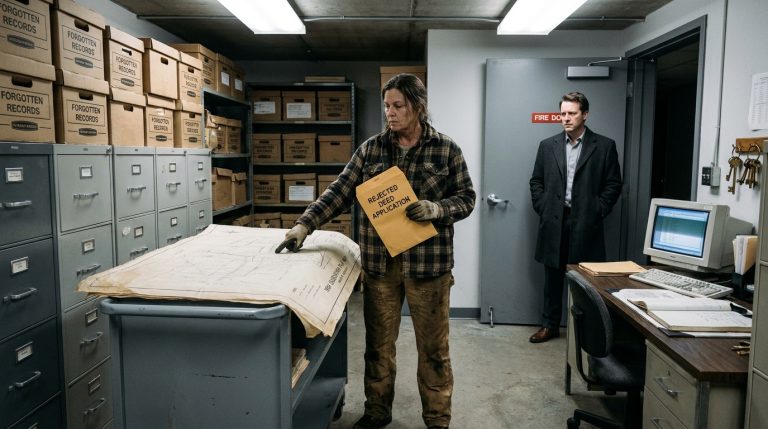
They entered. The office was small, packed floor-to-ceiling with metal shelving and the hum of microfilm readers. A woman with silver-framed glasses and hair pulled into a tight, utilitarian knot looked up from a document. She was exactly what Ritter had described: a gatekeeper of time.
“Dale,” she said, her voice dry as parchment. She looked at Hank, her eyes narrowing slightly. “And you’re Mueller. I recognize the face from the old unit files.”
“We’re looking for a specific series,” Ritter began, skipping the pleasantries. “Creekside range, regional land records, 1967 through 1984.”
She stood, moving toward a shelf with practiced efficiency. She pulled a box, but it wasn’t the box they expected. It was thin, marked with a red tag that had begun to fade to a sickly, pale pink. She set it on the table between them.
“I found this flagged three days ago,” she said. “Someone with high-level access requested it. It’s the original deed and the auxiliary training permits for the range. But look at the cross-reference.”
Hank reached out, his calloused fingers sliding the folder open. Inside were the documents he knew, but attached to the back was a newer, stapled sheet—a request for land re-zoning, filed under a subsidiary corporation he didn’t recognize. Vane Development Holdings. It was the decoy secret they had suspected, a document explicitly aiming to classify the range as “environmentally compromised” due to soil toxicity from long-term lead usage.
“He’s using a standard environmental loophole,” Hank said, his voice dropping. “It’s a clean, professional way to seize the land. He doesn’t need to fight us; he just needs the state to declare it a hazard.”
Ritter leaned over the desk. “Is it true? Is the soil toxic?”
“Any range with this level of activity has lead,” Hank said, his eyes scanning the technical breakdown of the survey. “But it’s localized. It’s manageable. This report is doctored. They’ve inflated the contamination radius by three hundred percent to justify a full-site seizure.”
The head of records nodded. “And it gets worse. Look at the signature on the re-zoning request. It’s not just a corporate officer. It’s signed by a former lieutenant from the district office—someone who was discharged from your unit, Hank. Someone who might hold a grudge.”
Hank felt a cold, sharp spike of recognition. He pulled the document closer, reading the name: Captain Elias Thorne. The name didn’t immediately ring a bell, but as he stared at the typed signature, the memory returned—not a face, but a moment. A field command where he had been forced to pull a unit back because a junior officer had ignored a wind reading, causing a near-disastrous outcome. He hadn’t just disciplined the officer; he’d effectively ended his career to save the unit.
“He’s not a corporate hire,” Hank realized, the weight of the past crashing into the present. “He’s a man who has been waiting forty years to turn the tables.”
The room seemed to vibrate with the hum of the archives. This was Layer 1—the decoy. It was a tangible, bureaucratic attack, a way to use the law to strip them of their home. But as Hank looked at the signature, he realized that the decoy was also a trap. Vane wasn’t just after the land; he was after the reputation, the final, absolute erasure of Hank’s history.
“He wants me to fight him on the environmental claim,” Hank said, his voice cold. “He wants me to go into a hearing, try to prove the soil is safe, and have him bring up the past to discredit me. He’s going to use the environmental hearing as a forum to put my career on trial.”
Ritter stood up straight, his face pale. “If he does that, he wins whether the range stays open or not. He destroys your name.”
“Exactly.” Hank closed the folder. The fluorescent lights flickered overhead, a harsh, unforgiving strobe. He felt the cold, familiar clarity of a man staring down a target. He had his path. He wouldn’t fight him on the soil. He would fight him on the ownership of the history itself.
“We need the rest of this file,” Hank said to the woman. “Everything Thorne touched while he was in the service. If he’s using the law, we use the truth.”
She hesitated, then began reaching for a deeper box on the shelf. “I can’t give you the originals, but I can give you the duplicates. Just don’t let them find out where they came from.”
As she pulled the second box, Hank looked at the microfilm reader, the glowing glass displaying a faded, blurred image of a group of soldiers—men he’d known, men whose names had been written in classified reports. He was staring at the foundation of his own life, a life now being leveraged by a man who had never understood the weight of the wind.
He reached out and touched the glass, a soft, lingering contact that left a faint smudge against the face of a man who hadn’t come home. “We have what we need, Dale,” he whispered. “Let’s go.”
They left the archive and walked out into the cool, dark night. The rain had stopped, leaving the asphalt slick and reflective, mirroring the harsh, artificial light of the streetlamps. Hank felt the folder heavy under his arm, a collection of papers that now stood between his community and the end of a tradition. He looked up at the sky, the clouds finally breaking to reveal a sliver of cold, distant moon. The hunt was no longer in the shadows; it was on the table.
CHAPTER 7: The Lesson of Silence
The morning sun hit the Creekside Range with a physical weight, baking the gravel until the air shimmered above the berms. Hank stood at the bench, his movements deliberate, his eyes fixed on the wind flags. They were limp, dead-hanging in the breathless heat, but he knew the mirage would start dancing soon. He was waiting for Marcus Delaney.
Beside him, Tyler was busy setting up the optics, his hands steady. The boy had grown quiet over the last two days, his movements mirroring Hank’s own disciplined, economy-of-motion style. He had seen the way Hank had moved when they returned from the archives, the way the old man had spent hours pouring over the xeroxed duplicates of Thorne’s past. Tyler didn’t ask questions anymore; he simply performed the tasks he was given, a silent partner in a deepening struggle.
The crunch of tires on gravel announced Marcus’s arrival. The young competitive shooter stepped out of his truck, his rifle case slung over his shoulder with the practiced, athletic ease of a man who lived for the sport. He looked energized, his eyes bright with the anticipation of the upcoming regional match. He didn’t know about Vane’s environmental zoning trick, or the history of a disgraced Captain named Thorne. To Marcus, this was still a game.
“Morning, Sergeant,” Marcus said, tipping his cap. He approached the bench, his gaze landing on the custom precision rifle Hank had gifted him months ago. “Conditions look tough today. Very little movement on the flags.”
“The wind hides where it wants to,” Hank said, his voice a low, raspy rumble. He didn’t look up from the chamber he was inspecting. “Don’t trust the flags. Trust the ripple on the gravel. Trust the way the heat hits the back of your neck.”
Marcus nodded, his smile widening. “You’re always so cryptic, sir. But it works. I’ve been practicing the adjustments you taught me. The long-range drills.”
“Then show me,” Hank said, gesturing toward the firing line.
Marcus took his place. He moved with the fluid, confident pace of a top-tier athlete. He adjusted his bipod, checked his scope, and focused his entire being on the target four hundred yards away. He was good—there was no doubt about that. He had natural talent, the kind that was rare and worth preserving. But he lacked the “quiet.” He was still fighting the target, still trying to impose his will upon the wind.
Hank stepped back, leaning against a weathered support post, and watched. He looked at Ritter, who was sitting in the shade of the range office, his eyes narrowed as he kept watch on the access road. The “distraction” was in place. Marcus’s training sessions were public, recorded by local media outlets interested in the range’s “star pupil.” It was the perfect noise to cover the movement of the archival evidence toward the state capital.
“Focus, Marcus,” Hank called out, his voice sharp enough to cut through the hum of the heat. “You’re breathing too fast. You’re trying to force the shot. The target doesn’t care if you want it to ring. It only cares if you respect the physics.”
Marcus exhaled, his shoulders dropping, his posture relaxing. He squeezed the trigger.
Clang.
The sound was clean, a sharp, metallic note that echoed across the dry valley. Marcus smiled, a flash of pure, unadulterated satisfaction. “Dead center.”
“It was a lucky break,” Hank said, though his eyes softened. “The wind shifted just as you broke the shot. You didn’t account for the thermal rise off the berm. You got lucky.”
Marcus frowned, his pride momentarily stung. “A hit is a hit, Sergeant.”
“Not when the stakes are higher than a trophy,” Hank said, stepping forward to the bench. He didn’t mean to reveal so much, but the weight of the papers in his pocket—the proof of Thorne’s vendetta—demanded a different kind of intensity. “Listen to me, Marcus. You think this is about the steel. You think this is about the score. But the day comes when the ground you’re standing on isn’t yours anymore. When that happens, your skill is the only thing that proves you were ever here.”
Marcus looked at him, his brow furrowed. “Is something wrong, sir? You’ve been… different since the expo.”
Hank didn’t answer. He turned his attention to the target, the silver plate glinting in the mid-morning heat. He saw a shadow move near the treeline, a flicker of movement that shouldn’t have been there. It was likely a stray deer, or maybe one of Vane’s observers, testing the perimeter again. He didn’t signal Ritter; he didn’t even blink. He simply reached out and adjusted the windage on Marcus’s scope, his fingers nimble and steady.
“When you shoot,” Hank said, his voice so low it was almost a whisper, “don’t just look for the center. Look for the truth of the environment. If you can’t see it, you can’t master it. And if you can’t master it, you’re just a guest on this land. You understand?”
Marcus nodded, his expression shifting from competitive pride to a sudden, serious focus. “I understand, Sergeant.”
“Good.” Hank moved back to the support post. “Again. And this time, don’t just shoot the plate. Listen to the wind before you pull. Tell me when it’s ready.”
As Marcus began his ritual, his breathing slowing, his focus tightening, Hank allowed himself a brief, weary exhale. The archives were in motion. The trap was set. He had planted the seed of competence in the boy, a legacy that would continue even if the range itself was buried under the weight of a corporate vendetta. He watched the mirage dance over the gravel, a beautiful, treacherous display of physics. It was the only thing he had ever truly understood.
He felt a hand on his shoulder—Tyler, standing close, his face determined. The boy didn’t say a word, but he watched the treeline with the same vigilance as Ritter. They were a line, a small, stubborn knot of resistance against a force that thought it could just buy its way into history. The sun climbed higher, the heat intensified, and for a moment, the only sound on the range was the slow, steady rhythm of a young man learning the quiet.
CHAPTER 8: The Ghost of Benning
Tyler sat cross-legged on the floor, the archive boxes spread out around him like an excavation site. The workshop was dim, the only light coming from a single swinging bulb that cast long, frantic shadows against the tool-lined walls. He had been quiet for hours, his focus absolute as he sorted through the faded, yellowing photographs and incident reports.
“Grandpa,” Tyler said, his voice barely above a whisper. He was holding a black-and-white print of a small training squad at Fort Benning. His finger traced the face of a soldier standing at the edge of the frame—a man with a sharp, angular jaw and a look of cold, calculating ambition.
Hank walked over, his boots heavy on the floorboards. He looked down at the photo, and the air in the room seemed to drop ten degrees. He recognized the man. He hadn’t seen the face in decades, but it was etched into his memory with the permanence of a scar. It was Captain Elias Thorne.
“He looks just like the developer,” Tyler said, his voice trembling. “Mr. Vane. The eyes, the way he stands… it’s the same, Grandpa. How is that possible?”
Hank reached down, taking the photo from Tyler’s hand. The paper was brittle, ready to disintegrate at the slightest pressure. He looked at Thorne, and then he looked at the name inscribed on the back of the photo: Thorne, E. – 1st Recon, 1968.
“It’s not just a resemblance, Tyler,” Hank said, his voice a low, hollow thrum. “It’s a lineage. Thorne didn’t just have a career; he had a legacy. If Vane is his kin, he’s not just acting on a grudge. He’s fulfilling a promise made long before you were born.”
The realization hit Hank with the force of a physical blow. The environmental zoning, the harassment, the methodical tearing away of the range’s history—it wasn’t just corporate opportunism. It was a multi-generational vendetta, a carefully calibrated effort to erase the memory of the unit that Thorne had been kicked out of. Thorne hadn’t just been disciplined; he had been the architect of a failure that Hank had been forced to correct. Thorne hadn’t forgotten, and he’d clearly passed that bitterness down.
“He’s using the legal system to settle a war that should have ended in the mud of 1969,” Hank said, his gaze fixed on the photo.
Suddenly, a crackle of static erupted from the radio on the workbench. It was a handheld unit Ritter had left behind, used for perimeter monitoring.
“Hank, do you read?” Ritter’s voice was distorted, clipped by interference. “We have activity at the north gate. Not just observers this time. They’re cutting the fence. And there’s more than one vehicle.”
Hank moved toward the workbench, his heart rate spiking into a steady, tactical rhythm. He didn’t answer immediately; he grabbed the radio and keyed the mic. “How many, Dale?”
“Three,” Ritter replied. “They’re wearing gear, Hank. Not surveyors. This is a move.”
Hank looked at the photos, then at Tyler, who had stood up, his face pale but resolute. The decoy secret—the environmental claim—was failing. Vane was escalating. He wasn’t waiting for the state to process the papers; he was going to take the range by force, hoping to present a fait accompli before Hank could get the archives to the state capital.
“Get to the back shed,” Hank commanded, his voice sharp. “Get the long-range optics and the gear we talked about. We don’t engage. We observe, we record, and we call the Sheriff’s office from the secondary line. Do not let them see you.”
“What are you going to do?” Tyler asked.
“I’m going to make sure they know someone is watching,” Hank said, grabbing his cap and the Ruger 10/22. He didn’t reach for a centerfire rifle; he didn’t want a fight. He wanted a tactical disruption—a way to force them to show their hand before they could do any real damage to the site.
He stepped out of the workshop into the dark, humid night. The woods were alive with the sound of snapping branches and the distant, low hum of engines. He moved with a speed that belied his age, his feet finding the familiar, hidden paths he had memorized over decades. He wasn’t a hero in a movie; he was a man protecting his home, and he knew every inch of this ground better than anyone who had ever tried to stake a claim on it.
He reached a ridge overlooking the north gate. Three figures were huddled by the fence, using heavy-duty cutters to breach the perimeter. Their movements were methodical, efficient—the movements of people who were well-trained and well-paid.
Hank knelt, resting the Ruger on a moss-covered log. He didn’t aim at the men. He aimed at the floodlight above the gate, a single, sharp shot that would plunge the area into total darkness and sound a silent alarm in their ranks.
He took a breath, the air cool and damp against his lungs. He wasn’t thinking about Thorne. He wasn’t thinking about the archives. He was thinking about the wind, the hold-over, and the quiet.
He squeezed the trigger.
The report was a sharp, rimfire crack, almost playful in the vast silence of the woods. The floodlight shattered, glass raining down on the intruders like diamonds. In an instant, the gate was consumed by shadow, and the men scattered, their tactical discipline fracturing into shouts and panicked movement.
Hank didn’t wait to see what they did next. He turned and vanished back into the trees, his pulse steady, his mind already calculating their next move. The decoy was dead. The real conflict had begun.