The Silent Ledger: A Master Sniper Forced to Choose Between Her Cover and Her Instincts
CHAPTER 1: THE WEIGHT OF THE FILE
The office was too quiet. That was the first thing Devon noticed. Even the hum of the cooling fan in the ceiling seemed to hold its breath.
Commander Vance sat behind his desk, his posture a study in calculated ease. He wasn’t looking at the door; he was looking at a thin, manila folder resting on the polished mahogany. His eyes, cold and slate-gray, shifted up as Devon stepped over the threshold.
“Staff Sergeant,” he said. His voice was smooth, lacking the friction of someone who dealt with paperwork all day.
Devon didn’t speak. She stopped two paces from the chair, her hands resting naturally at her sides, palms slightly open. She wasn’t a soldier who fidgeted; she was a predator who understood that stillness was a weapon. She caught the edge of the folder. Her name was printed on the label, but it was the weight of it—the sheer density of the pages inside—that registered in her mind. A standard file shouldn’t be that thick.
“I’ve been going over the logistics of your last deployment,” Vance continued, tapping the edge of the folder with a single finger. “The numbers, Cole. They don’t align with the mission parameters provided to your squad.”
Devon kept her expression neutral, the mask she’d perfected over years of service. If she allowed her heart rate to spike, he would see it. If she allowed a flicker of recognition to cross her face, he would own it. She felt the weight of her tactical pen in her pocket—the steel casing, the hidden spring—but she didn’t reach for it.
“Sir, every report was submitted according to standard protocol,” she replied, her voice level.
Vance stood up. He moved with the slow, deliberate grace of someone who knew the exact dimensions of his environment. He walked to the window, staring out at the base training grounds where men and women were running, unaware of the conversation unfolding inside.
“Protocols are for people who can’t handle the truth of their own actions,” he said, turning back to face her. “I don’t care about your combat logs, Sergeant. I care about the fact that you’ve been ghosting through the system for four years. And I care about the fact that this folder, according to internal security, was flagged yesterday for unauthorized access—by you.”
Devon felt a chill ghost down her spine. The accusation was clean, precise, and completely fabricated. He hadn’t just called her in to talk about her past; he was handing her a noose and inviting her to put it on.
“I haven’t accessed any files, Sir.”
“And yet,” Vance said, his gaze narrowing, “the login occurred from your terminal while you were supposedly out on the line. Which brings us to a rather difficult crossroads. I can either report this as a breach and have you court-martialed by noon, or…”
He paused, a flicker of something ancient and predatory passing behind his eyes.
“Or you can tell me exactly how you managed to survive the operation in the Valley three years ago, when the official report says everyone was liquidated.”
CHAPTER 2: THE ECHO OF THE VALLEY
The name of the place—The Valley—didn’t just hang in the air; it vibrated against the back of Devon’s teeth. It was a phantom location, a set of coordinates that existed in no official military geography. To hear it spoken aloud by a man who was supposed to be a mere administrative hurdle was like hearing a dead man whisper her name in a crowded room.
Devon’s pulse did not quicken. She forced her diaphragm to expand, breathing in the sterile, air-conditioned chill of the office. Her gaze remained locked on the Commander’s eyes, but her mind was already scanning the room for exits, for hidden microphones, for the tactical layout of the building should she need to move.
“I don’t know what you’re referring to, Sir,” she said. The lie was practiced, polished, and cold.
Vance didn’t blink. He walked slowly back toward his desk, his boots making a soft, rhythmic thud against the carpeted floor. Each step felt deliberate, a metronome counting down to an inevitable confrontation. He sat down again, interlocking his fingers on top of the manila folder. The movement was calm, but there was a subtle tremor of tension in his jaw—a sign that he was just as invested in this game of shadow-boxing as she was.
“Everyone has a breaking point, Staff Sergeant,” Vance said, his voice dropping into a register that was almost intimate. “For some, it’s the threat of a dishonorable discharge. For others, it’s the threat of exposure. But for you, I suspect it’s the realization that the past isn’t as dead as you’ve spent three years pretending.”
He slid the folder across the desk. It didn’t stop in the center; it glided all the way to the edge, hovering precariously.
“The Valley was a loss for the agency. A complete, unmitigated failure,” he continued. “Or so the reports claimed. But I was the one who authorized the operation. I was the one who signed the black-ink order to sweep the area once the primary objective was confirmed neutralized. I know exactly how many people were supposed to walk out of those mountains.”
He looked at her, his eyes searching for a crack in her armor.
“The math says zero, Cole. But my gut says you. And if I am right, that means you have been operating under deep-cover status for three years, holding onto secrets that could burn half of the command structure to the ground.”
Devon looked down at the folder. She didn’t reach for it. She knew the trap. If she touched it, she was confirming her interest. If she opened it, she was confirming her connection to the contents.
She took a half-step back, her posture shifting from defensive to ready. The room felt smaller now, the shadows in the corners stretching toward the center of the floor. A sudden thought pushed into her mind, unbidden: the way the mountain pass had smelled of pine needles and wet stone right before the strike team arrived. It wasn’t a memory she wanted, yet it was there, sharp and vivid, a sensory anchor that tethered her to a history she had sworn to leave behind.
“You’re making a dangerous leap, Commander,” Devon said, her voice a low, steady drone. “If you believe I’m a ghost, then treating me like a subordinate is a tactical error.”
Vance let out a short, dry laugh. “Oh, I’m not treating you like a subordinate. I’m treating you like a fuse.”
He leaned back, his eyes tracking her every move. “Go back to your barracks. Think about the arithmetic. If you’re a hero, you’re a dead one. If you’re a liability, you’re a prime target. I’ve given you twenty-four hours to decide which version of your life you want to present in this room tomorrow. If you don’t show, I trigger the breach report. And then, we won’t be talking about your records—we’ll be talking about your survival.”
Devon didn’t respond. She didn’t need to. She turned on her heel, the movement fluid and silent. She walked to the door, the heavy brass handle cool beneath her palm. As she stepped into the hallway, the light from the office hit the floor in a long, rectangular slice, and for a split second, she felt the eyes of every person on the base watching her—not as a Sergeant, but as something else entirely.
She didn’t look back. She walked toward the barracks, but her mind was already elsewhere, calculating the trajectory of her next move. The Commander didn’t just want her secrets; he wanted her to be the hammer he used to break his own rivals. And as she rounded the corner into the dim, industrial gloom of the supply wing, she realized with a cold, hollow certainty that the only way to survive was to become the very thing she had spent three years trying to hide from.
She reached into her pocket, her fingers brushing against the cold, hard steel of her pen. A single click echoed in the silence of the corridor.
The game had changed.
CHAPTER 3: THE FRICTION OF THE FACADE
The click of the pen was a small sound, but in the silence of the supply wing, it felt like a gunshot. Devon didn’t pause. She kept her stride steady, her boots striking the concrete floor with a rhythmic, predictable cadence. To any observer, she was just a Staff Sergeant heading back to her bunk after a routine briefing. Beneath that, however, her mind was mapping the architecture of the base—the blind spots in the security cameras, the layout of the server racks, and the distance to the logistics yard where her own gear was secured in deep storage.
She reached the intersection of the secondary corridor and slowed, her eyes darting to the overhead security feed. It was a standard digital array, the red lights of the cameras blinking in a synchronized pulse. But as she passed beneath the third unit, she noticed a faint, irregular smudge of oil on the lens housing. It was small—barely visible unless one was looking for it—but it was out of place. The base was run with obsessive, almost surgical cleanliness. A smudge on a camera lens meant someone had been manually adjusting the field of view.
Devon didn’t stop. She kept moving, but the information registered with the cold precision of a targeting solution. The Commander wasn’t just talking about monitoring her; he was actively re-tasking the eyes of the base to track her movements.
She turned into the logistics wing, where the air grew stale, heavy with the smell of floor wax and ozone from the heavy electrical conduits overhead. The facility was nearly empty at this hour, a cavernous space filled with row upon row of locked storage crates. She bypassed the main desk, weaving through the aisles with a practiced invisibility. She wasn’t here to draw attention; she was here to verify.
Her assigned storage locker was at the end of Aisle 4. She approached it, her hand hovering near the keypad. Before she entered her code, she glanced back at the camera mounted at the end of the aisle. The housing looked clean, but the angle was slightly skewed, pointed three degrees lower than standard protocol dictated. It was watching the locker, not the aisle.
Devon entered the code, the familiar sequence of numbers feeling like a heartbeat against the keypad. The lock clicked, a heavy, metallic sound that vibrated through her wrist. She pushed the locker open just enough to slide inside, closing it gently behind her.
Inside, it was pitch black and smelled of oiled steel and dry dust. She didn’t turn on a light. She didn’t need to. She reached for the false back of the locker, her fingers tracing the seam of the metal panel she’d modified eighteen months ago. It hadn’t been touched. She pulled it back, revealing a slim, fireproof case.
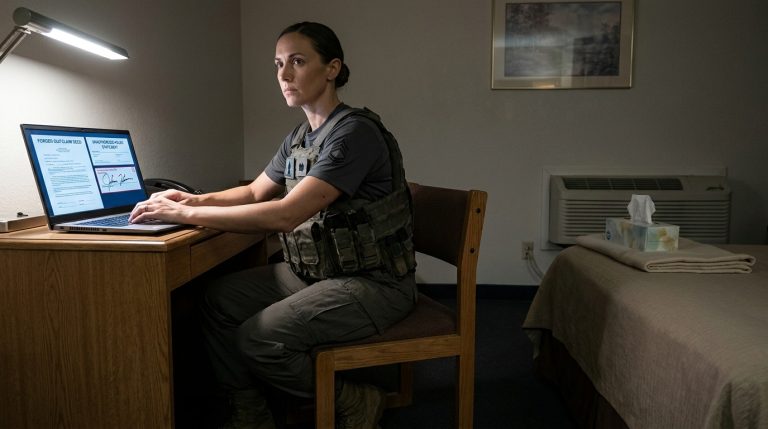
Inside the case lay a physical ledger—not digital, not networked, but paper. It contained the names, the dates, and the signatures of every mission she had officially “completed” during her black-ops tenure. She flipped to the entry for the Valley. The page was there, the ink still crisp. At the bottom, where the authorizing signature should have been, there was nothing but a scorched mark where the paper had been chemically treated to erase the name.
But the indentations remained.
She pulled a small, high-intensity penlight from her pocket, angling it low across the paper. The light caught the deep, pressure-marked grooves of a signature.
Vance.
The name wasn’t just a suspicion anymore; it was a physical fact, carved into the very paper he had tried to burn away. He hadn’t just signed the order to clear the area; he had signed the order to liquidate the team, including her.
The weight of the discovery didn’t make her angry. It made her focused. The Commander wasn’t trying to recruit her or punish her for a breach. He was trying to eliminate the only witness who could link him to the unauthorized massacre in the Valley. The “breach” was a ruse to get her into his office, and when that failed, it became the pretext to force her into a defensive posture where she would be vulnerable.
Devon slid the ledger back into its hidden compartment and sealed the panel. She moved to the front of the locker, peering through the slight gap in the door. The aisle was empty, but she could hear the soft, rubber-soled squeak of a shoe on the linoleum near the entrance to the wing. Someone was patrolling—not a standard guard, but someone moving with the silence and patience of a hunter.
She took a slow, deep breath, letting the tension in her shoulders drain away. She was the one who had been hunted in the Valley, and she had walked out of the mountains alive. Vance was a creature of the office, a man who lived in the comfort of signatures and authority. He had no idea what he had unleashed by cornering her.
She checked the time on her watch. She had until tomorrow morning before the “breach” report went live. That was more than enough time to change the landscape of the entire base. She reached into her gear bag and pulled out a small, unassuming spool of copper wire. It was time to start dismantling the eyes that were watching her.
As she stepped out of the locker and into the darkness of the aisle, Devon didn’t feel like a victim. She felt like a technician. And every technician knew that the first step in fixing a machine was identifying which part was rusted through.
CHAPTER 4: THE ARCHITECTURE OF EVASION
Devon didn’t move. She stood perfectly still in the darkness of the locker aisle, her breath hitched, barely a whisper of air against the back of her throat. The squeak of rubber on linoleum grew louder—a deliberate, heavy tread. It wasn’t the erratic shuffle of a bored guard; it was the measured pace of someone conducting a search.
She pressed her back against the cool, unforgiving steel of the locker doors. Her hand tightened around the spool of copper wire, her thumb tracing the textured surface. She knew this aisle. She knew that at the far end, there was a service gap—a narrow conduit space meant for electrical maintenance. If she could reach it without sound, she could bypass the main floor entirely and drop into the utility tunnels beneath the base.
The footsteps stopped three aisles over. A beam of white light cut through the gloom, sweeping rhythmically across the crates. The light was focused, professional—a tactical flashlight.
Devon moved. She didn’t run; she flowed, keeping her center of gravity low. She stepped with the balls of her feet, testing each square inch of the floor before committing her weight, ensuring no loose tile or grit could betray her position. Every muscle in her body was coiled, a spring ready to snap into violence if the need arose, but her mind remained detached, analytical.
She reached the end of the aisle and froze. A figure stood near the service gap, illuminated by the dim red emergency lights. It was a man in standard-issue base security gear, but the way he held his weapon—a low, ready carry—suggested someone who had spent more time in active combat zones than patrolling supply storage. He was looking at the vent cover, his head tilted slightly to the side, listening.
A sudden, sharp image flickered in Devon’s mind: the smell of cordite in the Valley, the sensation of mud sliding beneath her boots, and the sight of a man—the same build, the same tactical stance—standing over her fallen squad mate. The memory was an intrusive phantom, cold and blindingly bright. For a heartbeat, the logistics wing blurred into the mountain pass. She felt the phantom weight of her rifle in her hands, the phantom tension of a trigger pull.
She squeezed the spool of wire, the sharp edges digging into her palm. The pain anchored her. She pushed the memory into a dark, inaccessible corner of her brain, replacing the phantom rifle with the reality of the wire.
She needed to distract him.
She looked at the crates surrounding her. Stacked near the ceiling were heavy, reinforced containers meant for sensitive electronics. She found the release pin on the crate to her left, nudging it with the tip of her tactical pen. It wasn’t enough to drop the whole crate, but it was enough to shift the weight.
She let go of the pin. The crate shuddered, a heavy, grinding groan of metal on metal filling the aisle.
The security guard pivoted instantly, his flashlight beam snapping toward the noise. “Who’s there?” his voice was sharp, demanding.
As he moved toward the source of the sound, Devon surged. She didn’t go for the vent; she moved parallel to him, hugging the shadows of the aisles. She crossed the open space in a blur of motion, her movements so quiet they might have been part of the ambient hum of the facility. She reached the service gap, pried the panel open, and slipped inside, pulling the cover shut just as the guard rounded the corner of the aisle.
The interior of the conduit was claustrophobic, a tight, metal-lined tube that smelled of dust and ancient, decaying insulation. She crawled forward, the metal groaning under her weight, until she reached the junction box above the main hallway. Through the perforated steel, she could see the guard standing in the aisle she had just vacated, his weapon raised, his eyes scanning the darkness.
He wasn’t looking for a thief. He was looking for her.
Devon pulled the copper wire from her pocket. With a dexterity born of years of improvising tools in the field, she began to twist the wire into a localized short-circuit trap near the junction box’s main power lead. She wasn’t trying to blow the power; she was trying to create a controlled surge that would wipe the memory buffers of the security cameras covering the central hub of the base. If she was going to move, she was going to do it in a blind spot.
She checked her watch again. She had twenty minutes until the next shift change. If she timed the surge correctly, she could cause a momentary flick in the camera feeds—a millisecond of static that would allow her to cross the main courtyard toward the communications bunker.
She didn’t know what she would find in the bunker, but she knew what she was looking for: a way to transmit the data in the ledger, or at least a way to verify if Vance had wiped the digital records as well.
As she worked, she caught a glimpse of her own reflection in the polished steel of the conduit—a face that was tired, hard, and absolutely devoid of fear. She wasn’t just surviving anymore. She was shifting from the prey to the shadow. She reached out, secured the wire to the lead, and held her breath, waiting for the guard to move on. The hum of the facility seemed to change pitch, rising in anticipation of the spark.
She was ready.
CHAPTER 5: THE BLIND SPOT
The surge was not a roar, but a soft, wet pop—the sound of capacitors giving up their charge deep within the junction box. Instantly, the flicker of fluorescent light in the logistics hub died, replaced by the deep, bruised red of the emergency lighting. The cameras, for a fraction of a heartbeat, ghosted into a loop of static, their lenses dead eyes staring into nothing.
Devon didn’t wait to see if the guard had noticed. She dropped from the service gap, her landing silent—a soft thud of boots on cold concrete. She was already in motion, a dark shape cutting across the central hub toward the communications bunker.
Her heart was a steady, rhythmic thrum in her ears. Adrenaline was no longer a surge; it was a baseline, sharpening her focus to a razor’s edge. She moved through the corridors with a fluidity that ignored the fatigue beginning to burn in her calves. The facility felt different under the emergency glow; the sharp, clinical lines of the base were softened into elongated shadows, and the hallways seemed to twist, the familiar geography of the place distorted by her own exhaustion and the flickering of the dying lights. She caught herself leaning too hard against a corner, her eyes playing tricks on her—the ventilation grates looking like iron bars, the shadows of pipes stretching out like grasping fingers.
She pushed the disorientation aside. It was just the cost of the pace she’d set.
She reached the blast door of the communications bunker. It was a heavy, reinforced slab of steel, meant to resist everything from fire to unauthorized intrusion. It was locked, naturally, but it was also a system she knew better than the engineers who’d installed it. She didn’t use a code. She removed a small, circular panel near the base of the door frame, exposing the secondary maintenance override.
Her fingers flew, manipulating the pins with the same surgical precision she used to clear a rifle. She felt the click—the tumblers falling into place—and the heavy door groaned, sliding back just enough for her to slip through.
Inside, the room was a symphony of humming servers and glowing data arrays. The air was frigid, kept at a constant temperature to prevent the processors from overheating. She crossed to the primary terminal, her boots silent on the raised floor. She didn’t need to log in as an administrator; she used the backdoor she’d established for herself during her years on the project—a low-level diagnostic command that allowed her to tap into the real-time logs of the Commander’s office.
The screen flickered, a waterfall of green text scrolling past her eyes. She initiated a search for the “Valley” file—the one Vance had referenced.
The computer responded immediately, but not with the file she expected.
ACCESS DENIED. FILE ENCRYPTED. ORIGINATING AUTHORIZATION: COMMANDER VANCE.
Below that, a line of text blinked in a steady, rhythmic pulse: THREAT DETECTED. LOCATION: BUNKER ALPHA. SECURITY PROTOCOL: ENGAGED.
Devon went still. She hadn’t just accessed a file; she had stepped onto a tripwire. The bunker’s internal lights shifted from the dim red of the facility to a piercing, strobe-like white.
“Damn it,” she whispered. She hadn’t been careful enough. Vance hadn’t just secured the file; he had rigged the entire network to act as a siren.
She slammed a command into the keyboard, trying to wipe her access logs, but the terminal locked up, the screen turning solid black with a single line of text: I KNEW YOU WOULD COME.
The sound of the blast door grinding open behind her was the only warning she got.
She didn’t turn around. She dove into the narrow space between the server racks, the air around her suddenly filled with the sharp crack of suppressed weapons fire. Bullets shredded the insulation above her head, sending a spray of fiberglass dust into the frigid air. She pressed herself against the cold metal of the server housing, her mind racing. This wasn’t a standard patrol. This was a response team, and they were using live rounds.
She reached for her tactical pen, clicking it twice—not to engage the spring, but to switch the frequency of the small transmitter she’d hidden in the base’s logistics yard earlier that afternoon. If she couldn’t outrun them, she would have to blind them.
A grenade—a flash-bang—arrived in the center of the room with a sickening thud. She clamped her eyes shut and jammed her hands against her ears, curling into a ball.
The world turned into a searing white sun. The sound was a physical hammer that hit her chest, forcing the breath from her lungs. Even through the protection of the rack, her equilibrium shattered. She was blind, deaf, and disoriented, the room spinning as if the base itself were turning end over end.
She heard the rhythm of boots—heavy, tactical, closing the distance. They weren’t rushing. They were moving in a formation, searching, neutralizing.
She forced her eyes open, the world a smeared, out-of-focus mess of red and white. She had to move. If they reached the rack, it was over. She grabbed a heavy, unsecured cooling cable, braced her feet against the rack, and shoved. The entire server bank—three hundred pounds of steel and silicon—tilted, groaning as it tipped over, crashing into the incoming team with a sound like a collapsing building.
She didn’t stay to see the impact. She scrambled toward the back of the bunker, toward the emergency exhaust shaft, her lungs burning, her vision still dancing with spots of residual light. She was bleeding from a cut on her forehead, the warm liquid stinging her eye, but the pain was distant.
The trap had shattered. Her cover was burned. She was no longer a soldier on base; she was a combatant, and the only thing left was to see how much of Vance’s infrastructure she could take down before she was pulled into the dark.
CHAPTER 6: THE SHADOWED RETREAT
Devon dragged herself over the threshold of the exhaust shaft, her fingers scraping against the corrugated metal. Every movement was a chore. The flash-bang had left her equilibrium in tatters; the world tilted at a nauseating, uneven angle, and the persistent high-pitched whine in her ears drowned out the finer details of the environment. She didn’t let the disorientation stop her. She pulled her body into the shaft, the tight space providing a momentary sense of structural sanctuary, however illusory.
Behind her, the bunker door groaned as the response team pried it further open.
“Target has entered the ventilation system,” a voice crackled—clipped, professional, and devoid of emotion.
Devon didn’t listen to the words; she listened to the tempo of the boots. They were moving in a disciplined formation, two men sweeping the racks, one covering the rear. They were methodical. They were slow. They were exactly what they were trained to be, and that was their weakness—they were predictable.
She crawled deeper into the exhaust system, the metal of the shaft vibrating with the hum of the facility’s heavy-duty air circulation fans. She reached a junction where the main exhaust line split into two smaller ducts. One led toward the exterior wall of the bunker, the other deeper into the base’s subterranean cooling network. She chose the cooling network. It was tighter, hotter, and smelled of the heavy, chemical tang of the base’s massive chillers.
She moved with a desperate, crawling rhythm, her knuckles raw where they scraped against the sharp ridges of the ducting. She wasn’t running; she was shedding her identity as a soldier and becoming a ghost within the infrastructure.
She heard a metallic clang behind her—the sound of the vent cover she’d just passed being ripped away. The response team was gaining on her, but the confined space was working in her favor. They couldn’t move as quickly as she could; they had to navigate the tight bends of the ducting with their rifles drawn, their bulk a hindrance in the dark, restricted environment.
Devon reached a dead end—a drainage grate that fed into the base’s lower-level sanitation system. She knew this part of the base; she’d mapped it years ago during a routine security sweep. The grate was bolted from the outside. She didn’t waste time with tools. She gripped the metal bars, planted her boots against the opposite wall of the duct, and pushed. Her muscles screamed, a searing line of fire running from her shoulders to her spine, but the rusted bolts gave way with a screech of shearing metal.
She tumbled through the opening, landing in a pile of damp, foul-smelling silt on the other side.
She was in the basement level—the forgotten underbelly of the base, a place of dripping pipes, dark water, and the low, constant rumble of the main power turbines. It was dark, the only illumination provided by the occasional, rhythmic pulse of a floor-level warning light.
She stood up, shaking the grit from her tactical gear. She was wounded, exhausted, and effectively isolated, but she was out of the primary kill zone. She stood still, listening, her senses honed to the sounds of the facility. The hum of the turbines was loud enough to mask her movements, and the complexity of the piping would serve as a natural maze to confuse anyone following her.
She looked at her hands. They were trembling, not from fear, but from the massive, sudden drain of adrenaline. She needed to reassess. She had the ledger, she had the proof of Vance’s signature, but she had lost the digital access in the bunker. If she stayed in the base, they would eventually find her; the entire facility was a web, and Vance was the spider at the center.
She turned toward the far end of the basement, where a heavy, manual pressure door led to the subterranean storage tunnels. If she could reach the external communications array located at the north perimeter of the base, she might be able to bypass the internal network entirely and send the data to a third-party server—an off-site, civilian-sector backup she’d established for emergencies exactly like this.
It was a long shot. It was dangerous. It was the only move left on the board.
She stepped forward, her boots making no sound on the damp floor. The shadow of the massive turbines stretched across the room, a jagged, dark landscape. She stepped into the center of the room, her eyes fixed on the heavy door ahead. Every step felt like a gamble, but with each passing moment, the weight of the mission settled deeper into her posture. She was no longer just protecting herself; she was moving toward a final confrontation, a collision course with a man who thought he could erase her history as easily as he’d burned that paper.
She was coming for the truth. And she wouldn’t stop until it was laid bare.
CHAPTER 7: THE ARCHITECTURE OF ACCOUNTABILITY
Devon pressed herself against the cold, weeping concrete of the basement pillar, her eyes straining against the gloom. The warning pulse of the floor-level lights had ceased. The basement was now a tomb of absolute, heavy silence. She knew that silence. It wasn’t the natural quiet of an empty room; it was the suffocating, engineered stillness of a predator waiting for the prey to make the first move.
Her hand dropped to her side, finding the hard, reassuring edge of the ledger in her tactical pocket. She didn’t need to look at it to know it was still there. It was the only tether she had left to the reality of what Vance had done.
She shifted her weight, preparing to bolt toward the pressure door that led to the storage tunnels. She took a single, controlled step, her boot silent on the damp floor, but stopped when a thin, blue laser beam cut through the darkness, dancing momentarily across the turbine casing before locking onto her position.
“Don’t,” a voice commanded. It was Vance. He stood near the base of the massive turbine, his silhouette barely visible against the dim red glow of the facility’s secondary power output. He wasn’t armed with a rifle. He held a simple, heavy-duty keycard—the one that controlled the main facility lockdown.
Devon froze, her muscles coiling in anticipation of the inevitable move. She didn’t speak. She didn’t have to. The tension in the room was a physical weight, pressing against her lungs.
“You think you’ve uncovered a conspiracy, Sergeant,” Vance continued, his voice echoing slightly in the vast, hollow space. “You think you’re holding a ledger that exposes a war crime. But all you’re holding is a justification for my actions.”
“Actions you signed for,” Devon replied, her voice steady. “Actions that weren’t sanctioned by anyone but you.”
Vance moved, his boots deliberate and heavy. “The Valley was a necessity. Your team was a variable that needed to be accounted for. You were the only one who didn’t fit the expected outcome. You were the anomaly, and anomalies have to be purged.”
He stopped ten feet away. “Give me the ledger, Devon. And I’ll make the breach report disappear. You can walk out of here tonight, and the past will stay exactly where it belongs—in the dark.”
Devon felt a cold, sharp smile pull at her lips. She didn’t move toward him. Instead, she took a slow, calculated step backward, toward the maintenance junction of the power turbine. She had spent the last hour mapping the architecture of this room, and she knew exactly how the turbine’s pressure release valves functioned.
“The past doesn’t stay buried, Commander,” she said, her voice dropping to a whisper. “It just waits until someone with the right leverage comes along.”
She reached behind her, finding the lever for the turbine’s emergency vent. It was locked, shielded by a plastic seal that required a keycard to bypass. She looked at the keycard in Vance’s hand. He was standing in the perfect position to intercept her, but he was also standing in the path of the pressurized steam release.
She moved with a sudden, violent burst of speed. She didn’t aim for the keycard. She aimed for his legs. She dove, her body hitting the floor and sliding across the slick concrete, closing the distance between them in a heartbeat.
Vance stepped back, surprised by the sheer ferocity of the movement, and in that split second, he fumbled the keycard. It clattered to the floor, sliding away into the shadows.
Devon didn’t chase the card. She scrambled up, slammed her shoulder into the lever’s housing, and wrenched the locking mechanism with the sheer, brute force of her tactical knife. The metal groaned, then snapped.
The sound was immediate—a high-pitched, piercing hiss of escaping steam that rapidly escalated into a roar. A thick, scalding cloud of vapor erupted from the turbine, filling the room in an instant. The temperature spiked, the air becoming a blinding, opaque curtain of white.
Vance shouted, a sound of frustration and sudden, sharp pain as the edge of the steam caught him. He scrambled backward, his tactical gear providing little protection against the superheated output of the turbine.
Devon didn’t wait. She moved through the steam, guided by the memory of the room’s layout. She saw the keycard—a small, glowing rectangle of light in the darkness—and snatched it from the floor. She shoved it into the slot for the pressure door, the light on the reader turning from red to a steady, triumphant green.
The door groaned and swung open, revealing the long, dark tunnel that led to the north perimeter.
She stood for a second, catching her breath, the heat of the steam still clinging to her skin. Vance was shouting something, his voice muffled by the roar of the turbine, but he was pinned behind the steam wall.
She hadn’t just escaped. She had taken his control. She stepped through the door, pulled it shut behind her, and engaged the heavy locking bolts. As she moved into the tunnel, the silence of the bunker finally began to give way to the distant, rhythmic hum of the perimeter generators.
She was within reach of the communications array. She had the ledger, she had the access, and for the first time in three years, the truth was no longer a ghost she was running from. It was a weapon she was about to fire.
CHAPTER 8: THE FINAL ACCOUNTING
The north perimeter was a landscape of stark, industrial geometry—floodlights casting long, angular shadows over the reinforced perimeter fence and the squat, reinforced bunker housing the external array. Devon didn’t run. She walked, her boots crunching softly on the fine, gravel-like dust of the facility’s exterior. She reached the console of the array, the metal freezing cold under her fingertips, and began the override.
The terminal flickered to life. She inserted the digital link, her hands steady despite the exhaustion radiating from every muscle in her body. She had the ledger, she had the proof, and she had exactly sixty seconds before the system handshake initiated the upload to the off-site server.
“You’re predictable, Cole,” a voice said from the shadows near the bunker.
Devon didn’t look up from the screen. She continued to input the encryption keys. Vance stepped into the circle of light cast by the perimeter floodlamps. He was disheveled—his uniform singed, his face streaked with soot and sweat—but he held his weapon with the same unwavering, cold precision he had used when he first sat behind his desk. He wasn’t limping; he wasn’t broken. He was simply finished with games.
“I expected you to try to leak it,” he said, his voice quiet, devoid of the earlier theatricality. “You were always the most efficient asset I had. It’s a shame you couldn’t see that your life was a small price to pay for the stability of the program.”
“You weren’t ensuring stability,” Devon said, finally turning to face him. Her hands remained at the console, fingers hovering over the ‘Execute’ command. “You were ensuring your own silence. The Valley wasn’t an operational failure. It was an unauthorized hit. You needed to wipe the team because we saw the target was civilian, not insurgent.”
Vance smiled, a thin, mirthless line. “And who would believe you? A ghost with no record, standing in a restricted zone, actively sabotaging federal property? You’re not a whistleblower, Devon. You’re a terrorist.”
He raised his weapon. There was no hesitation in his eyes.
“The ledger,” he commanded. “Toss it, and I’ll make the end quick.”
Devon looked at the terminal. UPLOAD PROGRESS: 45%.
She looked back at Vance. She saw the man who had ordered her death, the man who had built a career on the erasure of people who were better, braver, and more human than he could ever be. She thought of the cold, clean silence of the mountains, and the heavy, metallic weight of the life she had been forced to lead in his shadow.
“You built a career on secrets,” Devon said, her voice resonant, carrying the weight of three years of survival. “But you forgot the most basic rule of the architecture you built. Everything has a structural load. And you’ve pushed this one past its breaking point.”
She didn’t toss the ledger. Instead, she took the tactical pen from her pocket and tossed it at his feet. It wasn’t a weapon; it was a distraction.
Vance’s gaze flickered to the object for a fraction of a second. In that micro-second, Devon didn’t dive for cover. She didn’t retreat. She stepped forward, closing the distance, and slammed her hand onto the ‘Execute’ command.
UPLOAD COMPLETE.
The light on the terminal turned a solid, brilliant green.
Vance realized it too late. He fired, the sound of the suppressed weapon a dull thwip that tore through the sleeve of her jacket, grazing her shoulder. The impact spun her, but she didn’t fall. She pivoted, her momentum carrying her into him.
They collided with the force of two freight trains. Vance was a creature of authority, but Devon was a creature of survival. She used the weight of his own momentum against him, driving her forearm into his throat and pinning him against the console. The weapon skittered across the gravel, disappearing into the darkness.
“It’s out,” she whispered, her voice a low, hard edge against his ear. “The ledger, the logs, the signatures. It’s on every server from here to the capital. You didn’t just lose the argument, Vance. You lost the narrative.”
Vance struggled, but the fight was gone from his movements. He realized, in that moment, that the weight of the evidence wasn’t just physical; it was terminal. He had relied on the system to protect him, and the system had just been forced to swallow the truth of his actions.
Devon stepped back, leaving him slumped against the console. She didn’t finish him; she didn’t have to. She watched as the first of the base security sirens began to wail in the distance—not a tactical alert, but a full-scale lockdown triggered by the incoming data breach. The cavalry wasn’t coming for her; it was coming for the man who had played God with the lives of his own soldiers.
She turned and walked away from the light, back into the shadows of the north perimeter.
The adrenaline finally left her, leaving behind a profound, hollow exhaustion. She reached into her pocket, felt the empty space where the ledger had been, and realized her hands were no longer shaking. She walked toward the tree line, toward the dark, quiet expanse of the world beyond the base’s reach.
She stopped, reached into her kit, and pulled out a small, damaged multi-tool—the same one she had used to repair her gear in the Valley, the same one that had been broken for three years. She clicked the blade back into place, the mechanism smooth, perfect.
It was a small repair, but it felt like the first step in a much longer walk toward something that finally felt like her own life. She turned, looked back once at the blazing lights of the base, and then vanished into the trees.
The war was over. The silence, finally, was hers.