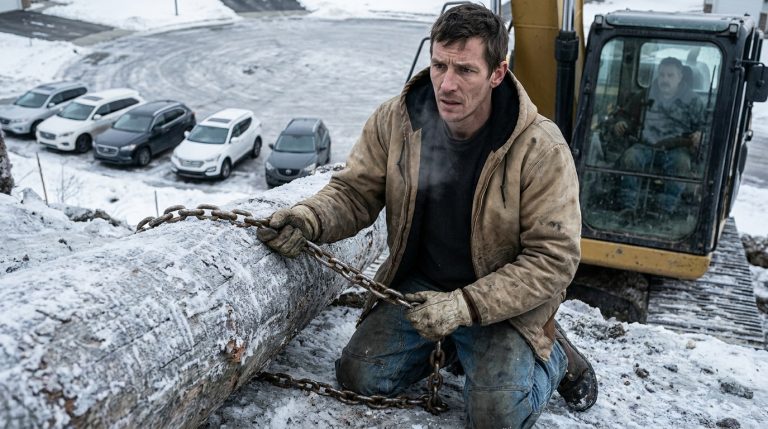
The Cold Copper Line: A Hardboiled Stand Against the Machinery of Suburban Power
CHAPTER 1: THE DARK CIRCUIT
The server array died at 03:00.
No alarm chime. No warning drop in line voltage. Just the sudden, unnatural silence of forty thousand dollars’ worth of silicon going cold in the Scottsdale dark.
I sat up. The air in the bedroom smelled faintly of cooling copper and dust. The standby LED on the wall panel was dead black.
My thumb went directly to the brass key-ring on the nightstand. Two halves of a sheared Master Lock sat beside it, heavy and cold against my skin. I didn’t reach for the light switch. I knew the circuit was dead.
I pulled on work boots, walked downstairs without a flashlight, and stepped into the humidity of the side yard.
The Generac enclosure door swung loose on its hinges, groaning against the desert wind.
The slab was bare. The six-hundred-pound steel frame had been unbolted, the heavy-gauge copper feed line snapped clean with bolt cutters. Raw wire ends bristled from the conduit like severed tendons.
I didn’t call the police from the porch. I knelt, picked up a single brass shaving left by the saw, and tracked the deep, freshly cut tire ruts across the dead Bermuda grass.
The tracks didn’t lead toward the main gate. They turned left, tearing straight through the manicured hedges toward the community clubhouse three blocks north.
Over the ridge of the golf course, floodlights blazed against the night sky. High-powered commercial halogens.
I followed the trail on foot, my boots crunching rhythmically against the gravel margin.
The flatbed trailer was idling behind the clubhouse kitchen. The custom royal-blue casing of my Generac unit sat bolted to its deck, vibrating violently as it sucked diesel from an auxiliary jug. Thick orange extension cords snaked out from its side panel, fed directly through a smashed basement window into the building’s main switchboard.
Inside, the lights were blinding. Strains of recorded brass music drifted through the double doors.
I pushed through the main entryway.
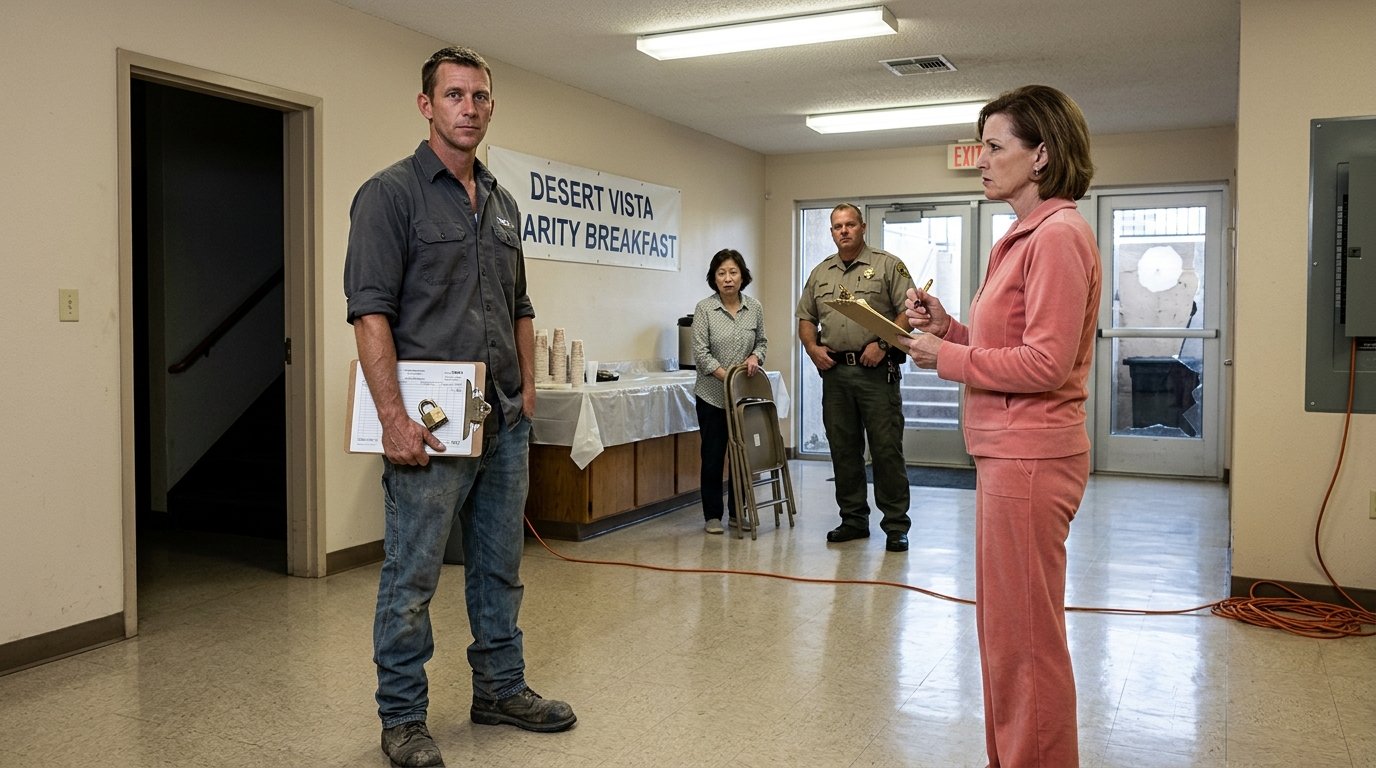
Patricia Williamson stood near the catering counter in a tailored salmon tracksuit, a plastic clipboard pinned under her arm. She was adjusting a banner that read DESERT VISTA CHARITY BREAKFAST.
“Lucas,” she said, her voice smooth, unhurried, perfectly modulated. She didn’t flinch. “You’re early. Registration doesn’t open until six.”
I didn’t look at the banner. I kept my eyes locked on her thumb, which was systematically flicking the latch of her gold pen.
“That’s my generator on the flatbed, Patricia.”
“It’s community infrastructure now,” she said smoothly, not taking her eyes off her clipboard. “The board exercised Section 4 emergency access. Circuit 4-A failed yesterday afternoon. We have two hundred civic leaders arriving in three hours.”
“Section 4 covers natural disasters,” I said, my voice dropping an octave, dead and level. “It doesn’t cover cutting a chain-link gate and trespassing on private property.”
“The bylaws grant executive discretion for regional representation events,” she replied, stepping forward until she stood inches from my chest. Her breath smelled of stale mints. “You’ll be reimbursed for the diesel, Lucas. Put a receipt in the HOA mailbox by Friday.”
“The lock was three-eighths hardened steel,” I said. “Who cut it?”
Patricia smiled, a tight, bloodless stretching of her lips. “Don’t be dramatic. We’re saving the neighborhood’s reputation. You should be thanking us for taking the initiative.”
Behind her, near the kitchen doorway, Margaret Chen stepped out holding a stack of folding chairs. Her hands were trembling.
“Lucas,” Margaret whispered, her face pale under the fluorescent tubes. “Patricia told the finance committee we rented a commercial unit from Mesa Power… She said the two thousand dollar voucher was cleared yesterday.”
I turned my head back to Patricia. Her pen clicked once. Twice.
“The police are already en route,” I said.
Patricia’s posture didn’t break, but her eyes narrowed into narrow slits of cold slate. “You wouldn’t dare embarrass this community over a piece of hardware.”
“It’s not hardware,” I said, rolling the sheared brass lock fragment in my pocket. “It’s a boundary.”
CHAPTER 2: THE PAPER WALL
The red light hit Patricia’s face in rhythmic, silent pulses, staining her pink tracksuit the color of raw rust.
She didn’t move. Her thumb remained hooked over the clip of her pen, but her jaw tightened until the tendons in her neck stood out like corded wire. Outside, the cruiser’s engine idle rattled the double-pane glass of the clubhouse doors.
“You have ten seconds to reconsider this, Lucas,” she said. Her voice dropped low enough that Margaret, still paralyzed three feet away with the folding chairs, had to strain to hear. “You live in this community. Your property values depend on the board’s standing. You file a frivolous report, and every architectural compliance record on your house goes under a microscope.”
“My house is built to code,” I said, rolling the brass padlock shard in my right pocket. “And the Generac isn’t an architectural violation. It’s a stolen asset.”
The glass door swung open. Cold desert air washed into the lobby, carrying the sharp, acrid bite of diesel exhaust from my engine idling on the flatbed outside.
Officer Morrison stepped in. His heavy duty belt creaked with every step, the leather worn smooth around the taser holster. He glanced at Margaret’s pale face, then at Patricia’s clipboard, before his eyes settled on me.
“Dispatch said we have an unauthorized removal of equipment,” Morrison said. He didn’t take out his notepad yet. He kept his right hand rested casually over his belt buckle. “Who owns the unit on the trailer?”
“I do,” I said. “Installed six months ago. Serial number LK-884-G. The mounting bolts were sheared off my concrete pad two hours ago.”
“It’s an administrative requisition,” Patricia interjected, her voice instantly snapping back to its polished, civic timbre. She held out the clipboard toward Morrison. “Officer, I am Patricia Williamson, President of the Desert Vista Homeowners Association. Under emergency charter provisions following the failure at Circuit 4-A Substation, the board authorized temporary auxiliary power draw for public safety and community continuity.”
Morrison didn’t take the clipboard. He looked past her, through the window, at the thick orange cables trailing from my generator through the basement window.
“Circuit 4-A is municipal infrastructure, ma’am,” Morrison said plainly. “APS handles city grid failures. HOA boards don’t have the legal standing to self-issue eminent domain over private personal property.”
He turned back to me. “Did you give permission, Mr. Kendrick?”
“No.”
“Did you receive written notice of an emergency easement?”
“No.”
Morrison finally unclipped a black ballpoint pen from his vest. “That makes it a civil boundary dispute turned into a criminal removal.” He looked at Patricia. “Ma’am, do you have a signed court order or an APS emergency work mandate?”
Patricia’s posture shifted. For a fraction of a second, her eyes flicked past Morrison’s shoulder toward the dark hallway leading to the basement stairs—a sharp, involuntary twitch of her head before she caught herself.
“The board approved a two-thousand-dollar allocation yesterday,” she said, her tone hardening. “The paperwork is filed under the Desert Vista Transit Trust account. We acted in good faith to protect community assets.”
I caught the phrase. Desert Vista Transit Trust. It wasn’t an HOA account name I’d ever seen on the annual budget disclosures.
I stepped closer to the basement door margin. On the wall conduit feeding into the lower level, a bright yellow plastic seal hung limply. It wasn’t an APS meter lock. It was a commercial security tag, clipped clean at the latch, bearing a stamped serial number matching the work orders for the clubhouse HVAC renovation six months prior.
“Margaret,” I said, without looking away from Patricia. “Did the finance committee authorize a transfer to a transit trust?”
Margaret set the chairs down with a sharp metal clatter. “We… we approved a equipment rental voucher for Mesa Power. There was no trust mentioned in the executive summary.”
Patricia turned on Margaret with a look that could cut glass. “Margaret, you are not authorized to discuss committee accounting with non-board members during an active operational event.”
“She doesn’t have to,” I said. I looked Morrison straight in the eye. “I want the removal documented as grand larceny. The unit value exceeds five thousand dollars, the gate lock was cut with hardened shears, and it was hauled across property lines.”
Morrison nodded slowly. He pulled a yellow carbon-copy form from his pocket binder. “I’ll need to inspect the installation site at your residence first, Mr. Kendrick. Then we take statements.” He looked at Patricia. “Ma’am, shut that unit down. If those cables are still drawing load in twenty minutes, I’m calling a municipal tow to impound the trailer as evidence.”
Patricia didn’t argue. She stood perfectly still under the white light as Morrison turned and walked back toward his cruiser.
As I turned to follow him out, Patricia leaned in slightly. The smell of mint was gone, replaced by the bitter, heat-struck tang of pure adrenaline.
“You think you’re protecting your perimeter, Lucas,” she whispered, her voice a flat, dangerous rasp. “You have no idea what’s running off that feed line downstairs. Turn this into a war, and you won’t just lose your generator. You’ll lose the deed to your dirt.”
I didn’t answer. I reached into my pocket, pulled out the cold, jagged half of the Master Lock they’d cut off my gate, and set it squarely on top of her plastic clipboard.
“Shut it down, Patricia,” I said. “Before I go downstairs and pull the main breaker myself.”
CHAPTER 3: LENSES IN THE DUST
The heavy thrum of the diesel engine didn’t fade gently; it sputtered twice, choked on a pocket of air, and died with a metallic clatter that echoed off the stucco walls of the clubhouse.
Silence slammed down instantly, heavy and stifling in the pre-dawn heat.
Officer Morrison didn’t look back. He clicked his heavy pen back into his vest pocket and kept walking toward the driver’s door of his cruiser. “I’ll follow you back to your lot, Mr. Kendrick. We’ll take photos of the mounting pad before I draft the formal affidavit.”
“Give me ten minutes,” I said. My boots crunched over the gravel shoulder as I stepped around the rear bumper of his idling police car. “I need to pulls logs off the perimeter sensor before the morning heat washes out the thermal contrast.”
“Ten minutes,” Morrison agreed, pulling his door open. The radio on his shoulder burst into a burst of low-frequency static before settling into a flat hum.
I walked past the dark, silent flatbed trailer. Inside the clubhouse, through the tinted glass, Patricia remained motionless under the fluorescent tubes, her hands flat on the counter beside the clipboard and the severed lock. Margaret was gone from the doorway.
The walk back across the fairway took six minutes. The grass was wet with heavy morning dew, soaking through the leather toes of my work boots.
At my side yard, the steel gate hung broken, its latch plate twisted where the heavy hydraulic cutters had pinched the frame. I didn’t push through it right away. I stepped off the concrete pavers, kneeling in the crushed dirt behind the oleander hedge where the estate’s original utility box sat half-buried in the soil.
Mounted inside the dense foliage, six inches off the ground, was a solar-assisted infrared trail camera housed in a matte-black weatherproof casing. The lens was caked in dried desert dust and dead gnat wings.
I popped the bottom latch with my fingernail. The rubber seal cracked with a faint suction sound. I pulled the MicroSD card from its spring slot, holding it by its plastic edges, and slid it into the rubberized reader case in my pocket.
My hands were steady, but the skin across my knuckles felt tight, scraped raw from where I’d checked the mounting studs on the pad three hours ago.
Inside my home office, the primary server rack was still completely dead. The room smelled of hot circuit boards slowly cooling in the airless dark. I flipped open my field laptop—running on its internal four-hour battery—and jammed the card reader into the side USB port.
The directory mounted instantly: DCIM/100MEDIA.
I didn’t open the video files first. I ran a script to sort the raw frame captures by timestamp, starting from 01:30 A.M.
At 01:41 A.M., the lens registered a spike in thermal ambient: 88 degrees to 102 degrees across the lower third of the frame.
I clicked the first video container.
The screen flickered, displaying the high-contrast monochrome infrared view of my driveway. At 01:47 A.M., a heavy dark silhouette backed into the frame. It wasn’t a standard residential pickup. The long bed had dual rear wheels, a commercial hitches, and a faint stenciled logo on the driver’s side door.
The resolution was too low to read the lettering under the IR illuminator, but the shape was unmistakable: a municipal utility truck.
Two men stepped out from the cab. Both wore heavy canvas work coats despite the eighty-degree night air. Neither of them hesitated. One carried a pair of long-handled bolt cutters; the other carried a battery-powered impact driver. They moved with the flat, mechanical efficiency of a crew that had worked the same physical setup a dozen times before.
They didn’t break my house lights. They didn’t look toward the windows. They went straight to the gate latch, snuffed the Master Lock in two seconds, and backed the trailer into the side yard.
Then a second vehicle pulled into the frame, its headlights cutting sharp white bars across the monochrome recording.
A dark sedan. The driver’s side door swung open, and Patricia Williamson stepped out onto my gravel driveway.
She didn’t stay in the car. She walked directly up to the side of the trailer, a manila folder tucked under her arm, gesturing toward the mounting bolts with her gold pen.
I paused the frame at 01:51:04 A.M.
In her left hand, partially obscured by her sleeve, she wasn’t holding an HOA clipboard. She was holding a heavy paper packet stamped with a blue corner seal—a standard municipal filing header. Visible across the top line in sharp black font were three printed words:
FORM 1090-B LEDGER — SUBSTATION DRAW
Directly beneath it was a handwritten routing number penciled in heavy graphite: DVTT-C4A.
My thumb hovered over the touchpad. The laptop fan whined softly in the silent office, straining against the battery drain.
This wasn’t a panicked, spur-of-the-moment decision to save a neighborhood charity breakfast. The utility truck had arrived before the clubhouse generator was ever shut down. The flatbed trailer had been staged in my driveway with a commercial winch already bolted to its tongue.
Downstairs, a heavy knock rattled the front door. Three sharp, measured raps.
I ejected the card, jammed it into my pocket alongside the brass padlock fragment, and pulled up the laptop screen just as Officer Morrison’s voice called out from the porch.
“Mr. Kendrick? The tow truck for the flatbed is staging at the main entrance. We need those pad photos now.”
I closed the laptop, my fingers leaving a faint smear of oil on the matte lid. “Coming,” I called back.
The step was made. The video wasn’t just proof of theft; it was proof of a pre-meditated strike. And whatever Patricia was trying to cover up in that basement, she’d used a city-marked vehicle to drag my property out of my yard to do it.
CHAPTER 4: THE BOARDROOM ASSAULT
The floorboards under my boots didn’t creak, but the porch door groaned as I pulled it wide. Officer Morrison stood on the concrete step, his right hand hooked casually over his utility belt.
“The tow rig’s backed up to the flatbed,” Morrison said. “They’re winching your Generac clear now. I need your signature on the custody sheet before we move it into the municipal impound lot.”
“It’s not going to impound,” I said, sliding the USB drive into my breast pocket alongside the cold brass lock shard. “It’s going back on the pad in my yard. And you’re coming with me to the emergency board hearing at six.”
Morrison hesitated, his brow furrowing under the brim of his cap. “Mr. Kendrick, police presence at an HOA administrative session—”
“Is required when the suspect is using municipal infrastructure documents to justify grand larceny,” I cut in, my voice low and flat. I held up my field phone, the high-contrast frame of Patricia’s IR capture frozen on the small screen. The dark dually truck with its stenciled door logo was sharp enough to cut glass. “That’s a city public works chassis backing into my driveway at 01:47 A.M. She didn’t call a commercial rental house. She called a city contractor.”
Morrison leaned in, his eyes fixing on the timestamp, then on the paper packet stamped with FORM 1090-B LEDGER in Patricia’s left hand. The air between us grew cold.
“Where’s the hearing?” he asked.
“Main hall,” I said. “Ten minutes.”
Shadows stretched across the asphalt as the desert sun crested the eastern ridge, burning away the morning haze. Seven minutes later, the double doors of the clubhouse main hall swung open under the force of my hand.
The room smelled of stale coffee, powdered donuts, and ozone. Fifty residents sat in rows of beige folding chairs, their voices a muffled drone that killed instantly the second my boots struck the linoleum aisle.
At the front of the room, behind a long oak dais, sat Patricia Williamson. She had traded her salmon tracksuit for a pressed charcoal blazer, though her fingers still drummed a erratic, silent rhythm against the edge of her wooden gavel. To her left, Margaret Chen sat slumped in her chair, her hands clasped tightly in her lap, her eyes glued to a single manila folder on the table.
“This assembly is currently closed to public comment until the treasury report is read,” Patricia announced, her voice booming through the overhead speaker array. She didn’t look at me; she looked directly at Officer Morrison walking two paces behind my left shoulder. “Lucas, if you are here to disrupt official board proceedings regarding community maintenance—”
“I’m not here to comment,” I said, stopping six feet from the edge of the dais. The heavy thud of my boots echoed against the acoustic tile ceiling. “I’m here to submit evidence into the record.”
I reached into my coat, pulled out a portable HDMI bridge, and plugged it directly into the wall-mounted projector port beside the podium.
Patricia’s hand shot out toward the gavel. “You do not have authorization to access the media system—”
“Section 12 of the covenants,” Margaret interrupted suddenly. Her voice was thin, trembling, but it carried across the silent room like a snapped wire. She didn’t look at Patricia. She looked straight at the crowd. “Any homeowner facing architectural or civil enforcement has the absolute right to present physical records before the board prior to an executive vote.”
Patricia turned on Margaret, her eyes turning to chips of black flint. “Margaret, sit down.”
“She stays,” I said, and hit the key on my laptop deck.
The overhead projector hummed to life, throwing a massive, fifteen-foot monochrome light box onto the white wall behind the dais.
The room collective exhaled a sharp, jagged breath.
The IR video played in dead silence. The city-marked dually backing onto my grass. The two men in heavy coats using hydraulic bolt cutters on my hardened steel gate latch. And then, Patricia stepping out of her dark sedan, holding the manila folder under the glaring white beam of her pen light.
I zoomed the frame 200 percent.
The header burned into the wall in massive, block lettering:
FORM 1090-B LEDGER — SUBSTATION DRAW
ROUTING: DVTT-C4A
“That’s not a rental voucher for Mesa Power,” I said, pointing a finger at the blue seal on the projected document. “That’s an unauthorized high-voltage draw permit from the Circuit 4-A Substation. My generator wasn’t stolen to power a charity breakfast, Patricia. It was brought in to mask the amperage drop when you hooked high-density array gear into the clubhouse basement grid.”
Gasps rippled through the rows of residents. Two senior board members at the far end of the table sat up, their faces draining of color as they stared at the blue seal on the wall.
Patricia didn’t flinch. Slowly, deliberately, she picked up her wooden gavel and set it down precisely two inches to the left of her blotter. Her thumb rubbed a raw, red blister on her index finger—the only sign of friction on an otherwise frozen mask.
“You’re making baseless allegations based on a misread utility code, Lucas,” she said, her tone smooth, icy, and entirely unbothered. “The Desert Vista Transit Trust handles regional infrastructure grants. The draw was cleared by the municipal liaison.”
“Then you won’t mind if Officer Morrison takes the basement keys right now,” I said.
I reached into my pocket, pulled out the brass padlock fragment from my gate, and dropped it onto the oak dais. It struck the polished wood with a dull, heavy clatter that rang through the quiet hall.
“Midpoint’s over, Patricia,” I said. “Unlock the door.”
CHAPTER 5: THE FORENSIC AUDIT
The silence in the main hall didn’t shatter; it curdled.
Patricia looked down at the brass lock fragment sitting on the oak dais. Her fingers hovered an inch above the polished wood, refusing to touch the metal. Across the table, two board members pushed their chairs back simultaneously, the rubber feet dragging against the linoleum with a shrill screech.
“Officer Morrison,” I said, my hand staying flat on the podium edge. “The basement door.”
Morrison didn’t ask for a warrant. He stepped around the dais, his boot heels striking a steady cadence as he moved past Patricia. He reached down, unclipped a heavy brass key-ring from her jacket pocket, and walked toward the reinforced door beside the utility hallway.
Patricia’s chin lifted. “You’re exceeding your scope, Morrison. That door accesses high-voltage municipal distribution. You enter without a certified APS technician, and you’re violating state utility safety statutes.”
“I’m investigating a grand larceny line trace, ma’am,” Morrison said calmly.
The lock cylinder turned with a heavy, dry snap.
Cold, stale air rushed up from the stairwell. It didn’t smell like dusty holiday decorations or spare folding chairs. It smelled of hot tin, ozone, and the distinct, sweet tang of frying insulation. Beneath the air came a low, rhythmic whine—not a single motor, but fifty small high-speed cooling impellers spinning at top RPM.
I followed Morrison down the concrete steps, my hand sliding along the cold iron handrail. Margaret came behind us, her breathing shallow, her heels clicking rapidly on the unpainted treads.
At the foot of the stairs, behind a partition built of unpainted drywall, sat four steel server racks.
They weren’t housing HOA files or irrigation scheduling computers. They were industrial-grade processing chassis, stacked tight, their intake LEDs flickering in erratic, green patterns. Thick, three-phase copper cables snaked across the bare concrete floor, bypassed the main meter box, and tapped directly into the heavy bus bars of the building’s primary breaker panel.
“Crypto rigs,” Margaret whispered, her hand going to her mouth. “She told us this room was locked for city emergency storage…”
“Look at the tap,” I said, stepping closer to the junction box.
I pointed my flash pen at the bus bars. A custom copper bus extension had been bolted straight into the line side of the meter—bypassing the utility counter entirely. But the cables feeding the rigs weren’t the only lines connected.
Two heavy black conduits ran out from the back of the breaker enclosure, passing straight through the rear concrete foundation wall toward the street.
“That’s Layer 1,” I said, tracing the conduit path with my finger. “The servers were the excuse. If anyone noticed an amperage draw, she could point to a high-density data server for community network management.”
“What are those conduits?” Morrison asked, shining his heavy duty torch into the wall gap.
“That’s not server power,” I said, kneeling in the dust. I scraped away a layer of fresh plaster around the pipe entry. “Those are commercial feed lines running out toward the municipal utility vault on the curb. She wasn’t just hiding a mining array down here. She was bridging the community’s private secondary line back into the main grid.”
I reached into the gap, pulling clear a laminated wire tag hanging from the primary conduit junction.
The black text was printed on grease-resistant tape:
PROPERTY OF DESERT VISTA TRANSIT TRUST
SUBSTATION FEED: CIRCUIT 4-A
LEDGER LINK: FORM 1090-B AUTHORIZED
“She wasn’t stealing electricity for herself,” I said, standing up and wiping grey concrete powder off my palms onto my jeans. “She was running a illegal bypass loop. Siphoning unmetered power out of Circuit 4-A, running it through our residential transformer to clean the paper trail, and billing the surge back to the city under the transit trust’s infrastructure maintenance fund.”
Margaret stepped forward, her face entirely devoid of color. “The two thousand dollar vouchers… every month for two years… she wasn’t paying Mesa Power for rentals. She was paying the kickbacks to the municipal crew who set up the tap.”
From the top of the stairs, a door slammed shut.
The heavy iron deadbolt clicked into place with a sharp, final thwack.
The overhead fluorescent tubes flickered twice and died. Darkness dropped like an iron sheet, illuminated only by the frantic green flickering of the server LEDs and the narrow beam of Morrison’s flashlight.
From behind the heavy steel door, Patricia’s voice came down the stairwell, muffled through the reinforced frame, flat and completely devoid of panic.
“The board meeting is adjourned, Lucas,” she said. “The city maintenance crew is already at the curb junction. By six-thirty, Circuit 4-A will be isolated, the conduit will be pulled, and your generator will be listed as the sole power source responsible for the line burn.”
Morrison slammed his palm against the heavy steel panel. “Patricia! Open this door!”
“You’re inside a high-voltage utility space during an active grid failure, Officer,” her voice returned, distant and cold. “I’m securing the site for public safety.”
I didn’t waste breath shouting. I turned my flashlight back onto the server racks, my eyes locking onto the heavy iron pry bar resting on the floor beside the unbolted breaker panel.
“She’s burning the line from the curb vault,” I told Morrison, my voice dropping to a low, steady murmur. “We have four minutes before the crew pulls the jumper wires and sets the evidence on fire.”
I grabbed the iron bar. The cold metal bit into my palm, but I didn’t let go.
CHAPTER 6: CHECKMATE ON CONCRETE
The iron pry bar was cold, raw, and weighted heavy in my grip.
“Morrison,” I said, my voice dead level in the dark. “Step back from the hinge side.”
I jammed the flattened wedge end of the bar directly between the reinforced steel door jamb and the striker plate. Metal screamed against metal. Concrete dust rained down on my shoulders as I threw my entire body weight onto the leverage arm.
The frame didn’t yield easily. The iron groaned, flexing under two hundred pounds of leverage, until the internal latch pin sheared with a sharp, crackling pop that sounded like a rifle shot in the enclosed stairwell.
The door swung wide.
Morning sunlight flooded down the stairs, blindingly white. Morrison took the steps three at a time, drawing his sidearm as he cleared the threshold into the main lobby. Margaret and I were right behind him.
Patricia wasn’t at the podium. She was already at the glass exit doors, her hand on the crash bar, gesturing frantically to two men in orange municipal vests standing beside a city dually idling at the curb. One of them held a pair of heavy insulated wire shears, stepping toward the curb vault where the underground feeds connected to Circuit 4-A Substation.
“Stay where you are!” Morrison’s voice boomed across the lobby, cutting through the low idle of the diesel engine outside.
The worker with the wire shears froze, his hand hovering over the open utility vault lid. Patricia turned slowly, her face pale, her jaw clamped so tight her cheekbones stood out under her skin like dry porcelain.
“Officer,” Patricia said, her voice dropping into that smooth, practiced tone, though her thumb twitched violently against the side of her blazer. “You are interfering with an emergency utility isolation authorized by the board.”
“The board never authorized a single wire,” Margaret said. She walked past me, stepping onto the outdoor concrete apron with a thick manila folder held against her chest. Her hands weren’t shaking anymore. “I just pulled the cross-reference logs from the ledger room. The two thousand dollar monthly vouchers were drawn from the general assessment fund, but they weren’t paid to Mesa Power.”
She threw the file onto the hood of Patricia’s sedan.
“They were deposited directly into an offshore account registered to the Desert Vista Transit Trust,” Margaret continued, her voice gaining strength with every word. “An account where you are listed as the sole managing trustee. You weren’t renting backup generators, Patricia. You were using HOA dues to pay off a municipal contact to let you tap Circuit 4-A Substation, routing unmetered commercial power through our community grid to fund that processing array downstairs.”
Patricia looked at the papers scattered across her hood. She didn’t weep, and she didn’t panic. She looked at me, her eyes narrowing to thin slits of cold slate.
“You think this saves you, Lucas?” she whispered, her voice low enough that only Morrison and I could hear. “You think destroying this board makes your home safer? You’re an island in this desert. You proved you don’t belong here.”
“I belong to my property,” I said. “And my property stays behind my line.”
Morrison stepped forward, the heavy black cuffs unclipped from his belt. “Patricia Williamson, you are under arrest for grand larceny, municipal utility tampering, and fraud.”
She didn’t fight as Morrison pulled her hands behind her back. The steel cuffs clicked shut with two sharp, mechanical notches. The worker by the vault dropped his shears into the dirt, stepping away with his hands raised high before Morrison even turned his head.
Four hours later, the sun sat high and hot over Scottsdale, turning the asphalt into a shimmering black mirror.
The flatbed trailer was gone from the clubhouse lot. The municipal dually had been towed under police escort, its tools and wire spools tagged as state evidence.
In my side yard, the air smelled of wet concrete and fresh rust-inhibitor spray.
The Generac unit sat squarely back on its pad, bolted down with four brand-new three-quarter-inch anchor studs sunk deep into the stone. The heavy copper lines were spliced, sealed, and encased in galvanized steel conduit that ran flush against the house wall.
Margaret stood by the open gate, holding a brand-new Master Lock still sealed in its plastic blister pack.
“The board met at noon,” she said, her voice quiet against the dry desert wind. “We voted to dissolve the emergency transit trust accounts. Every homeowner is getting a credit on their quarterly assessment once the forensic audit clears.”
“And Patricia?” I asked, tightening the final conduit clamp with a socket wrench until the bolt clicked home.
“Her attorney called twenty minutes ago,” Margaret said, setting the new lock on the concrete wall beside me. “She’s taking a plea on the state utility fraud charges to avoid federal wire charges. She won’t be returning to Desert Vista.”
I set the socket wrench down on the concrete pad. The metal was warm from the sun.
I took the new lock from the blister pack, slid the hardened shackle through the steel gate latch, and snapped it shut. The click was solid, heavy, and absolute.
“It’s locked, Lucas,” Margaret said softly.
“Yeah,” I said, picking up my tools and stepping back onto the stone path. “It is.”
The sun began its long drop toward the western mountains, throwing long, sharp shadows across the yard. The house was quiet. In the office, the faint, steady hum of the servers returned as the primary line re-engaged, running smooth, cold, and clean.