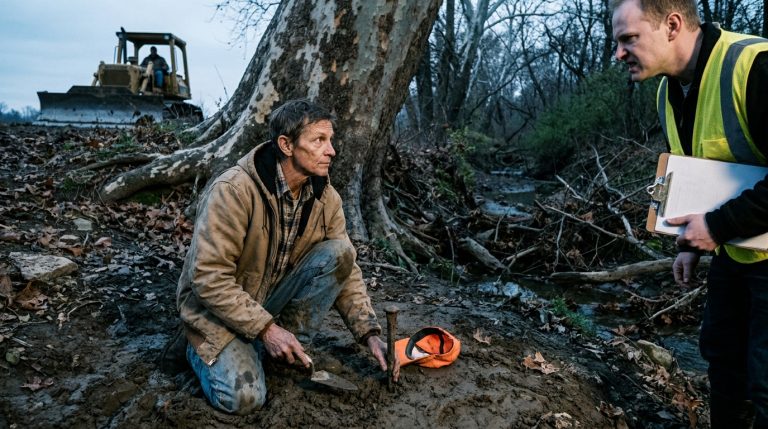
A Cold Gravity: The Unbending Law of Concrete, Paperwork, and the Winter Line
CHAPTER 1: THE SLOPES EDGE
The orange violation notice did not flap in the wind. It was taped flat against the rusted iron latch of the gate, heavy with ice, its black lettering bleeding slowly into the damp pulp of the paper. It cited Code 44B-Amended—an aesthetic ordinance designed for manicured shrubs, not the raw, shifting mass of a northern slope.
Alex adjusted his grip on the cast-iron thermos. The metal was cold enough to stick to his bare thumb, but the heat inside smelled of chicory and stale grounds. Down the hill, five pristine luxury vehicles sat nose-to-tail in the paved cul-de-sac like a row of polished teeth. Above them, three hundred tons of frozen clay and packed drift hung on a hairline trigger, held in place by a series of interlocking hemlock timbers Alex’s father had driven into the earth thirty years ago.
“The retaining structure is unpermitted,” Gary said, his voice flat, dry as the municipal binder he held against his chest. He was a small man who lived in the narrow space between sub-sections and filing dates. He didn’t look at the slope. He didn’t look at the way the hemlock had bowed three inches over the winter, its grain groaning under the weight of the frost. “And the HOA president has filed a formal obstruction complaint. It has to come down.”
“It’s holding the hill, Gary,” Alex said. He didn’t raise his voice. In the dusty gray of the morning, loud sounds only seemed to waste the heat in a man’s lungs. “If the hemlock comes out, the hill goes down. That’s not a policy. That’s gravity.”
From the edge of the asphalt below, Clare Wells began her ascent. She didn’t climb; she picked her way across the frozen mud with the calculated precision of someone who believed the earth could be managed by committee. Her coat was the color of unblemished bone. In her hand, she carried a brass-tipped surveyor’s rod—an antique she’d pulled from the HOA archives to prove her point.
“It’s an eyesore, Alex,” she called up, her breath rising in short, sharp plumes. “The board voted on Tuesday. We have potential buyers coming to look at the Miller estate next week. We cannot have twenty yards of rotting timber and dirty snow serving as the gateway to the cul-de-sac.”
Alex looked down at his boots. At the toe of his left leather work boot, one of the original iron surveyor stakes—the ones supposedly set during the Kelso Survey of ’94—was missing its copper cap. In its place was a fresh, raw gouge in the dirt, as if someone had recently tried to pry the iron out of the permafrost with a crowbar. It was a discrepancy of less than two inches, but on a slope this steep, two inches was the difference between a secure anchor and a slide.
“You’ve been digging around the boundary, Clare?” Alex asked softly.
Clare stopped ten feet down, her eyes narrowing as she adjusted her grip on the brass rod. “The association had the easement verified, if that’s what you mean. We have every right to enforce the visual continuity of this neighborhood. Friday, Alex. Or the county marshals will handle the abatement.”
She turned, her bone-white coat disappearing back toward the gleaming garage doors below. Alex took a slow sip from the thermos, the bitter warmth hitting the back of his throat. He looked back at the fresh gouge in the frozen earth near the stake. The game wasn’t about the snow. It was about the dirt beneath it.
CHAPTER 2: THE COLD MACHINERY
The bone-white hem of Clare’s coat was still visible, dragging through the slush at the bend of the cul-de-sac, when the heavy flatbed rounded the corner. It groaned under the weight of Sal Marino’s twelve-ton excavator. The yellow paint on the machine was scarred down to the dull gray primer, and the bucket was caked in dried, orange-brown river silt from a dozen forgotten drainage ditch contracts.
Alex didn’t watch Clare go. He kept his eyes on the fresh, triangular gouge where the copper-capped surveyor stake should have been. He reached into the deep, stiff canvas pocket of his work coat and pulled out a grease-stained, triple-folded blueprint. It was a copy of the original plot diagram from The Kelso Survey of ’94, its blue lines faded to the color of skim milk. The paper was stiff with frost, threatening to crack along the creases as he flattened it against the rusted hood of his utility box.
Sal cut the flatbed’s air brakes with a loud, violent hiss that startled a crow from the bare branches of a nearby maple. He hopped down from the cab, his heavy leather boots hitting the frozen gravel with a flat thud. He didn’t offer a hand. He just pulled a greasy rag from his pocket, wiped his nose, and looked up at the slope.
“The ground is breathing, Alex,” Sal said, his voice like gravel turning in a mixer. He walked over to the edge of the hemlock wall and kicked the lowest tier of timber. The wood didn’t ring; it gave a wet, hollow thud. “That ain’t just snow. The clay behind these logs has been holding water since the November rains. It’s a sponge. You pull these bottom keys, and the whole shelf is going to drop like a wet sack of feed.”
“The city wants it done by Friday,” Alex said, pointing a finger toward the orange paper taped to the gate. “Under Code 44B-Amended. They’re calling it an unpermitted nuisance.”
“Gary’s an idiot who doesn’t know the difference between sand and silt,” Sal grunted, spitting a dark stream of tobacco juice onto the frozen white crust near the missing stake. “But if the state says move, we move. I’ll get the bucket lined up. We’ll start from the top tier and shave the weight off before we touch the hemlock anchors.”
Sal climbed back onto the excavator’s tracks, the cold steel creaking under his weight. The engine roared to life, coughing a thick plume of black, unburnt fuel into the freezing air. The smell of hot hydraulic fluid and cold grease immediately cut through the clean scent of the pine needles.
But as Sal swung the boom around, intending to drop the bucket to clear a small patch of frozen scrub, there was a sharp, high-pitched metallic snap. The bucket didn’t drop; it swung loose, dangling from the arm like a broken wrist. The cold had seized the primary hydraulic coupling pin, shearing the rusted locking bolt clean off.
“Damn it,” Sal shouted over the rumble of the engine, shutting it down. The sudden silence that followed was heavy, filled only with the ticking of the cooling manifold. “The pin’s jammed. It’s seized in the sleeve.”
Alex walked down the slope to the machine. He climbed the greasy track and looked at the coupler. The steel pin was wedged at a brutal angle, the fracture line bright and silver against the surrounding rust.
“We don’t have time to wait for a mobile welder, Sal,” Alex said, his hand tracing the cold, rough edge of the broken steel. “If we don’t start clearing the top shelf today, Clare’s going to have the city marshal up here with an injunction before the first shovel hits the dirt.”
“We’ll have to rig a manual sling,” Sal said, climbing down to rummage through the rusted metal chest bolted to his flatbed. He emerged with a heavy, grade-80 transport chain, each link thick as a man’s wrist and coated in a greasy film of oil. “We’ll wrap the top hemlock anchor and use the boom’s sheer weight to drag it back, rather than digging. But you’ll have to set the hook yourself, Alex. I can’t see the base of that timber from the cab.”
Alex took the heavy end of the chain, the iron instantly leaching the remaining warmth from his work gloves. The links clinked with a heavy, dead sound as he dragged them up the steep, slippery incline. Below, the cul-de-sac remained silent, but he could feel the weight of five hundred eyes behind the curtained windows of the large, identical houses. They were waiting for the first slide.
CHAPTER 3: THE LEDGER OF FRICTION
Alex drove the edge of his boot heel into the icy crust, carving a temporary wedge in the dirt. He hauled the remaining six feet of the heavy iron chain upward, his breath coming in dry, shallow gasps that burned his throat. Five feet above him, the massive hemlock timber—the deadman anchor that held the entire upper tier of the snow wall—sat buried in the gray hillside like an old rib bone.
Below, Sal’s face was a dark knot of concentration through the dirty glass of the excavator’s cab. He kept his hand resting on the hydraulic lever, ready to drop the boom if the slope decided to slide while Alex was still pinned against the face. There was no engine noise now, only the whistle of the wind through the bare maple branches and the distant, rhythmic hum of a snowblower three streets over.
Alex reached the junction where the vertical hemlock pile met the horizontal brace. He dropped to one knee, the damp cold of the clay immediately soaking through the double-layered denim of his work pants. To secure the manual sling, he had to thread the greasy chain behind the main timber joint, a space barely wide enough for his gloved hand. He began clearing the packed, gritty ice from the pocket behind the beam with his small steel hand-shovel.
The blade didn’t hit wood. It struck something small, round, and metallic with a dull, hollow clink.
Alex paused, his fingers frozen against the shovel handle. He reached into the cleared cavity, his knuckles scraping against the rough, ice-crusted bark of the hemlock. His fingers closed around a cold cylinder. He pulled it free, wiping away a smear of gray silt and rotting pine needles. It was a weathered galvanized metal canister, about the size of a flare cartridge, sealed on both ends with dried plumber’s wax.
On the side of the tin, barely legible through the pitting rust, was a stamped brass label that had been riveted directly into the metal: The Moraine Ledger – Volume III (Soil & Slope Stability Data, 1982).
He didn’t open it. The wax seal was old, cracked in places but still intact, holding whatever was inside dry against the winter moisture. He slipped the heavy canister into the deep internal pocket of his canvas coat, the cold metal pressing hard against his ribs. The weight of it felt different than the chain—less like iron, more like an anchor of a completely different sort.
“Alex!” Sal’s voice boomed up from the flatbed, muffled by the rising wind. “You got that sling wrapped? The temperature’s creeping up to thirty-two. If this crust softens, we’re done.”
Alex shoved his hand back into the pocket behind the timber, feeding the heavy transport chain through the gap. The iron links scraped against the wood, shedding flakes of decayed bark and frozen mud. He looped the hook over the standing line, locking it into place with a heavy click that echoed across the slope.
“She’s hooked!” Alex shouted back, checking the angle of the chain. “Pull it tight, Sal. Slowly.”
The diesel engine roared back to life, its black exhaust curling around the boom as Sal raised the arm. The chain lifted from the mud, its links snapping straight one by one with a sequence of sharp, metallic cracks. The hemlock anchor groaned, the sound deep and structural, like a ship’s hull taking on water. A small cascade of loose gray pebbles and frozen clay detached from behind the timber, tumbling down the slope and bouncing off the roof of Clare’s immaculate garage below.
Alex backed down the slope, his eyes fixed on the joint. He didn’t look back to see if Clare was watching from her window, but he knew she was. The friction of the metal, the earth, and the paper trail was beginning to generate its own heat, and the cold was no longer enough to keep it from burning.
CHAPTER 4: THE REMOVAL MANDATE
The door of the county truck clicked open, and a man in a safety vest stepped out. He didn’t look like Gary; he had the thicker, weather-beaten neck of an field engineer who spent his life measuring the slow, stubborn shifts of the earth. In his hand was a heavy, weather-proof folder, and behind him, Clare Wells was already marching up the asphalt lane, her designer notebook clutched to her ribs like a weapon.
Alex wiped a smear of cold grease from his palm onto his canvas pants, his hand unconsciously pressing against the hard, cold cylinder of the Moraine Ledger buried in his inner pocket. The smell of the freshly disturbed clay was thick now—sharp, sulfurous, and rotten. It was the exact smell of the deep till his father had warned him about thirty years ago when they drove the first hemlock stakes into the slope. “The top looks like stone, Alex,” his father had said, wiping sweat from his forehead in the October chill. “But beneath the frost, it’s nothing but soup. If anyone ever tells you to clear the easement, you tell them they’re digging their own grave.”
“Mr. Vance,” the engineer said, his voice flat as he stopped at the gate. He ignored the groaning hemlock anchor still suspended by Sal’s heavy iron chain. “I’m Miller, County Surveyor. We’ve received a filed amendment to the neighborhood plat map. According to the board’s submission under Code 44B-Amended, this entire retaining slope has been reclassified as common HOA easement.”
Alex looked from Miller to Clare. Her mouth was set in a thin, triumphant line, her gloved fingers tapping a steady rhythm against her notebook.
“An easement,” Alex repeated, his voice quiet. “This slope has been private deeded land since the township was surveyed in ’94.”
“Not according to the Kelso Survey addendum filed three weeks ago,” Clare interjected, her voice sharp and transactional. She stepped closer, her expensive boots leaving deep, clean impressions in the wet slush. “The association commissioned a boundary review. The drainage and retaining structures on this hill are legally common property, which means you are in active violation of community standards by maintaining an unapproved, hazardous timber wall on association land.”
Miller opened the folder, holding out a single, freshly printed plot map. The blue lines looked authentic, but Alex’s eyes immediately went to the bottom corner. The signature block for the original Kelso Survey was there, but the red ink seal of the county registrar had a slight, uneven smudge on its left border—the kind of physical discrepancy that only occurred when a digital copy was manually overlaid on old, scanned vellum.
“The board has already approved the design for a limestone block wall to replace this monstrosity,” Clare said, her fingers tracing the edge of her notebook. “Since the timber wall is on common easement now, the removal order is immediate. If your contractor doesn’t pull those secondary tiers today, the county will execute the clearance and bill your property lien for the cost.”
Alex didn’t argue. He looked at the map, then down at the missing surveyor stake at his feet. The decoy was clever. By fabricating a boundary shift through a forged easement amendment, Clare wasn’t just trying to get rid of the ugly timbers—she was trying to legally force him to pay for her $50,000 limestone aesthetic upgrade by claiming he had encroached on common land.
“The secondary tiers are holding thirty thousand cubic yards of compacted shelf, Miller,” Alex said, turning his gaze back to the surveyor. “You pull those, and you’re stripping the only friction layer left on this slope.”
“The order is signed, Mr. Vance,” Miller said, his eyes shifting away from the groaning timber to the paperwork in his hand. He was a man who followed the seal, even if the ink was still fresh. “We have to clear the vertical easement line. We’ll start with the middle anchors.”
Behind them, Sal Marino let out a low, spitting curse from the cab of the excavator. He didn’t turn off the engine. The machine rumbled, a steady, vibrating heartbeat that traveled up through the soles of Alex’s boots, waiting for the first heavy link of the chain to snap.
CHAPTER 5: THE FINAL CUT
Alex took three deliberate steps back, his boots finding purchase on a narrow lip of frozen shale. He didn’t look at Clare, whose fingers remained locked around her designer notebook, nor did he look at Miller, who had retreated to the dry asphalt of the cul-de-sac. His focus was entirely on the link where the transport chain choked the primary hemlock deadman.
“Sal!” Alex called out, raising a single, grease-darkened glove. “Take the slack out. Keep it level.”
The diesel engine roared, a thick plume of black smoke coughing upward and instantly tearing apart in the biting wind. The excavator’s yellow boom rose three inches. The heavy iron links of the chain straightened with a sequence of dry, metallic snaps that sounded like pistol shots in the frozen air. The primary hemlock anchor—a timber sixteen inches square, seasoned by thirty years of mountain frost—groaned. It was a deep, wet sound of splintering fibers, the agony of wood under thirty tons of lateral pressure.
Clare took half a step forward, her white coat catching a smudge of gray soot from the exhaust. Her jaw was tight, her eyes fixed on the timber. She wanted the visual obstacle gone; she wanted her uniform line, her aesthetic victory under Code 44B-Amended. She had no concept of the lateral force held in check by those gray, weathering fibers.
“Move it faster, driver,” she called out, her voice thin but sharp enough to pierce the engine roar. “We have the landscape crew scheduled for tomorrow morning.”
Sal didn’t look at her. He didn’t look at anyone. His hands were light on the joysticks, feeling the resistance of the hill through the steel bones of his machine. The excavator’s tracks groaned, the heavy steel grousers biting into the flatbed’s wooden deck to keep the twelve-ton rig from sliding forward.
“She’s binding, Alex!” Sal shouted through the open side window, his face dark with grease and sweat despite the freezing air. “The clay behind this joint is freezing as it hits the air, but the core is still running wet. It’s sucking the timber back!”
“Give it the heel, Sal,” Alex said, his voice flat. He reached into his pocket, his knuckles grazing the cold, hard zinc of the canister containing the Moraine Ledger. “Pull it clear.”
The excavator’s engine pitched higher, a screaming whine of hydraulic pumps working at their absolute limit. The boom jerked back.
With a sound like lightning striking an oak, the primary hemlock tie ruptured. The main beam didn’t just slide out; it fractured down its center grain, throwing a shower of frozen, orange-colored splinters across the gray clay. The chain whipped wild, striking the steel arm of the bucket with a clanging roar that echoed off the garage doors below.
Immediately, the raw face of the slope was exposed. It was a vertical wall of dark, wet, uncompacted earth, smelling of deep-buried sulfur and ancient, rotting cedar. The removal of the timber left a massive, hollow scar six feet deep. Without the deadman to anchor the secondary layers, the upper crust of the hill—packed with three weeks of heavy snow and drift—began to sag.
It didn’t slide yet. The temperature had dropped three degrees in the last hour, and a thin, glassy skin of ice was already forming over the exposed wet clay, locking the surface in a temporary, fragile vault. But beneath that frost, the hill was naked. The friction was gone. The entire slope was held back by nothing but a freezing draft and the mechanical hope of a dry night.
Miller stepped forward, his eyes darting from the exposed, oozing clay to the blue lines on the Kelso Survey map in his hands. A small trickle of gray silt was already beginning to seep over the bottom lip of his boots. He looked at Clare, then back at the naked hill, his pencil hovering over the inspection sheet.
“We’re down to the vertical easement line, Mrs. Wells,” Miller said, his voice carrying a sudden, dry hitch. “But there’s no structural backup here. If this temperature spikes even two degrees before your block wall is laid…”
“The contract is signed,” Clare snapped, her voice cold as the clay. She turned her back to the mountain, her eyes dropping to her polished shoes. “The aesthetic standard has been cleared. The rest is simply a matter of scheduling.”
Alex stood at the gate, his hand resting on the cold iron latch. He looked down at the five luxury cars parked in a neat, vulnerable row directly beneath the unstable shelf. The trap was set, not by his hand, but by their own signatures.
CHAPTER 6: THE SOUND OF METAL
Alex did not let go of the iron latch. He watched Clare’s white coat retreat down the driveway, her polished heels clicking with a rhythmic, sharp cadence against the salted asphalt until she reached her garage. Miller, the surveyor, followed three paces behind, his eyes still glued to the newly amended boundary maps. They believed the paperwork had settled the earth.
Beside him, the excavator’s massive engine finally died with a sputtering gasp, the cooling metal ticking as the sudden silence of the evening rushed in to fill the void. Twilight was falling fast, bruising the sky into a deep, dirty purple that bled down the throat of the valley.
“I don’t like the feel of this, Alex,” Sal said, sliding down the track of the machine. His boots left wet, dark tracks on the yellow paint. He pulled off his leather rigging gloves, exposing palms calloused to the texture of wood rasp. “The wind’s coming from the south now. It’s bringing wet air over the ridge. This crust isn’t going to hold.”
Alex looked up at the raw, six-foot vertical cut where the primary hemlock tie had been ripped away. The sulfur smell of the deep clay was sharper now, mixing with the damp scent of melting snow. A single drop of water, thick with gray silt, detached from the upper lip of the shelf and fell, landing with a silent splash on the toe of his boot.
Then came another. And another.
“The temperature’s climbing,” Alex said, his voice a low scrape. He reached into his coat, his fingers checking the wax-sealed cylinder of the Moraine Ledger still nestled against his chest. “It’s not just thawing from the top. The pressure behind that face is squeezing the moisture out of the clay.”
“We need to get the plates down,” Sal muttered, gesturing toward the flatbed where three heavy steel trench shields lay stacked. “But if I try to walk the rig back up that slick shelf in the dark, she’ll slide sideways. We’re out of daylight.”
“Leave the rig,” Alex said. “Go home, Sal.”
“And you?”
“I’m staying.”
Sal looked at him for a long second, then spat a dark glob of tobacco juice onto the melting slush. He didn’t argue. He knew the look of a man who was keeping watch over his own fence line. He climbed into his service truck, the starter motor grinding twice before the engine caught, and backed slowly down the cul-de-sac, leaving Alex alone with the mountain.
The dark came on completely within thirty minutes, thick and heavy, lit only by the pale, cold glow of the sodium streetlamps at the bend of the road. Alex didn’t turn on his porch lights. He sat on the low stone retaining wall of his porch, his thermos of chicory coffee sitting cold between his feet.
At nine o’clock, the first real sound began.
It wasn’t a roar. It was a low, liquid whistle, like water being forced through a pinhole under immense pressure. Alex stood up, his joints stiff from the damp chill, and walked to the edge of the slope. In the dark, the exposed clay face looked like a black wound in the snow. Under the streetlamps, the surface was glittering, wet with a greasy film of runoff that was slicking the path down to Clare’s driveway.
He looked down at the cul-de-sac. The five luxury cars sat in their neat, expensive row, their roofs catching the yellow glare of the streetlights. They looked fragile, like tin toys waiting to be swept off a table.
A sharp crack split the silence—not the sound of wood splintering, but the distinct, clean ring of tension snapping inside an iron surveyor stake.
Alex leaned over the gate, his eyes tracking the dark line of the slope. Near the base, where the missing stake had left a raw gouge, the ground was beginning to buckle. The uncompacted backfill—the cheap, shifting muck that the original developer had used to level the cul-de-sac—was liquefying. It was no longer holding its shape; it was turning into a heavy, dark river of clay and stone, sliding silently toward the back of Clare’s garage doors.
The mountain was moving, and there was nothing in the county registrar’s office that could draft an injunction to stop it.
Within minutes, the security floods on Clare’s house snapped on, casting a harsh, white glare over the wreckage. Clare Wells was already on her driveway, her bare feet shoved into unlaced winter boots, her fur-lined robe dragging through the muddy runoff. Her voice rose in a high, fractured pitch that cut through the cold air.
“My cars! Alex, you did this! You cut the anchors!”
Alex walked down the slippery margins of the slope, his boots digging into the stable limestone bedrock on his side of the property line. His hands were tucked deep into his pockets, one of them firmly holding the cold, zinc canister of the Moraine Ledger, the other gripping a dry, plastic-coated envelope containing the certified copies of the original Kelso Survey.
A pair of headlights cut through the dark as a sheriff’s cruiser rounded the corner, its blue lights starting to spin, painting the snow-covered hills in alternating strobes of cold neon. Deputy Miller stepped out of the vehicle, his heavy duty belt creaking as he adjusted his posture against the freezing wind. He didn’t look at Clare; he looked at the wall of gray mud that was still slowly oozing from the garage.
“What is the status here?” Miller asked, his flashlight beam sweeping across the buried steel of the high-end cars, then up the raw, naked slope where the hemlock ties had been cleared.
“He destroyed my property!” Clare shouted, her finger pointing directly at Alex. “He pulled the retaining wall. I have the county removal order right here!”
Alex stopped three feet from the deputy, the smell of the damp sulfur-rich clay rising from the bottom of his boots. He opened the plastic envelope and handed a stack of notarized papers directly to Miller.
“I followed the county abatement order to the letter, Deputy,” Alex said, his voice flat, dry as the paper. “But more importantly, I followed Code 44B-Amended, which Mrs. Wells and her board filed three weeks ago. Here is the certified copy.”
Miller took the papers, his flashlight beam pinning the text.
“Under Code 44B-Amended,” Alex continued, pointing a finger toward the newly claimed boundary line, “the HOA legally declared this slope a common easement. They took ownership of the land and the retaining structures. By forcing me to remove the wood timbers on their newly claimed easement, the board—specifically the president who signed the filing—assumed complete structural liability for the stability of the hill.”
Clare’s jaw went slack, the brass-tipped surveyor’s rod she still held in her hand trembling slightly against the asphalt. “That’s… that was a boundary correction. It doesn’t mean we’re responsible for your dirt.”
“It’s not my dirt anymore, Clare,” Alex said, the corner of his mouth twitching slightly. “You wanted the land so you could control the aesthetics. Well, you own it now. Every single cubic yard of it.”
Deputy Miller flipped through the pages, his thumb stopping on the registrar’s official seal on the Kelso Survey map. He let out a slow, whistling breath through his teeth. “Mr. Vance is right, Mrs. Wells. If your association claimed this slope as common easement to force the timber removal under your municipal code, the resulting slope failure is a civil liability of the HOA. He was legally required to comply with your removal mandate.”
“But the wall… the replacement…” Clare stuttered, her eyes darting to the gray river of mud now freezing around the tires of her prized vehicles.
“The replacement wall was blocked by your own aesthetic committee,” Alex said, pulling the weathered zinc cylinder from his pocket and tapping the stamped brass label. “And you blocked it because you knew what was really in this hill. This isn’t simple runoff, Deputy. This is the Moraine Ledger. The original developers of this cul-de-sac—Clare’s primary investment group—knew this land was built on an active glacial moraine. They falsified the soil compaction reports in ’94 to sell these lots, and they’ve been trying to shift the stabilization costs onto my property line ever since.”
The silence that followed was heavy, cold, and absolute, broken only by the steady, slow drip of muddy water settling into the ruined garage.
CHAPTER 8: THE LIMESTONE LINE
Clare didn’t move. She stood on the edge of the ruined asphalt, the brass-tipped surveyor’s rod slipping from her limp, shivering fingers to clatter hollowly against the salt-crusted curb. Her eyes remained locked on the broken seal of the Kelso Survey map in Deputy Miller’s hands. There was no rage left in her expression, only the sudden, cold realization that every bureaucratic lever she had pulled over the past six months had simply tightened the knot around her own wrist.
“The builders…” she whispered, her chest tightening under her coat. “The investment firm said the slope was certified. They guaranteed the stability when they backed the HOA incorporation.”
“Your husband’s signature is on the Moraine Ledger, Clare,” Alex said, his voice flat, carrying the dry rasp of the cold wind. He tapped the zinc canister in his coat pocket. “The original development group knew this glacial moraine was actively shifting. They created the decoy easement under Code 44B-Amended to hide the structural failure from the state inspectors and bury the ledger’s geological data. But the hill doesn’t care about corporate shielding. It operates strictly on load limits and drainage.”
Miller folded the papers slowly, tucking them inside his leather jacket. He looked down at the mud wall pressing against the buckled garage doors. “This is no longer a code enforcement issue, Mrs. Wells. It’s an insurance foreclosure. The county will declare the entire cul-de-sac a restricted zone until a certified limestone retention system is anchored into the granite bedrock. And under your own amended easement filing, the HOA’s reserves will be tapped to pay for the stabilization.”
He turned away, his heavy boots crunching through the slush as he walked back to his cruiser, the blue lights finally dying down into a quiet, spinning hum.
The recovery was not fast, but it was absolute.
Over the next three weeks, the high-pitched hum of heavy drills replaced the quiet isolation of the cul-de-sac. Sal Marino returned, his yellow excavator repaired, the broken hydraulic pins replaced with fresh, heavy-duty alloy. There were no more threats, no more orange notices taped to Alex’s gate, and no more pristine luxury sedans blocking the turning circle. The five buried vehicles were towed away one by one, their chassis twisted and filled with hardened gray silt—worthless metal reclaimed by the soil.
By the end of the month, the raw, bleeding face of the hill was gone. In its place stood a massive, interlocking limestone block wall. Each dry-stacked stone weighed three tons, anchored deep into the underlying bedrock with twelve-foot steel rock bolts. The gray, pitted limestone gleamed softly under the pale winter sun, a clean, unyielding boundary that finally stabilized the shifting moraine beneath the cul-de-sac.
Alex walked the length of his property line, his heavy boots steady on the firm gravel path behind the new wall. At his side, the iron surveyor stake—the one that had been pried and hidden—was gone. In its place, Sal had driven a heavy, three-inch steel pipe directly into the limestone footer, capping it with a bright, unlacquered brass bolt that would never rust.
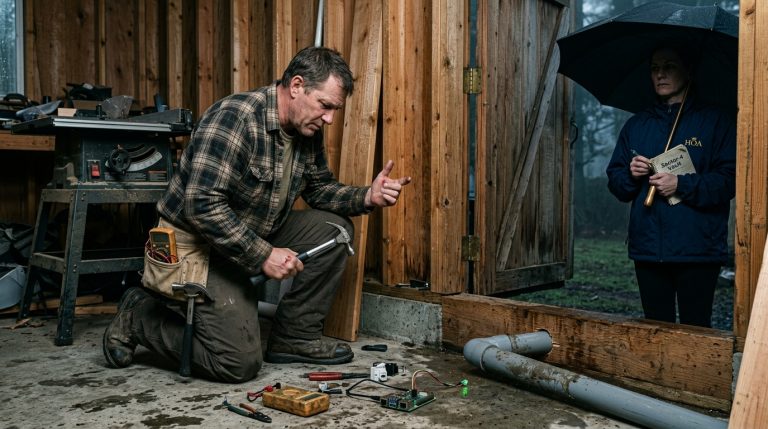
He stopped near the old wood shed. Resting on the bench was the cast-iron thermos his father had carried forty years ago. The green enamel was chipped, the bottom ring dented from decades of hard drops against frozen ground. Alex picked up a small file and slowly worked the rough edges of the iron latch on his utility box, the rhythmic scrape of the metal-on-metal acting as a quiet denouement to the winter’s friction.
Down below, a moving van was backed up to the driveway of the Wells residence. There was no bone-white coat on the balcony, no binoculars tracking the slope. The house was quiet, its manicured lawn scarred by the heavy tracks of the cleanup crew.
Alex took a slow sip of the hot chicory coffee, the steam rising in a steady, thin plume into the clean, biting air. He looked at the limestone blocks, then down at the stabilized earth. The mountain had settled. The ledger was closed. For the first time in thirty years, the land beneath his feet was perfectly, resolutely still.