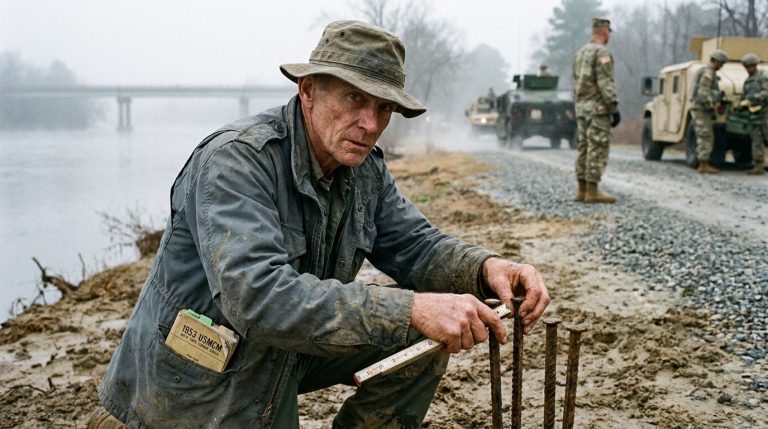
The Iron Boundaries of Cedar Ridge: A Quiet Reclamation of the Valley Soil
CHAPTER 1: THE INCISION
The metal tooth of the blade hit the first flagstone with a dry, screeching slide that vibrated through the pine pillars of the porch. It wasn’t a clean sound. It was the sound of iron meeting limestone, of decades of moss being sheared off in a single, unceremonious scrape.
I didn’t move from the railing. Beneath my palm, the cedar timber hummed with the high-frequency vibration of the idling diesel engine. The air smelled of burnt transmission fluid and the cold, mineral scent of subsoil—the dark, damp earth that hadn’t seen the sun since my grandfather laid the foundation beams in the autumn of 1912.
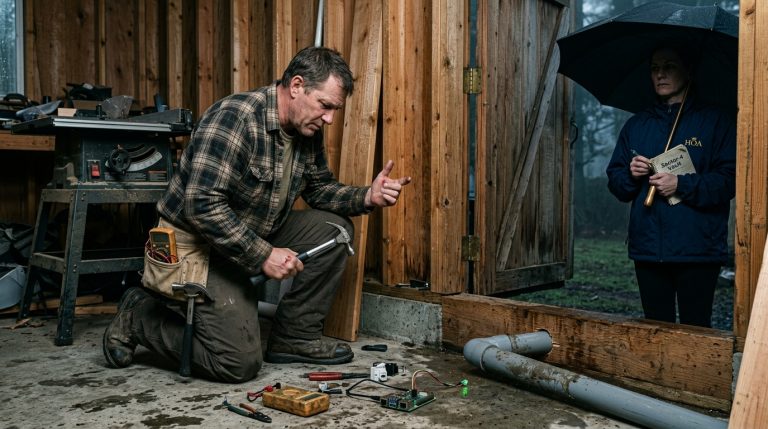
Renee Kesler stood just beyond the reach of the dirt spray, her clipboard held against her ribs like a breastplate. Her yellow safety vest was pristine, completely free of the gray dust that was already settling over my porch steps. She gave a short, horizontal wave of her hand, and the operator pulled a lever. The bulldozer’s metal tracks groaned, clattering as they reversed three feet, leaving a deep, raw trench where the wild phlox had bloomed only yesterday.
“We’re on a schedule, Richard,” Renee said. She didn’t raise her voice, but it carried clearly over the low, rhythmic throb of the engine. She took two steps forward, her narrow shoes sinking an inch into the freshly turned loam. “The county approved the easement alignment on Tuesday. If you check your mail, you’ll find the certified variance.”
I reached into my pocket, my fingers brushing against the cold, heavy brass of the old surveying plumb bob. Its weight was a steady, grounding anchor against the sudden heat rising in my chest. I didn’t pull it out. Instead, I looked down at the wooden stake the surveyor had driven into the dirt near the corner of my well-house.
Something was wrong with the wood. It was clean—too clean. There was no weathering on the cedar stake, yet the orange surveyor’s ribbon tied to it was frayed and sun-bleached, as if it had been salvaged from an old utility site down the road. A discrepancy of age. A small, silent lie planted in the dirt.
“Your alignment is twelve feet over the creek line, Renee,” I said. My voice was dry, matching the grit of the dust settling on my tongue. “The county doesn’t grant variances on protected riparian zones.”
“The board has a special exemption for infrastructure access,” she replied, tapping the metal clip of her board with a manicured finger. “We are correcting a century of poor planning. You’ve had your thirty days. The luxury development in the lower basin requires a contiguous access route, and this is the only logical grade.”
Behind her, the truck cab’s dash camera glinted in the morning sun, its small red light blinking in steady, silent intervals. Recording. Waiting for a reaction. They wanted a shout. They wanted a physical barrier they could film and show to a judge to secure an emergency injunction.
I looked back at the raw trench, then at the weathered, sun-bleached ribbon on the brand-new stake.
“The grade isn’t yours to cut,” I said quietly.
I turned and walked back into the shadow of the house, letting the screen door click shut behind me.
CHAPTER 2: THE SILT AND THE SEAL
The galvanized screen door settled into its frame with a metallic click, but the vibration lingered in the soles of my boots. Inside, the air was cooler, thick with the smell of old pine and linseed oil, yet the yellow haze of the bulldozer’s exhaust found the gaps in the weatherstripping anyway. It hung in the shaft of morning light cutting through the hallway, a slow-moving silt that settled on the dark wood of the stairs.
I didn’t go to the window. In this valley, if you let them see you watching from behind glass, they count it as a retreat. Instead, I walked to the kitchen table, where the yellow pine surface was rough under my fingertips. The old brass surveying plumb bob was heavy in my pocket, swinging against my thigh with a dull, reassuring rhythm. I pulled it out and set it on the table. The metal was pitted, darkened by decades of sweat and river moisture, but the tip was still a perfect, unyielding point.
From the kitchen window, the view didn’t offer the comfort of distance. The driveway was a narrow corridor of gray gravel, completely choked by the bulk of the HOA’s idling utility truck. The camera on its cab roof stayed level, its black lens staring toward the porch like a dead eye.
Renee’s high heels clicked twice on the bottom step of the porch, then stopped. She wasn’t following me inside—not yet. She knew the law of threshold. But she was waiting for the dust to do her work for her.
I reached for the white envelope she had left sticking out of the mailbox earlier that morning. The paper was heavy, cheap bond with a printed blue seal that read Cedar Ridge HOA: Progress and Preservation. Inside, the map was a multi-layered photocopy. My property line had been redrawn with a thick, digital felt-tip marker, a bold red swath that flattened the garden terraces and turned the creek into a straight line of blue ink.
At the bottom of the page, the signature block was crowded. Renee’s name was written in her sharp, aggressive cursive, but it was the three names below hers that made me pause. Miller, Vance, and Grier. The three board members who lived on the south ridge.
I brought the page closer to the light. The ink on Renee’s signature was fresh, a dark gel that caught the glare. But the names of the other three members had a strange, uniform texture. The loops of Grier’s ‘g’ and the cross of Vance’s ‘t’ were identical down to the micron—reproduced with the slight, pixelated feathering of a high-resolution flatbed scanner. They hadn’t signed this. The document had been compiled, sealed, and printed from a single terminal in the clubhouse basement.
Before I could set the paper down, the low rumble of the bulldozer changed pitch outside. The clatter of the treads grew louder, closer, the steel cleats grinding against the dry creek stones.
But then, the engine died. The sudden silence in the valley was heavy, almost physical, broken only by the tick of the cooling manifold and the high, thin whine of a hydraulic line losing pressure.
I picked up the plumb bob, its cold brass solid in my palm, and walked back to the front door. The screen door swung open with the same dry creak.
Renee was still standing near the bottom step, but her eyes weren’t on the porch anymore. She was looking down at her clipboard, her thumb tracing the edge of the paper as she listened to the operator shout something from the cab of the machine.
“Richard,” she called out, her voice dropping the professional sheen as she turned back to the porch. Her fingers clutched the board tighter. “We have a structural discrepancy in the lower basin survey. We’re going to need to clear the old timber along your north fence line to verify the easement marker. It’s standard procedure.”
I stepped onto the top plank of the porch, the cedar dry under my soles. “The north fence line has been dead center since the Cadastral Ledger of 1904, Renee. If your operator takes one foot of that timber, he’s clearing sovereign county record.”
Her eyes narrowed, the sun catching the sharp edges of her silver-rimmed glasses. “That ledger is ancient history, Richard. We operate on the current plat. And right now, the current plat says your fence is twelve feet inside our road.”
She didn’t know about the zinc maps in the county basement, and she certainly didn’t know about the black iron pin buried three feet under the roots of the old sycamore by the creek. She only knew the weight of the steel she had brought into my yard.
“Let’s go see the marker, then,” I said, stepping down the stairs.
CHAPTER 3: THE VAULT OF DEEDS
The heel of my boot sank into the wet clay as I descended the creek embankment. Behind me, the sharp rustle of dry weeds and the uneven scuff of leather soles meant Renee was following, her breathing slightly shallower now that she had stepped off her gravel and into the brush. The air down here by the water was cool, damp with the scent of rotting oak leaves and old silt, a sharp contrast to the gasoline exhaust hanging over the yard.
“There’s nothing down here but briars and runoff, Richard,” Renee said. Her voice lacked its previous platform authority, dropping into a tight, transactional hiss as a low branch snagged the sleeve of her polyester vest. “The surveyor’s team confirmed the easement points from the ridge road. They don’t need to climb down into a ditch to prove where the line sits.”
“A ridge-line reading is an approximation,” I replied, keeping my eyes on the muddy ground ahead. “But the ground doesn’t lie. Not when the markers were driven three feet into the limestone.”
We reached the base of the old sycamore. Its massive trunk was scarred by years of spring floods, the bark peeling away in papery, gray patches to reveal the pale wood beneath. At the junction of two thick, exposed roots, the earth was dark and packed solid by decades of seasonal pressure.
I knelt, the damp ground instantly soaking through the knees of my denim trousers. The scent of iron and cold, wet earth filled my nose as I cleared away a thick layer of decomposed leaves. In my pocket, the old brass plumb bob shifted, its weight solid against my hip. I pulled a small, rusted hand trowel from my belt and began scraping away the muddy silt wedged between the roots.
Renee stood a few feet back, her shadow falling across the excavation. Her clipboard was pulled tight against her ribs, the metal clip clicking rhythmically under her nervous thumb.
“The board won’t accept a hand-dug hole as a legal defense,” she said, though her gaze stayed fixed on the dark cavity I was clearing. “The development has institutional backing. Every tract has been cleared by title insurance.”
“Then their insurance missed the iron,” I said.
My trowel scraped against something unyielding. It wasn’t the dull, crumbling resistance of limestone, but the high, clear ring of solid iron. I cleared the remaining clay with my fingers, exposing the rusted, square head of a heavy metal stake. The top of the shaft was deeply pitted, but the hand-stamped markings were still legible under the layer of orange oxidation.
It was the Blackwood Boundary Pin.
Beside it, half-buried in the clay, lay a discarded surveyor’s cap from a modern transit tool—a bright orange piece of plastic that had been deliberately snapped off and buried. The discrepancy was obvious; someone had found this pin, realized its location disproved the ridge-line map, and covered it up to keep the bulldozers moving.
“Someone knew,” I said, pointing the tip of the trowel at the snapped plastic cap. “They found the Blackwood Pin, realized it puts your luxury access road twenty feet inside my timber line, and buried the evidence.”
Renee’s jaw tightened. The blood had left her cheeks, leaving her face pale under the gray shade of the sycamore canopy. “The county records are what matter. This is just a piece of old scrap metal. It doesn’t change the plat filed with the planning commission.”
“We’ll see what the county says when they compare your digital plat with the Cadastral Ledger of 1904,” I said, standing up and wiping the mud from my hands onto my trousers. “But we aren’t going to find those ledger files on a computer. They’re in the basement vault at the recorder’s office, and we’re going there now.”
Renee took a half-step back, her eyes darting toward the ridge where the bulldozer operator was watching us from his idle machine. “You’re stalling, Richard. A trip to the courthouse won’t stop the excavation schedule.”
“The operator won’t dig while there’s a disputed boundary pin on record,” I said, my voice quiet but steady. “Not unless he wants a personal lawsuit for criminal trespass. Let’s go.”
CHAPTER 4: THE DECOY SNARE
The roots of the sycamore offered only slick purchase as we scrambled back up the embankment. My boots slid once, churning up a grey layer of shale before my hand found a sturdier pine branch. Behind me, Renee’s breathing had turned into a ragged, wet whistle. She didn’t ask for help, and I didn’t offer it. When we reached the top of the slope, the idling bulldozer was still there, a massive yellow block of iron heat radiating into the humid air. The operator had killed the engine to a low, rhythmic rattle, his hands resting flat on the black steering levers as he watched us.
I didn’t stop to look back. I strode directly to my old truck, the door handle gritty with road dust under my fingers. The latch opened with a heavy, ungreased clunk. Renee’s white SUV was parked thirty feet back, its pristine tires coated in the thick red clay of my driveway. She didn’t speak as she climbed into her vehicle, the door slamming shut with a muted, expensive thud.
The drive down the ridge road was seven miles of washboard gravel. In my rearview mirror, the white SUV kept its distance, its headlights bouncing through the cloud of limestone dust my truck kicked up. My blower motor rattled behind the dashboard, blowing stale, warm air that tasted of dry earth and old copper. Every curve of the road was a physical reminder of the boundary line; the old wooden fence posts on the left were weathered black, while the right side of the road had been cleared for the new subdivision, marked by bright orange silt fences that flapped like plastic flags in the wind.
Twenty minutes later, the truck’s tires screeched on the hot asphalt of the county courthouse parking lot. The building was a three-story block of desaturated brick, its foundation stained by decades of coal soot and rain. I led the way down the concrete steps into the basement, where the air was cold and smelled of damp limestone and dry floor wax.
At the end of the corridor, behind a counter of scratched green linoleum, sat the county archives. A heavy steel mesh cage protected the oldest filing cabinets, its sliding track secured by an oversized padlocked bar.
“We’re looking for the original maps tied to the Cadastral Ledger of 1904,” I said to the clerk, an elderly man whose fingers were stained grey with ink.
Renee stepped up beside me, her heels clicking sharply on the concrete floor. “The current plat is already verified on the digital system, Albert,” she said, her voice reclaiming its hard, bureaucratic edge. “We don’t need to waste time dragging out those old books.”
Albert didn’t look at her. He took a heavy iron key from a peg on the wall and stepped to the cage door. He turned the key, but the lock didn’t yield; it gave a dry, metallic click, the internal tumblers jammed by decades of rust and lack of oil. He yanked the handle twice, the steel mesh rattling violently against its frame, but the gate stayed locked.
“Mechanism’s seized,” Albert muttered, his voice dry. “Happens every summer when the humidity gets down here.”
I didn’t wait. I reached through the wide gaps in the iron mesh, my fingers locating the sliding pin on the backside of the latch. The metal was coarse, covered in a gritty layer of red rust that bit into my skin. I applied leverage, pushing upward until the dry pin finally slid back with a loud, screeching pop that echoed down the quiet hallway.
The gate swung open.
Albert led us to the back corner, where the oversized leather-bound ledgers were stacked on steel shelves. He hauled the 1904 volume onto the viewing table. The cover was split, the dry calfskin crumbling into brown powder under his palms. When he flipped to the Cedar Ridge section, the paper was thick, yellowed at the edges, and smelled of stale vinegar.
I laid the HOA’s digital easement map directly next to the ledger’s hand-drawn ink survey.
The difference was absolute. On the ledger map, the red boundary line didn’t bend at the creek; it ran straight through the ridge, supported by the exact coordinates of the Blackwood Boundary Pin we had just uncovered. But as I traced my finger down the page, my eyes caught a marginal note written in purple ink from 1952.
“Easement subject to municipal utility bypass, Tract 12B.”
Renee’s posture shifted immediately. A tight, thin smile returned to her face. “You see, Richard? The forged signatures on our internal map don’t even matter. The 1952 bypass clause gives the HOA the legal right to claim the access route anyway, even if our surveyors made an administrative error on the current plat. The county can’t stop us.”
The decoy had sprung. The forged signatures on the easement maps—the very evidence I had counted on to halt the bulldozer—were legally irrelevant. Under the 1952 municipal code, the HOA had a backdoor right to the land, and the county’s hands were tied.
“The county might be tied, Renee,” I said, my fingers tightening on the edge of the table as the realization of the trap settled in. “But we aren’t done reading.”
CHAPTER 5: THE SILT OF CEDAR RIDGE
The edge of the heavy paper was dry, almost brittle enough to turn to dust under my thumb as I turned the massive page of the Cadastral Ledger of 1904. Renee’s breath caught—a tiny, sharp intake of air that betrayed the sudden tension in her shoulders. Her smug smile remained fixed, but her fingers were white where they gripped the plastic edge of her clipboard.
“The 1952 bypass is an amendment, Richard,” she muttered, her voice dropping into a hard, desperate register. “An amendment always supersedes the original tract.”
“An amendment only supersedes what is legally yours to alter,” I said, my voice low and level in the quiet of the basement vault.
I turned the final sheet. Affixed to the rear of the binding by two rusted iron brads was a document printed on heavy vellum, its edges darkened by a century of shadow. The seal at the top was not the county’s modern stamp; it was a deeply pressed wax medallion, cracked but whole, bearing the name of the original land patent.
“Albert,” I said, looking at the grey-stubbled clerk. “Read the title of the restrictive covenants attached to the original patent.”
Albert adjusted his wire-rimmed glasses, his thumb tracing the faded copperplate handwriting on the vellum. “The Kincaid Conservation Easement,” he read aloud, his voice dry and scratchy like the paper itself. “Dated October fourteenth, nineteen hundred and four. It covers the entire valley parcel, from the eastern ridge-line down to the creek bed.”
“That’s a private trust,” Renee interrupted, her heel taking a sharp, defensive step backward on the concrete floor. “Private trusts are subordinate to municipal utility access. The board has the authority to condemn for the common good.”
“Read paragraph four, Albert,” I instructed quietly.
The clerk squinted at the script. “This easement is established in perpetuity as a sovereign, non-developable forest preserve. No roads, no utilities, and no subdivisions may be constructed within its boundaries. Any alteration of the natural grade or clearing of timber nullifies all subsequent municipal zoning changes, returning the entirety of the valley to the state’s conservation registry.”
The silence that followed was heavy, absolute, and cold.
Renee’s clipboard didn’t fall. It shook, the metal clip rattling against the plastic with a high, frantic vibration. Her eyes darted from the crumbling vellum to the digital plat map she had laid out on the linoleum counter. The red marker lines she had drawn so confidently suddenly looked like cheap, childish graffiti across the face of an unyielding law.
The Blackwood Boundary Pin we had uncovered by the sycamore wasn’t just a property marker; it was the physical anchor of the Kincaid Conservation Easement. By driving her bulldozer into my yard, by forging the board’s signatures to bypass the environmental audits, and by selling luxury villa lots on land that could never legally be developed, Renee hadn’t just overstepped a boundary line. She had committed multi-million-dollar securities fraud against her own financial backers.
“This is an administrative error,” she whispered, her face draining of what little color it had left. “We can file for an exemption. The investors have already cleared the capital.”
“There are no exemptions for federal conservation land, Renee,” I said. “Every shovel of dirt your operator moved this morning is a separate, actionable violation. The county investigator is already on his way to the site with a permanent halt order.”
Renee’s confidence crumbled. She didn’t shout; she didn’t offer a final, dramatic defense. She simply turned and walked toward the heavy iron cage door, her heels clicking a slow, defeated rhythm down the concrete corridor until the sound was swallowed by the damp basement air.
Two hours later, the valley was quiet.
When my truck pulled back into the gravel driveway, the yellow bulldozer was no longer idling. It sat inert, its massive metal blade rested flat on a flatbed trailer while the operator quietly secured the heavy transport chains. The dust had settled, leaving a thin, grey film over the cedar siding of the mansion, but the air was clean again, carrying the rich, damp scent of the pine forest.
I walked to the edge of the front porch. The trench was still there—a raw, red wound in the dark soil where the machine had torn through the wild phlox. I knelt down in the dirt, the earth cool against my knees. With my bare hands, I picked up the split cedar stake Renee’s crew had hammered into the clay. I pulled it free from the ground and tossed it into the weeds.
Beneath the soil, my fingers found one of the limestone flagstones that had been dislodged by the bulldozer’s steel tracks. It was heavy, its underside coated in wet clay and fine white roots. I lifted it, cleared the silt from its bedding, and carefully pressed it back into its rightful place in the walkway, leveling it until it sat firm and unyielding against the earth.
I stood up, wiping the dark loam from my palms, and looked out over the deep green sweep of the valley. The forest was whole, the ridge was safe, and the silence was mine once more.