The Weight of Frozen Asphalt: A Chronicle of Friction, Ruined Seals, and Municipal Reckoning
CHAPTER 1: THE ORANGE LEDGER
The grease on the toggle switch had gone stiff from the cold, resisting the pressure of my thumb until it clicked with a dry, metallic snap. Outside the garage window, the sky wasn’t blue or gray; it was a flat, desaturated zinc that seemed to press down directly onto the roof ridges. The portable snowmelting rig sat beneath its shroud of clear polyethylene, the heavy-gauge steel frame cold enough to skin knuckles if handled without leather. Taped dead center across the pressure regulators were three orange violation tags, their adhesive brittle, the edges curling inward like dried oak leaves. Seven hundred and fifty dollars for the first twelve hours. Fifteen hundred for the second. The ink on the final warning line had run slightly before freezing, turning Miranda Holt’s cursive signature into a jagged smear of blue salt.
A vibration hummed against my thigh. It wasn’t a call, but the sharp, double-pulse of a data transmission. The screen of the phone was scratched across the corner, splitting the text of the attached PDF into twin lines of unreadable digits. It was an internal budget sheet, forwarded from an anonymous routing address three houses up—the metadata stripped, but the ledger entries intact. Halfway down the column for quarterly expenditures, under the heading for winter mechanical services, the allocation digit didn’t show a reduction or a temporary deficit. It was a single, clean dash. Zero.
The contract with the county plows hadn’t been delayed by the storm; it had been deleted in November to balance the structural ledger on the community clubhouse roof. The orange seals on my machine weren’t there to protect the storm drains from runoff or salt contamination. They were there to keep the street from finding out that the money was gone.
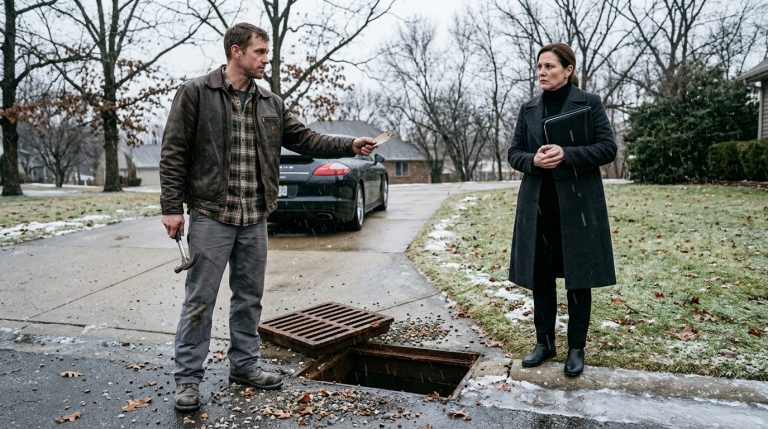
I walked to the lip of the driveway, the soles of my insulated boots crunching through an inch of fresh powder that covered a four-inch base of solid, compacted ice. The cul-de-sac didn’t function like a road anymore; it was a funnel, sloping downward between two rows of retaining walls that forced every drifting flake into a three-foot barrier at the dead end. A private plow from the upper tier had dumped its clearing load straight across the middle lane, creating a gray, frozen spine that looked like old concrete.
Two houses down, an older man was leaning into the handle of an aluminum shovel. Every three seconds, the blade would hit an unyielding ridge of ice beneath the powder, sending a dull, metallic shock through his forearms that made his shoulders hitch. He didn’t look up when I passed. He was staring at the space ten feet ahead of his bumper, calculating the exact weight of the labor required to move three tons of ice before his oxygen tanks ran dry.
I reached into my coat pocket, the fabric stiff with frozen salt spray, and pulled loose the small brass calipers I used for measuring fuel-line wear. I dropped to one knee at the edge of the asphalt where the road met the drainage apron. The ice here wasn’t white; it was an iron-gray skin, thick enough to swallow the entire depth of the curb. When I pressed the steel tip of the calipers into the runoff groove, the metal didn’t bite. It slid sideways, leaving a faint, white scratch that smelled instantly of sulfur and dry dirt.
The system was locked. The county road three hundred yards away was visible between the gaps in the pine trees—a clean, black strip of clear asphalt where the salt trucks had already run—but between that clear lane and the six houses at the bottom of our hill sat forty thousand cubic feet of dense, unplowed weight.
My phone vibrated again, the screen lighting up with an incoming regional advisory. The temperature at the valley floor had just crossed twelve degrees, and the wind was shifting three points to the north, aligning perfectly with the throat of the cul-de-sac. I stood up, my knees clicking against the cold canvas of my trousers, and looked back toward Miranda’s house at the top of the rise. Her garage doors were shut, the white paint flawless, the light from her kitchen window casting a pale, amber square onto a driveway that had been meticulously cleared by hand before the hard freeze set in.
I took a single photograph of the ice depth against the drainage apron, the timestamp burning white into the corner of the frame, and routed it directly to the regional dispatch center’s non-emergency log. There was no text in the body of the message, only the measurement and the coordinates. When the confirmation note came back nine minutes later, it didn’t contain an estimated arrival time or a crew assignment. It was a template response, cold and functional: Obstruction noted in civil log 404. No active incident reported.
I turned back toward my own garage, my boots finding the shallow, frozen tracks I’d cut into the snow the day before. The wind caught the corner of the orange violation notice on my door, tearing the top left staple completely free from the wood. It flapped against the cedar panel with a sound like a small whip cracking in an empty room. I didn’t pull it down. I reached past it for the brass handle of the service door, my eyes catching a strange discrepancy in the snow along Miranda’s side path—a single pair of small, hurried footprints that led down into the darkness of her lower garage entrance, but didn’t return.
CHAPTER 2: FRICTION THRESHOLD
The cold didn’t just drop; it crystallized, turning the moisture in the air into sharp, microscopic needles that bit at the inside of my nostrils with every breath. I stood at the threshold of the lower side path, the beam of my flashlight cutting a yellow, dust-mote-filled tunnel through the driving powder. The footprints were small, shallow, and lacked the distinct heel-strike of someone walking with intention. They were indented into the crust—Miranda’s boots, the small, patterned V-grooves of her winter tread—but there was an erratic sideways skid to the marks, like a body losing its center of gravity under a heavy, awkward load.
The path slid downward, hugging the rust-streaked foundation of her concrete retaining wall. The smell of dry earth and old iron filings rose from the crawlspace vents, overridden by the sharp, chemical tang of unvented kerosene. I leaned my weight into the slope, my boots finding the grit where the wind had swept the asphalt bare, exposing the raw, aggregate stones beneath the gray surface. The tracks ended abruptly at the threshold of her lower garage door—a weathered, single-panel overhead unit with iron hinges that had started to scale with red rust.
A dull, rhythmic thud echoed through the wood panels. It wasn’t a knock. It was the heavy, dead impact of muscle and bone hitting treated pine from the inside.
“Holt,” I said, my voice flat, instantly swallowed by the roar of the wind through the pines above. I pressed my palm against the door. The wood was freezing, but the iron handle was dead-cold, vibrating slightly against its housing. Another thud followed, lower down this time, accompanied by the distinct, frantic scratching of fingernails against the weatherstripping.
“He’s… he’s not answering the upper lock,” a voice rasped from the dark behind me.
I spun, my flashlight beam catching Miranda Holt three feet up the slope. She hadn’t put on her heavy parka; she was wrapped in a faded wool car coat, her fingers dug into her own collar to keep it pinned against her throat. Her face was the color of skimmed milk, her lower lip split down the center from the dry air, a tiny bead of dark, frozen blood clinging to the skin. Behind her, the street looked like an abandoned quarry, the snowdrifts rising in jagged, desaturated terraces toward the main road.
“The upper door is dead,” she said, her chest heaving, her breathing shallow and ragged. “The power cutout tripped the electronic override. He went down to hand-crank the old roller, but the base… the base is frozen into the drain channel.”
I didn’t answer right away. I stepped back to the iron handle, my fingers checking the cylinder lock. It was a standard mechanical deadbolt, but the brass housing was packed tight with blown ice that had melted from her body heat and refrozen into a clear, impenetrable plug. “He should have used the side entry before the drift sealed the frame,” I said, the words transactional, calculating the physical resistance of the door.
“I told him to stay inside,” she whispered, her eyes tracking the orange violation tags visible on my own garage across the lane. “I told him the county was handling the clearance. I showed him the advisory logs.”
“The logs you falsified?” I asked, my voice dropping an octave as I leaned my shoulder against the frozen pine panel. The wood groaned, the grain creaking under ninety pounds of lateral pressure, but the iron frame didn’t yield an inch. “The budget ledger came through an hour ago, Miranda. You zeroed the winter service contract in November. There is no county truck coming. There never was.”
A sharp intake of air rattled in her throat. She looked down at her boots, her hands trembling so violently she dropped the edge of her collar, letting the northern gale rip into the throat of her nightshirt. “The clubhouse roof had a structural sag,” she muttered, her voice defensive, the internal logic of the bureaucrat trying to reassert itself even while the concrete below us shook with another dull strike from inside. “The liability insurance would have dropped the entire community if we didn’t patch the main beam. We had a surplus in the road fund. It was a temporary allocation shift. The forecast didn’t show an Arctic cell.”
“The system doesn’t care about your allocation shifts,” I said. I pulled my flashlight back, tracking the lower edge of the garage door where it met the asphalt apron.
The problem wasn’t just the snow. The runoff from her cleared upper driveway had drained down into this low pocket before the hard freeze, creating a solid, four-inch wedge of blue ice that completely submerged the bottom rubber seal. The door wasn’t just closed; it was welded to the earth by two thousand pounds of frozen water.
From inside, a voice called out—muffled, high-pitched with the early stages of oxygen deprivation and panic. “Mom? It’s… the auxiliary unit is smoking. The lever broke.”
“Turn it off, Leo!” she screamed, lunging toward the door, her knees hitting the hard-packed crust. She began tearing at the blue ice with her bare fingers, her nails splitting against the aggregate stone embedded in the freeze. “Break the glass window! Use the spare rim!”
“The windows are wire-reinforced, Miranda,” I said, my hand catching her by the shoulder of her wool coat and lifting her back onto her feet. The fabric was rough, smelling of mothballs and damp storage. “He won’t break them with his hands, and if he uses the car, the impact will collapse the tracking rails. If those rails bend, he’s sealed in until the spring thaw.”
She stared at me, her eyes wild, her pride fully dissolving into the gray mask of horror. “Your machine,” she choked out, her fingers twisting into the sleeve of my canvas coat. “The propane rig. It can cut the apron. It can clear the drainage track in ten minutes.”
“The machine is under an official cease-and-desist order,” I said, my voice steady, matching the rhythm of the wind. “Signed on behalf of the board. Five thousand dollars in accrued penalties, followed by immediate property lien proceedings and a civil citation for environmental contamination.”
“I’ll void it,” she sobbed, the wind tearing the words from her mouth. “I’ll write the variance right now. I’ll sign the emergency waiver.”
“You don’t have the legal authority to sign a variance for a county-regulated zone during an active storm,” I said, looking up at the high ridge where the pines were bending like iron rods against the zinc sky. “And that’s not the biggest problem.”
I reached down into the snow near the hinge, my gloved fingers brushing aside the fresh powder to reveal a heavy, galvanized iron pipe that emerged from her basement wall and vanished directly into the frozen drainage ditch. It was the main relief line for her heating system’s overflow—and it was bone dry, clogged with a thick, internal plug of gray ice that had backed up into the foundation. The house wasn’t just losing heat; the internal systems were beginning to pressurize against the blockage.
“Mom?” the voice from inside was fainter now, followed by a wet, heavy cough that sounded like a shovel dragging through wet sand. “The air… it tastes like copper.”
I didn’t wait for her to answer. I turned and began the long, heavy climb back up the frozen slope toward my garage, my lungs burning as the wind drove a fresh wave of powder straight into my face. Behind me, the sound of her bare hands clawing at the concrete was a low, desperate scraping that didn’t stop.
Next = 3
CHAPTER 3: THE DECOY SECRET
The heavy rubber-coated casing of my handheld spotlight scraped against the frost-rimed brick of my porch, leaving a thin streak of black grease on the masonry. I dialed the emergency dispatch center back from my desk phone, setting the heavy plastic receiver to speaker. The connection didn’t click immediately; it went through three separate sub-routing relays, each one dropping a hard, mechanical frequency hum into the small room before a human operator answered.
“County Emergency Services, Log Operator 14,” the voice said, the cadence flat, entirely devoid of inflection. “State your reference or ongoing incident number.”
“Filing a safety verification report for Cul-de-sac 4-B,” I said, leaning over the spread ledger sheets I had printed before the residential network went dark. The paper felt stiff, brittle from the dropping humidity. “I have a non-responsive civil road status. I need the contractor log verification for the current quadrant.”
A sound of rapid keyboard typing mechanical keys rattled through the small speaker. “Quadrant 4-B is marked as self-managed under Association Exemption Code 99,” the operator replied. “A compliance verification form was submitted and electronically stamped at 0400 hours yesterday. The log states all primary turnarounds are cleared to bare pavement.”
I looked out the window. The three-foot barrier of compressed gray snow was visible under the yellow glow of the streetlamp, its surface hardened into an iron-like ridge. “Who signed the compliance verification?”
“The authorization belongs to the presiding administrative officer for the local board. M. Holt. The entry specifies third-party mechanical clearance completed via regional subcontractor.”
The piece of the puzzle clicked into the groove with a dry, metallic ring. Miranda hadn’t just shifted the funds from the winter maintenance pool to fix the clubhouse roof; she had falsified the mandatory safety logs to the county transit office to prevent an external municipal audit. If the county realized the neighborhood was completely cut off due to an intentional suspension of the service contract, the association’s operational charter would be revoked for structural negligence. She wasn’t just hiding a financial deficit from the homeowners; she was committing administrative fraud to keep the county from stepping into her jurisdiction.
“Log Operator,” I said, my thumb tracking the edge of the printed ledger sheet where the winter fund line item showed its single, clean dash. “I am documenting an active structural blockage. The turnaround is entirely non-functional. The base ice is currently sitting at four inches over the primary drainage apron.”
“Your notation has been entered into the civil ledger,” the operator said, the voice retreating back into its automated rhythm. “Be advised, without a direct physical casualty or active fire deployment, municipal units cannot cross onto association-maintained property under Code 99. The jurisdiction remains internal.”
I hung up, the heavy plastic receiver settling into its cradle with a definitive clack. The internal loop was perfect. Miranda had built a legal wall around the cul-de-sac that was more effective at containment than the snow itself. By filing the false compliance forms, she ensured the county wouldn’t check the road, and by using the association’s cease-and-desist mechanism against my mechanical melter, she kept anyone within the block from producing evidence that contradicted her logs.
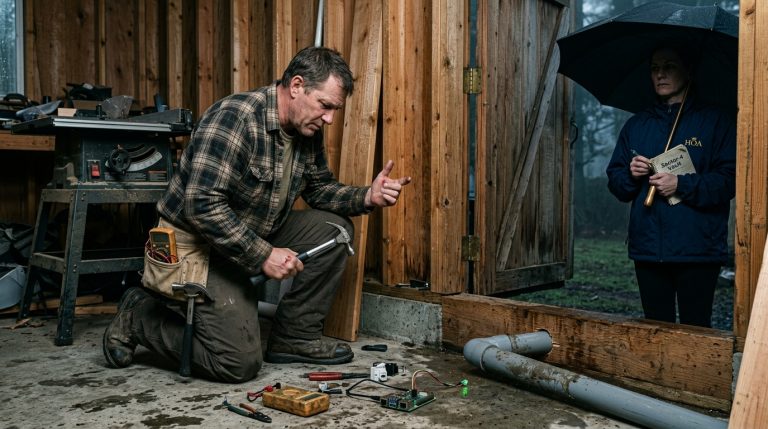
I grabbed my heavy canvas coat, the metal zipper cold against my chin, and walked back out into the garage. The air inside had dropped below freezing now, the copper pipes along the ceiling giving off a faint, high-pitched pinging sound as the water inside them began to contract. I moved to the rear of the portable snowmelting rig, my boot heel striking something hard and metallic embedded in the gravel floor near the drainage line.
I dropped to one knee, brushing away a layer of loose, gray dirt mixed with salt crust. It wasn’t a standard foundation bolt. It was a heavy brass disc, three inches in diameter, set deep into a concrete pillar that extended beneath the garage’s sill plate. The metal was pitted, coated in a layer of greenish-brown oxidation, but the stamped letters around the edge were still sharp enough to read under the beam of my light: State Transit Survey Marker — 1974. Municipal Boundary Line.
I rubbed my thumb across the center of the disc, feeling the deep, cold cross-hatches of the topographical grid. My garage hadn’t been built inside the association’s legal tract. The boundary line for the county’s public right-of-way ran directly through the center of my floor apron, placing the snowmelting rig—and the very driveway it sat upon—outside Miranda’s corporate jurisdiction. The orange seals she had wrapped around the steel frame weren’t just an overreach; they were a violation of civil transit territory.
Outside, the wind hit the garage door with a heavy, concussive boom that rattled the tracking rollers in their steel brackets. From down the hill, a sharp, metallic scream tore through the sound of the storm—the sound of an overtaxed electrical starter motor spinning itself into scrap iron against a jammed flywheel. Miranda’s house had just lost its auxiliary power generator.
Next = 4
CHAPTER 4: THERMAL BREACH
The sudden absence of the generator’s whine left a vacuum in the cold air, filled instantly by the low, guttural shriek of metal binding against metal down the hill. I didn’t reach for a tool. My fingers were already closed around the industrial box cutter in my pocket. I sliced upward through the thick, translucent polyethylene shroud wrapped around the snowmelting rig. The plastic tore with a loud, aggressive snap, the frozen orange violation seals splintering like glass as they sheared off the steel framework, their jagged fragments scattering across the aggregate concrete floor.
I hauled the five-hundred-pound rig forward. The small iron casters groaned, grinding through the salt crust and grit until the heavy steel chassis cleared the garage threshold. The northern wind hit the frame like a physical punch, trying to push the machine back into the shadows, but the momentum of the steel carried it into the powder.
“Miranda!” I yelled, my voice cutting through the hiss of drifting powder.
She was still on her knees by her lower door, her bare hands frozen into white, bloodless hooks against the concrete apron. She didn’t look up until the metal tires of the machine bit into the ice of the cul-de-sac. Her eyes were hollow, reflecting the zinc glare of the sky. “The starter… the auxiliary cracked,” she rasped, her teeth clicking together so hard a line of thin saliva ran from the corner of her split lip. “He’s not hitting the panel anymore.”
I ignored her, my hands moving with mechanical precision over the rig’s brass manifold. I cracked the primary valve on the propane tank. The gas hissed, a cold, sharp odor of mercaptan cutting through the smell of dry earth and sulfur. I struck the flint igniter. A orange tongue of flame spat across the burner tray, then settled into a low, roaring blue cone that radiated a sudden, violent wave of dry heat. The air between us warped, the falling snow turning to fat drops of water before they could touch the metal shroud.
“Get back up the rise,” I ordered, my boots shoving against the frame to guide the burner head down the incline.
The machine was built for friction, its center of gravity low enough to plow through compacted ice if driven by sustained weight. I forced the nose of the rig directly into the base of the three-foot barrier blocking the throat of her lower driveway. The moment the thermal shield touched the crust, an explosion of white steam erupted, hissing violently against the cold steel plates. The gray, compressed ice didn’t melt smoothly; it cracked apart in heavy, saturated chunks, spilling backward into the slush like shattered slate.
The labor was heavy, every forward inch requiring a deliberate heave of my shoulders against the pushback of the boiling runoff. The water didn’t drain; it pooled around my boots, freezing instantly onto the leather tops in a thick, translucent rind. Through the veil of steam, I watched the lower garage door panel. The wood was black with dampness now, the heat from the burner blistering the old white paint until it curled away from the grain in thin, crisp ribbons.
I jammed the steel nose of the rig against the iron hinge mechanism at the bottom corner of the door. The ice that had welded the rubber seal to the asphalt was thick—four inches of solid, blue-tinted runoff that had accumulated from weeks of structural neglect. The burner roared, its sound changing to a high, hollow whistle as the flame focused directly into the drainage channel.
A loud crack echoed from inside the housing—not the sound of wood breaking, but the dry, metallic snap of a corroded copper shear pin inside the manual crank mechanism. The tracking rail on the left side buckled inward by an inch, the steel twisting under the thermal expansion and the internal weight of the counterweights.
“Leo!” Miranda screamed, lunging forward through the hot slush, her wool coat dragging in the dirty water. “Leo, hit the lock! Use the manual slide!”
There was no answering scrape from the other side of the pine panel. The air exiting the lower foundation vent was thick now, carrying the heavy, unmistakable smell of unburnt fuel and carbon monoxide—the exhaust from the failed auxiliary unit that had settled into the lowest pocket of the foundation.
I dug the heels of my boots into the aggregate asphalt, using the frame of the snowmelting rig as a literal lever against the door’s lower edge. The metal was hot enough to scorch through my leather gloves, the smell of singed hide mixing with the steam. “Miranda, grab the pry bar from the rear tray!” I shouted.
She didn’t move fast enough, her limbs clumsy from the early stages of hypothermia. I reached back myself, my left hand ripping the three-foot steel bar from its clips. I jammed the wedge end into the narrow gap where the ice had dissolved beneath the tracking rail. I threw my entire weight against the iron bar, the muscles in my lower back tightening until they burned.
The door didn’t slide. It fractured along the bottom grain, the ancient pine splintering into raw, yellow wedges as the tracking rollers finally tore free from their rusted brackets. The lower six inches of the panel lifted, letting out a heavy, visible cloud of gray exhaust that smelled of burnt oil and panic.
I dropped the bar, lunging into the opening with my bare arms, ignoring the jagged edges of the broken wood. The darkness inside was absolute, smelling of cold metal and old grease. My hands found the wet wool of a jacket sleeve on the concrete floor just beyond the threshold. I dug my fingers into the fabric, bracing my feet against the remaining frame of the door, and pulled.
The weight was dead, unyielding, like dragging a sack of damp grain through a narrow trench. My boots slipped twice on the hot, slick asphalt of the apron, the ice beneath giving way under the pressure. With one final, wrenching heave that tore the skin across my knuckles against the splintered pine, I pulled the body out into the freezing air of the driveway.
He was motionless, his face a pale, pasty gray under the zinc sky, his lips a dark, bruised violet. Miranda fell over him, her split fingers clawing at his chest as she tried to clear the frozen breath from his nostrils. Down the block, the sound of the wind shifted again, but it wasn’t the only sound now. From the top of the hill, beyond the waist-high drift that sealed the entrance to the main artery, a faint, rhythmic pulse of red and blue light began to paint the undersides of the pine trees.
Next = 5
CHAPTER 5: THE CONCRETE AUDIT
The flashing red and blue strobes did not slice through the storm; they bled into it, turning the dense curtain of falling powder into an unstable, violet-tinted fog. The heavy diesel engine of a county utility truck groaned at the top of the hill, its transmission clunking hard as the driver shoved it into low gear. It crept forward, the massive studded tires biting directly into the steaming, black trench my machine had carved through the center of the cul-de-sac.
I didn’t step away from the rig. The propane burner was still running at half-throttle, its blue cone ticking softly against the wet, structural iron plates. The heat felt artificial, a small pocket of dry friction in an environment that was rapidly turning to slush. Water was pouring off the chassis in greasy lines, smelling of boiled salt and old gear grease.
A paramedic unit slid into the clearing right behind the utility truck, its rear tires skidding sideways before catch-chaining on the exposed aggregate. Two men in thick, high-visibility parkas slammed the doors, their heavy leather boots splashing into six inches of dirty, boiling runoff. They moved with a mechanical synchronization that had nothing to do with corporate protocols and everything to do with survival. They had a stretcher between them, the metal frame rattling against its guide rails.
“Pulse is thready,” the taller paramedic shouted, his voice muffled by the thick synthetic collar of his coat. He dropped to his knees right beside Leo, his gloved thumbs checking the carotid artery. “Skin is cyanotic. Get the oxygen mask on him now. We’ve got carbon monoxide blockages.”
Miranda didn’t speak. The authority she had carried like iron armor three days ago had completely evaporated, leaving nothing but a wet, shivering shape wrapped in a mothballed car coat. She sat on the wet asphalt, her fingers still bloodied from clawing at her own foundation, watching the plastic mask seal over her son’s mouth. Her jaw was locked, her chin trembling in rhythmic, erratic hitches that matched the buffeting of the wind through the pines.
“Who cleared this lane?” a voice barked from the side of the utility truck.
An official stepped into the amber glare of my machine’s burner tray. He wasn’t wearing an association badge. He wore the heavy, oil-stained canvas of a County Transit Supervisor, a heavy brass shield pinned to his lapel, pitted by years of road salt and river humidity. His boots stopped inches from the edge of the brass survey marker I had uncovered in the gravel floor of my driveway threshold.
“I did,” I said, my hand resting on the manual shut-off valve of the propane tank. The cold iron of the valve wheel bit through the tear in my leather glove, sticky with the residue of singed hide.
The supervisor looked down the length of the steaming road, then at the orange fragments of the broken violation tags lying in the dirty slush like dead leaves. He took a heavy flashlight from his belt, the aluminum casing scraped down to the silver primer, and shined the beam directly onto the wet, splintered wood of Miranda’s lower garage door.
“This is an unapproved mechanical removal device,” Miranda whispered, her voice cracking as she looked up from the concrete. Her eyes shifted toward me, a residual spark of administrative habit flaring behind her wet lashes. “The board… we issued a formal cease-and-desist order under the environmental protection clauses. The fines are legally binding.”
The supervisor didn’t look at her ledger or her notices. He stepped directly onto the brass survey disc embedded in the sill pillar, his boot heel making a sharp, metallic clink against the metal.
“Ma’am,” he said, his voice flat, carrying the dry, unyielding weight of municipal statute. “Your association clauses stop exactly twenty-six inches inside this garage threshold. This property sits on an explicit county transit right-of-way, designated under the 1974 civil autonomy act during the valley reservoir construction. Your board has zero enforcement jurisdiction over this equipment or this platform.”
He pulled a damp, tri-folded document from his internal pocket, the paper already absorbing the grease from his fingers. “Furthermore, our regional office received your electronic safety log at 0400 hours yesterday stating this turnaround was bare to the pavement. Because of that entry, emergency units were routed through the northern valley instead of the highway plow line. That’s a class-three administrative fraud violation under state transit code.”
Miranda’s mouth opened, but no sound came out. The cold wind caught the edges of her hair, plastering the thin, gray strands across her face like cobwebs.
“Your internal allocation shift almost put a body in a casket tonight,” the supervisor continued, his thumb tapping the edge of his clipboard against his knee. “The county executive signed an emergency order twenty minutes ago. All association enforcement authority in Quadrant 4-B is officially suspended under the reckless endangerment clause. An audit team will be at your main office by noon tomorrow to seize the maintenance logs and communication records.”
He turned back toward me, the amber flame from my machine casting long, rhythmic shadows across the deep lines of his face. “Keep this burner running until the ambulance clears the upper ridge,” he said, his nod short and transactional. “The county will cover the propane allocation under the civil safety clause. We’ll handle the rest of the ice once the salt trucks can turn around.”
I didn’t answer. I simply tightened my grip on the iron valve wheel, adjusting the flow until the blue flame settled into a steady, deafening roar that pushed the cold back another three feet. The paramedic unit slammed its rear doors with a heavy, concussive thud that cut through the hiss of the storm. The ambulance moved out, its studded tires gripping the black, steaming corridor we had cut through the wall of ice, its red strobes pulsing against the zinc light until the pines swallowed them whole.
I stood there in the quiet that followed, the grease on my machine ticking as it cooled against the iron frame. The rules hadn’t preserved the neighborhood; they had nearly buried it. But beneath the artificial ink of the association notices, the concrete and the boundary lines remained exactly where they belonged—solid, unyielding, and clear.