The frozen shadows beneath the soil will always find a way to claim their debt
CHAPTER 1: THE MELT
The bonded leather of the sectional didn’t just stick to the skin; it claimed it. Peeling my thigh off the cushions sounded like a strip of industrial duct tape tearing away from dry drywall.
Outside, the air didn’t blow. It hung. A heavy, yellow haze of Pennsylvania humidity that smelled of parched fescue grass and hot asphalt. In the corner of the living room, the central air vent let out one final, asthmatic cough—a metallic rattle like a tin can full of gravel being dragged behind a rusty tractor. Then, a thick, suffocating silence settled into the joists of the house.
I walked out to the back patio. The condenser unit was silent, a faint wisp of scorched copper wire drifting out of its rusted fan grate. The metal casing was hot enough to blisters.
“Six weeks, David. Maybe eight,” Mike the HVAC guy had told me, wiping a grease-smeared sleeve across a forehead that looked like wet river stone. “Every warehouse from here to Pittsburgh is backordered on control boards.”
I couldn’t leave. Barnaby, my ninety-pound golden retriever, was already panting on the kitchen tile, his ribs rising and falling like a bellows in a forge. If the heat got into his head, he’d start chewing the baseboards. I had spent four scraped-knuckle hours jamming a cheap, rattling 12,000 BTU window unit into the sash, securing it with rusted wood screws and prayers, just to keep one room down to eighty degrees.
Then came the knock. Three sharp, heavy raps that rattled the hollow-core front door.
Brenda stood on the concrete porch. Her floral blazer looked stiff, unaffected by the ninety-eight-degree glare. In her hand, she held a clipboard clamped over a stack of pink slips. Her hair was a frozen wave of gray, smelling faintly of aerosol hairspray and vinegar.
“Bylaw fourteen point two, section C,” Brenda said, pointing a manicured, claw-like finger past my shoulder toward the street-facing window. “Mechanical protrusions are strictly prohibited. It’s an eyesore, David.”
“It’s ninety-eight degrees, Brenda. My dog is vibrating on the floor.”
“The rules do not have heat-stroke exemptions,” she replied, her eyes flat and unblinking. She slipped a pink sheet from her clipboard and pressed it against my chest. The paper was hot. “Five hundred dollars a day, starting tomorrow at noon. We protect the property values of Oak Creek, David. No exceptions.”
She turned, her loafers crunching rhythmically on the dry gravel of my walkway.
I closed the door, the heat already rising through the floorboards like steam from an iron. I stared down at the pink paper. But as I walked toward the back yard to inspect the boundary lines near the common area, my boot struck something hard in the parched earth near my fence line.
I knelt, brushing away the dry, dusty soil. It was a survey marker—a heavy iron stake. But it wasn’t the rusted, orange-capped pin from 1985. This iron was clean, freshly driven into the dirt, with the initials E.B. stamped into the bright, unweathered top. It sat exactly three feet inside my own property line, as if someone had quietly moved the border while I slept.
CHAPTER 2: THE LOOPHOLE
My thumb lingered on the cold, sharp edge of the stamped letters. E.B. The iron was clean, lacking the deep, pitted corrosion of the old 1985 boundary pins that marked the rest of this development. It was raw, gray metal, smelling faintly of machine oil and freshly turned clay. I pressed down until the metal bit into the pad of my finger, leaving a white indentation. Someone had driven this stake recently. Quietly.
I stood up, the heat hitting me like a physical barrier as soon as I rose above the relative shade of the fence line. My knees popped, dry and protesting. I wiped my hands on my jeans, grinding the fine, yellow Pennsylvania dust into the denim. Beyond the fence, the common area lay in baking, manicured silence, its fescue grass turning a sickly pale green under the July glare.
I turned back toward the house. Every step across the scorched grass felt heavy, the air thick enough to resist my movement. Inside, the kitchen was a vault of trapped, stagnant heat. Barnaby didn’t even look up when the screen door clicked shut. He lay flat on the linoleum, his golden coat pressed against the dark seam where the floor met the bottom of the refrigerator, trying to leach whatever faint coolness remained in the dark corners. His breathing was a rapid, dry clicking sound.
“Hold on, boy,” I muttered, my throat dry.
I walked into the study. The air in here was worse—stuffy, smelling of old cardboard and hot adhesive. I bypassed the window unit in the living room; running it now felt like pouring water into a bucket with a hole in the bottom. The pink slip from Brenda sat on the desk, its edges curling in the humidity like a dying leaf.
I reached for the top shelf of the filing cabinet and pulled down the heavy, three-ring binder she had handed me when I signed the closing papers three years ago: Bylaw Ledger 84. The textured beige vinyl of the cover was sticky to the touch, the plastic warm and releasing a faint, synthetic chemical smell in the heat. I dropped it onto the desk. The thud it made was flat, lifeless.
I flipped it open. The pages were dry, yellowing at the margins, rust from the cheap steel binder rings staining the margins of the first dozen sheets. I began to read, my eyes scanning the dense, triple-column lines of legalistic gray text. Sweat dripped from the tip of my nose, landing with a soft splat on the margin of Article XII, leaving a dark, spreading circle on the paper.
I turned the pages methodically, looking for the chains.
On page one hundred and twelve, under Section 14.2.2, I found it. The language was written to trap, but it was also written by people who valued appearance over substance.
“…no mechanical devices, compressor units, auxiliary power generators, or cooling apparatus shall be visible from the street or neighboring properties.”
I stared at the word. Visible.
I leaned back, the cheap plastic of my desk chair creaking under my weight. If they couldn’t see it, they couldn’t fine it. The rule wasn’t about the temperature of the air inside my home; it was about the pristine, uninterrupted illusion of Brenda’s neighborhood aesthetic.
I pulled my closing document folder from the bottom drawer. The metal drawer slides squeaked, a high-pitched, rusted scrape that made Barnaby thump his tail once in the kitchen. Inside the folder was a large, thrice-folded blue sheet—the original survey of my lot, officially titled The Keystake Plat.
I unfolded it across the desk, the paper stiff and smelling of ammonia. My eyes traced the property line—the thick, dark boundary drawn back in 1985. I compared it to the mental image of the clean, unweathered iron stake I had just touched by the fence. On The Keystake Plat, my western boundary line was a straight shot, running parallel to the garage wall with a comfortable five-foot clearance.
But the new stake—the one stamped E.B.—was sitting three feet closer to my foundation. If that new stake was correct, my garage wasn’t just close to the property line; it was practically encroaching on the HOA’s common land.
I rubbed my chin, the stubble dry and scratchy against my palm. Brenda was pushing the boundaries, literally. But she had left a loophole wide enough to drive a drill rig through. If I couldn’t go out, and I couldn’t go up, I had to go down.
I reached for my phone, my fingers leaving damp prints on the glass screen, and began searching for a company that didn’t mind the dark.
CHAPTER 3: BEDROCKS RIG
The phone screen cast a pale blue glow over my dust-caked knuckles. I tapped the number. The connection didn’t ring so much as it vibrated, a low-frequency hum that seemed to travel through the plastic chassis directly into the bones of my hand. On the third vibration, the line opened with a wet, raspy click.
“Deep Core,” a voice said. It sounded like two paving stones grinding together in a dry mixer. “State the depth.”
“I have an HOA,” I said. My voice was tight, the dry air of the study making it rasp. “And I need an invisible thermal footprint.”
There was a long, static-filled pause. A match struck on the other end, followed by the wet draw of breath through paper. “We don’t do aesthetics. We do bedrock. Where are you?”
“Oak Creek Estates,” I replied, looking down at the blue sheet of The Keystake Plat on my desk. My finger traced the straight line of my western boundary, the point where the ink met the newly discovered, freshly stamped iron stake. “But the layout has some… ambiguities. You’ll need a rig that can squeeze between a garage wall and a fescue common area without taking out a power line.”
“Seven a.m. Saturday,” the voice ground out. “Have the survey marked. And clear the driveway. Barney doesn’t like backing up.”
The line died. I set the phone down next to Bylaw Ledger 84, the silence of the hot house rushing back in to fill the void. Beside my chair, Barnaby let out a long, shuddering sigh, his tail giving a single, heavy thud against the baseboard.
When Saturday morning arrived, the sun didn’t rise; it simply burned through the gray morning fog like a hot coal through wax. The air at 6:45 a.m. was already thick, carrying the smell of cut grass and stagnant creek water. I stood on the asphalt driveway, a mug of black coffee growing lukewarm in my hand, watching the end of the cul-de-sac.
At exactly 7:00 a.m., a low, rhythmic thudding vibrated through the soles of my work boots. It wasn’t the sound of suburban traffic. It was the deep, unyielding pulse of a multi-ton diesel engine under load.
The nose of the rig rounded the corner of Oak Creek Drive. It was a massive, tracked drilling platform, painted a flat, peeling industrial orange that had faded to the color of dried brick. Rust bled down the seams of the steel mast, which was folded flat over the cabin like a siege engine. The tracks left dark, oily smears on the clean municipal asphalt as it crawled toward my curb.
A rusted utility truck followed in its wake, carrying racks of heavy steel drill pipe and a large water tank. On the side of the truck’s cab, a faded, weather-beaten decal caught my eye. It didn’t say Deep Core Solutions. Instead, it bore a stylized, angular logo of a three-tiered pipeline system with the words The Apex Conduit stamped in peeling silver leaf. I stared at the name, the words registering as an oddity—not the typical branding for a residential well-driller.
The rig squealed to a halt at the edge of my lawn, its exhaust pipe belching a single, thick plume of black soot into the humid air.
The cabin door creaked open with the sound of ungreased hinges. A man stepped down onto the turf, the ground visibly compressing under his weight. He was built like a commercial water heater, his shoulders broad and slightly hunched, wearing a grease-spotted canvas vest with no shirt beneath it. A half-burned cigar was wedged into the corner of his mouth, the ash gray and undisturbed despite the engine’s vibration.
“You David?” he asked. He didn’t offer a hand. He just squinted at the garage wall, then down at the narrow strip of grass where my property met the pristine common area.
“I’m David. You must be Barney.”
“Bedrock,” he corrected. He spat a dark stream of tobacco juice onto the curb. “Where’s the boundary?”
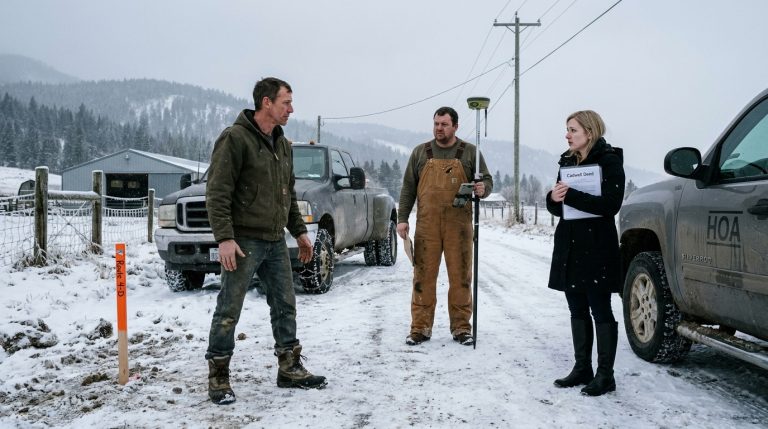
I walked him to the fence line, pointing to the newly driven iron stake. The metal was cool in the early morning shade. “This is the marker. But the original plat shows my line extends three feet past this point into the common turf.”
Bedrock walked over to the stake, his heavy leather boots sinking into Brenda’s manicured grass. He bent down, his massive, scarred fingers wrapping around the iron cap. He didn’t try to pull it; he just felt the weight of it, his eyes narrowing as he looked toward the center of the common area.
“This pin isn’t set in concrete,” Bedrock grunted, his voice low. “It’s soft. Someone put this here with a hand-pounder.” He stood up, wiping his palms on his thighs. “If you tell me your dirt goes thirty feet into that park, I’ll drill it. But once the bit bites, we don’t move. It’s your liability.”
“The plat is the legal record,” I said, my chest tightening as I looked toward Brenda’s darkened windows across the street. “Drill.”
Bedrock gave a single, curt nod. He turned back toward the rig and raised a massive arm, signaling his helper on the utility truck. “Unstrap the mast! We’re going deep!”
The diesel engine roared, a high-pitched turbo whine joining the deep thrum of the pistons. The steel mast began to rise, its hydraulic cylinders groaning under the immense weight of the iron. As the assembly lifted, I noticed a heavy plastic shipping sleeve zip-tied to the frame of the rig. Inside, a thick document was visible, waterlogged and yellowed. Across the top, in bold, black marker, were the words: Bylaw Ledger 84 – Approved Sub-Surface Permits.
I frowned, taking a step closer to the rig. The vibration of the engine rattled the teeth in my jaw. Why would an independent drilling rig have a copy of my HOA’s private bylaws attached to its chassis? Before I could reach out to touch the plastic sleeve, Bedrock’s helper slammed the steel stabilizing jacks down into my driveway, the metal pads biting into the asphalt with a sharp, crushing crunch.
The battle for the underground had officially begun.
CHAPTER 4: THE SLURRY WAR
The diesel engine’s pitch shifted from a heavy, guttural rumble to an agonizing, high-frequency scream. The massive rotary drive head slid down the vertical track of the mast, engaging the first ten-foot length of black steel pipe. When the carbide teeth of the drill bit met the compacted dry clay of my yard, the vibration didn’t just travel through the ground—it climbed my shins, rattled the fillings in my jaw, and set every window pane in my house to buzzing in its frame.
A thick, liquid plume of gray slurry erupted from the collar of the hole. It was a pressurized mixture of subsoil clay, pulverized limestone, and groundwater, driven upward by the rig’s compressor. The wet mud shot six feet into the air before collapsing outward in a heavy, fan-shaped arc.
“Back off!” Bedrock roared, his voice barely cutting through the mechanical thunder. He stood at the control console, his thick gloved hands fighting a pair of shuddering hydraulic levers.
The gray mud rained down. It coated the side of the utility truck, obliterated my newly painted fence, and sailed directly over the property line, landing with a wet, heavy slap across Brenda’s pristine, award-winning bed of pink petunias. The delicate flowers were instantly flattened, drowned beneath a three-inch layer of wet, cement-like silt.
But the machine didn’t stop. It chewed deeper, the steel pipe descending inch by grinding inch into the earth.
“We hit a pressurized pocket!” Bedrock yelled over the noise, his cigar bouncing wildly between his teeth. “Silt and gray clay! It’s blowing back!” He slammed a valve shut, throttling down the hydraulic pressure to keep the hole from collapsing in on itself.
Before the slurry could even begin to dry on the grass, a screen door slammed across the street with a sound like a pistol shot.
Brenda came sprinting across the common area. She wasn’t wearing her formal floral blazer today; she was wrapped in a silk robe that billowed behind her, her hair tightly bound in pink plastic curlers that bounced with every furious step. Her face was flushed a dangerous crimson under the morning glare.
“Stop this! Stop this machine right now!” she shrieked, her voice cracking as she reached the edge of my lawn. She stopped just short of the mud line, her slippers sinking into the damp perimeter of the spray.
Bedrock didn’t even look at her. He kept his eyes locked on the pressure gauges, his shoulder muscles twitching under his vest as he micro-adjusted the drill speed.
“David!” Brenda screamed, turning her fury on me. She reached into the pocket of her robe and pulled out a rolled-up document. The paper was old, yellowed at the edges, and secured with a heavy, rusted metal binder clip. She shook it at me like a weapon. “You are in direct violation of a cease-and-desist! This is trespass!”
“It’s on my property, Brenda,” I said, my voice cold, matching the steady, mechanical rhythm of the drill. I pointed down at the grass, where the mud was slowly pooling around the freshly stamped iron stake. “The plat says my boundary extends to the edge of the common turf.”
“Your plat is a lie!” she shouted, unrolling the document with a sharp, paper-tearing snap. She held it out, her fingers trembling with rage. “This is the certified amendment to The Keystake Plat, logged during the second phase of the development’s survey. Look at the coordinates, David!”
I stepped closer, ignoring the fine mist of gray mud that settled on my shirt. My eyes locked onto the faded blueprints she held open. It wasn’t a standard copy. The paper bore an official, dry-stamped seal in the bottom right corner, and the title block read: Sub-Surface Utility and Boundary Realignment – Section B.
My stomach plummeted. On this document, the boundary line didn’t parallel my garage. It made a sharp, three-foot jog inward. According to this certified plat, the western wall of my garage wasn’t five feet from the line—it was sitting exactly three inches over it. If this document was legitimate, my entire garage was an illegal encroachment on the HOA’s common property.
Brenda saw the realization hit my face, and her expression instantly hardened into a triumphant, mocking sneer.
“I have the original records right here, David,” she whispered, her voice carrying a venomous, quiet weight over the roar of the diesel engine. “Your garage is on my land. If you don’t shut this rig down in the next ten seconds, I won’t just fine you. I’ll have the county tear your garage down to the concrete slab.”
Beside us, the drill bit hit a harder stratum of rock, and the entire rig shuddered violently, throwing a fresh wave of gray slurry over our boots.
CHAPTER 5: LIQUID CAPITAL
Brenda’s smug grin remained frozen, her hand still holding the dry-stamped amendment to The Keystake Plat inches from my face. But before I could speak, a sharp, metallic screech ripped from the utility truck’s manifold behind us. The heavy water supply hose, which had been pulsating with municipal pressure, suddenly collapsed inward like a deflated lung, flattening against the dry gravel of my driveway.
“Loss of pressure!” Bedrock’s helper yelled, hammering his fist against the dry analog flow meter. “We’re dry, Bedrock! The bypass is starved!”
Bedrock slammed the rotation clutch into neutral. The grinding roar of the drill bit died, leaving only the deafening, static-filled idle of the diesel engine. The relative quiet was thick, heavy, and hot.
“They cut the hydrant,” Bedrock said, spitting a charred sliver of tobacco onto the deflated rubber hose. He pointed a grease-blackened wrench toward the street corner, where a municipal utility truck sat idling, its amber light rotating silently over the concrete curb. “Some suit in a county polo just locked our tap. No water, no drilling. The bit will melt in that hard limestone within five minutes.”
Brenda let out a short, sharp laugh, folding her amendment with a crisp, dry snap of the paper. “The municipal authority does not tolerate water theft for unauthorized construction, David. Your little excavation is over. Pack up this junk, or the sheriff’s department will do it for you.”
She turned on her heel, her pink slippers kicking up tiny puffs of gray mud as she marched back across the ruined common area, clutching her papers like a trophy.
I didn’t watch her walk away. My chest felt tight, the heat of the air pressing against my ribs like a physical weight. I looked at the deflated hose, then looked down the fence line toward the neighboring properties. Without water to cool the bit and flush the slurry, we were dead in the water. Brenda had successfully choked our supply line.
But a shadow fell across the fence. Mr. Henderson, my neighbor from two doors down, was leaning against his cedar fence post, squinting through the dry glare. He was holding a plastic pool-skimmer, his faded Hawaiian shirt damp with sweat. He caught my eye and gestured with his chin toward his backyard.
I didn’t run. I walked, my boots dragging through the dry clay of the yard. I reached the cedar fence line, the wood hot and rough under my palm.
“Miller and the county guys just drove by,” Henderson muttered, his voice low, barely carrying over the idling diesel of Bedrock’s rig. “Brenda’s been on the phone with the water authority since seven. She’s trying to freeze you out, Dave.”
“She did,” I said, wiping a mixture of sweat and gray limestone dust from my forehead. “Without three thousand gallons of water to keep the bit cool, we can’t clear the limestone layer. The rig has to pull out.”
Henderson looked back over his shoulder at his blue, sparkling in-ground pool. The water looked impossibly cool, the chlorine scent sharp and clean against the dry smell of baked earth. “My pump is running. I’m draining the shallow end anyway to patch a liner next week. That’s twenty thousand gallons of clean water sitting right there.”
I looked from the blue water back to Henderson. “The HOA has an easement clause. If she sees a hose running from your yard, she’ll fine you before the water hits my dirt.”
“She fined me seventy dollars last month because my trash bin was out three hours past collection,” Henderson said, his jaw tightening, his thumb tracing the worn handle of his skimmer. “She told my wife our mailbox numbers were the wrong font. I don’t care about her easement.”
“Seven hundred dollars,” I said, my voice transactional, quiet. “Cash. In your hand before we run the line. And I supply the pump.”
“Eight hundred,” Henderson countered, his eyes locked on mine. “And you help me haul the winter pool cover out of my shed when this is over.”
“Deal.”
I turned back to the rig. “Bedrock! Grab the three-inch trash pump and the suction line from the utility truck. We aren’t tapping the hydrant anymore.”
Bedrock’s helper scrambled to the bed of the truck, dragging a heavy, cast-iron gasoline pump across the gravel. Within five minutes, we had the suction hose slung over Henderson’s cedar fence, the black intake nozzle sinking into the clear, chlorinated blue of his pool.
“Pragmatic,” Bedrock grunted, pulling the starter cord on the trash pump. The small engine roared to life with a high-pitched, metallic buzz. “Not exactly municipal code, but it’s wet.”
The flat fire hose running from Henderson’s yard suddenly ballooned, stiffening as thousands of gallons of pool water surged through the manifold and directly down the hollow core of the drill steel.
The rotary drive head engaged again. The screech of the bit biting into the deep, hidden limestone resumed with double the fury, spraying a fresh, chlorine-scented gray slurry across the fence line.
We were back in the dirt. But as the pump thrummed, I looked down at the vibrating hose. On the side of the cast-iron pump casing, a brass inventory tag caught the light. It didn’t belong to Deep Core Solutions. Stamped into the metal was a serial number and a bold, engraved title: Property of The Apex Conduit – Private Utility Reserve.
The name appeared again, linking the heavy equipment on my lawn to a corporate infrastructure project I had never heard of. I reached down, touching the hot brass tag, the vibration of the water surging through the metal under my fingertips.
CHAPTER 6: THE CEASEANDDESIST
The small pump engine hummed, drawing a steady, cold stream of chlorinated water across the cedar fence. But the victory was short-lived. The sound of gravel crushing under heavy, slow-moving tires cut through the mechanical noise. A dark, unmarked sedan with tinted windows pulled up to the curb, its glossy black finish already caked in the gray limestone dust drifting from my lawn.
The engine killed. The door clicked open, and a man in a crisp charcoal suit stepped out into the stifling heat. He didn’t look like an inspector; his shoes were polished leather, completely unsuited for the muddy battlefield of my driveway. In his hand, he carried a stiff, manila folder.
Brenda emerged from her porch again, her posture straight, her chin lifted in triumph. She didn’t walk toward me this time. She walked directly to the suit, her hand pointing accusingly at the rising mast of the drilling rig.
“Mr. Vance,” she said, her voice sharp enough to cut the heavy air. “He’s bypassed the municipal water shutoff. He’s drawing directly from private residential reserves to continue an illegal excavation.”
The man in the suit, Vance, walked toward the rig with slow, deliberate strides. He stopped just outside the splatter zone of the gray mud. He opened the folder and pulled out a document stamped with a red, ink-wet seal.
“David?” he asked, his voice flat, professional, and entirely devoid of heat.
“I’m David.”
“My name is Thomas Vance, representing Oak Creek Estates Legal Counsel.” He held out the document. The paper was dry, stiff, and smelled of fresh toner. “I have a signed emergency temporary restraining order from the county court. You are ordered to immediately cease all subsurface excavation, drilling, and trenching on these coordinates, effective immediately. Failure to comply will result in immediate law enforcement intervention and a charge of contempt.”
I looked at the paper. The header didn’t just mention the HOA; it referenced a secondary corporate filing under The Apex Conduit municipal easement program.
“The drill is on my property,” I said, my voice quiet, matching his professional chill.
Vance pointed a polished finger toward the mud-slicked ground, specifically toward the iron stake stamped E.B. “According to the certified amendment of The Keystake Plat, your garage and this specific drilling zone are classified as an unapproved encroachment on common community land. Until a formal land-use tribunal reviews the coordinates, any further penetration of the soil is a civil and criminal violation.”
Bedrock stepped down from the rig’s platform, his heavy boots squelching in the gray paste. He wiped his hands on a greasy rag, his eyes scanning the suit, then moving to me. “What’s the play, Dave? The bit’s at eighty feet. If we shut down now without sealing the casing, the hole collapses.”
“You will shut down now, Mr. Bedrock,” Vance said, his eyes not leaving mine. “Or the rig is subject to immediate impoundment.”
I looked at Brenda. She stood behind Vance, her arms crossed over her chest, a faint, cold smile playing on her lips. She thought she had closed the vise. She thought the threat of the court order would make me panic, dismantle the rig, and melt quietly in my ninety-eight-degree living room.
But as I stared at the red seal on the court order, I realized what they were defending wasn’t the grass. It was what lay directly beneath it.
“We stop,” I said.
Bedrock blinked, his jaw tightening around his dead cigar. “Dave, if we pull the steel now—”
“I said we stop, Bedrock,” I repeated, my voice steady, carrying a deliberate, hollow weight of defeat. I looked back at Vance, then at Brenda. “I made a mistake. The survey lines are confusing. The marker… there was some mud on The Keystake Plat diagram. I thought I had the clearance.”
Brenda’s smile widened, her shoulders dropping slightly as she let out a long, satisfied breath. “You will restore every inch of this turf, David. The lawyer’s fees, the landscaping costs, the fines. You’ll pay for every blade of grass.”
“Of course,” I said, putting my hands in my pockets, letting my head hang just enough to sell the surrender. “But to prevent soil destabilization and sinkholes in the common area, I have to leave the heat-exchange loops in the ground. If I pull them, the wet clay will shift and undermine the foundation of my garage. And your common turf.”
Vance frowned, looking down at his paper, then at the wet, gray Swiss cheese of the lawn. He didn’t know the engineering, but he knew the word liability. He leaned in to Brenda, whispering something I couldn’t hear.
She looked at the mud, her expression hardening with disgust. “Leave the pipes. Just bury them. Get this mechanical monstrosity off my street by morning, or the fines double.”
“We’ll cap the manifolds and bury them tonight,” I said. “Everything will be flat by sunrise.”
They turned and walked back toward the black sedan, victorious.
I looked at Bedrock. He was staring at me, a slow, knowing grin creeping through the grease on his face. He didn’t say a word. He just reached over and killed the engine of the rig, the massive diesel silence returning to the valley of Oak Creek.
We had eighty feet of pipe in the ground, connected directly to the cool, deep heart of the earth. They thought they had stopped the installation.
But they had just agreed to let me bury the weapon.
CHAPTER 7: MIDNIGHT TRENCHES
The red taillights of Vance’s sedan vanished around the sweep of Oak Creek Drive, leaving behind a silence so thick it felt like physical pressure. The dust kicked up by his tires hung suspended in the humid, yellow glare of the streetlamp.
“They’re clear,” Bedrock murmured. He spat his dead cigar into the mud, his eyes fixed on the empty street. “For now. But Brenda’s got eyes behind every blind on this block. We’ve got until sunrise before she realizes surrender doesn’t mean defeat.”
“We move now,” I said. My shirt was plastered to my spine, stiff with gray limestone paste. “Where’s the excavator?”
Bedrock signaled toward the shadow of the utility truck. His helper pulled back a heavy canvas tarp, revealing a compact, all-electric mini excavator. It was a stripped-down, industrial-grade piece of iron, completely free of the noisy diesel clatter that had defined the afternoon. Its battery pack hummed with a quiet, high-pitched whine, like an oversized laptop fan.
“We don’t dig wide,” Bedrock whispered, mounting the small machine’s vinyl seat. His massive boots looked oversized on the narrow metal footrests. “We trench tight. Straight from the hole to your foundation wall.”
The rubber tracks of the excavator crawled silently onto the lawn, leaving deep, wet depressions in the ruined turf. The hydraulic arm hissed as it dropped the narrow bucket into the mud. Bedrock worked with a surgeon’s precision, peeling back the sod, laying bare the eighty feet of subterranean loop pipes we had managed to sink before the court order froze us.
I dropped into the trench. The earth was cool down here, six feet below the surface, but the air still smelled of sulfur, pulverized limestone, and the sharp, chemical tang of Henderson’s pool water. My knees sank into the wet clay as I hauled the heavy polyethylene loops toward the basement foundation wall, where my hammer drill had already bored a three-inch entry port.
“Hold this,” Bedrock’s helper whispered, sliding a massive, brass-bodied manifold down the trench wall.
My fingers traced the cold, heavy metal of the valve. It was polished, entirely distinct from the rough, sand-cast plumbing fixtures sold at the local hardware store. Near the primary inlet port, a tiny, laser-etched plate caught the beam of my headlamp. It bore the serial registry mark: Apex Conduit System-84.
My hand froze on the brass. This wasn’t standard residential geothermal hardware. It was commercial high-pressure infrastructure, built to handle massive fluid volumes—far beyond what a single-family home would ever require. Brenda’s panic, the court-ordered boundary realignment, the unrecorded survey she had brandished… they weren’t about my window unit. They were about keeping this specific dirt closed, hiding whatever lay directly beneath the common area.
“Dave,” Bedrock hissed from the edge of the trench, his voice cut with a sharp, warning edge. “Look at the foundation. Under the garage footing.”
I turned my headlamp toward the dark concrete footing of my garage wall, where the excavator’s bucket had just scraped away the deep subsoil.
The concrete wasn’t solid. A thick, high-density polyethylene conduit—painted a distinct, safety-yellow stripe—ran horizontally directly under my foundation, crossing from the common area straight into my property line. It was an illegal, undocumented municipal bypass pipe, completely hidden from public utility maps.
I reached out, my fingers scraping a thick layer of wet clay off the side of the conduit. Taped to the heavy plastic casing was a weather-resistant, yellow inspection tag dating back seven years. The signature on the authorization line was clear, written in a fading, precise blue ink: Edward Brenda – President of the Board.
A cold sweat broke out across my collarbone, completely unrelated to the stifling heat of the trench. Edward Brenda. Brenda’s late husband.
The bypass was drawing from the main community reserve loop, diverting utility access and masking thousands of dollars in unmetered geothermal cooling. The HOA’s reserve funds hadn’t evaporated due to bad management; they had been physically funneled into an unrecorded, private thermal loop to offset the massive utility bills of Brenda’s own estate, leaving the community’s accounts hollowed out and legally bankrupt. And my garage encroachment wasn’t a mistake—it was a calculated legal buffer zone she had established to prevent anyone from ever digging near this hidden bypass.
“We hook into it,” I whispered, the words tasting like copper in my mouth.
Bedrock leaned over the trench, his face cast in deep shadows. “That’s the main line, Dave. If we splice the manifold there, we bypass her bypass.”
“She wanted an invisible system,” I said, my teeth grinding as I reached for the heavy-duty pipe cutters. “Let’s give her exactly what she paid for.”
Under the cover of pitch darkness, the cutters clicked through the heavy plastic. We fused the loop, connected the manifold, and buried the evidence beneath six feet of wet Pennsylvania clay.
CHAPTER 8: THE COLD EXHALE
The basement was a cavern of cool concrete, smelling of old laundry detergent and damp stone. Bedrock stood beside me, his massive frame blotting out the light from the stairs, his thumb resting on the heavy black plastic toggle of the main breaker. The newly mounted heat pump sat against the wall like a silent steel monument, its copper lines wrapped in pristine black insulation that vanished straight through the foundation wall where The Apex Conduit had been tapped.
“Flip it,” I said. My voice was a low rasp, my throat lined with the dust of eighty feet of limestone.
Bedrock slammed the toggle up. The copper coils inside the unit didn’t rattle. They didn’t cough or gasp like the dying central air unit. There was only a faint, high-frequency hiss, a sound like a single drop of water hitting a red-hot iron skillet, followed by a deep, vibrationless hum that rose through the floorboards.
Within thirty seconds, the damp, stagnant heat of the basement began to retreat. I walked up the wooden stairs, my boots leaving gray, clay-caked prints on the steps. In the living room, Barnaby was already standing. He had his nose pressed directly against the low-profile floor vent.
The house exhaled.
It was a deep, silent, arctic cold, drawn from eighty feet below the surface. It smelled of deep rock and ancient, frozen earth, completely untainted by the humid, blistering air outside. The thermometer on the wall began its steady, downward march. Ninety. Eighty-five. Eighty. By the time the sky outside turned from midnight black to a pale, bruised purple, the living room was a crisp sixty-eight degrees.
I sat on the edge of the sectional, no longer sticking to the leather, and watched the condensation form in perfect, heavy beads on my coffee mug.
At 7:00 a.m., the sun broke over the horizon, a white-hot coin melting the morning fog. I walked out to the porch. The yard was flat. Bedrock’s crew had worked through the remaining hours of darkness to lay fresh, pre-cut sod over the trenches, rolling it flat until the seams were barely visible. To any casual observer, it was just a regular, manicured lawn.
Brenda was already standing on the common area. Her floral blazer was back on, but her clipboard hung loosely at her side. She was staring at the fresh sod, then at my silent, empty window frame where the window unit had been completely removed.
I walked down the steps, my movements slow, carrying the heavy exhaustion of a twenty-four-hour war.
“It’s quiet, David,” she said. Her voice lacked the sharp, bureaucratic edge from the day before. It sounded thin, hollowed out by the heat and something else. Something like dread. “No compressor. No mechanical protrusions.”
“It’s invisible, Brenda,” I said, stopping at the edge of the fence line. I reached down to the cedar post where a strand of rusted boundary wire had snapped during the drilling. I pulled a pair of pliers from my back pocket and began to twist the cold metal back together, my raw knuckles stinging as the wire tightened. “Just like we agreed. Everything buried.”
She looked at the sod, her eyes tracking the precise line where the trench met my foundation. “You restored the grass. But Vance said…”
“Vance didn’t look deep enough,” I interrupted, dropping the pliers. I reached into my pocket and pulled out the yellowed inspection tag we had cut from the buried yellow pipe, along with a photocopied page from Bylaw Ledger 84 and the original coordinates of The Keystake Plat. I set them on the top of the fence post, pressing them flat under my palm.
Brenda’s eyes darted to the papers. Her face didn’t flush this time; it turned a pale, chalky gray, the color of dry limestone.
“Edward’s signature is very distinctive,” I said, my voice quiet, conversational. “Seven years ago, when he was president of the board, he signed off on an unrecorded utility realignment. He tapped The Apex Conduit—the municipal loop—and ran a private bypass straight under what would become my garage. He used the HOA’s reserve funds to pay for the infrastructure, hiding the bills as ‘maintenance.’ That’s why the reserves are empty, Brenda. That’s why you moved the boundary stakes three feet inward. You weren’t protecting the property values. You were keeping anyone from ever digging here and finding his tap.”
She reached out, her manicured fingers trembling as they touched the corner of the yellow inspection tag. The cardboard was damp, smelling of the wet clay we had pulled it from.
“The neighborhood…” she whispered, her gaze fixed on the dirt. “If the county finds out about the bypass, the fines… the lawsuits will bankrupt everyone. My house. Mrs. Higgins’ house. Everything.”
“The county won’t find out,” I said. I picked up the papers, folded them neatly, and slid them back into my pocket. “Because the loop is closed. My geothermal system is running off his bypass now. His excess heat is my cold air. We are perfectly balanced.”
She looked up at me, her mouth opening slightly, but no words came out. The absolute authority of her clipboard, the pink slips, the three hundred pages of beige oppression—it had all evaporated into the dry morning air, defeated by the very secrecy she had tried to enforce.
“Have a good day, Brenda,” I said gently.
She turned silently, her feet dragging through the grass, her clipboard clutched to her chest like a shield that had failed. She didn’t look back as she crossed the street.
I walked back inside my house, pulling the heavy front door shut behind me. The latch clicked with a solid, cool sound. The air inside was still, freezing, and clean. I walked into the kitchen, grabbed a gray hoodie from the chair, and pulled it over my head.
Barnaby was curled up on his dog bed, his tail giving three lazy, rhythmic thumps against the floor as I sat down beside him. I reached out, my bruised hand burying into his thick, golden fur, feeling the steady, slow rise and fall of his ribs.
Beneath our feet, eighty feet down in the dark, the loop hummed in perfect, silent harmony with the earth. I took a sip of my coffee, watching the condensation run down the side of the mug, completely cold.