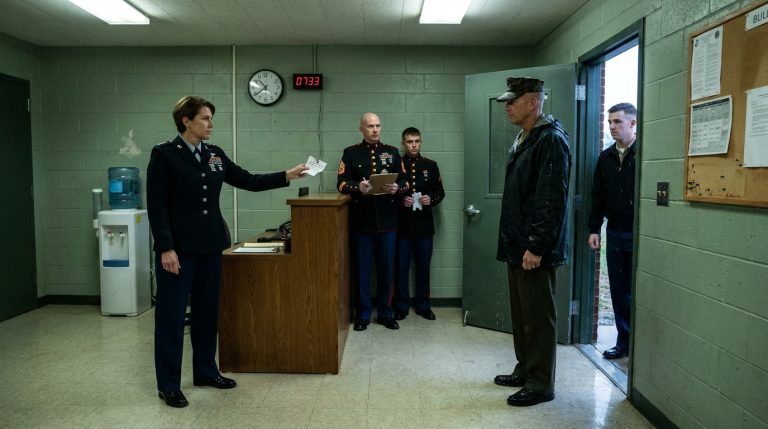
The Weight of the Star: An Officer’s Quiet Siege Against the Rusted Gears of Command
CHAPTER 1: THE RUSTED HORIZON
The air in Yokosuka tasted of sulfur and salt, a heavier, grittier atmosphere than the sterile halls of the Pentagon. I stood on the pier, the wind tugging at my service dress blues, my hands buried deep in the pockets of my coat. Before me, the destroyer rested against the concrete, a steel beast that had seen too many deployments and not enough care.
I looked at the hull. Even from thirty feet away, the orange bloom of rust creeping along the starboard waterline was undeniable. It was a structural scar, one that whispered of neglect.
“Admiral,” a voice rumbled behind me. It was Captain Elias Thorne, my new Chief of Staff, a man whose face was a map of twenty years at sea. “The maintenance logs for the hull plating were signed off last week. Everything is within parameters.”
I didn’t turn to look at him. I kept my gaze locked on the corroded seam. “Parameters are for people who want to keep their jobs, Elias. Ships are for people who want to survive.”
I walked toward the gangway, my boots clattering hollowly against the metal. Every step was an exercise in tension. I felt the familiar weight of the silver stars on my collar, a heavy, cold reminder that the room had decided, but the machine below it was still fighting the change.
As I stepped onto the deck, the silence was immediate, yet wrong. It was the silence of a crew holding its breath. I walked toward the bridge wing, noticing the deck plating under my feet. It felt thin, vibrating with a resonance that suggested metal fatigue rather than mechanical hum.
I paused, reaching down to trace a jagged edge near a hydraulic coupling. My finger came away coated in a fine, rust-colored powder. I pulled a small notebook from my pocket, but as I opened it to record the discrepancy, I noticed something else. A document, pinned to the bulkhead with a piece of rusted wire, sat slightly askew. It was an inspection report—the one Thorne had just cited.
I pulled the wire loose. It snapped, the metal brittle and tired. The report was stamped and verified, but the ink of the inspector’s signature was smeared, as if it had been forced onto the page while the document was still wet, or perhaps, fabricated in a hurry.
A shadow fell across the page. I looked up. A young ensign stood there, his face pale, his eyes darting to the report in my hand and then to the bulkhead. He started to speak, a nervous, jagged stutter, but then he clamped his jaw shut, his hands trembling slightly at his sides.
“Ensign,” I said, my voice low and measured. “What is your name?”
“Miller, Admiral.”
“Miller, does this ship ever get a moment of peace, or are we always this close to coming apart?”
He didn’t answer. Instead, he looked past me, toward the dark, churning water of the harbor, and for a fleeting second, his expression shifted from fear to a profound, weary understanding. Then, he looked back at me, his mask of discipline snapping back into place.
“The ship is operational, Admiral,” he said, the words practiced and hollow.
I looked down at the report, then back at the rusted seam on the hull. The discrepancy was small, a single signature, but it was the first crack in the foundation. And I knew, with a cold, sinking certainty, that beneath the official records, something was rotting far faster than the steel.
CHAPTER 2: THE ANCHORS FRICTION
The ensign, Miller, did not look away. He stood rooted to the deck, his breathing shallow, the silence between us thickening with the scent of stagnant sea air and the metallic tang of the ship’s environmental systems. The rusted wire I held felt sharp against my palm, a jagged piece of evidence that didn’t belong in a Navy that prided itself on perfection.
I didn’t press him. To do so here, in the open air of the main deck, would be a mistake—a clumsy maneuver in a chess game where the board was rigged against me. I held the snapped wire up, letting the cold wind of the Yokosuka harbor whistle through the gap, and then I tucked it into my pocket.
“Carry on, Miller,” I said, my voice as flat and unyielding as the hull plate.
He blinked, a momentary flicker of relief washing over his features before he retreated, his boots retreating with a rhythmic, hurried clatter toward the passageway. I watched him go, noting the hitch in his stride. He was carrying the weight of the ship’s rot in his shoulders, a physical symptom of a psychological malaise that had nothing to do with training or discipline.
I turned back to the waterline, but the focus was gone. A sudden, sharp memory pierced the present: the feel of the seawall in Annapolis, 1991. My father’s hands in his pockets, the casual, terrifying certainty in his voice when he told me about the first lieutenant needing to know the ship by feel. In the dark, with the lights out, he had said. I looked at my own hands, resting on the railing. I wasn’t just here to command; I was here to map a ghost.
Thorne was still hovering near the bridge wing, his presence a persistent, calculated weight. He saw me put the wire in my pocket. He saw the shift in my posture. He didn’t ask what I had found, which was the most telling detail of all. A true chief of staff would have been curious; Thorne was merely waiting for me to make a mistake.
“Admiral,” he said, stepping closer, his boots silent on the deck matting. “The shipyard liaison is waiting in the wardroom. They have the revised dry-dock schedule.”
“The dry-dock schedule that ignores the structural instability of the starboard waterline?” I asked, my gaze drifting to the orange, blooming decay.
Thorne paused. He didn’t blink. “The schedule is prioritized by fleet readiness, ma’am. The rust is surface-level. The primary concern is the propulsion alignment.”
I looked at him then, really looked at him. Thorne was a product of the same system that had produced the Marine captain in Memorial Hall. He was professional, efficient, and entirely committed to the illusion of order. He would defend the logs to the grave, not because he was complicit, but because he believed the integrity of the institution was worth more than the integrity of the steel.
“Let’s see the schedule, Elias,” I said.
We walked into the skin of the ship. The transition from the open air to the ship’s interior was like walking into a different world—the air grew heavy with the smell of recycled heat, coffee, and machine oil. My father’s voice echoed in the back of my mind, reminding me that a ship’s first lieutenant had to know every passageway by feel. I felt the vibration of the bulkhead against my shoulder as I walked. It wasn’t the smooth, rhythmic pulse of a healthy engine; it was a discordant, shuddering tremor.
The wardroom was dimly lit. A civilian shipyard supervisor stood at the table, a map of the ship’s internal guts spread out before him like a surgical chart. He looked up as I entered, his eyes sliding over my shoulder boards with the same practiced indifference I had encountered for two decades.
I took my seat at the head of the table. I didn’t reach for the documents. I leaned back, letting the silence of the room stretch, listening to the ship’s heartbeat beneath us—the shuddering, uneven rhythm of a mechanical system in distress.
“The dry-dock schedule,” I said, my voice cutting through the hum of the ventilation. “Walk me through the propulsion maintenance. And don’t give me the executive summary. Give me the raw data.”
The supervisor hesitated, then reached for a folder. As he opened it, I caught a glimpse of his watch. It was an expensive, heavy piece of engineering, out of place in a shipyard office. He began to recite the standard maintenance protocols, but I wasn’t listening to the words. I was watching his hands. They were steady, too steady. He was reciting from a script he had rehearsed a dozen times, the rhythm of his speech perfectly calibrated to reassure, not to inform.
I had been in rooms like this for twenty-eight years. I knew the cadence of the lie. It wasn’t in what they said; it was in the gaps between the sentences, the places where they expected me to nod, to sign, to move on.
“Stop,” I said.
The supervisor froze.
“The starboard waterline,” I continued, leaning forward until the light caught the silver stars on my collar. “The maintenance log claims it was reinforced last quarter. The reality I saw on the hull tells a different story. If this propulsion alignment is tied to that structural integrity, we aren’t just looking at a maintenance delay. We’re looking at a catastrophic failure waiting for the right swell.”
The supervisor’s mask didn’t slip, but his hands dropped to the table. Thorne, standing to my right, shifted his weight. The wardroom felt suddenly smaller, the air tighter. I hadn’t come here to play the role of the quiet admiral. I had come to tear the mask off the machine, one layer at a time.
CHAPTER 3: THE EMPTY CHAIR
The silence in the wardroom wasn’t just an absence of sound; it was a physical weight, like the pressure of a deep-sea descent. The shipyard supervisor stood frozen, his hand still hovering over the maintenance folder. Thorne remained a statue to my right, his eyes tracing the line of my jaw as if he were trying to gauge how much of my reaction was political theater and how much was the cold, hard logic of command.
I didn’t blink. I kept my gaze fixed on the supervisor. I could see the exact moment the realization hit him: I wasn’t here to be briefed; I was here to be an auditor.
“Admiral,” the supervisor finally said, his voice stripped of its earlier cheerfulness. “The structural logs are compiled by a team of civilian contractors. I’m simply the messenger for the maintenance schedule.”
“Then you’re a messenger with a faulty delivery, Mr. Henderson,” I replied, my voice steady, devoid of heat. I pushed the folder away from me, the paper sliding across the metal tabletop with an abrasive rasp. “The hull’s decay is visible from the pier. If the propulsion alignment is tied to those plating sections, and those plating sections are failing, then we aren’t talking about a maintenance schedule. We’re talking about a liability.”
Thorne leaned forward, his hands resting on the back of the empty chair opposite me. “Admiral, if we halt the schedule now, we lose our slot in dry-dock. That would set the entire deployment back by six weeks.”
“Better six weeks of delay than six feet of water in the engine room, Elias,” I said, rising from the table. My movement was slow, deliberate—a calculated shift in the room’s center of gravity. “I want a full, independent audit of the starboard waterline. Not by the contractors, and not by your team. I want it done by my Chief Engineer and a hand-picked crew from the Stout’s old maintenance division. They’re already in-country.”
The supervisor’s face tightened. “That’s unprecedented, ma’am. These contractors have been handling the Arleigh Burke class for decades. Their integrity isn’t—”
“Their integrity is currently being questioned by the very steel of this ship,” I interrupted. I walked toward the wardroom door, my footsteps echoing against the bulkhead. I stopped and looked back, not at the supervisor, but at Thorne. “I want the logs pulled from the last three years. Every single one of them. If the signatures are as inconsistent as the one I found this morning, I want the name of every inspector attached to them.”
I left the wardroom without waiting for an answer. The corridor felt narrower than it had an hour ago, the air stale with the scent of old oil and the metallic tang of uncleaned ventilation ducts. I needed to move, to keep the blood flowing and the mind sharp. I headed toward the bridge.
The path through the ship was a familiar language. I navigated the familiar turns, feeling the subtle shifts in the ship’s list—a lean that was too slight for the current tide, yet too persistent for a balanced vessel. It was as if the ship itself were leaning away from something, a subconscious bracing for an impact I couldn’t yet see.
As I climbed the ladder to the bridge, I saw Ensign Miller again. He was standing by the hatch, his back to me. He was fiddling with a handheld radio, his fingers moving with a frantic, repetitive motion. He didn’t hear me until I was at the top of the ladder.
When he turned, his face was a mask of alarm. He quickly shoved the radio into his pocket, but not before I caught the flicker of a frequency display. It wasn’t standard fleet protocol.
“Ensign,” I said, my tone neutral.
“Admiral,” he barked, coming to attention. His boots struck the deck with a sharp, synchronized crack.
“What are you doing with that radio?”
He hesitated, a pulse visible in the hollow of his throat. “Testing the localized comms, ma’am. The interference in the yard is… problematic.”
“Interference, or interception?” I asked, walking past him toward the bridge deck.
I didn’t stop for his answer. I stepped onto the bridge, the sudden expanse of the bay windows providing a visual relief from the claustrophobia of the passageways. But the relief was an illusion. Outside, the harbor was a chaotic web of industrial motion—tugboats churning the gray water, cranes looming like skeletal sentinels, and in the distance, the low, gray silhouettes of other destroyers waiting for their turn in the docks.
I stood at the center of the bridge, the command chair sitting empty behind me. It was an iconic piece of furniture, designed for a specific height and posture. I had spent my career moving toward this chair, but now, standing in front of it, I felt a strange detachment. It wasn’t just a chair; it was the focal point of a machine that was being deliberately sabotaged.
I looked down at the deck. I could see the scuffs where boots had stood for years, the wear and tear of a thousand watch-rotations. The ship had a history, a memory etched into its skin. And I was the one tasked with forcing it to remember the truth.
I pulled the wire I had taken from the hull out of my pocket and held it up to the light. The rust was flaky, peeling off in fine, orange scales that settled onto my uniform like dead skin. I would need to find someone I could trust to analyze the chemical composition of that oxidation. Thorne was too invested in the system, and the supervisor was clearly hiding behind a wall of bureaucratic obfuscation.
I needed a ghost. I needed someone who knew how to navigate the ship’s bowels without leaving a footprint in the logs.
I looked back at the hatch, where Miller was still standing, his eyes fixed on the bulkhead as if he were trying to fade into the steel. He knew something. He wasn’t the enemy, but he was a witness to the crime.
I didn’t turn around when I spoke. “Ensign, meet me in the petty officer’s locker room in ten minutes. And bring the radio.”
I waited for his response. For a moment, there was only the sound of the wind whipping against the bridge windows and the low, distant rumble of a tugboat engine. Then, the distinct, rhythmic click of his boots against the deck as he turned and moved toward the hatch.
The stage was set. The audit would be the decoy, a tactical move to draw out the saboteurs, but the real work—the work of uncovering the rot—was going to happen in the dark, where the logs couldn’t track us. I was finally taking command, not of the ship, but of the investigation that would define its future.
CHAPTER 4: THE ENGINEERING DEPTHDIVE
The locker room was a narrow, subterranean space that smelled of wet wool and industrial cleaner. Ensign Miller stood by a row of gray metal cabinets, his posture stiff, the small radio held in a grip so tight his knuckles were white. He didn’t speak when I entered, but the shift in his eyes—the way they locked onto my shoulder boards before dropping to the deck—told me everything. He was a young man caught between his duty to the machine and his recognition of the officer who had dared to pull the wire.
I stopped three feet from him. The overhead fluorescent light buzzed, a low, irritating hum that mirrored the vibration in the deck plating. I didn’t reach for him; I didn’t need to. The authority of the stars on my collar was a physical weight in the small room.
“The radio, Miller,” I said. My voice was a low, steady anchor in the cramped space.
He hesitated, then slowly extended his hand. The radio was an older model, its casing scuffed, the battery door held shut by a piece of black electrical tape. I took it, the plastic warm and greasy from his palm. I didn’t open it yet. I looked at him, searching his face for the flicker of conviction.
“You aren’t a saboteur,” I said. “But you’re holding a frequency that isn’t on the ship’s manifest. Why?”
Miller’s jaw worked, his throat bobbing as he swallowed. “It’s not sabotage, Admiral. It’s an alert. We’ve been tracking the structural oscillations in the hull for months. The shipyard liaison—Henderson—he’s been suppressing the logs. He’s been telling the fleet command that the vessel is stable, but every time we hit a certain speed, the resonance in the propulsion shaft spikes.”
He pointed to the radio. “That’s a civilian-band monitor. I’ve been listening to the shipyard’s internal channel. They aren’t fixing the rust. They’re installing dampeners that mask the vibration. They’re hiding the fact that the keel is warping.”
I felt a cold, sharp clarity wash over me. The “maintenance” wasn’t maintenance at all; it was a cosmetic cover-up, a way to keep the destroyer operational just long enough to pass a superficial inspection, while the structural integrity failed underneath.
“Show me,” I said.
We moved through the ship’s bowels, away from the light and the hierarchy of the bridge, down into the heart of the engine room. The noise here was a physical entity—a rhythmic, grinding roar that seemed to rattle the very marrow of my bones. The air was thick with the scent of ozone and the abrasive, biting grit of metal shavings.
Miller led me to the port-side propulsion shaft. He pulled a heavy maintenance binder from a shelf and opened it to a series of logs. “Look at the serial numbers on the dampener mounts,” he shouted over the roar of the turbines.
I leaned in, my eyes scanning the faded ink. The numbers were supposed to align with the ship’s original procurement specs. They didn’t. They were mismatched, a jumble of alphanumeric codes that looked as if they had been scavenged from a junkyard pile. More importantly, the signatures confirming their installation were all identical, the same looping, confident scrawl I had seen on the inspection report in the wardroom.
I traced the numbers with my finger. The friction of the paper, the uneven ink flow—it was a physical manifestation of a lie. Someone had been cutting corners, not just by weeks or days, but by years. And they had been doing it with the complicity of every inspector who had ever walked this deck.
“Who else knows?” I asked, my voice barely audible over the turbines.
Miller hesitated, his gaze drifting to the shadows behind the cooling pumps. “The Chief Engineer. He’s been trying to report the discrepancies for six months. He was told to stay in his lane. He was told that if he couldn’t live with the mission requirements, he could resign his commission.”
The betrayal hit me with the force of a physical blow. The system wasn’t just broken; it was actively hostile to the truth. My father had once told me that knowing the passageways was the first step toward survival. I now understood that the “passageways” weren’t just the physical corridors of the ship—they were the bureaucratic labyrinths that kept officers like the Chief Engineer silenced and compliant.
I looked around the engine room, at the rows of valves, the glowing pressure gauges, the tangled mess of conduits. It was a masterpiece of human engineering, currently being turned into a tomb by the people who were supposed to maintain it.
“Get the Chief Engineer,” I ordered. “And Miller? Keep that radio. If anyone asks, you’re running a diagnostic test on the external comms.”
He nodded, a new, sharper look of resolve on his face. As he turned to disappear into the shadows of the maintenance deck, I remained behind, my hand resting on the cooling pump. The metal was vibrating—a discordant, jarring rhythm that wasn’t supposed to be there.
I was no longer just the Admiral on deck. I was the person who was going to break the cycle. I pulled my notebook out and began to cross-reference the serial numbers with my own, internal database of fleet procurement records. The rot was deeper than I had suspected, a systemic cancer that required more than just an audit—it required a total, uncompromising surgical strike. And I was the only one with the scalpel.
CHAPTER 5: THE CONFRONTATION AT THE SHIPYARD
The air outside the dry-dock shed was different—colder, sharper, tasting of rain-slicked pavement and industrial exhaust. I stood by the chain-link fence, the notebook in my hand feeling heavy, its pages filled with the incongruent serial numbers I had spent the last two hours cross-referencing. Beside me, Miller paced, his eyes scanning the perimeter of the shipyard with the nervous agitation of a man who knew he was being watched.
“The Chief Engineer didn’t show, Admiral,” Miller said, his voice taut. “I went to his quarters. They said he was pulled for a ‘priority inspection’ by the shipyard director. He’s been gone since 0500.”
I didn’t answer. I looked across the expanse of the dry-dock to where our destroyer sat, cradled in the scaffolding. It looked fragile, almost skeletal, its massive hull exposed, the rusted seams I had noted earlier now partially covered by large, prefabricated dampener panels. They were moving fast—too fast.
“They’re burying the evidence,” I said, my voice cold. “They know I’m looking.”
“What do we do, ma’am? We can’t file a report without a physical inspection of the mounts.”
I didn’t need a report. I needed an action. I turned toward the shipyard gate, where the director’s office sat, a brick structure that looked entirely too comfortable for a place that maintained warships.
“We don’t file a report,” I said. “We perform an unannounced inspection.”
We walked across the yard, our footsteps ringing on the metal plating. The shipyard felt alive, a mechanical beast of cranes, welding arcs, and the rhythmic, guttural sound of heavy machinery. It was a world I had spent my career navigating, but here, in the underbelly of the maintenance cycle, it felt alien—hostile.
As we approached the director’s office, the door swung open. Henderson, the shipyard supervisor, stepped out. He was flanked by two men in high-visibility vests who didn’t look like maintenance workers; their posture was too upright, their gaze too clinical. They were security, repurposed for the occasion.
“Admiral,” Henderson said, his voice dripping with forced deference. “I didn’t expect to see you down here in the mud. The Chief Engineer is currently tied up in a safety briefing. It’s for his own protection, considering the structural instability.”
“His protection, or his silence?” I countered, stopping ten feet from him. The distance was a tactical necessity; it kept them in my peripheral vision, balanced the odds in the event of a physical escalation.
Henderson smiled—a thin, brittle expression that didn’t reach his eyes. “This is a high-security zone, Admiral. You’re outside your command authority when you enter the dry-dock perimeter without a scheduled appointment.”
“I am the command authority for that vessel,” I said, gesturing toward the destroyer. “And I am here to witness the installation of the dampeners on the starboard waterline. Unless, of course, you have something to hide.”
I saw the shift in his posture—the subtle tightening of his shoulders, the way he glanced at the security men. It was the “predator-prey” shift, the moment where the calculation of risk outweighed the logic of the lie. He was confident, but he was also desperate.
“I have my orders, ma’am,” Henderson said, his tone turning transactional. “The work proceeds. I suggest you return to your ship. It’s not safe in the yard.”
“I don’t recall asking for a safety assessment, Mr. Henderson.”
I took a step forward, and the security men instinctively mirrored the motion, their hands drifting toward the heavy tools on their belts. For a second, the tension in the yard was absolute, a frozen tableau of authority against intimidation. It felt like the Pentagon, but without the veneer of protocol—just raw, mechanical power and the silent, grinding weight of the shipyard around us.
I reached into my pocket and touched the cold, sharp edge of the rusted wire I’d pulled from the ship. It was my anchor, a small, physical piece of the truth that I carried to remind myself why I was here. I didn’t need to brandish it; I just needed to know it was there.
“You’re going to step aside,” I said, my voice dropping to a register that carried no room for negotiation. “You’re going to provide me with the original procurement documents for the dampener mounts. And you’re going to tell me exactly where the Chief Engineer is being held. If you refuse, I will initiate a full-scale fleet inspection of every single contract associated with this yard. I suspect that when the auditors arrive, they won’t just find mismatched serial numbers. I suspect they’ll find a pattern of fraud that reaches all the way to the top of the naval supply chain.”
The silence returned, deeper than before. Henderson’s gaze flickered to Miller, then back to me, searching for the crack in my resolve. He wouldn’t find it. I had spent twenty-eight years in rooms where people tried to walk me out of my own life. I wasn’t leaving this one.
“That would be a mistake, Admiral,” he said softly.
“The mistake was thinking I wouldn’t check the logs, Mr. Henderson.”
I held my ground, the grit of the shipyard floor beneath my boots, the cold wind whipping my coat, and the absolute certainty that if I backed down now, the machine would simply replace me, continue its rot, and move on. I was the interruption. I was the wrench in the gears. And I was not moving.
CHAPTER 6: THE SILENT WATCH
The sky didn’t just darken; it bruised, a deep, necrotic violet that collapsed over the shipyard in a single, thunderous instant. A torrent of rain hammered the dry-dock with such violence that the sound of Henderson’s voice was drowned out, replaced by the rhythmic, deafening drumming against the metal scaffolding.
Henderson flinched, his eyes darting toward the security men. They were already moving, their footing awkward on the slick, rain-slicked concrete. I didn’t wait. I stepped into the curtain of water, the cold shock of it piercing my service dress blues, turning the heavy fabric into a second, restrictive skin.
“The inspection continues, Mr. Henderson!” I shouted, the wind whipping the words away before they could even fully form.
I didn’t look back to see if Miller was following. I moved toward the destroyer’s hull, my boots finding purchase on the iron gratings. The ship loomed above us, a monolithic structure of oxidized steel. The rain was washing away the grime, exposing the deep, pitting corrosion on the starboard side—a visual confirmation of the failure the dampeners were meant to hide.
I reached the hull and pressed my palm against the cool, wet metal. It hummed. Not the healthy, rhythmic pulse of a working machine, but a jagged, erratic vibration that told of internal stresses no amount of cosmetic dampening could resolve.
Suddenly, a heavy spotlight snapped on from one of the cranes above, cutting through the deluge. It swiveled, blinded me for a second, then tracked toward the edge of the dock where Miller was struggling to open a maintenance access port.
“Get away from the port, Ensign!” a voice barked over a megaphone, the sound distorted and gargantuan.
I moved, my steps decisive. I didn’t care about the megaphone. I climbed the scaffolding, the metal slick with a film of oil and rainwater, my hands gripping the struts with a white-knuckled intensity. I reached the maintenance port just as Miller managed to pry it open.
Inside the cavity, behind the dampener panels, the truth was laid bare. It wasn’t just rust. It was a structural failure that had been patched with substandard, low-grade steel—a lazy, dangerous repair that was visibly buckling under the stress of the hull’s own weight.
I reached inside, the space cramped and smelling of stale, trapped air, and felt the edge of a weld. It was jagged, brittle, and already showing signs of fresh stress fractures. This wasn’t a mistake. This was a deliberate act of engineering sabotage, designed to fail the moment the ship hit full speed at sea.
“Admiral, we have to go!” Miller shouted, his voice barely audible over the fury of the storm. “They’re cutting the power to the dock!”
The lights on the scaffolding flickered and died, plunging us into a suffocating, rain-drenched darkness. The only illumination came from the lightning that arced across the harbor, casting the shipyard in sharp, strobe-like flashes. In one such flash, I saw them: three men in tactical gear, moving along the upper gantry with practiced, silent efficiency. They weren’t shipyard security. They were too disciplined, their movement too fluid.
The realization hit me with a cold, tectonic finality. They weren’t just protecting a secret; they were protecting an operational plan. The sabotage wasn’t a flaw—it was a feature.
I dropped from the scaffolding, landing in a puddle of icy water. My breath caught in my throat, not from the cold, but from the terrifying, jagged edge of the truth I had just uncovered. The dampeners weren’t meant to mask the rot; they were meant to trigger a catastrophic failure at a specific, predetermined moment.
“Miller, get to the communications locker,” I commanded, my voice sharp enough to cut through the storm. “Use the civilian-band radio to trigger an emergency broadcast to the Fleet Readiness Officer. Don’t use the ship’s internal network. They’re listening.”
“Ma’am, they’re coming down the gantry!”
“Let them come,” I said, my gaze fixed on the dark, looming shape of the destroyer.
I felt a surge of cold, tactical resolve. The “Empty Chair” I had been thinking about earlier—the position of command I had fought for—was no longer just a seat. It was a frontline position. I reached into my coat and gripped the rusted wire in my pocket. It was the only thing that felt real in the chaos.
I started to move, not away from the men, but toward them. The rain was a deafening, chaotic veil, but it was also a shield. I navigated the maze of dry-dock equipment, the wet concrete treacherous beneath my feet. I knew the ship’s layout, and I knew how to move through the dark. I wasn’t just an admiral anymore; I was a protector of the vessel, and I was going to ensure that this ship, and everyone on it, survived the night.
The system thought it had decided my fate. It was wrong. I was only just beginning to rewrite the sentence.
CHAPTER 7: THE PENTAGON BREACH
The rain was no longer just weather; it was a physical wall, an abrasive, stinging curtain that turned the dry-dock into a claustrophobic cage. I crouched behind a heavy generator housing, my breath hitching in my chest, the cold soaking into my bones. The men in tactical gear were closer now, their footsteps muffled by the roar of the storm, but I could hear the distinct, clinical clack-clack of weapons being checked. They weren’t here to detain me. They were here to ensure the “maintenance” was completed, by any means necessary.
I looked at the radio in Miller’s hand. He was huddled against the base of the generator, his face pale, eyes wide as he watched the perimeter.
“Do you have a signal, Miller?” I whispered, my voice barely audible over the thunder.
He shook his head, his fingers trembling as he adjusted the dial. “Too much interference from the cranes, Admiral. And the storm… it’s blanketing the band.”
“Then we make them come to us,” I said, a grim, tactical resolve hardening in my chest.
I reached into my pocket and retrieved the rusted wire—the only tangible evidence of the sabotage I had. I looked at it, then at the access port we had pried open. The shipyard was vast, a labyrinth of steel and concrete, but it had a vulnerability. The power grid that controlled the cranes and the dry-dock gates was centralized in a control bunker less than fifty yards away. If I could cause a surge, it would trigger a shipyard-wide emergency shutdown. It would force the security teams to prioritize the grid over me.
“Miller, listen to me,” I commanded. “When I move, you trigger the alarm on the ship’s fire system. It’s hardwired to the shipyard’s emergency loop. It will sound in every bay. It’s the only way to draw them off.”
“Admiral, they’ll see you!”
“That’s the point,” I said, rising to a crouch. I was the target. The system wanted to bury the evidence, but I was the one who had seen it. As long as I was the focus of their attention, the truth remained active.
I bolted. The rain-slicked ground was a treacherous trap, but I leaned into the momentum, my years of Navy PT surfacing in a cold, automatic rhythm. I didn’t look back. I ran through the maze of scaffolding, the roar of the storm masking my footsteps. The gantry lights swiveled, casting long, frantic shadows that seemed to claw at me, but I didn’t slow down.
I reached the control bunker’s exterior access point just as a deafening, piercing wail erupted from the ship’s alarm system. The sound was like a scream in the night, vibrating through the metal of the dry-dock.
I forced the panel open, the steel groaning under the pressure. Inside, the terminal was a mess of wires and blinking status lights. I didn’t need to be an engineer to find the bypass. I looked for the main feed—the thick, insulated cable that channeled the shipyard’s power. I gripped the wire I had pulled from the hull, its jagged end acting as a makeshift conductive bridge, and shoved it into the exposed junction box.
Sparks showered me, a brief, blinding display of blue-white light that seared the air with the smell of ozone. The entire shipyard groaned as the power failed, the cranes freezing in mid-motion, the lights dying in a rhythmic, cascading collapse.
In the sudden, absolute darkness, the only sound was the howling of the storm and the distant, confused shouts of the security team.
I didn’t wait. I retreated into the shadows of the dry-dock, my heart hammering against my ribs, the adrenaline beginning to curdle into the cold, sharp clarity of the next move. I had triggered the surge, but I knew what would follow. They would be coming for me now, and they wouldn’t be following protocol anymore.
I stood in the darkness, the rain washing the grit of the shipyard from my face, and I felt the weight of the silver stars on my collar—not as a symbol of rank, but as a target. I was no longer a bystander in this system. I was the personification of the truth it was trying to destroy. And I had never been more ready to fight for it.