Reclaiming the Sanctuary: How a Cold Suburban War Forged an Unlikely Line of Defense Against Greed
CHAPTER 1: THE DISPLACED WATER
The splintered gap in the cedar slat was less than two inches wide. Wide enough for an eye. Wide enough for a message.
I rolled a solid brass lock cylinder across my knuckles, feeling the sharp, machined ridges bite into my thumb callus. The rhythmic, heavy click-thud was the only sound in the house besides the hum of the server tower in the corner. Outside, Woodpine Ridge lay under a blanket of aggressive, manicured quiet. Lawns clipped to the millimeter. Passivity weaponized into a lifestyle.
My thumb stopped moving against the brass.
The water in the brand-new hot tub behind the glass sliding door wasn’t rippling from the built-in jets. It was sloshing. Heavy, rhythmic displacement. Someone was already inside.
I didn’t yell. I didn’t reach for a phone. Panic is an amateur’s luxury; calculation is the only currency that keeps a man alive in a world built on unspoken extortion.
I set the brass cylinder down on the cold kitchen island, walked to the back door, and slid it open three inches. Just enough to let the damp night air carry the scent of chlorine and cheap strawberry body wash.
“You’re tracking dirt onto the composite decking, Hoa,” I said, my voice flat, stripped of all warmth.
The splashing stopped instantly.
A silhouette rose from the billowing steam, a champagne flute clutched in a manicured hand. The silhouette didn’t flinch. It leaned back against the ergonomic headrest with the terrifying, unearned confidence of someone who believed every square inch of suburban earth belonged to her committee.
“Oh, good, Sam,” Hoa called out, her voice dripping with the faux-hospitable poison of a woman who treated boundary lines like suggestions. “We were just wondering when you’d crawl out of your cave. The filtration system is making a dreadful rattling sound. You really ought to service it before the neighborhood mixer.”
My thumb went back to the brass cylinder in my pocket, pressing down until the skin turned white.
“Get out of the tub,” I said.
Hoa tilted her head, the moonlight catching the hard, unyielding line of her jaw. “Don’t be provincial, Sam. Sharing builds community. And frankly, that gate latch was practically begging to be bypassed.”
She didn’t know it yet, but the water she was sitting in was already waiting for the timer to click past ninety-eight degrees.
CHAPTER 2: THE INVISIBLE CONSEQUENCE
Hoa didn’t lower the champagne glass. Her elbow remained locked, her wrist tilted at that deliberate forty-five-degree angle people use when they want an audience to notice the label on the bottle.
“You’re making a scene, Sam,” she said softly, the steam curling around her high, highlighted cheekbones. “We’re your neighbors. You live in a community, not an island.”
I didn’t answer. I reached out and tapped the digital display set into the lip of the composite shell. The LED read 98.2°F.
A quiet hum vibrated through the casing—the auxiliary heater engaging to balance the drop from the open night air. Beneath the surface, inside the secondary aroma dispenser tube where I’d packed the heat-reactive tracing compound two hours before, the thermal seal dissolved.
“Five seconds,” I murmured.
“Five seconds until what?” Hoa sneered, her eyes narrowing as she took a slow, deliberate sip. Behind her, Doug—the vice president who lived two doors down and routinely reported people for garbage cans left out past 6:00 PM—splashed a plastic noodle through the foam. “Are you calling the police? Over a hot tub? Do you have any idea how foolish that’s going to sound on an emergency dispatch recording?”
“Four.”
I kept my hands in the pockets of my canvas jacket, my left thumb resting against the cool, heavy ridge of the brass cylinder. Through the fabric, I could feel the microscopic scratches on the metal. Real objects have weight. Real boundaries have consequences.
“Three.”
“You’re child—”
“Look at your arm, Doug,” I said. My voice didn’t rise. It didn’t need to.
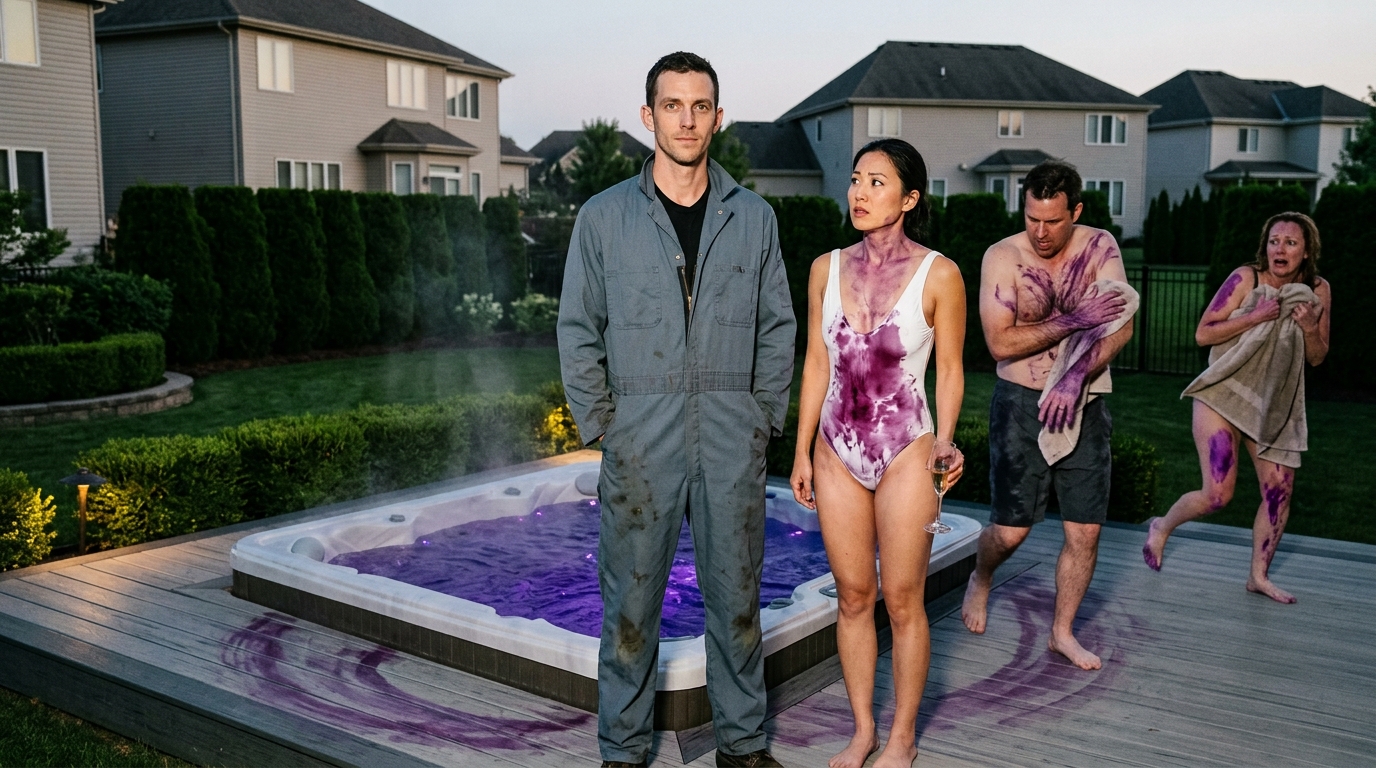
Doug stopped swinging the yellow foam noodle. He blinked down at his left forearm, where the water from the jet stream was swirling across his pale, freckled skin. A tiny streak of vivid, electric royal purple was spreading from the pore lines, blooming like ink dropped into clear gelatin.
“What the…” Doug lifted his hand out of the water. The purple didn’t wash off. It clung to his skin, brightening as the air hit it, staining his wrist a deep, metallic violet. “Hoa? What is this?”
“It’s just the lighting,” Hoa snapped, though her own glass wavered. “He put some cheap mood lights in the—”
“It’s not lights,” Cheryl gasped from the corner seat. She was already scrambling backward, her nails scraping against the non-slip plastic flooring as she looked down at her own knees. They were solid purple. Not a faint tint. A brilliant, unapologetic, permanent dye that looked like she’d been dipped in grape concentrate. “It’s on my legs! It’s on my swimsuit!”
The panic didn’t start with a roar; it started with the wet, slap-dash sound of three grown adults trying to exit a four-hundred-gallon basin at the exact same time.
Doug slipped on the top step, his knee striking the edge with a dull thud that sent a cascade of violet-tinged foam spilling over the cedar decking. Cheryl shrieked, clutching her towel like a shield, her arms already half-covered in purple splotches where she’d tried to wipe the water away.
Hoa remained in the center, frozen. She looked down at her chest, where the water line met her white swimsuit. The fabric had absorbed the dye instantly, turning a deep, rich plum color that crept up toward her collarbone like a chemical bruise.
“What did you do?” Her voice finally lost its smooth, committee-meeting polish. It came out thin, raspy, sharp enough to cut. “What did you put in here?”
“A tracing agent,” I said, stepping back just enough to clear the splash zone as Doug stumbled past me, cursing under his breath as he tried to scrub his arm with his dry towel, only to spread the purple in dark, frantic streaks across his chest. “Industrial grade. Nontoxic. Harmless to skin, harmless to plumbing.”
I paused, letting the silence from the surrounding yards settle into the space between us.
“It only reacts to heat,” I added. “And it takes about three weeks of continuous scrubbing with industrial pumice to break the molecular bond. Longer if you use hot water.”
Hoa climbed out of the tub slowly. She didn’t hurry like the others. She stood on the wet deck, her expensive white suit ruined, her skin from the neck down transformed into a mottled, violet nightmare. The champagne flute was still in her hand, but the glass was shaking so hard the remaining liquid was sloshing over her stained knuckles.
“This is assault,” she whispered, her teeth clacking once. “This is chemical warfare. I will have the county health board close this entire lot by morning. I will have your deed revoked.”
“You can try,” I said. “Permits are filed. The survey is recorded at the county courthouse. You unlocked a locked gate, bypassed a private security perimeter, and trespassed on private property to use an unmonitored electrical installation.”
I pointed toward the corner of the eaves, where the small green light of the optical camera was steady and bright.
“The feed went straight to a off-site cloud server three minutes ago,” I said. “Including the part where you used a hand tool to lift the gate latch.”
Hoa stared at me. For the first time since I’d moved into Woodpine Ridge, the mask slipped. Behind the visor, behind the clipboard, behind the endless passive-aggressive memos about grass height and neutral paint palettes, there was something cold, calculating, and deeply vicious.
She didn’t apologize. She didn’t threaten to call her lawyer again.
She simply leaned in, the smell of warm chlorine and metallic dye thick between us, and spat a single sentence before turning toward the gate: “You think this is about a hot tub, software boy? Check your property assessment next month. See what happens to your equity when the board logs a Class-4 environmental hazard on your parcel index.”
She turned and marched out the gate, her purple heels leaving wet, dark prints along the concrete path.
I stood alone in the yard. The water in the tub was still bubbling, a deep, glowing violet under the low-voltage lights. The air felt colder now, heavy with the scent of wet cedar and something else—something metallic that didn’t come from the dye.
I walked over to the control box on the side of the tub to shut down the main pump. As I lifted the plastic maintenance panel, my fingers brushed against something taped to the inside of the housing—something that shouldn’t have been there.
It was a small, weather-sealed junction box wired directly into my home’s primary ground line, stamped with a tiny, white inventory tag that read: Ledger-9 / Node-04.
I didn’t touch it. I pulled my hand back, feeling the cold air hit my palm.
I looked toward the dark fence line where Hoa had disappeared. The purple dye on the deck was already drying into a permanent, dark stain on the wood.
CHAPTER 3: THE VIOLET FALLOUT AND THE AUDIT TRAIL
My fingers didn’t shake, but the skin across my knuckles felt tight, cold, and stripped of grease.
I knelt on the damp composite deck beside the maintenance hatch, the smell of warm, dye-stained chlorine clinging to my fleece sleeves. The small junction box sat wedged behind the main pump capacitor, tapped directly into my home’s auxiliary breaker line with two non-standard wire piercers.
Someone hadn’t just used my backyard for a party. They’d spliced my grid.
I reached into my pocket, pulled out the heavy brass lock cylinder, and used its hardened tailpiece to gently tip the junction cover open. A single red LED pulsed once every three seconds inside the resin casting. No brand markings. No serial number—just the thermal-printed label on the side: Ledger-9 / Node-04.
I snapped a macro photo with my phone, logged the MAC address flashing on my network scanner, and cut the splice with a pair of insulated wire shears. The red LED died instantly with a faint, pathetic click.
By six in the morning, the suburban fog was sitting low over the manicured hedges of Woodpine Ridge, turning the streetlights into dim, yellow smudges. I didn’t sleep. I sat at the kitchen island, three terminal windows open across my primary monitor, tracking the IP traffic that had bounced off that tapped node over the last forty-eight hours.
The signal wasn’t pulling bandwidth from my home internet. It was injecting data. Small, encrypted packets sent every night at 3:15 AM straight to an off-shore cloud gateway, formatted in standardized real-estate ledger files.
A soft tap against the front door glass broke the hum of my cooling fans.
I didn’t rush. I walked to the entry, pulled back the blind two inches, and saw Devon standing on the porch. He was wearing an oversized oil-stained canvas coat, a lukewarm gas-station coffee cup held in his right fist, his fingernails permanently lined with grease from the testing lab.
I unlocked the deadbolt and pulled the door inward.
“You look like hell, Sam,” Devon said, stepping past me without asking, his heavy work boots leaving faint gray rings of road salt on the entryway mat. He set the coffee cup on the island and reached into his jacket, pulling out a sealed aluminum pouch. “I brought the neutralizer for your pump filters. But judging by your screen, you didn’t call me at midnight because you were worried about purple plastic.”
“Look at this,” I said, pointing the brass cylinder toward the center monitor.
Devon leaned over, his brow furrowing as he squinted at the raw hex dump. His eyes scanned the address headers, his thumb automatically rolling a strip of blue painter’s tape into a tiny, tight cylinder—his nervous habit whenever a diagnostic didn’t add up.
“That’s not home automation code,” Devon muttered, his voice dropping an octave. “That’s a remote telemetry tap. It’s monitoring utility draw, occupancy cycles, and… wait. Look at the file tag on packet forty-two.”
I zoomed in. Nestled in the raw metadata behind my utility meter reading was a document string: WV_REPOSSESSION_TRIGGER_FLAGS. Beneath it, an external record reference code was highlighted in pale yellow text: Title-Void.
“What is Title-Void?” Devon asked, looking at me. “Sounds like an insurance clause.”
“It’s a lien-trigger script,” I said, my voice dangerously calm. “Hoa isn’t just running an aggressive HOA board. She’s using utility taps to manufacture code violations on specific properties. If a owner goes out of town, the tap spikes the water or power readings, logs an uncorrected hazard, and triggers an automatic lien through a blind third-party servicer.”
Devon took a slow sip of his cold coffee, his eyes fixing on the junction box sitting on my desk. “She’s trying to force foreclosures?”
“She’s trying to tank the valuation of specific parcels so someone else can buy the deeds for pennies,” I corrected. “The hot tub parties weren’t just entitlement. They were cover to get physical access to my breaker box without setting off my perimeter alarms.”
A loud, metallic rattle echoed from the street outside—the unmistakable sound of a heavy diesel engine idling in front of my driveway.
I moved to the window, sliding the blind aside. A white, unmarked municipal van was parked by my mailbox. On the driver’s side door, a magnet bore the official seal of the County Environmental Health Department.
A tall man in a navy windbreaker stepped out, holding a silver clipboard in one hand and a digital water-testing probe in the other. Behind him, standing on the sidewalk in a beige trench coat with a high silk scarf wrapped tightly around her throat to hide her violet-stained neck, was Hoa.
She wasn’t smiling today. Her eyes were sunken, dark, and hollowed out by rage, her posture stiff as a steel rod. Beside her stood Doug, his hands tucked deep into his coat pockets, his wrists still visibly stained a dark, mottled lavender beneath his cuffs.
“They brought a health inspector,” Devon whispered, standing behind my shoulder. “Sam, if that guy logs a chemical hazard on your property title today, it triggers the automatic municipal hold.”
“Let him inspect,” I said quietly, reaching onto the counter and picking up my brass lock cylinder, sliding it into my coat pocket until the metal sat warm against my hip. “He’s about fifteen minutes too late.”
I unlocked the front door and stepped out onto the porch into the cold, damp morning air, letting the screen door click shut firmly behind me.
Hoa took two steps up my driveway, pointing a manicured, slightly purple finger at the side gate.
“That’s him, Inspector,” Hoa said, her voice raspy, carrying clearly over the diesel rumble of the van. “That’s the parcel owner who released illegal industrial contaminants into the neighborhood drainage system last night.”
The inspector looked up from his clipboard, his face neutral, bored, and tired. “Mr. Sam?”
“Yes,” I said, staying on the top step, my hands resting loosely in my pockets. “Can I help you?”
“We received an emergency complaint regarding toxic discharge from a private spa unit,” the inspector said, taking a step toward the porch. “I need to sample your secondary line and inspect your electrical panel for unauthorized modifications.”
“You’re welcome to test the water,” I said smoothly, stepping down one stair. “My friend from the regional industrial testing lab is inside with the certified neutralizer logs. But as for the electrical panel…”
I looked past the inspector, locking eyes with Hoa.
“I’ve already removed the illegal tap,” I said, keeping my tone completely level. “And I’ve already forwarded the raw telemetry data, the MAC address, and the Ledger-9 file manifests straight to the County State’s Attorney Fraud Unit.”
Hoa didn’t flinch, but her right hand twitched violently inside her trench coat pocket, her knuckles bunching against the fabric.
“You’re bluffing,” she spat, her voice dropping into a razor-thin whisper that the inspector couldn’t hear. “You’re a software contractor. You don’t know how the county land registry works.”
“I know how a database works,” I replied, taking the final step onto the driveway until I was standing less than three feet from her. “And I know that when a property deed gets tagged with Title-Void, the money doesn’t go to the neighborhood maintenance fund. It goes to a shell account registered under your maiden name.”
The silence that followed was absolute. Even the idling diesel van seemed to fade into the background.
Doug shifted his weight nervously, stepping back toward the curb, his eyes darting between Hoa and the inspector. “Hoa… what is he talking about? What’s Title-Void?”
Hoa didn’t answer him. She stared at me, her chest rising and falling in rapid, shallow breaths, the purple stain on her throat peeking out from beneath her silk scarf like a dark, suffocating mark.
CHAPTER 4: THE CLUBHOUSE CONFRONTATION
Hoa didn’t make a scene on my driveway. She slowly unbunched her fist inside her trench coat, smoothed the front of her collar, and turned on her heel without offering a single word to Doug or the health inspector.
She didn’t need to speak. Her silence was a tactical retreat to higher ground.
By seven that evening, the Woodpine Ridge Community Clubhouse smelled of harsh floor wax, damp coats, and industrial drip coffee. Forty residents sat on folding metal chairs arranged in ragged arcs across the linoleum. At the front, behind a long folding table draped in dark blue felt, sat the board.
Hoa occupied the center chair. She wore a high-collared charcoal sweater—no scarf tonight—her jaw set like poured concrete. The faint lavender edge along her hairline was dusted over with thick foundation, but under the harsh fluorescent tubes, the skin looked bruised, chalky, and raw.
“This emergency session of the Woodpine Ridge Board of Directors is called to order,” Hoa announced, her voice projected with practiced, clipped precision. She didn’t look at me where I stood near the back wall, my back against the brick pillar, my thumbs hooked into my coat pockets. “Item one on the agenda: an immediate special assessment and emergency lien authorization for Lot forty-two.”
A low murmur rippled through the row in front of me. Rick, a retired machinist who lived near the entrance, shifted in his chair and turned his head. “Special assessment for what, Hoa? Sam’s place?”
“For willful endangerment of community infrastructure,” Hoa said, lifting a manila folder from her stack and slapping it against the felt. The heavy thwip echoing off the cinderblock walls cut through the murmuring. “The board has received documented reports of chemical discharge into the common drainage easement. Furthermore, an independent audit of municipal records indicates unauthorized high-voltage connections on the property.”
“That’s a lie,” Devon’s voice cut through from three chairs over. He didn’t stand, but he held up his phone, the screen displaying a certified digital receipt. “The county inspector signed off on the water quality five hours ago. Neutralized, non-hazardous, zero runoff into the storm drains.”
Hoa didn’t even tilt her head toward him. “The county inspector handles public water, Mr. Vance. The board enforces private covenants. Under Section Nine of the neighborhood charter, any unapproved physical modification that causes reputational or structural harm to the association grants the executive committee immediate power to issue an administrative hold on the property deed.”
She reached for a fountain pen resting beside her gavel block.
“I move for a board vote on the immediate filing of an administrative hold against Lot forty-two, effective eight o’clock tomorrow morning.”
“Seconded,” Doug muttered from the end of the table. He was wearing long sleeves pulled down over his palms, his shoulders hunched, refusing to meet anyone’s eye.
My left thumb pressed against the cold brass cylinder in my pocket. I pushed off the brick pillar and walked down the center aisle. The screech of metal chair legs scraping linoleum followed me as neighbors leaned out of the way.
“You’re missing a page from that folder, Hoa,” I said.
Hoa’s hand paused two inches above the gavel. “You are out of order, Sam. You do not have the floor.”
“Page fourteen,” I continued, reaching the edge of the felt table. I didn’t raise my voice. I pulled a single folded sheet of laser-printed paper from my jacket and laid it flat over her manila folder, covering the assessment draft. “The physical routing manifest for Syndicate-Node seven. The one tapped directly into the street transformer behind the clubhouse.”
The air in the room went thin.
Rick leaned forward from the front row, squinting at the paper. “What’s a node?”
“It’s a data bridge,” I said, keeping my gaze locked on Hoa’s pale, unblinking eyes. “It doesn’t just read power meters. It alters the digital logs before they hit the county tax assessor’s database. It inflates utility usage on selected homes by three hundred percent over a ninety-day window. When the owner can’t pay the ghost bill, the board files a silent administrative lien.”
“This is absurd,” Hoa said, her voice dropping into a low, terrifyingly steady rhythm. “You are throwing around technical jargon to distract from your own civil liability. You flooded my board members with chemical dye.”
“The dye was harmless,” I said. “The paper trail isn’t.”
I turned around to face the forty residents sitting in the folding chairs.
“How many of you have received an unexplainable utility surcharge from the board in the last six months?” I asked. “How many of you got a notice saying your equity was flagged for a covenant breach you never saw?”
Slowly, three hands went up in the middle row. Then Rick raised his. Then two more near the back door.
Hoa slammed the wooden gavel down against the block. The sharp CRACK cracked through the room like a pistol shot.
“This meeting is adjourned!” Hoa stood up, her chair scraping violently back against the wall. “Security will clear the room! Any member remaining on common grounds past eight-thirty will be cited for unlawful assembly!”
She snatched her manila folder from the table, but as she pulled it back, her thumb slipped across the edge of my printed manifest. The sheet tore cleanly in half, revealing the bottom line of the metadata underneath: WV_SYNDICATE_REALTY_HOLDINGS.
I reached down and picked up the torn half off the felt table.
“You can adjourn the meeting, Hoa,” I said softly, as the room dissolved into raised voices and scraping chairs around us. “But the court date is already set for Thursday morning. And I’m bringing the junction box to the judge.”
Hoa looked at the torn paper in my hand, then up at my face. Her jaw twitched, the thick foundation along her jawline cracking slightly under the sweat forming at her temples.
“You think a county judge is going to take the word of a hermit software engineer over a licensed property manager?” she whispered, her voice venomous, stripped of every last shred of suburban decorum. “By Thursday morning, your parcel won’t even be in your name.”
CHAPTER 5: THE COURTROOM SETTLEMENT
Hoa’s threat was still ringing in my mind when the heavy, brass-latched double doors of Courtroom 302 swung shut behind us.
The morning sun cut through the tall, frosted windows of the municipal building, laying pale yellow rectangles across the polished oak pews. The courtroom smelled of institutional floor wax, stale coffee, and the cold, metallic tang of an old air filtration system.
I sat at the defense table, my wool coat folded over the back of the wooden chair. On the polished table surface before me rested three items: my laptop, a sealed anti-static bag containing the spliced Ledger-9 junction box, and the heavy brass lock cylinder I’d carried in my pocket since this war began.
Two yards to my left, Hoa sat flanked by a sharp-faced attorney wearing a charcoal pinstripe suit. She wore a high-collared beige dress, her hair pulled into a tight, flawless bun. But under the unforgiving courtroom lighting, her makeup couldn’t fully conceal the faint, stubborn shade of lavender staining the skin beneath her jawline.
Judge Vance, a broad-shouldered woman with silver hair and wire-rimmed glasses, adjusted her robe and tapped her pen against her notepad.
“We are here in the matter of Woodpine Ridge Homeowners Association versus Sam Miller,” Judge Vance announced, her voice flat and practiced. “Plaintiffs allege civil nuisance, property damage, and intentional release of hazardous materials. Defendant has filed a counter-claim alleging fraudulent lien activity, systemic harassment, and unauthorized network tampering.”
Hoa’s attorney stood, smoothing his lapels with a single, practiced movement. “Your Honor, my client simply seeks to enforce basic community standards. Mr. Miller released an industrial dye into a shared amenity, causing severe emotional and physical distress to board members.”
“The amenity was on my deeded property, Your Honor,” I said, standing up without waiting for a prompt. I didn’t raise my voice. I pulled up a file on my laptop and turned the screen forty-five degrees toward the bench. “And the water was contained entirely within a closed-loop system behind a locked six-foot fence.”
“He set a trap!” Hoa blurted out, her composure slipping for a fraction of a second as she leaned across her counsel’s arm. “He intentionally modified the heating element!”
“I added a heat-reactive tracing agent to my private spa to locate a thermal leak,” I replied smoothly. “You only came into contact with it because you picked a padlock, breached my perimeter, and entered my water without authorization.”
Judge Vance looked over her glasses at Hoa. “Is it the plaintiff’s position that board authority includes entering locked backyards unannounced?”
Hoa’s lawyer cleared his throat quickly. “Your Honor, the core issue is the financial and environmental damage—”
“The core issue,” I interrupted, stepping forward to lay a thick stack of printed network manifests onto the clerk’s desk, “is why the board needed physical access to my breaker panel in the first place.”
The paper hit the desk with a heavy, hollow thud.
“That junction box in the static bag,” I said, pointing to the defense table, “was spliced directly into my home’s primary utility ground. It contains a hardwired telemetry unit stamped Syndicate-Node. It wasn’t installed to measure water temperature. It was injecting ghost data into the county assessor’s digital queue.”
Hoa’s attorney frowned, glancing down at his own notes. “Your Honor, this is irrelevant technical—”
“It is entirely relevant,” Judge Vance cut in sharply. She picked up the top sheet of the manifest I’d provided, her eyes scanning the hex logs and IP routing headers. “Because this court received an emergency filing two hours ago from the State’s Attorney Financial Crimes Division.”
Hoa went completely still. Her hands, resting flat on the counsel table, began to tremble.
“The registry records for Woodpine Ridge,” Judge Vance continued, her voice growing colder with every word, “show a pattern of thirty-two forced administrative liens over the last three years. Every single one was triggered by automated utility anomalies flagged under code Title-Void. And every single flagged parcel was subsequently purchased at distress auctions by a single entity: WV Syndicate Realty Holdings.”
Judge Vance turned the page, her eyes locking onto Hoa.
“An entity where the sole registered managing partner is listed under your maiden name, Ms. Hoa.”
The courtroom fell into an absolute, suffocating silence. Behind us, in the spectator rows, Rick and three other Woodpine Ridge residents sat up straight, whispering in low, furious hushes.
Hoa’s lawyer looked at his client, his jaw slightly open, his hand slowly sliding away from her file folder. “Client… did not disclose this corporate structure.”
“I… I was protecting the neighborhood’s long-term solvency,” Hoa stammered, her voice losing its crisp authority, cracking on the final word. Her fingers clutched at the edge of the oak table, her manicured nails digging into the varnish. “The covenant allows for administrative recovery when properties fall behind on—”
“The covenant does not override state fraud statutes, Ms. Hoa,” Judge Vance declared. She picked up her heavy wooden gavel. “Plaintiff’s motion for emergency injunction is dismissed with prejudice. On the counter-claim, I am issuing an immediate freeze on all HOA accounts pending a full forensic audit by the State Receiver.”
She slammed the gavel down.
CRACK.
“Court is adjourned. Federal marshals are waiting in the corridor.”
Hoa sat frozen as Judge Vance stood and exited through the rear doors. Her attorney gathered his briefcase without looking at her, snapped it shut, and walked quickly out the side aisle.
I stood at my table, slowly folding my laptop shut and placing the brass lock cylinder back into my pocket.
Hoa turned her head toward me. The mask was gone. The polished suburban president was entirely gone, replaced by a hollowed-out, cornered figure sitting alone at a bare wooden table, her hands still faintly stained violet under the bright courtroom lights.
“You ruined this community,” she whispered, her voice barely audible over the sound of the marshals entering through the double doors behind her.
“No,” I said, slinging my coat over my arm. “I just put a lock on my gate.”
CHAPTER 6: THE QUIET WATER AND THE NEW PERIMETER
The heavy oak doors clicked shut behind me, muting the sharp scrape of chairs and the muffled, mechanical reading of federal rights inside Courtroom 302.
Outside, the hallway was wide, silent, and lined with marble pillars that reflected the gray afternoon sky. I didn’t linger near the elevators. I stepped down the wide stone staircase, my thumb tracing the cold, notched edge of the brass lock cylinder in my coat pocket.
The weight felt different now—not like a weapon waiting to be thrown, but like a key that had finally turned in a stubborn lock.
By dusk, the storm clouds that had hovered over Woodpine Ridge for three days broke apart, leaving thin strips of amber light burning across the damp cedar fences. The neighborhood was eerily still. There were no white municipal vans parked along the curbs, no clipboards glinting under streetlights, and no forced laughter echoing across manicured lawns.
A federal receiver’s notice was posted on the front glass of the community clubhouse, printed on stiff white cardstock that fluttered slightly in the evening breeze.
I walked down my gravel side path, my boots making a slow, deliberate crunch against the stone. The side gate moved smoothly on its hinges, silent and greased. I reached out, engaged the heavy mechanical deadbolt, and listened to the solid, metallic clack of the hardened steel throw seating itself into the frame.
The yard was empty. The composite decking had been scrubbed clean, the faint violet rings from three nights ago completely neutralized by Devon’s solution.
I took off my wool jacket, draped it over the wooden bench, and walked to the edge of the spa.
The cover folded back with a soft, heavy vinyl sigh. Inside, the water was crystal clear, completely still, reflecting the deep indigo of the fading evening sky. No dye. No unauthorized utility taps hidden beneath the maintenance hatch. The small cut wires where the Ledger-9 box had once spliced into my ground line were stripped back, capped, and sealed inside a weatherproof junction sleeve I’d installed myself an hour after returning from court.
I sat on the wooden step, pulled off my boots, and lowered my feet into the warm water.
The heat hit my ankles first, creeping up through my tired calves, unknotting muscles that had been braced against tension for three straight weeks. The internal pump hummed—a soft, steady, subterranean purr that resonated through the deck boards.
A low creak echoed from the cedar fence.
I didn’t reach for a phone or glance toward the optical camera mounted on the eaves. I simply turned my head.
Rick stood on the other side of the boundary line, holding a small wooden box filled with hand tools. His sleeves were rolled up past his elbows, his forearms dusted with fine sawdust from his workshop.
“The board held an emergency roll call at five,” Rick said quietly, leaning his forearm against his side of the top rail. “Victor—the guy from lot twelve, retired Marine—is stepping in as interim president until the state receiver clears the accounts.”
I leaned back against the ergonomic headrest, my shoulders sinking two inches into the warm water. “And the assessment hold?”
“Dissolved,” Rick said. He tapped the fence post once with his knuckles, a solid, respectful knock. “The receiver purged every Title-Void tag from the county database before lunch. Turns out when you rip out the Syndicate-Node in the clubhouse basement, the ghost billing stops cold.”
He paused, looking down at the newly reinforced latch on my gate.
“Victor asked me to drop by,” Rick added, his voice lowering. “Wanted me to tell you that the new board is passing an amendment on Monday. Section Nine is being rewritten. What happens behind a homeowner’s fence stays behind their fence. No exceptions. No clipboard inspections.”
“Good,” I said.
Rick nodded, shifted his toolbox under his arm, and turned to walk down his driveway. “Enjoy your swim, Sam.”
“Thanks, Rick.”
I reached over to the side panel and pressed the main jet control. A soft pulse of pressurized water surged through the brass nozzles, swirling the surface into a smooth, rhythmic vortex.
I pulled the brass lock cylinder from my pocket one last time. I looked at the worn ridges, the dull sheen of the machined metal, and the faint silver scratches where I’d used it as leverage against the junction box cover.
Then I set it down on the dry cedar ledge beside my glass of ice water.
I leaned my head back against the rim, closing my eyes as the steam rose into the cold night air. The neighborhood around me was dark, quiet, and completely still—not the artificial, suffocating silence of enforced rules, but the clean, honest peace of a line clearly drawn and permanently held.
The water bubbled softly in the dark, warm, clear, and entirely mine.