The Weight of the Line: A Novel of Property, Precision, and the Dusty Gray Boundary
CHAPTER 1: THE INTRUSION
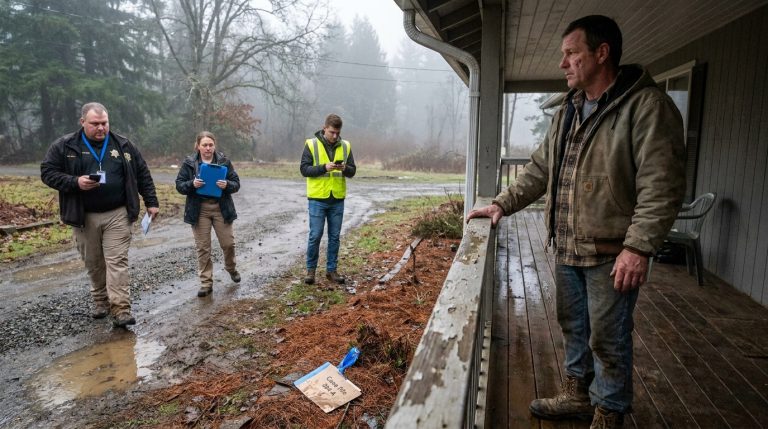
The midday heat sat heavy over the ridge, thick with the smell of baked pine needles and dry iron dust. Up here, past the last manicured lawn of the development, the road lost its asphalt skin and turned to packed shale. My boots found the familiar, unyielding lip of the retaining wall I’d poured six summers ago. It was solid work—six-inch steel anchors driven deep into the mountain’s rib cage so the spring runoff wouldn’t carry the turnout down into the valley. It was mine by deed, by sweat, and by the simple law of the slope.
Then the white SUV cleared the rise, its tires crunching over the loose gravel with a slow, deliberate arrogance. Magneted onto the driver’s side door was the green-and-gold crest of the Homeowners Association. It didn’t belong on this side of the cattle guard.
Karen stepped out before the dust could settle. She wore pressed canvas trousers and hiking boots that had never seen mud, her face set in that bright, transactional smile common to people who believe public safety is something you buy in a boutique.
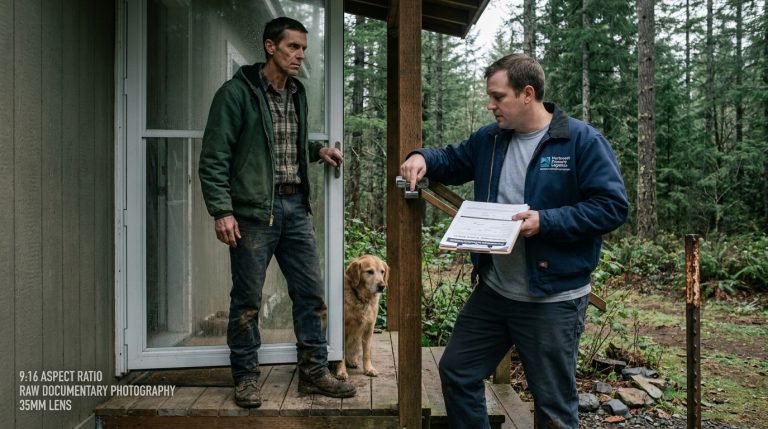
“Good to finally meet you,” she said, extending a hand. I kept my palms flat against the handle of the grease gun I was holding. She didn’t let the smile drop. Instead, she pivoted toward the mountain gate, her eyes measuring the heavy timber posts and the padlocked chain. “We’ve been reviewing the Ridge Emergency Flow parameters. Your gate and turnout came up in the sub-committee audit.”
“My gate isn’t in your subdivision, Karen,” I said. The sun beat down on the roof of her vehicle, the metal ticking as it expanded in the heat.
“This isn’t adversarial,” she replied, her voice dropping into a low, practiced register of communal concern. “We’re looking at wildfire readiness. Emergency apparatus sweep. Community circulation. Your current configuration may need to be modified for the safety of the entire ridge.”
“Modified by who?”
“By whoever needs to make the ridge safe,” she said, her fingers tapping the edge of the glossy packet she held against her hip. She looked past me, her gaze lingering on the stone base of the retaining wall, checking for cracks, checking for weakness.
She left five minutes later, leaving the packet on the hood of my truck like a summons. I didn’t watch her drive down. I walked to the edge of the turnout where the culvert cleared the silt. A flash of orange caught my eye in the dry weeds near the ditch. I knelt, the gravel biting into my jeans, and pulled back the brush. The iron boundary pin—the one driven into the granite by the county surveyor in eighty-four—was missing its yellow plastic cap. The dirt around it was fresh, loose, disturbed within the last forty-eight hours. Someone had already been up here with a shovel, measuring the dirt in the dark.
CHAPTER 2: THE PAPER TRAIL
The sharp edge of the missing plastic cap left a raw imprint on my thumb as I rubbed the bare, rusted iron of the surveyor’s pin. The dirt was still cold beneath the top layer of sun-baked shale, meaning whoever dug this out had done it under the cover of the early morning mist, long before the white SUV had climbed the ridge. I stood up slowly, brushing the dry earth from the knees of my jeans, my gaze tracking the fresh tire tracks Karen had left in the gravel. The ridge wind caught the edge of the glossy packet she’d abandoned on the truck’s hood, making the heavy paper snap like a small pistol shot in the silence.
I walked over, picked up the folder, and flipped it open. The pages were crisp, high-grade bond paper that felt out of place against the grease-stained metal of my fender. It was filled with colorful, multi-layered aerial overlays and high-resolution topographies of my parcel. My turnout was circled in a clean, professional red gradient, labeled Choke Point Alpha: Common Access Constraint.
But as my eyes skimmed the neat legend at the bottom of the schematic, something froze. The document cited the Route 9 Bypass Easement guidelines, an old county framework from the late nineties that had been superseded twice since the valley began expanding. Even more specific was the document footprint in the lower margin—a tiny, standard system index number indicating the file had been pulled from the county archive queue weeks before Karen ever made her little speech about neighborly cooperation.
I left the truck where it sat, grabbed the folder, and walked into the small workshop behind my cabin. The air inside smelled of machine oil, iron filings, and old paper. I sat at the wooden bench, the worn timber smooth under my palms, and booted up the old desktop monitor that connected directly to the county land records database.
A memory broke through the routine—a brief conversation two years back with an old clerk named Miller at the hall of records. He’d mentioned offhand that the original Calaveras Drainage Survey maps were being digitised, but the physical copies were being kept in a restricted annex due to structural corrections made during the early phases of the ridge development down below. At the time, I’d ignored it. Now, looking at the digital file properties of the PDF Karen had provided, the creation date read exactly four days prior to her visit, but the base map layout—the actual digital template—had been modified from an internal county template titled Calaveras_Sub_Drainage_Bypass.
I pulled up the current public version of the county wildfire safety guidance. I printed out the active three-page section regarding private road access and laid it flat next to Karen’s packet under the harsh light of the desk lamp. Section 4, Paragraph B was clear: an HOA had zero jurisdictional authority to enforce structural compliance or modify lawful, pre-existing access points on non-member private land, unless an active county code enforcement order was filed.
I checked the county database for active enforcement orders on my parcel. Nothing. The screen was clear, showing only my clean deed and the approved eighty-four structural variance for the retaining wall.
Karen hadn’t gone to the county to get an order because she couldn’t get one. Instead, she had taken the public safety language from the county website, copied the typography, and mapped it over an outdated easement drawing to make it look like an official mandate. She was building a paper maze, hoping the sheer weight of the technical jargon would make me sign the consent form attached to the back of the packet before I looked at the law.
I took out my phone, opened the camera app, and methodically photographed every page of her packet under the steady white light of the lamp, ensuring the native file indices in the margins were perfectly clear. I saved the images into a secure local folder named Ridge_Dispute_Log, alongside the driveway camera footage showing the exact arrival and departure times of her white SUV.
Outside, the mountain wind shifted, rattling the loose corrugated iron on the workshop roof. The sun was dipping below the ridge now, casting long, sharp shadows across the dry valley floor below, where the lights of the modern subdivision were just beginning to blink awake, orderly and uniform behind their clean, white fences.
CHAPTER 3: THE LINE IN THE DIRT
The amber glow of the desktop monitor flickered as the cooling fan spun down, leaving only the low, metallic hum of the hardware in the workshop. I didn’t shut the terminal off. The digital file registry for the Calaveras Drainage Survey remained burned into the screen, a luminous grid of dates and unapproved modifications. The mountain wind had quieted to a low hiss through the floorboards, but the peace didn’t last. A heavy, rhythmic vibration shuddered through the stone foundation of the workbench—the distinctive, low-frequency thrum of an uninsulated diesel block climbing the grade.
I stood up, the joints in my hands stiff from the hours spent clicking through decades of county archives. Walking to the small, grimy window facing the turnout, I pulled back the canvas curtain. The sun hadn’t broken the peak yet, but the dawn was bright enough to illuminate the large flatbed trailer cutting the corner past my mailbox.
Towed behind a scarred utility truck, the trailer bounced hard over the transition from the asphalt to my shale driveway, its steel ramps clattering against the frame. On the door of the truck, stenciled in faded black block text, was the name of a local excavation firm. Beneath it, a secondary clearance sticker listed the registry identifier for the Route 9 Bypass Easement operations.
The vehicle ground to a halt directly inside the mouth of my turnout, its exhaust plume hanging thick and grey in the cold morning air. Two men in high-visibility vests dropped down from the cab. One immediately unlatched the trailer gates, while the older one, his face lined like dry creek mud under a grease-stained cap, pulled a long, metal-tipped measuring wheel and a canister of commercial marking paint from the truck bed.
I stepped through the workshop door, the iron latch snapping shut behind me with a clean, heavy report. The gravel crunched under my boots as I crossed the distance between the cabin and the retaining wall. The contractors didn’t notice my approach until the shadow of my frame crossed the hood of their truck.
The older man stopped, his gloved thumb resting on the trigger of the paint canister. A bright, neon-orange line already bled into the grey shale, cutting across the corner of my masonry, exactly four feet inward from the original property line.
“Who authorized the layout?” I asked. My voice remained level, flat, matching the cold temperature of the stone wall beneath us.
The worker looked up, his jaw shifting as he glanced down the hill toward the subdivision. “Emergency sweep clearance normalization. The board contact said the county parameters were cleared for the safety lane.”
“The board contact doesn’t own the dirt under your boots,” I said, pointing down at the freshly painted stripe. “And that paint is on private property. Turn the loader off.”
The younger worker, who had been unhooking the tie-down chains from a compact front-end loader on the trailer, froze with his hand on the binder lever. He looked at the older man, then back at me, noticing the small camera lens of my phone already active and recording from my chest pocket.
Before the older contractor could answer, a car door clicked shut further down the rise. Karen had parked her SUV fifty yards back, out of the immediate dust zone, but she was already walking up the slope. She wore a bright red windbreaker today, the fabric rustling loudly against the quiet of the ridge. Her notebook was tucked neatly beneath her forearm.
“We’re simply documenting the required clearing dimensions,” Karen said, her voice carrying that same light, administrative rhythm from the day before. She didn’t look at the paint; she looked at the loader. “The county fire inspectors require the physical layout visible before the scheduled regional circulation review tomorrow.”
“You don’t have an inspection order, Karen,” I said, keeping my eyes on the contractor with the paint canister. “You have a digital template you stole from the record queue four days ago. If that machine comes off the deck of that trailer, it’s a civil trespass with commercial intent.”
The older contractor swallowed, his thumb slipping off the paint spray trigger. He looked at the orange line, then at Karen, his professional neutrality beginning to fray under the realization that he hadn’t been given the whole story. “Ma’am,” he muttered, his tone dropping an octave. “You said the easement access was fully public.”
“The documentation is being processed,” Karen replied quickly, her smile tightening at the corners until it was nothing more than a thin, bloodless line. “This is a matter of collective preservation.”
“I don’t care about the vocabulary,” I told her, stepping between the loader and the retaining wall. “I care about the deed. Pack the tools up and clear the turnout.”
CHAPTER 4: THE DECOY UNCOVERED
The older contractor’s jaw worked in silence, his fingers loosening their grip until the neon canister clicked against the steel frame of his tool belt. He didn’t look at Karen. He looked at the hard line of my jaw, then down at the phone lens capturing the exact geometric layout of his truck, his trailer, and the bright orange streak violating my masonry. The younger man on the trailer bed slowly climbed down, his heavy work boots dragging through the loose shale with a dry, scratching rattle that seemed to amplify the sudden stillness of the ridge.
“We’re done here until the office clears this,” the older one muttered. He tossed the paint canister into the open bed of the utility truck. The metal-on-metal impact was sharp, ringing out across the slope.
Karen’s posture stiffened, the thin fabric of her red windbreaker snapping as a fresh gust of mountain air swept over the turnout. Her fingers tightened around the edge of her folder, the cardboard buckling slightly under the pressure. “This is a municipal safety review,” she said, her voice dropping its warm, neighborly glaze entirely, replacing it with a hard, clipped authority. “You are interfering with a critical infrastructure assessment.”
“I’m clearing my property,” I said. I didn’t step back. I watched the older worker pull a crumpled clipboard from the dashboard of his cab. Attached to it was a single sheet of paper bearing a poorly replicated county shield—the exact same graphic discrepancy I had pulled from the archive queue the night before.
“Check the header,” I told the contractor, pointing a grease-stained finger at the top of his sheet. “That isn’t a county work order. It’s an internal HOA planning draft labeled under the Route 9 Bypass Easement parameters. Look at the lower margin. It’s a civil request, not a legal mandate.”
The contractor squinted at the paper, his sun-cracked brow furrowing as he pulled the clipboard closer to his face. His chest heaved with a low, troubled sigh. “Ma’am,” he said, turning fully toward Karen. “This sheet says Draft Review Only. You told our dispatcher this was an enforced easement clearance for a structural non-compliance citation.”
“It is a non-compliance issue,” Karen snapped, her heels digging into the loose gravel as she took a half-step forward, trying to block the contractor’s view of the road below. “The wall violates the current regional slope standards. The documentation from the county fire marshal intake queue confirms the easement is subject to public safety adjustments.”
My phone vibrated against my chest—a sharp, double-pulse notification. I pulled it out, keeping the camera oriented toward the group. An email from my attorney had just broken through the mountain cellar network. The text was brief, containing a forwarded PDF attachment from the county code enforcement database.
I opened the document. It was a formal, stamped file titled Preliminary Easement Non-Compliance Report. According to the text, my retaining wall was explicitly cited as an unstable, encroaching structure built over a dedicated public utility corridor. The signature at the bottom belonged to a junior inspector from the county road office, dated less than twenty-four hours ago. It was a perfect decoy—a legally binding roadblock designed to strip my possessory rights and force a structural teardown under the guise of municipal safety.
But as I scrolled down to the attached engineering schematic, the physical texture of the layout exposed the lie. The background map utilized for the citation didn’t match the county’s master parcel grid. It featured the distinct, faint watermark of the old subdivision blueprints—the exact same layout lines I had seen linked to the restricted digital archives. Karen hadn’t just filed a complaint; she had systematically fed a fabricated physical boundary report into the county’s automated intake system to generate a real, enforceable notice of violation.
“You built the report backward, Karen,” I said, turning the screen of my phone toward her so she could see the stamped index number matching the file properties from my workshop terminal. “You used a junior clerk to push a fraudulent easement claim. But you forgot to clean the digital fingerprint off the master drawing.”
The older contractor didn’t wait to hear her response. He climbed into the driver’s seat of the utility truck and slammed the door. The diesel engine roared back to life, spitting a dark cloud of exhaust over the orange line in the dirt as the younger man scrambled onto the passenger side. They began backing the trailer out of the turnout, their tires throwing loose shale against the base of my wall as they retreated down the mountain.
Karen stood alone in the center of the disturbed gravel, her face pale against the vivid red of her jacket. The thin smile was completely gone now, her gaze dropping to the bright orange stripe left behind on the stone—a permanent record of her intrusion, and the first physical link in the chain that would tear her paper maze apart.
CHAPTER 5: THE STRUCTURAL AUDIT
The white SUV retreated down the slope, its brake lights flash-bleeding against the grey dust kicked up by the contractors’ trailer. Karen had left without another word, her pristine canvas hiking trousers catching the low morning light as she vanished beneath the crest line. I stood alone in the center of the scarred shale, the persistent hum of the ridge wind dry in my throat. I looked down at the orange paint stain on my stonework—it looked wet, artificial, a false border scratched into unyielding granite.
I turned on my heel and walked directly back toward the workshop, my boots striking the gravel with heavy, measured steps. The phone was tight against my palm, its screen still displaying the junior inspector’s forged stamp. Inside the structure, the smell of grease and cold metal closed in around me like armor. I dropped into the worn wooden seat before the workstation, the old hard drive whistling high as it spun out of its low-power state.
My fingers went to the keyboard. If Karen had gone as far as entering a falsified infrastructure drawing into the county queue, the motivation had to run deeper than a neighborhood traffic bottleneck. An HOA president doesn’t risk a felony records charge just to clear a tight corner for a fire truck that has never had an issue navigating the ridge.
I bypassed the standard user interface and drew up the county’s archived land development registry, specifically targeting the original corporate filings for the ridge subdivision. I needed the full, unredacted sheets of the Calaveras Drainage Survey.
The digital clock in the corner of the monitor ticked forward in sixty-second jumps while the automated database request queued against the server. The screen flickered, dumping a complex stack of raw engineering text files and blueprints into my viewing window. I focused on the lower terrace, directly underneath my mountain parcel.
According to the original public master plan, the main access road for the development below had been approved under a strict environmental layout—a mandatory retention tank system designated to absorb the high-velocity spring runoff from my ridge. The document specified the construction parameters down to the millimeter, explicitly highlighting a safety clause labeled Code Variant 41-E.
I scrolled down to the actual inspection records from four years back, looking for the final structural approval stamp. It wasn’t there. Instead, there was a series of internal technical variances signed off by the primary building contractor and an obscure subsidiary listing Karen’s husband as a managing partner.
I leaned forward, my chest tightening against the edge of the workbench. I pulled up the engineering cross-sections of the lower development’s primary culvert network. The system had been downscaled. To cut costs on the deep rock blasting required by the original layout, the developer had omitted over three hundred feet of reinforced concrete sub-drainage, routing the entire volume of the hillside’s seasonal overflow into a single, shallow earthen ditch that ran parallel to the base of my retaining wall.
The pattern snapped into focus with the cold clarity of an engineering blueprint. The lower access road wasn’t just built poorly—it was actively failing. The massive rains from the previous winter had already caused the lower slope to shift, meaning the entire subdivision’s main access route was structurally compromised. If the county engineers discovered the structural shortcut, the subdivision’s universal fire insurance status would be pulled within thirty days, crashing property values across the entire valley.
Karen wasn’t trying to clear a safety route for the neighborhood. She was trying to seize my turnout, demolish my anchored retaining wall, and use my private land to dig a massive, retroactive drainage bypass that would dump the lower development’s shifting weight onto my side of the ridge. She needed my dirt to bury her husband’s structural fraud before the county’s scheduled winter survey team arrived.
I reached out and clicked the save icon, transferring the original Calaveras Drainage Survey blueprints and the unredacted developer variances into the encrypted log folder. The metal casing of the computer felt cold under my thumb, vibrating slightly with the force of the processor. The decoy about my gate being a hazard was shattered. I had the real architecture of the deception locked in my hand, but the regional circulation review was less than twenty-four hours away, and Karen still held the official county notice that could bring the state bulldozers to my gate by morning.
CHAPTER 6: THE CONFRONATION SETUP
The low-frequency vibration of the computer tower beneath the workbench felt like a persistent, metallic heartbeat against the soles of my boots. I didn’t let my hand leave the cold steel casing until the terminal screen completed the secure backup sequence, a single green progress bar flashing once before dissolving into darkness. The extraction was absolute. The unredacted structural blueprints, the historical land variances, and the complete audit history of the valley development were now nested inside the local directory.
I pulled the iron drive key from the lower chassis slot. The small rectangular metal piece felt unusually heavy, its zinc plating tarnished by years of workshop humidity. I slipped it into my canvas pocket, the sharp corner pressing tight against my hip as I reached for the telephone receiver resting on the corner shelf.
My attorney’s office picked up on the third ring. The audio quality was thin, broken by the high-altitude interference that always crept over the ridge during the sunset cooling.
“We have the structural cross-sections,” I said, my voice matching the flat tone of the machinery around me. “The variance records show the engineering layout was altered during the initial phase. They cut the lower retaining culverts to avoid rock blasting.”
There was a long pause on the other end of the line, followed by the dry rustle of paper being pulled across a desk miles down the valley. “That alters the liability threshold completely,” my attorney replied, his breath drawing steady through the speaker. “The county notice Karen filed is scheduled for summary authentication at the open board hearing tomorrow morning. If that report is validated by the regional fire marshal rep before we introduce the land survey data, the easement execution becomes automatic.”
“The report won’t be validated,” I said. “The file she entered contains a watermarked structural layer that doesn’t exist in the public grid. I’m bringing the unredacted engineering sheets directly to the session.”
“Be careful,” he warned, his voice sharpening slightly. “Karen isn’t operating as an isolated neighbor anymore. If the subdivision’s general indemnity status is linked to that drainage ditch, the board will close ranks behind her to protect the asset value. They won’t look at the dirt; they will look at the ledger.”
I hung up the receiver without answering, the black plastic clicking hard against the wall mount.
I reached for the heavy leather binder beneath the workbench—the old logbook where I kept the historical parcel records, the original eighty-four survey maps, and the physical printouts of every piece of correspondence Karen had generated since her white SUV first cleared the ridge line. One by one, I slipped the fresh laser-printed sheets of the Calaveras Drainage Survey into the transparent sleeves, the plastic crinkling under the calloused weight of my thumbs.
As I turned to the final layout page, my gaze stopped on the lower corner of the binder’s inner sleeve. The blue encrypted thumb drive containing the legal preservation notices—the one my attorney had couched in a special protective pocket just two days ago—was gone. The fabric loop was empty, the dark nylon stretched wide as if something had been hastily pulled free.
A cold stillness settled over the workshop. The door latch was still thrown, the windows bolted from the inside. I knelt down, tracking the edge of the floorboards with my fingers until the dust gave way to a faint, dry scrape in the pine wood near the rear utility entrance. The iron bolt on the threshold had been unlatched from the exterior, the thin layer of mountain silt outside disturbed by a small, narrow boot print that had already been partially filled by the evening wind.
Karen’s layout crew hadn’t just been marking the shale turnout that morning. While the loader was idling on the ramp, someone had crossed the rear slope, breached the workshop perimeter, and removed the primary legal counter-files before the confrontation could even begin. They thought they had hollowed out my defense before the room could open.
I didn’t waste time checking the perimeter. I pulled the zinc drive key from my pocket—the duplicate I had burned in silence while the contractors were still arguing over their paint lines—and locked the leather binder shut. The moon was breaking the eastern ridge now, throwing long, silver bars of light across the gravel turnout outside, where the bright orange line of paint glowed like a scar in the dark. The papers were set, the sequence was clear, and the mountain was finally quiet, waiting for the doors of the valley boardroom to swing open.
CHAPTER 7: THE BOARDROOM EVICTION
The wood frame of the rear utility door rattled against its stop as I hauled it open, my knuckles catching on the raw, unpainted edge of the iron latch. The footprint in the dry dirt outside was already losing its definition, the fine shale dust tumbling into the narrow tread marks under the steady drag of the evening wind. They thought the theft left me hollowed out. They didn’t know about the second backup card riding in the watch pocket of my denim vest, its tiny silicone edge biting light against my ribs as I secured the leather binder under my arm.
I did not pause to lock the workshop. The mountain road was a dark, unlit ribbon of loose rock beneath the truck’s high-beams as I drop-shifted down the ridge. The steering wheel shook violently against my palms, the front tires catching the deep ruts where the seasonal runoff had chewed into the shoulder. There was no shortcut down the grade; every foot of the descent had to be paid for in hard mechanical friction, the brake pads emitting a sharp, metallic odor as I navigated the sharp switchbacks bordering the subdivision’s upper fence line.
The community center sat at the base of the slope, a brightly lit concrete block surrounded by a sea of asphalt. I killed the engine before the truck had fully settled into its suspension, checking the pocket of my vest to ensure the drive key remained seated.
The double doors of the meeting hall opened into a blast of conditioned air that smelled faintly of cheap carpet cleaner and wet wool. Every seat in the rows of folding chairs was occupied, the murmuring voices of seventy ridge residents dropping to a sudden, brittle silence as my boots hit the linoleum aisle.
At the front table sat Karen, flanked by three HOA board members and a quiet man in a crisp khaki uniform bearing the county fire marshal’s insignia. Karen had traded her red windbreaker for a dark, corporate blazer, her hair pulled back tightly enough to smooth the sharp angles of her jaw. In front of her lay the master presentation folder—the one containing the fraudulent easement documentation.
“We are reviewing the final administrative authorization for the Route 9 Bypass Easement transition,” Karen said, her voice amplified by the small desk microphone until it boomed off the exposed rafters. She didn’t look up as I reached the clearing before the dais, though her fingers stiffened against the edge of her microphone stand. “The county notice has been entered into the record. The infrastructure sweep requirements are non-negotiable under standard safety parameters.”
My attorney stepped out from the side aisle, his brief case already open on the small presentation table. He didn’t make a speech. He reached out, took the leather binder from beneath my arm, and extracted three oversized, clear plastic sleeves containing the unredacted master prints.
“The notice entered by the board is based on a corrupted parcel index,” my attorney stated, his voice carrying the flat, regular rhythm of an expert witness. He laid the first schematic directly in front of the county fire official. “We are introducing the original Calaveras Drainage Survey records, including the unamended technical variances from four years ago.”
Karen’s face didn’t change color, but a small muscle below her right eye gave a single, sharp twitch. “That documentation is obsolete,” she said into the microphone, her tone cutting sharply through the room’s mounting tension. “The active safety lane requirements take precedence over historical surveys.”
“It isn’t obsolete,” I said, my voice cutting through the hall without the aid of a speaker. I stepped closer to the front table, the zinc drive key now resting openly between my thumb and forefinger. “The layout lines you submitted yesterday don’t belong to the county. They belong to a private development variance designed to bypass Code Variant 41-E.”
The fire marshal staffer adjusted his glasses, leaning over the wide blueprints my lawyer had unrolled. His finger traced the lower culvert line—the exact point where the developer had downscaled the retention system to avoid the expense of deep rock blasting. He looked up, his gaze bypassing Karen entirely to lock onto the stenciled stamp in the margin of the original survey.
“This layout doesn’t match the municipal fire flow map,” the official noted, his voice dropping into the quiet, dangerous register of a state inspector uncovering a violation. He tapped the watermark in the corner of the sheet. “This is an unapproved developer schematic. The county didn’t issue an enforcement order for this turnout. This packet was routed through an internal board alias to mask a structural failure on the lower access road.”
A low, collective intake of breath rippled through the rows of residents behind me. The board member to Karen’s left shifted his weight back, his chair scraping loudly against the floor as he physically distanced himself from the center of the table.
Karen’s hands dropped to her lap, out of sight beneath the table line, but her shoulders remained rigid, pinned against the back of her seat like a cornered beast preparing its final, desperate maneuver. “The association possesses the emergency allocation authority,” she whispered, the microphone picking up the dry, scratching sound of her breath. “The valley insurance framework requires the normalization of that grade.”
“The insurance framework requires an honest drainage system, Karen,” I told her, my hand dropping flat onto the table, the old grease lines on my skin contrasting sharply with the clean white laminate of the dais. “And you just put your signature on a structural forgery to hide the fact that the hill below your house is already sliding into the ditch.”
CHAPTER 8: THE RESTORED BORDER
The white laminate table beneath my hand felt unyielding, vibrating slightly with the force of the room’s collective stillness. Karen did not reach for the microphone this time. Her fingers pressed so hard into her notepad that the thin cardboard backing groaned under the strain. She looked down at the highlighted cross-sections of the Calaveras Drainage Survey, where the missing retention infrastructure was laid bare in indisputable black ink.
“This board meeting is suspended,” the fire marshal official announced, his tone cutting cleanly through the ambient hum of the air conditioner. He stood up, methodically folding the master engineering maps back into their transparent protective sleeves. He turned a hard look toward Karen, his face set in stone. “The county code enforcement office will issue a formal hold on all regional flow adjustments pending a comprehensive audit of the lower division’s primary drainage infrastructure under Code Variant 41-E. This intake packet is flagged for fraudulent submittal.”
A sharp murmur broke out from the front row of residents, but Karen didn’t move to answer them. Her jaw tightened into a rigid, defensive line as she stood up, grabbed her leather folder, and marched down the center aisle without looking back. Her heels struck the linoleum floor with a rapid, frantic rhythm that faded into nothing as the double outer doors clicked shut behind her. The boardroom was hers no longer; the grid had corrected itself.
By Saturday morning, the mountain had returned to its proper temperature. The dry valley wind carried the familiar scent of sun-baked shale and pine needles across the ridge as I stood at the edge of my turnout. The heavy grey excavation truck was gone, leaving behind only the jagged neon-orange line scraped across the masonry of my retaining wall.
I knelt down in the loose gravel, the earth hot through my work trousers. I took a stiff wire brush from my tool bucket, the wire bristles scratching loudly against the rough face of the stone. With short, deliberate strokes, I began clearing the artificial paint from the wall. The bright orange flakes crumbled away under the steel teeth, tumbling down into the dirt until the natural grey granite appeared once more, clean and unmarked.
After the last of the paint was gone, I walked over to the original surveyor’s pin near the drainage ditch. I pulled the replacement plastic cap from my vest pocket—a heavy, weathered yellow marker matching the county’s original specifications. I pressed it firmly onto the top of the iron rod, tapping it home with the butt of my hand until it sat perfectly flush with the granite base. The line was locked again.
I walked up to the cabin deck, where two neighbors from the lower ridge were already sitting by the iron grill. The smell of searing meat drifted through the thin mountain air, mixing with the dry scent of the brush. Nobody mentioned the HOA meeting, the junior inspector’s report, or the hidden files. The silence that settled over the slope wasn’t empty; it was the quiet, solid peace of a boundary that had been defended and restored to its proper limit.
Down below, past the cattle guard, a single white SUV sat parked in a driveway, its magnetic logos stripped bare from the doors. I picked up a cold glass from the table, took a slow drink, and watched the afternoon shadows stretch long and heavy across the valley floor. The shale under my boots was stable, the wall was clear, and the paperwork was filed where it belonged. Around here, the mountain doesn’t move for anyone.