The Subterranean Calculus of Suburban Warfare: A Study in Drainage, Gravity, and Slow Retribution
CHAPTER 1: THE DESCENT
The porcelain of the mug was hot, but the steam rising from the black coffee died the instant it met the gray, saturated air of the porch. It was 6:14 AM. The sun was nothing more than a bruised smear behind the low-hanging rain clouds, casting a flat, shadowless light across the yard.
Then came the sound.
It wasn’t the sharp bite of metal on metal or the screech of rubber. It was a dense, visceral thump-squelch—the sound of an absolute mass losing its argument with gravity.
I didn’t move. I kept my fingers wrapped tight around the warm ceramic, watching through the morning mist as the rear passenger side of the silver SUV listed heavy to the port side. The front passenger wheel was already buried to the chrome rim in the dark, organic soup of my newly graded bioswale.
The driver’s side door flew open with a violent metallic click. Karen stepped out, her heel immediately plunging three inches into the sod I had spent three years leveling. She didn’t look at her shoes first; she looked at my porch. Her eyes, small and dark under a canopy of sprayed blonde hair, locked onto mine.
“You,” she hissed, her voice cutting through the damp silence of the street like a rusted blade. “You did this.”
I took a slow sip. The coffee was bitter, under-extracted, but it kept my jaw tight. I didn’t answer. In the logic of the street, words were currency, and I wasn’t buying. I looked past her to the front tire. It was resting precisely at the bottom of the grade, where the sub-surface drainage pipe met the compacted clay barrier. The soil there looked solid—I had dressed it with fine-bladed fescue—but underneath, it was nothing but liquid suspension.
She took two heavy, squelching steps toward the driveway, her face tightening with every cold ounce of mud that seeped into her leather flats. “I know what you’re doing. This is a hazard. I’m having this entire trench filled by the city before noon.”
I reached into my pocket, my thumb brushing the cold, textured dial of the Sentinel Trail-Cam 4K remote. I didn’t pull it out. Instead, I pointed with my chin toward the low timber post at the edge of the grass.
Tied to the post was a small, white metal plate. Wetland Restoration Area. No Vehicle Access.
“The grade is legal, Karen,” I said, my voice low, flat, and entirely devoid of the anger she was begging for. “The water has to go somewhere.”
She opened her mouth to speak, but her left foot slipped, her weight shifting hard to the right as she tried to maintain her balance on the slick clay. For a fraction of a second, the predator looked like prey.
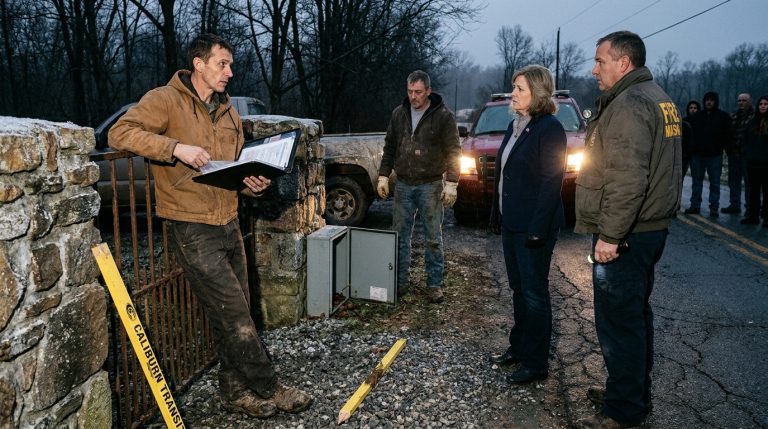
At the edge of my vision, near the property line, a small wooden stake with a faded orange ribbon caught the morning light. It wasn’t mine.
CHAPTER 2: THE SURVEYORS SHADOW
The orange ribbon fluttered, a thin strip of cheap, fluorescent plastic catching the damp draft off the street. It was tied to a splintered pine stake driven deep into the shoulder of my lawn, right where the fescue transitioned into the engineered slope of the bioswale. It shouldn’t have been there. In this county, a surveyor doesn’t plant stakes without filing a preliminary intent with the landowner. My mailbox had been empty.
Karen regained her balance with a wet, heavy slide of her heel, her fingers clawing briefly at the air before her posture stiffened. She saw me looking at the orange marker. Her eyes narrowed, the tight, defensive line of her shoulders betraying a sudden, sharp calculation.
“You like your little projects,” she said, her voice dropping from a shriek to a low, venomous rattle. She didn’t look at her sinking SUV now. She looked at the stake, then back at me. “Let’s see how much you like them when the city re-zones this entire runoff corridor.”
“The city doesn’t re-zone private drainage easements without a public hearing, Karen,” I replied. I stepped off the dry concrete of my porch, my boots sinking slightly into the saturated perimeter turf. The ground felt different here—less elastic, heavier, as if the water table wasn’t just draining, but pooling from an external source. “And they certainly don’t do it on a Tuesday morning without a notice on my door.”
She didn’t answer. Instead, she reached into her designer purse, pulled out her phone, and turned her back to me, her boots sucking loudly against the wet clay as she retreated toward the asphalt of the main road.
I didn’t follow her. I walked toward the stake.
The wood was fresh. The pine still smelled of sap and raw timber, indicating it had been driven into the earth within the last twelve hours—likely under the cover of the heavy rain we had last night. I knelt, my fingers brushing the damp, cold grain of the stake. There were no official municipal markings, no county tax map stamps. But there was a penciled code scrawled near the base, half-smeared by the wet earth: M-E / C-77.
My mind immediately cataloged the letters. C-77.
During my exhaustive review of the municipal bylaws, I had memorized the local zoning shorthand. Code-77 was the county designation for a high-volume commercial water main. But this neighborhood was residential. We were hooked up to standard eight-inch domestic lines. A commercial main required a massive, forty-foot easement. It required land.
The distant, low rumble of a heavy engine broke the quiet of the morning.
I looked up. A yellow flatbed tow truck was turning the corner, its yellow hazard lights stroking the gray bellies of the clouds with rhythmic amber flashes. The driver, a stocky man in a grease-stained high-visibility vest, slowed his vehicle to a crawl as he took in the sight of the silver SUV listing heavily into the ditch.
Karen was already standing by the curb, waving her phone like a flag, her face a mask of cold, triumphant authority. She didn’t look like a woman whose morning had been ruined; she looked like a woman who had just initiated a planned sequence of events.
“Right here,” she called out to the driver, her voice carrying over the idle of the diesel engine. “And make sure you document the depth of the trench. I need a full incident report for the county inspector.”
The driver climbed down from the cab, his boots making a loud, dry slap on the asphalt. He looked at the SUV, then at the bioswale, and finally at me. He didn’t look happy. He looked like a man who knew he was being inserted into a war he hadn’t volunteered for.
“Morning,” he muttered, nodding once toward me.
“Morning,” I said, my hand resting casually in my pocket, my thumb once again finding the ridges of the Sentinel Trail-Cam 4K remote. The camera was hidden fifty yards back in the hollow trunk of an old white oak, its lens trained directly on this corner. If someone had driven that stake last night, the footage was already sitting on the local drive in my study. “The ground’s soft off the asphalt. I’d keep your outriggers on the road.”
“I know my job, buddy,” the driver said, though he didn’t sound angry—just tired. He walked to the back of his rig and unhooked the heavy steel winch cable, the cold links clinking against the flatbed with a sharp, metallic ring that vibrated in the damp air.
I stood by the wooden stake, watching him work. Karen had retreated to the sidewalk, her eyes locked on her phone, her thumb moving rapidly across the screen. She was sending messages, but not to a towing company.
I looked back down at the stake. M-E / C-77.
M-E. Munson Easement.
The name hit me with the cold weight of a physical blow. Old man Munson had owned the entire tract of land before the developer carved it up into these neat, identical half-acre lots. He had retained a single, narrow strip of land that cut directly through my current backyard—a historical easement that had supposedly lapsed forty years ago.
If that easement wasn’t dead—if someone had quietly revived it—then my bioswale wasn’t just a drainage project. It was sitting directly on a legal fault line.
The tow truck’s winch began to whine, a high-pitched, mechanical strain that made the wet air feel even tighter. The cable went taut, cutting a deep, dark line through the grass as it lifted. The SUV groaned, its frame shifting as the mud reluctantly began to let go of its prize.
But the earth wasn’t done playing.
With a sudden, wet crack, the ground near the tow truck’s front left tire collapsed inward, the asphalt of the road shoulder shearing off in a clean, jagged line. The truck tilted forward, its massive front wheel dropping six inches into a newly opened void beneath the pavement.
The driver swore loudly, instantly releasing the winch control.
I looked at the newly formed hole. It wasn’t mud. Below the broken asphalt, the soil was entirely gone, washed away by a subterranean flow that had been silently hollowed out right beneath our feet.
Karen stopped typing. Her head snapped up, her face draining of color as she looked at the tilted tow truck and the yawning dark space beneath the road.
“What did you do?” she whispered, her voice shaking as she pointed a manicured finger at the crater. “What did you do to the road?”
I looked from the hole to the wooden stake, then back to Karen. The pieces were starting to align, and the picture they formed was far larger—and far darker—than a simple dispute over a ruined lawn.
“I didn’t do anything, Karen,” I said, my voice barely louder than the idle of the truck. “But I think we’re both about to find out who did.”
CHAPTER 3: THE CAVITY
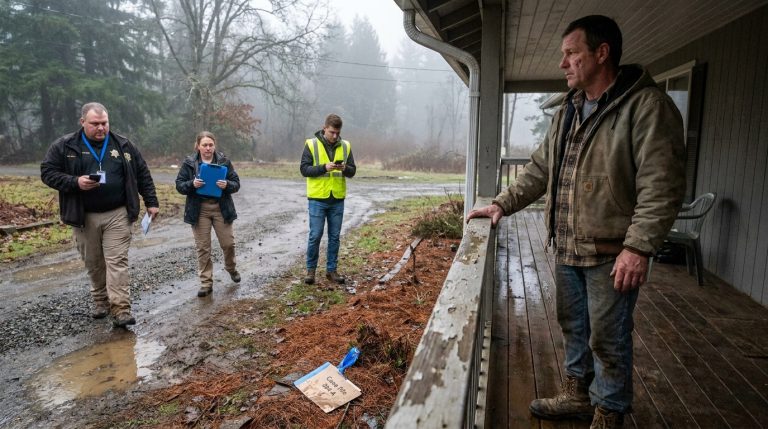
The tow truck’s rear axle lifted, a slow, mechanical groan escaping its suspension as the front left tire hung suspended in the newly opened void. Below the ragged boundary of asphalt, there was no gravel base, no supportive sub-base—only a dark, wet cavern of air where the earth had been systematically hollowed out. A steady, trickling sound rose from the darkness, the liquid hiss of subterranean water rushing past broken conduit.
The driver didn’t move for three long seconds. His hand stayed frozen on the winch lever, his torso rigid as he balanced against the cab’s tilt. His eyes locked on the black opening beneath his bumper, tracking the crumbling edges of the blacktop.
“Get back,” he breathed, the words barely carrying over the rattling diesel engine. “The whole street’s hollow.”
I took a deliberate step backward, my boots finding the solid concrete curb of my driveway. The wooden stake with its orange ribbon was vibrating slightly, the vibration carrying up from the subsoil. Karen, however, remained rooted to the yellowing turf, her manicured fingers white around her smartphone. She was staring at the hole, her mouth slightly agape, the carefully constructed mask of suburban dominance dissolving into something frantic.
“This is your fault,” she said, her voice rising, though it lacked its previous piercing volume. It was thin, reedy, vibrating with a panic she couldn’t quite contain. “Your trench… your stupid swamp drained the support right out from under the road.”
“Water doesn’t flow uphill, Karen,” I said, my voice deadpan. My hand remained in my pocket, fingers resting against the cold casing of the Sentinel Trail-Cam 4K remote. “The bioswale is three feet lower than the road bed. For the road bed to collapse like this, something had to be pumping high-pressure water under the asphalt from the opposite side. Like a leaking municipal line.”
“No,” she said instantly. The denial was too fast, too rehearsed. “There are no municipal mains on this side of the block. It’s a conservation zone.”
“Is that why the Code-77 Drainage Blueprint was filed under the Munson Easement three months ago?” I asked, testing the weight of the words.
Her head snapped toward me. The physical reaction was tiny—a slight twitch of her right eyelid, a sudden intake of breath—but it was enough. She knew the code. The smug assurance that usually sat in her eyes was replaced by a cold, calculating stillness. She didn’t deny it. She didn’t laugh. She simply stepped away from the crumbling pavement, her boots squelching in the mud as she made her way back to the dry asphalt of the street, keeping her distance from me.
The tow driver cautiously opened his cab door, keeping his weight distributed toward the right side of the vehicle. He climbed down, his eyes darting between the tilted frame of his truck and the gaping maw in the earth.
“I’m not pulling that SUV out,” he said, shaking his head. He pulled a heavy grease rag from his pocket and began wiping his hands with aggressive, nervous strokes. “Not with the ground settling like this. If I tension that line, my whole rig is going into the hole. I’m calling the city utility emergency line.”
“No!” Karen’s voice was sharp, a command disguised as a plea. She stepped toward the driver, her posture stiffening again. “Don’t call the city. We can handle this privately. I have a contractor—”
“Lady,” the driver interrupted, pointing a grease-darkened finger at the cavern under his front wheel. “That’s a class-four structural collapse. If a school bus drives over this lane, it goes down. I’m calling it in. If you don’t like it, take it up with the county.”
He reached into his cab for his radio, his shoulder blocking her view.
I turned away from their argument and walked back toward the porch, my mind working through the geometry of the collapse. The void was centered exactly where the Munson Easement intersected with my property line. If a commercial main was being pre-routed through here without my consent, the water pressure required for a system of that scale would explain the subterranean erosion. They had been tapping into the residential line to run pressure tests—quietly, under the guise of HOA drainage maintenance.
I entered my house, the heavy oak door shutting out the sound of Karen’s desperate negotiation with the tow driver. The interior of the house was cool, quiet, smelling of old paper and the faint, bitter trace of morning coffee. I walked straight to my study.
On the mahogany desk sat the receiver for the Sentinel Trail-Cam 4K. I clicked the power button, the small LED indicator blinking from red to solid green. The high-resolution display showed the split-screen feed of my yard. I scrolled the time-stamp back to 2:14 AM.
The screen was dark, dominated by the heavy, slanting lines of the midnight storm. But then, a shape appeared.
A figure in a yellow slicker, carrying a heavy metal bar and a bundle of stakes. They weren’t alone. A second person stood near the curb, holding a large, rolled paper document—the blueprint. Even through the rain and the low light, the high-definition lens captured the logo on the slicker of the second figure. It wasn’t a city uniform. It was the seal of the Crestview HOA Board, signed with the initials of the treasury office.
But it was the physical document they were consulting that held my attention. As the figure in the slicker unrolled it under a flashlight, the camera captured a crisp, clear image of the header: Project Munson-77: Commercial Water Main Bypass.
I leaned closer to the monitor. The alignment of the planned pipe cut directly through my kitchen. They weren’t just planning to run a line near my grass; they were planning to condemn the entire eastern half of my lot.
A sudden, sharp knock rattled the front door, the wood vibrating against the brass deadbolt.
CHAPTER 4: THE EMERGENCY SESSION
The three rapid strikes against the solid oak door did not just rattle the glass panels beside the frame; they vibrated through the floorboards of my study, traveling up the soles of my feet. On the high-definition monitor of the Sentinel Trail-Cam 4K, the frozen image of the HOA’s treasury seal seemed to shimmer with the impact. I closed the laptop lid with a muted click, the screen’s pale glow dying instantly against the shadow-draped mahogany desk.
I did not rush. A hasty step in this house was a concession. I walked out of the study, my palm sliding over the cool, rounded banister, tracking the path of the noise.
When I reached the foyer, the brass deadbolt was still shivering. Through the textured privacy glass, the silhouette waiting on my porch was broad, squared-off, and devoid of Karen’s frantic, bird-like posture. This shape was static. Large.
I turned the lock. The cylinder moved with a heavy, oiled click, and the door swung inward.
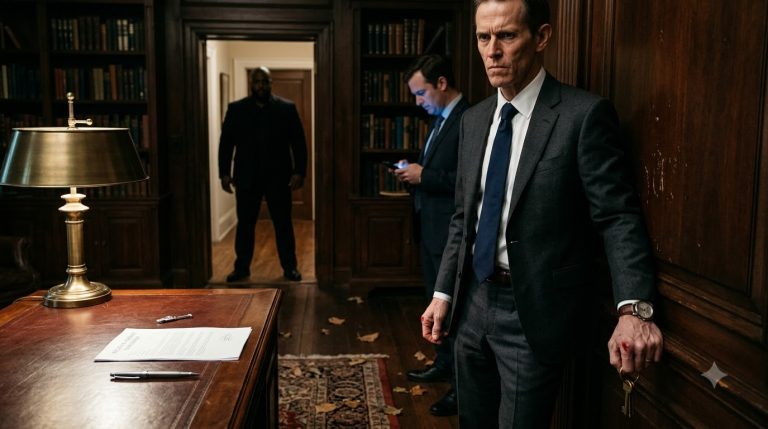
It wasn’t a city inspector. It was Richard Arthur, the president of the Crestview HOA—a retired corporate logistics manager who treated our neighborhood covenants with the severe, unyielding gravity of federal law. He wore a dark, waterproof trench coat that ran slick with rain, his silver hair combed back with military precision. In his right hand, he held a thick, yellow manila folder. Behind him, down near the curb, the amber warning lights of the tilted tow truck cast rhythmic, pulsating glares across his stern features.
“We have an emergency, Arthur,” he said without a greeting. His voice was a low, resonant baritone, dry and polished. “The street shoulder is collapsing. The tow driver says your drainage project has compromised the county roadbed.”
“The tow driver is a mechanic, not a civil engineer, Richard,” I replied, keeping my shoulder anchored against the doorframe. I did not invite him in. The damp draft off the street smelled of wet lime and hot diesel. “And my project was fully permitted by your board three weeks ago. I have the signed covenants.”
Richard did not flinch. He raised the manila envelope, tapping it against his palm with a slow, rhythmic cadence. “Things change when public safety is compromised. I’ve just received an emergency petition from three board members, including Karen. We’re convening an extraordinary session at the community center in twenty minutes. I suggest you bring your paperwork.”
I looked past his shoulder. Karen was standing near the front bumper of the tilted rig, her arms crossed tight over her chest, watching my doorway. She wasn’t yelling anymore. The panic I’d witnessed five minutes ago had hardened into something cold, deliberate, and entirely coordinated. She had played her card. The sinkhole wasn’t an obstacle to her; it was the catalyst she’d been waiting for to override my boundaries.
“And what’s the charge, Richard?” I asked. “Sinking an SUV that was illegally trespassing on marked conservation turf?”
“The charge is structural destabilization of municipal infrastructure under the Munson Easement covenants,” Richard said, his tone perfectly flat, devoid of personal animus but entirely locked into his procedural track. “The easement grants the association the right to reclaim adjacent private property in the event of an environmental hazard. If your bioswale caused that void, the board has the authority to seize the corner of your lot to stabilize the road. We will fill the trench with gravel before nightfall.”
The trap had finally sprung, but it wasn’t mine. It was theirs.
The Code-77 Drainage Blueprint wasn’t a future threat; it was an active operation. By engineering a scenario where my drainage project appeared to destroy the public road, they could invoke the emergency reclamation clause of the Munson Easement. They didn’t need my consent to lay the commercial main. They just needed a crisis.
“I see,” I said, my fingers tightening slightly against the edge of the door. “An emergency seizure. Convenient timing, considering the commercial survey stakes that appeared on my boundary line last night.”
Richard’s gaze remained perfectly level, his expression an impenetrable wall of administrative indifference. “The county handles municipal surveys. The HOA simply reacts to structural emergencies. Twenty minutes, Arthur. If you’re not there, we vote in your absence.”
He turned on his heel, his heavy leather shoes crunching onto the damp gravel of my driveway as he walked toward Karen’s waiting SUV.
I closed the door, the latch falling into place with a sound like a rifle bolt chambering a round. The house was dead silent again, but the silence had changed. It was no longer a refuge; it was a countdown.
I walked back to the study, my heart rate steady but my mind moving at a sprint. They had the board, they had the emergency clause, and they had a physical hole in the street to prove their point. But they didn’t know about the Sentinel Trail-Cam 4K. They didn’t know I had their faces, their slickers, and their blueprints recorded in ultra-high-definition at 2:14 AM.
I reached into the desk drawer and pulled out a clean black flash drive. I plugged it into the laptop, watching the progress bar slide slowly from left to right as the footage transferred.
They wanted an emergency session. They wanted to use the law as a hammer to shatter my peace.
I grabbed my folder of permitted drainage designs, tucked the black flash drive into my pocket, and blew out a long, slow breath. It was time to show them how gravity really worked.
CHAPTER 5: THE FINAL RECEIPT
The click of the brass latch settled into the quiet of the foyer, leaving the air heavy and thin. Exactly nineteen minutes remained. I slipped the cold steel cylinder of the black flash drive containing the Sentinel Trail-Cam 4K footage into my pocket. My fingers brushed the crisp edges of the Code-77 Drainage Blueprint copies and the approved HOA sustainability permits nestled within my folder. The drive was small, but its weight felt absolute—a concentrated payload of raw, undeniable data.
I did not take a vehicle. Driving would require navigating the blocked road, where the tilted tow truck still hung precariously over the dark, eroding sinkhole. Instead, I walked out my side door, cutting across the wet grass of my backyard. My boots pressed deep into the sod, leaving clean, dark impressions in the turf. I kept my stride measured, tracking the property line where the wooden survey stakes stood like thin, splintered sentinels.
The walk to the neighborhood community center took exactly nine minutes. The gravel path was slick from the morning’s downpour, the desaturated gray stone crunching under my weight. With every step, the physical layout of the subdivision became a map of their greed. They hadn’t chosen my corner by accident. My lot was the lowest point, the natural path of least resistance for a massive commercial water main designed to service the new commercial strip mall two miles east.
When I pushed open the double doors of the community center, the warmth of the interior hit me, carrying the stale smell of floor wax and instant coffee. The emergency session wasn’t being held in the main gymnasium, but in the small, fluorescent-lit annex room at the back.
I turned the brass handle and walked in.
The room fell instantly silent. Richard Arthur sat at the center of the folding table, his waterproof trench coat draped over the back of his chair. To his left sat the HOA treasurer, his fingers hovering over a tablet. To his right was Karen. She had changed out of her mud-soaked shoes into a pair of dry, black leather loafers, but the tight, defensive hitch of her shoulders remained. Her eyes tracked me as I walked toward the single empty chair opposite the board.
“You’re late, Arthur,” Richard said, his voice flat, professional, and entirely detached.
“I have ten minutes left on your countdown, Richard,” I said, pulling the chair back. The cold metal legs scraped against the linoleum tile with a sharp, echoing ring. I sat down, placing my folder flat on the table between us. “Let’s skip the procedural preamble. You called this emergency session to invoke the reclamation clause of the Munson Easement.”
The treasurer shifted his weight, his eyes darting briefly to Richard. “The physical evidence is clear. The collapse of the road shoulder threatens the structural integrity of the entire block. Under the emergency provisions, the association must seize the easement corridor to stabilize the subsoil.”
“The collapse didn’t happen because of my bioswale,” I said. I opened my folder, sliding three printed copies of the approved sustainability permits across the table. “My project was graded to manage surface runoff, completely lined with a semi-permeable clay barrier that prevents lateral migration. It was designed to withstand a five-hundred-year storm event. The only way that void could form is if there was high-pressure water injected directly beneath the roadbed.”
Karen let out a short, humorless laugh. “And where would high-pressure water come from on a residential street, Arthur? You built a trap, it failed, and now you’re trying to blame the infrastructure.”
“It came from the eight-inch domestic line,” I said, my voice dropping to a low, quiet register that forced the room to lean in. “Which your contractor tapped into last night at 2:14 AM to run a pressure test for the unauthorized Code-77 Drainage Blueprint.”
I reached into my pocket, pulled out the black flash drive, and set it on the laminate surface of the table. It slid forward, stopping precisely in the center of the wooden grain.
“The Sentinel Trail-Cam 4K has a wide-angle lens with infrared night vision,” I continued, looking directly at the treasurer, whose face had gone a flat, ashen gray. “It captures forty frames per second in ultra-high-definition. At 2:14 AM, it recorded two men in Crestview HOA service slickers driving the survey stakes, unlocking the municipal main valve on the opposite shoulder, and running a high-pressure bypass line directly through the old Munson Easement corridor to test the flow rate. You didn’t expect the storm runoff to liquefy the uncompacted fill dirt around your illegal tap.”
Silence descended on the room, thick and suffocating. The hum of the fluorescent lights overhead seemed to grow louder, vibrating against the windowpanes.
Karen’s hand twitched toward her purse, her fingers curling into a tight fist. “That footage is… it’s a violation of privacy. You can’t use that.”
“It’s private property, Karen,” I said, my voice remaining entirely calm. “You were standing on my lawn. And the county sheriff’s department, whom I contacted before walking over here, has already received a digital copy of the file along with the trespassing report.”
Richard Arthur stared at the flash drive. The rigid, administrative posture he had maintained on my porch began to sag, his silver eyebrows drawing together as he looked from the drive to the treasurer, and finally to Karen. The moral logic of his logistics career was simple: protect the institution. But the institution was now staring at a federal utility tampering charge.
“The board,” Richard began, his voice cracking slightly before he cleared his throat and restored his low baritone, “the board was assured that the preliminary testing was fully permitted under the historical county charter.”
“The charter lapsed in 1986, Richard,” I said, sliding the final document across the table—a certified title search from the county recorder’s office. “There is no Munson Easement. There is only my land. And you tried to steal it.”
The payoff was silent, cold, and absolute. The treasurer slowly closed his tablet, his shoulders slumping as he leaned back in his chair, completely checked out of the defense. Karen sat frozen, her lips pressed into a thin, colorless line, realizing that the very rules she had used as a leash had just been wrapped around her own neck.
By five o’clock that evening, the county utility rig had bypassed the block, sealing the unauthorized tap and stabilizing the roadbed with concrete slurry. The HOA board met in a closed, somber session three days later. The treasurer resigned. Karen’s seat was declared vacant, her property flagged for municipal easement fraud.
Three weeks later, the moving truck arrived at her house.
I stood on my porch, the morning light casting long, warm shadows across the grass. The air was clear, smelling of fresh earth and the sweet, damp scent of the native fescues. The bioswale had settled beautifully, the deep green blades of the wetland grasses swaying in the light breeze.
I held a mug of coffee in one hand and a brass screwdriver in the other. I walked down to the edge of the yard, where the physical scars of the vehicle ruts had finally healed over, filled with rich, dark topsoil. Near the corner, I knelt down beside the small garden statue—the tiny frog in sunglasses holding a spade. One of its mounting screws had loosened during the heavy rains.
I slowly turned the metal, feeling the threads bite into the wood, locking the little figure back into its solid foundation.
The street was completely quiet. The only sound was the low, steady hum of a distant mower and the light, rhythmic chirping of the frogs in the rushes. I stood up, took a slow sip of the coffee, and looked down the empty asphalt. The line had been drawn, the receipts had been filed, and the ground beneath my feet was finally, completely still.