The Dry Main: A Grit-and-Rust Account of Sovereign Soil, a ’67 Chevy, and the High Price of a Locked Meter
CHAPTER 1: THE DRY MAIN
The water didn’t sputter; it died with a hollow, metallic clink inside the galvanized pipe, leaving the smell of wet iron and half-rinsed soap stinging my eyes. I stood in the clawfoot tub, the silence of the 1954 pioneer house settling around me like dust. Outside, the steady, rhythmic shuck-shuck-shuck of the development’s plastic sprinklers drifted through the open bathroom window. My neighbors’ lawns were getting theirs. Mine was dry.
I wiped the lather from my eyelids with a coarse towel and pulled on a pair of stiff, grease-stained denim jeans. Down on the dirt driveway, the sun was just beginning to bake the red clay, casting a long, low shadow behind the primered cab of the ’67 Chevy.
At the edge of the asphalt where my dirt road met the blacktop of The Pines, the metal lid of my water meter box sat flush with the weeds. Someone had wrapped a heavy, grade-70 transport chain through the iron eyelets. It was secured by a laminated brass padlock, scarred with fresh tool marks as if it had been forced into place with a pipe wrench. Hanging from the shackle by a twist of copper wire was a square plastic tag. It wasn’t municipal blue. It was a bright, chemical green, stamped with three faded characters: P-4B.
The low, battery-driven whine of an electric motor cut through the morning air.
A white club-car golf cart rolled to a stop at the margin of my gravel. Karen sat behind the wheel, her fingers tapped against a plastic clipboard. On her safety vest, the word PATROL was printed in reflective silver letters that looked too new to have ever seen real dirt. Her blonde hair was pulled back so tight her eyes seemed permanently narrowed, scanning my driveway, the truck, and then my bare, damp feet.
“We gave you thirty days,” she said. Her voice had the flat, practiced clip of someone reading a slide deck. “The board doesn’t issue warnings twice.”
I didn’t step off my gravel. I reached into my pocket, my thumb shifting the dial on my phone to record, then held it flat against my thigh. “You chained the city main, Karen.”
“We secured a non-compliant service point,” she corrected, her pen hovering over her ledger. “Your account is five thousand behind in common-area assessments. The truck in the drive is an eyesore, and the siding on this structure doesn’t meet the color palette approved in the 2018 covenant revision. The service stays locked until the balance is cleared and the lot is brought to standard.”
“This lot was deeded before the concrete under your cart was poured,” I said, my voice low, matching the steady tick of the Chevy’s cooling manifold. “You signed the certified mail receipt for the plat map six months ago.”
“I don’t keep track of unsolicited mail,” she said. She turned the key in the ignition of the cart, the little machine giving a brief, impatient shudder. “The Pines is unified. No exceptions. You have the payment address.”
She pressed the pedal, the tires crunching over the stray gravel of my driveway as she swung back toward the manicured asphalt of her territory. I watched the green tag on the padlock swing in the dry wind, the metal-on-metal click-clack the only sound left on the hill.
CHAPTER 2: THE COLD CUT
The electric hum of Karen’s golf cart faded into the dry rustle of the surrounding pine woods, leaving only the metallic rattle of the brass lock settling against the iron meter box. I stayed on the edge of the gravel, my bare soles pressing into the sharp heat of the stones. The weight of the phone in my hand was a solid, cold reassurance. The screen was still live, the red recording dot blinking like a tiny, warning light. I pressed stop. The video saved with a quiet click.
My grandfather always said that when a bully hands you a rope, you don’t yank on it right away; you just keep your hands steady and let them wrap it around their own neck.
I leaned down, my knuckles brushing the rough, oxidized iron of the meter casing. The chain was a heavy transport grade, thick with zinc plating that hadn’t yet begun to pit. But the lock—the lock was cheap. A common hardware-store brass model, stamped with that curious green tag. My thumb traced the raised lettering: P-4B. The letters were stamped deep into the soft plastic, clean and sharp. It wasn’t a standard county designation. The county used blue aluminum tags for official locks, numbered with nine digits and registered to the public works database. This was private. It was a marker of possession, an illegal boundary line drawn by someone who had spent too many years looking at color-swatch cards and measuring the height of ryegrass.
I stood up, the heat of the morning sun beginning to prickle against the back of my neck. I didn’t head inside to the kitchen. Instead, I walked down the length of the gravel driveway, my gaze fixed on the dirt path where the property met the county road.
About thirty yards from the front porch, near the thick concrete collar of the old well main, the ground dipped slightly into a grassy hollow. This was where the division lay. On my left, the wild, uncombed orchard grass of my grandfather’s acreage grew knee-high, interspersed with stubborn blackberry brambles. On my right, the sod of The Pines began with an artificial, lime-bright green, perfectly leveled and severed by a clean concrete curb.
I knelt by the boundary line, reaching into the dry grass until my fingers found the rusted iron pin driven into the earth—the original surveyor’s monument from 1954. It was cold to the touch despite the sun, solid as an anchor. Just six inches from it, on the HOA’s side of the line, a small, circular plastic cap sat embedded in the manicured turf. It was stamped with the words Vance Utility Access.
A dull, rhythmic thrumming vibrated through the soil beneath my knees. It wasn’t the deep, slow pulse of the city water main. This was a shallower, more frantic vibration, like water being forced through a restricted pipe under high pressure.
I laid my palm flat against the dry earth over the Vance cap. The ground was slightly damp here, the soil loose and smelling faintly of stagnant pond water and sulfur. They had laid something new beneath the sod, right at the margin of my line.
“Looking for a leak?”
The voice came from the road. I didn’t jump. I stood up slowly, brushing the dry soil and pine needles from my palms before turning.
Mike, the municipal water district technician, was leaning against the side of his heavy utility truck. The vehicle was idling, its diesel engine a steady, rumbling bass note that drowned out the hum of the distant sprinklers. He had a pair of heavy bolt cutters resting over one shoulder like a rifle, the long steel handles painted a chipped, industrial yellow. His blue work shirt was dark with sweat at the collar, and his eyes were squinted against the glare of the gravel.
“Somebody reported an unauthorized service interruption,” Mike said, his voice flat, dry as the dust on his boots. He walked toward the meter box, the heavy cutters swinging slightly with his stride. “We don’t like it when people touch the curb stops.”
“Take a look at the chain,” I said, leading him back to the box.
Mike stopped, his gaze dropping to the heavy link and the green plastic tag. He reached down, his thick, calloused fingers lifting the lock to inspect the shackle. He let out a short, dry whistle that sounded like air escaping a pneumatic valve.
“P-4B,” Mike read aloud. He turned the tag over, searching for a county stamp that wasn’t there. “This isn’t our gear. Some local hero think they’re the sheriff today?”
“The HOA president,” I said. “She was here five minutes ago. Claimed she had board authority to lock the main until I paid five years of back dues.”
“The board doesn’t own this pipe,” Mike said. He didn’t wait. He set the jaws of the yellow bolt cutters against the brass shackle of the lock. He leaned his weight into the handles, the muscles in his forearms tightening under his dark hair.
With a sharp, metallic crack, the shackle sheared in two. The lock and the heavy chain slid off the meter box, clattering into the dry grass like dead snakes. Mike kicked the chain aside with the toe of his boot, then reached down and turned the brass tee-valve inside the box with his wrench.
Deep within the earth, there was a sudden, rushing hiss as sixty pounds of pressure flooded back into the galvanized lines of the old house. The sound was clean, cold, and immediate.
“The line is clear,” Mike said, pulling out a small black tablet from his hip holster to log the call. “But we’ve got a problem. This meter isn’t on their loop, but their new drainage line runs right along your southern easement. It’s too close, and it looks like they’re trying to hide something under the clay.”
He looked toward the green tag lying in the dirt, then back at me, his face hard. “Keep that tag. The supervisor’s going to want to see it.”
CHAPTER 3: THE SHADOW ON THE CLAY
The wet hiss of sixty pounds of pressure rushing into my grandfather’s old pipes didn’t completely drown out that shallow, frantic vibration humming under the turf. Mike stood there, his thumb still hovering over his black logging tablet. The yellow bolt cutters rested against his thigh, the steel jaws smelling faintly of sheared brass and burnt grease.
“Keep that tag,” Mike repeated, nodding toward the green plastic square lying in the weeds. “The supervisor’s going to want to see it.”
“I’ll keep it,” I said, bending down to retrieve the severed padlock and the green marker. The plastic felt cheap in my hand—rigid, brittle, and rough around the edges where the mold had released it. On the back of the tag, partially obscured by dirt, was a smaller printed string of digits: V-DE-53.
I stood back up, my bare feet treading on the border between my dry gravel and the artificial green turf of The Pines. My gaze drifted from the green tag down to the damp grass where the Vance Utility Access cap sat embedded. The earth around that plastic cap wasn’t just wet; it was settling unevenly, forming a shallow, raw depression in the clay that hadn’t been there forty-eight hours ago.
I took a slow step forward, crossing the invisible boundary line onto the HOA’s manicured sod. Mike didn’t follow me, but his diesel truck continued its steady, metallic rumble, a mechanical heartbeat in the quiet morning.
Just past the concrete curb, where the dirt road shoulder sloped down toward the main road, the grass was torn. Long, parallel gouges had been ripped through the topsoil, exposing the thick yellow clay beneath. These weren’t passenger tire tracks. They were deep, heavy-toothed tread marks from a tracked mini-excavator, the kind used to dig shallow trenches without waking the neighborhood. The clay inside the tread marks was still damp and dark, indicating the work had been done during the dead of night, shielded by the thick stands of pines.
“They did this late,” I muttered, more to myself than to Mike.
“HOAs don’t usually run their own pipe crews at three in the morning,” Mike said, walking over to join me at the shoulder. He looked down at the deep track marks, then traced the path they took. They started from the paved road of The Pines, cut directly across the narrow shoulder, and ran parallel to my southern line, disappearing into the heavy brush near my old wooden garage. “That’s a trenching run. They’re tapping or bypassing something.”
“My grandfather laid the original water main straight down this road in fifty-four,” I said, my voice dropping. My fingers tightened around the cool brass of the broken padlock. “The Vance family owned the easement on the southern boundary. If they put a line through there, they went right through my deeded buffer.”
I began walking the path of the tracks. The yellow clay stuck to my bare soles, cold and gritty. Every few yards, the ground gave a tiny, almost imperceptible dip, the classic sign of a hastily backfilled trench. The crew hadn’t used a compactor; they had simply dumped the dirt back into the hole, laid down pre-grown sod over the top, and hoped the next heavy rain would settle it before anyone noticed.
As I neared the old garage—the weathered pine structure where my ’67 Chevy sat waiting for its new cabin upholstery—the smell of wet earth grew sharper. Here, the brush was thicker, choked with wild blackberry vines and scrub oak. The tread marks narrowed, squeezing between a rusted iron boundary pin and my old wooden fence.
Underneath a low-hanging pine branch, a white plastic conduit pipe peeked out from the freshly turned mud. It wasn’t connected to any county water main. It was small, maybe three inches in diameter, and stamped with a faded red label: Vance Drainage System – Sector 4.
I knelt in the dirt, my shoulder brushing against the rough, sap-sticky bark of the pine. I reached out and cleared a handful of loose pine needles away from the pipe’s joint. It didn’t have the heavy, industrial fittings of a public works line. It was joined with cheap PVC solvent cement, the blue glue still sticky and smelling of strong chemical acetone.
They hadn’t just overreached; they were running an active, unpermitted drainage bypass directly through my grandfather’s land, hiding the evidence beneath a layer of stolen turf. And the green tag on my meter was the distraction, a calculated move to keep my eyes on the faucet while they buried their secrets under my feet.
CHAPTER 4: THE CELLULOID REBEL
The sticky, chemical sting of the blue PVC cement lingered on my fingertips as I pulled my hand away from the exposed conduit pipe. I stood up slowly beneath the low pine branches, the rough bark scraping against my shoulder. The quiet click-clack of the green plastic tag swinging from my pocketed lock was the only sound besides the receding rattle of Mike’s diesel truck. My bare soles were caked with cold, sticky clay, but there was no time to wash them. The moisture on that trench line was drying fast under the high morning sun.
I walked back up the dirt drive, leaving dark, textured footprints across the gravel, and stepped into the dim, cool air of my grandfather’s kitchen. The old linoleum floor felt slick and solid beneath my feet. In the corner of the room, tucked between a stack of weathered yellow maps and a copper kettle, my desktop monitor cast a steady, pale blue glow across the varnished wood of the counter.
I sat down, the wooden chair creaking beneath my weight. My fingers, still smelling faintly of solvent and dry earth, tapped the keyboard to bring up the security system interface. Six cameras covered the perimeter, high-definition lenses masked under the eaves of the 1954 cedar siding. I bypassed the daytime logs, scrolling the timeline directly back to the dark hours of early morning.
The screen flickered.
At 6:02 AM, the black-and-white infrared stream showed the road transition at the edge of my gravel. The Pines’ streetlights cast a distant, sterile glow on the boundary, but my corner remained deep in shadow. Then, a pair of headlights sliced through the dark. A dark, unmarked utility truck with a heavy rear bed slowed to a crawl at the margin of my road.
I zoomed in, enhancing the high-definition feed. The driver’s side door swung open, and a man stepped down into the tall weeds. Even in the desaturated gray of the night vision, the silhouette was instantly familiar—the broad, slightly slouched shoulders, the baseball cap pulled low, the rigid, hesitant posture of someone who knew he was trespassing on deeded soil. It was Karen’s husband.
He didn’t walk toward the house. Instead, he reached into the truck bed, hauled out a heavy coil of chain, and marched straight toward my municipal meter box. His head made that quick, guilty jerk to the left, then to the right, verifying the empty street before he dropped to his knees. The infrared light caught the sudden metallic glint of a padlock as he snapped it shut over the curb stop.
“Six-and-three,” I muttered, watching his fingers secure the plastic green tag—the one now sitting in my pocket.
But the recording didn’t end there. I didn’t stop the timeline. I dragged the cursor back further, bypassing the six o’clock hour, hunting for the heavy tread marks I had found near my old wooden garage.
At 3:14 AM, a different shape appeared on the southern boundary camera.
A compact, tracked excavator—its boom lowered to avoid catching the low pine branches—was being unloaded from a flatbed trailer parked deep within the shadows of The Pines’ entrance loop. No lights were active on the machine. Two men in dark, unmarked work shirts guided the tracks as they chewed into the soft shoulder of the road. They worked with a quiet, practiced urgency, their shovel blades cutting clean into the clay right along the property line, burying the white conduit before laying down a long, seamless strip of precut sod over the scar.
I paused the frame. The side of the excavator bore a small, magnetic stencil, barely visible under the infrared glare. I leaned in close, my breath fogging the glass of the screen.
Vance Contracting & Drainage.
It was the second seed noun. The name printed on the green tag matched the machine that had sliced through my grandfather’s soil. They hadn’t just made a mistake with a padlock. They had orchestrated a physical bypass, routing their development’s runoff drainage through my private ground under the cover of a manufactured HOA dispute.
I plugged a flash drive into the side of the monitor, copying the raw footage from both timelines, the file sizes ticking up as the blue progress bar filled. My hand was steady on the mouse. Karen had wanted to make this about a ’67 Chevy and unpaid dues, but she had handed me the one thing that would dismantle her board piece by piece: an uncompressed, high-definition record of a midnight conspiracy.
CHAPTER 5: THE SWELL AND THE SOIL
The blue progress bar on the monitor filled, the final block of uncompressed footage rendering into a solid, saved file. I pulled the small silver drive from the slot, the warm metal casing dry against my palm. At that exact second, a sudden, heavy patter rattled against the tin overhang of the kitchen window. The afternoon sky had bruised over, turning a dark, bruised violet. Within seconds, a torrent of cold summer rain began to hammer the parched red clay outside, the sudden temperature drop sending a faint fog rising off the hot driveway.
I slipped the drive into my front pocket alongside the severed green tag and the brass padlock, then stood up, my bare feet leaving damp patches on the linoleum. I couldn’t sit in the kitchen. Not now. The trench line along my southern border was fresh, uncompacted earth, laid down with loose clay and unbonded sod. If the rain kept up at this rate, the water would find the path of least resistance.
I grabbed my oilskin jacket off the peg by the door and stepped out onto the porch.
The cold water hit me instantly, plastering my shirt to my shoulders. I walked down the steps, my boots sinking into the gravel that was already turning into a slick slurry of mud. I marched toward the southern boundary line, where the original 1954 boundary pin lay buried in the tall orchard grass.
When I reached the line, the situation was worse than I’d estimated. The shallow depression I’d tracked earlier had already begun to form a miniature canal. The heavy runoff from the paved streets of The Pines was rushing down the asphalt, hitting the curb, and channeled directly into the raw trench they’d dug.
The sod they had hastily rolled over the trench was lifting. It floated on a rising bed of yellow soup, the unbonded roots unable to hold the soil together under the sudden sheer force of the water.
Underneath the churning mud, the white PVC pipe—stamped Vance Drainage System – Sector 4—was fully exposed now. It wasn’t just draining; it was vibrating under immense pressure. The joints, sealed only hours before with that cheap blue glue, were weeping, spitting tiny geysers of gray runoff water into my grandfather’s orchard grass.
“Hey!”
A voice cut through the roar of the rain. I turned my head, my collar channeling cold water down my spine.
At the edge of the paved road, standing next to a idling white pickup truck with the name Vance Contracting stenciled on the door, was a man in a yellow slicker. He was holding a heavy iron probe, his boots planted firmly on the HOA’s side of the concrete curb. He wasn’t looking at me; he was staring at the rapidly eroding trench line, his face tight with a sudden, sharp panic.
“You need to step back from that line,” he yelled, his hand tightening on the iron probe. “That’s active utility infrastructure.”
“This is private deeded land,” I said, my voice low but carrying through the downpour. I took a step closer to the leaking PVC joint, my boot sinking ankle-deep into the washing yellow clay. “And your infrastructure is washing my soil into the county ditch.”
“We have an emergency maintenance easement,” the man lied, his eyes shifting to the house, then back to the eroding bank. He took a step forward, his boot hovering over the concrete edge, but he stopped himself when he saw me slide my hand into my jacket pocket where the phone was.
“There is no easement on this plat,” I said. “And the county water district supervisor is already on his way with a sheriff’s deputy. I suggest you call your boss. Tell her the trench is collapsing.”
The man’s mouth twisted. He didn’t argue. He turned and scrambled back to the cab of his truck, the tires spitting wet gravel as he backed out of the cul-de-sac.
I knelt in the mud, ignoring the cold rain soaking through my jeans. The water was rising, swelling around the white pipe. If I didn’t get the official survey documents and the municipal team here before the whole bank collapsed, they’d claim the erosion was natural. I reached down, my fingers wrapping around the slick, muddy edge of the exposed PVC joint, feeling the violent, unnatural pulse of the water running through my soil.
CHAPTER 6: THE DEED AND THE DEPUTY
My fingers remained locked around the vibrating, slick plastic of the Vance Drainage Easement pipe as the white contractor’s truck tore away, its rear tires throwing up twin roostertails of gray gravel and liquid yellow clay. The downpour was relentless now, hammering my oilskin jacket and turning the shallow trench into a churning, sulfurous canal. Beneath my palm, the unnatural pulse of the pressurized water threatened to burst the cheap joints.
As I knelt there in the dissolving mud, my grandfather’s voice echoed from a distant corner of my memory. “People who build on stolen boundaries don’t stop until they’re forced to look down the barrel of a clean deed,” he’d told me when they first tried to run the main loop around our perimeter back in the nineties. He had spent his whole life defending this patch of red clay, knowing that once you let a corporate plow share an inch of your soil, they’d take the mile by morning.
I didn’t let go of the pipe. I kept my weight anchored against the shifting mudbank, watching the water rise toward the rusted iron surveyor’s pin.
A pair of bright halogen headlights cut through the gray curtain of rain, followed by the heavy, rhythmic throb of a diesel engine. It wasn’t the contractor returning. A white municipal utility truck with the county seal emblazoned on the door pulled onto the road shoulder, accompanied by a clean, black-and-white county cruiser.
The driver’s side door of the cruiser swung open. Deputy Miller stepped down, his wide-brimmed campaign hat protected by a clear plastic cover, his hand instinctively resting near his utility belt to protect his radio from the wet. Behind him, the supervisor of the municipal water district, a silver-haired man named Henderson, climbed out of the utility truck, clutching a weathered leather map-tube under his arm.
“Son,” Miller called out, squinting through the downpour as he navigated the slick slope of the shoulder. “What’ve we got here?”
“Unlawful trenching and unauthorized municipal utility bypass,” I said, standing up slowly. My boots made a heavy, sucking sound as I pulled them from the yellow clay. I pointed down toward the vibrating PVC line. “They dug this three hours ago under the cover of darkness. The rain is washing their backfill out, exposing the line they tried to run through my grandfather’s southern boundary.”
Henderson knelt by the edge of the collapsing bank. He didn’t mind the mud soaking through his work pants. He reached into his leather tube, pulled out a laminated plat sheet—the county’s official record of the Plat 4-B Exemption—and rolled it flat against his knee, using his heavy flashlight to illuminate the lines.
“This is private soil, Deputy,” Henderson said, his voice hard as iron. He traced a line on the map with a wet finger, then pointed directly to the rusted boundary pin sticking out of the mud beside my boots. “The Pines’ master plan doesn’t have an easement here. According to the original fifty-four survey, the Vance Drainage Easement was terminated when the public main was routed along the western bypass. They’re running unpermitted sewer runoff directly into an independent main.”
“And the lock on the curb stop?” Miller asked, looking toward the driveway where the broken zinc chain lay.
I reached into my oilskin pocket, my fingers brushing against the cold, metallic edges of the evidence. I pulled out the severed brass padlock, the heavy links of the chain, and the green plastic tag with the stamped code. I handed them directly to the deputy.
“Karen’s husband locked it at six this morning,” I said, my voice steady, devoid of anger. “I have the uncompressed high-definition security footage on a flash drive inside. You can see his face, his truck, and the excavator they used to dig this ditch at three AM.”
Miller took the lock, his gloved thumb rubbing over the green plastic tag. “P-4B. That’s the developer’s internal code. They haven’t used those tags since they tried to annex the county road ten years ago.”
He looked toward the manicured lawns of The Pines, where the decorative entrance fountain happily sprayed water into the storm, oblivious to the mud sliding down the hill. “This isn’t just an HOA dispute anymore. This is criminal property damage and tampering with municipal infrastructure. Go get cleaned up, son. We’re going to need that footage, and then we’re going to make a very official visit to the board office.”
CHAPTER 7: THE COLLAPSE OF THE COVENANT
Deputy Miller’s gloved fingers vanished into his pocket, taking the green plastic tag with them, as Henderson slid the damp plat map back into its protective leather tube with a wet, suctioning pop.
“Let’s move,” Miller said, turning his shoulder against the driving rain.
I didn’t run. I walked back up my gravel drive in an unbroken line, my mud-slick boots crunching on the stone, the cold water dripping from the hem of my oilskin jacket. The deputy and the water supervisor followed me up the wooden steps of the porch. Inside the dry, quiet kitchen, the screen of my computer still hummed with the pale blue light of the security feed. I reached out, my damp fingers cold against the plastic casing of the flash drive, and pulled it from the port.
I didn’t stop to change out of my wet clothes. I grabbed a pair of dry work boots from the mudroom, laced them up with stiff, wet-stringed laces, and grabbed my grandfather’s thick leather accordion file from the bottom drawer of the desk—the one labeled with the faded ink of the County Title Ledger.
Within three minutes, we were back in the rain. I climbed into the passenger seat of Henderson’s municipal truck, the smell of damp vinyl and diesel exhaust filling the cab as we followed the slow, flashing blue strobe of Miller’s cruiser down the asphalt road of The Pines.
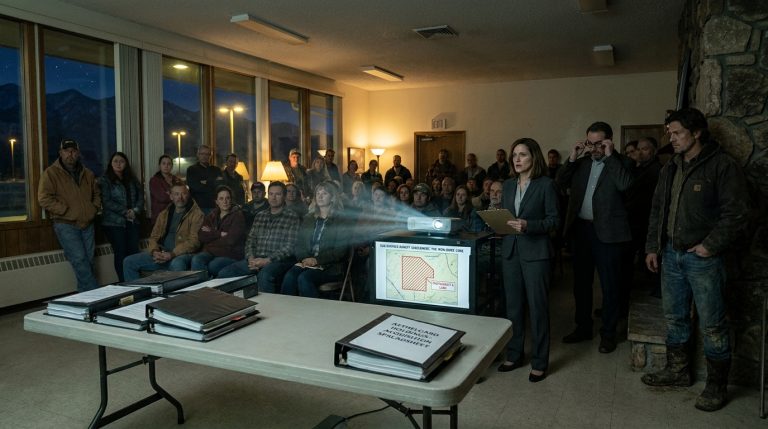
The community clubhouse was a sprawling, faux-stone structure with a manicured front lawn that was currently eroding under the force of the storm. Inside the double glass doors, the air was warm, smelling of pine-scented cleaner and dry heat. A hand-painted sign on the corkboard announced a special budget meeting was already underway in the main hall.
When we pushed through the heavy oak doors of the meeting room, the murmuring of thirty homeowners died instantly.
Karen stood at the oak podium at the front of the room, her tight blonde bun slightly frayed from the humidity, her fingers gripping the edges of her clipboard. Her husband sat in the front row, his boots still caked with the fresh yellow clay from my southern boundary.
“This is a private association meeting,” Karen said, her sharp voice echoing off the vaulted ceiling. She pointed her pen at me, her knuckles white. “Residents only. You have no standing here.”
Deputy Miller didn’t halt. His wet boots left a dark, linear trail of footprints down the center carpet. He stopped right at the foot of the podium, his utility belt creaking with the movement.
“Actually, ma’am, we’re here on municipal business,” Miller said, his voice flat, carrying the weight of a state warrant. He gestured toward Henderson, who stepped forward and laid the county plat map flat across the podium, covering Karen’s budget ledger.
“What is the meaning of this?” Karen’s voice pitched higher, her eyes darting to her husband, who had gone completely rigid in his seat.
“This is the County Title Ledger from nineteen fifty-four,” Henderson said, his voice quiet but clear enough to reach the back row of chairs. He pointed to the highlighted section of the map. “And this is the Plat 4-B Exemption. It explicitly excludes the pioneer lot from your association boundaries. But more importantly, it proves your development’s main drainage line—the Vance Drainage Easement—was legally terminated thirty years ago.”
A low, anxious murmur rippled through the seated homeowners. One man in the third row stood up, his face pale. “What do you mean terminated? The developer told us the drainage infrastructure was fully integrated.”
“It means,” I said, stepping forward beside Henderson, “that the board has been routing your community’s retention basin overflow through an illegal pipe under my land to avoid paying county environmental tap fees. And last night, they tried to bury the evidence under my dirt.”
I laid the silver flash drive on the oak podium right next to Karen’s trembling fingers.
“That drive has three hours of high-definition infrared footage,” I said, looking her directly in the eyes. “It shows your husband and a Vance Contracting excavator digging up my southern line at three in the morning, right before you personally chained my city main.”
The room erupted. Homeowners were on their feet, their voices rising in a panicked swell as the reality of the situation hit them. It wasn’t just a dispute about a ’67 Chevy anymore; it was an unpermitted utility line, a criminal tampering charge, and the immediate threat of a multi-million-dollar county environmental lawsuit that would be assessed directly to their individual property dues.
Karen stared down at the flash drive, her mouth opening and closing in silence. Her husband stood up, his chair scraping violently against the floorboards, but Deputy Miller stepped into his path, his hand resting calmly on his belt.
CHAPTER 8: SOVEREIGN BLUE
The scraping sound of the husband’s wooden chair legs against the clubhouse floorboards didn’t break the sudden, icy silence that had locked Karen’s jaw shut. Deputy Miller’s hand remained flat on his leather utility belt, his fingers mere inches from the polished snap of his holster.
“Sit down, sir,” Miller said, his voice dropping an octave, carrying the dry, dusty weight of the law.
Karen’s husband hesitated, his shoulders bunching beneath his damp cotton work shirt. The yellow clay from my southern boundary was already drying on his boots, flaking off onto the carpet in tiny, pale cakes. Slowly, under the collective, burning gaze of thirty neighbors, his knees gave way, and he sank back into his seat.
“There’s been a misunderstanding,” Karen whispered, her pen finally slipping from her fingers and rolling across the glossy mahogany of the podium. “The plat… the builder assured us…”
“The builder lied to you, Karen,” I said, stepping closer to the oak table. I opened the faded cover of my grandfather’s ledger, the old fiber paper smelling of dry pine and decades of closet dust. I turned the page to the official 1953 entry, where the county registrar’s ink was still sharp and dark. “And you knew it. Or at least, your developers did when they filed the master deed.”
I pointed to the highlighted seal of the Plat 4-B Exemption.
“The developer of The Pines intentionally omitted this pioneer lot’s exclusion from the maps they handed to the home buyers,” I explained to the room, my voice steady, cutting through the low murmur of the crowd. “They needed to show eighty contiguous acres to secure the commercial bank financing for the phase-two expansion. If they admitted this lot was independent, the bank would have pulled the loan. So they drew their lines right over my grandfather’s dirt, hoping nobody would look at the County Title Ledger until the concrete was poured and the developer’s entity was dissolved.”
Henderson nodded, his hand resting on his leather map tube. “The municipal water district is issuing a formal cease-and-desist order on the Vance Drainage Easement effective immediately. Because that runoff system was unpermitted, the association will be fined ten thousand dollars per day until the line is physically capped and routed back through public easements. That assessment is going to fall directly on the homeowners.”
A woman in the back row let out a sharp, panicked breath. The quiet in the room shattered into a chaotic roar of shouting voices, fingers pointing toward the podium where Karen stood. Her tight bun was completely frayed now, pale strands of hair clinging to her damp temples. She looked down at the silver flash drive, then at the deputy, her face drained of its color. She was no longer the patrol officer of the gates; she was just a tired, cornered resident holding a useless plastic clipboard.
Six months later, the rain had long since cleared, leaving the dry summer sky wide and pale over the valley.
A heavy, yellow moving truck stood parked at the curb across the street, its metal ramp clattering against the pavement as two men loaded a set of matching outdoor furniture. Karen stood in her driveway, her arms crossed tightly over her chest, watching her husband secure the rear door of the truck with a heavy iron latch. There were no golf carts. No vests. The house behind them bore a bright red Sold sign pinned to the manicured turf.
I stood on the gravel of my driveway, my boots planted firmly on my own soil. Beside me, the ’67 Chevy sat under the shade of the big oak, its primer-gray hood catching the warm afternoon light. The interior work was finally done; my hands were still stained with the dark, sweet scent of new vinyl adhesive and leather conditioner from finishing the bench seat.
I walked toward the side of the property where the new garage stood. The structure was solid, built from heavy, cured Douglas fir timbers that smelled of fresh resin and earth. I picked up a wide metal stir-stick and began stirring a gallon can of heavy oil-based paint.
It wasn’t white. It wasn’t the sandy beige or the charcoal gray approved by The Pines’ architectural committee. It was a bright, sovereign, cobalt blue—a shade that absolutely violated every line of their code.
I dipped my brush into the thick, glossy lacquer, letting the excess drip back into the can. With a slow, deliberate stroke, I drew the first line of blue across the raw wood of the garage wall. The paint went on smooth, filling the grain, sealing the wood against the coming winter.
I looked down near my boots, where the old copper grounding rod was driven deep into the clay next to the independent water main. The water was running clean, cold, and quiet through the pipes of the old house. Nobody was coming to lock my meter. Nobody was measuring my grass.
I took a deep breath of the dry summer air, dipped the brush again, and went back to work on my own land.