The Silent Perimeter: How a Solitary Man Weaponized the System to Starve Out a Predatory Empire
CHAPTER 1: THE INTRUSION
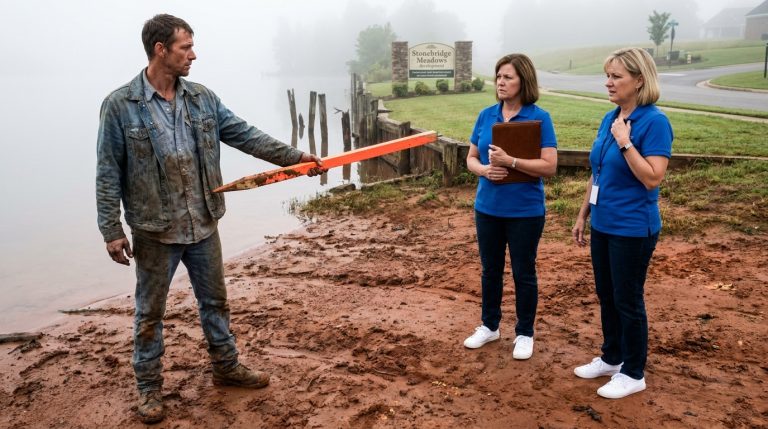
The plastic tape made a sharp, whipping sound against the steel fence posts, a high-frequency vibration that cut straight through the heavy silence of the pines. Three figures in reflective vests moved along my perimeter, their boots kicking up dry earth. They didn’t look at the house. They didn’t need to. They worked with the cold, practiced efficiency of men executing a foreclosure.
Behind them stood Karen Hoffman.
Her leather-bound clipboard was held tight against her chest like a shield, her polished HOA smile perfectly intact despite the biting chill coming off the lake. She watched the caution tape stretch across my boundary line, her gaze steady, assessing the psychological impact of the bright yellow plastic.
I stood on the porch, my fingers resting against the cold iron railing. I didn’t yell. I didn’t hurry down the steps. In a predatory landscape, sudden movement is a confession of weakness. Instead, I opened the notification that had just arrived on my phone. The PDF from my mortgage server sat open on the screen, the language flat and transactional. A formal notice of cancellation from my insurance carrier, effective in seventy-two hours, with a stark warning about force-placed coverage.
A shadow fell over the porch steps as Karen walked toward me. She didn’t climb them. She stood on the gravel below, looking up, her lanyard badge catching the pale mountain light.
“You can own the deed and still lose the house,” she said, her voice dropping to a quiet, clinical register. “Watch.”
“You’re on private property, Karen,” I said. My voice was flat, devoid of the anger she was hunting for. “The deed is recorded. The county map is clear.”
“Ownership doesn’t protect you from community obligations,” she replied, her eyes narrowing slightly as she adjusted her grip on the clipboard. “Not when safety and liability are involved. This parcel was designated for the Phase 3 expansion. Boundary adjustments are already under review.”
She turned on her heel, her designer boots crunching rhythmically on the gravel as she walked back to her black SUV. The vehicle door closed with a heavy, pressurized thud, and she drove away, leaving the three vest guys to finish wrapping my fence in plastic.
I walked down the steps. The workers were already packing their tools into the back of a utility truck, ignoring me entirely as they pulled out of the driveway. I stood by the wooden gate post where the yellow tape was anchored.
That was when I saw it.
Tucked into the weeds near the gate’s base was a discarded overnight courier envelope, likely dropped by one of the workers when they pulled out the sign stakes. It was empty, but the label was still intact. It wasn’t addressed to Karen Hoffman, nor was it sent by the Cedar Ridge Homeowners Association.
The recipient field was printed in bold, thermal ink: Aethelgard Holdings. Scrawled in black marker across the top was a handwritten filing reference: File-98-Echo.
I ran my thumb over the cold, waxy paper. The HOA wasn’t trying to absorb my land for a scenic trail. They were already delivering files to a corporate entity I had never heard of—and they had mapped my property line weeks before Karen ever set foot on my driveway.
CHAPTER 2: THE PAPER TRAIL
The waxy paper of the courier envelope was cold, holding the damp chill of the mountain soil. I didn’t pull it up immediately. I kept my fingers pressed against the cardboard, feeling the textured grain under my pads as the engine noise of Karen’s black SUV died away completely, swallowed by the dense pines. The three workers’ utility truck was already gone, leaving only the smell of diesel exhaust lingering in the damp air.
I knelt there on one knee, the gravel biting through my denim. I slid my index finger under the unsealed flap of the overnight envelope. It was empty of its original contents, but the interior had a gray, carbon-paper lining that left a faint smudge on my thumb. The thermal label was crisp, untouched by the moisture of the dirt.
Aethelgard Holdings.
The name felt heavy, industrial, and entirely out of place for a residential development corporation. Below it, the scrawled marker reading File-98-Echo was slightly bled at the edges, written with a fine-point permanent pen by someone who had been in a hurry.
I pulled the cardboard envelope from the weeds, folded it flat, and slid it into the inner pocket of my canvas jacket. The stiff paper pressed against my ribs like an uninvited hand.
I stood up and walked the perimeter line, checking the caution tape they had left behind. They had wrapped the yellow plastic around four of my cedar posts, the knots tied tight with double half-hitches. It was deliberate, a physical marker meant to look like an official condemnation. I reached out, my fingers catching the slick, cold plastic, and pulled. The yellow tape stretched, then snapped with a sharp crack that echoed off the lake. I reeled the plastic in, winding it around my forearm until it was a tight, crumpled ball of yellow waste, then stuffed it into the metal trash bin by my gate.
I walked back up the gravel driveway. Every step felt measured, my eyes scanning the tree line. In the high-altitude light, the shadows of the pines looked like long, dark fingers reaching across the road.
Inside the house, the silence was different. It wasn’t the peaceful quiet I had bought the place for; it was the pressurized stillness of a room before a storm. I went straight to my study. The room smelled of pine-oil cleaner and old paper. On the desk, my laptop screen was still awake, the PDF from my insurance carrier displaying the formal cancellation warning in clean, seventy-two-hour increments.
I sat down, the leather of the desk chair cold against my back. I opened a new browser window, my fingers hovering over the keys before typing the name on the envelope.
Aethelgard Holdings.
The search results were sparse, the kind of digital footprint designed to be invisible to anyone who wasn’t actively looking for it. A Delaware registry. A registered agent office in Wilmington. No public-facing executive team, no marketing collateral, no social media presence. They were a ghost, a shell company structured to hold assets and absorb liabilities without ever showing a face.
I opened my email and drafted a message to Nina Patel, my insurance broker.
Nina, I wrote, my keystrokes sharp and rhythmic in the quiet room. I need the complete underlying documentation for the third-party risk report. Specifically, the origin of the survey photos and the registration details of the vendor who submitted the safety review. If the carrier used an automated system to flag this, I need the raw XML data file or the underwriting notes. Advise immediately.
I didn’t mention the courier envelope. Not yet. In a chess match, you don’t show your opponent the pieces you’ve taken off the board until the trade is already in your favor.
I leaned back, my gaze shifting to the window. Outside, the lake was a dark sheet of glass, the reflection of the mountains upside down in the gray water. My phone vibrated against the wood of the desk, the sound loud as a gunshot in the silent room.
I picked it up. It was an email notification from Nina. Attached was a scanned document, a sub-file from the underwriting department that hadn’t been in the initial packet.
I opened the attachment. It was a single-page PDF, a copy of the automated intake form from the carrier’s risk assessment portal. In the bottom-right corner, under the vendor authorization block, was a digital signature line. The signature was a security hash, but the billing code listed directly beneath it matched the shipping reference on the waxy envelope in my pocket.
Aet_98_E.
The decoy of a simple HOA expansion was already starting to fray at the edges, revealing the cold, metallic structure of a corporate play underneath.
CHAPTER 3: THE SHADOW CAMPAIGN
The blue tint of the laptop screen illuminated the dust motes suspended in the quiet air of my study. I stared at the alphanumeric code—Aet_98_E—until my eyes burned. It was a bridge built of data, connecting the HOA’s public hostility to a private ledger.
I closed the lid of the computer. The screen’s hum died, plunging the desk into the dim amber glow of the desk lamp. I stood up, my joints popping in the quiet room. I grabbed my keys from the wooden tray by the door, sliding them into my front pocket where they settled with a heavy, metallic clink. I didn’t rush. The “Liability Awareness” meeting was scheduled for seven in the evening at the Cedar Ridge Clubhouse, and the clock on the wall read six-forty.
I stepped out onto the porch, pulling my collar tight against the draft of wind coming off the mountain. My truck sat in the gravel driveway, its hood cold to the touch. I climbed inside, the vinyl seat stiff under my weight, and turned the key. The engine roared to life, a low, guttural vibration that shook the dashboard. I backed down the driveway, my headlights cutting twin paths through the dark pines, and turned onto the public road that led to the gated entrance of Cedar Ridge.
The transition from my unpaved mountain road to the smooth, black asphalt of the subdivision was immediate. The tires fell silent, the loose gravel spray replaced by a rhythmic hum. I pulled the truck into the dark auxiliary lot behind the tennis courts, well away from the line of luxury SUVs parked directly in front of the clubhouse.
The clubhouse itself was a massive structure of faux-stone and polished timbers, radiating a sterile, yellow glow from its floor-to-ceiling windows. I walked up the side path, my rubber-soled boots making no sound on the stamped concrete. The double glass doors were propped open, letting out the warm, dry air of a forced-heat system and the low, collective murmur of forty worried homeowners.
I slipped inside, staying near the back wall where the shadows from the decorative support pillars fell thickest. Nobody looked at me. Their attention was fixed on the front of the room, where a projector cast a slide onto a large white screen.
Karen Hoffman stood beside a long folding table, her posture rigid, her fingers drumming a silent cadence against her clipboard. Next to her sat Brad Klene, the management representative, adjusting his wire-rimmed glasses as he scrolled through a tablet.
On the table behind them sat a stack of informational binders. I stepped closer to the back edge of the display, my eyes tracking the titles. Most were standard HOA community guidelines. But sitting slightly apart was a thick, black vinyl binder. Slid into the plastic sleeve on the cover was a technical diagram. I leaned in just enough to read the bold print beneath a geological cross-section map: Sub-surface Runoff Assessment: The Iron-Oxide Core.
The phrase sat there, dry and clinical, under a corporate header that had been partially blacked out with a marker.
“We are not here to alienate our neighbors,” Karen’s voice cut through the room, amplified by a lapel microphone that made her sound unnaturally close. “We are here to protect our collective equity. Unregulated boundary parcels create liability. Liability increases premiums. And those premiums are passed directly to you.”
The slide changed, displaying a map of the hillside. My parcel was highlighted in a harsh, diagonal red hatch.
While the room turned its collective head toward the screen, I stepped silently to the edge of the display table. I reached out, my fingers brushing the cool plastic of the black binder. I flipped it open with one hand, letting the heavy pages fall open. It wasn’t a safety review.
The first page was a master planning document for Cedar Ridge Phase 3. It was an acquisition spreadsheet detailing a $1.2 million developer payout from Aethelgard Holdings to a secondary entity called “Hoffman & Associates Land Trust.” The payout was contingent on one specific legal trigger: complete annexation and consolidation of parcel 404-B—my land.
My hand stayed perfectly still on the page. The entire public safety campaign was an engineered leverage play. Karen wasn’t trying to protect the neighborhood from a hazard. She had a contract to deliver my property to a corporate buyer, and she was using the collective fear of the homeowners to do her digging.
A low murmur rose from the crowd as Brad Klene pointed to a chart showing projected assessment increases. I closed the binder slowly, the plastic cover clicking shut against the metal rings, and slipped my hand back into my pocket.
Karen’s gaze swept across the room, stopping for a fraction of a second on the dark corner where I stood. Her eyes widened slightly, her fingers freezing on the edge of her clipboard. She didn’t name me. She didn’t have to. The silence that settled between us was sharp, transactional, and absolute.
I turned and walked out the door before the slide changed again, the dry air of the clubhouse giving way to the biting cold of the mountain night.
CHAPTER 4: THE BOUNDARY LINE
The truck’s cabin heater gave one final, ticking sigh as I twisted the key and killed the ignition. Outside, the night was a silent, freezing void, the mountain air biting instantly at my skin as I opened the door. The gravel under my boots didn’t crunch; it crackled, frozen solid by the drop in temperature. I walked around the hood, my breath pluming like white smoke in the beam of the porch light, and walked down the drive toward the dark boundary line where the pines clustered thickest.
Mark was already there.
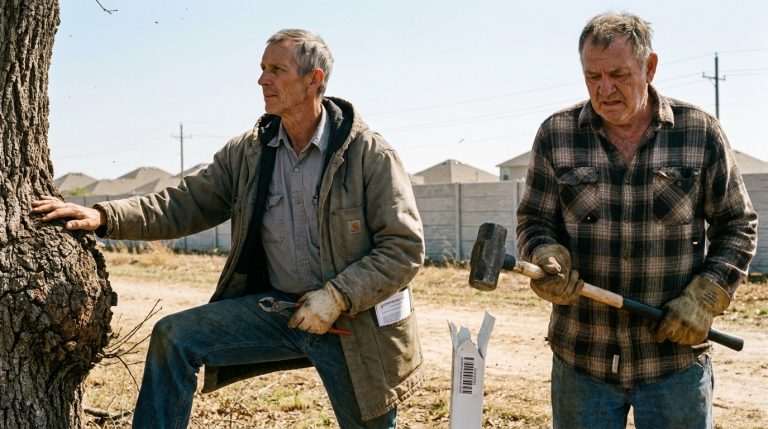
He stood near my southwest corner monument, his tall, slightly stooped frame clad in an oilskin duster that rustled like dry paper whenever he moved. A high-powered LED lantern sat on a flat rock near his boots, casting a harsh, horizontal white beam across the property line. In his gloved hands, he held a rolled blueprint—the original county plat map—and a brass plumb bob suspended by a braided nylon string.
“They’re pushing hard, Evan,” Mark said. His voice was low, weathered, carrying the gravelly texture of a man who spent more time listening to the land than speaking to people. He didn’t look up as I approached. He was watching the brass weight dangle, perfectly still, over the top of a rusted iron rod driven deep into the frozen mud. “Your fence line sits exactly three inches inside your deeded parcel. There’s no encroachment. No overlapping claim. The HOA’s survey is a complete fabrication.”
“I know,” I said. I pulled my collar up, the stiff canvas scraping against my jaw. “But they aren’t trying to win a legal argument, Mark. They’re trying to create a documented risk profile. If they keep filing reports, my carrier will drop me, and the lender will force a policy I can’t afford.”
Mark knelt, his knees making a dull popping sound. He brushed away a layer of decaying pine needles, exposing the stamped brass surveyor’s monument. It was old, green with oxidation, but the stamped numbers were still legible under the clean beam of his lantern. He reached into his duster pocket and pulled out a worn notebook.
“I took the measurements from the county benchmark down the road,” he said, using a stubby pencil to jot down a series of numbers. “The physical coordinates match this pin to the millimeter. There’s a discrepancy, though. A big one.”
I leaned down beside him, the smell of damp, frozen earth filling my nose. “What kind of discrepancy?”
He pointed his flashlight toward the slope below my fence, where the hillside dropped sharply toward the Cedar Ridge common trail. “The HOA’s consultant, RidgeSafe, filed their report claiming this entire slope was unstable due to ‘unauthorized boundary work’ on your property. But look at the water runoff patterns. See those deep, orange-tinted grooves in the soil?”
I looked where the light cut through the brush. The earth there was wet, despite the freeze, stained a dark, greasy rust color. It looked like dried blood against the gray granite rocks.
“That’s not surface erosion from rain,” Mark murmured, his finger tracing the path of the orange slime. “That’s coming from underneath. It’s highly acidic. It’s eating the root systems of the pines from the bottom up, making the whole hillside unstable. If this slope fails, it’s going to slide right onto the trail system below.”
He pulled a heavy, clear plastic specimen vial from his pocket and scooped a small amount of the orange muck into it. He capped it with a firm twist, the plastic threads clicking.
“The iron-oxide is leaching from the drainage systems of their Phase 2 development,” Mark continued, his voice tight. “They didn’t seal the retention basins properly. If the county finds out, the remediation costs will run into the millions. It’s a structural nightmare.”
I stared at the rust-colored vial in his hand. The waxy envelope in my pocket felt suddenly heavy. File-98-Echo. The corporate shell, Aethelgard Holdings, wasn’t trying to build luxury homes on my hillside. They were trying to annex my land so they could legally absorb the source of the subterranean leak—shifting the massive environmental cleanup liability onto my parcel before the state regulators flagged the damage.
“Would you put this in writing, Mark?” I asked, my hand closing around the cold iron fence post. “Factual, signed, with your license number.”
Mark stood up, wiping his hands on a rag. “Already did. It’s in the truck. But you need to be careful, Evan. When people are hiding a liability of this scale, they don’t stop at paperwork.”
He handed me the plastic vial. The liquid inside was thick, dark, and separated into greasy layers under the white light of the lantern, a physical piece of the secret they were trying to bury under my feet.
CHAPTER 5: THE SIEGE
The plastic specimen vial felt deceptively light in my hand, yet the thick, rust-colored sludge inside shifted with a heavy, viscous momentum. Mark nodded once, a silent, grim confirmation of the stakes, before turning to retrieve his lantern. His oilskin duster swept through the frozen ferns with a dry, rhythmic hiss. I watched the red taillights of his truck fade into the dark, winding road, leaving me alone at the perimeter with the cold and the chemical smell of sulfur lingering in the air.
I didn’t go to sleep.
I spent the remaining hours of the night in the kitchen, the vial sitting on the laminate counter under the harsh fluorescent light. I drafted a formal dispute to my insurance carrier, attaching Mark’s signed engineering statement and the county land records. By the time the first gray sliver of dawn cracked the horizon, the temperature had plummeted. A sudden, biting sleet began to fall, tapping against the glass like throwing handfuls of raw sand. It slicked the gravel driveway, turning the mountain air into a freezing, gray mist.
At exactly eight in the morning, the rumble of multiple heavy engines vibrated through the floorboards.
I stood by the window, coffee mug untouched, watching three vehicles navigate the slick turn of my driveway. A white commercial van branded with the RidgeSafe logo led the column, followed closely by a utility pickup carrying two men in bright orange vests. Karen’s black SUV anchored the rear like a command unit.
I set the mug down and stepped out onto the porch. The sleet stung my face instantly, melting into cold needles on my collar.
The two men in vests didn’t ask for permission. They hopped out of the pickup’s cab, carrying a bundle of metal sign stakes and a fresh roll of heavy caution tape. Brad Klene stepped out of the passenger side of Karen’s SUV, a ruggedized tablet held tight to his chest to protect it from the wet sleet.
“Mr. Brooks,” Shawn from RidgeSafe said, walking toward the porch. He kept his hands in his pockets, his posture stiff against the wind. “We’re here to install the physical barrier and hazard notices as mandated by the updated community risk assessment.”
“You’re trespassing,” I said. My voice didn’t rise; it carried flat and hard across the freezing yard. “You have no recorded easement. If those men drive a single stake into this ground, they are damaging private property.”
Karen stepped out of her vehicle, her designer trench coat zipped to her chin. She stood behind Shawn, her eyes bright with a cold, triumphant certainty. “We aren’t playing bureaucratic games today, Evan. Your carrier has already flagged your non-cooperation. Your lender’s forced-placed policy goes active at noon. If you interfere with a safety mitigation team, it’s a policy violation. You will be uninsured by lunch.”
One of the vest guys lifted a heavy iron post-driver, preparing to slam a metal stake directly into my frozen turf.
“Stop,” I said.
The man paused, the heavy iron tool hovering over the metal stake.
I didn’t look at Karen. I looked directly at Shawn. I pulled the copy of the county land survey from my jacket pocket, along with a laminated copy of the EPA municipal runoff guidelines.
“This is a certified county map showing zero public or private easement,” I said, holding the paper steady against the sleet. “And this is a physical analysis of the soil at this exact boundary line. It’s highly acidic, contaminated with industrial iron-oxide from the Phase 2 retention basins. If your firm signs off on a report claiming my fence is the hazard, you are certifying a fraudulent document to cover up an active environmental spill.”
Shawn’s eyes flicked from the paper to the rusted mud oozing near the fence line. He looked at Brad, then back at me. “We were told this was a standard slope stabilization issue.”
“It’s an environmental shift,” I replied, my voice cutting through the wind. “And the Special Investigation Unit of my carrier is already reviewing the electronic submission code Aet_98_E. If you proceed, your professional liability insurance is on the line.”
Shawn’s face went pale. He stepped back, turning toward Karen. “You didn’t say anything about an active runoff issue, Karen. Our contract doesn’t cover environmental liability misrepresentation.”
Before Karen could answer, the low, pulsing wail of a siren drifted up the hill. Deputy Morales’s cruiser rounded the final bend, its blue and red lights reflecting off the wet, frozen sleet. The cruiser slid to a halt on the slick gravel, blocking the driveway.
Morales stepped out, his hand resting casually on his utility belt. “We have a call about a physical property dispute. Who is the owner here?”
“I am,” I said, stepping down from the porch. “And I am requesting a formal trespass warning for everyone on this property.”
Karen’s clipboard clicked as she gripped it tighter. “Deputy, we are performing a mandated HOA risk mitigation—”
“Ma’am,” Morales cut her off, his eyes scanning the stakes and the caution tape. “Do you have a court order or a registered county easement to be on this parcel?”
“The boundary is under review—”
“That’s a no,” Morales said. He turned to the two men holding the post-driver. “Put the tools back in the truck. Now.”
Shawn didn’t wait. He waved his men back toward the van. “We’re done here. Pack it up.”
Within ninety seconds, the trucks were backing down the slick driveway, their tires spinning slightly on the frozen gravel before catching traction. Karen stood by her SUV, her face tight with a silent, furious rage.
“This isn’t over,” she whispered as Morales watched her. “You can’t fight a multi-million dollar asset restructuring alone.”
She climbed into her vehicle and slammed the door. As the SUV backed away, Morales walked over to me, handing me a small, yellow carbon copy of the incident report.
“They won’t be back today,” Morales said, his voice quiet. “But keep your eyes open.”
I thanked him and walked back inside the warm house. I pulled the folded papers from my pocket to file them with the rest of my documentation. As I smoothed out the copy of the county land records Mark had given me, a tiny, stamped engineering seal in the bottom-right corner of the original Phase 2 blueprint caught my eye.
I leaned closer under the desk lamp.
The signature authorizing the faulty drainage system that had created The Iron-Oxide Core—the very leak that was destroying the hillside—was dated ten years ago.
The lead design engineer’s name was printed in clear, bold block letters: Mark Vance, Senior Civil Consultant. My helpful neighbor hadn’t just discovered the trap. He was the one who built it.
CHAPTER 6: THE INSTITUTIONAL COLLAPSE
The ink of the signature—Mark Vance, Senior Civil Consultant—did not smudge under my finger, but the rough paper beneath it felt cold, holding the dry dust of a decade-long deception. I stared at the stamped engineering seal, realizing my quiet neighbor’s helpfulness wasn’t neighborly grease. It was self-preservation. The very drainage systems causing the acidic leak of The Iron-Oxide Core had been designed and signed off by his hand. If the hill collapsed, the county wouldn’t just sue the developers; they would strip Mark of his license, his assets, and his freedom.
I didn’t call him. I didn’t confront him. I didn’t give him a chance to run or prepare. Instead, I carefully slid the copy of the blueprint, the waxy envelope labeled File-98-Echo, and the soil sample specimen vial into my canvas folder. It was six in the evening. The emergency Cedar Ridge board meeting was scheduled for seven.
The sleet had stopped, leaving a thin, brittle crust of ice over the gravel as I walked to my truck. The freezing air pinched my throat, and the engine took a long, laboring turn before catching with a deep, metallic throb. I drove slowly down the mountain road, my headlights catching the glassy sheen on the blacktop. The silence inside the cab was absolute, save for the rhythmic clicking of my heater fan.
When I walked through the double glass doors of the Cedar Ridge Clubhouse, the atmosphere was completely different from the previous night. The room was packed, but there was no murmured consensus. The air was charged with a sharp, hostile vibration. Forty homeowners sat in hard folding chairs, their eyes darting toward the front stage.
Karen Hoffman stood at the podium, her knuckles white against her clipboard. Brad Klene sat beside her, staring intently at his lap, avoiding all eye contact with the crowd. On the side wall stood Mark Vance, his oilskin coat damp, his arms crossed over his chest, his jaw set in a rigid line.
“We are addressing a technical safety protocol,” Karen said, her voice amplified by the speakers, though it lacked its previous administrative smooth quality. “The board’s actions have been entirely within our oversight mandate.”
“Did you try to cancel a homeowner’s private insurance policy?” a voice called out from the third row. A man in a heavy flannel shirt stood up, waving a copy of an email. “We have the vendor logs, Karen. The carrier flagged potential misrepresentation originating from this office. Is that true?”
Karen’s mouth opened, but no words came out. Her gaze swept the room and locked onto me as I stepped out from the shadows near the back wall.
I didn’t shout. I walked down the center aisle, the heels of my boots striking the floorboards with a slow, heavy cadence. I reached the front folding table and laid the canvas folder down flat, opening it to reveal the documents.
“It’s not just about a fence,” I said. My voice was calm, cutting through the room with transactional precision. “The board—specifically Karen Hoffman—has been working to force an annexation of my parcel to execute an acquisition contract with Aethelgard Holdings.”
“That is a private business matter unrelated to—” Karen began, her voice cracking slightly.
“It is entirely related,” I cut her off. I pulled the blueprint with Mark’s signature and laid it next to the copy of File-98-Echo. “Because Aethelgard Holdings represents the primary investors of Cedar Ridge Phase 2. They discovered that the drainage basins designed by Mark Vance have failed. The Iron-Oxide Core is an active, acidic underground runoff that is liquefying the hill. If they can annex my land, they shift the environmental liability of that failure onto my parcel, protecting the developer and the lead engineer from millions in remediation costs.”
A collective gasp rippled through the audience.
Mark Vance’s arms dropped to his sides, his face turning the color of dry ash. He looked at the blueprint on the table, then at his own signature, and back up at me. He didn’t try to deny it. The weight of the documentation left him completely cornered.
“Is this true, Mark?” the man in the third row demanded, turning toward him.
“I… we had to manage the exposure,” Mark stammered, his voice barely a whisper, his posture collapsing as he realized his career and legacy had just evaporated on the table.
Karen’s clipboard slipped from her hand, hitting the hardwood floor with a loud, hollow clack. She looked at Brad, then at the silent, furious faces of the homeowners. Her authority didn’t just break; it unraveled in seconds, stripped away by the raw weight of county-recorded facts. The crowd began to shout, demanding a full audit, the dissolution of the board, and the immediate involvement of the state environmental division.
I didn’t stay to watch the shouting. I packed my folder, leaving the certified copies on the table for the homeowners, and walked out of the clubhouse.
Outside, the mountain air was clean and cold. The sleet had left the world washed, the stars cutting through the dark sky like sharp shards of glass. I drove up my gravel road, the truck climbing steady, and pulled into my driveway.
I walked to the southwest boundary line, where the caution tape had been cleared. The air smelled of clean pine and damp earth, the sulfurous taint washed away by the storm. I knelt in the dirt, brushing away a few stray pine needles, and ran my hand over the cold, green brass of the original surveyor’s monument. It was deep, solid, and completely unmoved.
I went inside, grabbed my pocket knife, and walked to the porch. A small cedar post on the railing had split from the dry freeze. I sat on the top step, my boots resting on the gravel, and began to shave a new piece of cedar to fit the gap. The wood was aromatic and pale, curls of clean shavings falling onto the frozen ground like winter leaves.
There were no more notices. No more fake deadlines. No more manufactured emergencies. Just the slow, steady rhythm of my own hands working the wood, and the deep, restorative quiet of the pines swallowing the sound of the wind.
Mine.