The Broken Vow at Lake Geneva and the Heavy Price of Cold Ambition
CHAPTER 1: SHADOWS IN THE MARBLE
The last glass of expensive cabernet was gone, leaving only a dark, sticky ring on the polished mahogany table.
I picked up my brass key ring, feeling the cold weight of the metal against my palm as I rolled the key for the main gate between two fingers.
Out in the driveway, the tail lights of the final investor’s sedan disappeared past the oak trees, leaving the grounds in absolute silence.
I turned back toward the study, the heavy soles of my work boots quiet against the Persian rug covering the cold marble floor.
A single lamp flickered on the corner of the desk, illuminating a folded document that hadn’t been there twenty minutes ago.
Beside the paper lay a small silver lapel pin, its sharp metal back glinting under the bulb like an open needle.
I didn’t reach for the desk drawer or look for a phone.
I just weighed the brass keys in my right hand, feeling the quiet, heavy stillness of a house that had suddenly grown very small.
A soft scrape of leather against hardwood echoed from the unlit doorway behind me.
“You should have signed the regional permit transfers back in Chicago, Marcus,” a voice said, low and entirely devoid of rush.
I turned around slowly, my thumb pressing hard into the teeth of the brass keys until the metal bit into my skin.
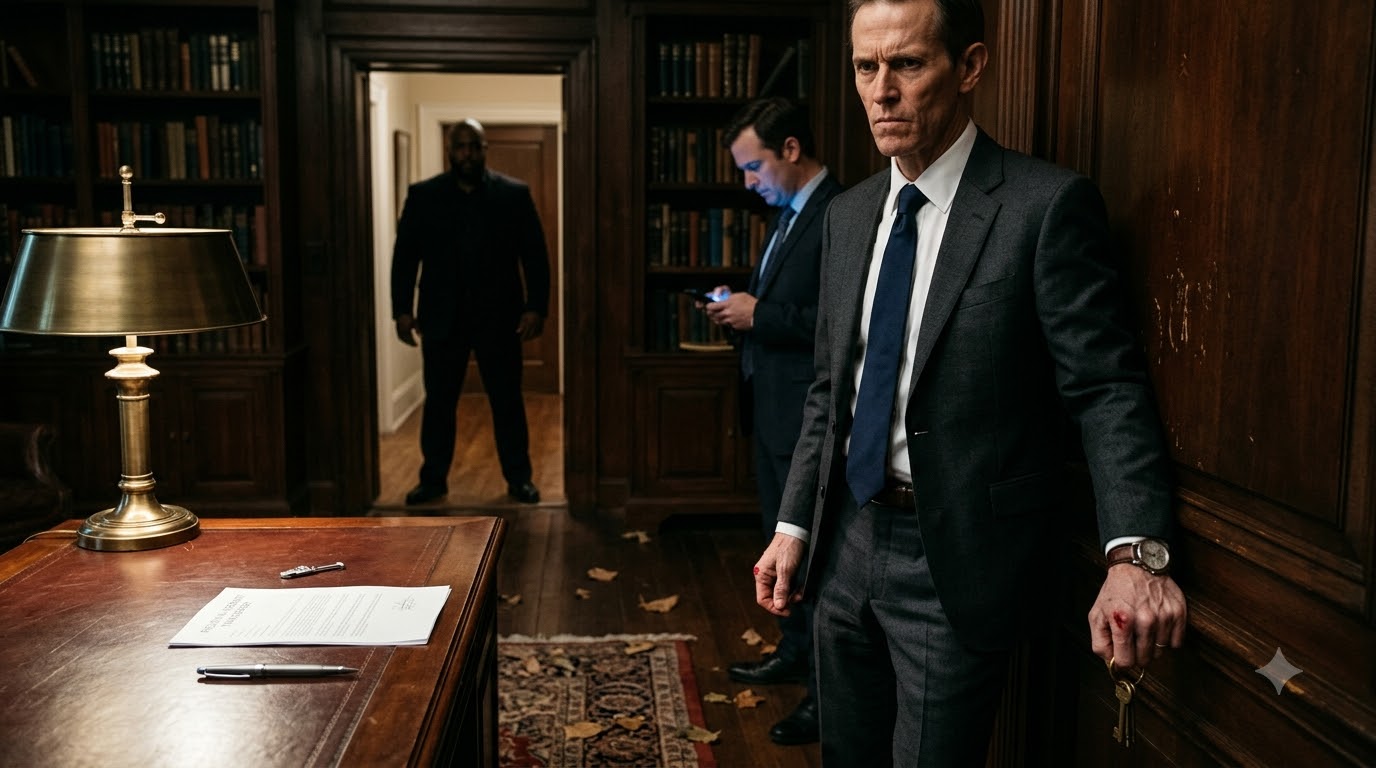
Three men stood in the dark threshold of the study, and none of them were wearing overcoats.
CHAPTER 2: THE INTRUDERS AND THE CONTRACT
“You took three steps past the rug, Marcus,” the lean man said, his voice as dry as salt. “That’s three steps too far from your desk.”
He didn’t pull a weapon.
He didn’t have to.
The large man with the stretched jacket seams took two broad strides forward, his heavy shoulder catching the edge of the doorframe and shutting off the hallway light behind him.
The room shrank until it was just the three of them, the heavy oak desk, and me holding a handful of metal keys.
“The regional transport licenses,” the lean one said, pointing a thin finger toward the folded paper resting on my desk beside the silver pin. “You’re going to sign the release form. Tonight.”
“Those licenses cover half the medical supply routes in three states,” I said, my voice flat, every line of my back holding stiff against the cold wall. “They aren’t personal property. They belong to the logistics firm.”
“Your firm,” the man holding the phone spoke up, his screen glowing bright in the dim room as he turned it toward me. “And your fiancee made sure we had the administrative clearance to transfer them the second your name goes on that line.”
The screen held a photograph—Victoria sitting at a corner table in a Milwaukee steakhouse, her arm draped casually over the back of the lean man’s chair, a glass of pinot noir raised in a toast.
The date stamp at the bottom read fourteen months ago.
Six months before I bought the ring.
Eight months before she asked me why I kept working eighteen-hour days when I could just let an Eastern management firm streamline the routes.
“Victoria doesn’t have executive sign-off on federal permits,” I said, cold realization settling behind my ribs like lead.
“She doesn’t need it,” the lean man stepped closer, his boots heavy against the floorboards. “She just needed to keep you busy while we mirrored your terminal credentials from the guest house. All we need now is your hand on the pen, or we take a quiet drive past the state line and do this the hard way.”
I looked at the paper, then down at the heavy brass key ring resting against my knuckles.
No silent button under the desk lip to push.
No security firm on speed dial.
Just two men blocking the only door, one man holding a camera, and a house full of sleeping staff who had no idea the lock had already been turned from the inside.
“You built this whole performance for a regional supply route,” I said, letting out a slow, heavy breath through my nose.
“We built it for the monopoly, Marcus,” the lean man said, pulling a heavy steel pen from his coat and laying it flat on the mahogany desk. “Now pick up the pen.”
CHAPTER 3: THE INTERRUPTION
“You’re running out of evening, Marcus,” the lean man muttered, tapping his foot against the mahogany base of the desk.
I didn’t answer.
I let my gaze drop to the heavy brass key ring still gripped tightly in my right hand, calculating the distance between the desk corner and the doorframe.
Then the quiet outside shattered.
It wasn’t a shouting match or a kicking door—it was the soft, uneven patter of bare feet against the cold hallway hardwood.
The large man blocking the doorway froze, his thick neck turning slowly toward the dark corridor.
A tiny figure stepped into the dim light frame, wearing faded pink pajamas covered in yellow stars, two uneven pigtails sticking out at odd angles.
Lily looked at the large man, her big brown eyes wide with sleepy confusion, then crossed her small arms tightly across her chest.
“Let him go,” she said, her three-year-old voice wobbling slightly, “or you’ll have to deal with me.”
The room went dead quiet.
The lean man stared at her, his lips parting in sheer disbelief, while the man holding the glowing phone took an involuntary step back toward the wall.
I didn’t move a muscle, my heart thumping hard against my ribs as I watched the large man’s face.
The hard, callous line of his jaw slackened, a sudden, heavy twitch catching the corner of his eye as he looked down at those star pajamas.
He didn’t reach for his coat pocket.
He didn’t move toward her.
“What are you waiting for?” the lean man snapped, his voice tight with rising panic. “Get her out of the way!”
“No,” the large man said, his voice quiet, flat, and suddenly exhausted.
He took one deliberate step backward into the hallway, away from the doorway, his eyes fixed entirely on the floorboards beneath the girl’s feet.
“I’m not doing this,” he muttered, turning his back on the study entirely. “Not with a kid here.”
CHAPTER 4: THE CRACK IN THE FOUNDATION
“Dennis!” the lean man shouted, his neck flaring red as he lurched toward the threshold. “Get back in here!”
The doorway stayed empty.
Only the soft rustle of pajama fabric and Rosa’s panicked, hushed whisper reached the study as she dragged her daughter back into the kitchen corridor.
The leverage in the room shattered into jagged pieces.
The man holding the phone backed up until his shoulder blades hit the built-in bookshelf, his eyes darting frantically between the unlit doorway and the open paper on my desk.
“He’s gone,” I said, stepping away from the wall until my thighs pressed against the heavy edge of the desk. “And you two don’t have enough hands to hold me down and forge a signature.”
“Shut up,” the lean man spat, turning back toward me, his hands twitching near his waist as sweat broke across his shaved scalp. “You think because a broad and a kid walked past that this contract disappears?”
“I think your muscle just walked out on a felony,” I said flatly, letting the brass keys drop onto the polished desk with a heavy, metallic clatter that rang out in the quiet room. “And I think you’re standing in a dead-end office with two regional supply licenses you can’t touch without my thumbprint.”
He reached for the paper on the desk, his fingers clawing at the corner of the document.
“We don’t need your thumbprint,” he gritted out, his voice sharp and erratic. “Victoria’s already uploading the corporate authorization from the regional server. All we need is you in the car.”
“Victoria doesn’t have the primary administrative seal,” I said, reaching down to slide the small silver lapel pin off the desk surface, holding the cold metal between my index finger and thumb. “Which means whatever syndicate paid for this pin is about to watch two years of corporate espionage go up in smoke.”
The man with the phone swallowed hard, his thumb hovering helplessly over the glowing screen.
“Call her,” the lean man ordered, without breaking eye contact with me. “Tell her we move to the secondary access point.”
“The server locked out three minutes ago,” the man at the bookshelf whispered, his voice cracking. “The system flagged a dual-login attempt from Chicago.”
CHAPTER 5: THE DESPERATE COLLAPSE
“Locked out?” the lean man roared, lunging across the corner of the desk, his hand clawing for my collar.
I didn’t reach for a drawer or flinch backward.
I swept my right hand down, grabbing the heavy iron desktop lamp by its brass neck, and jammed the solid base straight into the center of his chest.
The impact drove him back two paces, his boots catching on the heavy edge of the Persian rug as he stumbled into the man behind him.
“You don’t have the server, you don’t have the licenses, and you don’t have the muscle,” I said, stepping around the desk to block the open doorway with my own weight.
“You think you won something?” he snarled, his breath coming in ragged, shallow hitches as he grabbed a heavy glass paperweight off the side table, his knuckles white. “Victoria’s got half your personal accounts tied up in Eastern trusts right now. You sign these releases, or you spend the next five years broke, fighting bank injunctions in federal court.”
“She tried,” I said, holding up the brass key ring in my right hand, letting the keys swing in a short, heavy arc. “But those trusts require the primary physical token to execute a final transfer.”
I pointed with the keys toward the small iron lock on the floor safe behind the desk.
“And the only key that fits it is sitting right here in my hand.”
The man holding the phone dropped his arm, his knees visibly shaking as he backed into the corner of the bookshelf.
“He lied to us,” the phone man muttered, staring at the lean man. “He said the estate was clear, he said the credentials were live.”
“Shut your mouth!” the lean man screamed, swinging the paperweight wild and wide toward my shoulder.
I ducked beneath the arc, the heavy glass whistling past my ear, and shoved my weight straight into his ribs, driving him back against the mahogany desk until the wood groaned under the pressure.
The paperweight clattered to the floorboards, rolling uselessly across the rug.
The lean man lunged again, grabbing my coat lapels with desperate, clawing hands, trying to throw his weight forward to force me off balance.
I planted my boots firmly on the rug, straining against his weight, my forearm pressed hard against his sternum as we locked in a grinding, static strain.
“You’re done,” I gritted out, forcing my frame forward inch by inch until his back pinned flat against the edge of the desk.
From down the hallway, the loud, solid clatter of heavy boot heels hit the hardwood floor—the groundskeepers, alerted by the noise, moving in fast.
CHAPTER 6: THE QUIET AFTERMATH
“Keep your hands where they are,” Thomas, my head groundskeeper, said, his voice low and steady as he stepped past the desk with a heavy iron flashlight held firm in his right hand.
The lean man stopped twisting.
He slumped back against the mahogany desk, his breath coming in ragged, shallow wheezes, his eyes fixed on the silver lapel pin still resting in my left hand.
“Victoria’s standing at the front gate with two bags in her trunk,” Thomas added, nudging the dropped paperweight away with the toe of his work boot. “Frank stopped her at the guardhouse before she could hit the main road.”
The man holding the phone dropped his hands to his sides, letting the device slip from his fingers onto the rug without saying a word.
The syndicate’s entire plan—eighteen months of calculated infiltration, fake trusts, and borrowed authority—lay in pieces on the study floor.
It wasn’t a high-tech security grid or a quiet panic button under the desk that broke it.
It was a three-year-old girl in star pajamas who stepped into a dark doorway, and a brass key ring held tight by a man who refused to give up his boundary.
I stepped back, setting the brass keys down on the desk lip beside the folded transfer paper.
The lean man pushed himself up off the desk, wiping sweat from his forehead with the back of his sleeve, his face twisted in quiet, bitter defeat.
“This route was worth forty million,” he muttered, staring at the floorboards.
“It was worth the medicine it carried,” I said flatly, pulling the desk drawer open and sweeping the paper, the pin, and the pen inside before turning the lock.
Out in the hallway, the house was entirely still again.
Rosa stood by the kitchen door holding a fresh pot of coffee, her hands steady, her eyes watching me with calm, quiet understanding.
Behind her, on the small sofa in the breakroom, Lily sat wrapped in a cotton blanket, holding a blue crayon over a half-finished drawing of a horse.
I walked down the hall, pulled out a wooden chair across from her, and sat down.
I reached out my hand, picked up a worn yellow crayon from the basket, and pressed the tip flat against the paper.