The Price of Oak and Gravel: A Story of Hard Truths and Bitter Integrity
CHAPTER 1: GRAVEL AND RUINED SILK
The engine of the ’94 Ford rattled like a coffee can full of dry nails as it rounded the sharp turn past Blackwood Creek.
Noah Bennett shifted down into second gear, his calloused palm rough against the worn rubber of the gearshift. The bed of the truck groaned under eight hundred pounds of freshly split Douglas fir, the sweet, heavy scent of pine sap cutting through the exhaust fumes leaking from the floorboards. His shirt was soaked dark between his shoulder blades from four hours with a splitting maul, and the skin across his knuckles was stained grey with timber dust.
Then the brake pedal hit the floor under his boot.
He didn’t swear. He just hauled back on the wheel, letting the rear tires skid five feet through the loose gravel before the truck ground to a shuddering, dead-engine stop.
Twenty feet ahead, right in the center of the narrow logging track where the ruts ran four inches deep, sat a wheelchair.
The woman in it looked like she’d been dropped out of a plane.
Layers of torn, mud-caked white silk billowed around the rusted metal frame of her seat, the hem shredded into wet fringe where it dipped into the ditch water. Her hair, thick and dark, hung out of a crooked comb, plastered to her cheek by the damp autumn air. She wasn’t moving. She just sat there in the middle of nowhere, staring at his front bumper with hazel eyes that looked entirely too wide for her pale face.
Noah pulled the emergency brake until the cable screamed, turned off the ignition, and reached for the dented brass pocket compass sitting on the dashboard. He didn’t open it. He just tapped his thumbnail twice against the cracked glass face, feeling the cold brass anchor his breathing, before shoving it into his front pocket.
He opened the driver’s door. The hinges shrieked in the quiet woods.
“You’re blocking the hauling lane, ma’am,” Noah said. His voice was gravelly, dry from wood smoke and the chill setting over the ridge.
The woman didn’t flinch, but her hands—small, soft, with manicured nails that had never held an axe—gripped the armrests until her knuckles turned yellow. “My phone has no service. The wheel… the front caster snapped off in the rut.”
Noah walked over, his heavy work boots crunching rhythmically against the stone. He didn’t look at her face; he looked down at the left front wheel of the chair. The cast-iron spindle was snapped clean in half. That didn’t happen from a light stroll. That happened when a hundred and twenty pounds of metal and human weight hit an obstruction at speed.
“No service out here for ten miles,” Noah said, kneeling on one knee. The damp soil soaked instantly through the denim over his cap. He touched the broken metal. Cold. No grease on the shear line. “Where’s the vehicle you came out of?”
“Gone,” she said. The word was flat, stripped of whatever dramatic edge she might have wanted it to have. It came out like an invoice.
Noah looked up then. Close up, her skin had that thin, expensive look—the kind that came from indoor climate control and high-end soap. But the purple bruises blossoming along the underside of her forearms weren’t expensive. They were three hours old, deep, and ugly.
“Someone drop you?” Noah asked.
“I left,” she corrected sharply. Her chin came up half an inch, a reflexive twitch of pride that looked utterly ridiculous given the five inches of mud coating her skirt. “I drove as far as the gas lasted in an old loaner, the chair tipped when I tried to roll down the grade, and now I am here.”
Noah stood up, wiping his muddy thumb down the side of his jeans. “My name’s Noah Bennett. My cabin is three miles down this ridge. I’ve got a dry porch, a landline that works when the wind isn’t blowing north, and a nine-year-old girl who’s going to be off the school bus in forty minutes.”
She looked at his truck, then at his grease-stained flannel, then back to his eyes. “I can’t pay you.”
Noah let out a short, quiet breath that hitched in the cool air. “I didn’t offer a cab ride, ma’am. I offered a dry floor.”
He stepped behind the chair, slipped his hands beneath her arms and under the bend of her knees, and lifted.
She went rigid as iron. Her hands flew up, catching the collar of his shirt, her nails digging into the heavy wool. She was light—lighter than a dry bale of hay—but her body wasn’t dead weight. He felt the sharp, involuntary contraction of her thigh muscles against his forearm as he shifted her weight toward the passenger door.
Noah paused for a split second, the biological tension in her legs telegraphing straight through his sleeves. He didn’t say a word. He just nudged the passenger door open with his hip and set her down on the cracked vinyl seat.
“The chair?” she asked, her breath coming fast against his neck, smelling faintly of expensive mint and raw stress.
“Going in the back with the firewood,” Noah said, stepping back into the gravel. “It’ll ride rough, but it won’t break any worse than it already is.”
He hauled the metal frame into the bed, wedging it firm between two logs of Douglas fir, then slammed the tailgate shut. The iron latch clanged across the quiet valley like a gunshot.
CHAPTER 2: THE WEIGHT OF AN UNSPOKEN LIE
Noah let the clutch out slow, his left knee taking the tension as the truck pulled out of the rut. In the passenger seat, Evelyn didn’t relax. Her spine stayed rigid, her shoulders drawn up tight toward her ears, the ruined silk of her skirt bunched in huge, wet folds around her boots.
Her feet rested flat against the floorboard mat. The left boot sat at a ninety-degree angle, stiff and unyielding, but the heel was pressed hard into the black rubber. A person with dead nerves didn’t anchor their heels to brace against a turn. A person with dead legs didn’t shift their weight when the frame jolted over a exposed root.
Noah kept his eyes on the road. “Hold onto the dash. The bridge on Blackwood gets slick when the rain hits.”
She reached out, her small, pale fingers wrapping around the cracked plastic of the dashboard. Her grip was tight enough to show the white tendons across the back of her hand. “Is it much further?”
“Two miles,” Noah said. He reached into his shirt pocket, pulled out a crushed pack of matches, and tossed it onto the dashboard tray. It landed right next to a pristine, unblemished silver fountain pen tucked inside his grease-stained maintenance log.
Evelyn’s eyes flicked to the pen. Her breath caught—just a micro-second hit of air through her nose—before she forced her gaze back out the windshield. She didn’t touch it. She didn’t ask why an eight-dollar logbook in a thirty-year-old farm truck held a hundred-dollar piece of polished German steel.
“My name is Evelyn,” she said, her voice tighter now, trying to fill the cabin before the silence got too heavy. “I didn’t properly introduce myself.”
“You said it back on the road,” Noah replied. He dropped the truck into second gear to take the grade down toward the cabin. The engine engine-braked hard, the wood in the back shifting with a heavy, wet thud against the cab wall. “Evelyn. No last name.”
“Just Evelyn.”
“Suits me fine.” Noah cut the wheel left, bypassing the turnoff for town. “I don’t collect last names. They usually come with bills or lawyers attached.”
The cabin pulled into view through the dripping pine branches. It wasn’t a mountain retreat. It was forty acres of cleared timber, a low-slung hemlock house with a rusted tin roof, and a gravel driveway choked with wood chips and iron cold scrap. A stacked row of split cordwood ran thirty feet down the side of the porch, straight as a string line.
Noah killed the engine. The silence of the woods slammed down over the truck instantly, thick with the sound of water dripping off the eaves.
“Stay put,” Noah said, opening his door.
He walked around to her side, pulled the door wide, and braced himself. When he reached in to lift her, he didn’t rush. He slid his right arm under her knees again. Through the heavy, damp layers of her dress, the muscles in her quads went tight as steel wire—an active, unconscious effort to support her own hips.
Noah hoisted her clear of the bench. Her arms went around his neck, her knuckles pressing right against the sore muscle at the base of his skull. She was breathing through her mouth, short and quiet.
“You’re holding your breath,” Noah muttered, stepping onto the porch planks.
“I’m fine,” she whispered. Her face was buried in the wool of his collar. She smelled like wet earth, cold silk, and the faint, bitter edge of fear. “I’m not heavy.”
“Didn’t say you were.” He shoved the front door open with his boot heel.
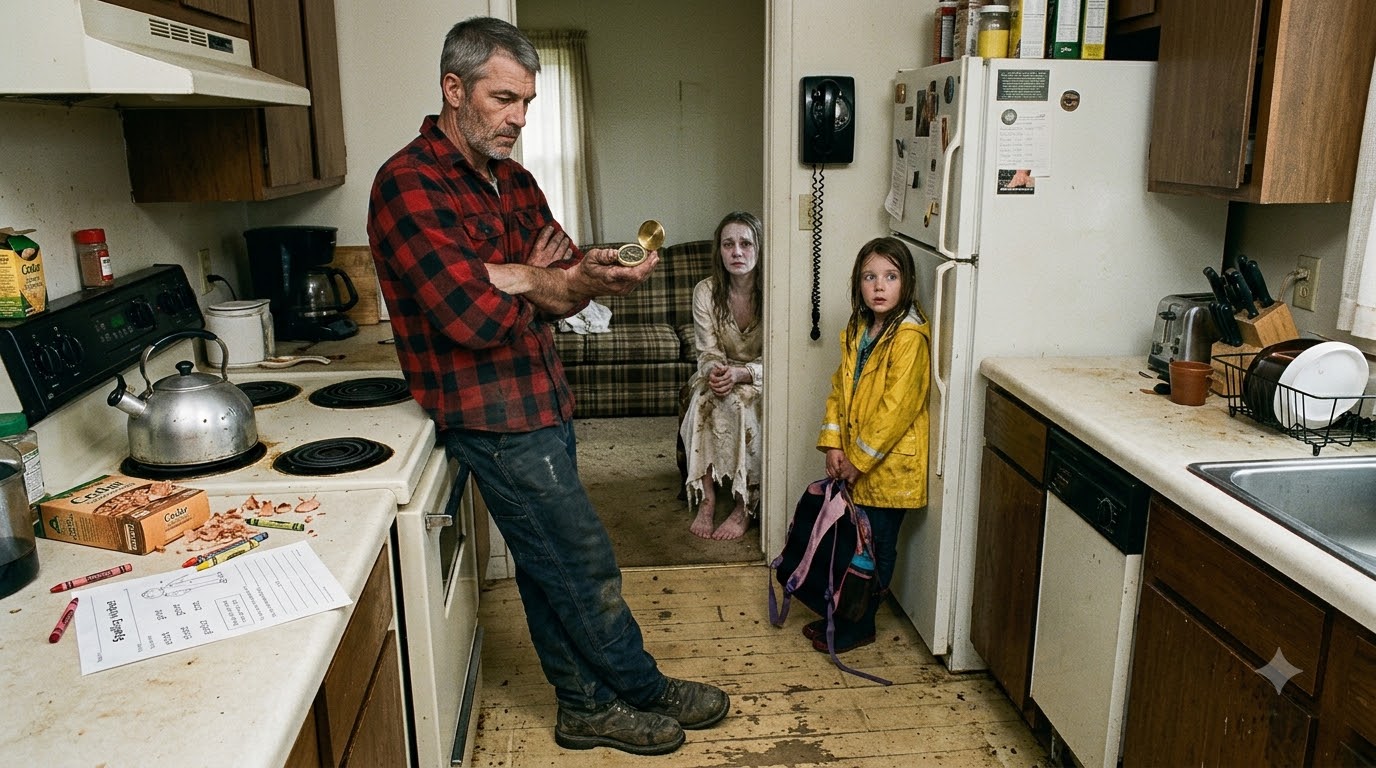
The cabin smelled like dried pine needles, wood ash, and the faint sweet scent of lavender oil. A small pair of mud-stained yellow rainboots sat neatly by the woodstove, next to a box of wax crayons and a half-finished spelling worksheet.
Noah carried her straight to the worn plaid couch against the back wall and set her down. The second her weight hit the cushions, she drew her legs up—not with her hands, but with an immediate, fluid pulling motion of her hip flexors—before she caught herself and dropped her feet flat to the rug.
Noah stepped back, his hands hanging loose at his sides. He didn’t call her on it. He just pulled the brass compass from his pocket, set it firmly on the end table beside her, and turned toward the woodstove.
“The phone’s on the kitchen wall,” Noah said, grabbing a handful of cedar shavings from the box by the hearth. “It’s a landline. Dial nine to get out. Call whoever you need to call to bring you a pair of dry pants.”
Evelyn stared at the black rotary phone hanging near the refrigerator. “I don’t… there’s no one to call.”
Noah struck a match against the iron stove. The sulfur flare caught his jaw, highlighting the gray stubble and the deep lines around his mouth. “Everyone’s got someone, ma’am. Even if it’s just the people they’re running away from.”
Before she could answer, the gravel outside crunch-crunched under a pair of small, jumping boots. The front door swung open, bringing in a sharp gust of cold air and nine-year-old Mia Bennett, her yellow raincoat dripping wet onto the threshold.
Mia stopped dead in her tracks, her school backpack slipping off one shoulder, her grey eyes wide as saucers as she stared at the couch.
“Dad,” Mia whispered, her eyes glued to the mud-stained silk gown. “Is there a bride in our house?”
CHAPTER 3: CRACKS IN THE GRAIN
Noah turned slowly from the hearth, his rough hands lingering on the warm iron door.
“Take off those wet boots before you track mud onto the rug, Mia,” he said, his voice flat and even. He didn’t look at the couch. He looked at his daughter’s dripping yellow hood. “Then go wash up.”
Mia didn’t move her feet. She unzipped her coat with a quick, plastic rasp, her wide eyes remaining locked on Evelyn’s torn veil. “Dad… her dress is stuck to her legs. Did she fall out of a parade?”
Evelyn shifted on the cushions. The movement was small, but Noah caught the sudden, sharp flexing of her left ankle—a clear, deliberate adjustment to tuck her heel back out of sight beneath the damp silk folds.
“I had an accident on the road, sweetie,” Evelyn said. Her voice had dropped its guarded, icy edge, replaced by a soft, carefully calibrated warmth. She reached out with one hand, resting it open on her lap. “My chair broke.”
Mia dropped her backpack on the floorboards with a dull thud. She stepped out of her muddy boots and walked straight past Noah, stopping three feet from the couch. “Why are you wearing a wedding dress if you’re in the woods?”
“Mia,” Noah warned softly.
“It’s okay,” Evelyn said quickly. Her fingers twitched against the plaid fabric of the couch cushion. “I was supposed to get married today. I changed my mind.”
Mia digested this, her chin tilted up. “Because he was mean?”
Evelyn’s breath hitched. A tiny, involuntary tremor rattled her lower lip before she clamped her teeth together to stop it. She didn’t answer. She didn’t have to.
Noah walked into the small kitchen area, the floorboards groaning under his weight. He filled a dented aluminum kettle at the sink, the pump rattling in the pipes. He set the kettle on the iron stovetop with a metallic clatter.
“She’s staying until her phone gets a charge or someone comes looking for her,” Noah said, pointing a finger toward the hallway. “Go do your spelling words at the table, Mia.”
“I can help her,” Mia said, looking up at Evelyn. “We have dry towels in the bathroom. Dad leaves them on the high shelf, but I can reach if I stand on the tub.”
“I don’t need a towel, Mia, thank you,” Evelyn said softly.
She reached down to adjust her skirt. In doing so, her hand brushed against the armrest, and her elbow knocked against her own small leather clutch resting on the cushion. The bag slipped, sliding off the slick leather edge and dropping toward the floor.
It was a sharp, six-inch drop.
Evelyn didn’t use her hands to catch it. Instinct hit her faster than her cover story—both her knees snapped inward instantly, her lower legs catching the falling bag smoothly between her calves before it hit the rug.
The room went dead silent.
The kettle on the stove began a low, thrumming whistle as the water heated.
Mia blinked, looking down at Evelyn’s calves clamped tight together around the leather clutch. “You caught it.”
Evelyn froze. Her face drained of what little color it had left, turning the color of wet chalk. Her hands hovered over her lap, trembling noticeably now. Slowly, deliberately, she relaxed her legs, letting the bag drop the final inch to the floorboards.
“Spasm,” Evelyn whispered, her voice cracking as she forced her eyes up to meet Noah’s. “It… happens sometimes. Involuntary.”
Noah stood by the woodstove. He picked up his brass compass off the end table, feeling the cold weight of the metal in his palm. He thumbed the latch open. The tiny needle spun violently before settling north toward the ridge.
“Is that right,” Noah said. It wasn’t a question.
He closed the compass with a sharp snap.
“Mia,” Noah said, his voice dropping into that low tone that meant no arguing. “Go to your room. Now.”
Mia looked between the two adults, sensing the sudden, thick wall of tension that had dropped into the cabin. She picked up her backpack without a word and retreated down the hall, her bedroom door clicking shut behind her.
Noah didn’t step closer to the couch. He leaned back against the edge of the kitchen counter, crossing his arms over his chest.
“You’ve got ten minutes on that phone charger, ma’am,” Noah said quietly, his gray eyes locked onto her trembling hands. “And then you and I are going to have a very clear conversation about what you’re bringing into my house.”
CHAPTER 4: THE SHATTERED MASK
Noah didn’t move to turn off the heat. He let the steam blast against the log wall, filling the small kitchen with a hot, damp haze.
Evelyn sat on the sofa with her spine rigid, her heels locked firmly into the carpet. The color had left her neck completely, leaving the purple bruises on her forearms standing out like dark oil smudges.
“You caught that bag with your knees,” Noah said over the screech of the kettle. “Dead nerves don’t twitch like that. A spasm pulls a muscle out; it doesn’t clamp a leather clutch before it hits the floorboards.”
Evelyn reached out with a trembling hand, her fingers clutching the edge of the plaid cushion. “I told you… my physical therapy—”
“—Is a lie,” Noah hijacked, stepping around the woodstove. He grabbed the kettle handle with his bare, calloused thumb, lifting it off the burner with a hard iron clatter. The whistling died instantly into a low hiss. “You walked onto that road. You sat in that chair because you wanted whoever pulled over to see a cripple in a gown.”
“It wasn’t like that,” she snapped. Her voice lost its fragile, helpless pitch, dropping an octave into something smooth, sharp, and cold. “I didn’t ask you to pick me up, Mr. Bennett.”
“No, you just sat in the middle of a blind logging curve where an eight-ton log truck would’ve ground you into gravel,” Noah said. He set the kettle down on the trivet with enough force to spill boiling water across the stove top. “You used my kid’s pity. You let Mia walk in here thinking she was looking at a tragedy.”
“Leave her out of this—”
“—She’s in my house!” Noah roared, the sound bouncing off the heavy hemlock rafters. He pointed a thick, wood-stained finger straight at her face. “You bring a ruined ten-thousand-dollar dress and a silver fountain pen into my truck, sit on my furniture, and play helpless so I’ll feel soft enough to let you stay?”
Evelyn gripped the armrests of the couch. Her knuckles turned white, the tendons in her forearms straining as she pushed herself straight up onto her feet.
She stood.
No shaking. No hesitation. She stood on two perfectly functional legs, her ruined silk dress hanging around her ankles like wet rags. Her hazel eyes burned with a hard, bitter light as she glared across the three feet of space separating them.
“I was testing him,” Evelyn said, her chest heaving as she spat the words out. “Marcus. The man I was supposed to marry today. I told him I lost every dime of my trust fund, that the banks took the real estate, that I was broke and couldn’t walk without help.”
Noah stared at her, his face stone cold. “And?”
“He laughed in my face,” she whispered, her voice raw. “He told me he wasn’t running a charity for damaged goods, threw his ring on the floor, and walked out of the suite. So I took the chair, I got into a car, and I drove until the tank ran dry because I wanted to see if a single human being on this earth would look at me without calculating what I was worth.”
Noah took a slow breath through his nose. He didn’t look impressed. He looked exhausted, the deep lines around his mouth cutting into his stubble like hatchet marks.
“So I was your lab rat,” Noah said softly. “I haul eight hundred pounds of firewood, my back aches every time the weather turns, and I spend my afternoon lugging a billionaire’s daughter across the mud so she can run a psychological experiment on country folks.”
“I didn’t know who you were!” Evelyn yelled, taking a full, solid step toward him. “I didn’t plan on your truck coming down that road!”
“You lied to my girl,” Noah said. His voice was dangerously quiet now. “Mia lost her mother three years ago to a disease that actually took her legs before it took her breathing. She spent twenty minutes in her room just now praying you’d be okay.”
Evelyn stopped dead. The anger drained out of her face, leaving her looking hollowed out, her mouth half-open as the weight of his words hit her chest like a timber beam.
Before she could speak, the gravel driveway outside screamed under the sharp lock of heavy tires. High-beam headlights cut through the front window, blinding and white, illuminating the rain streaming down the glass.
The heavy thud of a luxury SUV door slamming shut echoed across the porch, followed by the rapid, rhythmic click of leather dress shoes ascending the steps.
The front door didn’t knock. The brass handle turned, and the door was shoved wide open against the wall.
Marcus Roth stood on the threshold, a tailored charcoal overcoat draped over his shoulders, his manicured hair entirely untouched by the rain. His eyes swept the modest cabin—the woodstove, the worn rug, the child’s crayons—before landing on Evelyn standing on her own two feet.
“Well, Evelyn,” Marcus sneered, pulling a wet leather glove off his right hand with a slow, deliberate snap. “I see your little dramatic performance in the mud brought you right where you belong.”
CHAPTER 5: COLD RECKONING
“You left a tracking app open on your tablet when you stole that estate vehicle, Evelyn,” Marcus said. He didn’t look at Noah. He didn’t look at the woodstove. His eyes stayed glued to her face, a slick, practiced smile resting on his lips. “Did you really think forty miles of pine trees would hide a temper tantrum?”
Evelyn didn’t back down. She stood straight, her hands clenched into white-knuckled fists at her sides, the hem of her ruined gown dragging in the sawdust on the floor. “Get out of here, Marcus.”
“Oh, come now,” Marcus chuckled, stepping further into the room. His polished leather oxfords made a sharp, clean sound against the fir boards. “I drove four hours over logging roads to bring you home before your father notices the family equity took a twenty-percent hit from your little missing-persons scare.”
Noah didn’t move from the kitchen counter. He picked up his brass compass from the end table, feeling the cold, cracked glass against his thumb. He tapped it twice.
“You’re tracking mud on the rug, mister,” Noah said. His voice was low, flat, and completely devoid of hurry. “And you didn’t knock.”
Marcus turned his head, his eyes flicking over Noah’s grease-stained flannel, his dirt-lined fingernails, and the heavy work boots planted by the woodstove. The corner of Marcus’s mouth twitched up in an ugly, familiar sneer.
“I don’t knock on shacks, farmer,” Marcus said, pulling a thin gold cigarette case from his breast pocket. “Whatever she promised you for towing her out of the ditch, double it and bill my assistant. Now go back to splitting logs.”
“There’s a kid sleeping in the back room,” Noah said. He set the brass compass back down on the wooden trivet with a quiet clink. “Put the gold box away. Nobody smokes in this house.”
Marcus froze for a fraction of a second, his fingers tightening around the metal case before he let out a short, nasal laugh. “You’ve got a lot of nerve talking to me like I’m one of your hired hands. Do you have any idea who I am?”
“A guy who talks loud because he’s six hundred miles away from anyone who cares,” Noah said. He stepped forward, his heavy boots making no sound as he shifted his weight between Marcus and the hallway door. “Evelyn said leave. That means the front door’s behind you.”
“Evelyn is coming with me,” Marcus snapped, dropping the polite tone entirely. He reached out, his manicured fingers grabbing Evelyn’s forearm with a hard, controlling twist. “She signed the proxy agreement yesterday afternoon. Her family’s timber holdings are under my management now, whether she wants to play house in the dirt or not.”
Evelyn yanked her arm back, but Marcus’s grip held firm, pinching the soft skin right over her bruised wrist. She gasped, her balance wavering as her heels caught in the hem of her dress.
Noah moved.
He didn’t swing. He didn’t shout. He took two long steps across the rug, reached out with a hand that had spent twenty years handling four-inch oak timber, and clamped his fingers around Marcus’s wrist.
Noah squeezed. Just enough to feel the small bones of Marcus’s forearm grind together under his palm.
Marcus gasped, his face instantly turning a mottled red as his grip on Evelyn shattered. He stumbled back two paces, clutching his wrist to his ribs, his breath coming in sharp, wet rasps.
“You lay hands on me again, you hillbilly, and I’ll have the county sheriff rip this dump down to the joists!” Marcus choked out, his voice cracking with shock. “I own the timber rights on this entire ridge!”
Noah stood his ground, his shoulders broad and square against the doorway. “County sheriff’s name is Miller. He bought his dining table from my shop six years ago. You want to call him, the landline’s on the wall.”
Marcus glared at the black rotary phone hanging by the fridge, then back at Noah’s face. The arrogance didn’t leave his eyes, but it shifted—turning bitter, cold, and calculated.
“Enjoy the night, Evelyn,” Marcus spat, stepping backward toward the open porch. “By eight o’clock tomorrow morning, the county assessor’s office is serving an eviction notice on every unpermitted structure on this parcel. Let’s see how tough your local carpenter looks when the dozers roll up.”
CHAPTER 6: THE MECHANICS OF RESISTANCE
Noah pulled the cabin door shut, the heavy pine frame settling into the jamb with a solid, echoing thud. He didn’t lock it. A deadbolt on a three-quarter-inch fir door was just an insult to a man holding an axe.
Evelyn stood in the center of the rug, her shoulders tense beneath the ruined bodice of her gown. “He meant what he said about the assessor, Noah. He bought three timber leases in the valley last month. He has the county building inspector on retainer.”
“County inspector’s named Dennis,” Noah said. He pulled a pair of dry canvas work pants out of the wooden chest by the stove and tossed them onto the arm of the couch. “Dennis won’t sign an abatement order on a homestead built before 1974. State grandfather clause dictates thirty-foot setback from the road, not sixty.”
Evelyn stared at the folded canvas. Her hazel eyes flicked to his face, a sudden knot of tension tightening her jaw. “You don’t understand how Marcus operates. He doesn’t wait for state law. He files emergency injunctions through the regional court in Kalispell, attaches a lien for unpaid access fees on the logging spur, and locks the gate before you can pull a permit.”
“He can file whatever he wants in Kalispell,” Noah said. He reached into his shirt pocket, pulled out the brass compass, and set it squarely in the middle of his maintenance log on the counter. “This spur isn’t county land. It’s an unpaved right-of-way established by the U.S. Forest Service in forty-eight. The county can’t issue a lien on federal right-of-way without three public hearings in Helena.”
Evelyn caught her breath, her fingers twitching against her hip. “How do you know that?”
“Because I laid sixty yards of culvert pipe under that creek bed twelve years ago so the logging trucks wouldn’t wash out my well,” Noah replied flatly. “I keep the easement maps in the workshop desk.”
He didn’t wait for her to answer. He turned on his heel, grabbed his heavy canvas work coat off the iron peg by the door, and stepped out onto the porch into the pouring rain.
The yard was dark except for the twin red taillights of Marcus’s SUV idling down by the gate. The engine idle was smooth, expensive, and totally out of place against the dripping cedar branches.
Noah walked straight to the side of the house where his 1982 International Harvester tractor sat under a rusted corrugated tin shed. The battery cables were green with corrosion, and the hydraulic lift leaked fluid in a slow, dark drip onto the gravel. He grabbed a thirteen-millimeter box wrench from the tool tray, leaned over the iron engine block, and began loosening the lead terminal.
The gravel crunched behind him. Evelyn had followed him out, wrapping a blue wool blanket around her shoulders over her dress. She stood at the edge of the roofline, water dripping from the tin eaves directly onto her bare toes.
“What are you doing?” she asked, her voice competing with the rattle of rain against the iron roof.
“Taking the battery out,” Noah said, his knuckles scraping against the cold iron as the bolt gave way. “If he brings a flatbed up this ridge at dawn to block the turn, he’s going to find eight thousand pounds of dead iron parked across the narrowest pinch-point on the easement.”
Evelyn stepped closer, her heels sinking an inch into the wet sawdust. “That won’t stop a legal crew.”
“It stops a truck,” Noah said, lifting the heavy sixty-pound battery out of the frame with a grunt that strained his shoulders. “In these woods, if the truck can’t turn around, the legal crew walks three miles in the mud. And lawyers don’t like mud.”
He set the lead-acid block down on the workbench with a heavy, hollow thud.
“You’re fighting a man who spends fifty thousand dollars a month on retainers,” Evelyn said. She reached out, her small, pale hand resting against the grease-stained side of the tractor’s iron cowl. “You don’t have to do this for me. I can take the loaner car and drive back to the highway.”
Noah picked up a rag and wiped the black grease from his palm. He looked at her eyes—really looked at her—under the dim yellow bulb of the shed light.
“I’m not doing it for you, ma’am,” Noah said quietly. “I’m doing it because a man who thinks he can drive onto my gravel, grab a woman by the wrist, and threaten my home needs to learn how deep the ruts go out here.”
From down by the road, the sharp, metallic crunch of iron hitting iron echoed through the valley, followed immediately by the sudden, angry blare of a car horn.
CHAPTER 7: CORNERED LEVERAGE
He didn’t run. He walked with long, deliberate strides down the muddy lane, his heavy boots cutting deep ruts into the wet gravel. Evelyn followed three paces behind, her blue blanket pulled tight over her wet shoulders, her bare feet numb against the cold stones.
Marcus’s luxury SUV sat wedged at an angle against the heavy steel pipe gate. The front bumper was crumpled against the iron latch, steam hissing out of a split radiator hose where Marcus had tried to force the heavy gate in reverse.
Marcus slammed his door open, his polished shoes splashing ankle-deep into a puddle of freezing mud. His Italian wool coat was soaked through, and his face was bright red with sheer, unadulterated fury.
“You locked this gate!” Marcus screamed, his voice cracking as he pointed a mud-smeared finger at Noah. “You deliberately trapped my vehicle on private property! That’s illegal restraint, you hillbilly!”
Noah stopped five feet away, his hands resting loose in his canvas coat pockets. “The gate’s been chain-locked every night since seventy-eight to keep timber poachers out. The sign on the post says Private Drive. You drove in; you should’ve looked at the latch.”
“Cut the chain!” Marcus shoved his hand toward Noah’s face, his expensive signet ring caked in brown sludge. “Cut it right now or I swear to God I’ll have my legal team take every square foot of this dirt!”
Noah pulled his left hand from his pocket. He wasn’t holding bolt cutters. He was holding the grease-stained maintenance log from his Ford’s dashboard, with the unblemished silver fountain pen tucked neatly inside the binding.
Evelyn’s breath hitched behind him. She recognized that pen instantly—the custom Montegrappa her father had issued to senior board officers during the timber merger negotiations three weeks ago.
Noah opened the log. He didn’t read from it; he just rested his thumb on the silver clip.
“Your name isn’t on the county tax rolls for the Blackwood ridge, Roth,” Noah said, his voice dropping into a flat, deadly calm. “And you didn’t buy those timber leases to harvest pine.”
Marcus straightened his posture, trying to pull his soaked coat over his chest. “I don’t owe an explanation to a local wood-cutter.”
“You shorted her family’s timber stock four days ago,” Noah continued, pointing the silver pen directly at Marcus’s chest. “You leaked a fake environmental compliance report on the upper basin to crash the share valuation before the quarterly board vote tomorrow morning. That’s why you came out here to find her—not to get her back, but to force her signature on a proxy vote before the market opens at eight.”
Marcus went stone-still. The arrogant sneer on his lip twitched, then dissolved into an ugly, cornered glare. The rain poured over his forehead, dripping off his chin in dirty streams.
“You don’t know what you’re talking about,” Marcus snarled, his voice dropping an octave into a dangerous, raspy whisper. “You’re a illiterate local playing lawyer with a stolen notebook.”
“I don’t need a law degree to read a timber access log, Roth,” Noah said, stepping forward until his broad chest blocked the headlights. “My wife worked sixteen years as a clerk in the regional recorder’s office before she passed. I know what an SEC filing paper looks like when it’s folded inside a maintenance book.”
Evelyn stepped around Noah’s shoulder, the blue blanket slipping slightly off her neck. Her hazel eyes were cold as river ice. “The pen came from my father’s desk, Marcus. You didn’t just track me down—you broke into my private office at the estate before you drove out here.”
Marcus backed up an inch, his wet oxfords slipping against the muddy pipe gate. He looked at the heavy steel chain wrapping the post, then at Noah’s massive, calloused hands, and finally at Evelyn’s unwavering face.
“You think you’ve won something here?” Marcus hissed, his teeth bared in an animalistic grin of pure defiance. “You’re standing in thirty miles of mud with no power, no phone line, and a broken truck! I don’t need a signature to destroy your estate, Evelyn! By sunrise, the board votes by default without your proxy!”
Noah closed the maintenance log with a dry, heavy thunk.
“He’s right about one thing,” Noah said quietly, looking over his shoulder at Evelyn. “He doesn’t need to sign anything to ruin you.”
Noah looked back at Marcus, his gray eyes hard as granite. “Which is why he’s going to stay right here in this mud until the eight o’clock bus comes through to take my daughter to school.”
CHAPTER 8: THE DUSTY HORIZON
“You think you can keep me in a ditch?” Marcus lunged forward, his wet oxfords skidding in the gray slush, his manicured fingers clawing for the chain on the gate post. “I’ll call the state troopers! I’ll file grand larceny charges on this whole property!”
Noah didn’t flinch. He didn’t step back. He simply shifted his footing on the gravel, planting two hundred pounds of stubborn bone and muscle directly in Marcus’s path.
When Marcus hit him, it was like running into an oak stump. Noah absorbed the impact without moving an inch, his left arm coming up to lock Marcus’s shoulder firmly against the cold iron pipe.
“The phone line’s down at the junction, Roth,” Noah said, his voice quiet, steady, and utterly devoid of anger. “And your fancy cell phone doesn’t have a tower for ten miles. You’re going to sit right there on that bumper until the school bus comes by at seven-thirty.”
Marcus thritted against Noah’s grip, his face turning dark purple as he tried to yank his arm free. “Let go of me! Evelyn, tell this idiot who he’s touching!”
Evelyn didn’t move. She stood under the dripping pines, the blue wool blanket wrapped around her shoulders, her chin held high as she watched Marcus squirm.
“He knows who you are, Marcus,” Evelyn said softly. “You’re a man whose short position on my father’s stock expires at nine this morning. And you can’t reach a broker from Blackwood Creek.”
Marcus went completely limp against the gate, the sudden realization hitting him like a bucket of ice water. His chest heaved, his expensive coat dripping dirty mud water onto his ruined trousers. The arrogance drained out of his eyes, leaving behind the hollow, terrified look of a man who realized his leverage had vanished into the dirt.
The quiet returned to the valley, broken only by the steady, rhythmic pitter-patter of rain against the cedar needles and the distant, low rumble of the eight-o’clock bus climbing the lower ridge.
When the yellow bus rounded the curve, the driver took one look at the wedged SUV, tapped the horn twice in greeting, and let Mia off at the end of the driveway.
Mia ran up the gravel lane in her dripping yellow coat, stopping right next to Noah’s knee. She looked at Marcus shivering against the rusted gate, then at Evelyn standing tall in her muddy gown, and finally up at her father’s face.
“Dad,” Mia whispered, pulling her backpack higher on her shoulder. “Is that guy going to move his car? It’s blocking the mail mailbox.”
“He’s moving it now, Mia,” Noah said. He reached into his pocket, pulled out the key to the chain padlock, and unlocked the heavy steel link with a clean click. He swung the gate wide open. “Get in your truck, Roth. The road down the ridge is one-lane. Mind the ruts.”
Marcus didn’t say a word. He scrambled into the driver’s seat of his damaged SUV, backed the vehicle around with a screech of bent metal, and tore down the gravel trail without looking back once.
The red taillights disappeared into the morning fog, leaving the logging road silent again.
Evelyn let out a long, slow breath that misted in the crisp mountain air. She pulled the blanket tighter around her neck, looking at Noah’s weathered profile, then down at Mia’s muddy boots.
“My father’s lawyers will handle the rest of the proxy dispute by noon,” Evelyn said quietly, her voice dropping the sharp executive edge completely. “The silver pen… it was the only thing I took when I left the estate.”
“Keep it,” Noah said, stepping past her toward the porch steps. “A good pen is handy for signing timber permits.”
He didn’t make a grand speech. He didn’t offer a dramatic promise. He just walked onto the porch, kicked the heavy mud off his boots against the scraper, and pushed the cabin door open.
Inside, the woodstove was still radiating a deep, steady heat. The kettle had cooled on the iron trivet, and the brass compass lay quiet on the wooden end table, its needle pointing steady and true toward the north ridge.
Noah picked up the aluminum kettle, filled it fresh at the sink pump, and set it back over the iron fire box.
Outside, the rain had finally stopped, leaving the morning sky clear, bright, and washed clean over the Montana timber.