The Broken Vow: How a Dismissed Mother Took Down an Empire with Pure Common Sense
CHAPTER 1: THE COURTROOM AMBUSH
The air in Room 402 smelled of floor wax, old paper, and the sharp, chemical tang of Tiffany’s expensive perfume.
Julian didn’t look at me when the heavy double doors clicked shut behind us. He sat at the polished mahogany table, adjusting the cuffs of a charcoal Italian suit that cost more than my three months of rent in Queens. Beside him, Tiffany leaned back in her chair, her manicured fingers tapping a slow, arrogant rhythm against a leather handbag.
“Five minutes late, Sarah,” Julian said, his voice flat, low, and smooth. “I see you brought the circus with you.”
Leo and Mia sat on the wooden bench behind me, their small hands clutching a plastic tablet displaying a silent color match game. Leo’s tiny navy jacket was slightly broad at the shoulders, bought two sizes too large from a consignment shop down on 4th Street so he could grow into it. I didn’t answer Julian. I pulled out the heavy oak chair across from his lawyer and sat down.
Arthur Pendleton—a man whose billable hour could buy a reliable used sedan—didn’t even raise his head from his leather-bound binder. He simply smoothed the lapel of his coat and cleared his throat toward the bench.
“Your Honor,” Pendleton said, his tone carrying the practiced exhaustion of an elder partner. “The respondent is present, unrepresented, and clearly lacking the basic means to participate in these proceedings. We move for a default execution of the prenuptial agreement signed five years ago.”
Judge Sterling looked over the rim of his spectacles. His face was gray, lined with decades of watching people ruin their own lives over money. He looked at me, then at the two toddlers sitting quietly on the bench.
“Mrs. Thorne,” Sterling said, his voice like gravel rolling in a bucket. “You have no legal counsel present. Do you understand the terms of the petition filed by your husband’s counsel?”
“I understand them, Your Honor,” I said.
My thumb pressed hard into the sharp teeth of the brass key resting inside my cardigan pocket. The metal was cold, worn smooth at the top from five years of unlocking a front door Julian hadn’t stepped through in six months.
“She doesn’t understand a thing, Judge,” Tiffany piped up from the front row, her voice carrying a light, mocking pitch meant for the reporters sitting three rows back. “She used to spill coffee on my shoes at the diner on 8th. She thinks a contract is something you sign on a napkin.”
“Silence in the gallery,” Sterling barked, his gavel coming down once with a solid, wooden thud that made the glass water pitcher on the clerk’s desk vibrate. “One more remark from the gallery and I will have bailiffs clear the room.”
Tiffany shrank back, crossing her arms with a soft rustle of silk, but the smirk stayed fixed on her face.
Julian leaned forward, resting his forearms on the table. “Look, Sarah. Be reasonable for once in your life. Fifty thousand dollars is a generous settlement for a marriage that barely lasted five years. You get a clean break. The kids get a structured trust managed by my firm. You don’t have the background to navigate this world. You know that.”
I looked at him—really looked at him. The hairline was receding slightly near the temples. The gold watch on his wrist was the model he’d bought after the seed round closed, the one he’d told me was an investment for our family’s future while I was home scrubbing formula stains out of the living room rug.
“You froze the joint checking account three weeks ago, Julian,” I said, keeping my voice level. “You left twelve dollars in the market budget and changed the locks on the brownstone while I was taking Mia to the clinic for her ear infection.”
“Standard procedure to prevent asset dissipation,” Pendleton interrupted smoothly, sliding a three-page document across the wooden table toward me. “The prenuptial agreement explicitly waives all claims to Thorn Dynamics, its subsidiaries, and any intellectual property developed prior to or during the marriage. Signed, notarized, and sealed.”
I didn’t pick up the paper. I didn’t need to.
“The agreement covers Thorn Dynamics, Mr. Pendleton,” I said softly. “It covers the corporate entity registered in Delaware in 2021.”
Julian let out a short, dry laugh. “That’s the company, Sarah. That’s the whole business. I own ninety percent of the common stock.”
“You own ninety percent of the shell,” I said.
I took my hand out of my cardigan pocket and placed the worn brass key flat on the table. The small metal click echoed in the quiet room.
“When you filed the initial patent applications for the core engine five years ago, you didn’t have the filing fee for the international treaty register,” I continued, looking directly into Julian’s eyes. “You used my personal checking account to wire the twelve hundred dollars to the Geneva bureau. And because you didn’t want to pay a corporate attorney to draft the assignment schedules, you downloaded a template and listed the source code under the developer’s home address.”
Julian’s smirk wavered, just for a fraction of a second. “What are you talking about?”
“The server architecture doesn’t belong to Thorn Dynamics,” I said. “It belongs to the individual who holds the primary key registry for the private repository. You listed the registry under 414 Elm Street. My mother’s home.”
Pendleton stopped turning his pages. His eyes darted from the document in his hands to Julian’s face.
“Your Honor,” I said, turning toward the bench. “I am not asking for alimony. I am not asking for fifty thousand dollars. I am asking the court to subpoena the Swiss registry logs for the primary encryption key of the software that powers his entire company. Because as of 8:00 AM this morning, the owner of that address revoked the temporary execution license.”
Julian stood up so fast his leather chair scraped violently against the floorboards. “She’s lying! Your Honor, she was a waitress! She doesn’t even know how to write a line of Python!”
“Mr. Thorne, sit down!” Judge Sterling slammed the gavel down twice.
The courtroom was dead silent now. In the back row, a reporter’s pencil dropped onto the linoleum floor, the sound ringing out like a small bell.
CHAPTER 2: THE AUDIT OF ENTITLEMENT
“She’s lying!” Julian’s voice cracked, echoing off the high plaster ceiling of the hallway outside Room 402. “Your Honor, look at her! She lives in Queens! She doesn’t have the legal standing to revoke a commercial license!”
Judge Sterling didn’t even look up as his bailiff stepped smoothly between Julian and the bench, a heavy hand resting on his leather holster. “Court is adjourned for a fifteen-minute recess while I verify the server registry records with the state appellate clerk. Mr. Thorne, if you raise your voice in my corridor again, you will spend those fifteen minutes in a holding cell.”
The heavy oak doors swung shut behind the judge, sealing him into his chambers and leaving the hallway in a suffocating, fluorescent-lit silence.
Tiffany clutched her white leather handbag against her stomach, her brassy blonde hair slightly frayed at the edges where the humidity of the crowded gallery had gotten to it. “Arthur,” she hissed, grabbing the attorney’s silk sleeve. “Do something. Tell him she can’t do this. We have reservations at Le Cirque at one.”
Arthur Pendleton didn’t answer her. He stood near the marble water fountain, his expensive fountain pen frozen over his legal pad, his eyes darting across the handwritten registry address I had stated under oath. The arrogant polish on his face had cracked, replaced by the sharp, cold calculation of a man calculating his firm’s malpractice liability.
“Julian,” Arthur said softly, his voice stripped of its courtly cadence. “Did you execute the international treaty filings yourself, or did you let her handle the administrative submissions from the home IP address?”
“I was running the business!” Julian snapped, wiping a line of moisture from his upper lip with the back of his thumb. “I was raising three million in seed capital! She was sitting at the kitchen table with a laptop while the kids were asleep! What difference does it make whose IP address registered the primary key?”
“It makes the difference between a corporate asset and personal property, you idiot,” Arthur muttered, turning his back on Tiffany to lean close to Julian’s ear. “If the primary key registry was never formally assigned to the Delaware LLC, the deep learning core isn’t part of Thorn Dynamics. It’s an unencumbered personal asset sitting on a private server.”
I didn’t join the huddle. I walked over to the wooden bench near the elevators, where Leo and Mia were quietly splitting a small bag of unsalted pretzels I had packed in my canvas tote.
My thumb remained locked on the sharp, notched teeth of my old brass house key inside my pocket. The metal was warm now, holding the heat of my hand, but its heavy weight kept me anchored. Five years of listening to Julian explain why my name couldn’t be on the corporate bank accounts, why my contribution was just “domestic support,” why my ideas were just “helpful suggestions”—it all boiled down to this tiled floor and the sound of his breathing getting shorter.
Tiffany marched across the marble floor, her high heels clicking like sharp, angry hammer strikes against the stone.
“You think you’re clever, don’t you?” she spat, leaning down until her face was inches from mine, her heavy perfume mixing with the sour smell of cold coffee. “You think you can drag this out and force Julian to pay you off? He offered you fifty thousand dollars, Sarah. That’s more money than you’ve ever seen at once in your life.”
I looked up at her, noticing the tiny, dry flake of foundation settling into the crease near her nostril.
“Fifty thousand dollars doesn’t cover three years of unpaid engineering consulting, Tiffany,” I said quietly, keeping my tone so low the two reporters hovering near the elevator had to step closer to hear. “And it certainly doesn’t cover the three hundred thousand dollars Julian transferred from the R&D reserve account to pay for the down payment on your Soho loft last November.”
Tiffany’s jaw went rigid. Her hand twitched on the strap of her bag. “That was a corporate housing stipend!”
“There is no corporate housing stipend for non-employees listed in the Delaware filings,” I replied, pulling my key out and laying it flat on my knee. “I checked the public tax disclosures before I took the N train here this morning.”
Julian rushed over, shoving his way between Arthur and Tiffany, his face flushed a deep, mottled red. “You’ve been digging through the corporate filings? You don’t even have an accountant!”
“I don’t need an accountant to read a public ledger, Julian,” I said, looking him dead in the eye as Leo reached up and took my free hand. “You taught me how to read the balance sheets yourself, remember? Back when we were living on canned soup and you were afraid the landlord was going to lock the doors.”
A tall man in a dark grey suit stepped out of the private elevator at the end of the hall, carrying a thick yellow folder under his arm. He didn’t look like a lawyer; he moved with the precise, unhurried pace of a court auditor. He looked at the room number above the door, then his eyes locked onto Arthur Pendleton.
“Mr. Pendleton,” the auditor said, his voice flat and administrative. “Judge Sterling wants your client’s firm to produce the live server access logs for the core algorithm within the next ten minutes. The state tax authority just flagged an ownership discrepancy on the primary patent schedule.”
Julian turned to Arthur, his eyes wide, his hands opening and closing at his sides. “Arthur, fix this. Tell them it’s a technical error.”
Arthur looked at Julian, then down at his own leather briefcase. He slowly unsnapped the brass locks, his fingers stiff. “I can’t fix a primary registry conflict, Julian. Not without perjury.”
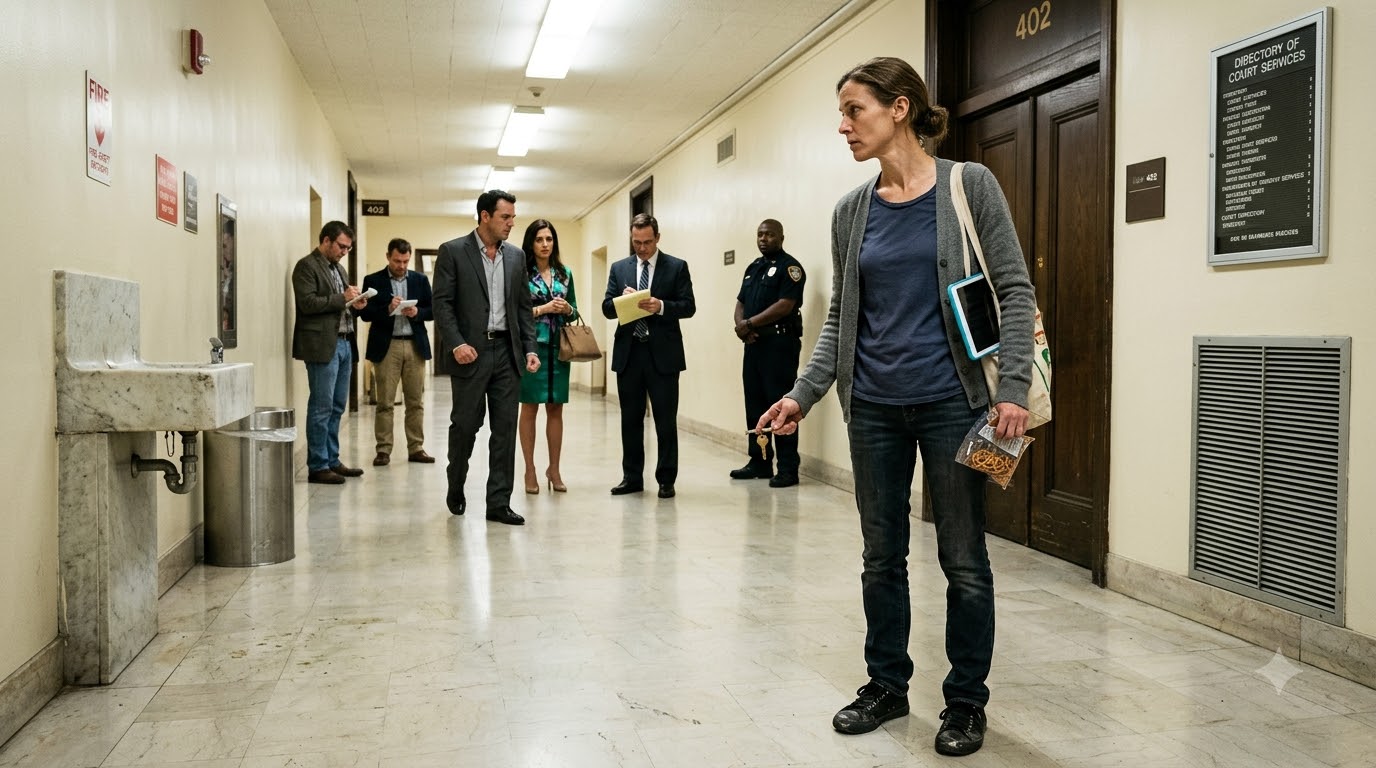
CHAPTER 3: THE COLD CONFRONTATION
The attorney’s thumb snagged twice on the brass latches before they finally popped open with a dull metallic click.
“Julian,” Arthur murmured, his eyes sweeping across the dense, single-spaced clauses of the initial corporate schedule. “Where is the executed IP assignment addendum for the deep learning core? The one signed by the original developer?”
Julian stood over him, his posture stiff, one hand crammed deep into his trouser pocket while the other adjusted his silk tie for the third time in two minutes. “It’s in the master binder at the office. I told you, Sarah signed a standard employee release when we launched.”
“She was never on the payroll, Julian,” Arthur said, turning a page so hard the heavy bond paper creaked in the quiet hall. “A release without consideration is legally worthless against a primary developer who registered the code from a private residential address prior to incorporation. If she didn’t sign Schedule C, the corporation doesn’t own the core.”
I stepped around the water fountain, the rubber soles of my worn sneakers making almost no sound on the polished floor. Mia’s weight rested against my left hip, her small thumb tucked firmly into her mouth as she watched the attorney with wide, sleepy eyes.
“He never gave me Schedule C, Mr. Pendleton,” I said, setting my brass key down on the edge of the bench right next to his leather briefcase. “He brought home a three-page form on a Tuesday night five years ago, told me it was a routine tax waiver so the company could claim the small business research credit, and asked me to sign it before the morning mail run.”
Arthur looked up from his papers. The polished composure he wore in front of judges was entirely gone, replaced by the grim, pragmatic gaze of a man realizing his client had handed him a burning house.
“Did you keep a copy of that waiver, Mrs. Thorne?” Arthur asked softly.
“I didn’t need to,” I said, touching the worn teeth of the key with my finger. “I didn’t sign my married name. I signed under my maiden name, Miller, and I checked the box marked ‘Independent Contractor’ instead of ‘Employee.’ The original document is filed with the county clerk in Ohio where we were living at the time.”
Julian let out a sharp, ragged breath, spinning around to face me, his face pale under the harsh corridor lights. “You set this up? Five years ago? When we were living in that drafty two-bedroom apartment?”
“I didn’t set anything up, Julian,” I replied, keeping my voice as flat and grounded as the marble floor under my shoes. “I protected my work. I told you three times that we needed a formal partnership agreement before you brought in outside investors. You told me my head was too soft for business and to go back to choosing paint colors for the nursery.”
Tiffany stepped up beside Julian, her fingernails digging so hard into her designer bag that the soft leather creaked under the strain. “Arthur, this is absurd! She was a waitress! Tell her we’ll give her twenty-five thousand more and she has to walk away right now!”
“Shut up, Tiffany,” Arthur said without looking at her.
He closed his briefcase with a slow, heavy thud. He didn’t lock the latches. He just sat there looking at Julian, his eyes cold and unblinking.
“Julian,” Arthur said quietly. “Your executive indemnification clause only applies to actions taken in good faith on behalf of the board. If you pledged an unowned asset as primary collateral for the venture debt round last spring, the bank won’t just freeze your lines of credit. They will accelerate the note.”
Julian froze. His jaw worked silently for a moment, his eyes darting from Arthur’s face to mine, then down to the small brass key resting on the wooden bench between us.
“The board meeting is on Friday,” Julian whispered, the arrogance entirely drained from his voice, leaving behind the thin, frantic strain of a man watching his reflection shatter. “We’re supposed to sign the merger terms on Friday.”
“There is no merger on Friday,” Arthur said, standing up and smoothing his trousers with a single, sharp stroke. “Not unless Mrs. Thorne signs a retroactive assignment deed before 5:00 PM today. And if I were her legal counsel, I would advise her to demand ninety percent of the equity before even looking at the pen.”
CHAPTER 4: THE MANSIONS SHADOW
I didn’t stick around to watch Arthur Pendleton hand Julian over to the process servers. I picked up Mia, grabbed Leo by his small wrist, and walked straight out through the side exit to the subway.
An hour later, the sea air hit my face with a sharp, salt-heavy bite that smelled nothing like Manhattan pavement.
The iron gates of the estate in the Hamptons were twice my height, their rusted hinges creaking softly as a guard in an unbuttoned dark suit swung one side open just enough for us to squeeze through. He didn’t ask for identification. He’d known my face since I was seven years old, back when I used to sneak out through the drainage culvert to avoid the afternoon tutoring sessions.
“He’s in the north library, Miss Sarah,” the guard said, his voice as flat and unfeeling as the gravel path under my worn sneakers.
I didn’t answer him. I carried Mia up the granite steps while Leo dragged his boots through the fallen damp leaves, his eyes wide as he looked up at the towering grey stone walls.
The heavy mahogany doors of the library didn’t creak when I pushed them inward. The room smelled of old leather bindings, lemon oil, and the dry, medicinal scent of oxygen tanks.
Sitting in a high-backed wing chair near the unlit stone hearth was my father, Peter. His skin looked like thin parchment stretched tight over his jawline, his pale eyes tracking me from across the room with the sharp, clinical focus of a hawk sizing up a field mouse.
“You look like a kitchen maid, Saraphina,” his voice rasped out, sounding like dry palm fronds dragging across rough concrete.
“I go by Sarah,” I said, stopping ten feet from his chair and setting Mia down on the thick Oriental rug. “And I brought the kids because you sent Silas to stand across the street from my apartment last Tuesday.”
Peter’s thin lips twitched upward into something that wasn’t a smile. “Silas was ensuring my grandchildren weren’t living in a fire hazard. A Queens walk-up is no place for people who carry my blood.”
“They carry my blood,” I said, my hand slipping into my cardigan pocket to wrap around the cold teeth of my brass key. “And they live where I can afford to feed them on what I earn with my own hands.”
“What you earn?” Peter scoffed, his fingers tapping a slow, dry cadence against the silver wolf’s-head handle of his walking stick. “You spent five years scrubbing dinner plates for an ambitious idiot who didn’t even know how to file his own corporate taxes. I watched you let him run your code while he bought diamond necklaces for a girl who couldn’t spell the word infrastructure.”
I turned the brass key over twice in my pocket, letting the sharp edge dig into the soft pad of my thumb until it stung.
“You knew,” I said. It wasn’t a question.
“Of course I knew,” he said, leaning forward until the firelight caught the grey cast of his cheeks. “I let him take the company public because I wanted to see how long you would play the quiet little wife before your spine woke up. You let him lock you out of your own creation, Saraphina.”
“I didn’t let him do anything,” I replied, stepping closer until I could hear the faint, mechanical hum of his portable oxygen concentrator behind the leather chair. “I let him build the customer base. I let him pay for the cloud hosting credits on his personal credit lines while I kept the master diagnostic keys off his servers.”
Peter stopped tapping his cane. His pale eyes narrowed slightly as he looked at me, then down at Leo, who was quietly tracing the woven gold pattern on the rug with the toe of his shoe.
“The core algorithm isn’t locked on his servers,” Peter said softly, his voice dropping into a razor-thin tone. “You left a live diagnostic backdoor in the deployment build.”
“I left a standard diagnostic check,” I corrected him, pulling my hand out of my pocket and letting the brass key dangle from my fingers. “And if anyone attempts to bypass the primary license key during Friday’s merger execution, the entire database shuts down automatically. Not because I filed a lawsuit, but because the code won’t run on unverified hardware.”
Peter sat completely still for three long seconds. Then a dry, rattling sound came from his throat—a laugh that turned into a short cough before he straightened his spine.
“You want me to buy out his debt holders,” Peter said, watching me with a cold, renewed interest. “You want my legal team to absorb his venture notes so you can take the company back without sitting in a courtroom for three years.”
“I don’t want your lawyers, Father,” I said, putting the key back in my pocket and taking both of my children by their hands. “And I don’t want your money. I came here to tell you to take Silas off my street. If he shows up in Queens again, I’ll release the diagnostic key to the open-source repository, and your private holding firm will lose forty percent of its cloud portfolio by midnight.”
Peter’s face went rigid, his knuckles turning white where they gripped the wolf’s-head cane. “You wouldn’t destroy your own work.”
“It’s not my work anymore,” I said, turning my back on him and leading the twins toward the heavy mahogany doors. “It’s just a tool. And I know how to turn it off.”
CHAPTER 5: THE TRAP AT THE SUMMIT
The security guard at the turnstile didn’t look at my canvas bag or my worn coat when the doors hissed open on the fortieth floor. He couldn’t. His eyes were glued to his computer monitor, where three red system alerts were flashing in rhythm with the muted fluorescent lights above his desk.
“You can’t be up here, ma’am,” he stammered, pulling at his collar. “The whole system is locking down. They’re in the main boardroom.”
I didn’t slow down. Leo and Mia walked on either side of me, their small boots making a wet, squeaking sound against the polished black granite floor.
The frosted glass doors of the executive boardroom were shut tight, but Julian’s voice carried right through them—shrill, desperate, and cracking like cheap pine under a heavy axe.
“—it’s a temporary server delay!” Julian screamed inside, his shadow pacing frantically against the glass. “Arthur, tell the buyers this happens during every scheduled deployment! Just sign the asset transfer!”
I pushed the double doors open.
The long oak table inside was surrounded by eight men in dark suits, two institutional venture partners, and Arthur Pendleton, who sat with his arms folded across his chest, staring straight ahead at a completely black projection screen. At the head of the table, Julian was sweating through his linen shirt, his thumbs pounding violently against a laptop keyboard that responded only with flat, grey error prompts.
Tiffany stood in the corner near the coffee bar, clutching a paper cup so tightly that lukewarm brown liquid was dripping down over her knuckles onto her beige trench coat.
“Get her out of here!” Julian yelled, pointing a trembling finger at me the second the doors hit the wall. “She’s trespassing! She brought those damn kids in here to mess with the building Wi-Fi!”
“The Wi-Fi is fine, Julian,” I said, setting my umbrella against the doorframe and taking my brass house key out of my pocket. “The core deployment architecture just checked the license register for its morning ping.”
One of the lead investors—an older man with wire-rimmed glasses named Vance—stood up, ignoring Julian entirely to look at me. “Mrs. Thorne? I’m the managing partner for Atlantic Growth. What does the primary license check have to do with our merger closing?”
“It has everything to do with it, Mr. Vance,” I said, laying the key flat on the edge of the oak table with a firm, metallic tap. “Julian told you Thorn Dynamics owns the deep learning core. But the core isn’t an asset. It’s an automated service running under an independent developer license.”
“That’s a lie!” Julian slammed both palms onto the table, his face turning a dark, bruised red. “I built that platform! I spent sixteen hours a day in our garage while you sat on the couch!”
“You spent sixteen hours a day playing video games and taking calls from recruiters while I wrote the diagnostic loops on my laptop,” I said, my voice dropping so quiet that the investors leaned forward just to catch the words. “And when you compiled the main build, you left my developer signature in the core manifest because you didn’t know how to recompile the binaries without breaking the database links.”
Arthur Pendleton let out a long, slow breath through his nose. He didn’t look at Julian. He pulled a pen from his breast pocket and laid it quietly on his legal pad.
“Julian,” Vance said, his voice dropping into a terrifyingly calm register. “Did you verify the developer manifest before you signed the warranty clause on page forty?”
“It’s a technicality!” Julian shrieked, stepping around the table toward me, his hands opening and closing as if he wanted to grab the key off the wood. “She’s my wife! Everything she made belongs to the marital estate! Arthur, tell him! Marital property!”
“Marital property applies to division of proceeds in a final divorce decree, Julian,” Arthur said flatly. “It does not grant an unlisted corporation the legal right to assign unvested third-party software to an outside buyer during a corporate merger.”
Julian stopped three feet from me, his chest heaving, his eyes wild and bloodshot. “You ruined it. We were twenty minutes away from fifty million dollars. Fifty million, Sarah! We could have bought anything! You could have had a house in the Hamptons!”
“I don’t want a house in the Hamptons, Julian,” I said, reaching down to take Leo’s hand as the diagnostic check on his laptop finished its final loop, turning the black projection screen into a solid, unyielding grid of locked red prompts. “I just wanted a husband who didn’t steal my work and call me a beggar.”
CHAPTER 6: THE QUIET NORMAL
The glass doors hadn’t even finished sliding shut behind the investors before Julian lunged forward across the oak table, his hand clawing wildly at the brass house key I had left sitting on the wood.
“Give me the master key!” he choked out, his tie pulled lopsided, his expensive jacket soaked in sweat at the armpits. “You can’t just kill the server! I’ll sue you for tortious interference! I’ll call the precinct right now!”
I didn’t reach for the key. I didn’t have to.
Arthur Pendleton leaned over and picked it up first, dropping it cleanly into his own coat pocket. “Julian, stop talking. You are on recorded commercial security feeds attempting to execute a fraudulent asset transfer. If you make one more phone call today without a criminal defense attorney present, you will be in handcuffs before nightfall.”
Tiffany dropped her wet paper coffee cup onto the carpet. “Arthur! What about my name on the lease for the Soho place? He said the company was paying for it!”
“The company’s bank accounts are frozen as of four minutes ago, Miss Blair,” Arthur said, snapping his briefcase shut with a sharp, final click. “I suggest you go home and start packing your personal belongings before the building landlord changes the deadbolts.”
Tiffany looked at Julian, her face contorting into a mask of pure disgust. “You pathetic loser,” she spat, turning on her heel and marching out toward the elevators, her heels clicking sharp and fast against the granite.
Julian sat alone at the head of the conference table, his head buried in his hands, his breath coming in dry, rattling hitches as the server screens in the background went completely dark one by one.
I took Leo and Mia by the hand, turned toward the glass doors, and walked out of the building into the afternoon light.
The kitchen in my Queens apartment smelled of warm toast and lavender soap.
Mia sat at the small laminate table, carefully coloring a blue bird inside a newsprint activity book, while Leo pushed a small plastic car back and forth across the clean yellow linoleum floor.
I set two mugs on the counter, poured hot water over two tea bags, and picked up the worn brass house key from the small ceramic dish near the stove. The metal was cool, solid, and familiar under my thumb.
There were no legal teams sitting in my living room. There were no process servers waiting outside on the sidewalk, and the phone on the counter stayed completely quiet.
I sat down at the table next to Mia, pulled my tea mug closer, and watched my children play in the afternoon sun.