The Iron Perimeter: A Soldier’s Calculus on the Dark Edge of Suburbia
CHAPTER 1: THE BLOCKADE
The heat coming off the asphalt of County Road 485 was a physical weight, thick with the smell of parched clay and dying cedar. Between my front bumper and the gate to my thirty acres sat twenty tons of coarse gray limestone. It was a jagged, raw mountain, steam still rising from its dust where the dump truck had let it fall. It didn’t just block the path; it choked it, the gray stones spilling into the wild Johnson grass on either side of my fifty-foot-wide deed easement.
Karen Peterson stood at the base of the pile, her silhouette sharp against the blinding glare of the afternoon sun. She held her clipboard like an infantry shield, her pink-slashed mouth twisted into a triumphant line. Behind her, the identical beige roofs of the Oak Hollow development shimmered in the haze, a neat, compliant grid of modern suburbia trying to crowd out my timber.
“This is an official HOA-sanctioned beautification project, Mr. Warren,” she said. Her voice had the flat, grating ring of someone who spent her life reciting bylaws to people too tired to fight back. “You should be thanking us for improving the aesthetic of your approach.”
I didn’t answer right away. I stepped down from the cab of my F-250, the soles of my boots crunching on the dry gravel of the county road. In the Army Corps, you learn to look at an obstacle not with anger, but with math. Twenty tons. Standard tandem dump truck. The tire tracks in the soft shoulder were fresh, deep grooves cutting directly back toward the paved, immaculate cul-de-sac of the subdivision.
“My deed is registered in Book 412,” I said, keeping my voice low, matching the steady hum of my idling diesel engine. “You’ve dumped aggregate on a legally recorded right of way. That road connects my home to the county line. By five o’clock today, it needs to be gone.”
Karen let out a dry, sharp laugh. “This is Oak Hollow property now, Jack. We’ve reclaimed the common area. If you want to discuss alternate access, you can submit a formal inquiry to the architectural review committee. But until then, I suggest you find another place to park.”
She turned, her floral pantsuit catching the hot breeze as she walked back toward her pristine white SUV. Her door clicked shut with a heavy, final thud, leaving me alone in the dust.
I walked to the edge of the limestone pile, kneeling down to look at the base. My fingers brushed the rough, sharp edges of the crushed rock. That was when I saw it—a small, yellow plastic marker buried beneath the leading edge of the slide. It was a survey cap, bright and out of place, crushed into the dirt by the weight of the dump. I pulled it free. The stamped numbers on the plastic didn’t match the county survey records I had memorized over three months of land-title research. It was a new marker, freshly placed, bearing a private surveyor’s license number that didn’t belong to the county registrar.
The boundaries had been moved. Not by nature, and not by the state.
I looked back at the beige houses, their windows dark and unblinking in the heat. The silence out here was heavy, but it wasn’t peaceful anymore. It was the quiet before the first mortar rounds find their range.
CHAPTER 2: THE DECEIT OF BORDERS
The yellow plastic cap was cold, despite the Texas heat baking the gravel mountain. The stamped license number—1094-Pratt—was freshly cut into the polymer, free of the grit and yellow clay that should have coated it after months in the ground. It was a phantom marker, a lie driven into the dirt to steal fifty feet of history. I squeezed my fist, the serrated edges of the plastic biting into my palm, and looked up as a second vehicle slowed on the county road behind me.
Dust from the gravel pile was still settling, hanging like a gray shroud in the stagnant air. A white Ford Explorer with the county sheriff’s emblem on the door turned onto the shoulder, its tires crunching to a halt ten feet from my tailgate. The engine died with a wet, mechanical sigh.
Deputy Miller climbed out, his utility belt clinking with a rhythmic, heavy metallic drag. He was a young guy, his tan uniform pressed so stiffly the fabric didn’t seem to yield to the midday heat. He took off his sunglasses, squinted at the massive heap of gray limestone, and then looked at me. His eyes lingered on my boots, then on the yellow cap I was slowly turning over in my hand.
“Mr. Warren,” he said, his voice flat with the weary resignation of a county cop caught between a tax-paying veteran and a subdivision board that bought the local patrol cars. “Got a call about an obstruction. Looks like they didn’t skimp on the delivery.”
“Twenty tons of roadbase, Deputy,” I said. I didn’t raise my voice. I didn’t need to. I walked toward him, keeping my movements deliberate, my boots tracing the exact line where my asphalt easement met the county’s chip-seal. “Dumped squarely within my deeded right of way. It’s a complete blockage of my only point of entry. If my well pump fails or my house catches fire, nothing gets through.”
Miller walked to the edge of the limestone, kicking a loose chunk of rock with the toe of his boot. The stone rolled into the stagnant, brown water of watershed drain alpha, the concrete culvert that ran along the northern boundary of the HOA line. A thin, iridescent film of diesel fuel from the delivery truck floated on the surface of the pool, trapped against the concrete lip.
“I see it, Jack,” Miller said, rubbing the back of his neck. His collar was already damp with sweat. “But you know how this goes. I talked to Mrs. Peterson on the way in. She’s claiming this is a common-area improvement. Got a paper from her board saying they re-zoned the easement buffer for a park. She’s calling it a civil dispute. A boundary line disagreement.”
“My boundary is registered in easement book 412,” I said. I held up the yellow plastic cap, letting the sunlight catch the fresh, unweathered stamps. “And someone just drove this fake marker into my dirt to justify it. That’s not a dispute, Miller. That’s a physical alteration of a legal survey.”
Miller took the yellow cap from my hand, his thumb running over the clean, sharp edges of the plastic. His brow furrowed as he looked from the marker to the fresh mound of gravel. “Pratt’s a private surveyor out of Conroe. He does contract work for the developers. But I can’t prove who put this here, Jack. Not without a witness or a camera. To a judge, this is still going to look like a neighborhood squabble over a driveway.”
He handed the cap back to me, his posture sagging under the weight of his gear. “I’ll write the report. I’ll document the blockage, and I’ll note that your emergency access is restricted. But my hands are tied. I can’t order a tow truck for twenty tons of limestone. You’re going to have to take her to court, get an injunction, and wait for the wheels to turn.”
“The wheels turn slow,” I muttered, looking past him to the neat row of beige houses.
“They do,” Miller agreed, stepping back toward his patrol car. “But that’s the system. Give it some time. Don’t go clearing it yourself, or she’ll have you cited for destruction of HOA property. I’ll file this by five.”
I watched his white Explorer pull back onto the county road, its tires kicking up a fresh plume of red dust that drifted over my blocked gate. The heat was rising, the metal of my truck’s tailgate burning through my jeans as I sat down, pulling my laptop out of the cab. I tethered the machine to my phone, my fingers hovering over the keys.
Miller was right about one thing: the system was designed to drag you down into a swamp of expensive, endless paperwork. But he didn’t understand that the system has its own structural weaknesses.
I opened the county records portal, my eyes scanning the scanned PDF of easement book 412. The digital ink was faded, a copy of a copy from the 1950s, but the legal description was clear. The fifty-foot easement wasn’t just a private agreement between neighbors; it was a designated utility and transport corridor, tied directly to the old rural electrification grid. The line didn’t just end at my property—it was a designated artery under Public Law 85-767.
I began to type, my strokes hard and rhythmic against the keyboard. The cease-and-desist letter wouldn’t be an appeal to Karen’s decency. It would be a cold, statutory listing of liabilities. I cited the Texas Property Code, the exact volume and page of my deed, and the public safety hazard of blocking a designated emergency lane. I attached the high-resolution photo of the fake survey marker and the silt runoff currently filling watershed drain alpha.
As I clicked save, the screen flickered, a notification popping up in my email inbox. It was an automated alert from the county deed registry. A new document had been uploaded to the title history of my adjacent parcel just two hours ago.
I opened the attachment. It was a scan of a handwritten land-use modification form, bearing the official seal of the Oak Hollow Architectural Review Committee. At the bottom, below Karen’s looping, aggressive signature, were two other names.
My chest tightened as I read the third signature: Albert Vance.
Albert Vance had died in a nursing home in Tyler three months before I even bought my land.
I stared at the screen, the blue light reflecting off the dust on my monitor. The wind shifted, bringing the faint, chemical smell of lawn fertilizer from the subdivision. Karen hadn’t just made a mistake; she had crossed into the dark. She was fabricating a paper trail with the names of the dead to steal the ground beneath my feet.
I closed the laptop, the screen latch clicking shut in the hot silence. I reached into my pocket, my fingers finding the cold, hard edges of the brass compass on my dashboard. The trap was still empty, but the bait was finally in place.
CHAPTER 3: THE STRATEGIC SERVE
The metal latch of the ruggedized laptop casing went cold against my thumb, but the steel tailgate beneath me remained a searing plate of hot iron. I didn’t get up. I sat there, the dry Texas wind whipping a fresh layer of yellow road dust across the black plastic chassis of my machine. Down in the ditch, a heavy bubble of stagnant water popped in watershed drain alpha, releasing a faint stench of sulfur and decaying vegetation.
I reopened the lid of the computer. The blue-white glare of the screen fought against the harsh afternoon sun. I dragged the cursor to the top of the forged Architectural Review Committee scan, zooming in on the pixelated edges of Albert Vance’s signature. The ink had been dry on the paper, but the digital signature profile had a registration metadata stamp from last Tuesday. Albert Vance’s obituary had run in the county weekly three months ago.
I pulled up the draft of my formal cease-and-desist letter. It was a precise, bloodless document. I added a new paragraph, citing the specific page from easement book 412, listing the criminal penalties for filing fraudulent real estate instruments under the Texas Penal Code. I didn’t mention Vance by name. Not yet. You don’t reveal your high-caliber rounds while the target is still stepping into the sights.
I plugged my phone into the laptop’s side port, initiating a secure cellular uplink. I sent the finalized document to the regional courier service in Conroe, paying the double-rate emergency fee to guarantee same-day physical delivery. The courier system returned a confirmation code: Runner 44 dispatched.
Closing the laptop again, I slid it into my canvas bag and grabbed my keys. I climbed into the cab of the F-250. The steering wheel was almost too hot to touch, the dark vinyl releasing the dry, baked smell of an old cabin. I turned the key, and the starter groaned once before the big diesel engine caught, its heavy, low-frequency rumble vibrating through the floorboards and up through my spine.
I shifted into reverse. Because the twenty tons of limestone completely blocked my gate, I had to back the long truck out onto the shoulder of County Road 485, watching the mirrors as the dual rear wheels navigated the narrow strip between the county asphalt and the deep, weed-choked ditch. Once straight, I shifted to drive and headed south.
The drive to the county seat was a five-mile stretch of empty blacktop, bordered on the left by the neat, artificial green of Oak Hollow’s manicured golf course, and on the right by wild post oak pasture. The contrast was sharp, like a border fire waiting for a wind shift.
Ten minutes later, I pulled into the gravel lot of the county clerk’s annex. The air inside the small brick building was freezing, over-conditioned to combat the August heat. A young clerk with tired eyes sat behind a security partition, her fingers tapping lazily on a mechanical keyboard.
I approached the glass, my boots leaving gray limestone dust on the clean linoleum.
“I need a certified copy of the physical plat maps for the original 1950 land grant,” I said, placing my driver’s license against the glass. “Specifically, the sections referencing the rural electrification grid layout for the northern border of Oak Hollow.”
The clerk sighed, her fingers moving to a database search bar. “That’s in the historical archives, sir. It takes about thirty minutes to pull the microfiche and run the prints.”
“I have thirty minutes,” I said.
I sat in the hard plastic chair against the wall, the low hum of the fluorescent lights overhead filling the silence. Through the glass double doors, I watched a black courier motorcycle pull up to the curb. The rider, clad in heavy scuffed leather despite the heat, stepped inside, carrying a thick yellow envelope with a bright red URGENT sticker across the seal.
He walked past me to the counter. “Delivery for Peterson, Karen. HOA President. Registry receipt requested.”
I watched him slip the clipboard under the glass partition for the clerk to stamp. The delivery was scheduled. By five o’clock, the paper would be in her hands, and the forty-eight-hour clock would officially start ticking. I reached into my pocket, my fingers brushing the cold, heavy edge of the brass surveying prism. The line was drawn. Now, we’d see how she negotiated the perimeter.
CHAPTER 4: THE ARCHIVE SHADOWS
The clerk slid my driver’s license back under the glass partition, the hard plastic ticking against the metal frame. I took it, sliding it into my pocket without taking my eyes off the yellow envelope the courier had left on the receiving tray. The red URGENT seal looked wet, like fresh gloss, reflecting the cold hum of the overhead fluorescent tubes. The courier was already gone, his heavy boots squeaking once on the linoleum before the heavy glass outer doors hissed shut behind him.
“Vance property file is in the back,” the clerk said, her voice dropping into a flat, practiced drone. “But like I said, the 1950 land grant plats are on microfiche. I’ll have to pull the drawer. You can wait at desk three.”
I nodded, grabbing my canvas bag. I walked past the low drywall partitions to desk three, a scarred laminate table in the corner where an old microfiche reader sat like a dead gray monument. The air back here was colder, smelling of ancient cellulose, iron rust, and the chemical bite of static electricity. I sat down, the metal chair frame groaning under my weight.
I didn’t turn on the reader yet. Instead, I pulled out my phone, opening the secure folder holding the digital scan of easement book 412. The original grant was a federal concession, a parcel carved out of the public domain to establish a regional utility grid. The signature on my digital deed copy was crisp, but the historical mapping of the lines had always been a thorn.
A few minutes later, the clerk returned, sliding a small gray plastic tray and a manila folder onto the laminate table.
“Here’s the Vance file from the probate run,” she said, her voice dropping even lower. “And the microfilm reels for the northern boundary grid. Don’t scratch the film.”
“Thanks,” I said.
I waited until her footsteps faded back toward the front counter before I opened the folder. The top sheet was the official death certificate for Albert Vance, certified by the state medical examiner. I checked the date: May 12th. I turned the page. Below it lay the property transfer papers for his adjacent parcel, which shared the northern boundary of my deeded corridor.
I reached for the gray microfiche tray, sliding the first transparent sheet into the reader’s glass carrier. I turned the dial, the internal lamp snapping on with a high-pitched buzz that vibrated through my temples. On the frosted screen, the white-on-black lines of the 1950 survey map flickered into focus.
I adjusted the focus wheel, zooming in on the northern line where my fifty-foot easement cut through. There was the boundary. There was the marker. But as my eyes traced the coordinate callouts, I froze.
The physical line on the microfiche map—the actual line drawn by the federal surveyor seventy years ago—didn’t match the modern county database plats Karen had used to assert her HOA common-area boundaries. On the historical map, the right of way didn’t just border the Oak Hollow subdivision; it ran fifteen feet inside the modern fence lines of the first three houses on their northern street.
I stared at the black-and-white grid. The modern HOA covenants had been drawn up using a 1994 plat map that completely ignored the federal land grant coordinates. The developer had built the houses over an active, federally protected easement.
That was why the yellow plastic survey cap I’d found under the gravel was so clean. It wasn’t just a random lie to justify a pile of rocks. It was a desperate attempt to cover up a systemic title defect that had existed for over thirty years—a defect that, if exposed, would invalidate the property lines of the very homes Karen claimed to protect.
A faint shadow fell across the frosted screen of the reader.
I didn’t turn around immediately. In the dark reflection of the glass screen, I could see the shape of a man standing near the end of the aisle of steel filing cabinets behind me. He was wearing a light gray sport coat, his hands shoved deep into his pockets. He wasn’t looking at the folders. He was looking at the back of my head.
“They don’t make maps like that anymore,” he said, his voice quiet, carrying the dry, raspy wheeze of a long-time smoker.
I slowly turned the focus wheel, blurring the screen, before I turned my head. The man was in his late fifties, his hair thin and slicked back, a silver county deputy commissioner pin pinned to his lapel.
“They don’t,” I said, my hand resting flat on the edge of the microfiche carrier. “Usually because the old ones had a habit of being accurate.”
The man took a slow step forward, his leather shoes clicking on the floor. His eyes drifted to the yellow folder on the desk. “Some boundaries are better left on the film, Mr. Warren. Out here, people pay a lot of money for peace of mind. They don’t like finding out their garages are sitting on someone else’s dirt.”
“They like it even less when someone fakes a dead man’s signature to keep them from finding out,” I said.
The deputy commissioner’s jaw tightened, a tiny muscle twitching beneath his ear. He didn’t answer. He just looked at me for three long seconds, a silent, cold appraisal, before he turned and walked back toward the administrative offices.
I pulled the microfilm sheet from the carrier, slid it back into its envelope, and closed the manila folder. My hand was steady, but the cold weight in my chest had hardened into steel. The decoy secret—the park, the beautification, the petty fines—was gone. The real war wasn’t about a pile of gravel. It was about the ground beneath their feet.
CHAPTER 5: THE PRESSURE CRACKS
I walked out of the county annex with the paper plat files zipped tight inside my canvas bag. The sky had turned the color of bruised iron, a heavy bank of Texas storm clouds rolling in from the west. The first fat drops of rain hit the dry hood of my F-250 with a succession of sharp, metallic slaps. The scent of hot asphalt mixing with ozone rose from the parking lot, sharp and chemical.
I started the engine, the big diesel block shaking the chassis as the wipers dragged across the dusty windshield. My phone buzzed in the center console. I picked it up, my eyes tracking the incoming number. It was Dave.
“Jack,” his voice came through the speaker, crisp and fast. “The courier delivered the packet to Karen’s house. I got the signature confirmation five minutes ago. But we’ve got a complication. My contacts in the county office are saying the HOA is trying to file a secondary title amendment. They are trying to backdate a property line adjustment to cover the first three garages on the north street.”
“I just came out of the archives, Dave,” I said, pulling out of the gravel lot onto the slick blacktop. The rain was coming down harder now, a steady, gray sheet that blurred the headlights of oncoming trucks. “I saw the original 1950 land grant plats. The easement runs fifteen feet inside their modern fence line. They built over Public Law 85-767 infrastructure. They’re trying to bury a systemic title defect.”
“They can’t bury it if the agencies get there first,” Dave said, his keyboard clicking in the background. “But they’re trying to pre-empt us. I’ve already flagged the Fire Marshal. Bilips is furious. He’s routing the violation notice through the county attorney’s emergency desk right now. But you need to get back to that property. If this rain keeps up, that loose pile of gravel is going to wash directly into watershed drain alpha. That’s our trigger for the state environmental inspectors.”
“I’m on my way,” I said, hanging up.
The drive back was a slow, blinding crawl. The storm had opened up, turning the county road into a slick mirror of gray water. Every time my tires hit a deep puddle, the water sprayed against the wheel wells with a heavy, pressurized hiss. My mind was calculating the flow. If the silt from that pile choked the drainage culvert, the runoff would flood the low pasture bordering my thirty acres, crossing right into the protected wetlands.
I pulled up to the entrance of my easement fifteen minutes later. The scene was already changing.
Through the curtain of rain, I could see Karen’s white SUV parked on the grass shoulder near the edge of the subdivision’s boundary. She wasn’t inside it. She was standing under a large black umbrella, her floral pantsuit damp at the cuffs, gesturing aggressively at two men in yellow rain slickers who were struggling to drive a wooden stake into the mud near the base of the gravel pile.
I cut the engine, grabbed my heavy flashlight from the glove box, and stepped out into the pouring rain. The cold water soaked through my shirt instantly, the wind whipping the scent of wet limestone dust and exhaust fumes across my face.
I walked toward them, my boots sinking into the slick clay at the edge of the road.
“Karen,” I called out, my voice cutting through the roar of the downpour.
She spun around, her face pale under the black canopy of her umbrella. Her eyes went straight to the canvas bag in my hand. “This is private HOA property, Mr. Warren. We are securing the boundary for the new park installation. You are trespassing.”
“You’re driving stakes into a federal right of way,” I said, stopping five feet from her. The two men with the wooden stakes stopped working, looking between the two of us. “And you’ve got a delivery confirmation on your desk. You have forty-eight hours to clear this limestone, or the county fines start at a thousand dollars a day.”
“Your empty threats won’t work anymore,” she spat, her voice rising to a screech over the sound of the wind. “The board has approved the land-use amendment. This area is officially designated as common green space. We have the surveys to prove it.”
“The survey with Albert Vance’s signature?” I asked, my voice deadly quiet.
She froze. The umbrella in her hand tilted slightly, letting a stream of cold rain run down her shoulder, but she didn’t look away. The silence between us was heavy, filled only by the rhythmic, hollow drum of rain hitting her umbrella. She knew what I had found.
Before she could speak, a loud, sucking gurgle rose from the ditch behind her. The loose gray gravel from the mountain was starting to liquefy under the torrential downpour, a thick, slate-colored slurry of limestone silt washing directly into the concrete mouth of watershed drain alpha. The water was already rising, backing up against the blocked culvert, beginning to spill over into the low weeds of my pasture.
The line had cracked. The escalation was no longer on paper. It was in the dirt.
CHAPTER 6: THE SILENT COALITION
The rain was thick enough to taste, a cold, metallic sheet that ran down my collar and soaked my chest. The slate-gray runoff from the limestone pile had already choked the narrow opening of watershed drain alpha, turning the concrete channel into a churning pool of liquid grit. I stood ankle-deep in the rising slurry, my boots losing their purchase in the slick clay of the shoulder. Under her umbrella, Karen didn’t move. A single, dark droplet of water hung from her chin, her knuckles white where her fingers clutched the curved handle of the canopy.
The two workers she had hired backed away from the muddy edge. One of them, a younger kid with a modern yellow slicker and a ball cap, let his wooden stake drop into the mud with a wet slap.
“Ma’am, the ditch is backing up,” the kid said, wiping cold rain from his eyes. “We’re going to flood the pasture if we keep driving these markers. The grading isn’t holding.”
“Drive it,” she hissed, her voice vibrating with a high, thin panic that the wind tried to carry away. “We have the ARC authorization. It’s official. The boundary is set.”
I stepped closer, my shoulder muscles locking against the chill. “The only thing that’s official, Karen, is the paper trail you just registered. Albert Vance didn’t sign that document. He’s been dead ninety days. You filed a fraudulent instrument in the county land records. That’s a state felony.”
Her gaze broke. For a fraction of a second, her chest hitched, a sharp, ragged gasp of wet air rattling in her throat. She didn’t deny it. She didn’t have the breath to. She turned on her heel and scrambled toward her white SUV, her leather shoes slipping once in the wet grass before she yanked the door open and threw herself inside. The engine roared to life, the tires spinning on the muddy shoulder before finding traction on the subdivision’s paved street and disappearing into the gray wall of the storm.
I stood in the downpour for a long moment, watching the red taillights vanish. The rain didn’t slow.
I climbed back into the cab of my F-250, the wet fabric of my shirt sticking to the vinyl seat. My hands were stiff as I grabbed the radio console, dialing Dave’s direct line. The connection was scratchy, competing with the static of the lightning striking the tree line a mile east.
“Dave,” I said, my voice dry. “She knows I found Vance’s signature. She just ran. But the runoff is already crossing the fence. We’re looking at active environmental damage to the tributary.”
“Good,” Dave’s voice crackled back, steady and cold. “I mean, bad for the creek, but perfect for our timing. I’ve already dispatched the emergency notification to the Texas Commission on Environmental Quality. Sarah has the case file open. But Jack, we need the leverage inside the neighborhood. The county fines are just numbers on a page to Karen until the people holding her checkbook realize she’s spending their retirements. Did you set up the meeting with George?”
“It’s tonight,” I said, wiping a streak of condensation from the side window. “After dark.”
“Take the plat maps,” Dave instructed. “Show them the fifteen-foot encroachment. If they realize their own garages are sitting on a federally protected corridor under Public Law 85-767, they won’t just vote her out—they’ll tear her apart to save their own equity.”
I hung up, the silence of the cab returning, broken only by the heavy, rhythmic drumming of the storm on the aluminum roof.
At 8:30 p.m., the rain had slowed to a steady, freezing drizzle. I parked my truck three blocks away from the subdivision’s entrance, in the dark shadow of an abandoned equipment barn, and walked. My boots made no sound on the wet asphalt of Oak Hollow’s pristine cul-de-sacs. The streetlights cast long, shivering reflections in the puddles, the neat, beige houses sitting like identical tombstones behind their manicured, chemical-scented lawns.
I slipped through the side gate of George Maxwell’s house, the dark cedar latch cold against my palm. The back door opened before I could knock.
George stood in the kitchen doorway, his shoulders hunched, his face lined with the deep, exhausted shadows of a man who had spent too many years waiting for the other shoe to drop. Behind him, sitting around a heavy oak dining table under a low-hanging brass chandelier, were five other residents.
“You’re wet, Jack,” George whispered, ushering me inside and closing the door with a soft, magnetic click.
“The rain’s high,” I said. I unzipped my canvas bag and pulled out the rolled, certified plat maps from the county archives, laying them flat on the table. The white paper was slightly damp at the edges, smelling of old cellar dust.
The widow, Mrs. Gable, leaned forward, her thin fingers grasping the edge of the map. Frank, the CPA with the oil-stained driveway, took out a pair of reading glasses, his eyes scanning the coordinates.
“What are we looking at, Jack?” Frank asked, his finger tracing the red ink boundary lines.
“You’re looking at the original 1950 land grant corridor,” I said, pointing to the northern boundary line. “The developer who platted Oak Hollow in 1994 ignored the federal survey. They built your homes fifteen feet over the easement line. Your northern garages, your fences, your sewer connections—they are sitting on a federally protected transit artery.”
The room went dead silent. The only sound was the hum of George’s refrigerator and the soft, rhythmic patter of the rain against the kitchen window.
“My… my garage?” Mrs. Gable whispered, her face losing what little color it had. “That’s where my husband’s workbench is. If the county… if they enforce this…”
“It’s not the county you have to worry about,” I said, my voice quiet, matching the gravity of the room. “The Federal Highway Administration has jurisdiction over Public Law 85-767. If they find an intentional obstruction, they don’t just fine the association. They can order the removal of any physical structures blocking the corridor. And Karen Peterson just filed a forged deed amendment with a dead man’s signature to cover it up.”
Frank stood up so fast his chair scraped against the hardwood floor. “A forged amendment? On our title chain? That’s fraud. That invalidates our title insurance. The bank could call our mortgages if the security is compromised.”
“Exactly,” I said. “She’s not protecting your property values. She’s using your homes as a shield to hide her own title liability. And by five o’clock tomorrow, the state is going to find the silt from her ‘park’ inside watershed drain alpha.”
George looked at the map, then at me, a hard, cold resolve replacing the fear in his eyes. “What do we do, Jack?”
“Go home,” I said, rolling up the plat maps and sliding them back into the bag. “Gather every piece of paper she’s ever sent you. Every fine, every threat, every notice. Tomorrow morning, the state and the feds are coming to the gate. I need you standing behind me, not her.”
CHAPTER 7: THE REGULATORY DESCENT
The transition from night to dawn was nothing but a slow, gray bleed that dissolved the remaining drizzle into a heavy, humid mist. By 9:15 a.m., the Texas sun was beginning to burn through the atmospheric haze, heating the waterlogged soil and raising a thick, humid steam from the pasture. I sat inside my F-250 parked exactly on the shoulder of County Road 485, watching the entrance to my easement.
A commercial box truck with the Oak Hollow HOA emblem was already idling on the grass near the limestone blockade. Two folding tables had been set up on the shoulder, decorated with a small cluster of blue balloons and a tray of donuts that was quickly attracting flies in the rising heat. A professionally painted wooden sign sat on a small easel, reading: Peterson Park – A Designated Community Green Space.
Karen stood next to the table, her floral pantsuit damp at the hem from yesterday’s storm, though her posture remained rigidly defiant. Her clipboard rested under her arm. Next to her, three of her loyal architectural committee board members milled about, holding lukewarm cups of coffee and avoiding the muddy puddle where the grey gravel from the pile had dissolved into watershed drain alpha. Behind them, several residents—some looking deeply uncomfortable, others clutching folders of their own—watched from a distance, standing on the paved streets of the subdivision.
At precisely 9:58 a.m., the first official vehicle turned off the county road. It was a white sedan bearing the state seal of the Texas Commission on Environmental Quality.
Sarah, the investigator, stepped out of the vehicle. She didn’t look at the donuts or the balloons. She wore knee-high rubber boots and carried a digital tablet, walking directly to the edge of the ditch where the slate-gray limestone slurry was actively spilling across the fence line.
“Excuse me,” Karen said, her heels sinking into the wet clay as she marched toward Sarah, clipboard raised like a shield. “This is a private community dedication ceremony. You are parked on our common easement buffer.”
Sarah didn’t look up from her screen, tapping a stylus against the glass. “I’m with the water quality enforcement division of the TCEQ, ma’am. I’m documenting an unpermitted discharge of industrial aggregate into a protected watershed. The runoff from this site is actively clogging watershed drain alpha, which feeds directly into the creek system.”
“This is a minor landscaping project!” Karen’s voice rose, a sharp, nervous squeak. “We have an approved ARC document!”
Before Sarah could respond, a second vehicle pulled onto the shoulder—a heavy county SUV with the Fire Marshal’s emblem. Marshal Bilips stepped down, his face like a thundercloud. He ignored Karen entirely, walking straight to the gray limestone mountain blocking my gate.
“Peterson,” Bilips barked, his voice carrying across the humid pasture. “The forty-eight-hour warning expired yesterday at five. You’ve got four thousand dollars in county civil fines on the books as of this morning. By five tonight, it’ll be five thousand. And I’m filing a formal obstruction of emergency services report with the county attorney.”
“This is a civil boundary dispute!” Karen cried, her face turning a blotchy, uneven pink. “The county has no jurisdiction over private HOA common areas!”
“The United States government does,” a cold, flat voice announced.
A dark blue government sedan had pulled up silently behind Bilips’ SUV. A woman with short gray hair, wearing a dark blue suit with a small federal seal on her lapel, stepped out. It was Agent Harris. She carried a thick, bound folder with a silver seal on the front. Behind her, a second man in a dark windbreaker with EPA block letters on the back stepped out of an unmarked truck.
Agent Harris walked with a slow, unhurried pace, stopping exactly at the boundary line where my easement met the subdivision road. She looked at the gravel pile, then at the wooden easel sign, and finally at Karen.
“Are you Karen Peterson?” Harris asked, her voice quiet but possessing a heavy, structural weight that made the board members behind Karen slowly lower their coffee cups.
“Yes, I am,” Karen said, trying to pull her shoulders back. “And who are you to disrupt our—”
“I am Agent Harris, Federal Highway Administration, Office of Program Administration,” she said. She opened the folder, pulling out a copy of the 1950 plat maps I had pulled from the archives the day before. “We are here to investigate a direct, willful obstruction of a federally protected right of way established under Public Law 85-767.”
Karen’s jaw went slack. She looked down at the paper, then back up at the federal agent. “This… this is an HOA buffer. We filed an amendment to—”
“Your neighborhood covenants do not supersede the United States Code, Ms. Peterson,” Harris said, her voice dropping to a freezing whisper. “This easement is a federally registered infrastructure corridor. By dumping twenty tons of loose limestone onto this artery, you have willfully obstructed a transport link protected by federal land grants. And according to our records, the land-use amendment you filed yesterday contains a forged signature of a deceased property owner, Albert Vance.”
The word forged fell like a heavy iron plate into the wet mud.
From the road behind them, George Maxwell, Frank, and four other residents stepped forward, their hands holding thick folders of their own historical violations. They didn’t speak. They just stood there, a silent, unyielding line of witnesses, their eyes locked on the crumbling facade of the woman who had ruled their neighborhood through fear.
Karen looked from the state investigator to the county marshal, then to the federal agents, and finally to her own neighbors standing in silent alignment behind me. The clipboard in her hand trembled, the corner of the plastic board slipping from her fingers and landing with a wet, heavy splash in the gray slurry of watershed drain alpha.
CHAPTER 8: THE SECURED BORDER
The clipboard lay half-submerged in the thick, slate-colored soup, the white paper sheets of her meticulously drafted park dedication slowly drinking the dirty water until the ink began to bleed. Karen stared down at it, her fingers still curved as if she were holding the plastic edge. Her mouth opened, but only a dry, whistling breath came out. Beside her, the two remaining architectural committee members quietly stepped back, their leather shoes squelching in the mud as they deliberately put five feet of distance between themselves and their president.
“This is a mistake,” Karen whispered, her voice cracking as she looked from the floating clipboard to Agent Harris’s unblinking eyes. Then, her posture snapped. The desperation broke through her graying face like a sudden fracture. She lunged forward, not toward the document in the mud, but toward me, her finger pointing wildly. “He did this! He planted that survey cap! He’s been cutting down protected vegetation and running heavy machinery through our buffer zone! He’s trying to destroy our community equity!”
Agent Harris didn’t shift her weight. She merely stepped into the line of sight, blocking Karen’s path. “Ms. Peterson, the federal registry has held the coordinates of easement book 412 since nineteen fifty. Your developer built over a designated transport corridor protected under Public Law 85-767. The physical evidence of your obstruction is currently blocking emergency access and leaching limestone sediment into a protected watershed. We are not here to debate your neighborhood aesthetics.”
The EPA investigator in the windbreaker knelt by the water, dipping a glass sampling vial into the run-off. “We’ll need the complete maintenance records for the association’s drainage system, starting from the nineteen ninety-four platting. If there’s systemic neglect of watershed drain alpha to hide the easement encroachment, the civil penalties will be assessed to each individual parcel owner.”
“No,” Karen gasped, her hands shaking as she looked toward the street where George Maxwell and the other homeowners stood. Frank was already holding his folder high, his eyes steady and cold as he watched her. “The board… we have immunity. The covenants protect the board’s executive actions.”
“Not for fraud, they don’t,” Fire Marshal Bilips said, stepping forward to hand her a bright orange tri-fold citation sheet. “And not for reckless endangerment. Clear this road, Peterson. The county’s contractor is already on his way with a front-loader. Every scoop they take is going on your personal tab.”
She didn’t scream. She didn’t try to run again. She stood there as the sun finally broke fully through the gray clouds, baking the wet mud into a hard, cracked crust around her shoes. Her empire, built on three-ring binders and petty threats, had evaporated under the cold, administrative weight of the law.
Three weeks later, the silence of the pasture had returned, clean and uninterrupted.
The heat of the Texas late summer had dried the ground, leaving the air smelling of parched grass and sweet cedar. The heavy rumble of the county’s commercial excavator was gone, replaced by the quiet, steady hum of the wind through the post oaks. The twenty tons of gray limestone had been scraped clean, down to the original hard-packed red clay of my road, the banks of watershed drain alpha cleared and reinforced with proper silt fencing paid for by the newly reorganized Oak Hollow HOA board.
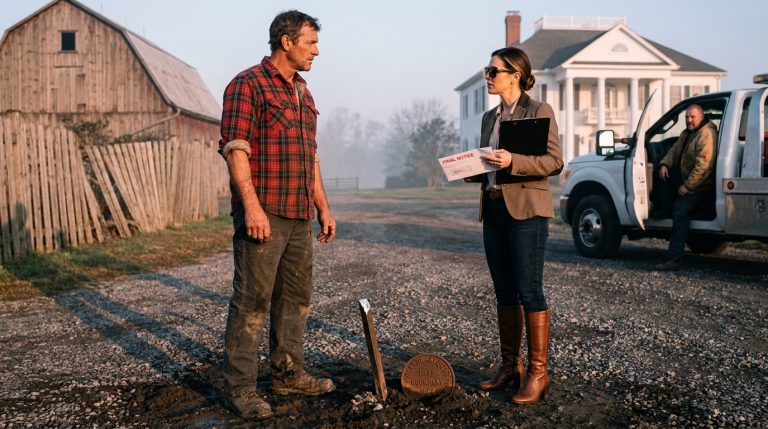
I stood at the entrance of my fifty-foot easement, the shadow of my F-250 stretching long across the county road. In my hand, I held a heavy sledgehammer, its steel head rusted but solid. At my feet sat a permanent, six-inch brass survey monument pin, its face deeply stamped with the coordinates from easement book 412.
I knelt in the dirt, placing the brass pin into the exact center of the original land grant coordinate point. I raised the hammer and swung.
Clang.
The sound was sharp, metallic, and final, echoing across the empty road and into the quiet woods. I hit it again, driving the brass deep into the hard clay until the flat head sat flush with the earth, immovable and permanent. No cheap plastic cap. No temporary lies. This line was anchored into the bedrock of the state.
I stood up, wiping the sweat from my forehead with the back of my sleeve. Down the county road, a figure was walking slowly toward my gate.
It was George Maxwell. He wore an old faded flannel shirt, his hands shoved deep into his pockets. He stopped at the edge of my fence line, his eyes tracking the clear, wide path of the easement leading straight to my thirty acres where the clean pine studs of my new workshop stood tall against the sunset.
“They held the emergency meeting last night, Jack,” George said, his voice carrying a quiet, steady ease I hadn’t heard before. “The board accepted Karen’s resignation. The county attorney’s office is moving forward with the title fraud charges. Her house went on the market this morning.”
I leaned on the handle of the sledgehammer, looking out over the golden-hour light washing across the trees. “And your front door, George?”
A genuine, slow smile spread across the old veteran’s face. “Cobalt blue. Painted it myself at dawn. Frank helped me hang the hinges.”
We stood there in the quiet country air, two men who had fought different wars but understood the exact value of a secured perimeter. I looked back at my land, the raw pine of the workshop frame glowing like gold in the last rays of the sun. The boundaries were clear, the path was open, and the silence was finally mine.