The Weight of Clay and Cold Iron: A Combat Engineer’s Silent War Against Suburban Tyranny
CHAPTER 1: THE BORDER DEMARCATION
The autumn wind cut through the pines, carrying the bitter scent of damp earth and the cold, metallic tang of the steel-framed Raku kiln behind me. Karen Miller stood precisely three inches inside the asphalt curb, her manicured sneakers planting a flag on what she clearly considered a conquered territory. Her powder-blue tracksuit was a loud, synthetic blotch against the desaturated gray of the gravel driveway. Her face, pinched and bloodless in the sharp October light, was a mask of cold administrative hunger.
I did not move. In the sandbox, you learned that movement was information, and right now, I wanted her operating on bad intelligence.
“Section 4, subsection C,” Karen said, her voice dropping like a heavy iron gate. Her hand, bloated and heavy with a gaudy gold ring, pointed directly at the brick pillar of my kiln. “It is an unapproved external structure. A fire hazard. An eyesore. You have seventy-two hours to level it, or the association begins drafting the five-hundred-dollar daily penalties. We will lean your house, Mr. Turner. Do not think we won’t.”
I looked past her, analyzing the geometry of her posture, the nervous twitch in the jaw of Gerald, the board secretary hovering five paces behind her like a stray dog waiting for scraps. They were deploying a classic envelopment tactic—hit the target’s sanctuary, threaten the supply lines, and force a panicked retreat. But they had miscalculated the terrain. The kiln was built on a six-foot reinforced concrete slab, anchored by welded angle-iron. It was engineered to withstand fifteen hundred degrees of internal heat. It was built to survive.
“I have the fire marshal’s safety clearance, Karen,” I said, my voice flat, holding the steady, low frequency I used when clearing pressure plates in Kandahar. “And my deed is exempt from the architectural covenants. This plot is five acres.”
“Was exempt,” she corrected, a thin, sharp smile slicing her pale face. She thrust the paper toward me. The edge of the sheet was crisp, catching the cold glare of the sun. “We amended the plat map charter two months ago. The board has universal jurisdiction now.”
She turned on her heel, her sneakers squeaking against the cold asphalt as she retreated toward her luxury SUV.
I waited until the sound of her engine faded into the quiet suburban hum before I looked down at the paper. The metal hood of my truck was cold against my palms as I smoothed the document out. The ink was cheap, slightly smeared at the margins, detailing the three counts of my alleged non-compliance. My left hand, carrying the deep, jagged scars of a pressure-plate IED, began its familiar, rhythmic tremor. I clamped it flat against the cold steel of the truck to force it still.
I flipped the page to find the footnote she had mentioned—the legal authority for the retroactive covenant amendment. My eyes traced down the columns of signatures certifying the board’s unilateral vote.
At the bottom of the page, under the bold header of Legal Counsel Approval, sat the crisp, digital signature of Dave Miller—my personal real estate attorney, the military brother-in-arms who had reviewed my property deed and sworn my sanctuary was safe.
Dave’s signature was dated three days before Karen’s first unexpected visit.
The wind died, leaving only the dead, heavy silence of the woods. The perimeter was already breached, and the call was coming from inside the wire.
CHAPTER 2: ESTABLISHING THE PERIMETER
The digital signature on the screen did not change, no matter how hard I pressed my scarred palm against the cold steel of the truck’s hood to stabilize my vision. The timestamp under Covenant Amendment 9-Alpha read precisely seventy-two hours before Karen Miller ever set foot on my property line. Dave Miller, the man who sat in the dirt with me outside Kandahar while we waited for the Medevac chopper, had authorized the bureaucratic ambush.
I folded the document with slow, mechanical precision. The paper creased with a sharp, clean snap under my fingers. Panic is an uncalibrated variable; it gets people killed. I didn’t let the weight of the betrayal settle into my chest. Instead, I categorized it as a structural breach. The perimeter was soft.
I walked back toward the house, my boots crunching rhythmically on the gray gravel. Gus, my golden retriever, rose from the porch, his ears pinned back as he caught the stiff, unnatural posture of my shoulders. “Inside, boy,” I murmured, the command flat and low. He moved without hesitation.
Inside the kitchen, the air was still, smelling faintly of the chamomile tea Sarah had left on the counter before heading into town. I bypassed the living room entirely and went straight to the secure router hub in my small back office. If Dave had signed off on a retroactive amendment to clear the way for something called the Aegis Corridor—a term I’d seen brief references to in local infrastructure proposals—then my physical property wasn’t the only thing being monitored.
My hands, which had spent years splicing fiber-optic lines and tracking wire frequencies under fire, went to work on the network terminal. I disconnected the main coaxial cable, dropping the house offline, before splicing in a secondary diagnostic laptop.
The screen flickered to life, its blue glow cutting sharp angles across the dark wood of my desk. I ran a standard packet analysis on the local network. Five minutes of absolute silence passed, punctuated only by the rhythmic hum of the refrigerator in the next room. Then, the interface registered an anomaly.
A persistent, unauthorized data-scrape was pulling logs from my home IP address. It wasn’t an external hack. It was an internal handshake authorized by an administrative credential. The access key belonged to Dave’s firm.
They weren’t just checking if I built a kiln. They were tracking my financial accounts, monitoring my disability deposits, and looking for leverage to force a foreclosure.
My jaw tightened until the bone ached. “You used my own backdoor, Dave,” I whispered into the empty room.
I pulled a fresh legal pad from the drawer. The grid lines on the paper were sharp and exact. I needed a counter-measure that didn’t alert the network. I needed to establish an offensive perimeter that Karen and Dave couldn’t touch.
The next morning, I drove forty miles east to the desaturated brick landscape of the industrial district, far outside the jurisdiction of Oakmont Estates. I didn’t use our joint banking account. I went to a regional commercial bank and withdrew ten thousand dollars from a personal military savings account I hadn’t touched since retirement. The cash felt thick, heavy, and real inside my jacket pocket.
From there, I went to an independent surveillance supply warehouse. The air inside the store smelled of ozone and hot circuit boards. I didn’t talk to the sales floor reps. I went straight to the commercial section and selected four weather-proof, high-definition security units with closed-circuit local storage drives. No cloud access. No wireless handshakes. If Karen wanted to stand on my property line, she was going to do it on a closed loop that she couldn’t subpoena or hack.
“Paying cash?” the clerk asked, his eyes lingering on the jagged scar running from my wrist up into my sleeve.
“Cash,” I said, placing the crisp bills on the glass counter. “No receipt on the ledger. Just the standard factory warranty.”
By the time I returned to the property, the sun had dipped behind the treeline, casting long, iron-gray shadows across the workshop yard. I spent the next four hours climbing the structural beams of the post-and-beam studio, drilling mounting brackets into the raw timber. My left hand trembled as I tightened the bolts, but I adjusted my grip, utilizing the friction of the wood to steady the tool.
The cameras were positioned to cover every approach angle: the driveway entrance, the western property line, the small valley leading toward the undeveloped woodland, and the concrete foundation of the Raku kiln. The local storage box was bolted inside a fireproof safe beneath my workbench.
The final piece of the perimeter was the financial front. I sat down at the workbench, the cold metallic smell of my tools hanging thick in the air, and logged into a secure escrow portal via a temporary encrypted hot-spot. I initiated a daily automated transfer of five hundred dollars into a locked legal escrow account.
Every morning the HOA sent a grenade over my wall in the form of a violation notice, the money would leave my bank, but it wouldn’t land in Karen’s ledger. It would sit in a judicial vault, proving my compliance while stripping her of the ability to claim I was a non-paying delinquent.
As I snapped the padlock shut on the storage safe, a sudden headlight beam swept across the workshop’s high frosted windows. The engine tone was heavy, low, and smooth—a luxury vehicle idling down at the gravel turnout by the main road.
I didn’t turn on the workshop lights. I stepped into the shadows near the door, my eyes adjusting to the dark, and watched the silhouette of the car through the trees. It sat there for exactly three minutes, its exhaust pluming white in the cold night air, before shifting into reverse and disappearing into the darkness of the estate.
The war wasn’t coming in seventy-two hours. It was already outside the door.
CHAPTER 3: RECONNAISSANCE ON THE ASPHALT
The crimson glow of those retreating taillights bled into the mist hanging over Magnolia Lane, leaving only the sharp tang of exhaust and the heavy, dripping silence of the forest behind them. I stood in the deep shadow of the workshop eaves for a full ten minutes after the sound of the engine dissolved completely. My right thumb mechanically traced the rigid padlock on the safe beneath the workbench, confirming the tactile boundaries of my security line. The network was dark; the local closed-circuit loops were humming silently in the floorboards. The tactical map was drawn, but the coordinates lacked names.
When the first thin ribbon of dawn cracked across the eastern ridge, it brought no warmth, only a flat, desaturated light that turned the uniform vinyl siding of Oakmont Estates into rows of gray blocks. I swapped my heavy work boots for canvas walking shoes, slipped a small digital audio recorder beneath the heavy cotton weave of my jacket pocket, and whistled low.
Gus met me at the door threshold, his thick tail thumping once against the baseboard before he fell into a disciplined heel. To a casual observer looking through a set of faux-wood blinds, we were a retired soldier and an aging retriever completing an ordinary morning routine. To Karen’s surveillance grid, we were a harmless domestic cliché.
The residential blacktop was cold, coated in a slick sheen of condensation that mirrored the sharp, angular roofs of the houses. I kept our pace steady, tracking seventy-five paces per minute, our eyes scanning the trim lines, the driveway cracks, the subtle deviations from the community’s mandated aesthetic monotony.
Three streets over, the uniform rhythm of the neighborhood fractured. I paused near a mailbox anchored in a perfectly manicured lawn, letting Gus track an invisible scent along the curb while my eyes locked onto the concrete driveway of number forty-two.
A pristine 1967 Mustang sat elevated on heavy iron jack stands behind a closed garage door that had been pulled down to within eighteen inches of the concrete slab. Underneath the gap, the silhouette of a man’s heavy work boots shifted. A faint, rhythmic scratching of metallic tools against iron components resonated through the morning air.
I moved to the apron of the driveway, keeping my movements deliberate and visible. “Carburetors don’t clean themselves,” I said, my voice cutting low and steady under the garage door.
The scratching stopped instantly. A socket wrench clattered against a steel tray. The boots shifted, and a lined, oil-smudged face appeared under the edge of the metal door, blinking against the dawn light. It was Bob, the retired mechanic from the contractor lists. His knuckles were raw, stained with deep grease that no chemical soap could fully remove.
“You’re the fellow with the kiln,” Bob muttered, his voice carrying the dry, raspy scratch of a lifetime spent inhaling industrial fumes. He pushed the garage door up with a sudden, metallic rattle, revealing the immaculate crimson flank of the machine. “She’s patrolling today. Sent a notice through the web portal at six a.m. sharp. Said the fumes from my degreaser were violating the environmental preservation code.”
“Did she offer an alternative?” I asked, my fingers brushing the smooth, cold handle of the recording device inside my jacket.
Bob let out a dry, humorless bark, wiping his hands on a frayed lint-free rag that caught the gray light. “Yeah. Reliable Towing. They have a permanent authorization on the association board’s letterhead. If this car isn’t down on four wheels and behind a solid enclosure by Friday night, they’ll hook it from my own driveway. Costs eight hundred bucks just to clear the impound gate. The yard is forty miles out.”
“Reliable Towing,” I repeated, letting the name settle into memory. It matched the registration sequence of the vehicle that had monitored my fence line six hours prior. “Who authorizes the release forms?”
“Karen,” Bob spat, his jaw tightening until a muscle along his cheek twitched rhythmically. “Always Karen. Gerald just files the ledger entries under administrative recovery. You try to appeal, and the paperwork gets stuck in the review queue for ninety days while the storage fees compound. They ran the same pattern on the family down on Cedar Ridge. Took their kids’ play set down with a flatbed because the plastic hue was three shades off the woodland grid.”
I nodded slowly, looking down at the dark asphalt between us. The pattern wasn’t random enforcement; it was a liquidation process designed to generate artificial municipal debts against specific titles. I took a short step forward, our shadows stretching long and sharp across his clean concrete floor.
“Don’t lower the stands, Bob,” I said, my voice dropping into the flat register of an operational briefing. “Keep the wrenches moving. The ledger is shifting.”
He paused, the grease-stained rag tightening around his knuckles as he looked into my face, tracing the stiff line of my jaw. He didn’t ask questions. In our world, you recognized the shift from defense to tracking. He simply nodded once, a quick, functional gesture, and lowered his body back beneath the crimson steel of the chassis.
I checked my watch—0642. The morning sweep was fifty percent complete, and the operational limits of the board’s legal ambush were beginning to crystallize against the cold stone of the estate.
CHAPTER 4: THE VANITY GLAZE
The kitchen deadbolt cleared the strike plate with a heavy, isolated click that marked the end of the 0642 morning patrol. Gus immediately dropped to the floor mat, his ribcage expanding in deep, exhaustive cycles against the threshold tiles. I shed my jacket, feeling the subtle resistance of the canvas seams against my shoulders, and carried the concealed recording unit back to the layout desk. The morning light had stalled, pressing flat against the glass panes like a gray pane of industrial slate.
Sarah was still asleep in the upstairs master wing, leaving the ground floor trapped in a cold, analytical quiet. On the glass surface of the coffee table, her deliberate attempt to dilute the administrative tension sat waiting: a glossy stack of pristine lifestyle and home architecture journals, their heavy, clay-coated paper catching the desaturated light.
I ignored the digital recorder for a split second, my hand instead resting on the top spine of the print pile. My index finger traced the cold, embossed cover logo of Oakmont Interiors. It was a clean, minimalist typeface, but under closer inspection, a tiny, micro-printed trademark disclaimer ran along the bottom trim: A Subsidiary of Vanguard Communications Inc.
The name didn’t register fully on the first pass, but the tactical instinct required an unconditional accounting of all local printing nodes. I sat down on the edge of the leather cushion, the frame stiff and unforgiving against my tailbone, and opened the volume.
The pages turned with a thick, satisfying snap of heavy stock. It was a sterile layout of imported stones and white lacquered cabinets that looked less like living spaces and more like high-security containment units. On page twenty-four, the layout shifted. The headline was typeset in an ostentatious, gilded font: Opulence in Oakmont: A Master Bathroom Retreat.
My eyes skimmed the fawning text, picking up the quotes attributed directly to the homeowner, Karen Miller. But the prose became an indistinct background hum the exact micro-second my gaze locked onto the high-resolution architectural photograph spanning the center fold.
The image captured a deep, custom-poured stone basin surrounded by soaring walls. The vertical surfaces were covered from floor to ceiling in an intricate, interlocking mosaic of hand-formed ceramic tiles. They formed a dark, metallic wave structure that shifted from deep, abyssal cobalt to a cold, glistening emerald, before resolving into an unstable, iridescent bronze border.
The studio lighting of the camera crew had caught the exact, micro-fractured geometry of the glaze. It was a specific, web-like pattern—a network of microscopic cracks caused by thermal shock when red-hot clay is pulled from a combustion chamber and plunged directly into an oxygen-starved reduction bin.
I didn’t need to look at a signature. I knew the specific chemical ratio of that metallic luster. I knew the exact physical drag of the wire-tool that cut the back of those slabs to give them grip on a mortar bed. The copper carbonate formula was mine. The physical labor was mine.
Karen Miller was sleeping inside an absolute fortification of my own art while attempting to grind the kiln that forged it into powder.
My left hand went entirely rigid, the old shrapnel paths along the tendon turning into straight, hard ridges beneath the skin. I didn’t let the tremor start. I leaned forward, the slick paper of the journal cool against my palms, and examined the deep corner shadow of the main photograph where the mosaic met the molding.
There was a tiny, rectangular anomaly in the tile alignment—a single piece set three millimeters lower than the surrounding grid. I memorized that mistake two years ago. It happened when the reduction barrel lid jammed for four seconds, letting oxygen bleed into the smoke chamber and altering the shrinkage rate of the final six units.
I reached for the phone, my movements slow, calculated, and stripped of raw emotion. I needed the invoice trail. I needed to trace the paper path from Seline’s high-end firm at Prestige Interiors directly into the bank accounts Karen was using to fund her enforcement apparatus.
As I pulled the old 2022 commission ledger from the bottom of the safe, a loose clipping slid from the interior pocket of the binder. It was an old municipal notice regarding local infrastructure zones that Dave had mailed to me during our closing process. Near the bottom boundary of the zoning section, a tiny map index code was listed for future commercial transport corridors.
The code printed on the public document matched the prefix of the covenant amendment she had handed me at the curb: Ref: Aegis Corridor / Sec-9A.
The pieces of the perimeter weren’t just touching anymore; they were locking into an iron grid.
CHAPTER 5: THE SQUEEZE
The rigid plastic edge of the desk phone pressed into my palm, a hard line of absolute leverage against the sprawling infrastructure network hidden beneath the community’s vinyl exterior. I did not give myself a window to hesitate. My finger struck the keys with precise, calculated force, punching in the numbers extracted from the 2022 ledger file. The ring tone cut through the dark office, a shrill, metallic blade fracturing the silent house.
“Prestige Interiors, executive suite,” a sharp, defensive voice clipped down the wire before the third cycle completed.
“Put Seline on,” I said, keeping my vocal frequency entirely flat, letting the lack of inflection carry the cold weight of an operational mandate. “Tell her Mark Turner is holding. The ceramicist from the Riverflow project.”
“I’m afraid she’s in a closed corporate briefing—”
“Then open it,” I cut in, the syllables dropping like cold iron weights. “Tell her the feature spread in Oakmont Interiors just compromised her end client’s anonymity. If she wants to prevent a public disclosure that names her firm in an ongoing investigation regarding local infrastructure zoning, she will pick up this line in ten seconds.”
A dead silence choked the receiver. A mechanical click echoed as the call was thrust into a holding queue. I counted the beats by tracking the small, flickering LED on the diagnostic laptop beside me. Eight seconds. Then, a sharp intake of breath hissed through the earpiece.
“Mark, what is the meaning of this intrusion?” Seline’s voice was instantly defensive, tight as an over-torqued cable. “Our contracts are fully executed. Your creative accounts were settled two years ago.”
“The accounts are bleeding into my yard, Seline,” I said, my gaze locked on the specific map index code printed on the old municipal slip before me. “Your anonymous client from 2022 was Karen Miller. She’s currently utilizing her position on the Oakmont board to file multiple forty-thousand-dollar compliance actions against my workshop. She calls my kiln an illegal commercial venture.”
A long, calculated pause stretched across the line. I could hear the faint rustle of heavy document folders being shifted on a polished desk miles away. “Whatever domestic disputes you maintain with your local homeowner association are entirely outside the purview of my firm. Our non-disclosure provisions are comprehensive.”
“They don’t cover fraud,” I replied, my voice sinking an octave, sharpening until it carried the jagged edge of a battlefield ultimatum. “I am staring at a public filing link between Vanguard Communications and the Oakmont Interiors publication. If I file my disclosure with the state architectural board, your firm’s proprietary billing logs become part of an open-record civil discovery. Every high-net-worth client on your ledger will watch their private financial arrangements drag through a public court docket.”
The silence returned, but this time it was heavy, the suffocating atmosphere of a position that had been completely flanked. Seline’s breathing turned rhythmic, shallow, and cold.
“What are the parameters of your resolution, Mark?” she finally whispered, the professional veneer completely stripped away, leaving only the raw transaction.
“A formal, sworn affidavit,” I stated, pulling a clean document draft from my ledger pile, its stark margins catching the pale light from the window. “Stating that Prestige Interiors contracted me for thirty-two thousand seven hundred and fifty dollars to produce a custom mosaic. You will explicitly name Karen Miller and her residence at 124 Magnolia Lane as the final delivery destination. I want the document signed, notarized, and dispatched via courier to my studio threshold within forty-eight hours.”
“That will destroy our administrative relationship with her estate,” she hissed.
“Then you’d better find an alternate market,” I said, my hand closing tighter around the plastic receiver. “Because if that courier isn’t on my gravel by Thursday morning, I’m letting the county title office pull every transaction code attached to Project Riverflow.”
I severed the line before she could formulate a counter-strike, slamming the receiver down into its cradle with a dry, conclusive snap.
I leaned back, my eyes tracking the light as it crawled across the glass surface of the coffee table. The tactical friction was mounting, but as I glanced down at the open ledger file, a specific corporate registry listing on the diagnostic screen caught my attention. The holding company that owned Seline’s design firm shared an identical registration address with the entity that Dave had used to authorize the charter revisions—a firm buried under three layers of paper, carrying the designation of The Aegis Development Syndicate.
The decoy secret—the simple contractor kickback ring I’d been hunting with Bob—was just a superficial crust. The true objective was much larger, an institutional clearance mechanism designed to push the small landowners completely off the grid.
CHAPTER 6: THE COUNCIL OF OUTCASTS
The impact of the plastic receiver settling into its cradle vibrated upward through my forearm, leaving a dull ache along the bone. On the diagnostic screen, the name The Aegis Development Syndicate blinked in rhythmic intervals, casting long, sharp blue needles across the concrete floor of the back office. The immediate tactical layer had cracked, exposing the deeper infrastructure mechanism beneath Karen’s local border skirmish. I didn’t let the weight of the broader corporate alignment slow my hands.
I disconnected the hard drive, slipped the encrypted storage drive into my internal jacket pocket, and walked out to the main workshop bay.
The air inside the timber studio had altered. An unseasonable, heavy freezing fog was rolling off the 100 acres of undeveloped woodland behind my plot, bleeding through the floor ventilation and reducing the visibility within the rafters to a thick, iron-gray haze. The single halogen bulb overhead cut a cone of harsh, yellow light over my central workbench, illuminating the cold steel surfaces of the pottery wheels and the raw, damp bricks of the small detached kiln shed outside.
A faint tap rattled the side door frame—three rhythmic beats, a pause, then two more.
I unbolted the steel security latch. Bob the mechanic stepped through the threshold first, his heavy canvas work jacket damp with condensation, his skin carrying a gray pallor under the workspace lighting. Behind him came Maria and Hector Garcia, their shoulders hunched against the biting cold, followed by six other residents whose properties backed up to the eastern grid boundary. They didn’t speak. They moved into the center of the bay like soldiers occupying a fallback trench, their boots leaving wet, dark prints on the dry concrete.
“The web portal just dropped a new structural amendment link,” Bob muttered, his voice cracking slightly as he pulled a folded sheet of paper from his pocket. The edges of the sheet were wet with fog. “They’re fast-tracking the property valuation reviews. Anyone with an unresolved citation gets their voting proxy transferred to the board executive pool by next Monday.”
“They’re closing the loop before the annual meeting,” I said, my voice cutting flat through the damp chill of the room. I laid my legal pad down on the iron surface of the workbench, the grid lines stark and clean. “Karen isn’t running a standard compliance ring to inflate neighborhood aesthetics. The firm backing her—Aegis Development—is systematically stripping voting authority from the perimeter deeds. They need a sixty percent corporate block to certify the corridor easement through our plots.”
Maria Garcia crossed her arms tightly, her fingers digging into the worn wool of her sleeves. “Hector found two surveyors at the forest boundary an hour ago. They had industrial marker stakes branded with a corporate logo. They wouldn’t show us their county permits.”
“They don’t have them yet,” I replied, leaning my palms flat against the cold metal edge of the bench. “Therefore, they need us liquidated before the public hearing. But the bylaws they weaponized carry an internal vulnerability. Section 12, subsection D allows an immediate recall petition if sixty percent of the recorded title holders sign the registry.”
I pushed a thick, heavy clipboard across the timber table. Secured to the steel clip was the first clean print of our neighborhood petition, its headers demanding an immediate audit of the association’s financial accounts.
“We divide the grid by streets,” I stated, my eyes locking onto Bob, then shifting to Hector. “No group declarations. No arguments on the doorsteps. You walk the retriever cover lines if you have to, but you gather the signatures on paper ledger pages. No digital handshakes. Karen’s firm is tracking the local IP addresses through the main router hub.”
Bob reached out, his grease-stained thumb pressing firmly against the aluminum frame of the clipboard as he pulled it toward his chest. “What about Dave? His firm handles the legal verification for the board.”
“Dave is a compromised node,” I said, the words slipping from my throat like a cold stone. “I’m bypassing his office entirely. I’ve already secured a leverage path through Prestige Interiors that forces Seline to produce the physical delivery trail for Karen’s private residence. We don’t strike until the paperwork is notarized and filed with the county clerk.”
A sudden sound rattled the high frosted windows of the workshop—the low, heavy thrum of an engine idling out on the gravel shoulder beyond the pine buffer. The headlights didn’t cut through the dense, freezing fog, but the twin red orbs of the taillights burned like open entry wounds through the gray mist.
Nobody in the room moved. The silence in the workshop grew heavy, thick with the smell of wet earth and the sharp, metallic tang of the unheated iron stoves. We stood in the yellow cone of the halogen lamp, a small circle of outcasts watching the perimeter line through the glass as the tracking vehicle sat frozen in the dark, measuring the depth of our resistance.
CHAPTER 7: THE FILING OF THE IRON CLAD
The low vibration of the idling engine outside filtered through the timber framing, humming deep within the iron legs of my central workbench before the vehicle slowly shifted gears, its tires grinding on the wet gravel road as it slipped back into the fog. My hands didn’t drop from the metal table. Around me, the collective breathing of the outcasts slowly returned to a steady, quiet rhythm, their outlines still obscured by the damp gray mist clinging to the rafters.
“They’re tracking the physical assembly now,” I said, my voice cutting through the thick chill with an icy, definitive weight. “Which means the window for an administrative resolution is officially dark. Bob, take the clipboard. Hector, clear the western section before the afternoon mail run. I’m pulling the truck out.”
Alex, our legal proxy, stepped forward from the shadow of the storage racks, a thick manila folder pressed firmly under his arm. The structural steel clips on his briefcase gleamed under the dying yellow glare of the halogen bulb. “The county registrar closes the civil filing desk at precisely four o’clock. If we aren’t stamped before the ledger locks, Karen’s emergency proxy vote goes live on Monday without a judicial stay.”
“Then we move,” I said.
We left the workshop without utilizing the main overhead doors, slipping through the narrow side clearance to avoid casting clean profiles against the road. The interior of my utility truck was freezing, the black vinyl bench seat stiff and entirely unforgiving against my spine. I turned the key, listening to the heavy diesel engine turn over with a harsh, unyielding clatter that felt solid, grounded, and entirely real compared to the phantom paper loops we were fighting.
The journey out of Oakmont Estates was an exercise in systematic avoidance. I kept the speed exactly two miles under the community limit, watching the rearview mirror as the gray silhouettes of identical houses slid past the wet glass. Alex sat rigid in the passenger seat, his thumb restlessly flicking the brass latch of his folder.
“The structural basis for the property lien is thin, Mark,” he murmured, his eyes scanning the fog-swept asphalt ahead. “If Karen’s counsel proves the mosaic tiles are separate from the commercial kiln’s ongoing manufacturing log, the judge can vacate the filing within forty-eight hours.”
“She won’t risk the discovery phase,” I replied, my left hand holding the steering wheel with an absolute, unyielding grip to counter the micro-tremor in the joint. “Seline’s affidavit explicitly anchors the purchase to Project Riverflow. For Karen to argue the tiles aren’t part of the kiln’s direct commercial output, she has to expose the ledger entries linking her personal account to the Aegis Development Syndicate. She’ll choose the property cloud over the corporate leak every single time.”
We struck the county highway fifteen minutes later, leaving the desaturated vinyl borders behind as the road transitioned into the hard, gray limestone architecture of the civic center. The county courthouse sat like a block of weathered granite against the overcast sky, its wide concrete steps slick with dark, pooling rainwater.
Inside, the air smelled of stale floor wax, industrial ammonia, and old binding glue. Our boots rang out with a sharp, hollow echo against the polished terrazzo floors as we navigated the basement corridor toward the Real Estate Records division. The counter was fronted by a thick plate of security glass, behind which a heavy iron sorting wheel held thousands of open title deeds.
Alex didn’t waste motion. He unslung the folder, laying the clean, notarized pages flat against the narrow stainless steel tray beneath the glass partition.
“Filing a claim of lien against parcel 410-B, registered to Miller, Karen,” Alex stated, his tone dropping into the dry, transactional rhythm of the court. “Accompanied by a verified civil complaint for breach of fiduciary duty and intentional misrepresentation.”
The clerk behind the glass didn’t look up immediately. Her fingers moved across a mechanical stamper with a heavy, repetitive thud that sounded like a small mortar tube firing in the distance. She pulled our sheets through the slot, her eyes scanning the verification stamps on Seline’s affidavit before she aligned the heavy iron matrix over the top margin of our deed application.
Thump.
The ink was black, thick, and permanent, biting deep into the fiber of the page. The document was digitized, registered, and locked into the public index.
As the clerk handed back the certified copies, a thin, digital notification pinged on Alex’s handheld terminal. He pulled the device from his belt, his eyes widening slightly as the small screen illuminated his face with a pale, cold glare.
“Mark,” he said, his voice dropping until it was nearly swallowed by the hum of the overhead ventilation units. “The board just filed an expedited eviction notice against Bob’s parcel through an automated corporate entity. They aren’t waiting for Monday. They used Covenant Amendment 9-Alpha to declare his garage an immediate environmental hazard.”
I took the stamped lawsuit papers from his hand, the crisp edges of the paper clean and stiff between my fingers. The enemy had checked our flank before we even cleared the field. “Then the briefing is over,” I said, turning back toward the exit. “We turn the garage into the courtroom.”
CHAPTER 8: SERVING THE SOVEREIGN
I pivoted, my shoulder cutting a hard angle toward the brass-handled double doors of the municipal basement. The thick rubber sole of my right boot gripped the polished terrazzo, arresting my static posture and converting it into immediate, forward momentum. Alex didn’t waste a syllable of breath asking questions. He fell in step beside me, the heavy manila folder clutched tight against his ribs as we pushed through the heavy glass exit and out into the biting, freezing drizzle of the county plaza.
“Call the civil processing division,” I ordered, my voice flat against the roar of the afternoon traffic as we crossed the slick concrete to my utility truck. “Get the on-duty sheriff’s deputy to meet us at 124 Magnolia Lane. We have a certified property lien and a civil summons for intentional misrepresentation. They need a county badge to execute the service on a sitting board president.”
Alex slid into the freezing vinyl passenger seat, his fingers flying across the cold glass of his phone screen. I turned the ignition. The heavy diesel block caught with a harsh, unyielding clatter, the vibration traveling up the steering column and into my forearms.
The forty-minute drive back to Oakmont Estates was an exercise in pure mechanical discipline. The wiper blades scraped a rhythmic, harsh tempo against the windshield, clearing the freezing rain that blurred the desaturated highway. I kept the speedometer pinned exactly at the structural limit of the truck, calculating the time-loss against Karen’s digital proxy maneuver. Every mile of wet asphalt swallowed by the tires was a second ticking down on Bob’s property rights.
We breached the stone pillars of the Oakmont entrance at 4:48 PM. The neighborhood was suffocating under the early twilight, the identical gray houses bleeding into the fog.
As we turned onto Magnolia Lane, the tactical landscape materialized.
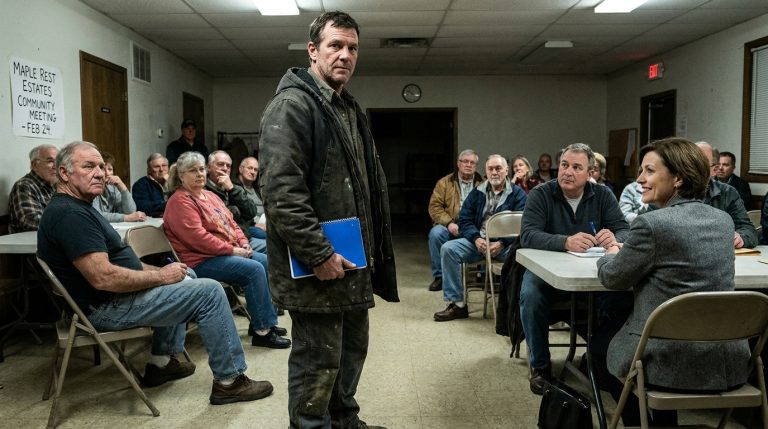
Karen Miller’s sprawling driveway was choked with vehicles. Her three-car garage—the sanitized community clubhouse—was completely exposed to the freezing air, all three bay doors rolled up into the ceiling. The interior was flooded with harsh, sterile white fluorescent light that spilled out onto the wet blacktop like a chemical leak. Inside, the space was packed. Over fifty residents stood shoulder-to-shoulder in the frigid air, their breath rising in pale plumes. At the front, seated behind a rigid plastic folding table, sat Karen, her face a mask of pinched, absolute authority. Gerald hovered beside her, his knuckles white as he gripped a stack of printed proxy forms.
I killed the diesel engine. The silence inside the cab was absolute for exactly three seconds before the heavy crunch of tires rolling over wet gravel sounded behind us. A county cruiser eased to a halt at the curb, its lightbar dark, the heavy steel grill glistening with rain. A uniformed deputy stepped out, securing his utility belt. Alex met him at the bumper, handing over the stamped manila folder.
I didn’t wait for the legal exchange. I walked straight up the center of the driveway. The crowd of residents parted instinctively, sensing the cold, sheer density of the momentum carrying me forward. Bob stood near the front row, his jaw locked tight; Hector and Maria were flanking him, their faces drawn and exhausted.
“…and pursuant to the emergency provisions of Covenant Amendment 9-Alpha,” Karen’s voice amplified artificially through a cheap portable microphone, cutting through the damp air like a rusted bandsaw, “the board is hereby executing an immediate remediation order on parcel forty-two. The hazards will be cleared by authorized contractors at the owner’s expense. Moving on to the proxy tallies—”
“The tallies are frozen, Karen,” I said.
My voice wasn’t amplified, but it possessed the heavy, acoustic density of the concrete slab beneath my boots. The murmurs in the garage snapped into a dead, suffocating silence.
Karen’s head snapped up. Her eyes narrowed into thin, hostile slits, reflecting the overhead fluorescent tubes. “You are out of order, Mr. Turner. This is a closed executive proceeding. If you do not step back behind the property line, I will have you cited for trespassing.”
“You don’t own the grid anymore,” I replied, closing the final ten feet until the edge of her plastic table pressed against my thighs. I reached into my jacket, extracting a secondary copy of Seline’s affidavit, and dropped it flat onto the center of her meticulously organized agenda. “That is a sworn, notarized declaration from Prestige Interiors. It traces thirty-two thousand dollars from your private accounts to a custom tile installation at this exact address. The same tiles I fired in the commercial kiln you’ve been fining me forty thousand dollars to destroy.”
The color drained from Karen’s face in a rapid, vertical wave, leaving her skin the color of old chalk. Her eyes darted from the Prestige Interiors logo to the signature at the bottom. The pristine, impenetrable aesthetic of her authority fractured in real-time.
From the edge of the crowd, the sheriff’s deputy stepped into the harsh light, his heavy boots echoing off the drywall. He bypassed the folding chairs, coming to a halt directly beside Gerald.
“Karen Miller?” the deputy asked, his tone devoid of any inflection.
She stared at the badge, her throat working silently.
The deputy dropped the thick, county-stamped manila folder directly on top of the affidavit. “You are hereby served with a civil summons for fraud, and formal notice of a judicial property lien recorded against this deed for the sum of thirty-two thousand, seven hundred and fifty dollars. Your title is locked.”
The garage erupted. The residents, paralyzed for years by the bureaucratic suffocation, suddenly realized the fortress was made of paper. The shouting bounced off the concrete walls, a chaotic wave of vindication.
But Karen didn’t collapse.
I watched the micro-expressions on her face. The shock faded, replaced instantly by a cold, cornered desperation. She didn’t look at the crowd. She looked directly at me, her lips curling into a razor-thin, bloodless smile.
Her hand slid over the paperwork, her gaudy ring scraping against the plastic table. “A lien,” she whispered, her voice a dry, venomous hiss meant only for my ears. “You think a local mechanic’s lien matters to the board’s parent charter? You’re playing in the dirt, Sergeant.”
She reached down and pressed a single transmission button on her two-way radio.
A heavy, guttural air-horn shattered the night air outside. The sound was massive, industrial, and close.
I turned sharply. Rolling slowly past the edge of Karen’s driveway, its amber strobe lights cutting through the freezing fog, was a massive commercial flatbed wrecker bearing the Vanguard logistics logo. But it wasn’t turning toward Bob’s garage. It was grinding its way down the asphalt, accelerating steadily toward the eastern perimeter of the estate. Toward my acreage.
“The proxies transferred at four-thirty,” Karen said, her voice turning hollow and metallic. “While you were at the courthouse filing paperwork, I authorized the physical demolition of your fire hazard.”
CHAPTER 9: THE FALL OF THE CASTLE
The radio transmission clicked dead in Karen’s hand, the small plastic casing rattling against her heavy rings, but the low, industrial rumble of the heavy flatbed wrecker was already vibrating through the wet asphalt beneath my boots. She didn’t move from behind her plastic table. Her bloodless smile remained fixed under the harsh fluorescent lights of her garage, a final, desperate gesture of administrative defiance.
I turned from the table, my shoulder slicing back through the packed crowd of residents without a micro-second of hesitation.
“Deputy, on me,” I commanded, the frequency sharp and carrying the absolute authority of a field extraction.
Alex sprinted alongside my flank as we hit the wet driveway. The freezing rain stung my skin, but my eyes were locked on the twin amber strobes of the Vanguard truck vanishing into the dense gray mist down Magnolia Lane. I vaulted into the driver’s side of my utility truck, my scarred left hand slamming the door shut as my right twisted the ignition. The diesel block roared to life instantly, vibrating through the metal frame as I threw the transmission into gear and punched the accelerator.
The chase was a direct calculation of mass and friction. The flatbed was heavy, but its amber strobes carved an explicit path through the freezing fog, giving me a target vector. I tracked its tail markers through the winding curves of the development, the utility truck’s tires screaming against the slick asphalt as we cleared the turnouts. Alex held the dashboard with a white-knuckled grip, his phone held high.
“I’ve got the county zoning clerk on an emergency line,” he yelled over the engine roar. “The land registry shows Covenant Amendment 9-Alpha was never officially indexed by the state. The entire easement is an uncertified corporate illusion!”
We broke through the final timber line, and my property materialized through the gray haze. The Vanguard flatbed had already breached my gravel apron, its hydraulic stabilizers lowering with a high-pitched, metallic hiss directly in front of the detached kiln shed. A man in heavy industrial overalls was stepping down from the cab, an iron pry-bar clutched in his gloved fist, his eyes fixed on the brick pillar of my sanctuary.
I slammed the utility truck to a halt, blocking his retreat angle. Before the engine had even died, I was out of the cab, my boots striking the wet stone with an iron thud.
“Step away from the structure,” I said. My voice was low, flat, and stripped of all emotional resonance.
The driver paused, the heavy pry-bar hovering three inches from the welded steel frame of the kiln. He looked from my face to the county cruiser that had just roared onto the gravel behind us, its emergency lights finally erupting into a violent sequence of blue and red flashes that sliced through the dark pine canopy. The uniform deputy stepped into the light, his hand resting firmly on his utility holster.
“Engine off, driver,” the deputy ordered. “The title to this parcel is subject to an active judicial stay. Touch that brick, and you’re executing an unauthorized commercial demolition on a locked record.”
The driver dropped his arms, the heavy iron bar clattering harmlessly against the gravel. The physical threat was neutralized in real-time.
But the true liquidation happened back at the clubhouse garage.
By the time we returned with the deputy, the crowd of residents had swelled, sealing the entrance to Karen’s property line. Bob stood at the center of the floor, holding a printed copy of the newly pulled county land index. When Karen saw the deputy step back into the fluorescent light, her posture collapsed. The legal trap had closed completely.
The extraction of the corporate truth was methodical. Under the sharp glare of the flashing police lights, the paper trail was unraveled. The Riverflow Ledger didn’t just document thirty-two thousand dollars in tile work; the backend corporate metadata verified that the funding had been routed through a shell company directly managed by Dave’s firm, underwritten by Vanguard Holdings. The entire purpose of the aggressive aesthetic enforcement was to create a cloud of artificial debt on every independent parcel along the eastern boundary, forcing a foreclosure epidemic that would clear the path for the multi-million dollar Aegis Corridor commercial freight route.
Karen didn’t give a villain speech. When the realization of her absolute exposure settled, she simply sank into her folding chair, her hands trembling as she pulled her tracker radio apart. Within three months, her sprawling estate carried a prominent repossession sign on the manicured lawn. Her vanity bathroom, lined with the fruits of my own clay and copper formulas, was locked behind a bank foreclosure notice. Her reign of administrative terror was completely broken, her empire reduced to public record exhibits in a civil conspiracy suit.
The aftermath brought a slow, desaturated peace to Oakmont Estates. The freezing rain cleared by morning, leaving the autumn horizon sharp, cold, and clean. The interim board—composed of Bob, Maria, and myself—spent the first week executing a total systematic purge of the old bylaws, burning the ambiguous citation clauses until the community charter was stripped back to basic property protections.
On a quiet Saturday evening, the air smelled of wet pine needles, woodsmoke, and dry earth. I stood inside the detached shed, my tools arranged in precise, geometric lines across the workbench.
My left hand was steady. The shrapnel scars along the wrist were cold, but the involuntary tremor had gone completely still. I picked up a small iron wire-tool that had been bent during the initial confrontation with Karen, and slowly, methodically straightened the steel loop using a small pair of pliers until the edge was perfectly aligned once more.
Sarah stepped through the timber threshold, a heavy wool blanket draped over her shoulders. She didn’t speak. She simply stood beside me, her shoulder pressing lightly against my jacket sleeve as we looked out through the open bay doors.
Outside, twenty yards away on its reinforced concrete pad, the custom Raku kiln stood silent and monumental against the darkening sky. A soft ribbon of clean white smoke curled from its brick chimney, drifting lazily into the open, unprotected acreage of the free forest beyond. The war was over, the wire was clear, and the ground beneath our feet was finally ours.