The Iron Perimeter: A Colonel’s Siege on the Whispering Pines Hegemony
CHAPTER 1: THE STONE EMBANKMENT
The wind coming off the north ridge carried the scent of wet pine needles and diesel from the interstate. Jack Miller stood with his boots planted in the damp clover, his fingers resting on the rough, cold granite of the stone wall. The wall had been dry-stacked in 1842. It didn’t use mortar; it used gravity and the sheer, unyielding weight of the stones to keep the pasture from spilling into what was now a manicured, chemical-green cul-de-sac.
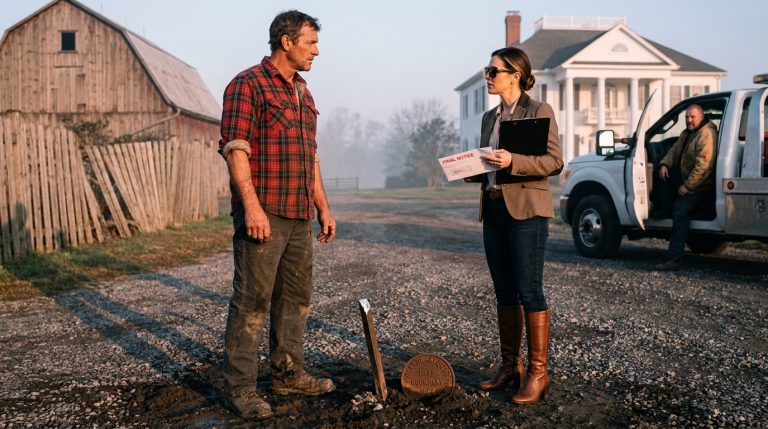
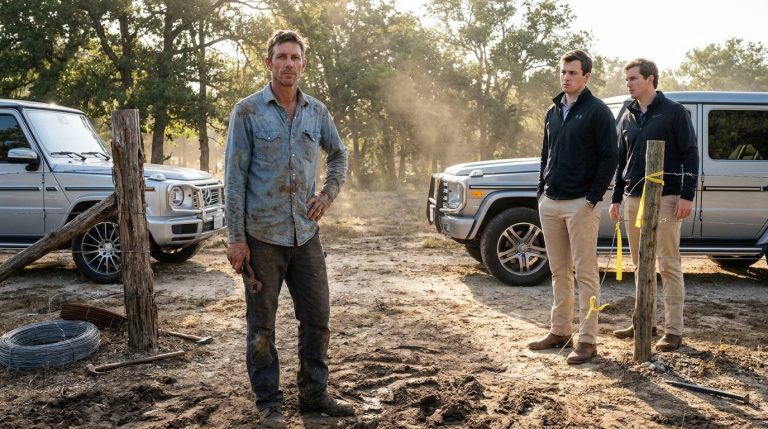
Karen Petrov stood exactly three inches onto her side of the property line. She was flanked by two men in navy blazers who held leather binders like shields. Her pink tracksuit looked absurd against the dark, wet woods, but there was nothing ridiculous about the cold calculation in her eyes. She wanted the fifty acres of low rolling grass behind Jack. She wanted it because her husband’s excavators were idling, and a three-million-dollar developer’s payout was the only thing keeping her faux-Tuscan villa from a bank-ordered auction.
“The appraisers will be here Tuesday, Jack,” Karen said, her voice dropping the syrupy neighborhood-gossip tone she used in the monthly newsletters. This was the voice she used when she fined young couples for using the wrong shade of mulch. “We’ve cited local ordinance 74B. For the public good. A community asset.”
“There is no municipal water under this pasture, Karen,” Jack said. His voice was flat, a low, even rasp shaped by thirty years of engineering logistics in places where people died for miscalculating terrain. He didn’t look at her; he looked past her, toward the cul-de-sac where a black luxury SUV sat with its engine humming. “And this isn’t a municipality. It’s a country club with a tax ID.”
“The board has the vote, Colonel. The lawyers have the papers. It’s already done.”
Jack’s gaze shifted down. At the base of the wall, where the moss was thickest, a dark, greasy stain sat on the stone. It was fresh oil. Not from his tractor—this was high-grade hydraulic fluid, the kind used in survey rigs. Someone had been at his wall in the dark. A subtle discrepancy, a signature of unauthorized reconnaissance.
He didn’t point it out. In the desert, when a scout noticed a fresh footprint outside the perimeter, he didn’t shout; he quietly adjusted his coordinates.
“You’ve made a structural error,” Jack said, his hands remaining loose and steady at his sides. “You’ve assumed this is a negotiation.”
“We’re past negotiating,” Karen said, her lips thinning into a hard, bloodless line. “Enjoy the view while it lasts.”
She turned, her rubber-soled shoes squeaking on the asphalt as she walked back toward the SUV. The two blazers followed her in lockstep, their binders tucked under their arms.
Jack stood in the silence of the pasture. Behind him, Samson, his oldest rescue gelding, let out a low huff, the horse’s breath turning to steam in the crisp air. Jack turned back toward the farmhouse, his eyes fixed on the long, dark shadows stretching across the grass. The stone wall was old, but the paper buried in the county registry was older. The siege had begun.
CHAPTER 2: THE FORMAL OFFENSIVE
The heavy oak door of the farmhouse clicked shut, sealing out the damp autumn wind, but the chill lingered on the collar of Jack’s canvas coat. He didn’t shed the jacket. In his thirty years with the Corps, he had learned that transitions were the moments where a man’s vigilance slacked. You didn’t unpack until you had mapped the room.
He walked straight to the dining table. The wide planks of heart pine, scarred by decades of daily use, held nothing but a yellow legal pad, a sharpened pencil, and the thick, pristine packet that had been delivered while he was out at the stone wall. The certified mail sticker on the front of the heavy manila envelope was slightly crooked.
Jack sat down, the dry wood of the chair groaning under his weight. He pulled the envelope toward him, his thumb catching on the edge of the tracking label. His eyes narrowed. The label was fresh, the adhesive still slightly tacky at the corner, but the postmark printed underneath was dated four days prior. The tracking database had logged it as delivered at 0900, yet the courier’s hand-written log on the plastic sleeve showed 1430. A five-hour discrepancy. It was a minor friction point, but in logistics, a five-hour gap in a chain of custody meant someone had held the cargo back to synchronize an impact. Karen’s confrontation at the wall hadn’t been a spontaneous warning; it had been timed to the minute to match the arrival of this packet.
He tore the top of the envelope with a steady, clean slice of his pocketknife.
Inside lay thirty-two pages of heavy, cream-colored bond paper. The letterhead at the top was embossed with metallic blue ink: Wittman, Price, and Holloway. The typography was clean, conservative, and designed to look like an institution that had existed since the signing of the Constitution. Jack ran his calloused finger over the raised lettering. It felt smooth, expensive, and entirely hollow.
He flipped past the introductory cover letter—a page filled with passive-aggressive phrases like “amicable resolution” and “mutual community benefit”—and focused on the core of the document: the acquisition proposal.
ACQUISITION VALUATION AND OFFERS: PARCEL 14-B (THE MILLER TRACT)
Acreage: 50.00 (Pasture/Agricultural)
Assessed Fair Value (Sub-Board Standard): $60,000.00
Authority: Whispering Pines HOA Charter, Section 9 (Eminent Domain Proxy) via Municipal Ordinance 74B.
Sixty thousand dollars. For fifty acres of ancient, self-sustaining silt loam that had never known pesticide or a developer’s blade. It wasn’t an offer; it was a provocation disguised as a bureaucratic formality. They wanted him to react to the number. They wanted him to get angry, to call their offices, to storm into the next town council meeting and make a scene that their legal team could document as “uncooperative hostility.”
Jack turned to the second document: a photocopied excerpt of Local Ordinance 74B.
He leaned forward under the low-hanging copper light fixture, his eyes tracing the dense, single-spaced columns of legal text. His military training was in structural engineering, which meant he didn’t read paragraphs; he read load-bearing structures. He looked for the nouns that held the sentences up.
“Ordinance 74B: Authorization for the installation, maintenance, and expansion of subterranean municipal utility lines, including but not limited to graywater transit, sewer main bypasses, and associated municipal pumping facilities.”
The word municipal appeared eleven times in the first two paragraphs. The word private did not appear once. The Whispering Pines Homeowners Association was registered as a domestic non-profit corporation. They had as much public utility authority as a local grocery store.
Jack picked up his pencil and made a single, light mark next to the section. He didn’t write a note. He just drew a small, clean triangle—the engineer’s symbol for a delta, a change in state.
He leaned back, his gaze shifting to the window. Outside, the sky was darkening to a bruised violet, and the far corner of his pasture was swallowed by the shadow of the tall pines. At the edge of that darkness sat the Blackwood Borehole, an old, capped test well from the late fifties that sat just inside his boundary line, silent and rusting in the weeds. He had forgotten about that rusted iron pipe until now.
He picked up his desk phone, the heavy plastic receiver cold against his ear, and dialed a number he knew by heart.
“CSM,” a voice answered on the second ring. It was dry, clipped, and devoid of greeting. Marcus didn’t do small talk, not even after ten years out of uniform.
“Marcus,” Jack said, his voice quiet in the empty kitchen. “I need a structural profile on Petrov Built Commercial. Check their county landfill contracts from last year. Look for the dry wells.”
“Understood, Colonel,” Marcus replied. The line went silent for three seconds before he added, “The wind’s shifting out your way. You want me to double the perimeter watches?”
“No,” Jack said, looking back at the cheap adhesive on the envelope. “They’re still in the staging phase. They think they’re clearing an obstacle. Let them build their line of departure.”
He hung up. The clock on the kitchen wall ticked, its rhythmic clack the only sound in the old house. Jack picked up the pencil, turned to a clean page on his yellow pad, and began to draw a chronological grid of the next forty-eight hours. Every move had to be calculated. Every reaction had to be paid for in their currency, not his.
CHAPTER 3: RECONNAISSANCE
The pencil lead remained pressed against the yellow paper, holding the physical weight of his hand. Outside, the low rumble of a diesel engine vibrated through the farmhouse’s floorboards. Jack didn’t lift the graphite until the engine cut out, followed by the double-click of a truck door closing in the drive.
He didn’t need to check the window. Marcus walked with a slight, rhythmic drag of his left heel—a souvenir from an unexploded ordnance sweep outside of Fallujah. It was a physical metric Jack could identify through two inches of solid pine door.
The brass knocker struck twice, sharp and transactional.
Jack stood, his knees popping in the quiet house, and unlatched the deadbolt. Marcus stepped inside, bringing the cold air with him. He wore a faded oilskin duster that smelled of woodsmoke and old grease. Under his arm, he carried a water-resistant canvas map case. His face, carved into deep, permanent lines by dry desert winds, was completely unreadable.
“Tea’s cold,” Jack said, closing the door behind him and locking it.
“I didn’t come for hospitality, Colonel,” Marcus replied. He walked straight to the dining table, cleared a space next to the legal pad with a single sweep of his forearm, and unbuckled the brass snaps of the map case.
As Marcus pulled out a stack of paper, Jack’s eyes flicked to the corner of a digitized county ledger page sticking out from the folder. Printed in faded blue ink along the margin of the historical county boundaries was a stamp: Albright Charter Reference – Subject to State Trust. Jack’s thumb brushed the edge of the sheet, feeling the cold, smooth plastic sleeve protecting it. He didn’t ask about it. It was a background detail, a quiet piece of ancient bureaucracy filed away under the land’s history.
Instead, Jack looked at the physical blueprints Marcus had spread across the table. They were the site plans for the Whispering Pines golf course expansion.
A sudden, sharp memory flared in Jack’s mind—not of his wife, but of the heavy-trenching operations along the Euphrates. The way the engineers had laid out the defense lines, mapping the natural depressions of the dry riverbeds to trap vehicles. He looked down at the layout of his fifty-acre pasture on the paper. The proposed fairways didn’t follow the natural contours of the hills. They were aligned in rigid, parallel lanes that converged directly on the flat ridge near the old farm boundary.
“They aren’t just grading grass, Jack,” Marcus said, his voice dropping an octave as he pointed a thick, calloused index finger at the center of the diagram. “Look at the drainage specifications. These aren’t standard water traps. They’re planning deep-grade excavation. Eighteen feet down, straight into the limestone.”
“Stan Petrov’s company doesn’t do landscaping,” Jack observed. His finger traced the perimeter fence line. “They build commercial structures. Footings. Foundations.”
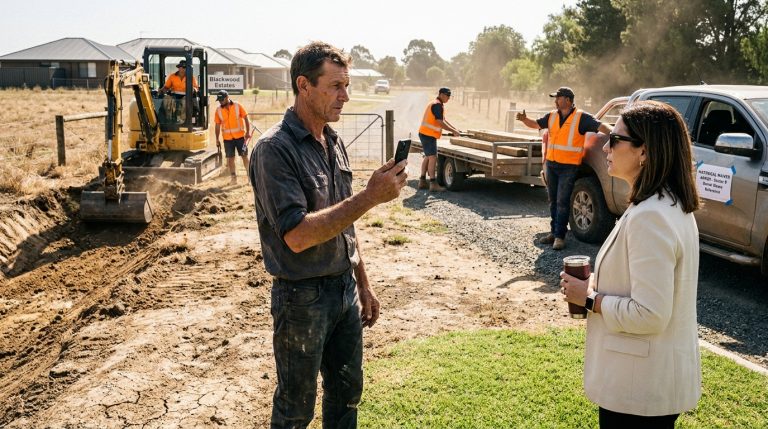
“Exactly,” Marcus said. He pulled a second sheet from the case—a corporate credit registry. “Petrov Built Commercial is bleeding eighty thousand dollars a month in interest on three heavy excavators they leased for a highway project that fell through. If they don’t dig somewhere, and dig deep, the leasing company repossesses the fleet by winter. The golf course contract is a sham to cover the mobilization of heavy equipment under a private municipal waiver.”
Jack leaned over the table, his knuckles pressing into the wood. The room felt smaller under the yellow glow of the light bulb. “They’re trying to use Ordinance 74B to run a commercial bypass line under the pasture. If they get the machinery on my side of the stone wall under the guise of an eminent domain appraisal, they can dig before the court even sets a hearing date.”
“They’re counting on the delay,” Marcus said. “By the time your lawyer gets a judge to look at the injunction, the excavation is already forty percent complete. The pasture is ruined, and they offer you a settlement because the land is no longer in its natural state.”
“A tactical fait accompli,” Jack muttered. He picked up his pencil again, his mind translating the financial pressure on the Petrovs into physical momentum. They were desperate, which meant they would move faster than the legal system. “They won’t wait for Tuesday.”
“No,” Marcus agreed. He reached into his pocket and pulled out a small black thumb drive, setting it on the table with a soft click. “I pulled the logs from the county planning office. Karen’s signature is on the pre-authorization forms for the grading permits. But there’s a second signature on the engineering waiver. Someone signed as an authorized representative of the state trust.”
Jack didn’t touch the drive. He kept his eyes on the layout, the cold weight of the strategic chess match settling in his chest. “We don’t show the easement yet. If we show it now, they pivot to a different line of approach. We let them bring the equipment to the boundary.”
Marcus nodded slowly, his eyes reflecting the sharp, hard shadows of the kitchen. “And if they cross the wall?”
“They won’t,” Jack said. “But we let them think they can.”
CHAPTER 4: THE SUBVERSION
The damp gravel of the county road crunched under Jack’s boots with a steady, military cadence. Marcus’s truck had already slipped into the dark, its taillights vanishing behind the bend of the ridge, leaving Jack alone under the skeletal branches of the oaks. To his right, the ancient stone wall ran parallel to his path, a silent, dark sentinel in the night. To his left, the sprawling lights of Whispering Pines cast a faint orange dome into the low clouds.
Jack adjusted the collar of his canvas coat against the rising draft of the valley. He wasn’t marching to a battlefield; he was moving toward an extraction point.
The García house sat at the extreme edge of the subdivision, its concrete driveway abutting Jack’s western fence. Unlike the neighboring faux-villas with their aggressive floodlights, Miguel’s home was modestly lit, a single warm porch lamp cutting through the mist. As Jack reached the threshold, the door swung inward before he could raise his fist to knock.
Miguel stood in the frame, his shoulders tense, a dish towel gripped tightly in his right hand. His face was pale beneath the porch light, his mouth compressed into a thin, straight line. Behind him, the low murmur of voices leaked into the cold air.
“Colonel,” Miguel said, his voice a low, tight rasp. He stepped aside, letting Jack cross the threshold into the small, carpeted entryway. “They’re here. Six families. All of them have the papers.”
Jack closed the door, the click of the latch echoing in the small hallway. He hung his hat on the wooden peg by the door. “Any contact from the board since this afternoon?”
“Just the certified letters,” Miguel said, turning to lead Jack toward the kitchen. “The ones warning us about ‘unauthorized gatherings.’ Karen’s patrol car—that golf cart of hers—has been circling the block twice every hour.”
The dining table in the García kitchen had been pushed against the wall to make room for a circle of mismatched folding chairs. Elena García was pouring coffee from a glass carafe, her movements deliberate, her face set in a hard mask of quiet anger. Around the table sat five other residents. Their postures were uniform: slumped shoulders, hands clasped tightly around mugs, eyes fixed on the scattered legal packets laid out on the wooden surface.
Jack did not sit. He walked to the edge of the circle, his tall frame drawing their eyes upward. The air in the room was thick with the scent of roasted garlic, cheap coffee, and the sharp, metallic tang of anxiety.
“Thank you for coming,” Jack said, his voice calm, dropping into the room like a heavy weight. “I’ve reviewed the packets you received.”
“They’re going to fine us five hundred dollars a week, Colonel,” said a retired woman sitting near the stove, her fingers nervously picking at the frayed hem of her cardigan. She pointed to a red-stamped paper. “They say my late husband’s memorial garden violates Section 4 of the aesthetic code. It’s been there five years.”
“They want you isolated,” Jack said, his gaze sweeping over the faces. “They want you looking at your own mailboxes, calculating your own losses, while they clear the pasture behind us. It’s a classic flanking maneuver. They create a secondary front to keep you from looking at the main line of advance.”
He reached into his pocket and pulled out the photocopy of the Section 12-A Mineral Ledger that Marcus had retrieved. He laid it flat on the center of the table, directly over an HOA fee sheet. The faded blue ink of the ledger’s seal stood out sharply against the modern, white printer paper.
Miguel leaned forward, his knuckles pressing into the tabletop. “What is this?”
“The original easement layout,” Jack said, his voice steady. “They’re using Ordinance 74B to justify an appraisal. But they aren’t looking at the grass. They’ve already pre-leased three excavators from a commercial supplier. They need to break ground within thirty days to keep their corporate credit from collapsing.”
Elena stopped pouring, the carafe hovering an inch above a mug. “So the golf course isn’t about progress at all. It’s a bailout.”
“It’s a liquidation plan,” Jack said. “They use your dues to pay the legal fees to sue me. If they get the pasture, they use the construction contract to pay off Stan Petrov’s equipment debt. If they fail, they leave the HOA’s accounts dry and walk away.”
The room fell completely silent. The hum of the refrigerator seemed to grow louder in the absence of speech. The residents looked from Jack to the ledger, the realization of the fraud settling over them like cold water.
“We don’t fight them on their terms,” Jack said, his hand resting on the back of Miguel’s chair. “We don’t file appeals with the board. We let them file their suit. But tomorrow, we document the accounts. Miguel, I need the names of everyone who has been fined under Section 4 this year. We build the file.”
Before Miguel could answer, a sudden, bright flash of light cut through the kitchen window, sweeping across the pine cabinets and washing the room in a cold, white glare. It was the high-beams of a vehicle turning slowly in the cul-de-sac outside, its engine idling with a low, modern purr.
CHAPTER 5: THE COLD FLANK
The backyard of the García property was a narrow wedge of unmanicured weeds bordered by a rusted chain-link fence. Jack slipped through the rear door, letting the latch click home with a silent, thumb-pressed release. The white glare of the golf cart’s headlights continued to wash over the front windows of the house, casting long, sharp silhouettes of the neighbors onto the dry grass of the side yard.
Jack stayed in the deep shadow of a mature walnut tree, his boots pressing into the wet leaves without a sound. He didn’t run. A hasty retreat was a signature of guilt, and he was currently conducting a deliberate reconnaissance of his own perimeter.
He crossed the property boundary at the gap in his dry-stacked stone wall. Here, the ground sloped downward toward the creek bed, where the run-in shed stood under a canopy of old sycamores. The cold air was heavy with the smell of wet limestone and the faint, sweet scent of sweetfeed from the barn.
As Jack reached the dark side of his tractor shed, his phone vibrated once against his ribs. He pulled the device from his inner pocket, keeping the screen shielded against his chest.
It was an encrypted message from Maria Flores.
ATTACHMENT: County_Registry_Scans_WP_09.pdf
NOTE: Check the signature line on the easement waiver filed yesterday. It didn’t come from our files.
Jack tapped the file. Under the harsh blue glow of the low-intensity screen, the document appeared as a scanned copy of a standard Land Trust waiver. It was a release of development restrictions, specifically citing the fifty-acre pasture. At the bottom of the page, the name Sarah Miller was written in a flowing, elegant hand.
Jack’s jaw tightened, the muscle along his temple twitching once.
He didn’t need a handwriting expert to tell him what he was looking at. The loops of the letters were too uniform, the ink density consistent across the entire signature. Sarah had signed every land document with a light, dragging stroke at the tail of the ‘h’—a physical habit from a childhood injury that had never quite healed. This signature was a sterile, perfect replication. A digital trace from an old DMV registration, lifted and printed onto the cream-colored bond paper.
But the real discrepancy lay in the tracking slip attached to the filing. The notary stamp belonged to an office registered to Petrov Built Commercial.
“They’re committing a federal felony to bypass the state registry,” Jack murmured, his voice absorbed by the cold mist rising from the creek.
He turned his head as a low, mechanical grinding sound echoed from the northern boundary. It wasn’t the hum of Karen’s golf cart. This was the deep, rhythmic thrum of a heavy-duty diesel engine—a wide-track excavator moving slowly along the public easement road just beyond the trees. The headlights of the machine were doused, but the amber marker lights on the cab cast a dull, dirty orange glow onto the trunks of the pines.
They weren’t waiting for the court to review the fraudulent waiver. They were moving the physical assets into position tonight, betting that a forged waiver in the county system would give them enough legal cover to break ground before his legal team could file a formal challenge.
Jack adjusted his grip on his phone, his thumb hovering over the dial key for Maria.
The strategy was evolving rapidly. The decoy secret—the forged waiver—was now active in the field. If he exposed it immediately, the developers would simply retreat behind their legal counsel, claiming a administrative error. He needed them to physically cross the stone line with the machinery. He needed the breach to be documented and absolute, turning their tactical gamble into a permanent legal trap.
He began his walk back toward the farmhouse, his footsteps tracing the dark margin where the pasture met the trees, his eyes fixed on the amber lights of the excavator as they crept closer to his boundary.
CHAPTER 6: THE ENVELOPE OF SHADOWS
The digital white of the phone screen faded as Jack slipped it back into his pocket. Under the canopy of the sycamores, the dark was absolute, save for the rhythmic, dull flash of the excavator’s amber clearance lights a hundred yards north. Each low-frequency pulse of the engine shook the loose silt beneath his feet. The machine was idling just outside his boundary, a massive iron shadow waiting for the order to breach.
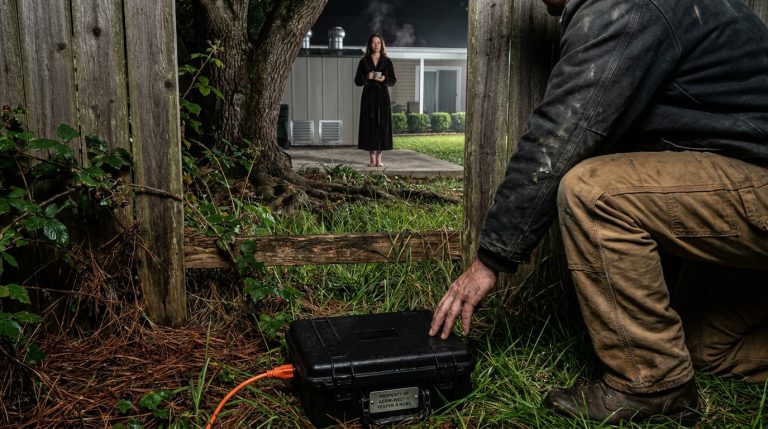
Jack did not return to the warmth of the farmhouse. Instead, he adjusted his path, his boots sinking into the wet clay of the creek bed as he marched directly toward the old wellhead—the Blackwood Borehole.
The wellhead was a vertical column of rusted structural iron, capped with a heavy, six-bolt flange that had oxidized to the color of dried blood. It had sat undisturbed in the weeds for over seventy years. Jack knelt beside it, his palms resting on the cold, pitted iron. The metal was freezing, drawing the heat straight out of his skin, but beneath the surface vibration of the excavator, he felt a deeper, much more subtle frequency. The earth itself seemed to be humming, a low-volume resonant pitch trapped inside the steel casing.
He pulled a small, brass-backed pocket flashlight from his lapel pocket. Rather than shining it broadly, he cupped his hand over the lens, allowing only a thin, surgical needle of light to spill between his fingers.
Near the base of the rusted column, where the iron met the concrete pad, something caught the light. A fresh, bright scratch had stripped away decades of orange rust, exposing a sliver of clean, silver steel beneath.
Someone had been here with a pipe wrench within the last twenty-four hours.
Jack leaned closer, his chest nearly touching the damp ground. Beside the scratch, tucked into the narrow crevice between the iron collar and the concrete foundation, was a small, plastic-wrapped document. It had been folded into a tight, dense square no larger than a matchbox.
His fingers, stiffened by the autumn chill, worked the plastic free. Under his cupped palm, he unfurled the wet paper.
It was a page torn from a ledger, the top marked with the heading: Section 12-A Mineral Ledger – Southern Tier. Below the heading was a hand-drawn map of his pasture, but the boundary lines were different. They didn’t end at the stone wall. The map showed a subterranean corridor—the Albright Charter corridor—stretching directly beneath his pasture and terminating at the borehole.
Written in red ink across the bottom of the ledger page was a single notation: Excavation restricted under federal charter. Sub-surface rights remain under the sovereign administration of the State Land Trust. No surface modifications permitted.
The decoy waiver Karen’s lawyers had filed was designed to strip away the conservation easement, but they didn’t know about the ledger. They didn’t know that even if they broke the surface agreement, the very dirt beneath their feet was anchored to a federal charter that made any excavation a non-negotiable violation of sovereign law.
The sound of a snapping dry branch broke the rhythm of the idling diesel.
Jack cut the light instantly, tucking the ledger page into his inner pocket. He didn’t move. He remained on one knee in the deep shadow of the wellhead, his breathing shallow and silent.
A figure emerged from the tree line fifty feet away. The silhouette was short, thick-shouldered, and dressed in a dark heavy coat that muffled the sound of their movement. They carried a long, yellow-handled tool—a surveyor’s grade stake driver.
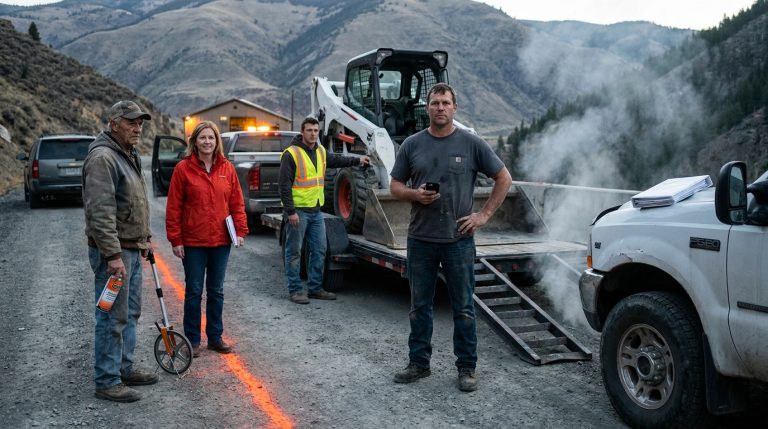
In the dim amber reflection of the distant excavator, Jack recognized the profile. It was Stan Petrov. He was moving with a frantic, jerky momentum, his boots slipping on the wet clay as he approached the dry-stacked stone wall. He lifted a wooden survey stake, its pointed end wrapped in reflective orange tape, and drove it hard into the earth on Jack’s side of the boundary line.
Jack watched the shadow work in the dark. The man was panting, his breath escaping in rapid white plumes. This wasn’t the behavior of a confident builder executing a legal easement; it was the frantic desperation of a man trying to physically establish a line before the sun rose and the lawyers intervened.
Jack let him finish. He let him drive three stakes into the virgin soil of his pasture. He didn’t shout, and he didn’t step forward. Every strike of the mallet was another documentable act of criminal trespass, another link in the chain that would bind the Petrovs to their own ruin.
Only when Stan turned and scrambled back through the brush toward the idling machine did Jack stand. He walked to the first stake, his fingers closing around the cold wood. With a single, vertical pull, he slid the stake from the wet ground. He didn’t break it. He simply carried it back to the barn, his mind already recalculating the layout of the Marriott ballroom.
CHAPTER 7: THE GALLOWS MANDATE
The brass handle of the ballroom double doors felt solid beneath Jack’s palm. He did not rush. Behind him, the corridor was a sterile expanse of patterned carpet and polished brass, but through the gap in the wood, the dense atmosphere of the meeting leaked out in hot, low-frequency waves. He adjusted his grip on the heavy leather folder tucked under his left arm. Inside lay the original pages of the Albright Charter, the Section 12-A Mineral Ledger, and the certified forensic analysis of the forged easement waiver.
Beside him, Maria Flores smoothed the lapel of her charcoal suit jacket. Her expression was neutral, her breathing even—the disciplined quiet of a trial lawyer about to step into an open courtroom.
“The board’s attorney just walked in,” Maria said, her voice barely louder than a whisper. “He’s carrying three copies of the summary judgment motion. They think they’re filing a default because we didn’t submit a rebuttal to the forged waiver.”
“Let them present their case,” Jack replied, his hand resting on the brass plate of the door. “They need to put their signatures on the record before we introduce the ledger. A forgery is only useful to the defense if the prosecutor officially enters it into evidence.”
He pushed the door open.
The glare of the chandeliers was blinding after the dark pastures of the valley. Over two hundred chairs were filled, a sea of pastel polo shirts, gold watches, and the murmuring, low-level anxiety of a suburban neighborhood turning on itself. At the front of the room, behind a long banquet table draped in white linen, sat the three members of the Whispering Pines executive board.
Karen Petrov sat in the center. Her pink tracksuit had been replaced by a stiff, dark blazer, but her face was flushed, her fingers tapping a frantic rhythm against the polished laminate of the head table. To her right, Stan Petrov stood near the projection screen, his shoulders hunched, his hands buried deep in the pockets of his coat. He looked exhausted, his eyes darting toward the back entrance as Jack and Maria entered.
“The meeting will come to order,” Karen’s voice boomed through the low-grade public address system, the microphone squealing slightly with high-frequency feedback. “We are here to vote on the formal ratification of the acquisition of Parcel 14-B. This board has executed due diligence, and we have received the signed release of the conservation easement from the county recorder’s office.”
A slide flashed on the screen behind her. It was the scanned document Jack had viewed on his phone—the waiver bearing the elegant, forged signature of Sarah Miller.
“The law is clear,” the slick attorney from Wittman, Price, and Holloway spoke from the side podium, his voice dripping with condescending reassurance. “The easement restrictions have been legally dissolved by the property owner’s representative. The Whispering Pines Association is now authorized to proceed with the excavation under Ordinance 74B to facilitate the necessary subsurface drainage lines.”
“That signature is a lie,” Miguel García’s voice cut through the room from the third row. He stood, his chest out, a printed copy of the waiver gripped in his fist. “We checked the notary stamp. The notary of record is registered to Petrov Built Commercial. This isn’t community progress—this is fraud.”
“Mr. García, you are out of order,” Karen snapped, her mallet striking the wooden block with a sharp, dry crack that rattled the microphone. “Any further outbursts will result in your removal by hotel security. The legal document has been recorded. It is a matter of public record. The vote will proceed.”
Jack walked down the center aisle. His boots made no sound on the thick carpet, but his tall, broad-shouldered frame drew the room’s attention like a heavy weight shifting in a narrow boat. The murmurs died away, replaced by a dense, expectant silence that stretched from the front rows to the exit doors.
He did not stop at the guest seating. He walked straight to the small microphone stand set up for public comment at the base of the stage.
“The document on your screen is indeed a matter of public record, Karen,” Jack said. His voice was quiet, but it carried to the back corners of the ballroom with the flat, unshakeable authority of a commander delivering a final briefing. “Which means the forgery is now a matter of state record as well.”
“Colonel Miller,” the slick attorney said, stepping between Jack and the head table. “This is a closed board action. If you have a legal challenge, your counsel can file it in county court next month. Currently, we have a valid waiver.”
“You have a piece of paper,” Jack said, his hand opening the leather folder on the podium. He pulled out the original parchment of the Albright Charter, its edges frayed and darkened by a century of storage. “But you don’t have the mineral rights.”
He turned the page, exposing the Section 12-A Mineral Ledger map. The red ink of the original survey lines glowed under the hot stage lights.
“This pasture sits on the Blackwood Borehole corridor,” Jack continued, his gaze shifting from the attorney directly to Karen’s pale face. “In 1952, the state land trust chartered the sub-surface mineral rights to the sovereign administration of the state. Under Section 12-A, no surface excavation of any kind is permitted within five hundred yards of the borehole. The conservation easement you tried to forge your way around was only the top layer of defense.”
He stepped closer to the head table, his shadow falling across Karen’s hands.
“Your husband drove three survey stakes onto my land last night,” Jack said, his voice dropping into a low, vibratory rasp that made the board members flinch. “He was attempting to establish a physical easement before we could present this ledger. But the moment his heavy machinery idle-tested on the north boundary, he violated a federal preservation charter. Maria.”
Maria Flores stepped forward, placing a thick stack of blue-bound legal briefs directly onto the white tablecloth in front of the board’s attorney.
“A motion for summary judgment has been filed with the state supreme court,” Maria said, her voice sharp and level. “We have also submitted the forensic ink analysis of the waiver to the state attorney general’s commercial fraud division. The notary license for Petrov Built Commercial has been suspended as of four o’clock this afternoon.”
Karen’s hand froze over her mallet. She looked down at the blue folders, then at her husband, whose face had gone a dull, hollow gray. The silence in the ballroom was absolute, a dead zone of sudden, catastrophic realization.
“This meeting is adjourned,” Jack said.
CHAPTER 8: THE SECURED SANCTUARY
The heavy glass doors of the hotel lobby hissed shut, cutting off the frantic, high-pitched shouting of the homeowners and the dry static of the public address system. The night air was instantly clean, carrying a sharp autumn frost that bit at Jack’s collar. He didn’t look back at the warm windows of the Marriott. His eyes stayed fixed on the gravel road ahead, his boots striking the pavement with a slow, rhythmic cadence. Behind him, Maria Flores was already heading toward her sedan, her legal bag slung over her shoulder, her profile silhouetted against the streetlamps.
“The state attorney general’s representative confirmed receipt of the files,” Maria said, pausing at her car door. Her voice was level, completely drained of the theatrical tension of the courtroom. “They’re dispatching a commercial fraud team to Petrov Built Commercial at nine tomorrow. Karen and Stan won’t be able to lock their offices before the warrants arrive.”
“The ledger was the key,” Jack said. He stopped under the pale light of a mercury-vapor lamp, his hand resting on the cold fender of his truck. “They were looking at the surface. They didn’t calculate the depth.”
“They never do,” she replied with a brief, tired nod. “Get some sleep, Jack. The valley is yours again.”
He climbed into the cab of his truck, the worn vinyl seat cold against his thighs. The engine roared to life with a low, mechanical growl, and he backed out of the space, turning the nose of the vehicle toward the dark ridge of the northern pasture.
The journey back was a transition of absolute silence. As the luxury homes of Whispering Pines fell away, replaced by the ragged edge of the old timber, the air grew thick with the smell of wet limestone and damp clay. Jack turned the truck into his gravel driveway. The high-beams swept across the dry-stacked stone wall, illuminating the dark, mossy crevices where the ancient granite blocks had settled over two centuries.
He cut the engine. The quiet that rushed into the cab was immense, broken only by the lazy flick of a horse’s tail near the run-in shed.
Jack got out, his boots crunching on the gravel. He walked to the center of the yard, his hand slipping into his pocket to touch the small, brass-backed flashlight. He didn’t turn it on. He didn’t need to. In the pale glow of the rising moon, the pasture lay before him like a vast, dark canvas of silver and shadow. Samson and Delilah stood near the creek bed, their silhouettes still and secure against the dark line of the sycamores.
He walked toward the old barn. The wooden door, dry and grayed by decades of rain, hung slightly crooked on its iron strap-hinges. He stepped inside, the interior smelling of sweet clover hay and old leather.
On the workbench sat the first wooden survey stake Stan Petrov had driven into the pasture. It was still wrapped in its reflective orange tape, a bright, modern scar on the aged pine of the table. Jack picked up his old drawknife, the double-handled iron blade cold and heavy in his hands. He secured the stake in the heavy wooden vise of the bench.
With slow, deliberate strokes, he began to shave the orange plastic tape off the wood. The steel blade sliced through the synthetic material with a dry, rhythmic curl, exposing the clean, pale white pine beneath. He worked in silence, his shoulders moving with a steady, military precision, letting the curls of orange plastic fall into the dirt floor.
He was repairing the boundary. Not with force, but with the quiet, permanent labor of preservation.
Once the stake was stripped clean of its false markings, he carried it out to the stone wall. He found the shallow, narrow indentation where Stan had forced it into the earth. Jack knelt, his knees pressing into the damp clover, and pressed the clean wood back into the soil, securing it with three heavy, flat stones he gathered from the base of the wall.
“It’s done, Sarah,” he whispered into the crisp night air.
The wind rustled through the dry oak leaves above, a low, sighing breath that swept over the hills and died away in the valley.
He stood and walked back to the farmhouse porch. He poured two fingers of rye whiskey into a heavy, square-bottomed glass, the amber liquid catching the silver moonlight. He sat in the old wicker chair, his fingers resting on the dry wood of the armrest, and looked out over the fifty acres of rolling green. The shadows of the trees were long and still. The air was cold, but the earth beneath was solid, anchored deep by the ancient laws of the land and a promise kept in perpetuity.
The perimeter was secure.