The Weight of the Fence Line: A Story of Rusted Truth and Property Lines
CHAPTER 1: THE ORANGE TAG
The bright orange card did not belong on the high-tensile wire, its cheap plastic edges fluttering against the rusted iron staple like an invasive bird. I left the diesel idling in the gravel lane, the low vibration thrumming through the soles of my boots as I stepped down into the dust. The air smelled of wild onion and dry clay, the afternoon heat settling heavy over the creek burm. I didn’t touch the paper yet. After twenty-two years of pulling facts out of bad wreckage for the county, you learn that the first thing people leave behind isn’t their guilt—it’s their signature.
The zip-tie holding the notice to the fence was a neon blue, clean and unweathered by the valley sun. It didn’t match the oxidized gray of the three-point barbed wire I’d tightened myself the month before. The laminated sheet carried a bold heading: Notice of Immediate Corridor Inspection. Below it, the text referenced Blackwood Estates Covenant Book 4.
I pulled my phone out, framing the shot. Wide view first—showing the gravel lane, the clear gap between my stand of oaks and the subdivision’s manicured grass line three hundred yards east, then the close-up on the text. The camera lens caught the timestamp: 14:12.
“Mr. Walker,” a voice called from across the ditch.
The white SUV had killed its engine quietly. Pamela Wexler stepped out onto the gravel, her cream blazer pristine despite the dust kicking up from the main road. Her sunglasses stayed on, two dark ovals reflecting the wire fence line between us. She carried a thin leather portfolio under one arm like a shield.
“I see you found our advisory,” she said, her smile tight, small, and perfectly measured for public consumption. She didn’t offer a hand this time; she simply walked the line of the grass until she was standing exactly where the subdivision setback met my gravel. “We’re just doing the preliminary routing for the seasonal maintenance access. It’s a standard safety measure for the creek line.”
“Covenant Book 4 doesn’t cover this side of the ditch, Pamela,” I said. My phone remained in my left hand, the thumb resting against the audio record toggle inside my pocket.
“The easement has always been functional, Mr. Walker. The residents have used this lane during the spring floods since ninety-eight,” she replied, her tone dropping into that smooth, practiced rhythm people use when they want you to believe their convenience is the law. “The paperwork is simply catching up to the physical reality of the community’s needs.”
Beyond her shoulder, down the paved curve of Blackwood Estates, I could see a flatbed trailer stacked high with cut stone blocks, completely blocking the designated fire lane near their decorative iron gate arm. The irony was heavy, thick as the dust on my bumper.
“My deed doesn’t list a functional easement,” I said, my voice flat, level. “And the county line says the boundary is four feet past this post.”
“We’ll let the administrative review sort that out,” she said, turning back toward her vehicle with a brief, dismissive nod. “Just make sure the gate remains unlocked for the survey team tomorrow.”
She didn’t wait for an answer. The door of the SUV clicked shut with a muffled, expensive thud. I watched the white truck back out onto the blacktop, leaving nothing but a lingering scent of air freshener and the slow rattle of gravel settling back into the ruts. I walked back to my truck, my hand sinking into my pocket, my fingers brushing against the cold, pitted surface of the old brass padlock sitting in the tray. The sequence had already begun.
CHAPTER 2: THE SOFT STRIKE
The old brass padlock in the console tray gave a short, metallic rattle as I shifted the truck back into reverse. Its polished surface was scarred from years of hitting utility boxes, a solid weight that didn’t move easily unless forced. I backed down the lane, keeping my eyes on the rearview mirror where the dust from Pamela’s white SUV was still settling over the chicory weeds. She had left her paper warning behind, but the real weight wasn’t on the wire fence anymore. It was sitting in my shirt pocket, the steady heat of the phone recording her own admission that the paperwork hadn’t caught up with her ambition.
By the time I reached the house, the afternoon heat had turned thick and sticky. I didn’t drop the tailgate. I went straight up the steps, the gravel crunching under my work boots like dry bone. Inside, the kitchen was quiet, smelling faintly of the pine cleaner my wife had used on the counters before she took the kids into town. I cleared a space on the oak table, pulling the phone out first to upload the audio file to the secure county drive I still maintained for backup.
Three days later, the postman didn’t leave the mail in the box by the road. He drove up the lane, the government-issued Jeep creaking as it stopped outside the porch. He held a thick, cardboard-backed envelope that required a signature.
“Official business, Walker,” he said, handing over the electronic pad.
I signed without a word, watching him back down the gravel before I broke the seal on the expensive cream paper inside. The return address was embossed in a raised, silver foil: Law Offices of Aris & Vance, Representatives for the Blackwood Estates Board of Directors.
Inside was a thirty-page compliance packet. The language was clean, heavy with administrative weight, and designed to look like a court order from thirty yards away. It stated that my rear fence line obstructed a designated emergency egress corridor and that voluntary removal of the barrier within ten business days would mitigate formal statutory enforcement.
The centerpiece of the packet was a cropped plat map labeled Exhibit A: Blackwood Covenants Book 4. The image was sharp, but the crop was where the lie lived. The edge of my parcel had been cleanly clipped off, leaving just enough white space around the subdivision boundary to make their claimed access lane look like it naturally extended across my ditch. It was standard leverage strategy: flood the target with formal process language, simulate immediate legal authority, and hope the recipient confuses a lawyer’s letterhead with a judge’s signature.
I didn’t call their office. I turned on the old flatbed scanner in the study, the machine letting out a mechanical whine as the green light moved beneath the glass. I saved every page into a master file labeled 2026_Property_Dispute, then picked up the phone and called the county recorder’s office.
“Registry, this is Martha,” the voice came through, thick with thirty years of county tenure.
“Martha, it’s Walker. I need the full vesting file for the old Miller parcel, the one outside the Blackwood eastern line. Send the complete exclusion map and the original deed maps from the ninety-eight subdivision filing.”
“Give me twenty minutes, Walker. The old ninety-eight files are still on the local archive server.”
The machine on my desk hummed, warm air blowing from the back vent as the pages printed out side-by-side. When the county files arrived in my inbox, I laid them out on the kitchen table under the bright overhead light. On the left was the HOA’s cropped version; on the right was the certified county plat.
I drew a thick circle with a red ink pen around the actual survey markers. The clean map showed the Blackwood Estates boundary stopping exactly four feet short of my ditch, bounded by a historical county document labeled the Sector 9 Denial Memo. The HOA layout had deliberately omitted that reference number entirely. They were trying to manufacture a record by erasing the pieces that didn’t fit.
I leaned back, my fingers tracing the frayed edge of the county document. The paper was cold, solid, and completely legal. Pamela hadn’t just made a mistake on the fence line; she was trying to execute a pre-planned expansion using a document that had already been dead for a decade. I gathered the two maps, placing them into a clean manila folder next to my truck keys. They wanted a paper war, and I was going to give them the sequence.
CHAPTER 3: THE BROKEN CHAIN
The paper felt stiff under my palm, the embossed seal of the old county registry providing a solid anchor in the quiet room. Then the kitchen wall phone broke the silence, its harsh electronic bell vibrating against the wood paneling. I didn’t rush. I picked up the receiver on the third ring, my thumb still pressing the corner of the certified exclusion map.
“Walker,” a voice barked over the line—it was Miller from the neighboring orchard parcel down the road. “You’ve got heavy equipment at your east gate arm. Three flatbeds and an excavator. They aren’t waiting on the county.”
The receiver clicked back onto its cradle. I didn’t stop to change out of my work shirt. I grabbed the manila folder, shoved it into the glove box of the truck, and had the engine running within forty seconds. The truck tires threw dry stones against the undercarriage as I traveled down the long access lane. The heat of the day had peak-crested, baking the dirt road into a hard, white crust that cracked under the weight of the truck.
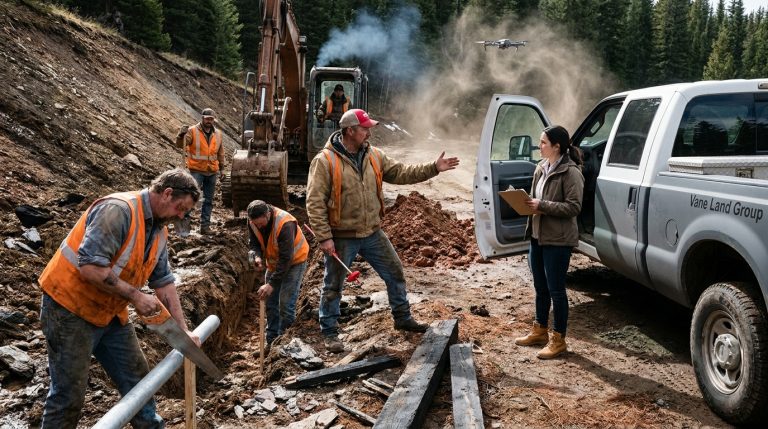
When I rounded the final stand of oaks, the physical reality met me. A yellow compact excavator sat idling right on the ditch bank, its steel tracks throwing up clods of dark, wet sod. A flatbed trailer sat angled across the gravel lane, completely blocking my entry point. Two workers in orange high-visibility vests stood near the hinges of my farm gate, one holding a pair of heavy long-handled bolt cutters, while a third worker unloaded short, pressure-treated timber posts from the truck bed.
Ten feet back, standing on the manicured grass of the subdivision, was Pamela. She held an insulated travel mug in one hand and her phone in the other, her posture perfectly stiff beneath the afternoon sun.
I cut the diesel, the sudden absence of the engine’s thrum making the metallic clatter of the excavator sound twice as loud. I stepped out, my boots hitting the dirt with a firm, rhythmic stride. I pulled my phone from my front pocket, activating the video feed as I neared the boundary line. The camera captured the excavator bucket as it swiveled, its rusted iron teeth hovering inches above the survey stakes I had driven into the creek burm.
“Stop right there,” I said, keeping my voice low, clear, and projected enough to register on every microphone within thirty feet.
The man with the bolt cutters hesitated, his grip loosening on the handles. He looked past me toward the white truck, then back at Pamela. She gave him a short, forward jerk of her head.
Snap.
The tempered steel jaws bit through the padlocked chain, the links dropping into the dust with a dull clink.
“We’re installing the designated safety posts under the authority of the Blackwood Estates Board,” the foreman said, his chest expanding as he tried to fill the space between the gate posts. He pointed a gloved hand toward a sheet of paper taped to his truck door. “We’ve got a filed emergency easement waiver.”
I walked parallel to the wire line, never crossing into their workspace, never touching a single tool. The camera lens recorded the detail: the rental logos on the excavator’s chassis, the license plates of the flatbed, the exact spot where the track pulled up the grass markers. Then I leaned slightly over the fence line, my eyes catching the document taped to the truck. It wasn’t a standard permit. The header read Historical Waiver Annex, but stamped at the very bottom in faint ink was a code: Sector 9 Denial Memo Reference.
They had brought the dead file right to my gate, dressing it up as active authority. It was the decoy secret—the document they thought would settle the argument before anyone checked the metadata.
“This is private property,” I said, my phone tracking Pamela as she finally took three steps forward, her leather shoes crunching onto the edge of my gravel. “You’ve crossed a marked boundary line without a county engineering permit.”
“This is routine enforcement work, Mr. Walker,” she said, her voice dripping with administrative calm, though her thumb began to tap rhythmically against the side of her travel mug. “The emergency easement allows for immediate site stabilization. The paperwork is filed.”
“The county clerk says otherwise,” I replied, my voice unhurried. I tapped the screen to ensure the video log caught the precise moment the excavator’s bucket took its first bite out of the sod bank, dropping the wet clay directly onto the lane. “Every foot of this is recorded. The trespass, the destruction of the burm, and the specific names on the authorization.”
I dialed the sheriff’s dispatch number right in front of them, keeping the line on speaker. “This is former Deputy Walker. I need an incident number for an active property trespass and unauthorized commercial excavation at the eastern boundary of the old Miller tract. Document the names: Pamela Wexler, Blackwood Board.”
The foreman stopped his crew, his arms dropping to his sides as the dispatch operator’s voice crackled clearly over the phone. Pamela’s small smile didn’t vanish, but her jaw tightened, a small muscle jumping along her cheekbone as she realized the sequence wasn’t stopping. She turned back toward her vehicle, but the camera had already caught the broken chain hanging from the iron latch. The conflict had moved past letters. It was now down in the dirt, and the clock was ticking.
CHAPTER 4: THE HALLWAY CONFRONTATION
The sound of the excavator engine died down as the sheriff’s cruiser finally crunched onto the gravel access lane, the red and blue lights throwing long, rhythmic strobes across the broken fence line. The foreman immediately ordered his crew back to the flatbed, their boots kicking up dry dust as they abandoned their half-placed timber posts. Pamela stood perfectly still next to her white SUV, her face frozen into a tight mask as the deputy began taking statements. The physical lines had been drawn in the dirt, but the true reckoning had already shifted down to the county government building.
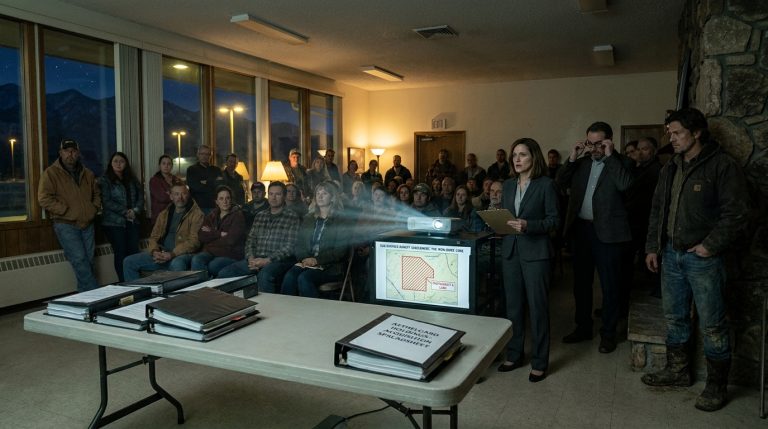
By the following Friday, the dispute moved from the open sky to the basement levels of the municipal annex. The hearing room was narrow, smelling heavily of floor wax and old ledger ink, illuminated by the hum of ancient fluorescent tubes.
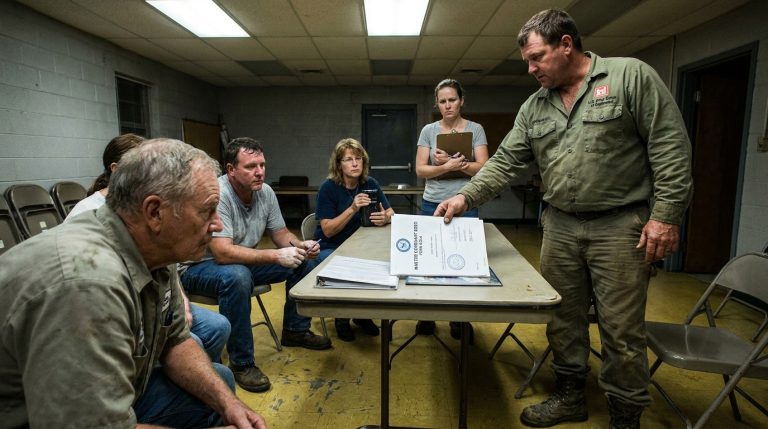
Pamela sat at the front table, surrounded by two board members, her retained attorney, and the community enforcement supervisor who kept clicking a cheap ballpoint pen in a rhythmic, irritating sequence. In the back row sat ten residents from Blackwood Estates, their whispers filling the small space like dry leaves scraping across a driveway. They hadn’t come to support her; they had come to see if the legal structure she used to police their lawns would finally collapse inward on her own head.
“We are here to address the emergency injunctive relief filed by the property owner,” the hearing officer said, adjusting his glasses as he looked over the initial filings.
Pamela’s attorney stood up first, smoothing the front of his dark suit jacket. His voice carried the slick, unhurried cadence of a man paid by the hour to make an overreach sound like a public service. He laid out a laminated copy of Blackwood Covenants Book 4, pointing directly to a clause regarding public safety egress.
“Our actions were completely justified under the emergency provisions,” the lawyer stated, his eyes scanning the bench. “We possess a signed, historic emergency-use waiver authorized by the prior owner of the Walker parcel. This document explicitly grants the community the right to clear and maintain the creek corridor to prevent structural threats to the larger development.”
He laid the paper down with a deliberate flourish, glancing back at the residents as if the case had already concluded. It was the decoy secret they had relied on from the beginning—the paper shield meant to blur the property line just long enough to establish their physical footprint.
My lawyer didn’t raise his voice. He stood up slowly, opening a heavy manila folder that contained the certified records we had pulled from the archives.
“The document referenced by the board is not an active easement,” my lawyer said, his voice flat and cutting through the room’s humidity. “It is a draft proposal associated with the Sector 9 Denial Memo from over a decade ago. A proposal that was formally rejected by the county engineering office because the subdivision boundary stops precisely four feet short of the creek bank.”
He clicked a remote, and the projector screen on the wall flared to life. The original, uncropped county plat map filled the wall, the red survey marks glowing brightly against the desaturated blue lines of the development plan.
“Furthermore,” my lawyer continued, his finger tapping the table, “our formal records request has finally yielded the internal communications from the HOA server. We have successfully retrieved the raw files, including the specific electronic correspondence sent forty-eight hours prior to the excavation.”
On the screen, an email header appeared, listing Pamela’s personal address and the board’s private listserv. Attached to the bottom was a document labeled Metadata Attachment 12-B.
The room went completely quiet, the only sound being the rhythmic clicking of the supervisor’s pen, which stopped instantly as the text appeared on the wall. The internal notes left by the contractor were still embedded in the digital margins: Install posts before county pushback. Use safety language. President approved entry even if owner objects. Sheriff title rumor not confirmed.
Beneath it was Pamela’s own reply: Once the lane is cut, he’ll have to negotiate from the back foot.
I watched her face drop. The confident, measured posture she had maintained since stepping onto my gravel vanished all at once. Her shoulders slumped forward by an inch, her eyes locked onto the glowing letters of Metadata Attachment 12-B as the board member sitting next to her quietly shifted his chair two inches to the left, completely breaking their united front. The hearing officer leaned forward, his expression cooling down into a hard, professional glare. The decoy had cracked wide open, and the absolute reality of their premeditated fraud was laid bare under the fluorescent lights.
CHAPTER 5: THE RUSTED TRUTH
The projected text of Metadata Attachment 12-B burned into the white wall of the hearing room, casting its pale light across Pamela’s face. She didn’t speak. Her lips thinned into a white line, her hand tightening around the leather portfolio until the seams groaned.
“This panel has seen enough,” the hearing officer said, his knuckles rapping twice against the laminate bench. The sound cut through the low murmurs of the gallery like a gavel. He looked directly at Pamela’s attorney, whose briefcase remained open, completely useless against the electronic sequence on the screen. “The emergency designation is denied. The county will issue a permanent injunction against the Blackwood Estates Board, effective immediately.”
Pamela bolted to her feet, her chair scraping sharply against the floorboards. “This leaves the subdivision vulnerable,” she asserted, her voice catching on a dry breath, the mask finally slipping to reveal the raw desperation underneath. “If the creek line floods—”
“If the creek line floods, the county handles it through authorized engineering channels, not through backdated board votes and midnight trespass,” the officer cut her off, his pen slicing down onto the formal ledger sheet. “Every notice issued under the guise of Blackwood Covenants Book 4 is hereby vacated. The board will cover the full costs of property restoration, legal fees, and administrative fines. Furthermore, this panel is referring the construction firm to the state licensing board for executing a project with an explicitly documented awareness of its illegality.”
The corporate enforcement supervisor stood up quietly, sliding his notepad into his pocket and walking toward the rear exit without looking back. Pamela remained frozen for three seconds, a cornered actor whose stage had just been dismantled around her, before she gathered her papers with trembling fingers and marched toward the door.
I didn’t follow her immediately. I waited until the room cleared, the heavy silence of the municipal basement settling back into the corners. Outside the annex building, the heat of the afternoon was beginning to break, long shadows stretching across the concrete parking lot. Two county deputies handling courthouse security walked past the columns, their badges catching the low glint of the sun. They nodded to me as I came out the glass doors.
Pamela was standing by her white SUV, her lawyer speaking in hushed, urgent tones near her window. As I walked down the path, her compliance man muttered, “This never had to become law enforcement.”
I stopped at the edge of the grass, reached into my pocket, and pulled out the gold-and-enamel star I’d carried for more than two decades. I didn’t flash it high or make a scene; I simply held it low where only their side could see the polished weight of it.
“No,” I said, my voice quiet, carrying the flat finality of a settled boundary line. “It became law enforcement when you tried to fake it.”
Her lawyer pulled her arm gently, guiding her inside the vehicle. The door shut, and the truck backed out into the street, disappearing into the valley traffic without a single rehearsed line left to offer.
A month later, the valley had dried out completely. The heat was still present, but the air carried the clean scent of cured hay and river stones. The yellow excavator was gone, its iron tracks replaced by the steady growth of fresh sod along the creek bank. The HOA’s timber posts had been pulled from the dirt, leaving only clean holes that I had filled and packed down with my own shovel.
I stood by the gate lane, the afternoon sun hitting the rusted iron frame of the old farm entrance. The broken chain had been cleared away. In its place hung a heavy, triple-linked steel line, secured by the old brass padlock I had carried in my truck tray for months. The brass was scarred, pitted from years of actual use, but as I turned the key and snapped the shackle shut, the mechanism clicked with a deep, satisfying resonance. It was a physical sound—the lock binding into the metal, solid and unyielding.
My wife walked down from the porch, carrying two cold jars of water, her bare feet kicking up small puffs of dust from the gravel. Behind her, the kids were down by the water’s edge, their laughter echoing off the limestone bluffs as they skipped flat stones across the shallow currents.
I took the jar from her, the glass cool against my calloused palm. We didn’t give a victory speech. We didn’t need a summary. I looked out over the stand of thick oaks, the lane empty and quiet under the wide valley sky. The line was exactly where it belonged, the dirt was exactly where it had been placed, and the land finally looked like my land again.