The Weight of Iron: A Marksman’s Legacy Against the Forged Prejudices of a Modern Military Machine
CHAPTER 1: THE GHOST IN THE STEEL
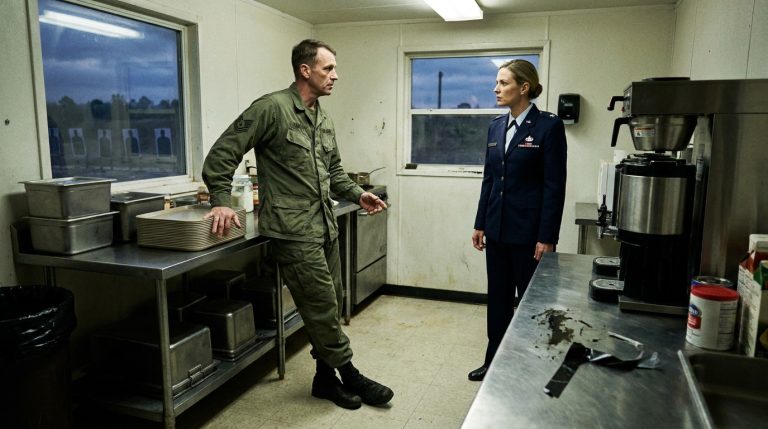
The barracks smelled of stale sweat and high-grade solvent, a combination that usually grounded Sergeant Elias Thorne. Today, it only sharpened the sting of the silence.
The Colonel’s finger, blunt and calloused, jabbed at the rifle stock, tapping against the worn, dark walnut like a judge rapping a gavel. “You’re carrying a museum piece, Sergeant. Are we preparing for a tour, or are you hoping to bore the enemy to death with nostalgia?”
The other operators lounged on their bunks, the predictable grins plastered on their faces. They saw a relic. They saw a woman clinging to a dead man’s tool. They saw a liability.
Elias didn’t blink. She felt the M24’s weight against her shoulder—the balance was perfect, the wood warm where her palm rested. She didn’t look at the Colonel’s face; she looked at the way his shoulder dipped, a tell-tale sign of a man who hadn’t shouldered a rifle in years. She noticed the slight tension in his jaw, not from the humor of the moment, but from a flicker of recognition he couldn’t quite contain.
“It still hits, sir,” she said. Her voice was flat, devoid of the defensive edge he was fishing for.
She reached out, her movements deliberate and slow, and pulled the rifle back into her own space. As her thumb brushed the bolt assembly, she felt it: a minute, jagged imperfection near the lug. It was a hairline scratch that shouldn’t have been there, a tiny, metallic burr that screamed of deliberate tampering. Her pulse didn’t quicken, but her world narrowed down to the size of that scratch. Someone had been inside her gear.
The Colonel’s grin faltered, his eyes darting to her hands. For a fraction of a heartbeat, the air in the room grew heavy, the static of suppressed history filling the space between them. He leaned in, his voice dropping to a low, serrated whisper that only she could catch.
“Everything has a shelf life, Sergeant. Even legacies.”
He turned on his heel, signaling the end of the spectacle, but Elias wasn’t watching him walk away. She was looking at the small, dark smudge of oil on his cuff—the exact same color as the lubricant she used on the firing pin, a specific, high-viscosity brand that hadn’t been issued to the unit in five years.
The realization hit her with the cold clarity of winter air: the sabotage wasn’t about the weapon. It was about the hand that had held it last.
CHAPTER 2: THE ANATOMY OF A LURKING BETRAYAL
The barracks had emptied, the sound of heavy boots retreating down the concrete hallway and the distant slamming of the armory door leaving behind a suffocating stillness. Elias stood frozen by her bunk, the M24 cradled in her arms as if it were a wounded animal. The oil on the Colonel’s cuff had been a singular, damning detail—a vintage, sulfur-heavy blend that hadn’t seen standard issue since her father’s unit was scrubbed from the rolls.
She didn’t move toward the door. To leave now would be to acknowledge the Colonel’s gaze, to play the role of the rattled rookie he expected. Instead, she sat on the edge of her cot, the metal frame groaning under her shifting weight. She placed the rifle across her knees and clicked the safety on, the sound unnervingly loud in the hollow space.
Her hands, usually steady as stone, betrayed a microscopic tremor as she reached into her kit for a microfiber cloth and a vial of universal solvent. As she began to break down the bolt assembly, the familiar, biting scent of the cleaning chemicals clawed at her memory. It was the smell of her father’s workbench—the smell of integrity, of long, grueling nights spent smoothing out the friction in a mechanism until it moved like liquid.
The phantom of his voice drifted through her mind, a low murmur of advice: “If they want you gone, Elias, they won’t come for you. They’ll come for your tools. A soldier without a reliable weapon is just a target waiting for a reason to break.”
She pulled the bolt free, the steel cold against her fingertips. She held it up to the dim, amber glow of the wall-mounted light. There, caught in the grooves of the lug, was the tiny, intentional burr she had felt earlier. It was a masterpiece of subtle sabotage. It wouldn’t cause a catastrophic explosion—that would be too easy to trace. No, this was a precision-engineered frustration. Under the pressure of a live-fire exercise, the friction would build, the casing would snag, and her shot would drift just enough to miss the target. It was a death sentence for her reputation, a quiet, professional assassination of her career.
She took a fine-grit honing stone from her pocket. She didn’t rush. Rushing was what the Colonel wanted; rushing led to mistakes, and mistakes were the cracks he was waiting to exploit. She worked the steel with agonizing slowness, the rhythmic shhh-shhh of stone against metal acting as a metronome for her thoughts.
Every stroke of the stone felt like a conversation with the past. The Colonel was trying to erase the legacy of a man he feared, using the very methods that man had taught her. It was a cruel irony, a circular trap of his own design. She traced the initials carved into the stock—the same ones he had stared at with such volatile resentment. They weren’t just a mark of ownership; they were a tether to the truth of what happened to her father, a truth the Colonel was clearly desperate to keep buried in the rust of history.
As the burr began to smooth, the metal surface reclaiming its seamless integrity, she heard a muffled, rhythmic thudding from the hallway. Footsteps. Too heavy to be a fellow operator, too deliberate to be a passerby. She slid the bolt back into the housing with a soft, confident click, the sound resonating through the room like a closing door.
She wasn’t just a sergeant defending her gear anymore. She was a ghost hunter, and the Colonel had just given her the first piece of the map. She carefully stowed her kit and stood, her posture fluid, her mind already calculating the distances, the angles, and the tactical blind spots of the building.
She turned toward the barracks door, her shadow stretching long and jagged against the peeling grey paint of the wall. The game hadn’t just begun; it had shifted from the field to the architecture of the barracks themselves. She didn’t need to confront him yet. She needed to know who else had access to the armory and why they were willing to risk their own reputations to help a man like the Colonel dismantle a legacy.
She stepped out into the hallway, the cool air hitting her face like a slap. The corridor was empty, save for the flickering fluorescent light that hummed a low, discordant note. She followed the scent of the oil, faint but unmistakable, leading not toward the Colonel’s office, but deeper into the belly of the facility—toward the restricted records room.
CHAPTER 3: THE FRICTION OF THE ARCHIVE
The corridor was a vein of oxidized steel and concrete, stretching ahead with a symmetry that felt almost predatory. Elias moved with a deliberate, low-profile gait, her boots making no sound against the damp floor. The scent of the sulfur-heavy oil was stronger here, clinging to the air like a stain. It led her toward the heavy, reinforced door of the records room—a place where the past was filed away in cabinets of rusted iron, far from the polished, modern facade the Colonel maintained in the barracks.
As she reached out to test the door handle, the overhead light gave a violent, spasmodic jolt. The flickering frequency accelerated, the buzzing vibration rattling the light fixture in its housing. Then, the power surged and died. The hallway plunged into a deep, absolute charcoal dark.
The abrupt transition was a tactical nightmare. Her eyes, adjusted to the weak, flickering amber, struggled to recalibrate. In the sudden absence of sight, the other senses flared to life. She could hear the hum of the facility’s ventilation, a rhythmic, wheezing sound that reminded her of an old machine struggling for breath. She smelled the dust of decades, the metallic tang of unventilated copper, and beneath it, that persistent, synthetic scent of the Colonel’s oil.
She didn’t retreat. Panic was a luxury she couldn’t afford; it was the quickest way to reveal her presence to whoever might be monitoring the sensors. She stayed pressed against the cold, damp wall, her heart rate kept under strict, disciplined control. She reached for her belt, feeling for the small, low-lumen penlight she kept for emergency field maintenance.
She clicked it on—not the full beam, but a sliver of light directed at the floor. The narrow cone revealed the scuff marks on the concrete. They were fresh, etched into the grime by heavy-soled boots. Someone had been here recently, and they hadn’t bothered to wipe their tracks.
She eased the door handle down. It gave way with a soft, lubricated snick that suggested recent maintenance. The Colonel wasn’t just hiding his secrets; he was ensuring he had unfettered access to them.
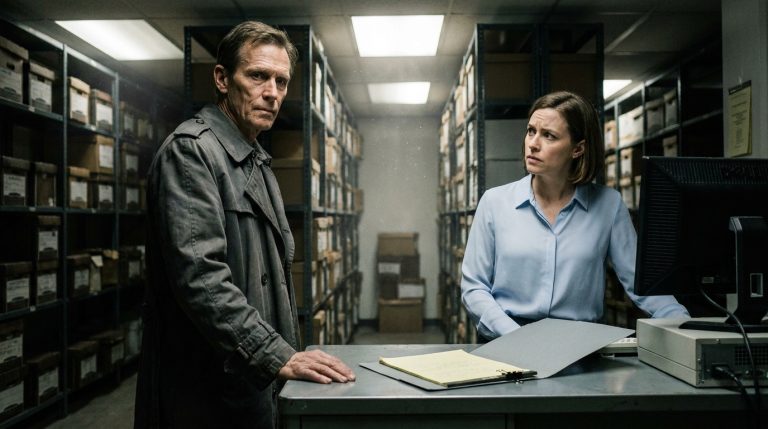
Inside, the room was a tomb of paperwork and outdated hardware. Rows of filing cabinets, their paint peeling away in curled, blistered strips, stood like silent sentinels. She stepped inside, the penlight cutting a fragile path through the dust motes. Her goal was the index—the master log that listed all weapons assigned and decommissioned over the last ten years.
As she navigated the aisles, she realized the room wasn’t just a archive; it was a museum of erasure. Cabinets labeled with her father’s unit designation were empty, the drawers sliding open with a hollow, clattering sound. Every folder, every report, every scrap of paper had been methodically purged.
Then, she saw it. Tucked into the back of a drawer that should have been empty, a small, laminated file folder lay forgotten. It wasn’t standard military issue. It bore a different set of markings, a hand-stamped code that triggered a sharp, cold realization in her chest.
She pulled it out, her movements careful, almost reverent. She didn’t open it immediately. She listened, her ears tuned to the ambient groan of the building. Somewhere in the distance, a door clicked shut. The rhythm of the facility had changed; the usual silence of the night shift had been broken by the deliberate, heavy cadence of someone patrolling the restricted sector.
She flipped the folder open. Inside, a series of maintenance logs detailed a recurring, systemic failure pattern in the M24 series, but these weren’t standard issues. They were custom, pinpointed malfunctions—the exact same kind of “friction” she had discovered in her own bolt assembly. And at the bottom of every log, in the margin, was a signature she recognized: an elegant, sweeping script that belonged to the Colonel, dating back to his time as a junior officer under her father’s command.
It wasn’t just a grudge. It was a long-term, calculated campaign. The Colonel had spent years perfecting the art of the undetectable failure, using her father’s own gear as his testing ground.
She heard a footfall in the hallway—slow, rhythmic, and closer now. The shadow of a figure stretched long and distorted under the crack of the door. She didn’t have time to replace the file, nor the space to retreat. She looked around, her eyes locking onto the heavy, industrial-grade ventilation grate built into the back wall.
She slid the file into her jacket, the paper cold against her side. She had the evidence she needed to start unraveling the web, but she was trapped. The footsteps stopped just outside the door. The handle turned, a slow, predatory movement that signaled the end of her cover.
She stood in the center of the room, her back to the shelves, her hand resting on the grip of her sidearm. She wouldn’t be taken easily, and she certainly wouldn’t let the truth be filed away in the dark again. As the door began to creak inward, she realized that the Colonel had left the door unlocked for a reason: he was waiting for the rat to crawl into the trap.
CHAPTER 4: THE CALCULATION OF THE ARCHIVE
The hinges groaned, a long, high-pitched protest that felt like a sound from another era. Elias didn’t flinch. She pivoted on the ball of her boot, her body settling into a balanced stance, the penlight in her left hand cutting a sharp, blinding arc through the darkness of the doorway.
The figure standing there wasn’t the Colonel. It was a man she recognized from the armory—Quartermaster Vance. He was older, his uniform pristine, his face a mask of bureaucratic indifference that didn’t quite reach his eyes. He stopped mid-stride, his gaze darting from Elias’s steady hand to the file she hadn’t quite managed to bury back in the drawer.
“Sergeant,” Vance said, his voice as dry as the paper that filled the room. He didn’t look surprised; he looked inconvenienced. “You’re a long way from the barracks. And even further from the scope.”
Elias kept the penlight steady, pinning him in the center of the beam. “I was looking for some historical context, Quartermaster. It seems the history of this unit is… poorly maintained.”
Vance didn’t move, but the atmosphere in the room shifted. He leaned his shoulder against the doorframe, his posture oozing a casual, practiced menace. “Historical context is dangerous for soldiers, Sergeant. It tends to weigh them down. We prefer the future here. A clean, uncomplicated future.”
He gestured toward the file in her hand. “You’ve found things that were slated for incineration. Policies change. Equipment rotates. It’s the cycle of progress.”
“Is that what we’re calling it?” Elias kept her voice quiet, the words measured and cold. “Progress? I’d call it institutionalized sabotage.”
Vance’s expression didn’t shift, but his fingers tapped a rhythmic, uneven beat against his thigh. She noticed it immediately—the same twitch, the same lack of coordination that she had seen in the Colonel’s shoulders. It was a symptom of the same rot. He wasn’t just a guard; he was an accomplice. And he was watching her, calculating her next move with the same cold, tactical scrutiny she was applying to him.
She felt a flash of doubt—a sharp, stinging internal phantom. Was she right? Was this really a long-game conspiracy, or was she projecting her own grief onto a series of administrative failures? The doubt clawed at her, urging her to step back, to surrender the file, and to walk away. But then, she caught the faint, unmistakable scent of the sulfur-heavy oil on his hands as he adjusted his grip. It was the same smell.
“I’m not interested in the cycle of progress, Vance,” she said, her voice hardening. “I’m interested in the structural failure of an M24 bolt assembly. The one I’m carrying. The one that was tampered with before it even reached my locker.”
Vance sighed, a sound that carried a genuine, weary disappointment. “You were always too sharp for your own good, Elias. Just like him. He couldn’t leave well enough alone either, and look where it got him. A name erased from the registry, a career scattered to the wind.”
“He was a better marksman than the Colonel will ever be,” she countered.
“Maybe,” Vance said, finally moving into the room. He didn’t come at her; he walked with the confidence of a man who owned the floor. “But he was also a man who didn’t understand that true authority isn’t about aim. It’s about maintenance. You maintain the status quo, or the status quo maintains you.”
He stopped five feet from her, his presence dominating the cramped, dusty aisle. “You have a choice, Sergeant. You can leave that file here, walk back to your barracks, and accept your reassignment to the depot. Or you can hold onto it, and we find out just how fragile that M24 really is when you’re standing in the middle of a live-fire sector.”
It was a direct ultimatum, delivered with the casual air of a weather report. Elias felt the grit of the floor beneath her boots, the suffocating presence of the past closing in on her. She realized then that this wasn’t about the weapon. It was a test. If she surrendered, she would survive, but she would be a ghost—just another name erased from the registry. If she fought, she would be a target, but she would be the only one who knew the truth.
She tightened her grip on the penlight, the beam wavering for a fraction of a second against his chest. “I’m not a depot soldier, Vance.”
She shifted her weight, the movement subtle, a preparation for a sudden, kinetic engagement. But Vance just shook his head, a thin, ghost of a smile playing on his lips.
“Then I’ll see you on the range, Sergeant. Let’s hope your maintenance skills are as good as you think they are.”
He turned and walked out, his footsteps echoing down the hallway, leaving her alone in the tomb of erased history. He hadn’t tried to take the file. He had let her keep it. The realization turned her blood cold. The trap wasn’t the room; the trap was the evidence itself. He wanted her to take it, to use it, and to expose herself as the variable they needed to purge. She looked at the file, the paper suddenly feeling heavy with a dangerous, unseen burden, and knew that the next phase of their plan was already in motion.
CHAPTER 5: THE WEIGHT OF EVIDENCE
Elias didn’t wait for the sound of the locks to cycle. She moved, her instincts honed by years of anticipation, sliding the file into the interior pocket of her tactical vest and securing the zipper with a sharp, metallic click. She crossed the room in three long strides, the dust motes dancing in the wake of her movement like tiny, disrupted stars. She bypassed the door and scrambled toward the industrial ventilation grate.
The screws were rusted, fused by time and lack of care, but she didn’t have the luxury of a toolkit. She jammed the edge of her multi-tool into the slot, gritting her teeth against the resistance of the oxidized metal. With a sharp, guttural exertion, she forced the first screw to turn. The grate rattled, a jagged, discordant sound that felt loud enough to wake the dead. She pulled it back, the metal scraping against the concrete, and slid into the dark, narrow aperture of the ventilation shaft just as the hallway lights flickered back to life with an aggressive, buzzing pop.
The shaft was a tomb of grit and stagnant air. She crawled, her movements constrained, her shoulders brushing against the rough, galvanized steel. The smell of the facility—that mixture of machine oil, old dust, and damp concrete—was even stronger here, concentrated in the claustrophobic space.
She crawled until the light of the archive was a distant, dying square, then paused to catch her breath. Her pulse hammered against her ribs, a frantic, irregular rhythm. She pulled the file from her vest, using her penlight to illuminate the contents. The documents were worse than she had imagined. They weren’t just logs of failure; they were blueprints for a systematic liquidation. The Colonel hadn’t just been targeting her father’s gear; he had been profiling the entire unit, identifying those who relied on “analog intuition” over his new, digital protocols, and marking them for failure.
She reached for the M24 she had slung across her back, needing the tactile reassurance of the cold steel. As her hand slid over the stock, she felt it—a small, slightly raised section of the wood that she hadn’t noticed before. She pressed her thumb against it, and a tiny, concealed panel shifted.
Her breath hitched. She opened the compartment. Inside, nestled within the heart of the weapon, was a slip of paper, aged and yellowed, etched with a serial number. It didn’t match the receiver. It didn’t match the barrel. It was a mismatch—a piece of evidence that the rifle wasn’t just a relic; it was a patchwork, a hybrid. Her father hadn’t just been maintaining it; he had been hiding something inside it.
The weight of the reality shifted. She wasn’t just protecting a legacy; she was carrying the key to the Colonel’s deepest fear. The “friction” wasn’t just a technical defect he was creating; it was the mechanism of a cover-up.
A heavy, echoing thud resonated through the shaft—boots walking on the grate she had just exited. The sound stopped.
“I know you’re in there, Sergeant.”
The voice was the Colonel’s, calm, authoritative, and utterly devoid of doubt. He didn’t sound angry. He sounded like a man who had been expecting this moment for a very long time.
“You can crawl until your hands bleed, but you’re in a loop of your own making,” he continued, his voice vibrating through the steel of the shaft. “That rifle wasn’t meant for a markswoman. It was meant to be a grave marker.”
Elias stayed perfectly still. She could feel the vibration of his footsteps on the grate above her. She looked at the paper in her hand, the serial number a meaningless jumble of digits that suddenly felt like a map. She realized then why he hadn’t had her arrested in the archive. He wanted her to find this. He wanted her to reach the point of no return.
She began to crawl again, faster, her movements driven by a sudden, cold clarity. She wasn’t just a pawn in his game; she was the catalyst. She reached the next junction, the vent leading toward the peripheral armory—a place where the security was lax, and the infrastructure was rotting.
She emerged into a narrow utility corridor, the air thick with the smell of wet earth and rust. The walls were weeping, streaks of oxidation tracing the path of slow-moving leaks. She hit the floor running, her boots silent on the corrugated metal, her mind already calculating the next point of failure in the facility’s defenses. The Colonel wasn’t just chasing her; he was herding her, but he had underestimated one thing: she wasn’t just following the map he’d laid out—she was changing the geography of the trap.
CHAPTER 6: THE ARMORY OF ERRORS
The door pushed open with a low, agonizing groan that seemed to reverberate through the very foundations of the facility. Elias slipped into the armory, her movements fluid and devoid of wasted energy. The space was a sterile, climate-controlled box of polished concrete and bright, unwavering LEDs, a sharp contrast to the decaying labyrinth of the utility sectors she had just escaped. Rows of rifles stood in their racks like upright glass soldiers, their surfaces gleaming with synthetic precision.
She kept her profile low, eyes scanning the room for the tell-tale infrared sensors of an automated monitoring system. The Colonel was a man of patterns; if he’d left the archive unlocked, he was banking on her desperation to lead her here—to the one place where he could control the variables.
She moved toward the central workstation, her boots clicking softly on the floor. Her father’s voice played in her mind, a ghost-track of warnings: “Always look for the adjustment, Elias. When a man like that builds a trap, he doesn’t use walls. He uses the tools you rely on.”
She reached the rack where her backup equipment was stored. The M24’s twin—a weapon she’d been forced to surrender during the initial inspection—rested there. She approached it with caution. As she reached out, her fingers hovered inches from the stock. The surface was cool, but it felt wrong. She didn’t touch it. Instead, she leaned in, her eyes tracing the line of the receiver.
The serial number was etched with the same precision she had seen in the archive logs. It didn’t match the inventory stamp on the rack. She drew back, a sharp, cold realization piercing through her exhaustion. This wasn’t her rifle. It was a replica, a perfectly calibrated decoy designed to trigger an alert the moment a biometric seal was broken.
The facility’s intercom crackled to life, the sound of the Colonel’s voice filling the room with a calm, predatory resonance. “I knew you’d come for the backup, Sergeant. It’s a natural instinct. But curiosity in this unit is an expensive commodity.”
Elias turned, her hand dropping to the sidearm at her hip, though she kept it holstered. She scanned the high catwalks circling the ceiling. The Colonel was there, a silhouette against the harsh, white glare of the overheads. He wasn’t armed with a rifle; he held a remote trigger, a small, black device that looked utterly innocuous.
“You think you’ve uncovered a conspiracy,” he said, his voice echoing off the concrete walls. “You think you’re exposing the ‘erasure’ of a legacy. But you’re only exposing your own inability to accept the necessity of evolution. Your father didn’t build a legacy, Elias. He built a bottleneck. He kept the unit chained to outdated mechanics because he was afraid of what would happen if his soldiers stopped needing him.”
“He kept them alive,” Elias said, her voice steady. She took a step toward the center of the floor, forcing him to track her movement. “He taught them to understand the machine, not just operate it. You didn’t replace him because he was obsolete. You replaced him because he was the only one who knew how to fix the rot you were planting.”
The Colonel stepped out from the catwalk, his face partially obscured by shadow. “The rot is the progress, Sergeant. And you are the final piece of the cleaning cycle. By taking that file, you’ve confirmed your own obsolescence.”
He pressed a button on the remote.
A sudden, sharp hiss filled the room. Vent covers popped open in the ceiling, and a fine, translucent mist began to descend. It smelled of nothing—no ozone, no chemical bite—but Elias recognized the weight of it in the air. It was a high-density, airborne fire-suppressant, a gas designed to displace oxygen in seconds.
She lunged for her kit, ripping a small, pressurized oxygen canister from the side, but the room was already changing. The lights dimmed, the brightness fading into a dull, pulsing red. The heavy steel doors sealed with a final, hydraulic thud.
She wasn’t just trapped in a room. She was being suffocated in a vacuum of his design. She scrambled toward the floor, knowing the gas would settle, seeking the thin, narrow layer of breathable air along the concrete. She pressed her face to the cold, unforgiving floor, her breath coming in ragged, shallow gasps. She looked up and saw the Colonel standing at the edge of the catwalk, looking down at her like a technician watching an experiment conclude.
She had been right about the trap, but she had been wrong about the scale. He wasn’t just trying to catch her; he was trying to wipe the entire armory of her presence, and the evidence she held in her jacket was starting to feel like a shroud. She clutched the file to her chest, the paper crinkling under her fingers, and stared at the door. There had to be a manual override, a mechanical point of failure in a system that relied so heavily on digital perfection.
She started to crawl, the grit of the concrete digging into her palms, her eyes fixed on the heavy, junction box tucked beneath the main console. If the system was automated, it had a power source, and if there was a power source, there was a physical connection that could be broken. She had to find the friction in his perfect, sealed loop.
CHAPTER 7: THE FRICTION OF THE ARCHITECT
The air was thin, tasting of ozone and stale, recycled dust. Elias forced her movements to stay slow, deliberate. Every rapid breath was a tax on her dwindling supply of focus. She reached the junction box, her fingers numb from the cold radiating off the steel. The heavy, industrial casing was bolted shut, a final, stubborn complication in a room designed for total control.
She pulled her multi-tool, the metal biting into the screw heads with a sharp, grating scrape. The sound of her own labor was amplified by the silence of the room, every turn of the tool a loud, mechanical heartbeat. Above, the strobe light pulsed—an agonizing, rhythmic flash that bleached the room into monochrome for a fraction of a second, then plunged it into deep, suffocating shadow.
She timed her movements to the flicker. Turn. Pull. Flash.
Her mind wandered back to her father’s workshop, to the way he would handle the components of a weapon. He didn’t see parts; he saw relationships. He saw how the tension of a spring dictated the travel of a bolt. She looked at the junction box not as a security measure, but as a system of relationships. The Colonel wasn’t just a soldier; he was a man obsessed with the illusion of order. If he had built this system, he had built it with a flaw—a bypass meant for his own maintenance, tucked away behind the facade of perfection.
She pried the cover back. Wires spilled out like a tangled, copper nervous system. She didn’t look for the power line; that was what they wanted. She looked for the feedback loop.
Her fingers moved with a phantom memory of her father’s hands. She found the bridge—a thin, secondary wire that didn’t connect to the main array but ran to a separate, auxiliary circuit. It was the override. She gripped it, her heart thudding a slow, heavy rhythm against the floor. If she cut it, the doors would lose their hydraulic lock. If she was wrong, she would be closing her own casket.
Flash.
The light revealed the Colonel standing just outside the glass panel of the armory’s observation deck, watching her. He wasn’t reaching for the remote. He was simply waiting, his expression unreadable, as if he were observing a specimen in a jar. He knew she would find the override. He was allowing the sequence to reach its natural conclusion.
The realization hit her with the force of a physical blow. This wasn’t about catching her in the armory; it was about forcing her to acknowledge the system she was fighting. He wanted her to see the architecture of the cage so that when he finally dismantled it—and her with it—she would understand exactly why it was necessary.
She didn’t hesitate. She squeezed the wire with the cutter, the metal snapping with a sharp, final ping.
For a heartbeat, nothing happened. Then, the strobe light died. The hum of the atmosphere scrubbers shifted, a sudden, violent change in pitch that vibrated through the floor. The heavy, hydraulic groan of the seals let go. The doors didn’t just open; they hissed, releasing the trapped gas in a violent, swirling fog that obscured the room.
Elias rolled away from the console, gasping as the fresh, cold air of the corridor flooded in. She didn’t head for the door. She knew the Colonel would be waiting there. Instead, she moved to the rack where the decoy rifle sat. She had identified the mismatch in the archive; she knew that the weapon wasn’t just a trap—it was a container.
She slammed the stock of the rifle against the edge of the rack, the wood splintering with a satisfying, raw crack. The rifle broke along the line of the hidden panel, and a small, magnetic drive tumbled onto the concrete. She scooped it up, the cold weight of it against her palm, and stood, her body aching with the fatigue of the struggle.
The fog was clearing. She could see the Colonel stepping through the doorway, his pace unhurried, his hands empty. He wasn’t reaching for a weapon. He was walking toward the center of the room, toward the evidence she now held.
“You think you’ve broken the cycle, Elias,” he said, his voice quiet, almost mournful. “You’ve only managed to break the container. You have no idea what you’re holding, do you?”
She didn’t answer. She stood, her M24 clutched in her other hand, her eyes locked on his. The armory was silent, the hum of the facility returning to its standard, rhythmic pulse. The truth wasn’t just in the drive; it was in the way the Colonel looked at her—not as a threat, but as a mirror. She realized then that the final revelation wasn’t about her father’s legacy. It was about the cost of maintaining the silence.
She backed away toward the utility exit, the drive tucked securely in her pocket. The endgame was here, and the friction was no longer in the machines. It was between the two of them, and for the first time, she saw the fear behind his composed, bureaucratic mask. He wasn’t just protecting a system; he was terrified of what would happen if the machine finally, completely stopped.
CHAPTER 8: THE SILENCE OF THE ARCHITECT
Elias did not retreat. She stood firm, her boots planted on the concrete, the magnetic drive held steady in her hand. The Colonel’s mask had not merely slipped; it had dissolved, replaced by a raw, naked terror—the terror of a man who realized his meticulously constructed reality was a house of cards built on a foundation of dry, brittle bone.
“You don’t understand what you’re holding,” the Colonel said, his voice straining against the sudden, absolute silence of the room. He stepped forward, his movements erratic, the grace of his authority gone. “That drive contains the history of this unit’s failures, yes, but it also contains the protocols for our survival. If you expose it, you aren’t just destroying me. You are stripping away the veneer that keeps this entire sector from collapsing into chaos. You are burning the only map we have.”
“Then we’ll learn to navigate by the stars,” Elias replied, her voice low and serrated.
She walked toward the master terminal, her eyes locked on his. She saw the moment he realized the pivot—he reached into his coat, a desperate, final motion. Elias moved with a kinetic economy that made the action seem almost static. She didn’t draw her sidearm; she swung the M24, the heavy, wooden stock clipping his wrist with the precision of a guillotine. The remote trigger clattered across the floor, spinning into the darkness beneath a rack of rifles.
The Colonel collapsed, not from the force of the blow, but from the realization that his leverage was gone. He looked up at her, his face pale, his eyes tracing the line of her silhouette.
“You think you’re the first?” he hissed, his composure fracturing completely. “Your father tried this. He thought he could outmaneuver the system, that he could carve his own truth into the stock of a rifle. And look where it left him. He didn’t die for a cause, Elias. He died because he was a relic who refused to be upgraded.”
“He didn’t die,” Elias said, her hand reaching into her vest to pull out the slip of paper she’d recovered. “He was erased. And that’s a different kind of crime.”
She slotted the magnetic drive into the terminal. She didn’t dump the data; she began a slow, methodical upload—not to the central command, but to the public, unencrypted channels of the sector’s communication network. The Colonel scrambled to his feet, lunging for the console, but Elias met him with the weight of the rifle, pinning his arm against the desk. The force of her resolve was a physical wall. She was no longer fighting for her career; she was fighting for the memory of a man whose legacy had been used as a tool for his own destruction.
“You wanted to upgrade the unit,” Elias said, her face inches from his. “But you forgot the most basic rule of engineering. If you ignore the structural integrity of the base, the higher you build, the harder it falls.”
The terminal pinged—a final, melodic chime signaling the completion of the upload. The Colonel froze. The silence that followed was total, broken only by the hum of the cooling fans. Outside, in the distant corridors of the facility, the muted chaos of realization began to stir—the sound of voices, the rhythmic thump of boots, the sudden, sharp shift in the facility’s rigid order.
The Payoff arrived not in a flash of violence, but in the steady, rhythmic chirping of the Colonel’s own comms unit as it began to flood with incoming, critical queries. He listened, his head bowing as if under an invisible weight. He had been defeated by his own tools—by the very systems he had built to control the flow of information.
The cool-down followed, slow and inevitable. The lights in the armory shifted back to their standard, warm white. The Colonel sat at the console, his hands resting on the cold, stainless steel, a broken man waiting for an end he had spent years crafting for others. Elias didn’t gloat. She didn’t offer a final word. She simply picked up the broken pieces of the decoy M24 from the floor.
She found the splintered section of the stock, the wood raw and pale where it had fractured. She sat on the edge of a supply crate, her exhaustion finally catching up to her. With slow, rhythmic movements, she began to clean the wood, removing the grit and the dust of the archive. She wouldn’t be able to repair it perfectly—the wood was too fractured—but she could make it whole again. It was a small act, a quiet, tactile bridge back to the man she had been trying to reclaim.
The facility’s alarm system began to wail, a low, pulsing sound that marked the end of the Colonel’s era. Outside, the world was waking up to a different kind of truth. Elias stood, the restored rifle cradled in her arm, and looked out the observation window at the vast, gray expanse of the horizon. She felt a lightness in her chest, an emotional clarity that was as steady as the weight of the steel against her shoulder. She had earned this silence. She had paid for it in friction, in cold, and in the slow, agonizing removal of a mask. She stepped out into the hallway, leaving the armory—and the ghost of the man who had tried to build a kingdom on sand—behind her. The journey ahead was unwritten, but for the first time in years, the road didn’t feel like a path laid by someone else.