The Weight of Silence: A Journey Through Memory, Redemption, and the Quiet Legacy of Honor
CHAPTER 1: THE WEIGHT OF THE PIN
The olive drab canvas of the tent held the heat of the afternoon, turning the historical exhibit into a humid, airless box. Corporal Davis stood over the folding chair, his posture a textbook study in aggressive, unearned authority. His boots were polished to a mirror shine, reflecting the flickering fluorescent lights above, while the man sitting before him looked as though he had been pulled from a different era entirely.
Harold Winters sat with his hands resting on his knees, his fingers gnarled and steady. He didn’t look up when the Corporal spoke, his focus fixed on the middle distance, perhaps seeing something far beyond the tent’s stifling confines. The air between them was thick with the scent of dry earth and old paper, a fragile atmosphere that Davis seemed intent on shattering with every sharp syllable.
“I’m going to need to see some identification,” Davis demanded, his chest puffed out, a grin playing on his lips—a look that anticipated an easy victory over a target who couldn’t—or wouldn’t—fight back. He shifted his weight, his uniform creaking in the silence. Behind him, the laughter of his peers acted as a brittle fuel for his ego.
Harold’s hand moved slowly, almost mechanically, to his back pocket. He pulled out a leather wallet, its edges frayed and softened by decades of persistent use. As he fumbled with the plastic sleeves, Davis rolled his eyes, signaling to his friends that this was exactly the kind of time-wasting annoyance he expected from the civilians who wandered into their space.
“Come on, Grandpa. We don’t have all day. Just pull out your license so I can call you a cab.”
The insult hung in the hot air, but Harold didn’t flinch. He finally extracted the ID and held it out. Davis snatched it, his thumb grazing the edge of the card, but his gaze didn’t stay on the name for long. His eyes snagged on the collar of Harold’s faded blue polo shirt. There, pinned with a clumsy, off-center dignity, was a small, tarnished scrap of metal. It caught the light dully, a forgotten piece of junk that looked entirely out of place in a modern military facility.
Davis pointed a gloved finger at it, his sneer deepening. “What’s that? A prize for finishing your oatmeal? Did you lose a bet at the nursing home?”
As the laughter erupted, Harold’s gaze finally shifted. His eyes—a clear, piercing blue that seemed to hold the cold of a distant winter—locked onto Davis’s. It wasn’t the look of a victim realizing he was cornered. It was the look of someone suddenly remembering exactly how much the ground beneath their feet was worth, and the terrifying cost it took to hold it.
The tent seemed to grow colder, the light shifting into a harsh, metallic gray, as if the very air were preparing for a sudden, devastating change in pressure.
CHAPTER 2: THE ANATOMY OF A SHADOW
The sound of the young Marine’s laughter—that sharp, confident braying—did not vanish; it merely changed texture. To Harold, it became the whistle of wind over a ridgeline, a hollow, biting sound that stripped away the comfort of the air-conditioned tent. The fluorescent lights overhead flickered, losing their sterile, white glow, replaced by the iron-gray misery of a sky that had been spitting snow for three days straight.
Harold did not look at the Corporal. He could not. His peripheral vision had been replaced by the sight of raw, chapped knuckles gripping a frozen entrenching tool. The weight of his own body felt different—he was twenty years old again, his marrow aching from a cold so profound it felt like it had crystallized his very soul. Beside him, in the space where the display tables now sat, there was only the ragged, wet rattle of Captain Richards’ breathing.
The captain’s chest was a ruin, a map of shrapnel and sacrifice that had no place in an open house exhibit. Harold felt the phantom pressure of a cold, jagged piece of metal being pressed into his palm. It was the pin. It was not a decoration. It was the weight of every man who had not walked off that hill.
“Hey! I’m talking to you, old man!”
The voice, distant and tinny like a radio broadcast from a dying frequency, snapped at his consciousness. Harold blinked. The gray, frozen hills of North Korea receded, pulling back into the shadows of his own mind, but the chill remained. He was still in the folding chair, his knees aching with the dull throb of eighty-nine years, but his hand—the one that had held the pin—remained curled as if it were still protecting that fragile, jagged relic.
He looked up. Corporal Davis was leaning in, his face a mask of annoyed authority. The young man’s skin was smooth, unscarred by the frost, his eyes clear of the haunted, hollowed-out look that Harold had seen in every mirror for seven decades. Davis was a creature of a different world—a world of starch and polish, of rules that lived on paper rather than in the blood. He saw the pin not as a monument, but as a flaw in the display.
“What is that?” Davis demanded again, his finger twitching, desperate to find a reason to eject this intruder from his carefully managed domain. “Some flea market trash? You think you can just pin any piece of scrap on your collar and demand respect?”
Harold felt a strange, quiet pity—not for himself, but for the boy. Davis was so terrified of being ordinary that he had mistaken cruelty for strength. The Corporal thought he was guarding the integrity of the Corps, unaware that he was trampling the very foundations of it.
“It’s not for sale,” Harold said, his voice raspy, the sound of dry leaves skittering over stone. He didn’t intend to explain. He didn’t want to explain. To put it into words was to diminish it, to turn a sacred obligation into a cocktail party anecdote.
Davis laughed, but it lacked the confidence of his previous attempts. He felt the silence in the room. The crowd, previously a shapeless mass of onlookers, had shifted. A woman in a floral dress had stopped chewing her gum; a man beside her had tucked his hands into his pockets, his posture turning rigid. The air in the tent had grown heavy, expectant, as if the room itself were holding its breath, waiting to see if the Corporal would notice the warning signs.
Davis didn’t. He reached out, his hand hovering near Harold’s shoulder, a gesture that was half-shove, half-seizure. “I’m tired of the games. You’re coming with me to the station. We’ll see how ‘sacred’ that piece of junk is when we have it tagged as evidence in a trespassing report.”
As the Corporal’s fingers closed toward his collar, Harold felt a ripple of movement at the edge of his vision. Someone was approaching from the periphery. A figure who had been watching, whose measured steps didn’t belong to the casual, drifting flow of the exhibit crowd. The atmosphere sharpened. The friction between the Corporal’s blind arrogance and the encroaching reality of the room became almost electric. Harold sat still, a statue in the center of a storm he had survived once before, waiting to see if the world would finally recognize the ghost standing in its midst.
The Corporal’s hand grazed the fabric of his shirt. The touch was like an insult to the memory of the cold. Harold shifted his gaze, not to the Corporal, but past him, catching the eye of a man who knew what the silence meant—a Gunnery Sergeant whose expression was no longer one of mere observation, but of dawning, gut-wrenching alarm.
CHAPTER 3: THE FRICTION OF COMMAND
The space between Corporal Davis’s hand and Harold’s shoulder was only a few inches, but in the silence of the tent, it felt like the width of an ocean. Gunnery Sergeant Reyes stepped into that gap with the fluid, heavy grace of a man who moved by reflex rather than thought. He didn’t touch the Corporal—he didn’t have to. He simply planted his boots with enough deliberate weight that the ground seemed to absorb the kinetic energy of his arrival.
“Corporal,” Reyes said, his voice stripped of the volume Davis was accustomed to. It was a low, granular sound, like stones shifting deep underground. “Stand down and step away.”
Davis flinched. The command was sharp enough to slice through the haze of his own ego. He pulled his hand back, his fingers curling into a frustrated fist that he quickly hid behind his back. The bravado he had worn like armor for the last hour began to show hairline fractures. He looked at his friends, expecting them to bridge the gap, to offer the casual, mocking support that had buoyed him, but they had gone silent. They were looking at Reyes, then at the old man, and finally at their own feet, suddenly aware of the air cooling in the room.
Harold did not look at the Sergeant. He remained in the chair, his posture unchanged, his eyes still fixed on that elusive point beyond the canvas. He was breathing with a rhythmic, shallow cadence, the kind practiced by men who had learned how to wait out an artillery bombardment. He wasn’t ignoring the conflict; he was simply existing outside of it. The pin on his collar, that small, tarnished scrap of history, seemed to catch the overhead light, a dull, metallic eye watching the scene unfold.
“I’m in the middle of a security procedure, Gunny,” Davis stammered, his voice climbing an octave, losing its firm, starched edges. “This civilian is being obstructive. I’m just doing my job.”
Reyes didn’t blink. He kept his gaze locked on Davis, his expression unreadable, a mask forged by years of navigating the complex, often brutal, hierarchies of the Corps. He had seen this look before—the arrogance of the uninitiated, the terrifying ignorance of someone who thought the uniform made them a god rather than a servant.
“Your job,” Reyes said, taking a slow, measured step forward, forcing Davis to retreat, “is to understand who you are dealing with. And I am telling you, Corporal, you have failed that mission entirely.”
The environment suddenly conspired against the tension. From somewhere deep within the bowels of the base’s power grid, a heavy, rhythmic thrumming sound—likely a massive generator shifting its output for the evening—vibrated through the floorboards. The tent poles rattled in their moorings, the canvas snapping sharply in the sudden draft of a cooling breeze. The light overhead didn’t just flicker; it died for a heartbeat, casting the tent into a bruised, indigo twilight.
In that brief, artificial night, the illusion of the modern base felt fragile. For a few seconds, the tent was just a piece of fabric stretched over a cold, indifferent earth. Harold’s shadow, cast long and distorted against the back wall, looked less like a man and more like an outline of everything the base was built to protect but had largely forgotten.
When the lights buzzed back to life, the mood had curdled. The crowd was no longer merely watching; they were pressing in, a slow, inevitable tide of quiet disapproval. A young mother, who had been hovering near the entrance, took a protective step closer to the older man, her hand hovering near Harold’s shoulder in a gesture of instinctive support.
Davis felt the shift. He was losing his audience, losing his ground, and most terrifyingly, he was losing his narrative. He looked at the ID card still clutched in his hand—Harold Winters, Northwood—and tried to force it back into a box that no longer held it.
“I’m calling the MPs,” Davis said, his voice brittle. “I don’t care who you think you are, Gunny. I’m following protocol.”
Reyes’s eyes narrowed, a glint of genuine, cold pity surfacing in their depths. He didn’t argue. He didn’t escalate. Instead, he reached into his own pocket and produced his phone, his movements as economical as a surgeon’s. He turned his back on Davis, not out of dismissal, but as if the Corporal were no longer a factor in the equation he was about to solve.
Harold shifted, his joints popping with the dry, hollow sound of brittle wood. He looked at Reyes’s back, then at the Corporal, and for the first time, a small, barely perceptible crease of sorrow appeared at the corners of his eyes. He realized the Sergeant was doing more than calling for help; he was initiating a chain of events that would pull this young man apart piece by piece.
“It doesn’t have to be this way,” Harold murmured, so softly that only Reyes might have heard him.
But Reyes was already speaking into the phone, his voice a low, steady stream of information that sounded like a death knell for the Corporal’s career. Harold looked down at the pin. He thought of Captain Richards, of the cold in the hills, and of the price of silence. He understood now that he could no longer hold the line alone. The truth was leaking out, staining the pristine, polished surface of the base, and soon, the whole world would have to confront the weight of what he had been carrying for seventy years.
He closed his eyes for a second, feeling the vibration of the generator through his chair—a constant, mechanical pulse that seemed to count down the seconds until the inevitable arrival of a higher authority. He was tired, so deeply and thoroughly tired, but he found he could still sit, he could still wait, and he could still endure.
CHAPTER 4: THE ARCHIVE OF BONE AND STEEL
The command center was a tomb of silence, save for the rhythmic, aggressive clicking of keyboards and the low-frequency drone of the HVAC system. Master Sergeant Frank Miller, a man who viewed his job as the orderly maintenance of history, stared at his monitor as if the pixels themselves were hemorrhaging. The data on the screen wasn’t just text; it was an indictment.
He didn’t mean to drop his pen. It slipped, a betrayal by his own nerves, and the sharp clack-clack-clack of the plastic casing hitting the desk sounded like a gunshot in the sterile room. Miller’s chair rolled backward, the wheels screeching against the floorboards, and slammed into a filing cabinet. The noise shattered the concentration of everyone in the room.
Captain Evans, a man whose face was usually etched with the rigid, calm lines of a career officer, strode over, his brow furrowed in annoyance. “Miller, report. What is the—”
He stopped. His gaze fell upon the screen, and the irritation in his posture evaporated, replaced by a sudden, jarring stillness. Evans leaned in, his hands hovering over the back of Miller’s chair as he read the entry. The service record of Harold Winters was not a list of assignments; it was a biography of the twentieth century’s most brutal conflicts, written in blood and commendations.
“Is this a glitch?” Evans whispered, his voice thin, stripped of its habitual command tone.
Miller shook his head, his throat dry. “No, sir. It’s live. The system pulled it the moment I entered the name.”
Evans looked at the photo at the top of the file—a young man with eyes that were already old, staring out from a black-and-white past. Beneath it, the words Medal of Honor seemed to pulse with a significance that made the modern, air-conditioned room feel flimsy. Evans reached out, his fingers trembling as he grabbed the handset of the desk phone. His mind was racing, discarding protocols and procedures, realizing that the situation in GP104 was no longer a civilian disturbance; it was a seismic event.
“Gunny Reyes,” Evans said, his voice tightening with a panic he couldn’t mask. “This is Captain Evans at Command. What is your exact location? Listen to me very carefully. Do not—under any circumstances—let Mr. Winters leave. I mean the civilian. Your new mission is to ensure his safety and comfort. Is that understood?”
Across the base, in the tent, Gunnery Sergeant Reyes listened, his expression shifting from professional focus to a profound, hollowed-out shock. He glanced at Corporal Davis, who was currently posturing and preening, utterly oblivious that his own world was currently dissolving into nothingness. Reyes didn’t answer with a shout; he simply stood straighter, his posture becoming an anchor of stability.
“Understood, sir,” Reyes replied, his voice low, his eyes never leaving the old man in the folding chair.
“The base commandant is on his way,” Evans continued, his words tumbling over each other. “I repeat, the General is en route to your location. Secure the perimeter of that display, Gunny. Treat the area as a sterile zone.”
Reyes hung up the phone and looked at Harold. The old man hadn’t moved. He was still watching the pin on his collar, his fingers tracing the edge of the tarnished metal. For a brief moment, their eyes met. Reyes saw no triumph in Harold’s gaze, no satisfaction at the imminent collapse of the young corporal’s world. He saw only a heavy, weary resignation—a man who had been called upon once again to witness the fragility of honor.
Corporal Davis, emboldened by Reyes’s silence and the lack of immediate intervention, took another step toward Harold. He was sweating now, the heat of the tent finally getting to him. “Well? Did you get your validation, old man? Did you find someone to cry to?”
Davis looked at his friends, waiting for the familiar laughter, but they were backing away, their faces pale. They had seen Reyes’s face when he hung up the phone. They had seen the way the Sergeant was suddenly guarding the old man as if he were made of glass.
Davis didn’t understand. He couldn’t. He viewed the world through the lens of rank and procedure, and to him, the old man was a variable that simply needed to be cleared. He reached out to grab Harold’s shoulder, a final, clumsy attempt to assert dominance, but Reyes didn’t let him.
The Gunnery Sergeant moved with the speed of an apex predator. He didn’t strike the Corporal; he simply clamped a hand onto Davis’s forearm, the grip like a steel shackle. He didn’t say a word. He just stood there, holding the younger man in place, a living barrier between the ignorance of the present and the weight of the past.
“Gunny, let go,” Davis hissed, trying to pull away, but he was pinned by a force that wasn’t just physical. It was the weight of every regulation, every tradition, and every sacrifice that Reyes had spent his life upholding.
Outside, the sound began—a rising, piercing whine that shattered the air. It wasn’t the single, sharp bark of an MP car. It was a rhythmic, cascading sound of sirens, a convoy approaching with the unstoppable momentum of a landslide. Tires crunched on the gravel outside the tent, and the silence in the room became absolute, a vacuum that waited for the door to open. Harold Winters shifted in his seat, the leather of the folding chair creaking, and he finally looked up, his pale blue eyes clear and steady as the storm arrived.
CHAPTER 5: THE SALUTE OF THE SEVEN DECADES
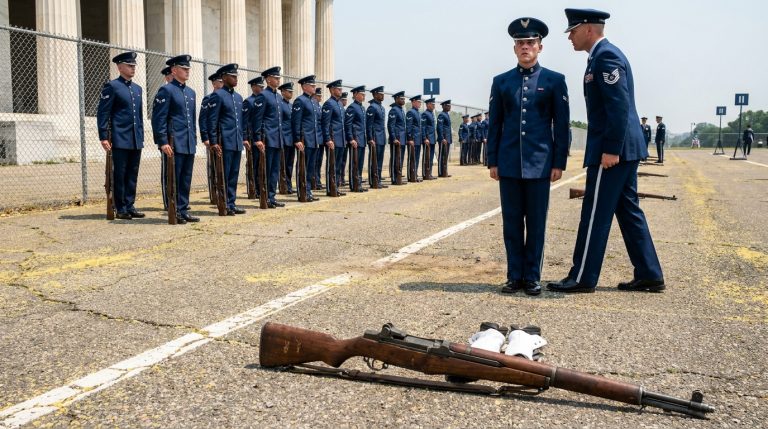
The tent flap was thrown back with the violence of a breaking dam. The light that flooded in was not the hazy, golden hue of the afternoon, but the harsh, unforgiving glare of authority. Two Military Police officers moved with the synchronized, predatory grace of a well-oiled machine, their boots crunching into the dry dirt floor as they took up positions like bookends to a tragedy.
Then, Major General Marcus Thorne strode in.
He moved with an ease that made the entire space feel smaller, his presence warping the gravity of the room. His uniform was an impeccable dark expanse, a wall of ribbons and brass that seemed to consume the light. Corporal Davis, still held in Gunnery Sergeant Reyes’s iron grip, looked as though he had been hit by a physical blow. His skin had gone the color of parchment, his eyes wide and vacant, staring at the General not as a man, but as an impending sentence.
General Thorne did not look at the Corporal. He did not look at the stunned crowd, nor at the historical displays that had served as the stage for this humiliating farce. His gaze cut through the tent with the precision of a laser, zeroing in on the solitary figure in the folding chair.
Harold Winters stood up. It was a slow, agonizing process—the protest of old joints, the stiffening of muscles that had spent a lifetime holding up the sky—but there was no hesitation in his movement. He did not reach for his cane; he did not look for support. He simply rose, his shoulders squaring with a phantom memory of drill instructors and cold, iron-gray mornings.
The General stopped three feet away. The silence was absolute. It was a vacuum that drew in the sound of the base outside—the distant hum of aircraft, the rhythmic thud of equipment—and silenced it. Then, the General’s body locked into a rigid, unnatural tension. He raised his right hand to his brow in a salute so sharp, so profound in its execution, that the very air seemed to vibrate with the force of it.
“Sergeant Major Winters,” the General’s voice was a low, resonant boom, stripped of its administrative polish, vibrating with a raw, visceral reverence. “It is an absolute honor to have you on my base, sir.”
The title—Sergeant Major, sir—hit the room like a physical shockwave. A woman near the front of the crowd let out a sharp, audible gasp, her hand flying to her mouth. Behind them, an older man in a faded Vietnam-era cap didn’t just stand; he stood at attention, his face flooded with the sudden, overwhelming realization of who stood before them.
Harold gave a single, small nod. It was the movement of a man who had seen kings and paupers treated with the same cold indifference by time, yet he acknowledged the gesture with a quiet, dignified grace. He didn’t smile; he simply held the General’s gaze, his eyes—clear, pale blue, and terrifyingly calm—reflecting the weight of the pin on his collar.
General Thorne held his salute for a heartbeat longer than regulation required, a defiance of protocol that spoke volumes. When he finally lowered his hand, his expression shifted. The rigid lines of command dissolved, replaced by a sudden, chilling mask of fury as he turned toward Corporal Davis.
The Corporal was trembling so violently that Reyes had to tighten his grip to keep him upright. Davis’s mouth opened and closed, a pathetic, soundless movement, his eyes darting frantically around the tent as if looking for an exit that no longer existed. He was a small, fragile thing in the face of the storm he had invited.
“Corporal Davis,” the General said. His voice was not loud, but it possessed a terrifying, measured quality, like the grinding of tectonic plates. “In my three decades in the United States Marine Corps, I have never been more ashamed than I am at this moment.”
Every syllable was a weight. The General didn’t shout; he didn’t need to. He stood in the wreckage of Davis’s career, dismantling the young man’s world with the cold, clinical precision of an executioner.
“You wear a uniform that men like this bled for,” Thorne continued, his eyes locked on Davis, who had begun to whimper, a small, involuntary sound that was lost in the vast, tomb-like silence. “You stand in a tradition he helped build with his own hands, and you use that authority to humiliate a man to whom you and I and every person in this country owe a debt that can never be repaid.”
Harold moved then. He took a single, slow step toward the General, the fabric of his polo shirt rustling in the stillness. He looked at the Corporal, then at the General, his face a landscape of exhausted, hard-won compassion.
“General,” Harold said, his voice firm, reaching out to touch the air between them as if he were trying to settle the dust. “He is just a boy. We were all young once, all full of fire and not enough sense. He doesn’t need to be broken. He needs to be taught.”
The General’s eyes softened, though the underlying cold toward Davis remained. He looked at Harold, a profound, almost desperate respect in his expression. “As you wish, Sergeant Major. He will be taught.”
As the MPs moved in to take the weeping Corporal away, Harold looked down at his collar. The tarnished pin caught the light one last time—a jagged, ugly, beautiful reminder of the cold in the hills of Korea. He felt the phantom chill of that winter once more, but this time, it was balanced by the warmth of a truth finally brought into the light. The burden was shifting; he was no longer holding the line alone.