The Weight of Silence: A Former Marine’s Final Stand Against the Erosion of Honor
CHAPTER 1: THE WEIGHT OF IRON
The air in the town square tasted of dry grass and impending storm, the kind of static charge that makes the hair on your arms stand rigid. Gordon Whitaker sat on the wooden bench, his back a straight line that ignored the ache in his lumbar. The training pistol was pressed against his temple. It was molded blue and orange plastic, vibrant and absurd, but the pressure behind it was real.
Bryce’s hand was steady, though the skin around his knuckles was drained of color. He was breathing in sharp, jagged bursts—a boy playing at soldier, realizing too late that he’d aimed his weapon at a mirror he couldn’t break.
Gordon didn’t move. He kept his hands resting on his knees, his palms flat against his corduroy trousers. He wasn’t looking at Bryce. He was watching a dry leaf dance on the pavement, caught in a swirling gust. In his peripheral vision, he saw the other three cadets—Peterson, the lanky one, trembling—stepping back, their boots scuffing the concrete. They were looking for an exit, but the park felt suddenly small, contained by the weight of the moment.
The pistol dug in, a dull, localized ache. To Bryce, this was a power play, a way to reclaim the narrative of his own superiority. But to Gordon, the plastic wasn’t blue or orange. It was the heavy, biting weight of an M1911, and the air wasn’t crisp autumn—it was the metallic, choking stench of mud and rotting jungle. The memory didn’t wash over him like a wave; it hit him like a physical impact, a sudden, grinding friction of gears.
He felt the phantom weight of his captain’s hand on his shoulder, warm and damp with grime. He heard the whisper that had defined his last fifty years: You honor him by wearing it now.
Gordon shifted his gaze. Slowly, with the deliberate care of a man who knows the fragility of everything, he moved his eyes to Bryce. He didn’t use anger. He used the silence. It was a vacuum that pulled the energy out of the boy’s lungs.
“The safety,” Gordon said, his voice a dry rasp, barely audible over the distant hum of traffic. “You haven’t checked the safety, son.”
Bryce flinched, the pistol wavering. “Shut up,” he spat, his face flushing a mottled, ugly red. “Don’t you tell me about weapons. You’re a relic. You’re nothing.”
But Bryce was wrong. He was looking at the tarnished pin on Gordon’s lapel, the eagle, globe, and anchor, but he wasn’t seeing it. He was seeing his own reflection in the metal, a cracked, distorted image of a boy holding a toy, while the man in front of him remained as immovable as an old oak.
The air grew heavy. Somewhere in the distance, a sound began to bleed into the quiet—not a siren, yet. Just a low, vibrating hum that felt like the earth itself beginning to grind. Gordon closed his eyes for a fraction of a second, just to ground himself in the present, then opened them. The boy was still there, but the world had shifted. The trap was set, not by the old man, but by the weight of the truth Bryce was about to stumble into.
CHAPTER 2: THE SIGNAL IN THE STATIC
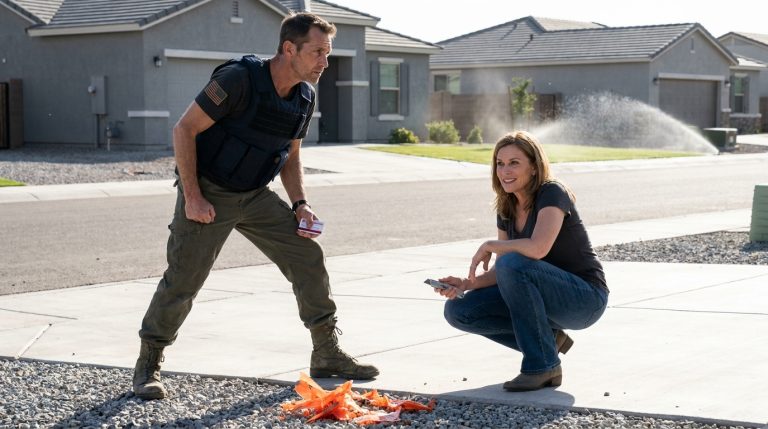
Frank Jensen stood on the edge of the manicured lawn, his boots anchored in the damp soil. The air felt thin, stripped of its warmth. Across the street, the tableau remained frozen. The boy—Bryce—was still leaning into the older man, his knuckles white against the orange and blue plastic of the training pistol. It was a tableau of absolute, unearned confidence meeting the immovable mass of something ancient.
Frank’s thumb jabbed at his phone screen. He wasn’t thinking about the consequences; he was thinking about the geometry of the situation. He had seen this alignment before—in the mountains, in the dust of foreign cities, in the way a man holds his breath before the hammer falls. He knew the look in Gordon Whitaker’s eyes. It was the look of a man who had long ago ceased to fear death and had instead started to treat it like an old, tiresome acquaintance.
Frank’s gaze shifted to the academy entrance, then back to the scene. He knew the general. He knew the rigid, bureaucratic pride that guarded West March. If he called the local police, they would arrive with their blue lights and their confusion, likely escalating a situation that required a surgeon, not a sledgehammer. But Marcus McRaven? McRaven understood the language of the ‘Ghost.’
He tapped the contact. The line whistled with a hollow, digital loneliness.
“McRaven,” the voice on the other end was a low, disciplined rasp.
“Frank Jensen,” Frank said, his voice clipped, kept at a volume that wouldn’t draw the attention of the gathering crowd. He didn’t look at the passersby; his world had narrowed to the three-foot radius around Gordon’s bench. “I’m in the town square. You have four of your cadets currently holding a weapon to the head of a civilian. A veteran.”
There was a silence on the line, a sudden, sharp intake of breath that spoke volumes. The general’s voice dropped an octave, turning into something like grinding stone. “Are you certain they’re mine?”
“I’m looking at their shoulder patches, Marcus. West March. And you need to get down here. Not your MPs. You. The old man… he’s not scared. He’s reaching for a solution that you, me, and everyone in this park is going to regret seeing.”
Gordon’s posture on the bench remained unchanged, but Frank saw the minute shifting of the old man’s shoulders. It was a subtle, predatory adjustment. A memory flared in Frank’s mind—an intrusive, violent flash of a trench, the smell of cordite and wet mud, the way a man looks right before he decides that honor is more important than his own survival.
“Describe the man,” McRaven commanded.
“Elderly, eighty-plus, wearing a red windbreaker. He has a pin on his lapel. An old Eagle, Globe, and Anchor. Tarnished, worn smooth.”
The line went dead.
Frank lowered the phone, his hand trembling slightly. The silence that followed was suffocating. He watched as Gordon’s hand moved—not to the weapon, but toward his own thermos. The old man’s fingers, steady and deliberate, gripped the metal cap. He didn’t look back at the boys. He looked at the distant horizon, a man standing on the edge of an abyss and deciding, with agonizing slowness, whether to jump.
The weight of the pin seemed to press down on the entire square. Frank felt the rust in the atmosphere, the friction of a past that refused to stay buried. He knew the history of that pin. He knew what it represented in the dark, restricted ledgers of the Corps. If McRaven didn’t arrive in the next thirty seconds, the history of West March would be rewritten in a way that left no survivors, not even the ones who walked away.
The boy, Bryce, pushed the plastic muzzle harder into Gordon’s temple. “I said, are you deaf or just stupid, old man?”
Gordon didn’t answer. He just poured his coffee, the steam rising in the crisp, cold air, a thin, gray ghost against the backdrop of the academy’s green fields. He was waiting. And in that wait, Frank could feel the clock ticking, a mechanical heartbeat that was about to stop.
CHAPTER 3: THE ARRIVAL OF THE STORM
The screech of rubber against asphalt wasn’t the sound of an arrest; it was the sound of a structural failure. Three black SUVs, gleaming with an aggressive, polished sheen that seemed out of place against the weathered brickwork of the town square, veered in at punishing angles. They blocked the road, their heavy frames acting like steel barricades. Before the engines had even finished their dying rattles, the doors flew open.
Gordon didn’t turn his head. He didn’t flinch. He watched Bryce, who had finally gone pale, the arrogance evaporating from his features like steam off a hot pavement. The boy’s hand, still clutching the training pistol, began to tremble with a frantic, uncoordinated energy. The plastic muzzle wavered, slipping from Gordon’s temple to the air beside his ear, then back again.
General Marcus McRaven stepped out of the lead vehicle. He was a man chiseled from the same stone as the academy itself—rigid, uncompromising, and currently radiating a cold, pressurized fury that seemed to dim the autumn sunlight. He didn’t look at the crowd; he didn’t even acknowledge the gasps of the onlookers. His eyes were locked, with the unwavering intensity of a laser, on the small, unassuming figure sitting on the park bench.
“Stay back,” Bryce barked, his voice cracking, a desperate, high-pitched yelp that betrayed his sudden, gut-wrenching realization of his own mortality. He took a step toward Gordon, trying to regain his footing, trying to reassert a power that had already deserted him. “I said, nobody moves! This is a field exercise!”
McRaven ignored the boy entirely. He moved forward, his boots rhythmic and heavy on the dry grass, a tactical advance that cleared the space between the cadets and the veteran with the precision of a military maneuver. Behind him, his command staff fanned out, a phalanx of Class-A uniforms and grim expressions that acted as a physical barrier between the confrontation and the rest of the square.
The air felt metallic, thick with the scent of exhaust and cold steel. Frank Jensen, standing across the street, felt his breath hitch. He recognized the look on the General’s face. It wasn’t the concern of a leader for his subordinate; it was the look of a man who had just seen a ghost and was frantically calculating the cost of its resurrection.
McRaven stopped three feet in front of Gordon. He didn’t glance at the training pistol, which was still shaking in Bryce’s grip. He didn’t even acknowledge the fact that he was currently being pointed at by an armed subordinate. He stood to attention, a movement that was so abrupt, so perfectly executed, that it sounded like the sharp crack of a dry branch in a silent forest.
“Sergeant Major Whitaker,” McRaven’s voice boomed. It wasn’t a shout; it was a projection of pure, undiluted authority. It hit the air with the weight of an anchor. “General McRaven, Commandant of West March. It is an honor, sir.”
The effect on the square was instantaneous. The hum of the crowd vanished. The sound of the wind, the rustle of leaves, the distant traffic—all of it faded into a profound, suffocating silence.
Bryce froze. The pistol dropped from his nerveless fingers, clattering onto the pavement with a hollow, plastic thud that sounded unnaturally loud in the void. His jaw worked silently, a fish out of water. He stared at the General, then at the old man, his eyes darting back and forth as he tried to reconcile the man he had been hazing with the man standing before him now—a man to whom a General had just rendered the highest possible sign of military deference.
Gordon slowly turned his head. His eyes, the color of a faded, storm-tossed sky, met McRaven’s. There was no warmth in them, no acknowledgment of the General’s rank. There was only the weary, ancient patience of a man who had seen too many generals come and go, and whose own path had been carved out of much deeper, darker canyons.
“General,” Gordon replied, his voice barely a murmur, yet it seemed to echo against the surrounding buildings.
The command staff shifted, a subtle, uneasy movement. They were all looking at the pin—the tarnished, worn Eagle, Globe, and Anchor—and then at the General’s face, which had gone the color of parchment.
“Frank,” Gordon said, without looking away from McRaven, his voice still that low, scraping friction. “I believe you’ve brought us a bit of a distraction.”
McRaven took a half-step forward, his voice a tight, dangerous whisper. “We need to talk, Sergeant Major. Not here. The archives… there’s a discrepancy. A critical one.”
The tension in the air tightened, a physical coil of energy that threatened to snap. Gordon didn’t move. He continued to watch the General, his expression unreadable, a closed book that refused to be opened. The “distraction” wasn’t just the cadets. The distraction was the history currently sitting in the pocket of the General’s coat—the records that were never meant to be read, and the truth that was starting to rustle like dry leaves in the wind.
CHAPTER 4: THE PRICE OF THE SALUTE
The salute held. It was a perfect, geometry-defying arc of respect, but as General McRaven maintained the position, Gordon noticed the subtle, rhythmic tremor in the man’s right hand. It was a small detail, easily missed by the crowd and the cowering cadets, but to Gordon, it was a diagnostic. The General wasn’t just performing a duty; he was fighting to keep his own composure from fracturing under the sudden, crushing weight of the ‘Ghost’ designation.
“Sergeant Major,” McRaven repeated, his voice strained, a tight wire vibrating in the silence of the square. “The academy… we’ve had a failure of command. A systemic failure.”
Gordon didn’t offer the General an ‘at ease.’ He remained seated, the thermos cap still in his hand, a mundane object that felt like an anchor in the storm of military protocol. He watched the cadets—Bryce especially. The boy looked as though he were physically dissolving, his shoulders hunched, his eyes fixed on the grass as if he were trying to find a way to burrow into the earth and escape the gaze of his commandant.
“You didn’t come here for the cadets, Marcus,” Gordon said, his voice low, a gravelly friction that didn’t invite debate. “You came because Frank made a call, and that call forced you to look at something you’ve spent your entire career trying to keep filed away in a triple-sealed box.”
McRaven’s face didn’t twitch, but the lines around his eyes deepened. He was a man accustomed to control, to the orderly movement of troops and the clean, decisive lines of bureaucratic authority. But here, in the middle of a public park, the order was gone. The chaos of the moment was exposing the rust in the foundation.
“I came here because of a breach,” McRaven said, his voice lowering to a level that only Gordon could hear. “The archives, Sergeant Major. Access logs were triggered. Someone—or something—in your old file has been accessed from the outside. If that data becomes public, the academy… the funding, the donors, the entire structure… it won’t just be an embarrassment. It will be an autopsy.”
Gordon finally looked away from the General and toward the four boys, who were still standing in a pathetic, broken line. “They’re just boys, Marcus. They’re full of pride with no war to put it in. They don’t know that the uniform is just a garment. They think it’s armor.”
“They are liabilities,” McRaven snapped, his professional mask slipping for a fraction of a second, revealing the cold, pragmatic fear beneath. He took a step closer, leaning down so his polished brass buttons caught the light. “I have to contain this. I have to contain you. If you leave this park with that pin, with that story… the people who funded this place won’t just look at the cadets. They’ll look at the record. And they will come for the source.”
Gordon leaned back against the bench, the wood creaking under the subtle tension of his frame. He felt the weight of the Eagle, Globe, and Anchor on his lapel—not just as a piece of metal, but as a map to a forgotten history. He knew now what had triggered the General’s frantic arrival. It wasn’t the bullying of a veteran; it was the proximity of a truth that could incinerate the institution.
“You talk like a man who’s already decided the outcome,” Gordon said softly.
“I am a man who knows the cost of the truth,” McRaven retorted. He straightened up, his hand finally dropping from his salute, though his fingers still twitched against his thigh. He gestured to the command staff. “Major Thorne, see to the cadets. Ensure they are moved off-base immediately. Their presence here is no longer conducive to the mission.”
As the majors stepped forward, their faces stone-cold, Gordon watched them. He didn’t see soldiers. He saw the enforcers of an institutional myth. He felt the cold concrete beneath his boots, the sharp, biting scent of ozone as the storm clouds continued to gather on the horizon. The park, once a place of quiet Tuesday mornings, had become a frontline. And as he watched the General turn to walk back toward the SUVs, Gordon felt the familiar, dangerous pull of the past.
He didn’t need to see the file to know what was in it. He knew who had ordered the silence fifty years ago. And he knew that by coming here, by bringing his entire staff, McRaven hadn’t solved the problem. He had just confirmed that the ghost wasn’t just a memory. It was an active, breathing threat to the life of the academy.
“General,” Gordon called out, his voice cutting through the mechanical hum of the idling vehicles.
McRaven paused, his back stiff as a rifle barrel. He didn’t turn around.
“The truth isn’t a file,” Gordon said. “It’s a debt. And it’s coming due.”
CHAPTER 5: THE VOID OF THE AFTERMATH
The black SUVs didn’t just drive away; they retreated with a surgical, disciplined efficiency that left the town square feeling abandoned. As the final tail-light bled into the grey horizon, the silence that returned to the park wasn’t the calm of a Tuesday morning—it was the heavy, suffocating quiet of a crime scene. The bystanders, who had been frozen in a state of suspended animation, began to stir, their whispers like the rustle of dry leaves against a gravestone.
Gordon didn’t move. He sat on the bench, his fingers still curled around the thermos cap. The park felt hollowed out. The cadets were gone—hustled into the back of a military police cruiser with the speed of a forgotten mistake—but the residue of the encounter remained. It was in the air, a metallic tang that signaled the coming storm. The sky had bruised into a deep, sickly purple, and the first fat drops of rain began to pock the dust of the pathways, a rhythmic tapping that sounded like fingers on a snare drum.
Frank Jensen was the first to bridge the distance. He walked across the grass, his boots making a soft, squelching sound in the mud. He stopped a few feet from the bench and stood there, his shoulders hunched against the rising chill. He didn’t ask if Gordon was alright; he knew better. He looked at the old man, really looked at him, and saw the same unnerving stillness that had held the park hostage minutes ago.
“They’re gone, Gordon,” Frank said, his voice barely audible over the wind. “But the General… he didn’t leave because he was done. He left because he was afraid.”
Gordon finally looked up. His eyes were clear, reflecting the darkening sky. “Fear is a powerful motivator, Frank. It makes men do things they think are necessary, even when they’re only digging their own graves deeper.”
“He knows about the file,” Frank continued, his voice tightening. “He knows what you’re carrying. You can’t go back to the way things were. Not after today.”
Gordon looked down at the lapel of his jacket. The pin was still there, tarnished and seemingly insignificant, but in the growing gloom, it caught a flicker of light—a dull, stubborn gleam of iron. He felt the cold seep into his bones, a reminder of the decades he had spent keeping that piece of metal safe, and with it, the memory of the men who had died in the mud of a place history had agreed to forget.
“I didn’t come to the park to start a war, Frank,” Gordon said, his voice as dry as winter grass. “I came for coffee.”
“And yet, you’ve started one,” Frank retorted, his gaze sweeping the empty road where the General’s entourage had vanished. “McRaven is going to mobilize his staff. He’s going to sanitize the archives, scrub the logs, and find a way to make sure that whatever ‘Ghost’ refers to, it stays under triple seal. He’s already making his move.”
Gordon stood up. The movement was slow, deliberate, the joints of his knees protesting with a soft, audible click. He adjusted his windbreaker, the fabric sighing against the damp air. He didn’t look like a giant anymore; he looked like an old man in a threadbare jacket, vulnerable to the elements. But as he began to walk, his stride possessed a rhythmic, tactical precision that spoke of miles marched and lines held.
“Let him scrub,” Gordon said. “The rust doesn’t care how much you polish the surface. It eats from the inside.”
They walked toward the edge of the square, their figures small against the looming backdrop of the town’s architecture. The rain began to fall in earnest, turning the dust into a slick, dark mire. The park was empty, save for the discarded plastic training pistol lying abandoned on the concrete—a useless, hollow shell of a weapon.
Gordon didn’t look back at it. He was focused on the road ahead, his mind already moving with the calculated, dangerous clarity of a man who had nothing left to lose. The decoy secret—the idea that this was just a dispute between a veteran and some overzealous boys—had shattered completely. Now, the path forward was a jagged, uphill climb through the grey fog of a cover-up that reached higher and deeper than even he had initially suspected.
“Where are you going?” Frank asked, his voice struggling to keep up with the old man’s pace.
“To see the damage,” Gordon replied.
He didn’t explain. He didn’t need to. He knew that the General’s panic was a map, and every panicked order, every redacted file, and every movement of the command staff was a breadcrumb leading back to the source of the rot. He wasn’t the prey anymore. The moment the General had saluted, the dynamic had shifted. He was the catalyst, and the storm he had brought with him was only just beginning to break.