The Quiet Constellation: A Legacy of Faded Ink, Shared Shadows, and the Architecture of Grace
CHAPTER 1: THE WEIGHT OF SUGAR
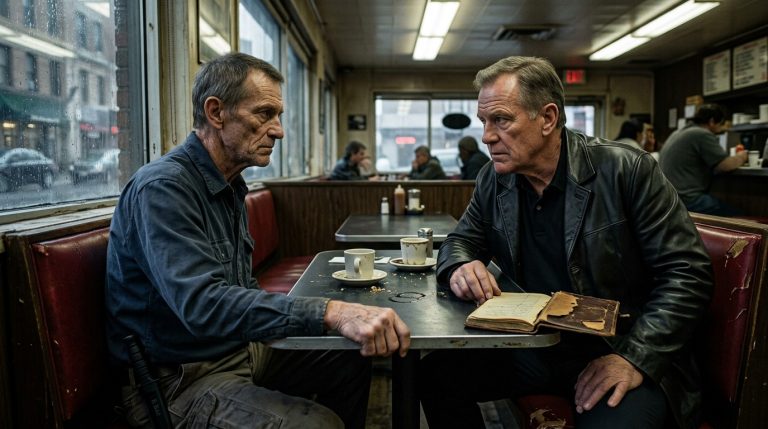
The third cube of sugar refused to dissolve. Glenn Patterson watched it with a detached, methodical intensity, his silver spoon turning the dark liquid in slow, concentric circles against the bottom of the thick ceramic mug. The ceramic was chipped near the handle—a gray, porous scar beneath the glaze that felt rough against his thumb every Tuesday and Thursday morning.
He didn’t look up when the air in the booth grew heavy. He didn’t need to. At eighty-one, the world no longer surprised him with its sudden movements; instead, it announced itself through the density of objects, the shift in ambient light, and the unmistakable smell of young men who carried the weight of government-issued steel beneath their civilian jackets.
“I’m talking to you.”
The palms that slammed onto the worn laminate table were massive, the knuckles cross-hatched with pale, jagged lines of scar tissue that only came from hitting things harder than bone. The young man leaning into Glenn’s space—Cutler, according to the sharp, aggressive cadence of his stride earlier—had eyes that were too bright, too empty of doubt. They were the eyes of a creature that believed the world had been built specifically for him to conquer.
Glenn let the spoon clink once against the inner rim. A tiny flake of dried coffee fell from the lip. He didn’t pull his left forearm back from the table. It rested there on the frayed yellow vinyl, sunspotted and thin as parchment, the blue veins tracing paths beneath skin that looked like old linen. And there, near the wrist, sat the serpent.
It was an ugly thing by modern standards. The ink had spread into the deep dermis over fifty-eight years, transforming the crisp scales into a blurred, slate-gray smudge. The snake swallowed its own tail in a loop that wasn’t quite perfectly round, its head slightly flattened. Inside the circle, the five-pointed star was uneven, the top point leaning two millimeters to the left—the unmistakable signature of a tool held by fingers slick with river mud and sweat.
“What about it?” Glenn’s voice didn’t rise to meet the young man’s heat. It remained down in the gravel, a low, dry rasp that sounded like boots grinding over gravel.
“The tattoo,” Cutler said, his smirk widening as his partner, a quieter man with the shadowed jaw of someone who spent too much time behind optics, tried to tug his sleeve. “Leave it, man,” the quiet one muttered, his eyes darting toward the counter where Sarah had stopped her coffee pot mid-pour.
But Cutler was already fed up with the stillness. He wanted a reaction; he wanted the small, satisfying tremor that usually came when men of his size occupied a room. “Some kind of biker club? The geriatric guzzlers? We don’t much care for people wearing things they didn’t sweat for around here, old man. Stolen valor’s a nasty habit.”
Glenn looked past the scarred knuckles, past the crisp collar of the young man’s shirt, and out the grease-filmed window toward the distant pines of Fort Liberty. The sun was hitting the pine needles, turning them the color of old copper. For a second—just the space between two heartbeats—the smell of bacon grease and burnt toast vanished. The air became thick with the suffocating, sweet rot of the tri-border jungle, the heavy wump-wump of a rotor blade bleeding through the floorboards of his memory, and the cold, wet touch of a bamboo sliver dipped in gunpowder black.
He felt the young man’s thick finger tap directly against the faded star on his skin. A casual, dismissive prod.
The contact was a small spark in the quiet diner, but beneath Glenn’s placid surface, the ancient mechanism clicked. He didn’t flinch. He simply pulled his arm back, millimeter by millimeter, until the ink was hidden beneath the fraying cuff of his flannel shirt, leaving the space between them completely empty.
CHAPTER 2: THE KEYPAD WINDOW
The silence didn’t just fall over the Scrambled Egg; it pooled around Glenn’s booth like stagnant river water. Cutler’s hand hung in the air for a fraction of a second, his thick fingers still twitching with the residual energy of that dismissive tap against Glenn’s faded skin. He looked down at his own hand, then back at Glenn, a minor flicker of confusion clouding his sharp eyes. He had expected a flinch, a sudden tightening of the jaw, or perhaps the familiar, defensive bristling of an old man whose pride had been clipped. He got nothing but the steady, rhythmic rise and fall of Glenn’s flannel-covered chest.
Across the table, Reyes shifted his weight, his rubber-soled boots giving a short, sharp squeak against the linoleum flooring. “Cutler,” Reyes said again, his voice dropping an octave, carrying the distinct, flat tone used in the field when an element was moving out of its designated sector. “Sit down. Now.”
Cutler didn’t sit, but he didn’t lean in further either. The smugness on his features had stiffened into something more rigid, a defensive posture masked as authority. “Just checking the paperwork, Reyes,” he muttered, though his eyes never left the blurred outline of the serpent hidden beneath Glenn’s cuff.
Three booths away, Sarah didn’t wait to see if the young man’s hand would drop a second time. Her fingers closed around the handle of the glass coffee pot with enough force to turn her knuckles the color of skim milk. She didn’t make a sound as she set the pot down on the rubber mat next to the cash register. She didn’t look at Glenn, and she certainly didn’t look at the two massive frames blocking the sunlight from the front window. She knew every creak in the diner’s floorboards—which ones groaned under a light step, and which ones remained silent if you kept your weight on the outer edges near the wood trim.
She slipped past the pie case, her apron brushing against the corner of the counter with a faint swish. To anyone watching, she was simply heading toward the back to fetch a fresh tub of butter or a stack of clean saucers. But once she cleared the swinging kitchen door, the smell of grease and pancake batter sharpened into the narrow, unventilated musk of the back office.
The office was little more than a converted pantry, crammed with stacks of old invoices, a single metal desk, and a small window that looked out onto the gravel alley behind the building. The glass was coated in a fine layer of gray dust that softened the harsh morning light into a pale, milky haze. Sarah reached into the pocket of her uniform, her fingers locating the ridged plastic casing of her old flip phone.
Her hands were shaking. Not with fear—she had buried enough family in this county to be done with simple fear—but with the cold, concentrated anger that comes from watching an old tree get kicked by a stray dog. She flipped the phone open, the small internal screen casting a weak blue glow across the columns of paper on the desk. She pressed the memory key for the third speed-dial slot. Her cousin Stacy’s schedule at the Joint Special Operations Command building was predictable; at this hour, she would be sitting behind the grey desk outside the inner vault, her headset clicked over one ear.
The line clicked. A rhythmic, sterile hum filled the small earpiece, followed by the crisp, standardized greeting that Stacy used when she had her professional face on. “General Thorne’s office, this is Senior Airman Miller.”
“Stacy, it’s Sarah,” she whispered, her voice tight, pressed close to the phone’s microphone to keep the sound from traveling through the thin wood of the kitchen door. “Listen to me. I don’t have a lot of time before they wonder where the coffee went. There are two of your boys here. Big ones. Civilian clothes, but they’ve got that post-line look about ’em.”
On the other end, five miles away inside the concrete perimeter of Fort Liberty, a chair creaked. “Sarah? If they’re causing a scene, you need to call the local sheriff or the military police detail. I’m deep in the morning log here—”
“No, you aren’t listening to me, Stacy,” Sarah interrupted, her eyes fixed on a fraying cardboard box of receipt books on the shelf. The light through the dusty window showed the individual motes of dust drifting in the air, lazy and unbothered. “They aren’t just loud. They’re sitting in Glenn’s booth. They’re putting hands on him.”
“Glenn? Old Mr. Patterson?” Stacy’s voice shifted slightly, losing a fraction of its administrative frost. “Sarah, he’s eighty. Just tell them to leave him be.”
“They’re mocking him, Stacy. They’re calling him a phony. They’re poking at that old blue ink on his arm—the one with the snake swallowing itself and the little star in the middle.”
The silence that followed didn’t belong on a telephone line. It was instantaneous, a sudden dropping away of the background office noise on the other side, as if Stacy had physically clamped her hand over the receiver. Sarah held her breath, listening to the faint, high-pitched whine of the long-distance connection.
“Stacy?”
When her cousin spoke again, the professional cadence wasn’t just gone; it had been replaced by a thin, sharp edge that made Sarah’s thumb go cold against the plastic battery cover. “Describe the mark again, Sarah. Exactly how he wears it. Don’t leave anything out.”
“It’s on his left arm,” Sarah said, her whisper dropping lower still, her body leaning against the cold metal of the filing cabinet for balance. “The snake’s tail is in its mouth. The star inside… it ain’t straight. The top point leans a little bit to the side. Like it was done by an amateur.”
A heavy intake of air rattled through the speaker. “And you’re sure it’s Glenn Patterson? That’s the name on his ticket?”
“He’s been buying the same eggs here for twelve years, Stacy. Of course I’m sure.”
“Listen to me very carefully,” Stacy said, her words coming out in a fast, low clip that sounded like she was reading from a manual she hadn’t wanted to open. “Do not go back out there and look at them. Do not try to move Mr. Patterson. If those men try to get him out of that booth, you find a way to delay them. Spill something. Drop a plate. Anything. Just don’t let them leave that property.”
“Stacy, what is—”
The line went dead with a dry, mechanical click. Sarah remained standing in the narrow slot between the desk and the wall, the phone still pressed to her ear until the screen went dark and reflected her own tired, pale face in the glass. Outside the office door, the low murmur of the diner hadn’t returned. The space remained caught in that single, frozen micro-second, waiting for whatever was coming down the road.
CHAPTER 3: THE VAULT INTERRUPTION
The mechanical snap of the telephone circuit leaving the line echoed like a miniature pressure wave inside Stacy Miller’s headset. For three seconds, she didn’t lower her hand from the desktop. Her fingers remained poised above the flat, non-reflective keys of her logistics terminal, the pale amber text of the morning transport manifests reflecting in tiny, sharp geometric blocks across her safety lenses. The air inside the Joint Special Operations Command anteroom was heavily filtered, carrying a dry, chemical chill that always smelled faintly of static electricity and starched wool.
Through the heavy, triple-glazed security window to her left, the main corridor of the command suite was silent. The brass fittings on the oak partitions looked dull under the recessed fluorescent tubes, their edges worn soft by thirty years of passing shoulders and starched sleeves. Stacy took a slow, deliberate breath, the starched fabric of her uniform collar scraping against her jawline as she pulled the headset down around her throat. Her palm was damp where it had pressed against the plastic casing.
The description Sarah had given wasn’t a designation found in the standard field manuals. It didn’t exist within the active inventory logs, nor was it part of the standardized symbols assigned to the modern tier-one elements operating out of Fort Liberty. But Stacy had spent thirty-six months filing the unvouched travel vouchers and the non-numbered operational requests that filtered down from the old administrative archives—the folders bound with thick, faded cotton twill instead of plastic rings. She knew the ghost stories. She knew that before the modern nomenclature was formalized, before the committees and the appropriations bills drew bright lines around the shadow tier, there were men who existed solely as line-item discrepancies in old logistics ledger books.
She stood up, her chair making no sound as its rubber casters rolled back over the anti-static matting. Her boots felt heavy, each step toward the inner vault door sounding distinct and deliberate against the tight weave of the government carpet.
The heavy, steel-reinforced door to the Sensitive Compartmented Information Facility—the SCIF—was sealed with an acoustic gasket that whistled softly when the pressure differential shifted. Behind it, General Marcus Thorne was currently conducting a closed-door operational review with his component commanders. A single red LED glowed above the keypad, indicating a locked, top-secret briefing state. Protocol was a rigid, unyielding structure in this building; to breach that line without an active perimeter warning or an automated distress signal was an action that could dismantle a career before the door finished swinging shut.
Stacy reached the threshold and stopped. The brass plate on the door frame was slightly tarnished around the screws, a faded texture that matched the rest of the aging wing. She didn’t use the electronic interphone. Instead, she lifted her right hand and rapped her knuckles firmly against the center panel—three sharp, heavy strokes that sounded remarkably like the telephone click that had started the sequence.
The small inspection slide slid back with a dry scrape. A colonel with sharp, bloodshot eyes and an eagle pinned precisely to his starched lapel looked through the thick glass, his brow furrowed into a tight, dark knot of immediate professional annoyance. He cracked the door exactly two inches, the acoustic seal releasing with a low hiss.
“Airman,” the colonel whispered, his voice sharp enough to cut through the hum of the corridor’s cooling vents. “We are in a closed session. This log is sealed until eleven hundred. Return to your desk.”
“Sir, with all due respect, I need to pass a message to the general,” Stacy said, her voice remaining level, pitched at the flat, unemotional cadence required for tactical transmissions. She didn’t lower her eyes. “It concerns an off-post incident involving active personnel from the unit.”
“The military police detail handles domestic infractions, Miller. File the notification and wait for the break.” He started to ease the door back into its seating.
“The subject of the incident is Glenn Patterson, sir,” Stacy said quickly, her hand moving slightly forward to catch the edge of the steel frame, keeping her palm flat and visible. “They are currently documenting a field symbol at the Scrambled Egg diner. A serpent swallowing its own tail. Internal five-point star, offset to the left.”
The colonel’s hand froze on the internal lever. The irritation on his face didn’t fade; it simply petrified, the muscles around his jaw locking into a rigid, pale mask. He didn’t look back into the room behind him. For two long seconds, he simply stared at Stacy’s safety lenses, checking the reflection for any sign of hesitation or administrative error.
He didn’t answer her. He pulled the door open another six inches, stepped aside, and allowed her to pass into the low-lit hum of the briefing room.
The interior of the SCIF was vast and gray, dominated by a long, oval conference table made of dark, polished laminate that reflected the shifting hues of three large satellite displays on the forward wall. The air here was colder, vibrating with the deep, bass thrum of the encrypted server racks beneath the floorboards. Around the table, seven men in service dress uniforms sat with their folders open, their faces pale under the downward glare of the task lighting.
At the head of the table sat General Marcus Thorne. His four silver stars glittered under the low lamps, but his face was half-hidden in the shadow of his hand as he studied a map overlay. He looked like an extension of the room’s concrete core—weathered, grey, and completely still.
“General,” the colonel said, his voice losing its sharpness and taking on a formal, cautious weight. “Airman Miller has a priority field update from the gate.”
Thorne didn’t look up immediately. His fingers, long and spotted with age but unmoving, traced the edge of a plastic divider. “This brief is unclassified within the command group, Colonel. Whatever it is can be logged at the half-hour.”
Stacy stepped past the colonel, her boots clicking once against the exposed metal trim of the floor box. She leaned down toward the general’s left ear, the scent of his old leather belt and standard-issue soap cutting through the sterile room air.
“Sir,” she whispered, her words carefully spaced. “A source off-post reports that two operators from the unit are currently confronting an individual at the diner down the road. The name given is Glenn Patterson. They are altering the posture of the interaction based on a mark on his forearm. A blue serpent with an offset star.”
The change was not a violent motion. It was a complete and instantaneous cessation of all sound from the general’s position. The plastic divider beneath his fingers didn’t snap, but his hand stopped moving entirely, his thumb pressing down until the skin over the nail went completely white. When he lifted his head, the light hit his eyes—they were pale, clear, and filled with a cold, old-world fury that seemed to drop the temperature in the room by ten degrees.
He looked at Stacy, not as an airman delivering a report, but as a man looking through a window into a dark room he hadn’t opened since 1968. The color didn’t just leave his cheeks; it seemed to sink back into his collar, leaving his face looking like carved granite under the grey lights.
“Repeat the name,” Thorne said, his voice a low, gravelly whisper that carried clearly across the silent table.
“Glenn Patterson, sir,” Stacy said.
Thorne rose. He didn’t push his chair back; he simply stood, and the heavy leather seat rolled away until it hit the rear partition with a dull thump. He looked at the component commanders, his eyes skipping over their stunned faces as if they were nothing more than empty desks.
“Get my personal detail,” Thorne commanded, his voice dropping into a guttural register that Stacy had never heard used in an office setting. It was the tone of an element leader on a hot LZ. “Get the Suburbans at the side ramp. Now.”
He didn’t wait for the colonel to move. He unbuttoned the top constraint of his service coat with a single, practiced jerk of his hand and strode toward the heavy door, his boots leaving dark tracks in the thin dust of the high-security carpet.
CHAPTER 4: THE SOUND OF SUBURBANS
The small glass salt shaker on the edge of Glenn’s table didn’t move much, but it began to hum. It was a fine, microscopic rattle, a rapid oscillation that caused the tiny white grains inside to crawl slowly toward the worn metal cap. Glenn felt it first through his left elbow, which rested against the yellow vinyl of the booth. The deep, systemic vibration wasn’t coming from the kitchen’s ancient refrigeration compressor. It was coming through the asphalt outside, moving through the concrete footing of the building, and rising up through the iron frame of his seat.
Cutler had his left hand wrapped around the upper sleeve of Glenn’s flannel shirt now, his fingers tightening just enough to bunch the thick plaid fabric into a hard knot. “All right, Grandpa,” Cutler said, his voice dropping into a flat, transactional drone that felt entirely out of place beneath the bright yellow breakfast signs. “Let’s take a little walk outside. You and me, we can talk about respect where it’s a bit quieter.”
Glenn didn’t lean away from the pull. His frail body remained light, almost anchorless against the massive bulk of the younger man, but his pale eyes stayed fixed on the dust motes drifting through the beam of morning sun that split the booth in two. He could smell the pomade in Cutler’s hair—something clean and chemically sharp, like eucalyptus—juxtaposed against the ancient, dry smell of his own skin.
“Cutler, drop it,” Reyes said, his hand coming down onto his partner’s forearm with a sudden, heavy slap. The quiet operator wasn’t looking at Glenn anymore; his head had turned ninety degrees toward the front plate-glass window. His jaw was tight, his nostrils flaring as he caught the shift in the ambient sound outside.
The roar didn’t arrive with the high-pitched wail of local authority sirens. It was a low, synchronized thrum, the unmistakable guttural growl of three heavy-duty six-liter V8 engines running in close formation, their exhaust notes bouncing off the brick facade of the hardware store across the road. Through the grease-filmed glass of the diner door, the light shifted from bright morning yellow to a dense, blocking shadow as three black, government-plated Chevrolet Suburbans swung into the gravel lot.
They didn’t park. They executed a precise, low-speed tactical envelope, the lead vehicle sweeping wide to block the exit lane while the trailing two pinched the flanks of Cutler’s parked sedan, their heavy steel brush-guards coming to a rest within three inches of the German engineering. The gravel beneath their wide tires didn’t just crunch; it shrieked, a sharp metallic grinding that died instantly as the doors flew open.
Inside the booth, Cutler’s grip on Glenn’s shirt went entirely slack. His fingers didn’t just open; they bounced off the flannel as if the fabric had suddenly grown hot. The arrogance that had spent the last ten minutes curing into his face didn’t shatter—it simply evaporated, leaving his skin looking grey and doughy under the fluorescent tubes.
“What the…” Cutler muttered, his boots scraping back as he tried to adjust his posture within the narrow confines of the booth.
Through the swinging door of the kitchen, Sarah emerged with a fresh tray of mugs she didn’t need, her eyes tracking the movement outside with a cold, silent satisfaction. The men stepping out of the black vehicles weren’t standard military police detail. They didn’t wear the high-visibility vests or the nylon duty belts of base security. They were men with silver-grey hair and faces like dried leather, wearing crisp, dark service dress uniforms with the silver lining of the command security detail showing at the cuffs. They moved with an unnerving, silent precision, forming a five-point perimeter around the diner’s wooden porch without a single word being exchanged.
The rear door of the center Suburban swung open with a heavy, armored thud that made the diner’s front door frame rattle in its casing.
A single foot appeared, clad in a low-quarter shoe polished to a mirror shine that caught the sharp glare of the Carolina sun. As General Marcus Thorne stood up, the silver stars on his shoulder epaulets flashed once through the dusty glass pane, a cold point of light that seemed to lock every eye in the Scrambled Egg into a permanent stare. He didn’t look at his security detail. He didn’t look at the parked vehicles or the handful of local contractors who had stopped their trucks at the edge of the road to watch. His eyes, dark and fixed as iron rivets, were locked entirely on the low glass door of the diner.
Glenn watched him through the window. He didn’t move his arm back from the table. He simply let his thumb slide over the gray, porous scar on his ceramic mug, tracking the long, heavy strides of the man who had once been a thirty-pound weight on his back through the tall grass of the tri-border. The general hadn’t changed the rhythm of his walk since the old days; it was still the same deliberate, heel-first stride of a man who assumed the ground beneath him would either hold his weight or get out of his way.
The small brass bell above the diner door didn’t ring when Thorne pushed it open—it gave a short, choked jingle as his massive shoulder caught the frame, his presence immediately sucking the remaining air from the small vestibule. The smell of high-grade leather, starched linen, and the bitter trace of command-suite coffee moved into the room, obliterating the stale grease and sugar that had hung there since dawn.
Cutler and Reyes were already on their feet, their bodies automatically snapping into the rigid, hollow-backed posture of the institutional elite. Their hands were pinned to the seams of their civilian trousers, their chins tucked back until the veins in their necks stood out like blue cords. But Thorne didn’t look at them. He strode past their booth as if they were nothing more than a pair of coat racks left in the aisle, his polished shoes coming to a dead stop exactly three inches from the edge of Glenn’s yellow laminate table.
The silence inside the Scrambled Egg was no longer stagnant; it was pressurized, the small crowd of regulars holding their breath as the general’s shadow fell completely over Glenn’s cooling coffee mug.
CHAPTER 5: THE HEELCLICK
The sharp, clean strike of General Thorne’s heels meeting on the grease-stained linoleum didn’t echo; it absorbed into the room like a sudden drop in barometric pressure. His back went ramrod straight, a line of absolute mechanical perfection executed in the middle of a five-dollar breakfast rush. His right hand came up, fingers locked, palm angled with the severe, textbook precision of an honor guard, rendering a silent salute toward the faded flannel shoulder of the old man in the booth.
Time didn’t just crawl inside the Scrambled Egg; it petrified. Cutler’s chin was still tucked back into his throat, his eyes wide and bloodshot as he watched the highest-ranking special operations officer in the United States military hold a posture of absolute submission before a man who smelled faintly of old wool and cheap tobacco. Cutler’s right knee gave a tiny, involuntary tremor against the edge of the laminate table.
Thorne held the salute for three full seconds, his eyes unblinking, fixed on a point just above Glenn’s silver hairline. When his hand finally snapped down to his seam, his chest remained chest-high, the row of ribbons on his left breast clinking softly like tiny sheets of slate.
“Glenn,” Thorne said. His voice was a low, heavy rumble that didn’t carry the administrative crispness of the JSOC briefing rooms; it was thick, weathered, and slightly cracked at the edges, sounding like a machine that hadn’t been run at full throttle in decades. “It’s been too long.”
Glenn didn’t lean back into the vinyl. He slowly lifted his pale blue eyes, the cloudy lenses catching the low morning light filtering through the yellow curtains. A faint, dry crease formed at the corner of his mouth—the barest ghost of a smile that didn’t quite disturb the deep wrinkles around his jaw. He picked up his silver spoon, letting the metal bowl rest against the inner lip of his mug with a dull, hollow clink.
“Marcus,” Glenn said, his rasp barely clearing the edge of the table. “You got old.”
A microscopic twitch altered the line of Thorne’s mouth—a grim, silent acknowledgment that lasted less than a second before his face hardened back into a block of dark granite. He turned his head exactly forty-five degrees to the right, his eyes sweeping over Cutler and Reyes with a level of frozen contempt that seemed to make the starched collars of their shirts look suddenly too tight.
“You,” Thorne said, his voice dropping into a register so quiet it required the entire diner to remain perfectly still to hear it. “You questioned this man’s lineage.”
Cutler swallowed. The sound was loud, a dry click in his throat that he couldn’t suppress. His fingers were still pinned to his outer seams, but they were trembling now, the tips of his fingernails pressing into the cotton fabric until the skin turned a bruised purple. “Sir,” he stammered, his chin shaking as he tried to find a baseline of operational discipline. “The… the identifier was not in the active registry. We were conducting a lineage validation based on the protocol—”
“Quiet,” Thorne whispered.
He didn’t shout. He didn’t need to. He reached down with his right hand, his fingers unbuttoning the heavy brass constraint at his right wrist with three slow, deliberate movements. He rolled the starched fabric back, past the silver watch strap, past the pale skin of his lower wrist, until his forearm was entirely exposed under the fluorescent tube.
There, etched into the darker, weathered flesh near the tendon, was the exact same serpent. The ink was newer than Glenn’s—the blue lines had been touched up sometime in the late nineties, the scales holding a sharper edge—but the anatomy was identical. The head was flattened where it met the tail, and inside the circle, the five-pointed star leaned precisely two millimeters to the left. The hand-carved irregularity was unmistakable; it was the work of the same primitive bamboo needle, historical DNA written directly into the skin of the high command.
A collective shift in weight rippled through the regulars near the counter. Sarah didn’t drop her tray, but she lowered it onto the formica with a slow, deliberate care that kept the metal handles from rattling.
“Let me clarify the ledger for you, operator,” Thorne said, his eyes drilling into Cutler’s pale face until the younger man had to shift his gaze downward toward the salt shaker. “Before there was a command architecture in this county, before the manuals were printed in gray ink, there was a five-man element sent into the southern slots to establish the baseline. They were called Project Omega. They didn’t have names on their vouchers. They didn’t have service records in the vault.”
Thorne stepped closer, his chest nearly brushing the shoulder of Cutler’s jacket, forcing the younger man to lean back against the partition to keep his balance. “In 1968, deep inside the neutral sectors of the Laos border, an entire battalion spent twenty-two days trying to scrub that five-man element from the map. This man—Glenn Patterson—carried an injured lieutenant through four miles of river mud with a broken collarbone and an empty magazine to reach the extraction frame. That lieutenant was me.”
He let the words settle into the vinyl. The thrum of the black Suburbans idling in the gravel outside seemed to grow louder, filling the spaces between Thorne’s breath.
“Of the five men who earned this mark with gunpowder and river water,” Thorne said, his voice dropping into a surgical whisper, “only two are breathing today. You are currently standing between both of them.”
He looked down at Cutler’s hand—the one that had held Glenn’s flannel sleeve sixty seconds ago. The young operator’s knuckles were white, the skin around his scars looking raw and distinct in the cold light. Thorne rolled his sleeve back down, his fingers locking the brass cuff button with a sharp, final click that sounded like an operational order being closed.
“My office,” Thorne said, his voice returning to the flat, unemotional cadence of the JSOC suite. “Zero five hundred tomorrow morning. Bring your credentials, operator. You are finished with the tier.”
CHAPTER 6: THE LEGACY DIRECTIVE
The words left Thorne’s lips not as a shout, but as a low-frequency vibration that seemed to settle directly into the joints of the diner’s structural beams. Cutler didn’t look up. His gaze remained pinned to the dull zinc surface of the napkin dispenser, his eyes wide and completely unblinking as his shoulders sank roughly three inches. The rigid, textbook posture that had defined him for his entire adult life didn’t crumble—it slowly, systematically deflated under the weight of the general’s presence.
Beside him, Reyes remained frozen, his chin tucked so deeply into his collar that the tendons in his neck looked like taut wire under the skin. He knew the mechanics of the command; a verbal directive issued by a four-star element commander in front of a civilian theater was not an opening for an appeal. It was a structural deletion.
Thorne didn’t look back at them to confirm if the order had been absorbed. He shifted his bulk slightly, the heavy gold piping on his shoulder strap catching the dusty sunlight as he turned his attention toward the small hallway that led to the kitchen. His eyes didn’t slide or wander; they tracked with a cold, radar-like precision until they found Sarah, who was still holding the empty tray against her apron, her knuckles white against the battered aluminum rim.
“Sarah,” Thorne said, his voice dropping into a raspy, flat cadence that held a strange, familiar warmth beneath the command-suite steel. “Get these two out of my sight line. Send them to the security detail at the perimeter. They can wait in the rear truck until the documentation is drafted.”
Sarah gave a single, slow nod. She didn’t say a word, nor did she look at Cutler as the young man finally began to move. His boots dragged against the linoleum with a heavy, hollow scrape, the sound completely devoid of the sharp, rhythmic click that had announced his arrival forty minutes prior. Reyes followed a half-step behind, his head remaining lowered, his arms pinned rigidly to the sides of his civilian trousers as they pushed past the wooden door frame and into the bright, unyielding glare of the gravel parking lot.
The brass bell above the entrance gave a short, metallic rattle as the door swung closed behind them, leaving only the sound of the three black Suburbans idling out front—their deep, systemic exhaust notes vibrating through the floorboards like a distant storm.
Thorne didn’t sit down. He stood in the narrow space between the counter and the booth, his polished low-quarters inches from the yellow vinyl paneling. He reached into the inner breast pocket of his uniform coat, his fingers returning with a small, unadorned leather folder. The leather was split along the spine, a faded texture that had turned a pale, chalky gray from years of being carried in hot pockets and field packs. He didn’t drop it on the table; he placed it down with a slow, deliberate care that didn’t make a sound against the laminate.
“The registry isn’t empty, Glenn,” Thorne said softly, his voice barely rising above the low thrum of the idling V8s outside. “It’s just kept on a different ledger. The kids… they don’t look at the foundation until the walls start to lean.”
Glenn looked down at the folder. He didn’t open it. His hand, thin and spotted with old sun-damage, remained resting near the base of his ceramic coffee mug, his thumb tracing the small, porous scar in the glaze where the white porcelain showed through. The warmth of the liquid was almost gone now, leaving a dark, reflective skin on the surface of the coffee that captured the reflection of the three silver stars pinned to Thorne’s collar.
“They look at what you teach ’em, Marcus,” Glenn said, his low rumble dry as sand. “You give ’em shiny tools and a lot of loud engines, they’re going to think the world’s made of iron. They forget that iron rusts if you leave it in the rain long enough.”
Thorne let out a slow, heavy breath through his nose, a sound that carried the distinct, dry weariness of a man who spent his nights reading casualty projections and budget appropriations under fluorescent tubes. He reached down and pulled the other side of the yellow vinyl booth back, his large frame fitting into the narrow seat with a heavy, metallic creak from the internal springs.
“The training pipeline’s changed,” Thorne muttered, his eyes drifting toward the window where the command security detail was currently closing the rear doors of the trailing vehicle. “It’s all velocity now. They want them in the field in sixteen months. No history. No lineage. Just numbers and profiles.”
“Then change it back,” Glenn said simply. He didn’t lift his head, but his fingers finally moved away from the mug, sliding over the old leather of the folder Thorne had left between them. The texture was rough, holding the specific friction of old grease and field sweat that could never be entirely cleaned out of the grain. “You’ve got the stars, Marcus. Use ’em to buy some time for the ones coming up. Before they lose the only thing they actually own.”
Thorne didn’t answer immediately. He looked at Glenn’s left forearm, where the cuff of the flannel shirt had slipped back just enough to reveal the flat, gray tail of the serpent swallowing itself. The lines were so old they seemed to be a part of the skin itself, like the dark grain in a piece of old oak that had been pulled from a swamp.
“I’ll draft the directive before the noon log,” Thorne said, his voice tightening into an operational line that Stacy Miller would have recognized instantly from the SCIF suites. “A mandatory block. No gear. No range time. Just the legacy. We’ll bring the old heads in from the line—the ones who still remember how to move in the dark without a battery pack.”
He leaned forward, his massive palms flat on the table, his eyes locking onto Glenn’s face with a quiet, unyielding intensity. “And you’re going to be the first name on the syllabus, Glenn. I’m not letting you sit in this booth until the ink turns white.”
Glenn’s thumb ran once more over the split spine of the leather folder. The light through the grease-filmed window was shifting now, the sun climbing higher into the Carolina sky, turning the gravel lot outside into a white, blinding sheet of heat.
“Get me a fresh cup of coffee first, Marcus,” Glenn said, his voice falling back into the low, placid gravel of his Tuesday routine. “This stuff’s gone cold while you were busy making a scene.”
CHAPTER 7: THE FRICTION OF IRON
The steel bin labeled 3/8-Inch Hex Bolts was deep, cold, and smelled faintly of zinc oxide and machine fluid. Glenn Patterson’s fingers, stiffened further by the passage of another winter, sorted through the heavy, threaded metal pieces with a slow, dry rustle. Each bolt clinked against its neighbor like cold teeth. He was looking for a specific pitch—something thick enough to bite into the sheared casting of his old three-horsepower lawnmower housing. The hardware store aisle was narrow, flanked by towering walls of green-painted steel shelves that held the accumulated grease and dust of forty years of small-town repairs.
The air in the back of Miller’s Supply was unheated, carrying the sharp, metallic bite of iron filings and old fan belts. It was the kind of quiet Glenn preferred on a Thursday afternoon, a space where the world moved only as fast as a manual tape measure could slide.
A boot heel clicked against the concrete floor two aisles over. It wasn’t the soft, yielding step of a local mechanic or the uneven stride of a retired farmer. It was a flat, even, double-tap—the distinct heel-toe compression of an institutional issue sole that hadn’t quite forgotten how to keep its weight perfectly centered over the arch. Glenn didn’t lift his head from the bin. He simply let his thumb slide over the coarse threads of a three-inch zinc bolt, his internal clock counting the steps as they slowed down near the end of the aisle.
A shadow fell across the drawer bin, blocking the weak light from the overhead fluorescent fixture.
“Sir.”
The voice was lower than it had been twelve months ago. The young, razor-edged arrogance that had once marinated every syllable inside the Scrambled Egg diner had been scoured out, replaced by the flat, raspy cadence of a man who spent his mornings reading logistics logs and loading manifests for cross-country veterans’ transport details. Cutler stood at the entrance of the fastener row, wearing a faded olive-drab army physical training sweatshirt and a pair of standard utility trousers. His massive frame was leaner now, the heavy granite muscles around his neck tucked into a more subdued, functional posture.
Glenn held the bolt up to the gray light, checking the shoulder for irregularities. “The threads on these imports are usually cut too thin,” he murmured, his low rumble dry as parchment. He didn’t look at Cutler’s face. “You have to go to the industrial bins if you want something that won’t strip the head the first time you hit a root.”
Cutler didn’t step into the row. He remained at the threshold, his large hands clasped loosely in front of his belt, his fingers unmoving. The scarred knuckles that had once slammed onto Glenn’s laminate breakfast table were hidden beneath the line of his cuffs, but his shoulders held none of the old, combative weight.
“Mr. Patterson,” Cutler began, his voice hesitant but entirely level. “I didn’t think I’d run into you outside the route. I… I wanted to say something. Properly.”
Glenn turned the bolt in his hand, his thumb catching the edge of the hexagonal head. The cuff of his gray flannel shirt had pulled back slightly, exposing the blurred slate-gray tail of the serpent swallowing itself against the spotted parchment of his skin. The star inside the circle remained crooked, its top point leaning those two small millimeters to the left—a tiny, permanent discrepancy that had outlasted three command structures and a dozen modern deployments.
Cutler’s eyes flicked down to the mark, then immediately back up to Glenn’s shoulder. There was no mockery in his expression now; there was only the specific, quiet fatigue of a man who had spent three hundred days driving eighty-year-old veterans to clinic appointments, listening to the unrecorded details of things done in countries that officially never appeared on the map.
“I spent the last ten months handling the legacy logistics at the archive wing, sir,” Cutler said softly, the words coming out with a slow, deliberate weight. “We logged the personal files from the sixty-eight slots. The non-attributed segments. I… I saw the original ledger entries for the extraction at the tri-border.”
He took a short, sharp breath through his nose, his jaw tightening into a hard knot before he let it go. “What I did that morning in the diner… it wasn’t just undisciplined. It was wrong. I was blind to everything that came before the gate, and I had no right to touch that ink. I’m sorry, sir. For all of it.”
Glenn let the zinc bolt drop back into the iron bin. The sound was a loud, singular clank that seemed to clear the remaining air between them. He turned his body slowly, his worn work boots grinding a small pinch of dry earth into the concrete floor as he faced the younger man. He looked at Cutler’s eyes—they were clear now, the empty brightness gone, replaced by the heavy, shadowed understanding of a soldier who had finally learned the difference between the uniform and the history written underneath it.
Glenn extended his hand. His fingers were crooked and lined with gray grease from his mower engine, but his palm was steady.
Cutler looked at the hand for a fraction of a second before stepping forward, his large, scarred fingers closing around Glenn’s grip. He didn’t execute a performance of strength; he held it with the precise, controlled reverence required when handling a piece of old silk or an unexploded casing. The old man’s grip was surprisingly firm, the skin dry and rough as horsehide against Cutler’s palm.
“We all have things to learn, son,” Glenn said, his pale blue eyes holding the young operator’s gaze until the tension in Cutler’s shoulders finally released its last anchor. “The world gives you a lot of noise when you’re young and you think you’re the first ones to build a fire. The important thing is that you just keep learning how to handle the smoke.”
He gave Cutler’s hand a single, firm nod, then released the grip, his fingers sliding back toward his pocket. He turned his attention back to the iron bins, his eyes searching the smaller compartments for the matching zinc nuts.
“Get back to your detail, operator,” Glenn added quietly, his voice returning to the slow, methodical pace of his Thursday afternoon. “Marcus doesn’t like his logs running behind, and I’ve got a lawn to cut before the rain comes in.”
CHAPTER 8: THE WARMTH REMAINING
The iron bin at Miller’s Supply grew distant as the afternoon sun collapsed into the western tree line, bleeding its heat into a pale, violet haze that settled over the county. The transition back to the Scrambled Egg was a slow, deliberate march through shifting shadows. Glenn Patterson stepped across the threshold of the diner exactly as the neon sign beneath the eaves flickered to life, its weak crimson hum throwing soft geometric lines across the worn wooden porch. The air inside had cleared of the midday heat, holding only the thin, sweet aroma of fresh chicory and the faint, grounding musk of floor wax drying in the corners.
He walked toward his booth—the third one from the door, where the vinyl was split near the seam. Marcus Thorne was already sitting there. The general had stripped his service coat away, leaving only his starch-stiffened olive undershirt and the dark leather of his shoulder holster, its brass buckles holding the patina of decades of administrative and field friction.
“The import bolts were cut wrong,” Glenn said, his low rumble scraping through the quiet space as he slid his frail frame back onto the yellow seat. “I had to find an old domestic die-set in the back of the shelf just to chase the threads.”
Thorne didn’t look up immediately from his coffee. His large, sun-spotted hand was cupped around a fresh ceramic mug—one without chips, which Sarah had set out specifically for his arrival. “The pipeline directive went through at noon, Glenn,” Thorne muttered, his voice dropping below the low hum of the refrigeration tubes behind the counter. “The legacy block is locked into the budget. The modern candidates start their documentation review before they ever touch an operational receiver.”
Glenn didn’t answer right away. He reached into his coat pocket and pulled out the old three-horsepower lawnmower casting—the small, fractured aluminum bracket that had kept him occupied for three days. He placed it on the laminate table between them. The metal was pitted, darkened by decades of grass stains and dry earth, its mounting eyelet sheared clean through the middle. He pulled a small steel file from his sleeve and began to work the edge, the rhythmic, high-frequency scritch-scritch of the teeth biting into the metal filling the space between them.
“You didn’t do it for the registry, Marcus,” Glenn said without breaking the rhythm of his stroke. He watched the tiny, silver flakes of aluminum gather on the yellow tabletop like frost. “You did it because you were tired of looking at walls that didn’t have any mortar left in ’em.”
Thorne let out a slow, dry breath, his thumb tracing the blue tail of the serpent on his own forearm. The ink looked vivid next to the pale white starched fabric of his rolled-up sleeve, a sharp contrast to the faded, ink-smeared parchment of Glenn’s skin. For thirty years, Thorne had kept the ledger locked, hiding the true nature of Project Omega’s final mission—not to preserve a black-budget appropriation, but to protect the quiet pact made by five men who had agreed to become ghosts so the line could breathe. The modern operators had been chasing a decoy secret, a false bottom engineered to test their discipline, while the absolute reality sat right here in a vinyl booth, filing a lawnmower bracket in the twilight.
“They needed to know who laid the track, Glenn,” Thorne said softly, his eyes settling on the irregular star inside the snake’s loop. “They thought the tier was built out of titanium and satellite links. They forgot about the bamboo.”
Sarah stepped up to the edge of the booth, her movements light and unhurried as she set a fresh pot of coffee down on a rubber mat. She didn’t offer a word of exposition or domestic small talk. She simply lifted Glenn’s chipped mug, filled it until the dark liquid reached exactly a quarter-inch below the rim, and slid the silver spoon back into its place against the porcelain. She looked at Glenn for a single, quiet heartbeat—a silent validation of the order she had restored with a single phone call—before turning back toward the kitchen, her apron rustling softly against the dark wood trim of the counter.
The scritch-scritch of Glenn’s file slowed, then stopped entirely. He wiped the silver dust away with the side of his thumb, revealing the clean, bright edge of the repaired aluminum casting. The sheared eyelet was smooth now, ready to receive the zinc bolt he had chased by hand in the unheated aisle of the hardware store.
“The kids will be fine, Marcus,” Glenn said, his pale blue eyes lifting to meet the general’s gaze as the last remainder of the day’s tension dissolved into the warm amber light of the diner. “As long as you don’t let them forget how to sit in the quiet. The ink don’t mean a thing if the man wearing it can’t stand the silence.”
Thorne lifted his mug, the dark surface of the coffee reflecting the fading purple of the sky outside the window. He didn’t render another salute; he simply held the ceramic against the light for a fraction of a second before taking a slow, steady sip. Outside, the black Suburbans remained parked in the gravel, their lights dark, their engines cold, completely absorbed by the ancient, unmoving shadows of the Carolina pines.