The Echo of Silence: A Soldier’s Journey Home and the Unmaking of a Fragile Ego
CHAPTER 1: THE WEIGHT OF THE COLD CUP
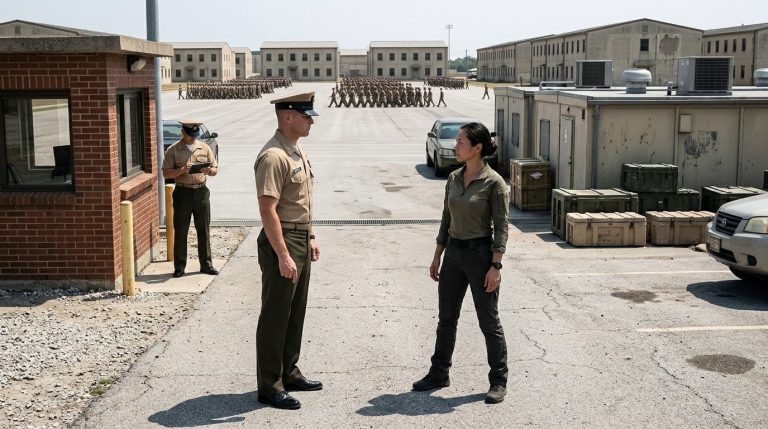
The mess hall at Camp Lemonnier was a cavern of stale air and the lingering scent of diesel. At 21:47 hours, the base had settled into a deceptive, rhythmic quiet. Chief Petty Officer Ethan Cole sat in the far corner, his back to the wall, his civilian boots tucked neatly beneath the table. He was forty-one years old, but in the dim, buzzing light of the canteen, he felt every one of his twenty-one years in the Teams as if they were physical weights stitched into his coat.
In front of him lay an open leather wallet. His fingers, calloused and mapped with the fine white lines of a lifetime of work, hovered near a photograph. It was Wyatt—his son, Caleb—back in Virginia Beach, holding a tiny, shimmering bass with a pride that made Ethan’s own chest ache. It was a bridge to a life that felt a million miles away, a life of fishing rods and missing teeth, currently three weeks out of reach.
The door slammed open, cutting through the silence like a gunshot.
Six men spilled in, radiating the kind of loud, unearned confidence that only comes from being the biggest fish in a pond that hadn’t yet realized the ocean was coming. Sergeant Brett Halloran, six-foot-four of thick-necked bravado, led the pack. They knocked over a chair, stole a sandwich from the young, wide-eyed corporal behind the food line, and claimed the central table.
Ethan didn’t look up. He felt the shift in the air—the way the room’s ambient hum died, the way the radio operators and mechanics began to evaporate from the hall, sensing the atmospheric pressure of the wolf pack. He just took a slow, steady sip of his black coffee, tasting the bitterness, grounding himself.
“Hey, grandpa,” Halloran’s voice boomed, jagged and abrasive.
Ethan continued to look at the photograph. He traced the line of his son’s smile. The right hand, resting on the laminate table, curled into a fist—slow, controlled—and then relaxed.
“I said hey, you deaf?”
Halloran was looming now, a shadow that blotted out the hum of the fluorescent lights. The smell of chewing tobacco and aggressive youth rolled off him. Ethan didn’t move. He didn’t rise. He simply finished his coffee, set the cup down with a soft clack, and looked up.
He didn’t glare. He didn’t sneer. He just looked—with a quiet, patient, and terrifyingly steady gaze that forced the smile on Halloran’s face to waver. It was the look of a man who had seen the bottom of the world and realized it wasn’t worth shouting about.
“That,” Halloran said, his voice dropping into a dangerous, performative growl, “is the senior officer’s mess. You some kind of janitor?”
Ethan leaned back, his eyes tracking the way the fluorescent lights flickered above them. He wasn’t seeing a bully. He was seeing a man who was desperate to be noticed because he had never learned how to be seen.
Halloran reached out, his hand snapping toward the coffee cup. He knocked it across the table with a sharp, violent flick. The cup spun, arced through the air, and shattered against the wall. Coffee sprayed the floor like dark, cooling ink.
The room hit a vacuum of silence so deep it felt like it might collapse on itself. The kid behind the food counter stopped breathing.
Ethan looked at the shards of ceramic on the floor. He didn’t flinch. He didn’t get angry. He only felt a deep, resonant sadness for the boy in the uniform standing over him.
“That was my coffee,” Ethan said, his voice flat, quiet, and impossibly calm.
Halloran’s grin, forced and brittle, stretched thin. “Did I spill your little drink? You want to cry about it?”
Ethan stood up. He didn’t reach for a weapon. He didn’t pose. He simply rose to his full height, his eyes fixed on Halloran’s throat, seeing the frantic, rhythmic pulsing of a man who was currently digging his own grave with a teaspoon. He realized then that Halloran wasn’t just a pest; he was a mirror, and it was time for him to see his own reflection.
“No,” Ethan said softly. “I don’t want to cry about it. But I do want you to listen, Sergeant. Because you’re about to make a choice that you won’t be able to undo.”
Ethan reached into his breast pocket and tucked the wallet away. As his hand brushed the photograph, the weight of his promise to his late wife pulsed in his mind—Don’t let it turn you cold, Ethan. He would keep that promise. He would save these men, even if he had to break them to do it.
CHAPTER 2: THE SAND AND THE PROMISE
Ethan stepped out of the mess hall, the heavy, grease-scented air of Camp Lemonnier clinging to his skin like a second coat. The desert night was a vast, indifferent velvet, stretching away from the base lights into a profound, suffocating black. He didn’t look back. To look back would be to acknowledge the pettiness of the confrontation, and Ethan had no room for pettiness in a life measured in three-week intervals.
His boots crunched on the gravel, a steady, rhythmic sound that kept his heart rate anchored in the low fifties. Each step was a calibration. He felt the weight of his own physical form—the lingering ache in his lower back, the phantom itch of old scar tissue on his left forearm—and he processed them as data. He was a machine built for a specific, quiet purpose, and tonight, the purpose had shifted.
He walked past the hum of the generator farm and toward the narrow, poorly lit path that bordered the training range. In his breast pocket, the wallet pressed against his ribs, a reminder of the boy with the missing teeth.
Suddenly, the desert wind shifted, carrying with it the smell of ozone and scrub brush. The scent triggered a flash of memory—not the desert, but the sterile, antiseptic white of a hospital ward three years ago. He felt the cold, plastic texture of a bedside chair and the fragile, thinning warmth of his wife’s hand as she reached for a wooden block to carve. Don’t let it turn you cold, Ethan. The memory was a sudden, freezing phantom, a psychological hitch in his stride that forced him to stop dead in his tracks.
He stood in the darkness, the sand whispering against his pant legs. He had to breathe. He closed his eyes, forcing the image of the hospital bed to dissolve, replacing it with the image of Caleb holding that small, silver-scaled bass. Presence. He had to remain present. The Marines—Halloran and his pack of loud, posturing boys—were just noise. The real conflict was the one between his own capacity for violence and the vow he had made to that fading, brave voice in his memory.
He began to walk again, his pace slightly more deliberate. He had cataloged them in the mess hall. Halloran: the apex of the fragile ego, the one who lived for the volume of his own voice. Riggs: the follower, the one who needed the pack to feel his own teeth. Diaz: the one with the hesitation, the latent capacity for something better if the pressure was applied at the right angle.
He reached his quarters, a small, utilitarian box that offered nothing but a bunk and a desk. He didn’t turn on the light. He didn’t need it. He moved to the desk where his gear was already laid out in a precise, geometric grid.
He didn’t reach for a rifle. He didn’t reach for tactical comms or NVGs. He reached instead for his own skin, for the reality of his own body. He stood in the center of the room and began to move, a slow, silent kata of muscle memory, testing his center of gravity, shifting his weight. He was preparing not for a fight, but for a dismantling.
His phone buzzed on the desk. A standard operational alert from Colonel Reeves—a notification that the “exercise” for tomorrow night had been quietly cleared on the schedule. Ethan didn’t read the message. He knew the parameters. Reeves understood the unspoken language between them; the Colonel knew that if Ethan were to go out there, he wouldn’t just be meeting them for a drill. He would be holding a mirror up to their collective face, and they would either see the truth or shatter against it.
He sat down on the edge of the bunk, the springs groaning softly. He looked at his hands. They were steady. He had twenty-one years of service, and every year had been a lesson in knowing exactly when to apply force and when to withhold it. Tonight, the withholding was the harder task.
He thought of the mess hall again. The look in Halloran’s eyes hadn’t been malice; it had been hunger. The man was starving for relevance, and he was trying to fill that emptiness with noise. Ethan understood that hunger. He had felt it himself, decades ago, when he was young and loud and convinced that the only things that mattered were the ones you could hold in your sights.
He reached into his pocket and pulled out the small, wooden cross, his thumb tracing the smooth, hand-carved grain. The wood felt warm, imbued with the intent of a woman who had spent her final days creating something that would keep him anchored to his humanity.
“Three weeks,” he whispered to the empty, dark room.
It wasn’t a countdown to freedom. It was a countdown to a test. He would go to the range tomorrow. He would be the anvil, and Halloran would be the hammer, and if he did his job well enough, maybe, just maybe, he would send a few of these men home to be the fathers their children deserved.
He stood up, his joints popping, and began to ready his kit. No armor—armor was a barrier between him and the world he needed to reach. Just the basics. He was going to walk into the desert and show them exactly what “nothing” looked like. And when they finally saw it, they would understand that the silence of a man who has nothing left to prove is the loudest thing in the world.
CHAPTER 3: THE EXTRACTION OF EGO
Ethan stepped out into the pre-deployment gloom of the base, the desert air already beginning to leach the heat from the day. He walked with a heavy, steady gait, his gear feeling like an extension of his own skeletal structure. Behind him, the base hummed—a mechanical, indifferent hive—but his focus was narrowed to the three hundred meters of sand that separated him from Sector Nine.
He reached the perimeter gate, where the dust devils danced in the dying light. He wasn’t watching the road; he was watching the frequency. He pulled a small, outdated radio from his kit—a piece of obsolete tech that wouldn’t even register on modern scanners—and listened. He could hear them. The Marines. They were already moving, their voices bloated with the kind of performative intensity that betrayed their lack of true, seasoned patience.
“Diamond formation. Spread thirty meters. Sweep east toward the village.”
Halloran’s voice was too loud, too close to the mic. He was broadcasting his location, his intent, and his anxiety to anyone with a receiver. Ethan tapped his radio, a soft, deliberate key-up that didn’t transmit but confirmed his signal synchronization. He wasn’t an attacker; he was a conductor, and he was about to start the symphony.
As he reached the edge of the range, the terrain became a chaotic sprawl of broken dunes and jagged rock—the “dusty gray” world he knew better than his own home. He stepped into the shadows of a wind-scoured ridge, his breath slowing, his perception widening. He didn’t use night vision. The goggles were a crutch that distorted the nuance of the dark, and Ethan had long ago learned to read the shifting gradients of the starlight.
He moved through the brush, not like a soldier on patrol, but like a shadow passing through a corridor.
He heard them before he saw them. The heavy, syncopated rhythm of boots on gravel—the sound of six men trying to maintain a formation they didn’t fully trust. Riggs was lagging. He could hear the man’s heavy, erratic breathing. He was the weak point, the one who looked to the left and right to see if the pack was still with him.
Ethan adjusted his position, sliding behind a shelf of sandstone. He watched them pass through the gap in the dunes. They were moving in a rigid, aggressive line, their rifles held high, their flashlights taped to the rails like unblinking, nervous eyes. It was a textbook hunt, and Ethan was the ghost they were hunting.
He waited until they had moved ten meters past his position. He didn’t strike. He didn’t make a sound. He simply watched the back of Riggs’s neck, noting the way the man’s head swiveled, the way his shoulder dipped.
“Anybody got eyes on Grandpa?” Halloran’s voice crackled through the comms.
Ethan moved. He slipped into the space between the rear of their formation and the darkness, a movement so fluid it seemed to displace the air rather than the sand. He closed the distance with Riggs in three long, silent strides.
He didn’t use a strike of anger. He used physics. A precise, low-torque pressure applied to the junction behind Riggs’s ear—a technique intended to shut down the vestibular system before the brain could signal a struggle. Riggs went down, his rifle slipping from his fingers, his body folding into the sand with a soft, muted thud.
Ethan caught him before he hit the ground, lowering him with the care of a father putting a child to sleep, then eased back into the blackness. He didn’t take the rifle. He didn’t want the weapon; he wanted the vacancy. He wanted the silence that would follow.
He stood in the dark, watching the four remaining Marines pulse forward, their formation slightly tighter, their heads snapping toward the spot where Riggs had been moments before. He could see their fear, not as a visual, but as a vibration in the way they carried their shoulders.
“Riggs? Riggs, you copy?”
Halloran’s voice was no longer a command; it was a plea for order.
Ethan pulled back, moving with a rhythmic, measured cadence toward the northern flank. He was shifting the weight of the night, rearranging the geometry of their fear. He knew exactly where they were going to turn, exactly when the panic would reach the threshold of the tactical, and exactly how long it would take for them to realize they weren’t fighting a man—they were fighting their own expectations.
He stopped, his back against a cold, wind-eroded pillar of rock. He pulled the leather wallet from his pocket and held it for a second—a fleeting anchor to the warmth of the world he was fighting to return to—then tucked it away.
“Somebody dropped him,” a voice whispered over the radio. “Somebody dropped him, Brett. There’s a mark on his neck…”
Ethan smiled, a thin, mirthless line. The dismantling had begun. He didn’t need to hurry. He had all night, and the desert was on his side. He turned, his gaze fixed on the next shadow, and stepped forward, the ghost in the machine of their ego, ready to guide them toward the truth they were so terrified to find.
CHAPTER 4: THE SECOND FLOOR CONFRONTATION
Ethan moved through the shifting curtain of the sudden wind squall, his eyes narrowed against the stinging, amber dust that rolled off the eastern flats. The wind did not disturb his cadence; it wrapped around him, a coarse cloak that frayed the edges of his silhouette. Ahead, the concrete structures of the mock village rose like jagged teeth from the dry earth, their unpainted walls gray and hollow under the thin sliver of the moon. He tracked the heavy, chaotic crunch of boots sprinting across the remaining fifty meters of open sand. Halloran, Diaz, and Carrera were running now, the tight symmetry of their initial formation completely dissolved by the panic of the unknown.
He did not chase them. He synchronized his stride to the rhythmic howling of the wind through the hollow window frames of the central two-story building. He watched from the shadow of an overgrown acacia scrub as the iron rebar handle of the structure’s single ground-floor door slammed shut, followed by the metallic rasp of a makeshift bar being slid into place from the inside. They were inside the box now. They believed the thick concrete walls and the vertical advantage of the upper floor would give them a perimeter they could hold.
Ethan stepped out of the shadow and approached the rear of the structure. He knew every seam in these walls; he had read the structural logs before the transport plane had even touched down at Camp Lemonnier. His fingers found the rough, unfinished edge of an unpoured concrete section near the back corner—a gap left by the base construction crews for joint reinforcement exercises. The surface was gritty, crumbly under his touch, leaving a pale residue on his calloused skin. He placed his boots into the narrow ridges of the lower blockwork, shifting his center of gravity inward, using his legs to lift his frame without allowing his clothes to rustle against the rough aggregate.
Inside, the muffled sound of Halloran’s breathing drifted down from the upper stairwell, frantic and shallow.
“Webb? Webb, do you copy?” Static answered, thick and crackling. Then, the calm, measured playback of Ethan’s voice over their encrypted link echoed faintly from the upper floor. He had left Webb’s recovered radio sitting on a high ledger on the first level, a homing beacon to keep their attention locked firmly on the interior stairs.
Ethan reached the rim of the upper wall opening, his muscles burning with a slow, cold fatigue that he ignored. He pulled himself through the horizontal gap with an incremental, liquid motion, his boots making no more sound than a settling layer of dust. He stood upright in the deep shadow of the back wall, his frame blending perfectly into the vertical seam where the two concrete slabs met.
Across the room, crouched behind a half-collapsed partition wall, Brett Halloran held three rifles. His frame was tense, his large shoulders hunched as if trying to shrink the target he presented to the dark. He kept his weapon aimed dead at the iron door of the interior stairwell, his finger twitching against the trigger guard of the simunition rifle. His arms were shaking from the prolonged isometric strain of holding the frame.
“You looked at the wrong doorway, Sergeant,” Ethan said, his voice dropping into the small space like a smooth stone into an empty well.
Halloran spun, his boots scuffing violently against the grit on the floor. A dry gasp caught in his throat, his face pale under the soft green wash of the ambient starlight. He started to swing the barrel of the M4 around, his movements wide, desperate, and heavy with tactical exhaustion.
Ethan didn’t wait for the alignment. He stepped inside the circle of Halloran’s reach, his movement clean and unhurried. His left hand struck the side of the rifle barrel, deflecting the trajectory away from his torso with a sharp click of metal against bone. In the same micro-second, his right hand caught Halloran’s extended wrist, twisting the joint outward to break the leverage of the weapon’s grip.
Halloran tried to use his weight to counter, his large frame driving forward, but Ethan shifted his heel behind Halloran’s left ankle, altering the axis of the Sergeant’s momentum. The concrete floor rushed up to meet them. Halloran hit the deck on his back with a dull, hollow thud that expelled the remaining air from his lungs in a ragged wheeze.
Ethan remained pinned over him for a long, silent beat, his knee resting firmly across Halloran’s pelvic girdle, locking the larger man’s hips against the floor while his hands secured the Sergeant’s right arm against his chest. There was no struggle left in the frame. The air in the room felt thick, tasting of old cement dust and the bitter salt of sweat.
“Easy,” Ethan murmured, his breath steady, his eyes looking down into the frantic, searching stare of the younger man. “Easy. Breathe.”
Halloran stared up, his lips parted, his chest heaving as the leverage held him entirely immobile. The swagger was gone, stripped away by four seconds of absolute physical clarity. In the silence that followed, the wind continued to scrape against the broken windows, a faded, rhythmic reminder of the world outside this concrete cell.
CHAPTER 5: THE PARADE GROUND RECKONING
Ethan didn’t let go immediately. He kept his hand steady on Halloran’s arm, feeling the tremor of adrenaline and shock vibrate through the Sergeant’s muscles. He waited for the rhythm of Halloran’s breathing to shift from the ragged gasp of a man fighting for dominance to the slow, hollow exhalation of a man who had realized he was standing on a precipice.
Outside, the crunch of boots grew louder. Flashlights began to weave through the ruins, their bright, artificial beams cutting through the dust-choked air of the village. The “Hard Mercy” was about to become public record.
“They’re here,” Ethan said, his voice barely audible above the wind. He released the pin and stood up, smoothing his own uniform. He looked down at Halloran, who remained on the concrete floor, his eyes staring at the ceiling—not in defeat, but in a strange, terrifying appraisal of the space he now occupied.
“Get up, Sergeant,” Ethan said, reaching out a hand. This time, there was no weight in the gesture, only an invitation. Halloran took it, rising slowly, his frame awkward and uncoordinated, as if he were rediscovering the simple mechanics of standing after a long sleep.
They walked out of the structure into the harsh, white glare of the medical team’s lanterns. The two corpsmen stopped, their faces tight with confusion as they shone their lights on the Chief Petty Officer and the defeated Sergeant. They looked at the discarded rifles, the disarray of the room, and the peculiar, almost domestic calm radiating from the older man. Ethan didn’t explain. He simply nodded toward the stretcher being readied for Pruitt and the other men who had been laid low in the dark.
“He’s done,” Ethan said to the lead corpsman, gesturing to Halloran. “He just needs the check-out.”
The walk back to the base was a long, soundless procession. They didn’t ride in the trucks; they walked the three hundred meters as the first, bruised light of dawn began to bleed across the horizon. The base, when they finally reached it, was already waking up, though it moved with a hesitant, cautious pace. Men in uniform stood in small, silent clusters, watching the Chief and the Sergeant as they moved toward the center of the parade ground.
There was no cheering. There was no spectacle. There was only the heavy, collective weight of a secret that was about to be made manifest.
By 0800, the parade ground was a sea of gray and green, a thousand souls held at parade rest. The silence was absolute, thicker than the desert air. Ethan stood on the platform, his uniform pressed, his hands folded. He looked out over the sea of faces, recognizing the young corporals he had observed, the radio operators who had fled the mess hall, and the senior NCOs who had watched from the periphery.
He felt the presence of the wooden cross in his pocket—a grounding, tactile weight. He wasn’t thinking about the fight. He was thinking about Caleb, about the way the boy’s hands would feel when he finally touched them again. The work here was just a clearing of the brush; the real life was still waiting three weeks away.
Colonel Reeves stepped forward, his silhouette sharp against the rising sun. He began to speak, his voice a steady, rhythmic cadence that stripped away the rumors, the myth-building, and the prideful distortions. He detailed the “exercise.” He spoke of the challenge, the engagement, and the outcome. With every word, Ethan felt the atmosphere in the formation shift, moving from curiosity to a profound, sobering vulnerability.
Then, Halloran stepped forward.
Ethan watched him from the side. The Sergeant looked smaller than he had in the mess hall—less a pillar of ego and more a man finding his footing on solid ground. He didn’t look at the formation. He looked at the horizon.
“My name is Sergeant Brett Halloran,” the voice began, cutting through the morning heat. It was steady, devoid of the theatrical swagger that had filled the mess hall. “I have served in this branch for eight years, and tonight I learned that I have spent most of those eight years being a lousy excuse for a Marine.”
Ethan closed his eyes for a second, feeling the resonance of those words. It wasn’t the sound of a man breaking; it was the sound of a man being rebuilt. When Halloran turned to the young Corporal he had terrorized, his voice cracked, not with weakness, but with the raw, jagged edges of honesty.
The silence that followed the apologies wasn’t empty. It was filled with the collective breath of eleven hundred people who, for a few minutes, were forced to look at the same mirror that had shattered Halloran’s world. Ethan stayed where he was, a quiet observer of the shift. He had set the stage, but the grace of the moment belonged entirely to the Sergeant.
When it was Ethan’s turn to step to the platform, he didn’t talk about tactics or deployments. He talked about the boy with the missing teeth. He talked about the quiet duty of coming home. He saw the way the younger men leaned in, not to hear a legend, but to catch a glimpse of the man who had shown them that arrogance was just a, wall, and that walls were meant to be broken.
As the formation dismissed, he didn’t wait for the congratulations or the questions. He turned and walked away, his steps measured and light. He had done what he promised. The brush was cleared. The path back to his son was just a little bit wider, and for the first time in three years, the weight he had carried was no longer a burden—it was a compass.
CHAPTER 6: THE QUIET LIFE
The transport plane had been a cavern of humming steel and vibrating air, but as it banked over the Virginia coastline, the world beneath Ethan looked impossibly vibrant. He stepped onto the tarmac at Naval Air Station Oceana, the air tasting of salt and impending autumn—a clean, sharp departure from the dry, suffocating dust of Djibouti. His duffel bag felt lighter than usual, though it contained the same gear; the weight of the last three weeks, the tactical disarming of Halloran’s ego, and the cold, hard mercy he had delivered in the desert, had all been left in the sand.
He walked past the gate, his eyes scanning the small group of civilians gathered near the terminal. He saw her first—his mother-in-law, her face lined with the familiar, patient fatigue of someone who had held the line while he was away. Beside her stood Caleb.
The boy was eight, his stature a miniature of the man Ethan saw in his own reflection, save for the missing front teeth and the spark of untainted curiosity in his blue eyes. Caleb saw him, and for a heartbeat, the world stopped moving. The boy sprinted, a blur of energy that collided with Ethan’s legs. Ethan dropped his bag, his knees hitting the tarmac with a dull thud as he gathered the boy into his arms. The smell of Caleb’s hair—shampoo and outdoors—was a physical anchor, a sensory proof that he was finally, truly, in the world he had fought to protect.
“You’re home,” Caleb whispered into the collar of his uniform, the words muffled and certain.
“I’m home, buddy,” Ethan said, his voice thick, struggling against the sudden, hollow ache that always accompanied the return. “I’m home.”
The drive back to the house was a montage of passing trees turning toward their autumn gold, the landscape quiet and ordinary. They spoke little. Caleb filled the silence with disjointed updates about school, lost teeth, and a fishing trip planned for the weekend. Ethan listened to every word, storing them like precious cargo. The man who had faced down six Recon operators with nothing but a steady gaze was now simply a father, trying to navigate the sudden transition from the absolute stakes of the desert to the quiet, mundane rhythm of domestic life.
Six months later, the transition had settled into a new, deliberate geometry.
Ethan sat at his desk in the corner office of the Naval Special Warfare Group 2 headquarters. The room was modest, illuminated by the soft, directional light of a desk lamp, the walls barren save for the shadows of passing clouds outside the window. He was a Senior Operational Advisor now—a role that required the tactical mind he had honed over two decades, but allowed him to leave the field, to leave the desert, and to leave the shadows.
On the shelf beside his computer, the artifacts of his journey were arranged with architectural precision. There was the small, wooden cross his wife had carved—a jagged, imperfect, beautiful thing that reminded him of the line between duty and humanity. Beside it was the new photograph of Caleb, his smile broader, his teeth filling in, his eyes bright with the confidence of a boy who knew his father was a permanent fixture in his life.
And then there was the letter.
It was from Brett Halloran, postmarked from Quantico. Ethan reached out, his fingers tracing the edge of the envelope. He had read it four times that month. It spoke of a leadership course that was harder than any deployment, of a relationship being mended in San Diego, and of a man who was finally, slowly, learning how to lead by listening. Halloran wasn’t the man he had been in the mess hall. He had been broken, yes, but in the way a building is broken to clear space for a better foundation. He was becoming something else—something smaller, quieter, and infinitely more capable of holding the weight of command.
Ethan leaned back in his chair, the leather creaking in the stillness. He looked out the window. The trees in the headquarters courtyard were vibrant, their leaves a chaotic, beautiful fire of red and gold. The work that mattered, he realized, wasn’t the war or the legends or the aftermath of the desert. It was the simple, consistent act of being present.
His phone buzzed—a reminder, set for 2:45 PM.
He didn’t hesitate. He stood up, shut down the terminal, and picked up his coat. He checked his shelf one last time, his gaze lingering on the wooden cross. The promise had been kept. The desert was behind him, and the work of the future was waiting in the hallway of a suburban elementary school.
As he walked out of the building, he saw his own reflection in the glass of the door. He wasn’t the tired, gray-eyed man who had sat in a corner booth, staring at a photograph of a ghost. He was just a father, walking toward a life that was finally, peacefully, his own. The silence he had carried into the desert had been returned to him, not as a tactical tool, but as a space for his own life to grow.
He started his car and pulled away, the engine hum a quiet, steady companion on the road back to the only work that ever really mattered.