The Weight of Silence: An Operator’s Path Toward the Quiet Dignity of a Forgotten Shadow
CHAPTER 1: THE HANGARS DUSTY LIGHT
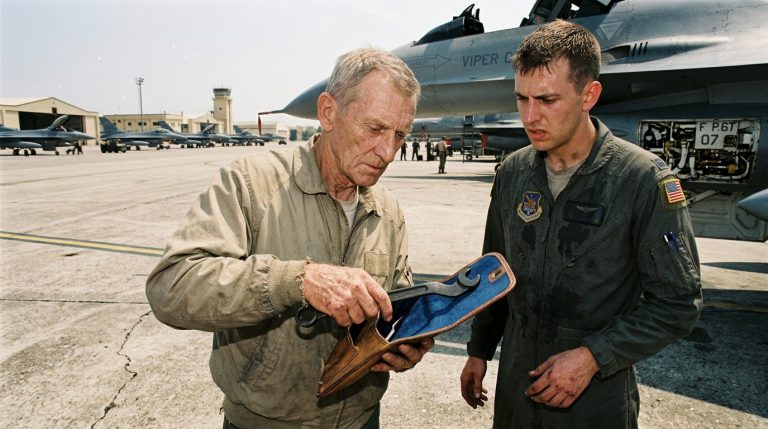
The metal of the clipboard was cold against Ila’s palm, a grounding sensation that centered her as the hangar silence pressed in. Around her, the air was a haze of suspended dust motes caught in the aggressive, dying glare of the midday sun. Twenty years of tactical training had etched a rhythm into her bones—a way of standing that shifted the weight of her body into the heels, ready to pivot at a heartbeat’s notice—but here, in the dim, grease-slicked sanctuary of the maintenance bay, she forced herself to breathe.
She could feel them watching. The younger ones, the airmen with smooth faces and crisp uniforms, were like wind-up toys losing their tension. Their initial laughter had curdled into something brittle, a hesitant confusion that hung in the air.
Ila didn’t look at them. She looked at the rotor hub of the Blackhawk in Bay 7.
The brass calibration tool in her pocket—an artifact from a life that officially ended in a burning helicopter in 2011—felt heavy against her thigh. It was a small, unassuming thing, worn smooth by thousands of hours of field repairs, etched with a serial number that shouldn’t exist in any logistics database. She touched the cold metal through the fabric of her coveralls. This was her center.
“Ma’am?”
It was the duty sergeant, his voice thin, stripped of the bravado that usually shielded the men in this bay. He was hovering near the edge of her workspace, his eyes darting toward the exit where Colonel Fen had departed.
Ila turned, her expression as flat and neutral as an unwritten report. She noticed the way the sergeant’s hands were trembling—just a micro-flicker of a pulse in the webbing between his thumb and index finger. She didn’t call him out on it. She didn’t have to.
“I need the torque wrench for the primary assembly,” she said, her voice steady, barely rising above the ambient hum of the facility’s cooling fans.
The sergeant blinked, his focus snapping back to the machine. “Right. Torque wrench. I’ll… I’ll get that.”
He hurried off, his boots echoing sharply on the concrete. Ila watched him, then pivoted back to the aircraft. As she traced the line of a hydraulic casing, she noticed a subtle discoloration in the sealant—a small, dark blemish that looked like a stain, but to her practiced eye, it was a structural weakness. It wasn’t wear. It was something else.
She leaned in, her forehead almost brushing the metal. A phantom sensation flared in the back of her skull—a memory of heat, the smell of burning rubber, and a voice—not her own—whispering coordinates. She winced, the pain sharp and blinding, blooming behind her eyes.
She blinked, the hangar flickering back into focus, the dust motes dancing in the light.
Stay, she told herself.
She reached into her kit, pulling out a jeweler’s loupe to inspect the blemish again. It was a deliberate mark. Someone had scratched a symbol into the sealant, something so small it would be invisible to any inspector not trained to look for it. It was a bird, wings spread—the same mark on her back, but inverted.
The air in the hangar felt suddenly, impossibly cold. The door behind her groaned on its hinges. She didn’t turn. She knew the rhythm of the gait approaching: it was rhythmic, heavy, and deliberate.
“You missed a spot,” a man’s voice murmured from the shadows of the bay.
Ila froze. She had been here for three hours, and she had accounted for every soul in the building. But this rhythm—this wasn’t the gait of an airman. It was the movement of a predator walking through his own territory, and he was standing right behind her.
CHAPTER 2: THE COLONELS SANCTUM
Ila did not flinch, though every nerve ending in her back—the skin marked by the ink of a ghost unit—tensed in a synchronized, involuntary warning. She turned slowly, her movements measured, calculated to convey a standard of casual professionalism she didn’t feel.
The man standing in the doorway was not an airman. He wore the charcoal-gray uniform of the base security director, a man named Miller whom she had cataloged upon her entry. But there was something in the way he held his shoulders—too relaxed, too deliberate—that betrayed him. He wasn’t guarding the bay; he was monitoring her.
“The torque wrench is in the locker, three bays down,” Ila said, her voice a flat, steady instrument. She didn’t acknowledge the bird tattoo symbol etched into the sealant. “I don’t recall requesting assistance with the assembly.”
Miller stepped into the light. His eyes, pale and searching, bypassed her face and landed on her toolbox. “You didn’t. But the Sergeant seemed… distracted. I thought I’d lend a hand.” He moved closer, the scent of ozone and stale office air clinging to his coat. “That’s a fine bit of precision work you’re doing there, Ms. Ror. Most mechanics would have used a digital scanner. You’re working by touch.”
“The gear tells you more than the software ever could,” Ila replied. She stepped aside, giving him space, but keeping her hand near the heavy wrench resting on the workbench. “Was there something else, or are you just here for the scenery?”
Miller smiled, a thin, paper-dry expression. “Colonel Fen wants to see you. Now. It seems your inspection report has raised some questions that the logistics department isn’t equipped to answer.”
Fen. The name echoed in her mind, not as a colleague, but as a potential rupture in her carefully maintained anonymity. She looked at the bird mark again, then at Miller. “I have a protocol to finish. The aircraft is grounded until the torque specs are verified.”
“The aircraft is moving to a secure hangar, Ms. Ror. That’s an order from the Colonel.”
The room tilted. For a split second, the sound of the power tools shifted into the whine of an engine struggling against a mountainous downdraft. The smell of burning rubber replaced the sterile scent of the bay. Ila gripped the edge of the workbench, the wood grain biting into her palms. Focus. The phantom sensation of the 2011 crash—the way the ground rushed up to meet the fuselage like a hungry animal—flared behind her eyes. She saw the cockpit instrumentation, the needles spinning, the flickering lights of the neural-mapping interface.
It was a memory she had buried under layers of grease and iron, a fragment of the “self-calibration” she performed to keep the program from consuming her identity.
“Ms. Ror?” Miller’s voice sounded muffled, as if he were speaking from the other side of a pressurized door.
She inhaled, dragging herself back into the present. The hangar light felt harsh, artificial. “I’ll pack my kit.”
The walk to Fen’s office was a study in sensory deprivation. Every step was a calculated placement of her boots on the polished concrete. She felt like an intrusion, a ghost walking through a world of living, breathing people who had no idea how fragile the reality around them truly was. She watched Miller’s reflection in the glass of the corridor windows—he was checking his watch, his hand hovering near his sidearm. He was terrified, not of her, but of what she might represent if she truly existed.
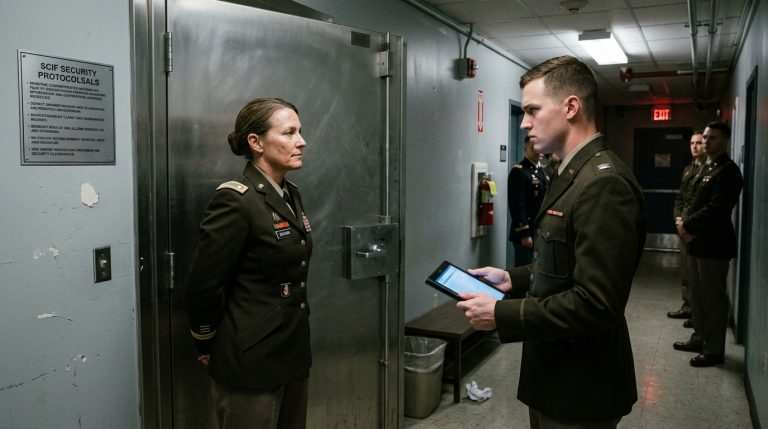
When they entered the office, the air was cool, smelling of filtered ventilation and ancient paper. Fen was sitting behind a desk that looked more like a command console than a piece of office furniture. He didn’t look up immediately. He was studying a monitor that displayed schematics of the very Blackhawk she had just been inspecting.
“You’re a difficult woman to find in a database, Ila,” Fen said, finally leaning back. His chair creaked, a heavy, rhythmic sound. “I’ve checked with every branch. You don’t have a history before 2012. You have a social security number that was issued in a dead-drop post office in Nebraska. You’re a ghost.”
Ila set her toolbox down. She didn’t sit. “I’m a contractor, Colonel. I do the work.”
“You did more than work. You identified a hairline fracture in a support strut that the factory-certified scanners couldn’t see,” Fen said, leaning forward, his eyes locked onto hers. “And you found a flaw in the hydraulic housing that was—by all logic—designed to be undetectable unless the system reached a specific thermal threshold.”
“Experience is a better diagnostic tool than a computer,” Ila said.
“Whose experience?” Fen pushed a folder across the desk. It contained no text, only high-resolution photographs of the tattoo on her spine. “Task Force Viper wasn’t just an ops unit. I spent the last three hours digging through shredded, archived directives from the 2011 Afghanistan engagement. Viper was the pilot program for the neural-mapping interfaces. They weren’t looking for soldiers, Ila. They were looking for processors. They were looking for people who could integrate with the aircraft.”
Ila felt the brass tool in her pocket again. The weight of it seemed to increase, pulling at her coveralls. The room was too quiet. The hum of the computer fans sounded like a heartbeat.
“I was a mechanic,” she said, her voice cold. “I am a mechanic.”
“If you were just a mechanic, you wouldn’t have known about the bird symbol on the sealant,” Fen countered softly. “Miller saw you looking at it. He said you recognized it.”
Ila stared at the Colonel. She saw the fear in his posture—the way his hand twitched toward a secure line phone. He wasn’t trying to expose her; he was trying to figure out if she was a weapon or a warning.
“I’m here to fix the aircraft, Colonel,” she said, taking a step toward the desk. “If you want the truth, you’re looking at the wrong set of variables. You’re looking for a person. I’m just trying to make sure the bird stays in the air.”
“Why?” Fen asked, his voice cracking slightly. “After everything they did to you? After they erased you?”
Ila looked out the window, past the hangar, toward the sun-bleached desert horizon. The vastness was comforting in its indifference. “Because when you’ve been in the dark that long, the only thing that matters is keeping the lights on for someone else.”
She turned to leave, but Fen’s voice stopped her. “They’re coming to verify your credentials, Ila. A team from Central Command. They’ll be here by morning. If they find out what you really are—what the tattoo really means—they won’t let you leave.”
Ila paused at the door, the handle cold beneath her fingers. She didn’t look back. She knew the rhythm of the coming storm. It wasn’t about the job anymore. It was about the fact that she was the last thread holding her own sanity together, and the system was finally pulling at the loose end.
CHAPTER 3: THE RIPPLE EFFECT
The corridor between Colonel Fen’s office and Hangar 7 was longer than it should have been. Or perhaps it was simply that Ila’s perception of time had begun to drift, the consequence of the neural-mapping remnants reacting to the stress of Fen’s interrogation. The walls were a sterile, aggressive shade of eggshell, illuminated by flickering fluorescent tubes that pulsed with a low-frequency hum. To anyone else, it was just a hallway. To Ila, it was a diagnostic chamber of her own undoing.
She kept her hands buried in the pockets of her coveralls, her fingers pressing into the rough, worn metal of the brass calibration tool. She needed the physical texture to keep the world from dissolving into the chaotic, fragmented data-streams of 2011. Every step on the linoleum floor was a tactical decision. Each stride was identical in length, a testament to the discipline she used to anchor herself.
She could feel Miller trailing her. He was six paces back, his stride intentionally erratic, designed to disrupt her concentration. It was a classic “shadowing” technique, one she recognized from the very training manuals that had likely been used to draft his current security protocol. He wasn’t just escorting her; he was conducting a field analysis of her response time.
She stopped at a junction where the corridor branched toward the mess hall. She didn’t turn around. She simply waited, looking at the reflection in the polished surface of a fire-alarm box.
Miller stopped, his breathing audible in the hollow space. “The hangar is that way, Ms. Ror.”
“The maintenance schedule says the primary rotor housing requires a specific chemical solvent for the final wipe,” Ila said, her voice devoid of inflection. “The standard-issue solvent in the hangar will degrade the composite material. I need to visit the supply depot.”
Miller’s jaw tightened. He stepped forward, his silhouette looming large against the white wall. “The Colonel gave you orders to return to the hangar, not to go shopping for supplies.”
“If the rotor fails during the flight test, the responsibility won’t be mine, and it certainly won’t be the Colonel’s,” Ila turned then, her eyes meeting his. She didn’t look like a threat. She looked like a tired technician, her face etched with the pragmatic weariness of a woman who had spent too many years cleaning up other people’s mechanical catastrophes. “Do you want to explain to the board of inquiry why a two-dollar solvent caused a multi-million-dollar airframe to lose structural integrity?”
Miller hesitated. The logic was sound—cold, transactional, and impossible to argue with. He was a creature of regulation, and the threat of a written report was the only language he truly understood.
“Twenty minutes,” he said, checking his watch. “And I’m going with you.”
“Of course,” she replied.
The supply depot was a cavernous, dimly lit space at the far end of the flight line. It smelled of heavy lubricants, dry cleaning agents, and the stale scent of trapped desert heat. As they walked through the rows of shelved components, Ila focused on the task. She felt the environment—the weight of the shelves, the specific acoustic dampening of the stacked crates—but her mind was elsewhere.
She picked up a small, sealed container of solvent and turned it over in her hands. As she did, she deliberately knocked a stack of inspection tags off the counter.
“Damn it,” she muttered.
Miller sighed, stepping forward to help her gather them. As he knelt, his eyes were momentarily diverted from her face. In that split second, Ila dropped the container, and as it hit the floor, she shifted her position, creating a brief visual obstruction. It was a practiced, almost invisible maneuver.
She looked at the shelf behind him. There, pinned to a notice board, was a shift roster. Her eyes scanned the names, the dates, and the internal memos stapled to the side. She saw the heading: Task Force Viper Continuity Audit.
Her heart didn’t race; she didn’t allow it to. But a cold, crystalline clarity settled in her chest. They weren’t just investigating her. They were trying to resurrect the mapping project. The memo outlined a request for “legacy hardware” and “subject availability.”
Subject availability.
She had been a volunteer for the project in 2011 because she believed the neural-mapping would save lives. She had been the only one who didn’t lose her mind when the system went live. Now, she understood why she had survived: she hadn’t just used the system; she had incorporated it.
“Everything alright?” Miller asked, standing up and handing her the tags. He was watching her eyes now, looking for a flicker of recognition.
Ila accepted the tags, her face a mask of mild annoyance. “These logistics departments. They can’t keep a simple inventory system running for more than a week without creating a mess.”
She walked back toward the hangar, the solvent container tucked under her arm. Miller followed, but his confidence had shifted. He sensed something—not an overt threat, but a change in the frequency of her presence. She wasn’t just a contractor anymore. She was a moving part in a machine he didn’t fully comprehend.
As they reached Hangar 7, the environment had changed. The mechanics were working in a tense, rhythmic silence. The chatter was gone. They were all looking at the Blackhawk in Bay 7, but not as if it were a piece of equipment. They looked at it as if it were a dormant cage.
Ila walked to the workbench, her movements fluid and unhurried. She placed the solvent down and looked at the rotor assembly. She could feel the “bird” etched into the sealant, staring back at her like a mirror. She knew what she had to do. She couldn’t just finish the inspection. She had to dismantle the very evidence they were using to track her, and she had to do it without leaving a footprint that could be traced back to her.
She reached for her tool bag and pulled out a small, specialized laser-etching tool—a piece of gear that looked like a simple maintenance instrument but was capable of rewriting the digital signatures of aircraft components.
She began to work, her hands moving with the grace of a surgeon. Beneath the hum of the hangar, beneath the watchful eyes of Miller and the nervous glances of the airmen, she began to rewrite the history of the aircraft, piece by piece, byte by byte. She was erasing the markers of the Viper program from the hardware, ensuring that when the verification team arrived, there would be no trail left to follow.
But even as she worked, the phantom memory returned—the feeling of the interface connecting to her spine, the absolute, cold logic of a machine that knew her better than she knew herself. She wasn’t just repairing the helicopter; she was hiding from the version of herself that the machine had created.
CHAPTER 4: THE CALIBRATION OF SHADOWS
The darkness was not merely an absence of light; in the context of the base, it was a tactical weapon. When the hangar grid failed, the secondary emergency lights took a full three seconds to engage—a delay that, in the world of Task Force Viper, was a lifetime. Ila didn’t move. She didn’t breathe. She stood perfectly still, her hands instinctively positioned to protect the delicate, half-erased composite panel of the Blackhawk. The laser-etching tool sat on the workbench, its faint, green indicator light now the only star in the hangar’s sudden, pressurized void.
The air shifted. The scent of ozone from the dying electrical lines mingled with the sharp, metallic tang of hydraulic fluid. She felt the vibration in the concrete floor before she heard the sound—the synchronized, heavy cadence of boots. They were coming from the main entrance, not the security office. This was not Miller. This was a sweep.
Ila’s mind, usually a fortress of locked compartments, felt a sudden, frantic flicker—the “neural-mapping” phantom. She felt the weight of the aircraft’s internal systems as if they were extensions of her own nervous system. She knew, with a terrifying, intuitive certainty, that the helicopter’s self-diagnostic protocols were about to trigger a system-wide reboot in the dark. It would emit a localized electromagnetic ping, a flare of data that would act like a beacon to anyone scanning for Viper-era signatures.
Calibrate, she commanded herself.
She reached into the heart of the engine bay, her fingers finding the master bus connection. It was a delicate, frantic dance. She had to bypass the primary diagnostic feed without triggering the fail-safe. If she failed, the signature would leak. If she succeeded, she might just fade back into the background noise of the base.
Her hands moved with the efficiency of a machine, guided by a tactile map of the Blackhawk’s anatomy that she hadn’t consciously learned—it was embedded, a legacy of the mapping. She felt the cold edge of the connector, the resistance of the safety lock. She twisted it. A sharp, mechanical click echoed through the silent hangar, loud as a gunshot.
“Identify,” a voice barked from the darkness near the flight line. It was crisp, devoid of the hesitation Miller had shown. Professional. Cold.
Ila didn’t answer. She pulled a piece of industrial-grade tape from her vest, covering the tiny green indicator light of the laser tool. She shifted her weight, moving behind the massive tail rotor housing. She wasn’t hiding; she was becoming part of the equipment.
A beam of a high-intensity flashlight sliced through the darkness, sweeping over the equipment in Bay 7. It passed over the workbench, illuminated the spilled solvent, and then hovered for a heart-stopping second over the spot where the Blackhawk’s composite panel had been etched.
The light moved on.
Ila exhaled, the sound suppressed into the collar of her coveralls. She watched the shadows of three figures as they moved toward the center of the bay. They were moving in a tactical diamond, weapons drawn but at low-ready. They were looking for something—or someone—who didn’t exist on paper.
“The sensor array is picking up a residual spike in the local power net,” one of the shadows said. The voice was distorted, likely coming from a throat mic. “It originated from this bay.”
“Check the hardware,” the second shadow replied. “Fen said the contractor was working on the structural mounts. If the signature is here, it’s in the avionics.”
Ila realized then that she had been the decoy. Fen hadn’t brought her here to fix the aircraft; he had brought her here to flush out the verification team. He was using her as a lightning rod, gambling that the verification team would be arrogant enough to think she was the only vulnerability.
She felt a surge of cold, hollow anger. She had spent years cultivating a life of quiet, of anonymity, and yet the machinery of national security still regarded her as a piece of property to be traded, analyzed, and discarded.
She turned her gaze to the Blackhawk’s cockpit. If she was going to be the lightning rod, she would ensure the lightning struck where it was intended. She reached for the manual bypass for the auxiliary power unit. It wasn’t designed for a cold start, but if she could force the intake to cycle without the digital handshake, she could dump the residue of the neural-mapping signature into the hangar’s main power drain. It would look like a simple surge, a glitch in the aging electrical system, and it would wipe the hardware clean of the Viper signature.
It was a dangerous move—the power surge would be enough to fry the hangar’s local network—but it would effectively “blind” the verification team’s scanning equipment.
“Movement in Bay 7,” the lead figure shouted.
Ila didn’t wait. She yanked the bypass.
The Blackhawk groaned. The intake fans spun up with a high-pitched, screeching whine that shattered the silence of the hangar. The emergency lights flared, then pulsed violently, turning the hangar into a strobe-lit nightmare of shadows and motion. Sparks showered down from the overhead conduits.
The verification team staggered, their flashlights failing as the electromagnetic pulse rippled through the bay.
Ila moved. She didn’t run; she transitioned. She stepped out from behind the tail rotor, a blur of motion in the chaotic light. She didn’t confront them—she bypassed them, moving with a fluid, unnatural speed that made her appear to be in two places at once. She reached the hangar exit, her boots hitting the concrete with the precise, rhythmic intensity of a machine hitting its stride.
She burst through the heavy hangar doors and into the cool, dark air of the desert night. The base was alive with sirens now, a frantic, waking beast. She didn’t look back. She knew the team would follow, and she knew the Colonel would be waiting. But for the first time in years, the data-stream in her head wasn’t screaming. It was silent. She had successfully hidden the truth, but in the process, she had finally accepted that the ghost she was protecting was herself.
CHAPTER 5: THE SUNSET DEPARTURE
The desert wind was a physical weight, abrasive and dry, scouring the skin of her face as Ila moved across the perimeter tarmac. Her footsteps were silent, practiced movements that left minimal disturbance in the sand-dusted concrete. Behind her, the base was a chaotic web of searchlights, their beams cutting frantic, uncoordinated patterns through the darkness. The verification team was sweeping the inner perimeter, their movements precise, professional, and entirely predictable.
Ila didn’t head for the main gate. She knew the protocol: secure the exits, establish a kill box, and compress the radius. Instead, she moved toward the older, deactivated flight line, a graveyard of mothballed airframes that had been abandoned long before the current security protocols were drafted.
She paused behind the fuselage of a derelict transport plane, pulling her toolbox closer. Her hands were steady, despite the internal fracture she felt expanding behind her ribs. She needed a way to signal the end of the game—not for the team behind her, but for herself. She opened the toolbox, the metal hinges silent. In the dim light of the distant perimeter floodlights, she saw it: a small, folded piece of paper tucked into the lining of the kit, a set of coordinates she didn’t remember writing.
They weren’t just numbers. They were a frequency.
She realized with a jolt of clarity that she had been leaving breadcrumbs for herself—a contingency protocol she had initiated years ago, during the final days of the Viper program, when she had suspected her own memory would be the first casualty of the mapping. She had engineered a fail-safe, a way to disconnect the neural interface before the system could fully overwrite her personality.
Calibration, she thought, the word now carrying a terrifying weight. She hadn’t been repairing helicopters to hide; she had been repairing herself, piece by piece, hoping to find the remaining fragments of the woman who had volunteered for the program in the first place.
She heard the snap of a twig—a deliberate, tactical sound. Miller. He wasn’t relying on the verification team; he was hunting her personally. He wanted the glory of the recovery, the badge of honor for bagging a ghost.
“I know you’re here, Ila,” Miller’s voice didn’t carry the arrogance of his earlier posture. It was flatter, more dangerous. He was in the dark, and he knew it. “The Colonel is already cutting ties. You were never here. You were never a contractor. You’re just a data leak, and data leaks get purged.”
Ila didn’t respond. She pulled a small, multi-tool from her belt and began to interface with the transport plane’s still-functional, though long-dead, radio array. She didn’t need to transmit; she needed to broadcast a feedback loop. If she could bounce the Viper signature off the satellite link—the same link the verification team was using—she could overload their gear. It would be a suicide signal for the equipment, and it would leave her permanently severed from the mapping interface.
It was the only way to be free. But it would be painful.
The disconnect would be violent. The neural mapping wasn’t just data; it was her memories, her personality, her very sense of self. To sever it was to lose the last, structured remnants of the person she had become since 2011.
“I have a bead on you,” Miller said, his shadow stretching long across the tarmac, a distorted, predatory shape. He moved with a heavy, confident stride. “Don’t make this a report. Just come out.”
Ila’s hand hovered over the transmit key. She felt the ghost-echo of the neural interface in her mind—the vast, cool, logical perfection of the machine, promising her a life without the ache of human fragility. The temptation was a physical pull, a siren song of total, emotionless clarity.
She thought of the sergeant in Hangar 7, the way he had looked at her with genuine, unscripted respect. She thought of the helicopter rotor she had fixed, not because the computer told her to, but because she knew the pilot needed it to be safe.
She looked at the coordinates on the paper.
She pressed the key.
The sound was instantaneous—a high-pitched, harmonic shriek that tore through the night. The radio array flared, a blinding white light erupting from the transport plane’s console. The effect was immediate: the searchlights across the base surged, then blew out in a cascade of shattered glass and sparks. The perimeter alarms died in a synchronized, discordant wail.
Miller dropped his weapon, his hands flying to his ears, a cry of genuine, primal pain escaping his throat as the feedback spike slammed into his comms gear.
Ila collapsed against the fuselage, her breath hitching as the connection to the Viper program shattered. It felt like a physical tearing, a vacuum opening up inside her skull. The vast, cool logic of the machine vanished, leaving her in the sudden, terrifying silence of her own mind. She gasped, the air rushing back into her lungs, raw and cold. She felt the ache of her muscles, the grit of the sand on her skin, the sharp, human pain of being entirely, dangerously, and wonderfully alone.
She didn’t wait for Miller to recover. She crawled away from the wreck, into the vast, dark expanse of the desert, where there were no coordinates, no protocols, and no ghosts—only the long, quiet walk toward a dawn that finally belonged to her.
CHAPTER 6: THE SILENT DAWN
The dawn came not as a sudden illumination, but as a slow, gray bleed across the horizon. Ila sat against the rusting chassis of the transport plane, her legs pulled to her chest, her breathing finally matching the slow, rhythmic pulse of the desert wind. The feedback spike had been absolute; the connection to the Viper interface was dead. The phantom voices, the algorithmic suggestions, the cold, high-speed data streams—they were gone, replaced by the profound, terrifying simplicity of her own thoughts.
She watched the sun crest the jagged peaks in the distance, casting long, bruised-purple shadows across the tarmac. The base was a smudge of gray against the dawn, distant and irrelevant.
She reached into her coveralls, her fingers brushing the brass calibration tool. It was just metal now. The serial number, the weight, the impossible precision—it all belonged to a set of priorities she no longer served. She pulled it out and set it on the sand. Then, she took the small piece of paper with the coordinates and let the wind catch it, watching it dance away into the brush until it vanished.
She was not the operative they had built. She was not the contractor they had hired. She was merely Ila, a woman with graying hair and worn-out boots, sitting in the silence of a world that didn’t know her name.
The sound of an engine broke the morning stillness—not the high-pitched whine of a Blackhawk, but the low, steady rumble of a truck. She didn’t reach for a weapon; she didn’t check the perimeter. She remained still, watching as Colonel Fen’s vehicle approached, slowing to a halt fifty yards away.
Fen stepped out. He was alone. He walked toward her, his posture stripped of the command-level stiffness he had worn in the office. He didn’t carry a sidearm. When he reached the transport plane, he stopped, looking down at her. He didn’t look like a Colonel. He looked like a man who had spent a long night staring at the ceiling of his own conscience.
“The verification team is gone,” Fen said. His voice was quiet, stripped of the authority that usually carried across a hangar bay. “They found a fried network and a ghost-signature that didn’t lead anywhere. They’ve closed the file.”
Ila didn’t look up. “Then why are you here, Colonel?”
“Because you’re the only one who knows what it was like,” Fen sat down in the sand a few feet away, the fabric of his uniform rasping against the grit. “I was the liaison who signed off on the mapping project in 2011. I knew the operators were losing their humanity, and I buried the reports because the intelligence was too good to ignore. I’ve been living in that hangar for fifteen years, waiting for someone to remind me what the cost actually looked like.”
Ila looked at him then. For the first time, she saw him not as a function of the system, but as another piece of Kintsugi—another broken thing that had been glued back together with the gold of regret. She saw the truth of her own existence: the neural-mapping had not just been an experiment to create a soldier; it had been a desperate attempt by the military to replicate the human capacity for resilience in the face of impossible trauma. They had tried to build a person who could survive the absolute destruction of their own self.
They had succeeded, but they had also created the only person who could truly judge them.
“I’m not a weapon, Fen,” she said, her voice raspy from the night’s silence.
“I know,” he replied. He reached into his pocket and placed a small, nondescript envelope in the sand between them. “That’s a set of papers for a life that doesn’t exist in any database. It’s not a mission. It’s not an assignment. It’s just… a way to go somewhere where the air doesn’t smell like jet fuel.”
Ila stared at the envelope. It was the final pillar of the catharsis. The antagonist—the system—wasn’t defeated by fire, but by the quiet realization of its own obsolescence. She didn’t need to destroy it; she only needed to stop participating in it.
She stood up, her joints protesting, the physical aches of her body a welcome reminder of her own fragility. She walked to the envelope, picked it up, and felt the weight of a blank slate. She turned back to the transport plane, her gaze lingering on the metal casing. She reached out and traced a scratch on the side of the hull, a small, imperfect mark she had made hours ago while working. It was a small act of repair, a tiny, human correction in a world of standardized chaos.
“Where will you go?” Fen asked.
“Somewhere where things grow, not where they fall,” she replied.
She began the long walk toward the perimeter, away from the base, away from the ghosts, and away from the life of a phantom. She didn’t look back to see if he followed. She just kept walking, her shadow stretching out before her in the morning light, long and thin and entirely, beautifully real. The silence of the desert wasn’t empty anymore; it was full, a vast, open space where she could finally hear herself think, and for the first time in a decade, she liked the sound of the silence.