The Frozen Horizon: A Sovereign Land Defense of Whitefish Ridge
CHAPTER 1: THE LINE IN THE FROST
The fresh powder at the eastern boundary had been churned into a dirty gray slurry.
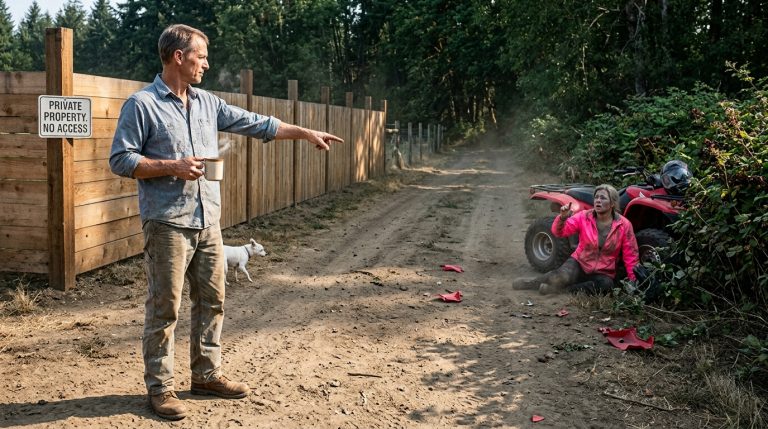
Marcus knelt in the sub-zero wind, his thumb rubbing the cold steel casing of a mechanical caliper he’d pulled from his shop coat. He didn’t need to measure the tread width to know the signature. Eight inches wide. Deep lug cleats. Patricia’s red sled had crossed the yellow surveyor’s spike forty minutes ago.
He snapped the caliper shut. The metal clinked sharply in the quiet forest.
They thought he was a retired desk jockey hiding behind a computer screen. They thought a certified letter printed on high-grade bond paper with a $5,000 penalty demand would make a Seattle engineer pack his bags or write a check.
They didn’t understand how steel and dirt worked.
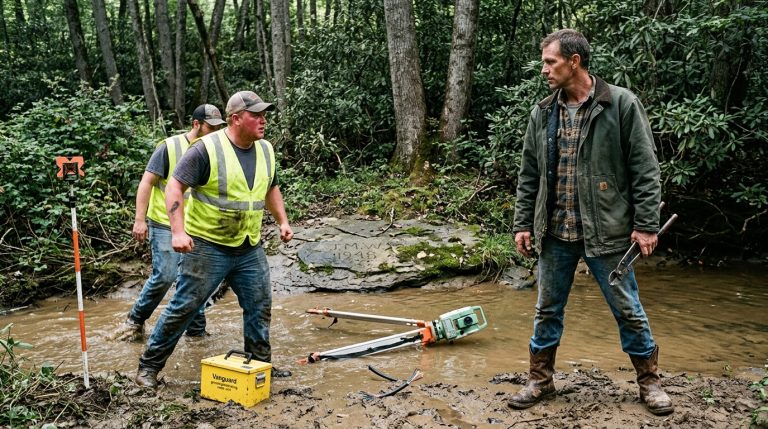
Marcus stood up, his boots crunching through the crusted top layer of snow. Behind him sat thirty feet of structural grade I-beam pipe, towed out by his utility tractor at dawn. To his left, mounted six feet up a dead larch tree, the green status LED of an industrial optical camera flickered once every three seconds.
An engine whined in the distance. High RPM. Rising fast from the valley trail.
Marcus didn’t move. He reached into his canvas jacket, pulled out a rag grease-stained with 80W-90 gear oil, and slowly wiped the caliper clean.
The red snowmobile broke through the treeline, banking hard around the pine cluster. Patricia wasn’t alone this time. Behind her came a heavy two-seater utility rig carrying two men in heavy canvas work coats.
She cut the throttle twenty feet back, letting the machine slide to a halt across the line. She flipped up her helmet visor. Her face was flushed red from the wind, her eyes tight and dark.
“You’re blocking an active emergency access corridor, Mr. Zanakis,” she shouted over the idling rumble of the twin-cylinder engines. “That steel pipe is a safety hazard.”
Marcus didn’t raise his voice. He stepped forward until his steel-toed boot rested directly on the yellow surveyor’s pin.
“You crossed the line, Patricia.”
“We issued a lawful assessment,” she said, pulling a laminated paper from her chest pocket. She didn’t offer it. She held it like a weapon. “Five thousand dollars for environmental degradation and unauthorized alteration of community rights-of-way. It doubles every seventy-two hours.”
The stocky man on the second machine stepped down. His heavy boots sank eight inches into the drift. He had a heavy crowbar strapped to the side of his rack.
“Move the beam, pal,” the man said. “We’ve got work to do up the ridge.”
Marcus looked at the man’s hands. Heavy leather gloves. Worn at the knuckles. No badges, no county insignias. Local hired muscle.
“This beam stays,” Marcus said. He turned his gaze back to Patricia, dropping the caliper into his deep coat pocket. His fingers closed around the cold metal. “And your five-thousand-dollar paper isn’t worth the ink it ruined. Dennis filed the formal trespass notice with the district court at eight this morning.”
Patricia laughed, a sharp, dry sound that cut through the freezing wind. “Dennis Chun is a small-town conveyancer. He doesn’t understand regional development law. This trail is registered under the Highlands Infrastructure Act of 2003.”
“Old Bill didn’t sign the 2003 charter,” Marcus said softly.
Patricia’s smile flickered. Just for a fraction of a second, her pupils tightened.
“He didn’t need to,” she said, leaning forward over her handlebars. “Public utility by continuous open usage. We own the access, Marcus. You just pay the property taxes for us.”
She gestured to the man with the crowbar. “Clear the line.”
The man took two steps forward, his hand reaching for the steel bar on his rack.
Marcus didn’t retreat. He took one smooth step sideways, positioning his body directly between the man and the winch cable anchored to the larch tree. The air between them went dead silent, save for the rhythmic clack-clack of the idling snowmobile engines.
“Touch that cable,” Marcus said, his voice dropping to a flat, dangerous register, “and you’ll be explaining to Deputy Kowalski why you brought a pry bar onto private land after being formally served.”
The worker hesitated, his gloved hand hovering two inches above the iron tool. He looked back at Patricia.
Patricia’s jaw set hard. She stared at Marcus, searching his eyes for the twitch of a man ready to fold. She found nothing but thirty hundredths of an inch of hardened steel and three hundred acres of locked ground.
“This is your last chance to settle this quietly,” she hissed.
“You’re on my dirt,” Marcus said. “Get off.”
CHAPTER 2: THE PAPER TRAP
Patricia’s fingers twitched against the rubber throttle grips of her red snowmobile. She didn’t pull the cable right away.
She sat there in the sub-zero wind, her sharp blue eyes fixed on Marcus’s boot anchored over the yellow surveyor’s pin. The twin-cylinder engine rattled beneath her, puffing blue-gray exhaust into the frozen pine air.
“You’re making a catastrophic mistake, Marcus,” she said, her voice tight against the roar of the idling machine.
“The line’s marked,” Marcus said. He didn’t take his right hand out of his jacket pocket. His thumb traced the cold, notched edge of his mechanical caliper, pressing the hardened steel until it bit into his skin. “Drive back.”
Patricia glared at him for three long seconds. She weighed the thirty-foot structural steel I-beam against the green LED flickering on the larch tree behind him. Then she slapped her helmet visor down with a hard plastic snap, yanked the handlebars, and hit the throttle.
The track spun, biting into the crusted drift and hurling a spray of ice back across the property line. The two hired hands turned their heavy utility rig and followed her down the ridge, the high-pitched whine of their engines fading into the timber.
The smell of unburnt two-stroke gasoline hung in the frost for ten minutes before the mountain wind cleared it.
Two hours later, the cab of Marcus’s heavy three-quarter-ton pickup smelled of stale gas-station coffee and hot diesel exhaust. The snow tires hummed a low, dull rhythm against the frozen slush of Highway 93 as he dropped down into Kalispell.
The flat gray winter light slapped hard against the dirty stone facade of the Flathead County Courthouse.
The basement archives of the County Assessor’s office smelled of old paper dust, floor wax, and dry radiator heat that made the back of Marcus’s throat itch.
Behind a high oak counter stood Arlene—sixty-something, wearing thick bifocals on a silver neck chain and a faded wool cardigan. She didn’t care about Whitefish HOA disputes or wealthy weekend snowmobilers. She cared about parcel ID numbers and ledger bounds.
“You want the 2003 tax map overlay for Section 14, Mr. Zanakis?” Arlene didn’t look up from her flickering CRT monitor. Her fingers clacked steadily over an old mechanical keyboard. “That drawer’s in the back vault. The steam pipe leaks back there; the lockbox is jammed frozen half the time.”
Marcus leaned his forearm on the worn oak counter, the wood grooving his coat sleeve. “I need the original deed boundaries for Parcel 402, and every special assessment filing attached to the White Fish Highlands Association since 2003.”
“Special assessments are public record,” Arlene said, pointing a gnarled plastic pen toward a heavy iron door at the back of the room. “If they’re filed. Half the stuff those private board presidents drop off never gets recorded past the preliminary desk because they don’t want to pay the twenty-dollar filing fee.”
Marcus pushed open the vault door. The temperature dropped ten degrees in a single step. A radiator in the corner hissed like an angry snake, leaking a thin wisp of steam that coated the metal filing cabinets in a film of cold, slick moisture.
He gripped the handle of the bottom steel drawer for Section 14. The runners screeched against old rust as he hauled it open.
Inside, green hanging folders were jammed tight. Marcus pulled the file for the Harov Estate. He laid the thick parchment maps across the cold zinc surface of a reading table, wiping a smear of condensation off the corner with his sleeve.
The original deed was rock solid: 300 acres, unencumbered fee-simple title, transferred from William Harov to Marcus Anakis. No easements. No HOA inclusions.
Then he pulled the secondary sleeve—the HOA’s 2003 filing.
The document wasn’t a county-certified easement at all. It was an unofficial map amendment signed by Patricia Morrison as board president, stamped with a notary mark that lacked a state registration index.
Attached to the back was a yellowing carbon copy titled The Harov Codicil—a hand-penciled draft note from 1998 where old logger Bill had allowed temporary neighborly snowmobile passage for one winter while the main county culvert was washed out.
Patricia had taken that twenty-year-old informal permission slip, pasted an HOA header onto it, and filed it as a perpetual public access easement to satisfy a land-development credit for a firm stamped at the bottom: Project Sentinel – Escrow Hold Account #884.
Marcus’s thumb dragged over the faint blue ink of the stamp.
“You aren’t supposed to be digging in the secondary archives without a board clearance, Zanakis.”
Marcus didn’t jump. He turned around slowly.
Patricia Morrison stood in the vault doorway. She had traded her snow suit for a tailored charcoal wool coat and leather boots that clicked sharply against the damp concrete floor. Her hands were jammed deep into her coat pockets, her posture rigid against the cold steam draft.
“Public record room, Patricia,” Marcus said flatly. He picked up the carbon copy of the codicil by its corner. “You built a five-thousand-dollar fine on a twenty-year-old hand note that Bill never recorded with the county.”
“That note established continuous public use,” she said, taking two steps into the room. Her eyes locked on the paper in his hand. “The community relied on it. The developers relied on it.”
“You lied to the county, and you lied to your lot buyers,” Marcus said. He pulled out his phone, angled the camera lens, and snapped three clean, high-resolution photos of the un-notarized document and the Project Sentinel stamp. “This isn’t an easement. It’s fraud.”
Patricia’s face paled, the color draining until her lipstick looked like a fresh cut across her skin.
“Put the phone down,” she said, her voice dropping an octave, losing its polished suburban cadence. “You don’t know what you’re stepping into. That trail network is tied to a regional infrastructure bond.”
“It’s my dirt,” Marcus said, dropping the phone back into his coat pocket alongside his calipers. He picked up his certified land deed and slapped the file folder shut. The heavy cardboard slammed against the zinc table like a rifle shot. “Dennis is filing a formal cloud-on-title notice with the county recorder right now. Every escrow account tied to your HOA’s trail network gets frozen until this fraudulent filing is expunged.”
Patricia took a rapid step forward, her leather gloves balling into tight fists at her sides. “If you lock those trail transfers, the board will sue you into absolute bankruptcy!”
“You can try,” Marcus said, stepping past her shoulder, forcing her to yield the narrow aisle between the rust-spotted filing cabinets. His canvas coat brushed hers, the cold smell of diesel exhaust cutting through her perfume. “But starting today, every time one of your machines crosses my line, it’s not a board dispute. It’s a felony land breach.”
He walked out into the dry heat of the main office, leaving her standing alone in the damp draft of the vault.
CHAPTER 3: KINETIC FRICTION
The sleet hit the windshield of Marcus’s truck like thrown gravel, snapping him back from the image of Patricia standing cold and rigid in the archive basement.
He didn’t wait for the glass to defrost. He threw the heavy transfer case into four-high, the mechanical linkages thumping solid under his palm, and cut the wheels toward the highway exit.
Forty-five minutes of steady, white-knuckle driving through the mountain pass brought him back to the eastern approach of Section 14. Shadows were already stretching long across the snow, turning the white slopes a deep, bruised violet.
The truck’s headlights swept across the timber line, and Marcus instantly saw the break.
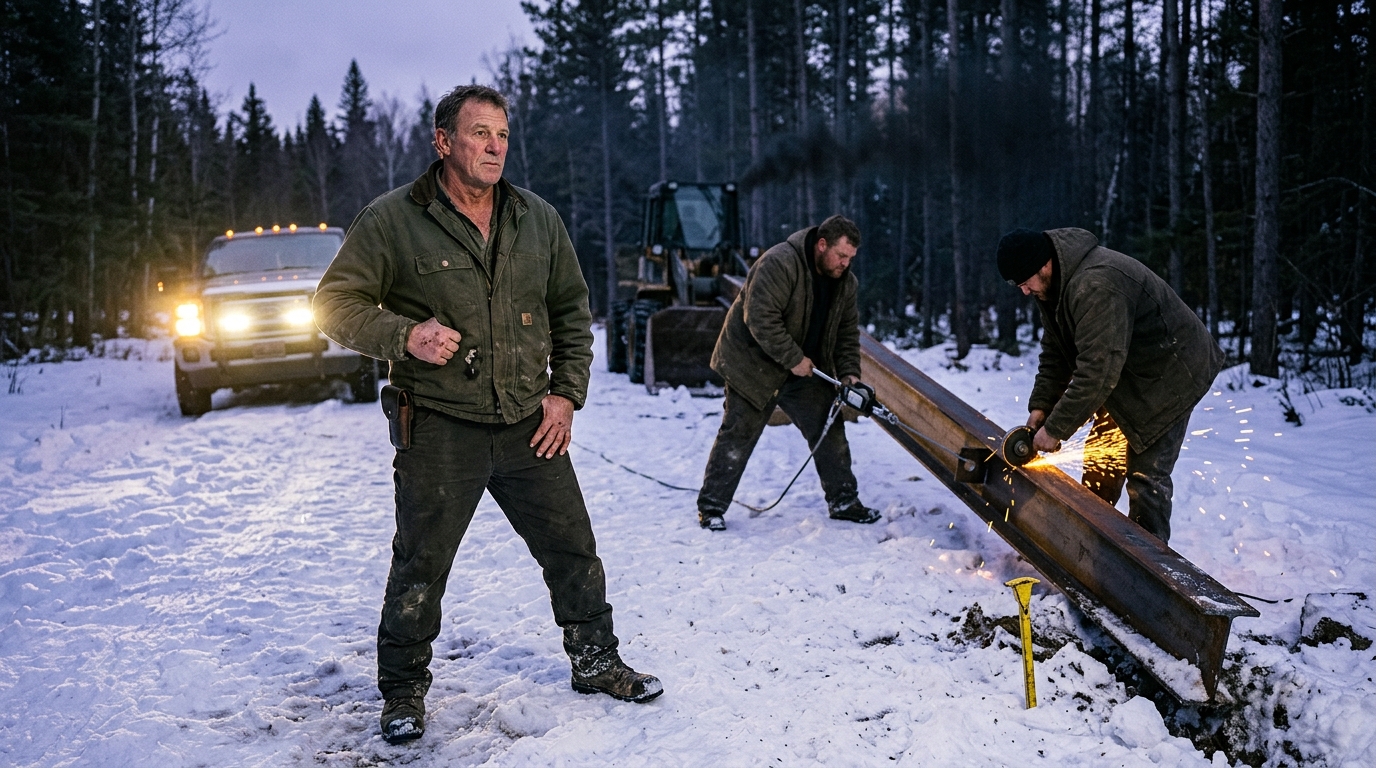
The thirty-foot structural steel I-beam he had positioned across the choke-point wasn’t where he had anchored it. It sat tilted at a grotesque thirty-degree angle, its far end dragged through three feet of packed snow, grooving a deep, dark trench into the frozen mud below.
An engine chugged in the tree shadow—a heavy diesel utility loader, its exhaust stack coughing black soot into the icy air.
Two men stood near the cable anchor at the base of the larch tree. One was the stocky hand from the previous morning, holding an electric angle grinder that buzzed like an angry hornet, casting shower after shower of yellow sparks into the dusk. The second man was working a lever on a portable hydraulic winch.
Marcus slammed the truck into park, killed the ignition, and stepped out before the engine even ceased turning over. The cold air hit his lungs like a knife blade.
“Off the rig,” Marcus said.
His boots sank into the wet slush as he moved toward the boundary line. His canvas coat was unbuttoned, his hand resting flat against his hip, his thumb hooked into his belt loop right beside his leather holster pouch.
The man with the grinder didn’t stop the wheel. The screaming disc kept biting into the thick steel lug of the camera mounting bracket, spraying hot metal shavings across the snow.
“Patricia said the easement’s under court review,” the stocky man yelled over the screech of iron. “Which means status quo holds. We’re clearing the hazard.”
“The county recorder accepted the cloud-on-title notice forty minutes ago,” Marcus said, taking three rapid, heavy steps forward. “You’re cutting steel on private land. That’s criminal property destruction.”
“Take it up with the board, pal,” the winch operator grunted, leaning his entire weight into the hydraulic lever to tension the steel cable bound to Marcus’s I-beam.
Marcus didn’t argue. He reached the operator in two strides. He didn’t swing a fist—he knew the law on assault, and he wasn’t giving Patricia a clean battery charge to hand to the prosecutor. Instead, he drove his shoulder directly into the man’s ribs, using all two hundred pounds of his momentum to pin the worker flat against the cold, iron side of the winch housing.
The operator gasped, the air rushing out of his chest in a white plume. He grabbed at Marcus’s coat collar, his heavy leather work gloves clawing for leverage.
Marcus locked his right forearm under the man’s chin, applying hard, steady mechanical pressure against the jawbone—not shutting off his wind, but forcing his head back against the steel frame until his grip slipped off the canvas. With his left hand, Marcus reached down, grabbed the hydraulic relief valve knob, and yanked it counter-clockwise.
The high-pressure line hissed. The winch drum freed instantly, spinning backward with a sharp metal snap. The heavy steel cable went dead slack, whipping through the snow and slapping hard against the tread of the loader.
“Hey!” the man with the grinder roared, dropping the power tool into a drift where it sputtered and died with a hiss of steam. He surged forward, grabbing a iron pry bar off the loader’s side rack.
Marcus let go of the operator, letting the man slide down the cold side of the winch to his knees in the snow. He turned to face the second worker, setting his feet wide in the frozen mud, his center of gravity low.
“Drop the iron,” Marcus said, his chest heaving, his breath coming in steady, metered bursts. “You’re on camera. The larch lens is dead, but the bumper feed on the truck is recording at sixty frames a second.”
The worker stopped three feet away, the heavy six-foot pry bar held diagonally across his chest. His knuckles were white inside his leather gloves. He looked past Marcus toward the truck, where the dual LED headlights illuminated every flake of sleet falling between them.
The man looked at his partner, who was still on his hands and knees, coughing violently into the crusted snow, gasping for breath.
“This ain’t worth eighty bucks an hour, Frank,” the coughing man wheezed, pushing himself up, his face slick with sweat despite the sub-zero air. “He’s got the paper. Patricia lied about the deputy.”
The man with the pry bar lowered the tool by an inch, the iron tip dragging in the frozen slush. He stared at Marcus, his jaw working silently.
“We leave the beam,” the worker muttered, stepping backward toward the diesel loader. “But you ain’t won nothing, Zanakis. The survey trucks for Project Sentinel are already staged down at the main junction. They don’t care about your little camera.”
Marcus stood his ground, the cold wind whipping the unbuttoned flaps of his jacket. He watched them scramble up into the high cab of the loader. The heavy diesel engine roared, reversed out of the clearing, and lumbered back down the narrow logging trail, its red tail lights disappearing into the dark pine forest.
When the sound of the engine died away, the silence of the mountain settled back over the ridge, heavy and absolute.
Marcus walked over to the I-beam. His hands were raw, the skin over his knuckles scraped red from the winch housing. He knelt in the snow, reached into his pocket, and pulled out his mechanical caliper. The steel was freezing to the touch, but he used the depth gauge to check the crack the grinder had left in the mounting lug.
Two millimeters deep. Repairable with a quick bead from the shop welder.
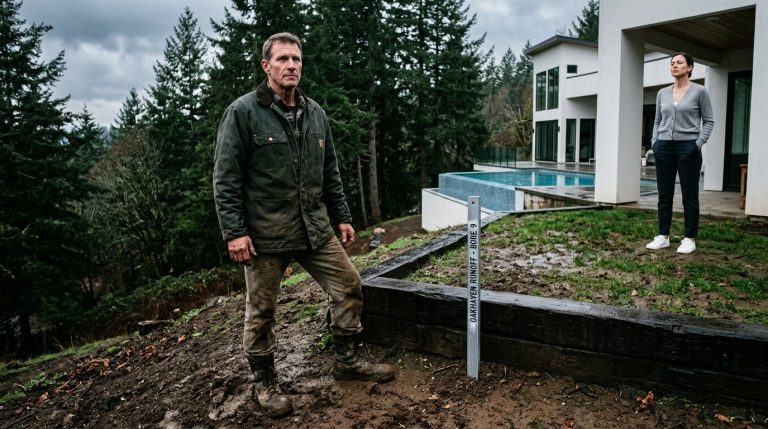
As he closed the tool, his eyes caught a white plastic marker peg sticking out of the snow ten feet past his property line—left behind by the loader’s tracks.
He slid over on his knees and pulled the marker out of the frozen ground.
Stamped on the side in faded red weatherproof ink were two words and a code: Aquifer Junction 14 — Flow Test Marker.
Marcus stared at the plastic stake, the cold wind biting at his face. The HOA wasn’t trying to clear a trail for snowmobiles. They were marking water.
CHAPTER 4: THE LEAK AT AQUIFER 14
Marcus’s thumb pressed into the cold, sharp edge of the plastic marker peg until his skin turned white.
Aquifer Junction 14.
The red weatherproof ink didn’t smudge under the melting ice on his glove. He stood up slowly, the joints in his knees popping in the dead quiet of the dusk. Behind him, the damaged steel I-beam sat silently in the snow, its mounting bracket twisted from the grinder’s teeth.
He didn’t head back to the cabin. Instead, Marcus grabbed the heavy waterproof spotlight from the floorboard of his truck, switched the beam to narrow-focus white LED, and walked fifty paces off the trail into the thick pine timber on the north slope of his land.
Old Bill had maintained three capped well-heads across the property. Marcus had seen them on his original land survey three months ago—simple four-inch steel casings sticking two feet out of the dirt, capped with rusted iron plates. He’d assumed they were abandoned testing holes from Bill’s logging days to monitor ground runoff.
He found Well-Head Three under a heavy overhang of snow-laden cedar boughs.
The snow around the base had been disturbed. Fresh boot prints—deep heel marks from heavy insulated work footwear—had churned the pine needles into the snow.
Marcus dropped to one knee. He shined the spotlight directly onto the iron cap.
The old rusted square bolt securing the lid wasn’t covered in lichen like the rest of the casing. It was bright, scraped down to bare silver steel. Someone had put a heavy pipe wrench to it within the last forty-eight hours.
Marcus reached into his canvas coat pocket and pulled out his mechanical caliper. He didn’t use it to measure. He used the hardened steel tip to scrape at a smear of fresh grey grease left along the threads of the cap. He brought the tip to his nose.
Not standard machinery lube. Silicone-based borehole sealant. The kind used by industrial hydro-geological crews when dropping sub-surface telemetry probes into pressurized water tables.
He stood, pulled out his phone, and dialed Dennis Chun’s direct line. The call rang three times before the lawyer answered, his voice muffled over a crackling speakerphone.
“Marcus? It’s past seven. Did Patricia’s hands leave the gate?”
“The gate’s intact,” Marcus said, his voice flat, staring down at the silver-scraped bolt. “Dennis, check the state Department of Natural Resources water rights database. Cross-reference my parcel with Project Sentinel.”
Silence stretched over the line for five seconds, punctuated by the faint clatter of Dennis typing on a keyboard.
“Natural resources?” Dennis asked, his tone shifting from tired to sharp. “Marcus, the HOA dispute is about trail access and informal easements—”
“The trail is the cover,” Marcus interrupted. “They don’t care about snowmobiles. I just pulled a hydro-test marker out of my eastern border, and someone cracked the seal on Well-Head Three on my north ridge. Look up the water basin allocations for Section 14.”
The typing accelerated over the speaker, steady and rhythmic like hail on a tin roof.
“Okay…” Dennis muttered. “Pulling up the Flathead Basin sub-district map. Section 14… Wait.”
Marcus held the phone closer to his ear, his breath plume hanging still in the freezing air. “What do you see?”
“There’s a commercial extraction application filed six months ago,” Dennis said, his voice dropping into a tense whisper. “It wasn’t filed under the White Fish Highlands HOA. It was filed by Sentinel Resource Holdings LLC. They’re applying for a high-volume municipal tap into an unmapped subterranean basin.”
“Where’s the tap point?”
“Right at the boundary corner,” Dennis read off the screen. “Parcel 402… your land, Marcus. According to this filing, Project Sentinel claims the entire underground flow of Aquifer Junction 14 is unappropriated state water because the surface owner never filed a commercial beneficial-use claim.”
Marcus felt a cold sensation in the pit of his stomach that had nothing to do with the Montana winter.
“They aren’t trying to build a snowmobile path,” Marcus said softly, his mind clicking through the pieces like code compiling in a compiler terminal. “They need the trail clear so they can run heavy drilling equipment and utility conduits onto my ridge without raising red flags at the county zoning board.”
“It’s worse than that,” Dennis said, the sound of papers shuffling rapidly in the background. “I’m looking at the annexed corporate charter for Sentinel Resource Holdings. The managing director listed on the Secretary of State portal isn’t a regional developer.”
“Who is it?”
“Patricia Morrison,” Dennis said. “She signed the water extraction application as the managing agent for Sentinel, and she attached The Harov Codicil to the application. She’s claiming that Bill’s 1998 hand note didn’t just grant trail passage—she’s claiming it severed the subsurface water rights from the surface estate and transferred them to the community board twenty-five years ago.”
Marcus’s fingers tightened around his phone until the plastic case groaned. The decoy was dead. The neighborhood petty tyrant demanding $5,000 for snowmobile noise was a ghost. Patricia was executing a multi-million dollar corporate water heist using a forged easement to hijack his land’s vital lifeblood before he even knew what he owned.
“Does her filing hold up?” Marcus asked.
“Not if you hold absolute title,” Dennis snapped. “In Montana, surface ownership carries implied appurtenant water rights unless explicitly reserved in the deed. And your deed from the Harov estate has zero reservations. But if she completes the thirty-day public notice window without a formal protest, state law grants Sentinel a default senior water right by default.”
“How long is left on the notice window?”
“Fourteen hours,” Dennis said. “The public protest window closes tomorrow at eight in the morning.”
Marcus looked down at the white plastic marker in his hand, then back at the cracked seal on Well-Head Three.
“Dennis,” Marcus said calmly. “Get your coat. We’re going to shut her down.”
CHAPTER 5: SYSTEMIC COUNTERSTRIKE
The call cut out, leaving only the steady drip-drip of snow melting off the pine boughs onto the hood of Marcus’s truck.
Fourteen hours until the state DNR default grant took effect. Fourteen hours before Patricia’s entity turned Aquifer Junction 14 into an unassailable commercial asset.
Marcus pulled the phone back up to his face, his thumb scrolling past Dennis’s contact down to a long-dormant terminal link on his personal server array. He didn’t fire up an engine or drive down to the county building. He climbed into the heated cab of his truck, flipped open a heavy, rubberized industrial laptop from the center console, and plugged it directly into the vehicle’s high-gain satellite uplink transceiver.
“You want a corporate infrastructure war, Patricia,” Marcus muttered, his fingers flying across the mechanical keys, the rhythmic clack-clack-clack echoing inside the quiet truck cab. “Let’s look at your grid.”
He didn’t hack into bank accounts or override municipal servers. He didn’t need to break any laws. His 15 years as a systems architect in Seattle had taught him one fundamental truth about modern private development: every corporate shell relies on third-party digital telemetry to secure bank credit lines.
He ran a public record query against Sentinel Resource Holdings LLC, pulling every linked municipal easement, utility bond, and environmental compliance certificate registered under Project Sentinel.
Within twenty minutes, the data stream resolved into a crisp, undeniable map.
Project Sentinel wasn’t just a local water tap. It was a twenty-two-million-dollar regional resort development backed by an escrow syndicate out of Denver. To maintain their low-interest municipal bond funding, Sentinel had to certify three distinct physical prerequisites by eight o’clock the following morning: clear surface access to the drilling rig site, a verified non-interrupted aquifer telemetry log from Well-Head Three, and an unencumbered title to the intake valve corridor.
Marcus opened his local mesh network controller.
When he had installed his security array along the 300-acre perimeter three weeks prior, he hadn’t just put up wireless cameras. He had built a private, high-frequency signal relay across the entire ridge, utilizing the old metallic fence wires as low-voltage antenna lines.
He located the telemetry transmitter Patricia’s hydro-geological crew had clamped onto Well-Head Three. It was pinging a digital handshake every sixty seconds to a cellular receiver tower down at the White Fish Highlands community office—sending flow rate, hydrostatic pressure, and aquifer volume data straight to the Denver syndicate’s automated audit portal.
Marcus opened his terminal interface. He tapped into his ridge relay and initiated a targeted, high-power white-noise frequency sweep across his private property boundaries.
He didn’t touch their equipment. He simply turned his fence line into an electromagnetic shield that absorbed every radio packet leaving Well-Head Three.
On his screen, the live telemetry data stream flatlined. The green status light on the Project Sentinel audit portal flickered, turned amber, and began flashing a red alert code: TELEMETRY LOSS – SENSOR DISCONNECT AT PARCEL 402.
Marcus picked up his phone and dialed Dennis.
“Dennis. I just killed their live flow data. The Denver escrow system is going to drop an automatic compliance flag on Patricia’s inbox within ten minutes.”
“That’s a tactical pin,” Dennis said, his voice coming through crisp over the truck’s cab speakers. “I’m standing at the printer right now. I’ve drafted a emergency Motion for Temporary Restraining Order based on the un-notarized Harov Codicil. I’m attaching your photos of the altered filing, the certified deed, and a sworn affidavit of water rights appurtenancy.”
“Where do we serve her?”
“She’s at the Highlands Community Center right now,” Dennis said, the sound of a heavy stapler punching through a thirty-page legal stack echoing over the line. “They’ve got an emergency board meeting scheduled for eight tonight to vote on an emergency assessment to cover their legal fees. She thinks she’s going to ratify the water lease before the sun comes up.”
Marcus shut the laptop screen with a firm plastic click. He looked out through the frosted windshield toward the eastern boundary road.
“Meet me at the gate, Dennis,” Marcus said. “Bring the paper.”
The White Fish Highlands Community Center was a massive, timber-framed lodge sitting at the top of a manicured asphalt hill. Floor-to-ceiling glass windows cast a warm, yellow glow over twenty parked luxury SUVs.
Marcus didn’t park in the lot. He pulled his dirty three-quarter-ton diesel right up to the front entrance, blocking the primary snowplow turning lane. The heavy engine idled with a deep, rhythmic thrum that vibrated through the glass doors of the facility.
He stepped out into the cold night air, his work boots caked in frozen ridge mud, his canvas jacket stained with gear oil and trail snow. In his right hand, he carried a heavy, black leather binder containing the original 1998 land survey maps, his stamped title deed, and the printed telemetry interruption logs.
Dennis Chun met him at the flagstone steps, holding a thick white envelope stamped with the seal of the Flathead County District Court.
“Judge Miller signed the temporary emergency injunction at six-thirty,” Dennis whispered, his breath clouding in the freezing air. “It freezes every transfer action under Project Sentinel until a full evidentiary hearing next month. She touches that aquifer, and she’s in direct contempt of court.”
Marcus pushed open the heavy iron-handled oak doors.
Inside, forty homeowners sat in padded leather chairs facing a raised dais. Patricia Morrison stood at the podium in a cream-colored cashmere sweater, holding a microphone, her voice echoing off the vaulted timber ceiling.
“…and this temporary obstruction by the new owner of Parcel 402 will be cleared through standard administrative protocols,” Patricia was saying, her tone smooth, authoritative, and practiced. “We are asking the board tonight to authorize an emergency ten-thousand-dollar allocation from the reserve fund to secure our infrastructure access—”
The heavy oak doors slammed shut behind Marcus, the sound cracking through the vaulted room like a thunderclap.
Every head in the audience turned.
Marcus didn’t look at the homeowners. He walked straight down the center carpeted aisle, his steel-toed boots leaving dark, wet patches of mountain slush on the pristine floor. Dennis walked two paces behind him, the legal envelope held flat against his chest.
Patricia froze, her hand tightening on the microphone until her knuckles turned chalk-white under the chandelier lights.
“This is a private association meeting, Mr. Zanakis,” Patricia said, her voice dropping its warm cadence, amplified loud and harsh through the wall-mounted speakers. “You are trespassing on community property. Leave immediately or I will have security remove you.”
Marcus reached the front row. He stopped three feet from the podium, laid his heavy black binder flat on the oak table in front of the board vice-president, and reached into his coat pocket.
He pulled out his mechanical caliper. He didn’t point it. He simply set it down beside the binder, the cold, hardened steel clinking sharply against the polished wood.
“You aren’t voting on a reserve allocation tonight, Patricia,” Marcus said, his voice quiet, clear, and unhurried.
He didn’t use the microphone, but his voice carried to every corner of the silent room.
“You’re explaining to these forty homeowners why Sentinel Resource Holdings just lost its escrow funding at seven-fifteen this evening.”
CHAPTER 6: THE FROZEN CHECKMATE
The metal clink of the caliper against the polished oak podium echoed into the timber rafters.
Nobody moved. Forty homeowners sat frozen in their padded chairs, their eyes darting between Marcus, the black leather binder, and Patricia Morrison’s chalk-white face.
“What is the meaning of this?” a man in the third row called out, his voice sharp. “Patricia, who is this guy?”
Patricia didn’t answer right away. Her breath came in short, shallow hitches. She looked down at the black binder, then at the thick white envelope Dennis held in his gloved hands.
“He’s a disgruntled property owner,” Patricia said into the microphone, her voice trembling slightly before she forced it back into a tight, brittle register. “He’s attempting to disrupt a legal association proceeding. Board members, please call the local authorities.”
“The authorities are already outside,” Dennis Chun said calmly, stepping forward two paces. He laid the court document flat beside Marcus’s caliper. “And this is a signed Temporary Restraining Order from District Judge Miller. Case number 2026-CV-884.”
The room erupted into a flurry of muted whispers.
Marcus stepped closer to the table, leaning his hands flat on the wood. He didn’t raise his voice. He didn’t need to. The room went dead silent again to catch every word.
“She didn’t tell you about Project Sentinel, did she?” Marcus said, looking directly at the vice-president sitting to Patricia’s left. “She told you I was blocking a public snowmobile trail. She told you I owed five thousand dollars in fines.”
The vice-president, a grey-haired man named Henderson, looked at the court order, then up at Patricia. “Patricia? What’s Project Sentinel?”
“It’s nothing,” Patricia snapped, pulling the microphone off its stand. “It’s a regional infrastructure partner. It has no bearing on our trail maintenance charter—”
“It’s an offshore holding company registered under her sole name,” Marcus said. He flipped the black binder open with his thumb, exposing the certified state filings, the high-resolution photo of the un-notarized Harov Codicil, and the printout of the telemetry blockage from Well-Head Three. “She used an informal twenty-year-old snowmobile note from Bill Harov to forge a public access easement across my eastern ridge. Not for your snowmobiles. For commercial drilling equipment.”
Henderson reached out and pulled the binder toward himself. His glasses slid down his nose as his eyes scanned the stamped documents.
“She filed a commercial extraction claim on Aquifer Junction 14,” Marcus continued, his voice steady as iron. “She pledged three hundred acres of my subterranean water table to a private Denver syndicate to secure a twenty-two million dollar development credit. If that credit went through at eight tomorrow morning, the water rights beneath this entire valley would have been privatized under her entity. And the HOA would have been named as a co-defendant in a federal title fraud lawsuit.”
Patricia slammed her palm onto the podium. “That filing was a legitimate asset acquisition for the long-term solvency of this community!”
“It was a land heist,” Marcus said flatly. “And five minutes ago, your live telemetry link to Denver flatlined. The syndicate’s escrow account just froze your line of credit. You don’t have twenty-two million dollars, Patricia. You have a court injunction, a fraud investigation from the county prosecutor, and forty neighbors who just realized you put their homes up as collateral.”
A woman in the second row stood up, her face flushed with anger. “Is this true, Patricia? You put our reserve funds into a private LLC?”
Patricia backed away from the podium by half a step. Her confidence crumbled, exposing the frantic, cornered panic underneath. She looked to Henderson, then to the other three board members. None of them looked back at her. Henderson slowly pushed the microphone away, closed the binder, and looked up at Dennis.
“Is the water rights claim blocked?” Henderson asked Dennis quietly.
“As long as Marcus holds absolute title to Parcel 402, nobody touches Aquifer Junction 14,” Dennis replied. “The court order strips the HOA of any standing on his land. The trails are private property. The water stays in the ground.”
Patricia didn’t utter another word. She grabbed her leather bag off the side chair, pulled her coat tight around her shoulders, and walked briskly down the side aisle toward the rear emergency exit. Nobody moved to stop her. The heavy door clicked shut behind her, cutting off the cold mountain draft she left in her wake.
The clock on the cabin wall read 11:30 PM by the time Marcus returned to Section 14.
The storm had passed. The sky above the northern ridge was clear, sharp, and black, peppered with millions of cold white stars. The wind had dropped to a whisper through the pines.
Marcus stood at his workbench in the workshop, the yellow light of an overhead bulb casting a warm circle on the wooden table.
He picked up his mechanical caliper—the same one he’d laid on the board table two hours ago. He wiped the fine layer of dust off the steel jaw with his grease-stained rag, turned the adjustment screw until the zero line aligned perfectly with the gauge index, and tightened the locking pin.
The quiet of the mountain felt different now. It wasn’t the tentative silence of a man waiting for an engine to roar up his trail. It was the deep, permanent stillness of three hundred acres of locked, sovereign earth.
He slid the caliper into his canvas coat pocket, turned off the shop light, and stepped out into the crisp, frozen night. Beneath his boots, the snow crunched solid and firm. The line was drawn, the paper was sealed, and the dirt was his.