Forged in Scars and Raised in Light: The Unlikely Guardian Who Built a Home from the Ashes
CHAPTER 1: THE GAVELS DROP
The wood of the bench echoed through the quiet courtroom like a rifle shot.
Diesel didn’t flinch.
His massive shoulders remained pinned back against the stiff fabric of a borrowed suit that smelled faintly of mothballs and dry cleaner plastic.
Across the aisle, the state attorney packed his leather briefcase with slow, deliberate precision, signaling his silent disagreement with the bench’s ruling.
“Temporary custody is granted,” the judge repeated, his voice flat and devoid of theatrical triumph.
Diesel stood up.
His boots hit the linoleum floor with a heavy, unhurried thud that drew a sharp look from a bailiff standing near the exit.
He didn’t care about the look.
He cared about the six small pairs of shoes waiting down the hall.
The hallway was drafty, smelling of old paper and industrial floor wax.
Marcus was leaning against the wall, arms crossed tight over his chest, his eyes fixed on the baseboards as if calculating the exact distance to the nearest exit.
The twins were sitting cross-legged on a bench, arguing in sharp whispers over a crumpled candy wrapper.
And Grace stood by the window, her fingers hooked into the hem of her oversized shirt, staring out at the parking lot where the county vans idled.
When she heard his boots approach, she didn’t turn around immediately.
She waited until he stopped right beside her.
Only then did she lift her chin, her eyes searching his face for any sign of bad news.
“We’re going home,” Diesel said, his voice dropping an octave to match the quiet space between them.
Grace let out a breath she must have been holding since morning, her shoulders dropping an inch.
She didn’t smile, but her fingers unhooked from her shirt and reached down to grab his calloused thumb.
Her grip was small, fierce, and entirely absolute.
They walked out of the building together, past the smoking area where tired lawyers checked their watches, and straight toward the battered pickup truck idling at the curb.
CHAPTER 2: THE MORNING GRIND
The kitchen counter looked like a supply depot after a flash flood.
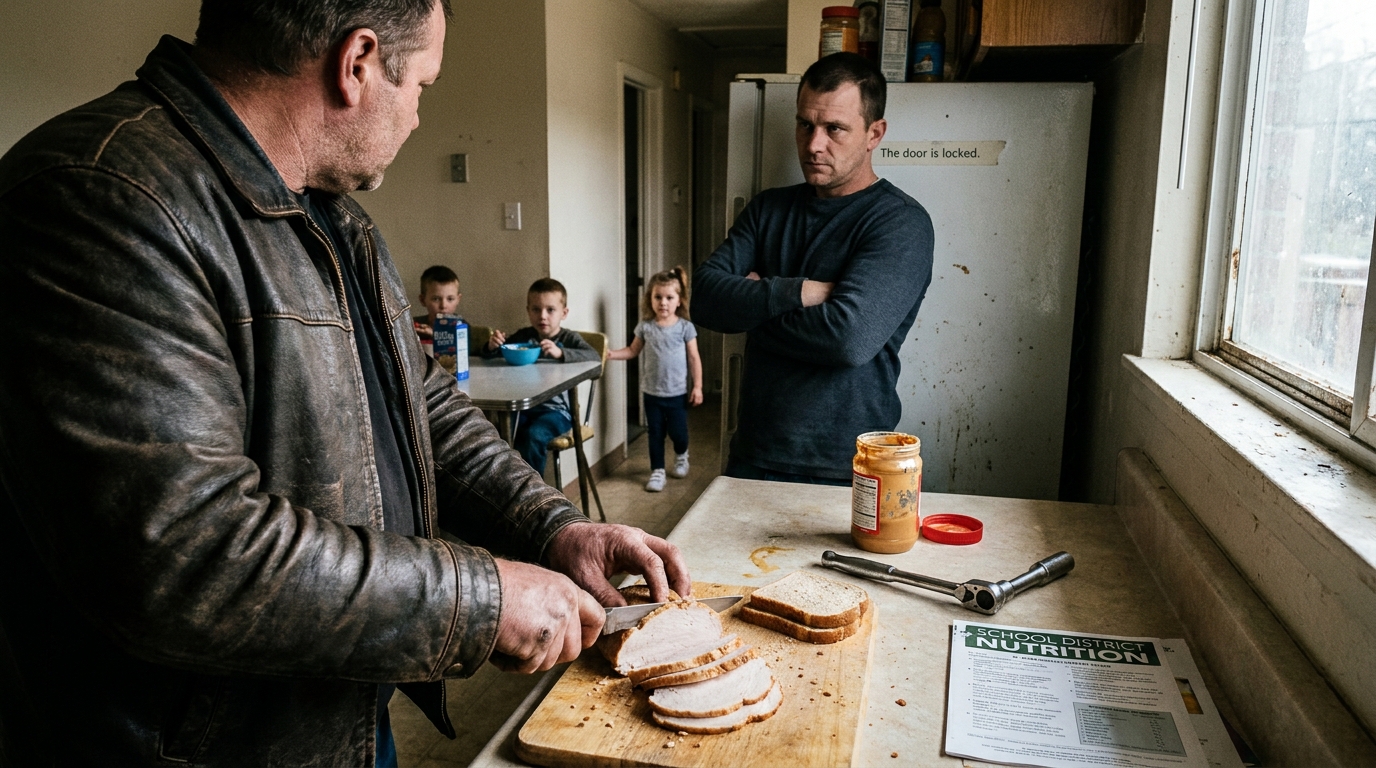
Bread crusts, plastic bags, and a jar of peanut butter that was already half-empty sat wedged between a grease-stained socket wrench and a school district nutrition pamphlet.
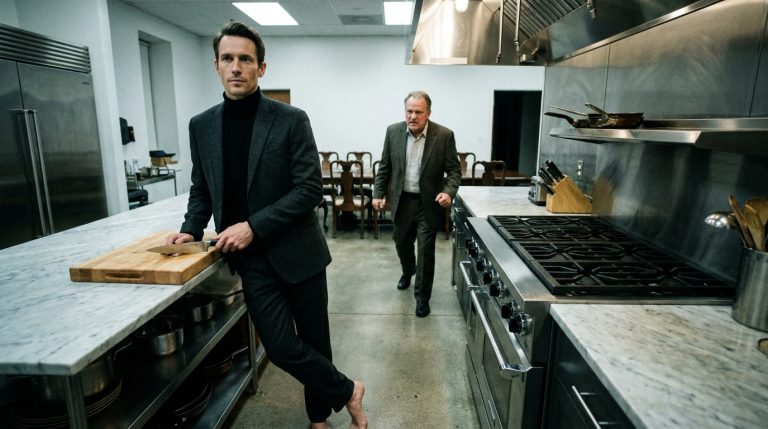
Diesel stood over the board with a serrated knife in his massive right hand, pressing down just hard enough to keep the turkey slices from sliding off the rye.
Marcus leaned against the refrigerator frame, arms locked tight across his chest, watching every move with the cold calculation of an auditor inspecting a sinking ledger.
“You’re cutting them too thick,” Marcus said.
“She likes them thin,” Diesel muttered, not looking up from the board as he squared off the edges of the bread.
“She doesn’t care about the edges,” Marcus shot back, his voice dropping an octave as he pushed off the fridge. “She just cares if someone’s watching the door.”
Diesel stopped the knife blade mid-stroke against the wooden grain.
The silence in the kitchen wasn’t peaceful; it was heavy with the brittle tension of kids who had learned to measure safety in seconds.
He didn’t offer a hollow reassurance or an easy smile.
Instead, he finished the cut, dropped the sandwich into a brown paper bag, and shoved it across the table toward the boy.
“The door is locked,” Diesel said flatly. “And the deadbolt is thrown twice. Eat your breakfast.”
The front room erupted into sudden noise as the twins began arguing over who got the blue cereal bowl.
Grace emerged from the hallway, her hair pulled back into a lopsided ponytail that Diesel had spent twenty minutes struggling with before giving up on perfection.
She walked straight to the front door, stopped dead in her tracks, and reached down with her left hand.
Without looking at anyone, she nudged her small white sneakers an inch to the left until they were perfectly parallel against the baseboard.
Not a millimeter out of line.
She stood up straight, hoisted a backpack that was twice too big for her thin frame, and looked at Diesel with eyes that had seen entirely too many mornings start just like this.
“We’re going to miss the bus,” Grace said, her voice entirely flat.
CHAPTER 3: THE BUREAUCRATIC WALL
The knock on the front door didn’t sound like a neighbor or a brother from the club.
It came in two crisp, rhythmic taps that carried the unmistakable weight of a county badge.
Diesel didn’t rush to answer it.
He stood in the center of the kitchen, wiping his hands on a rag, listening to the heavy silence that instantly settled over the hallway as Marcus stepped back from the living room archway.
When Diesel finally pulled the door open, the county supervisor stood on the porch holding a leather folder against her grey blazer like a shield.
“Mr. Hernandez,” she said, her voice clipped and professional. “We have a scheduling adjustment for the six-month review.”
“You were here last month,” Diesel said, his hand remaining flat against the inside edge of the doorframe.
“Protocols have shifted regarding multi-minor household placements under active parole supervision,” she replied, stepping uninvited past his shoulder into the hallway.
Her eyes scanned the tidy line of shoes by the door, lingering for a fraction of a second on Grace’s white sneakers before moving up to the living room walls.
“The committee is reviewing the district’s placement quotas. We need additional documentation on your daily oversight.”
Diesel’s jaw tightened as he watched her pencil tap against the leather folder.
She wasn’t looking at the kids’ homework on the table or the chore chart on the fridge; she was looking for a technicality to shrink the numbers.
“They have beds, they have school, and they’re safe,” Diesel said, his voice dropping into a low, rumbling register that made the supervisor pause her pen.
“Safe is a legal definition, Mr. Hernandez, not just a feeling,” she fired back without looking up. “And our files indicate certain compliance discrepancies that require immediate clarification.”
From the end of the hall, a soft rustle broke the standoff.
Grace was standing by the doorway of her room, holding a small, worn composition notebook in both hands, her knuckles white against the cardboard cover.
She wasn’t looking at the supervisor; she was staring straight at Diesel with an expression that spelled out an entirely new kind of trouble.
CHAPTER 4: THE HIDDEN PAGE
Diesel pulled the cover back slowly, the paper crackling like dry leaves in the quiet kitchen.
Inside were no drawings, no school notes, and no childish doodles.
Every page was covered in precise, hurried columns of street names, house numbers, and emergency escape routes mapped out across three different counties.
“Where did you get this?” Diesel asked, his voice dropping into a low rumble as he looked across the table at the girl.
Grace didn’t blink, her fingers locked tightly around the edge of her seat.
“I wrote them down when the lights went out,” she said, her voice entirely flat. “So we’d always know where to run if the doors weren’t locked.”
The supervisor’s clipboard still lay on the counter by the door, a stack of blank compliance forms waiting to dismantle everything he had built.
Diesel looked down at the names in the notebook, recognizing addresses of abandoned lots and condemned properties where children learned to hide before they learned to read.
This was Layer 1 of the county’s game—using quotas and paperwork to blindfold the system while kids like Grace kept their own escape bags packed by the door.
“You don’t need to run anymore,” Diesel said, his thumb tracing the worn edge of the cardboard.
“People always say that right before the doors open,” Grace whispered back, her eyes fixed on his scarred knuckles.
Diesel didn’t offer another empty promise.
He closed the notebook, stood up from the table, and walked over to the front door where the supervisor’s paperwork sat waiting for signatures.
He picked up a pen, not to sign their compliance forms, but to write down every single address from Grace’s notebook directly onto the back of the county’s legal notice.
CHAPTER 5: THE FINAL HEARING
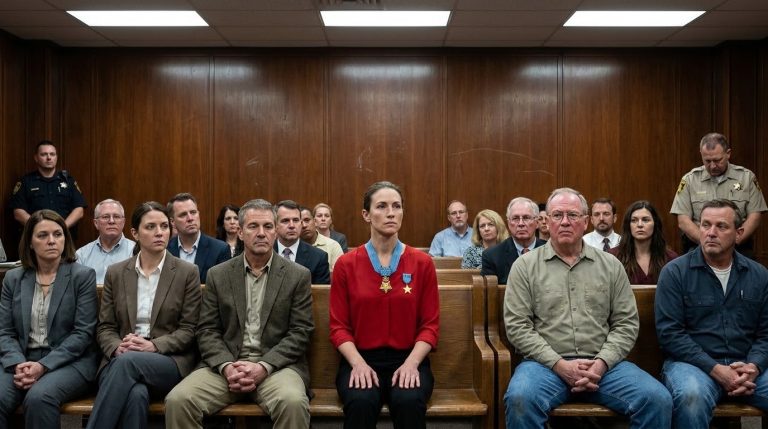
Diesel walked down the center aisle with his shoulders squared, the borrowed jacket straining slightly against his ink-stained arms.
The supervisor sat at the state’s table, her pen already tapping a steady, rhythmic beat against a stack of printed code violations.
She didn’t look up when he took his seat at the defense table, choosing instead to align her papers with absolute, clinical precision.
“Mr. Hernandez,” the judge said, peering over his glasses with a gaze that had seen every version of broken life in Sacramento. “The state maintains that your residential environment fails to meet statutory safety thresholds.”
“The state hasn’t looked inside the house since we put up curtains,” Diesel said, his voice level and entirely devoid of courtroom polish.
“Your criminal history is a matter of public record, sir,” the county attorney interjected, standing up to adjust his tie. “A convicted felon cannot simply rewrite institutional standards with a box of cereal and a clean floor.”
Diesel reached into his breast pocket and pulled out the county compliance notice he had marked up three days ago.
He didn’t hand it to his lawyer; he slid it across the polished wood directly toward the judge’s bench.
On the back were written twenty-four emergency addresses copied straight from Grace’s notebook—every abandoned lot and condemned structure where the county’s own caseworkers had failed to track missing children.
“They aren’t statistics,” Diesel said, leaning forward until his knuckles rested flat on the wood. “They’re kids who were sleeping on concrete while the system filed paperwork about quotas.”
The courtroom went dead silent.
The supervisor stopped tapping her pen.
The county attorney glanced down at the notice, his expression shifting from confident arrogance to sudden, sharp unease as he realized what those addresses represented.
CHAPTER 6: THE UNBROKEN DOOR
The kitchen table was crowded with seven mismatched chairs, each one pulled up tight against the polished wood.
A box of dry cereal sat in the center, flanked by an open carton of milk and a row of turkey sandwiches packed neatly in brown paper bags.
Diesel stood by the counter, his massive hands carefully sectioning a thick strand of hair into three even parts.
His fingers were clumsy, scarred, and completely unsuited for ribbons, but he worked with slow, unyielding patience until the braid held firm.
Grace looked up at him through the kitchen mirror, her reflection steady and calm.
“Is the front door locked?” she asked, her voice carrying the quiet routine of a morning that belonged entirely to them.
“Two turns on the deadbolt,” Diesel said, resting a heavy hand gently on her shoulder. “Every single night.”
Marcus walked past the doorway, pausing only long enough to straighten the chore chart hanging by the fridge before heading out toward the school bus.
The county supervisor’s compliance files were gone, replaced by gold stars, homework folders, and a stack of library books piled high in the corner.
There were no more escape routes to map, no more bags packed by the floor, and no more waiting for someone to knock the door off its hinges.
Diesel walked out to the front porch as the yellow bus rounded the corner, its brakes hissing softly against the asphalt.
He looked down at the corner of the garage where an old broom made of sticks and string still leaned quietly against the wall, untouched and permanent.
He didn’t move it.
He didn’t need to.
The porch light above his head stayed on, burning bright against the morning sky, casting a steady, unbroken glow across a home built from the ground up.