The Iron Anchor: A Veteran’s Quiet Siege Against a Courtroom’s Rotting Authority
CHAPTER 1: THE FRICTION OF ORDER
The air in Courtroom 4B tasted of recycled dust and the lingering, metallic tang of too many stale arguments. It was a space designed to exert pressure, a room where the walls seemed to lean in, impatient for the next verdict. Ella Anderson sat in the third row, her back a straight line of iron, her hands resting on her knees as if waiting for a command that never came.
Judge Harrington tapped his gavvel—a rhythmic, irritating sound, like a rusted bolt scraping against a drainpipe. He was staring at her, or rather, at the five-pointed gold star pinned to the pale blue ribbon against her red blouse. His annoyance was a physical thing, a twitch in his left temple that signaled the collapse of his patience.
“Ma’am,” he said, his voice grating and thin, echoing off the mahogany paneling. “I have already instructed you. Remove the decoration. It is a distraction, and this is a place of law, not a theater.”
Ella did not shift. She looked at him, but she did not see the robes or the elevated bench. She saw the fraying edges of a man who equated control with justice. The medal against her chest felt heavy—not with gold, but with the phantom weight of the men who had died in the sand, their voices now hushed in the hum of the overhead fluorescent lights.
The bailiff, a man whose uniform looked two sizes too small for his weary frame, hovered in the aisle. He looked at the Judge, then at Ella. There was a flicker of something in his eyes—a recognition of the weight she carried, a hesitation that spoke of a deep-seated respect for the metal he now knew to be the Medal of Honor. He took a step forward, his boots sounding loud on the industrial carpet.
“Ma’am,” he whispered, his voice an apology she didn’t need. “Please. I don’t want to do this.”
Ella looked up at him. The room was still, but the silence was not empty; it was pressurized. She thought of the mortar fire, the way the sky had turned to jagged glass in the Helmand valley. If they wanted the medal, they would have to tear it from her. She would not make it easy. She would not surrender the past to a man who thought honor was a matter of courtroom decorum.
She offered the bailiff a small, sad smile, the corners of her mouth barely lifting. She didn’t speak. She simply leaned back, her composure a fortress.
Then, the Judge’s voice cracked like a whip. “Bailiff! I said remove it. Now.”
The bailiff reached out, his hand shaking. As his fingers closed near her shoulder, the air shifted. A memory of smoke and cold, biting wind surged through Ella’s mind, drowning out the courtroom’s stifling order. It was then that David, the clerk at the side desk, moved. His face was pale, his eyes wide with a sudden, violent realization. He ducked his head, his hands disappearing beneath the desk, his thumb flying across his phone screen with a desperation that shattered the room’s rhythm. He was sending a signal, and the gears of a different kind of authority—the one that did not deal in fines or contempt—had finally begun to turn.
CHAPTER 2: THE WEIGHT OF THE BAILIFFS HAND
The bailiff’s fingers hovered just inches from the pale blue ribbon, and for those few seconds, the entire courtroom seemed to hold its breath. The air grew thick, charged with the static of a storm that had not yet broken. He was a man who knew the machinery of this room—the gavel, the oath, the standard procedures—but he did not know how to handle a hero. His hand, calloused from years of gripping batons and opening doors, looked clumsy and misplaced against the delicate fabric of the ribbon. He looked at Ella, expecting fear, expecting a plea, but he found only a stillness that felt heavier than lead.
Ella didn’t pull away. She didn’t flinch. She simply sat there, her gaze fixed on a point just above the Judge’s shoulder, her breathing rhythmic and undisturbed. She was a woman anchored in a memory far more severe than this sterile chamber, and her lack of movement was a quiet, crushing pressure that made the bailiff’s own skin crawl. He could feel the eyes of the gallery—the silent, watching witnesses—and he could sense the Judge’s frustration radiating from the bench like a heat haze.
“I said move, Bailiff,” Harrington barked, his voice straining with the effort of maintaining a dominance that was already beginning to fracture.
The bailiff swallowed hard. He looked down at the gold star, its intricate anchor center gleaming under the flat, artificial light. He saw the way the medal caught the glare, creating a tiny, sharp point of light that seemed to pierce through the surrounding dimness. He wasn’t just reaching for a decoration; he was reaching into a history he had no right to disturb. The friction of the moment—the sheer, abrasive reality of what the Judge was ordering—ground against his professional conscience. He was a man trained to follow the chain of command, but the chain had just snapped.
He took a half-step back, his boots scuffing against the industrial carpet, a sound that cut through the silence like a jagged blade. He looked up at the Judge, his eyes pleading for a reprieve, for an acknowledgment that this was a line that shouldn’t be crossed.
“Your Honor, I—”
“Don’t you dare,” Harrington snapped, his gavel hitting the wood with such force that a sliver of polished oak chipped away and skittered across the desk. “Contempt is a choice, and you are currently making yours.”
Ella watched the bailiff’s face drain of color. She felt no malice toward him. He was a cog, just like the clerk, just like the stenographer—part of a machine that had been set in motion long ago and was now spinning wildly off its track. She felt the phantom weight of the trauma bag strap on her shoulder, the way it used to bite into her skin during those long, desperate crawls through the Helmand heat. The medal against her chest felt warm, a living thing, pulsing with the names of the four men she had saved and the two she had not. It wasn’t jewelry. It was a debt. And she was not going to pay it here, in a room that smelled of floor wax and indifference.
To her side, David Cho was still hunched over his desk, his posture rigid. He had slid his phone back into his pocket, but his hands were still fisted beneath the surface of the desk, his knuckles white. He was waiting. He was looking at the door, his eyes darting toward the heavy oak frame that separated the quiet misery of the courtroom from the world outside. The room’s tension had shifted; it was no longer just about a dispute over decorum. It was about the arrival of something inevitable.
Ella felt a subtle change in the air, a drop in pressure that only someone who had spent their life bracing for impact would notice. The courtroom was a rusted vessel, vibrating under the strain of an authority that no longer fit the reality of its contents. The Judge was still ranting, his words a stream of self-righteous static that faded into the background of Ella’s focus. She felt the metallic tang of the room deepen, the scent of dust and old iron becoming almost overpowering, like a battlefield at dusk.
She looked at the Judge—really looked at him—and saw the fragility behind the mask. He was scared. Not of her, but of the possibility that he was no longer the loudest voice in his own kingdom. That fear made him dangerous, but it also made him obsolete. Ella straightened her posture, the medal settling against her chest with the finality of a lock sliding home. The bailiff, sensing the change, withdrew his hand entirely, his arms hanging limp at his sides. He had made his choice. He was going to wait.
The silence that followed was not the absence of sound; it was the presence of an incoming tide. Every person in the gallery leaned forward, their faces illuminated by the pale, flicker-prone light, their collective breath suspended in the stale air. The courtroom was waiting for the door to open, and Ella, the anchor in the third row, closed her eyes for a fleeting second, bracing herself for the storm.
CHAPTER 3: THE CIRCUITRY OF DISSENT
David Cho’s thumb moved with the rhythmic, calculated precision of a radio operator—a habit ingrained during four years of embassy duty, where a single mistimed transmission could mean the difference between a secure line and total isolation. Under the desk, his personal phone felt unnervingly hot against his palm. The screen was dark, but he knew the outgoing call had registered. The connection was made. The fuse was lit. He pulled his hand back, resting it on the polished edge of the clerk’s desk, and forced his breathing to slow, even as his heart hammered a frantic, uneven rhythm against his ribs.
Across the room, Judge Harrington was still locked in his performative rage, but the cracks were deepening. His gaze, previously imperious, kept darting toward the heavy oak doors at the back of the courtroom. It was a nervous, bird-like motion—a predator suddenly realizing he might be in the territory of something larger. He didn’t know what David had done, but he could feel the shift in the room’s atmosphere, a sudden drop in temperature that turned the recycled air sharp and biting.
David watched the judge, his perception sharpened by the cold sweat pricking his hairline. He noticed the tremor in Harrington’s hand as it rested near the gavel. The man wasn’t just angry; he was spiraling, losing his grip on the carefully constructed artifice of his authority. To David, this was a familiar breakdown. He had seen it in the eyes of local officials overseas when the reality of their position finally dawned on them—the moment the facade of power gave way to the raw, unvarnished truth of their own insignificance.
“You are testing my patience, Anderson,” the Judge muttered, his voice losing its booming, courtroom resonance and dropping into a jagged, defensive tone. “This is not a game. I have the power to ruin you.”
Ella, however, remained unmoved. She sat with her hands folded, her posture perfect—the posture of a woman who had stood in the eye of a literal storm and survived. She didn’t look at Harrington; she looked at the flag beside him, her gaze fixed with a quiet, reverent intensity. To anyone else, she was a quiet woman in a red blouse. To David, she looked like a monument. He caught the slight sheen of moisture in her eyes—not tears of weakness, but a reflection of the profound, heavy memories that the Judge’s insults were inadvertently dragging into the light.
The bailiff, sensing the Judge’s fraying composure, remained in the aisle, his posture stiff, his eyes avoiding the bench. He had effectively checked out of the proceedings. He was no longer an enforcer of Harrington’s will; he was a spectator to the Judge’s unraveling. The room felt like a rusted mechanism, the gears grinding and sparking as they struggled to rotate against an immovable object. The smell of the room—that lingering, dusty scent of old files and dry-rotted paper—seemed to amplify, a physical manifestation of the decay inherent in the system Harrington was trying so desperately to defend.
David reached down and adjusted the stack of legal pads on his desk, his movements slow and deliberate. He had to be careful. If he showed even a flicker of awareness, Harrington might latch onto him as an outlet for his building panic. He caught the eye of a young public defender in the second row—a woman who usually kept her head down during these sessions—and saw a flash of understanding. She, too, had heard the tone of the Judge’s voice. She, too, had sensed the change in the room’s gravity.
The silence stretched, agonizing and thick. The hum of the overhead lights, usually a soft background drone, now felt like a high-pitched whine. David felt a bead of sweat track down his temple. He knew the Master Gunnery Sergeant. He knew the man’s reputation for efficiency, for the way he moved through a chain of command like a scalpel. If the Master Guns was coming, he wouldn’t be coming alone. He would be bringing the full, crushing weight of the institution that Harrington had so casually insulted.
Every second that ticked by felt like a gear clicking into place, turning the room closer to an inevitable collapse. Ella didn’t move. She didn’t blink. She sat in the center of the mounting chaos like a stone set in a river, the current of the Judge’s fury simply parting around her. David gripped the edge of his desk until his fingers turned white. He was waiting for the thud of the doors, the sound of the world outside finally arriving to break the cycle of the room. He didn’t know how the Judge would react, but he knew one thing: when the door opened, the courtroom as it existed—the stale, predictable, rusted entity it was—would cease to exist forever.
CHAPTER 4: THE MARCH OF CONSEQUENCE
David Cho’s ears pricked up, his neck muscles locking as he strained against the oppressive quiet of the room. It wasn’t the sound of a janitor’s cart or the chaotic bustle of the hallway. It was cadence. A slow, measured, and unmistakably unified thud-thud-thud of dress shoes hitting the tiled floor in the lobby. He looked at the heavy oak doors, his breath catching in his throat. He had signaled for help, but he hadn’t fully processed what that help would look like—or what kind of seismic shift it would cause in the rotting foundation of Harrington’s courtroom.
Judge Harrington had heard it too. His head snapped toward the back of the room, his eyes wide and glassy, his hand frozen mid-air as he gripped the gavel. The red flush on his face had deepened to a mottled, unhealthy purple. He looked like a man trapped in a burning building, desperately scanning for an exit that didn’t exist. He stood up—not with the commanding grace of a jurist, but with the jerky, uncoordinated movement of a marionette whose strings were being cut.
“Bailiff,” the Judge hissed, his voice failing to project even as far as the second row. “What is that? Who is out there?”
The bailiff didn’t answer. He had shifted his stance, his feet planted wide on the carpet, his chin tucked slightly into his chest. He was no longer looking at the Judge or at Ella; he was facing the doors, his entire body poised in a posture of involuntary, reflexive salute. He wasn’t acting as a guard anymore; he was a sentry guarding the threshold of a truth that was about to walk inside.
Ella remained the only motionless thing in the room. She was looking toward the doors, her expression unreadable, though her hands had tightened imperceptibly on her lap. She wasn’t surprised. She was braced. She knew the weight of the organization that stood behind the metal on her chest, and she knew exactly what its arrival meant: the end of the Judge’s masquerade.
The footsteps grew louder, closer. They were not hurried. There was no desperation in the rhythm—only the cold, iron-clad certainty of military protocol. It was the sound of a system that didn’t argue, didn’t negotiate, and certainly didn’t care about the petty sensibilities of a local court. The double doors didn’t swing open with a creak; they were pushed with a firm, professional pressure that made the entire frame shudder.
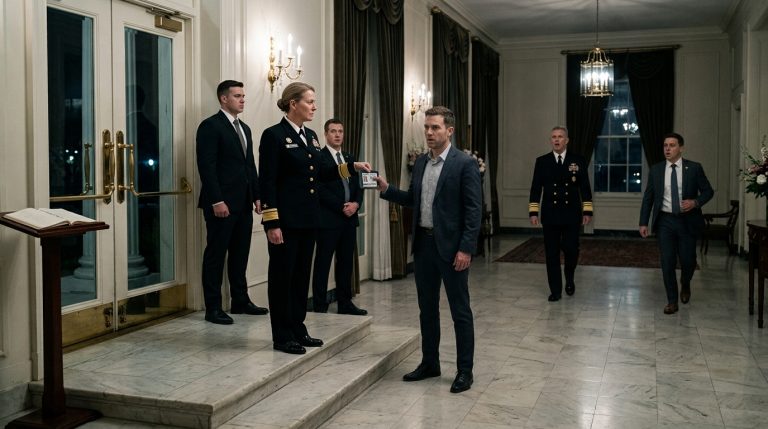
Three figures moved through the aperture. They didn’t storm in; they flowed, a unified block of starched white and dress blue. Admiral Thompson led them, his four silver stars catching the overhead light, but it was the Master Gunnery Sergeant beside him who seemed to draw the room’s oxygen. His dress blues were a dark, commanding contrast to the courtroom’s dreary beige palette, his chest a tapestry of service stripes and ribbons that looked like a history of conflict etched into fabric.
They walked down the center aisle, their pace perfectly synchronized. Every eye in the gallery was glued to them. Even the lawyers, hardened cynics who viewed every day as a series of billable hours, sat frozen. The courtroom’s atmosphere shifted instantly. The stale, recycled air felt as if it had been purged, replaced by a cold, sharp, metallic sense of accountability.
David felt his heart rate begin to settle, replaced by a chilling clarity. He watched as the Admiral navigated the aisle. Harrington was still clutching his gavel, but it looked absurdly small in his trembling hand. He was shouting something—something about authority, about decorum, about the sanctity of his courtroom—but the words were being swallowed whole by the rhythmic, inevitable approach of the men in uniform.
The Admiral didn’t look at the bench. He didn’t look at the lawyers. He walked with a narrow, laser-focused purpose, his gaze locked onto the woman in the third row. He wasn’t here to argue law; he was here to enforce a reality. As he reached the front of the public gallery, the silence in the room became absolute, a vacuum so total that David could hear the distant, muffled sound of a siren somewhere out on the street—a sound that felt like it belonged to a different, less significant world. The Judge’s mouth was still working, a frantic series of movements without sound, as the Admiral finally halted in front of Ella Anderson, his presence turning the courtroom into a staging ground for a much larger, much heavier history.
CHAPTER 5: THE SALUTE THAT SHATTERED THE BENCH
Admiral Thompson did not break his stance. He remained locked in that precise, agonizingly sharp salute, his gaze fixed on Ella with a level of reverence that made the courtroom seem to shrink around them. It was a silent, devastating broadcast of priorities. In the presence of a Medal of Honor recipient, the Judge’s bench, the gavel, and the entirety of Harrington’s jurisdiction had been rendered entirely ornamental.
The courtroom fell into a state of total structural failure. The stenographer’s fingers stopped mid-keystroke; the lawyers’ pens remained hovering over their pads. Harrington was physically shrinking, his frame pulling inward as if the very air had become pressurized. He opened his mouth to speak, but the words were stolen by the sheer, undeniable gravity of the Admiral’s presence. The silence was so dense it felt like iron.
Ella felt the ribbon at her neck tighten. The weight of the star—that heavy, gold-and-laurel anchor—seemed to pull on her skin, bringing with it the sudden, violent surge of the Helmand Valley. It was a psychological phantom, a sharp, metallic scent of cordite that eclipsed the sterile, dust-choked air of the courtroom. She saw the Judge not as a man of power, but as a flickering, fragile image projected onto a wall of smoke. The sound of the courtroom faded, replaced by the high-pitched whine of incoming mortar fire that she had buried beneath thirty years of silence.
The Admiral finally dropped his hand, but he didn’t turn away. He kept his eyes on her, his face a mask of iron-clad professionalism. “Master Chief Petty Officer Anderson,” he said, his voice a resonant baritone that bypassed the Judge entirely, filling the room with the authority of the deep, gray sea. “It is an honor to see you again.”
The declaration landed like a physical blow. A murmur rippled through the back of the room, a collective release of tension that sounded like wind through dry, rusted grass. The Judge’s eyes darted frantically between the Admiral and the gallery, his face a pale, sickly shade of grey. He reached out to grab his gavel, his fingers trembling so violently that he knocked a glass of water off his desk. The shattering of glass on the hardwood floor sounded like a gunshot in the vacuum of the room.
“This… this is an unauthorized intrusion!” Harrington stammered, his voice cracking, the thin veneer of his dignity shredded. “This is a court of law! You cannot simply march in here and—and disrupt these proceedings!”
Admiral Thompson turned then. He didn’t move quickly, but the shift was so deliberate it felt like the rotation of a turret. He looked at Harrington with the cold, detached gaze of a commander inspecting a faulty piece of equipment. The Admiral didn’t yell; he didn’t lean forward. He simply stared, and the lack of aggression was far more terrifying than any outburst could have been.
“Your Honor,” the Admiral said, each syllable measured and weighted. “There is a federal law regarding the sanctity of this decoration. There is also, I suspect, a significant body of review regarding your conduct in this chamber. I suggest you choose your next words with extreme care.”
David Cho, sitting at the clerk’s desk, felt his heart hammer against his ribs. He had lit the fuse, but he hadn’t realized the explosion would leave nothing behind. The courtroom had become a battlefield where the only thing being fought over was the legitimacy of the Judge’s entire existence. Ella felt the phantom weight of the trauma bag strap digging into her shoulder again, the rough canvas of the past warring with the stiff fabric of the present. She was witnessing the structural collapse of a system she had sworn to defend, and it was a cold, pragmatic, and entirely earned destruction.
Harrington scrambled to compose himself, his hands fumbling with his robes as if they were a suit of armor that had suddenly lost its structural integrity. He looked at the bailiff, then at the gallery, but there was no support to be found. The courtroom had shifted its allegiance. The authority had left the bench and moved, quite physically, to the woman in the third row.
Ella looked at the Judge, and for a fleeting, terrifying moment, she felt the phantom weight of the fallen Marines—the ones she hadn’t saved—pressuring her to break. She had to hold. She had to be the anchor. The room felt like it was tilting, the floor beneath the Judge’s feet eroding into dust, and in that moment, she realized the Admiral wasn’t just here to save her—he was here to ensure the rot was exposed to the light. The Judge wasn’t just being defeated; he was being erased.
CHAPTER 6: THE TESTIMONY OF THE SCARRED
Judge Harrington’s hands were shaking—a rhythmic, tapping vibration that seemed to transmit the decay of his courtroom directly into the oak bench. He was desperate to find a lever, a clause, anything that could turn the tide of the mounting, crushing weight of the room’s new reality. He gripped the edges of his desk so hard the wood groaned, his knuckles white. He looked out into the silent, stagnant air, ignoring the Admiral, trying instead to find the gaze of the bailiff, the clerk, anyone who would acknowledge the “law” he believed he was still presiding over.
“This is…” Harrington began, his voice failing him, a thin, reedy sound that died before it reached the back of the room. He cleared his throat, forcing a counterfeit strength into his posture. “This is an obstruction of justice. You are all… you are in contempt. I will have this entire floor cleared.”
But the bailiff didn’t move. He stood like a rusted statue in the aisle, his eyes fixed on the Admiral. The entire gallery remained locked in a suffocating, mesmerized silence. David Cho, sitting just feet away from the judge, saw the pathetic, shivering reality behind the robe. The Judge was a man who had built his life on the hollow assumption that authority was something granted by a desk and a title, rather than earned by the substance of one’s own life.
Admiral Thompson moved then. It was a slow, heavy transition—the kind of movement that belonged to a man who had navigated war-torn coastlines in the dark. He didn’t approach the bench with malice. He approached it with the cold, measured patience of a man reviewing an after-action report. He stopped at the bar, his presence so massive it seemed to physically push the Judge backward.
“Your Honor,” the Admiral said, his voice dropping into a register that made the floorboards feel like they were vibrating. “The citation for the Medal of Honor is a matter of public, federal record. It is not an ‘unauthorized decoration.’ It is a testament to an act that saved the lives of four Marines. If you wish to proceed with charges of contempt against the bearer, I invite you to read the record into the court proceedings yourself. Let the stenographer type every word of that afternoon in the Helmand Valley into the official record of your courtroom.”
The Admiral held a small, weathered folder—the file David had requested—and held it out, resting it on the edge of the judge’s bench. It sat there, a block of paper that carried more weight than any ruling Harrington had ever made.
Ella stood up. The movement was slow, painful, a testament to the old ache in her shoulder—a physical reminder of the cost of that afternoon in the valley. She didn’t look at the Judge. She walked past the Admiral and stood near the center of the floor, the space suddenly feeling like a parade ground. The metallic, cordite-scented memories in her mind were beginning to bleed into her vision. She saw the faces of the Marines—the young ones, the ones with the Ohio accents and the jokes that felt like a lifetime ago.
“I don’t need you to apologize, Mr. Harrington,” Ella said, her voice clear, unforced, and entirely devoid of the Judge’s theatricality. It was a voice that had spoken over the roar of helicopter rotors and the deafening, earth-shaking blast of mortars. “And I don’t need you to validate this medal. What I needed was for you to be a man capable of seeing the reality of the people who defend the very system you pretend to serve. You failed that test. The question isn’t whether I am in contempt of your court. The question is whether your court is in contempt of the people who allow it to exist.”
The impact of her words was devastating. It wasn’t an attack; it was a diagnosis. David Cho felt his breath hitch in his throat. He watched the Judge, who had collapsed back into his chair, his robes now looking like a heavy, suffocating weight. The mask had been ripped away. The court was no longer a place of law; it was a place of reckoning.
The air in the room felt heavy, metallic, and cold. The Judge looked at the file on his desk, his fingers hovering over the paper as if it were white-hot. He knew that if he read the record, if he spoke the details of that day, he would be sealing his own professional grave. But if he didn’t, he was finished anyway. He was trapped in the rusted machinery of his own ego, and for the first time in his career, he had absolutely no counter-move. The courtroom was waiting, held in a silence so perfect it felt like a collective, held breath.
CHAPTER 7: THE UNRAVELING OF THE GAVEL
The gavel, a piece of polished oak that had served as the physical manifestation of Harrington’s power, rolled across the floor with a series of dull, rhythmic clicks. It came to a stop against the base of Ella’s chair. No one moved to retrieve it. It lay there, an abandoned tool in a room that had suddenly realized its master was naked. The Judge’s hands were still raised, trembling in the empty air, his face a landscape of absolute, crushing defeat. He looked small—shrunken, as if the air had been pumped out of his robes.
Admiral Thompson watched him, his expression one of clinical, detached observation. He hadn’t raised his voice, he hadn’t threatened him, he hadn’t even engaged in a debate; he had simply provided the truth, and the truth had hollowed the Judge out from the inside. The room was no longer a courtroom. It was a space of transition, where the old, brittle rules of Harrington’s ego were being discarded like trash.
“It is done, Your Honor,” the Admiral said, his voice quiet, lacking even a hint of triumph. “The record is clear. You have the choice to acknowledge the law as it is written, or you can continue to hold yourself in contempt of the people you swore to serve.”
Harrington blinked, his eyes unfocused, staring at the empty space where his authority used to be. The silence that filled the room was heavy, smelling of ozone and floor wax, the atmosphere of a pressure cooker after the valve has been blown. David Cho, still sitting at the clerk’s desk, felt his muscles finally begin to unlock, though his hands remained damp with sweat. He looked at the young sailor, Peterson, whose face had gone from panic to a sort of dazed, wide-eyed awe. The boy didn’t understand the full machinery that had brought the Admiral here, but he understood the result: he was free.
Ella slowly stood up. The movement was difficult; the phantom weight on her shoulder seemed to grow, the memory of the Helmand Valley pulling at her concentration. She looked at the gavel on the floor, then at Harrington. She saw the man’s panic—not the kind of panic that inspires a fight, but the kind that precedes total psychological collapse. He was a man who had staked his entire identity on being the smartest, most powerful person in a small, windowless box, only to realize he had been playing for stakes he didn’t even understand.
“Mr. Harrington,” Ella said, her voice soft but carrying to every corner of the room. “You spent all day worrying about the decorum of this court. But you forgot that the decorum doesn’t come from the robe. It comes from the cost. It comes from the people who keep the world safe so you can sit in this chair.”
She didn’t wait for his response. She turned away, her movements fluid and purposeful. As she walked toward the exit, the officers and the Admiral parted like a sea, a wall of starched, disciplined order that followed her out into the lobby. The bailiff, who had been guarding the door, stepped aside, his head bowed in a gesture that wasn’t just professional, but deeply, instinctively respectful.
Behind them, the courtroom began to drift. Voices started to murmur, low and uncertain. The Judge remained slumped in his chair, a ghost presiding over an empty throne. David watched him for a second longer, a strange mixture of pity and contempt rising in his chest. Harrington was still staring at the floor, his fingers tracing the patterns in the fabric of his robes. He was already a relic.
As Ella crossed the threshold of the courtroom, the transition from the sterile, artificial light of the court to the natural, unfiltered daylight of the hallway felt like a resurrection. She felt the heavy, phantom pack slip from her shoulders, the weight of the Marines she hadn’t saved finding a quieter, more peaceful place in her mind. She didn’t look back. She walked with the steady, measured pace of a woman who had already fought her war and simply needed to survive the aftermath. Behind her, the doors swung shut with a firm, final, definitive click—the sound of a period placed at the end of a long, exhausting, and entirely necessary sentence. The case, for all intents and purposes, had been resolved not by law, but by the relentless, quiet force of the truth.
CHAPTER 8: THE WEIGHT OF THE SETTLED DUST
The commissary aisles were bathed in the flat, humdrum light of a Tuesday afternoon, a stark contrast to the sharp, jagged tension of the courtroom weeks prior. Ella pushed her cart, the metal wheels squeaking slightly against the polished linoleum—a mundane, grounding sound. She felt the phantom ache in her shoulder, a dull, rhythmic pulse that reminded her not of the battle, but of the price she had paid for the quiet peace she was now trying to inhabit.
She turned into the canned goods aisle and stopped.
Standing near a display of soups, looking smaller and decidedly more fragile than she remembered, was Harrington. He was dressed in civilian clothes—a rumpled windbreaker and slacks that looked like they hadn’t been pressed in days. He was studying a label on a can of peas with a concentration that seemed misplaced, almost desperate. As he turned, his eyes met hers, and the flicker of recognition that crossed his face wasn’t arrogance, but a profound, weary shame.
He didn’t run. He didn’t look away. He swallowed, a visible, painful contraction of his throat, and stepped into her path. “Master Chief Anderson,” he said. His voice was quiet, stripped of the booming, resonant authority that had once filled Courtroom 4B.
Ella stopped her cart. She looked at him, really looked at him, and saw the man behind the robe—a man who had clung to a false, rusted version of order because he had nothing else. She felt the medal resting against her blouse, the hidden weight of those four names—the Marines who had come home—and the two who hadn’t. That was the Layer 2 truth she had carried into that court, the reason why his dismissal of her service had been so visceral. The medal wasn’t a souvenir of glory; it was a scar of responsibility.
“Mr. Harrington,” she replied, her tone even, neither forgiving nor condemning.
“I wanted to apologize,” he said, the words seemingly dragging themselves out of him. “Again. I have had a lot of time to reflect on what you said. About the standards. About the wisdom.” He paused, glancing at his feet before meeting her eyes again. “I didn’t understand that the uniform—that the things we wear—are just the final, superficial layer. I failed to see the cost beneath it. My ignorance was… it was profound.”
Ella felt a quiet, settled peace. She wasn’t holding onto the anger anymore; the anger had been burned away by the Admiral’s arrival, by the cold clarity of the truth. She remembered the Oval Office—the president’s solemn face, the weight of the ribbon—and she realized that the contrast between that historic moment and this mundane commissary aisle was where her life was finally meant to reside. She wasn’t a symbol. She was a woman who had simply done what was necessary, and the system—the grand, rusted, sprawling system—had finally been forced to acknowledge the weight of that reality.
“What’s done is done,” Ella said, her voice steady. “But I heard about the training program you’ve implemented at the courthouse. I heard the staff are actually learning the history, not just the rules.”
Harrington nodded, a faint, tentative trace of relief touching his face. “It’s a start. It’s not enough to fix what I broke, but it’s a start.”
“That’s all any of us can do,” Ella said.
She moved past him, her hand brushing the handle of her cart as she continued down the aisle. She felt the heavy, phantom pack on her shoulders finally, completely, dissipate. The repair wasn’t in the apology, but in the acknowledgment of the reality she had defended. She stopped at the end of the aisle to reach for a box of pasta, her shoulder giving a familiar, dull protest, and she reached up with her other hand to touch the medal through the fabric of her shirt, a small, private gesture of connection.
The commissary was quiet, filled with the everyday sounds of people going about their lives, unaware of the ghosts she carried or the storm she had weathered. She felt a deep, profound sense of connection—not to the system, but to the people around her, the ones who went to work, who shopped for dinner, who lived in the silence that the sacrifices of others had bought them. It was enough. The battle was over, the truth had been spoken, and for the first time in a long time, the weight on her heart felt like nothing more than the quiet, steady rhythm of her own breathing.