The Silent Anchor: A Vice Admiral’s Journey Through the Weight of Invisible Service and Hard-Won Peace
CHAPTER 1: The Threshold of Visibility
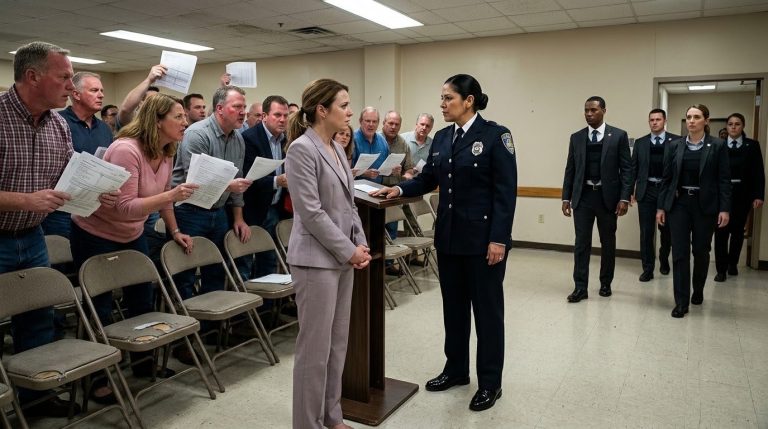
The air in the British Embassy foyer was too thin, or perhaps it was just the sudden transition from the humid D.C. night to the sterile, pressurized climate of the inner circle. The two Navy SEALs—Trent and Garrett—stood like monuments carved from granite. They had the blank, professional gaze of men who had seen everything except the person standing directly in front of them.
Their smirk was the most honest thing about the night. It was that specific, dismissive curl of the lip that had followed me through every family dinner, every promotion, every single milestone of my career. It was the face of a world that believed intelligence was something you read on a page, not something you lived in the marrow of your bones.
“Wrong entrance, ma’am,” Holloway said, his voice steady, rhythmic, and entirely wrong. “Spouses through the side.”
Beside me, Tobias shifted. He didn’t just stand; he radiated the comfortable, easy dismissal of someone who had never had to fight for his seat at the table. His laughter was a physical weight, a low hum that vibrated through the small of my back.
“Even the Navy doesn’t know who you are, Astor,” he murmured. It wasn’t a malicious sound; that was the tragedy of it. It was just natural. To him, I was still the sister who played dress-up in uniforms that didn’t fit.
I stood on the second step, the hem of my navy gown brushing against the cold, historic stone. My heartbeat was a slow, mechanical thud—a metronome counting down the years. I looked past the SEALs, past the brass handles, toward the quiet, opulent interior of the embassy. I reached into my clutch. My fingers brushed the cold metal of my identification badge—the heavy, tactile proof of three decades of work that would never be acknowledged in a family photo.
I didn’t argue. I didn’t raise my voice to match his. I simply held the badge up, steady as a compass needle.
The air changed. The familiar heavy thud of heels echoed on the marble inside. Rear Admiral Ellis Quinn appeared, a silhouette against the warm glow of the foyer. He wasn’t looking at me, not yet—he was looking at his sailors, his people, his team. But then his gaze snagged on the badge. He paused, the movement unnatural, a stutter in the rhythm of his stride.
He looked at the two SEALs, then at the woman standing on the threshold.
He didn’t just recognize me; he remembered the mission. He remembered the handshake in the secure room in 2011, the one that had cost me a marriage and a lifetime of being a stranger to my own kin. His spine locked, a sudden, precise line of tension.
He didn’t speak. He didn’t need to. He snapped his hand to his brow in a salute so crisp it sounded like a shot in the silence of the foyer.
“Vice Admiral Lansing, ma’am.”
The world shifted. The SEALs’ faces drained of color, their hands falling away from their belts like dead weight. Tobias went silent, his breath hitching, the laughter dying in his throat as if the oxygen had suddenly been pulled from the room.
I held the salute. I looked past the Admiral, into the polished, unforgiving reflection of the glass doors. For the first time in my life, I didn’t see a daughter, or a sister, or a spouse. I saw an officer who had arrived exactly where she was supposed to be.
But as the Protocol Officer hurried forward, his face etched with panic, I felt a new, chilling realization settle in my chest. This wasn’t the victory. This was just the beginning of the noise. And somewhere in the dark, I could still hear the ghost of my father’s voice, whispering that even now, I was standing in the wrong room.
CHAPTER 2: The Geometry of a Salute
The hotel room was an island of beige and quiet, a stark contrast to the marble-clad, high-stakes theater of the British Embassy. I moved toward the closet, the navy gown feeling suddenly heavy, like a costume that had served its purpose but refused to be shed. I stepped out of the heels, the relief of bare feet on the plush carpet a small, grounding anchor.
My reflection in the mirrored closet door was a stranger. Vice Admiral Astrid Lansing, 51, the first woman to lead the Defense Intelligence Agency. But in the dim light of the Willard, I still saw the 14-year-old girl at a picnic table in Annapolis, eating a hamburger at a kitchen sink because there wasn’t a place for her at the table where the “real” Navy talked.
Tobias. He was likely pacing his own room three floors down, his mind undoubtedly spinning through the same feedback loop that had haunted us both since childhood. That laugh—that soft, sideways, protective laugh he had kept in his pocket for thirty years—had died on the embassy steps. For the first time, he hadn’t laughed because he wanted to mock me; he had laughed because he had finally run out of ways to process the fact that I was someone he didn’t know.
I turned away from the mirror and walked to the window. The lights of Washington were a sprawling, glittering map of a city I had spent my entire life trying to map for others. I traced the path of the Potomac, my mind returning to the Admiral’s hand at his temple.
That salute wasn’t a gift. It was a professional obligation, a recognition of rank that had bypassed the familial architecture entirely. That was the rub. The Admiral had given me the one thing I had spent three decades trying to earn from a father who was already gone. And yet, sitting in the hollow silence of this room, I felt no surge of triumph. I felt only a profound, hollow resonance.
I picked up the green notebook from the nightstand. The leather was worn, the corners frayed like the cuff of an old dungaree shirt. I flipped to the page where I had underlined Harlan Pierce’s words: If you do this job right, your family will think you push paper for the rest of your life. That is the cost.
I had paid the cost. I had paid it in missed anniversaries, in two failed marriages, in the polite, distant rapport I maintained with my own brother. I had paid it in the thousands of hours spent in windowless rooms, drinking 4:00 AM coffee and watching screens that mapped the fate of men who would never know my name. But tonight, the cost had shifted. It was no longer about what I had lost; it was about what I had built in the absence of their understanding.
My phone, sitting on the glass-topped desk, pulsed with a soft, amber light. A notification from the British Embassy protocol office—an automated follow-up. I ignored it. I didn’t need to read the confirmation of a night that had already rewritten my personal history.
I walked to the bathroom and turned on the tap, splashing cold water over my wrists. I stared at myself in the vanity mirror. The pearl earrings I had borrowed from my grandmother seemed to catch the light, flickering like small, pale warnings.
I had invited Tobias because I wanted him to see the weight of the work. I had wanted him to look at me—truly look at me—and see the Admiral, not the sister. I had succeeded, and the cost was that I had finally, irrevocably, shattered the safety of his ignorance. He could no longer pretend I was “playing dress-up.” He was now a witness to the reality of my life, and that meant he was now accountable for the distance he had maintained.
The silence of the hotel room was beginning to feel less like a sanctuary and more like a waiting room. I knew, with the precision of a strategic assessment, that the silence between Tobias and me wouldn’t last through the morning. He would want to talk. He would want to offer an explanation that wouldn’t hold up under the light of day. Or, perhaps, he would choose to stay silent, protecting the ghost of our father’s world at the expense of our own.
I reached for my gown, still laid out on the bed, the deep navy fabric shimmering in the artificial light. I realized then that I wasn’t just tired; I was finished. I was finished with the act of performing for ghosts. I would return to Arlington, I would put on the uniform, and I would continue to do the work. The work was honest. The work had a rubric. The work didn’t ask me to be anything other than what I was.
I pulled the robe tight around me and sat at the edge of the bed, my hand resting on the notebook. Tomorrow, the feedback loops would reset. The Senate would have questions, the DNI would require a briefing on the partner nation request, and the world would continue its rotation. But tonight, the room was mine. And for the first time in thirty years, I didn’t feel the need to justify the air I was breathing. I turned off the lamp, letting the room submerge into a familiar, comforting dark, and waited for the morning to tell me who I would be when the sun rose.
CHAPTER 3: The Geometry of Friendship
The air in Old Town Alexandria was thick with the scent of damp brick and roasting coffee, a morning sensory overload that felt like an intrusion. I walked toward the coffee shop with my coat collar turned up against a biting February wind. My heels clicked against the uneven pavement—a sharp, rhythmic sound that reminded me of the embassy floor. I was Vice Admiral Lansing in the eyes of the world, but here, in the shadow of the brick storefronts, I was just Astrid, the woman who had finally run out of reasons to apologize for her own existence.
Iris was already inside, seated at a corner table bathed in the pale, filtered light of a weak winter sun. She had a cup of black coffee in front of her, the steam curling into the air in thin, ghostly ribbons. When she saw me, her expression didn’t shift into the practiced mask of a colleague; it softened into the weary, knowing gaze of a woman who had been in the trenches beside me for thirty years.
“You look like you haven’t slept,” she said, her voice quiet, conversational. She didn’t offer a platitude. She didn’t ask how I was doing. She knew.
I pulled out the chair, the legs scraping against the floorboards, and sat down. My own coffee arrived a moment later, the ceramic warm against my palms. I held it there, letting the heat sink into my skin, grounding me.
“The embassy,” I began, my voice steady but brittle. “It wasn’t just the salute, Iris. It was the moment afterward.”
Iris leaned back, her eyes tracing my face with the clinical precision of someone trained in intelligence. “Tell me.”
I spoke then, not as an Admiral giving a briefing, but as a person unraveling a knot that had been tied for a generation. I told her about the SEALs, the smirk, the sudden shift in the air when the Admiral appeared, and finally, the way Tobias had looked at me on the ride back—not with pride, but with a bewildered, crumbling fear. I didn’t hold back the ugliness of it, the way the “triumph” felt like ash in my mouth because it had been granted by a stranger, while my own brother remained trapped in the architecture of our father’s silence.
Iris listened, her fingers tracing the rim of her mug. She didn’t interrupt. She let the silence build until it was heavy enough to hold the weight of everything I had been carrying.
“You did it to wake him up,” Iris stated, more a fact than a question. “But you’re realizing that waking someone up in a house built by a dead man is a dangerous thing.”
I looked out the window at the people passing by on King Street—a young couple laughing, a man in a courier uniform hurrying toward the harbor. I felt a sudden, sharp pang of envy for their simplicity. “I thought if he saw the work, he’d understand. I thought the work was the evidence he needed to finally say it. But he didn’t say it. He just stopped laughing.”
Iris shifted, her posture becoming more deliberate. “Astrid, why did you invite him?”
The question hung in the air, deceptively simple. I opened my mouth to give the standard answer—to share the history, the familial duty, the desire for reconciliation—but the words stuck. I looked at Iris, really looked at her, and saw the faint lines of concern etched around her eyes. I realized then that she wasn’t asking about my brother. She was asking about my father.
“Because I am still seventeen years old in that Annapolis kitchen,” I whispered, the admission tasting like copper. “Waiting for a letter to be read and a word to be spoken that was never going to come.”
Iris’s hand moved across the table, covering mine. Her touch was firm, steady, and entirely devoid of pity. “Your father is dead, Astrid.”
“I know.”
“Tobias is not your father.”
“I know.”
“Then why are you still playing the game?” she pressed, her voice dropping an octave. “You aren’t trying to bridge a gap with your brother. You’re trying to build a bridge to a cemetery.”
The revelation hit me with the force of a physical impact. I looked down at the coffee in my cup, the dark surface reflecting the distorted shape of my own face. I had spent my entire career treating my life as a counter-intelligence operation, trying to out-maneuver the ghosts of my family. I had been so busy building a defense against a father who was no longer there that I had forgotten to live in the life I had actually earned.
I looked back at Iris. “How do I stop?”
“You start by admitting the game is rigged,” she said, pulling her hand back to take a slow, deliberate sip of her coffee. “You’ve been waiting for a payoff that doesn’t exist. The only person who can validate this rank, this career, this life… is you. Not Tobias. Not your mother. Not the ghost of your father.”
I watched her, the realization settling into my bones, a cold, sobering weight. I had come here looking for a strategy, a way to handle my brother, but Iris had handed me a mirror instead. I didn’t need to invite Tobias into my world to make it real. I needed to be comfortable enough in that world to stop caring if he ever stepped across the threshold.
“I have a file at home,” I said, my voice barely audible above the low hum of the cafe. “A letter he wrote before he died. I haven’t opened it in six years.”
Iris raised an eyebrow. “What’s stopping you?”
“The fear that the answer is already there,” I replied, staring at the rain beginning to streak the windowpane. “And that I’ve been too busy looking for a key to notice the door was never locked in the first place.”
CHAPTER 4: The Unsealed Weight
The apartment was suffused with the late afternoon light, the kind of gray, filtered sun that seems to emphasize the dust motes dancing in the air. I stood for a moment, letting the silence settle. My apartment had always been a place of calculated order, a reflection of the agency’s demands, but tonight it felt like a museum of a life deferred.
I walked to the desk, my movements slow and deliberate, as if I were moving through water. The drawer slid open with a soft, protesting groan. Inside, beneath a stack of classified travel vouchers and old administrative logs, lay the envelope. It was nondescript, the paper slightly yellowed from time and the stifling air of the drawer.
I pulled it out and set it on the kitchen table. The sight of my father’s handwriting—cramped, purposeful, and as rigid as the man himself—sent a shiver through me. It was the handwriting of a man who lived his life by the hull numbers and the watches, a man who never once wavered in his belief that the world was divided into those who commanded and those who did the work.
I didn’t open it immediately. Instead, I sat down and let my hands rest on the table. My mind drifted back to a Tuesday in 1993, the Annapolis post office, the smell of damp newsprint and floor wax. I remembered the feeling of mailing that Naval Academy application, the terror of believing I was betraying the only family I had, even as I was desperate to find a world that looked like mine.
The ghost of that feeling, the suffocating pressure of being an officer in a house that didn’t produce them, flared in my chest.
Slowly, I slid my thumb under the flap and tore the paper. The sound was deafening in the stillness of the apartment. Four pages of yellow legal paper unfolded with a crisp snap. I began to read.
My father’s words were a map of a life I had observed from the outside but never truly understood. He spoke to Tobias of the technical nuances of the trade—the specific way a chief had to balance the technical requirement of the machinery with the fragile, chaotic humanity of the crew. He gave advice on how to lead from the deck plate, how to command respect through consistency rather than volume. It was a beautiful, devastatingly precise manual on how to be the man he had been.
I read through the first three pages, finding myself nodding despite the distance between us. He was a master of his domain, a man who found grace in the mechanics of service. But the further I read, the more I felt the widening gulf. He was handing Tobias the keys to a kingdom I had been told, repeatedly and with biting precision, I was never allowed to enter.
Then, I reached the fourth page.
I paused, my breath hitching, as I reached the bottom. There it was—the postscript. A single sentence, written in the same steady, blue-inked hand that had detailed the maintenance schedules and the leadership philosophies of a lifetime.
Tell your sister I’m proud.
I stared at the words. They were stark, clinical, and yet, somehow, they felt like a scream in a room that had been silent for thirty years. He hadn’t said it to me. He had written it to Tobias, a message to be carried, a burden to be transferred. I looked at the handwriting, searching for a tremor, a flaw, a sign that it had cost him something to write those words. But the ink was as smooth and unyielding as the man who had penned it.
He could write it. He could commit it to paper, safely insulated by the medium of a letter, but he could never look me in the eye and let the sound escape his throat.
The realization, the “decoys” of my life—the belief that he was simply withholding love, the belief that I wasn’t enough—began to collapse. It wasn’t about me. It was about his inability to speak in a language he hadn’t been taught. He had been a man shaped by his own ghosts, unable to break the cycle because he didn’t even have the vocabulary to acknowledge it existed.
I pushed the paper away, the weight of the years pressing down on the table. My eyes caught the photograph of the destroyer captain behind me, the one Tobias had sent, staring out with a fixed, noble gaze. The cycle of the “deck plate” philosophy, the generational silence, the rigid compartmentalization of pride—it was all there, a legacy of iron and rust.
I didn’t cry. The exhaustion was too deep for tears. I stood up and walked to the window, the river stretching out before me, dark and indifferent. I had been waiting for this note to be the key that unlocked the door to my father’s approval, but as I looked at the letter, I saw it for what it truly was: a record of his own limitations.
I had been carrying this letter like a holy relic, a validation I had fought for my entire life. But the man who wrote it was a stranger who had spent his life staring at a photograph of his own father, unable to reach out to his children in anything other than the coded language of duty. I hadn’t been rejected; I had been caught in the crossfire of a war he had been losing since the day he first stepped onto a ship.
I walked back to the table, picked up the four pages, and folded them with slow, steady movements. I had the answer. It didn’t change the past, and it didn’t heal the scars, but for the first time, the “weight” of my father’s silence wasn’t a mountain I had to climb anymore. It was just an object. Something I could hold, something I could set down, and something I could walk away from.
The apartment felt different now—less like a shrine to a ghost, and more like a room I was actually allowed to inhabit. I went to the kitchen, poured myself a glass of water, and stood in the dark, watching the city lights. Tomorrow, I would have to talk to Tobias. I would have to tell him I had read it. But tonight, I was just Astrid. And that, I realized, was finally enough.
CHAPTER 5: The Norfolk Intersection
The rental car, a nondescript sedan that lacked the familiar, disciplined hum of my own vehicle, began to shudder about thirty miles outside of Norfolk. It was a rhythmic, insistent thrumming, like a mechanical heart missing a beat. I glanced at the dashboard; no warning lights, just the insistent vibration beneath my feet. I should have pulled over immediately, but the momentum of the last few days—the letter, the realization, the need for this conversation—pulled at me like a tide.
Then, the car groaned, a sharp, metallic sound that pierced the cabin, and the engine lost its bite. I steered it onto the shoulder, the tires crunching against gravel and dried brush. I brought the car to a halt in the dark, the silence of the countryside rushing in the moment I killed the ignition. The smell of hot oil drifted through the vents, pungent and sharp.
I stepped out into the night. The rain had started again, a fine, misty drizzle that clung to my coat. I stood by the side of the road, the headlights of passing trucks sweeping over me like searchlights, illuminating the desolate landscape of the I-64 corridor. My phone buzzed in my pocket—a text from Tobias asking for my ETA.
I didn’t answer. I stood there, watching the steam rise from the hood of the car, and felt a sudden, irrational flash of anger. It wasn’t directed at the car, or the mechanic who had failed to maintain it. It was the absurdity of the timing. I was finally on my way to have a real, unvarnished conversation, and the universe had decided to throw a mechanical wall in my path.
I paced the shoulder, the wet grit shifting under my heels. The “Butterfly Detour” was exactly the kind of complication I had spent my life trying to outmaneuver. I wanted the clean, linear progression of a mission objective: travel, arrive, speak, resolve. But life, I realized, was never a clean line. It was a series of unplanned stops on the side of the road, waiting for someone to help you fix what had broken.
I pulled out my phone and dialed the number for roadside assistance. As I waited for the automated system to cycle through its menu, I looked down at the envelope in my pocket. The paper felt thick, sturdy.
“Ma’am, we have your location,” the operator’s voice said, tinny and detached. “A tow truck will be there in forty-five minutes.”
Forty-five minutes.
I leaned against the trunk of the car, the metal cold and damp. I was stranded, a Vice Admiral of the United States Navy standing on the shoulder of a highway in the middle of Virginia, waiting for a tow truck. The irony was not lost on me. For decades, I had prided myself on being the one who never broke down, the one who navigated every contingency with a tactical, disciplined grace. And here I was, incapacitated by a faulty engine.
I thought about Tobias. If he were here, he would be looking at the engine, his hands already stained with grease, laughing at the sheer, mechanical injustice of it. He would have known exactly how to fix it, or at least how to get it moving again. That was his world—the tangible, the mechanical, the fixable. My world was the abstract, the intelligence, the invisible.
I took the letter out and held it. The mist was beginning to soak through the paper, darkening the edges. I didn’t care. I read the postscript again, shielding the page with my body. Tell your sister I’m proud.
He was a man who lived in the world of deck plates and machinery, but he had died trying to reach across the distance. He had failed, but the attempt was etched into the ink. I realized then that my frustration with Tobias, my need for this conversation to be “perfect,” was just another way of trying to force a result that wasn’t mine to control.
The tow truck’s headlights appeared in the distance, a pair of bright, piercing eyes cutting through the rain. I put the letter back in my pocket and stepped out toward the road. My feet felt heavy, anchored, but my mind was clearer than it had been since the embassy reception.
When the truck finally pulled up, its yellow beacons sweeping over the wet pavement, I didn’t look like an Admiral. I looked like a woman whose car had broken down, a woman who had spent thirty years trying to outrun her own shadow. The driver hopped out, a burly man in a reflective vest, his face unreadable in the dark.
“Trouble with the engine?” he asked, popping the hood.
“Something like that,” I said.
As he worked, I watched the way he handled the tools—the deliberate, rhythmic motions that reminded me of my father in the Annapolis kitchen. It wasn’t the work I did, but it was work. It had a purpose. And for the first time, I didn’t feel the need to distinguish myself from it. I was just someone standing in the rain, waiting to get to where I needed to be.
The road to Norfolk was still ahead, and the conversation with Tobias was still unwritten. But as the truck groaned under the weight of the sedan, I knew that the detour hadn’t stalled the mission. It had only given me a moment to stand still, to breathe the damp air, and to realize that the destination didn’t matter as much as the fact that I was finally, honestly, on my way.
CHAPTER 6: The Parade Ground Perspective
The tow truck pulled into the service bay in Norfolk just as the sky began to bruise with the first light of dawn. I stepped out, my legs stiff, the cold air hitting my face like a physical blow. The driver was efficient, uncommunicative, and professional—qualities I usually admired, though now they felt like a reflection of my own guarded interior. I checked my phone: 0530. Tobias would be awake; he was always awake at this hour, his internal clock tuned to the relentless rhythm of the watch.
I arranged for a rental, the process a blur of forms and signatures, and drove the remaining distance to the harbor. My thoughts were a churning sea of the letter’s postscript—Tell your sister I’m proud—and the knowledge that I had been fighting a phantom war against a man who had lacked the very emotional fluency I was currently trying to teach myself.
When I pulled up to the curb near the harbor, I saw him. Tobias was standing by his truck, his silhouette framed against the gray, churning water of the Chesapeake. He looked tired. He was wearing a dark sweater, his shoulders hunched slightly, and he was holding a paper cup of coffee that looked like it had gone cold hours ago.
I walked toward him, the distance between us feeling like the literal miles I had just traversed. I didn’t know what I was going to say. I had the letter in my pocket, a weapon I had turned into a tool, but I wasn’t sure if it was enough.
He turned as I approached. There was no mockery in his eyes, no defensive posture, just a quiet, guarded expectation. “The truck was a disaster,” he said, skipping the greeting entirely. “I tried to call, but you weren’t answering.”
“The engine gave out on the I-64,” I said, my voice sounding strange to my own ears. “I’m sorry. It was a long night.”
We stood there for a moment, the only sound the rhythmic lapping of the water against the pilings. Tobias looked at me, his gaze lingering on my face as if searching for something—perhaps to see if the ‘Admiral’ had finally cracked, or if the sister he had teased for thirty years was actually hiding beneath the service dress.
“I didn’t come here to talk about the car, Tobias,” I started, reaching into my pocket.
“I know,” he interrupted, his voice rough. He looked away, toward the horizon. “I’ve been thinking about what you said. About the embassy. About the laugh.”
I held the envelope out. My fingers were cold, but my grip was steady. “I read the letter. The one he wrote to you.”
Tobias froze. His gaze snapped back to mine, sharp and guarded. He didn’t reach for the paper. “You weren’t supposed to read that.”
“I know,” I said. “But I did. And I found the postscript.”
The wind gusted, whipping his hair across his forehead. He looked at the envelope, then at me, and I saw a flicker of something—a genuine, raw vulnerability that I had never witnessed before. It was the face of a brother who had been carrying a secret he hadn’t known how to share, a man who had also been trapped in the same rigid hierarchy of silence.
“He told me to tell you,” Tobias whispered. “But when I looked at you, I saw how much you were pushing, how hard you were running, and I thought… if I told you, would it make it worse? Would it make you think that he only cared once he was dying?”
The truth, stark and painful, hit me. I hadn’t been fighting a war of rejection; I had been fighting a war of timing. He hadn’t withheld his pride out of malice; he had simply been paralyzed by his own inability to be the man I needed him to be. And Tobias, in his own misguided, protective way, had kept the secret to keep me from realizing the emptiness at the center of our father’s world.
“It doesn’t make it worse,” I said, my voice firm. “It just makes it real.”
I reached out and placed the envelope in his hand. He didn’t pull away. He took it, the paper crinkling under his touch.
“I don’t want to play the game anymore, Toby,” I added, using the nickname that had been buried for decades. “I don’t want to be the officer in the room who’s always waiting for the ‘deck plate’ to validate her. I’m an officer. I’ve done the work. That’s the only reality that matters.”
Tobias looked down at the letter. He looked like he was about to say something, something heavy and transformative, but then he just nodded. It was a small, hesitant motion, but it was there. He walked over to his truck, opened the door, and placed the letter on the dashboard. When he came back, he didn’t reach for a joke. He didn’t look at the ground. He looked me straight in the eye.
“You’re not the sister I thought you were,” he said. “And that’s on me. I’m sorry it took so long to see it.”
The air felt lighter, less pressurized. We weren’t there yet—we weren’t magically repaired—but the tension that had defined our entire lives had shifted from a wall to a threshold. I stood there, watching the sun finally crest the horizon, and for the first time in thirty years, I didn’t feel the need to perform. I was simply here, standing on a pier in Norfolk with my brother, and the weight of the past was finally starting to dissipate in the morning light.
CHAPTER 7: The Archive of Truth
The drive back to Arlington was a slow, contemplative crawl through the Sunday traffic. I kept the photograph of the destroyer captain on the passenger seat, the glass reflecting the passing overhead lights of the tunnels. Tobias hadn’t said anything else when we parted ways at the harbor, but he hadn’t needed to. The silence wasn’t the heavy, suffocating weight it had been at the embassy; it was a companionable, quiet acknowledgment that we were both finally breathing the same air.
I arrived at my office just as the sun began to dip below the horizon, casting long, amber shadows across the carpet. My executive officer, Pierce, was nowhere to be seen—a Sunday blessing. I let myself into the office and closed the door, the click of the lock a sharp, final note of punctuation.
My office was a testament to a life of service that I had spent years treating as a provisional arrangement, as if at any moment someone might knock on the door and tell me I was standing in the wrong room. But as I walked toward the bookshelf behind my desk, the room felt different.
I picked up my commissioning photograph from 1997—the wide-eyed, determined ensign staring back at me—and set it down on the center shelf. Beside it, I placed the small, folded American flag from Harlan Pierce’s funeral. And finally, in the center, I leaned the portrait of the destroyer captain.
He was a stranger, yet he felt like a linchpin. My father had pointed at this face when I was five, and in his voice, I had heard the entire curriculum of my life: He was an officer. Officers don’t see the work, they sign the paper.
I looked at the portrait now and realized my father had been wrong, not about the officer, but about the work. The work wasn’t just below the deck or in the wardroom; the work was the act of showing up, day after day, in a world that didn’t expect you to be there. The “deck plate” philosophy was just a different kind of paperwork—a set of rules designed to keep you small so that you didn’t have to face the terrifying, infinite possibility of being something else.
I sat in my chair—the chair I had once feared to claim—and looked at the archive I had created. It wasn’t an office anymore; it was a foundation. I realized then that I had been seeking “Layer 1″—the decoy secret, the idea that my father’s silence was a riddle I could solve if I just looked at enough evidence. But the evidence was staring back at me from the shelf. He wasn’t a puzzle. He was just a man who had built a wall to keep out the light because he didn’t know how to see it without being blinded.
My phone chimed—a message from Carolyn, my niece. Aunt Astrid, I got the letter. Thank you. I’m starting to study for the seminar now.
I read the text twice. A small, genuine smile touched my lips—the first one that didn’t feel like a practiced maneuver in years. I didn’t need to respond immediately. I just leaned back in the chair and let the quiet of the office wash over me.
The security monitor in the corner displayed the routine status of the directorate. A notification for a briefing tomorrow morning, a signature required for a personnel change, a travel itinerary. All of it was just work. It wasn’t the sum of my soul. It was just the labor I had chosen, the labor I had earned.
I looked at the portrait of my grandfather and then at the flag in its glass case. The ghost of the girl in the Annapolis kitchen finally felt like she was a long way off. She was still there, but she wasn’t running anymore. She was just sitting in the office she had built, looking out at the world she had navigated, and finally, finally, giving herself permission to stop explaining.
The door to the office stood closed, but I wasn’t guarding it. I was just occupying it. And for the first time in my life, that was enough.
CHAPTER 8: The Flow of the River
I stepped away from the bookshelf and walked to the window. The Arlington skyline was bruising purple and gold, the Memorial Bridge a delicate arc of light over the dark, moving water of the Potomac. My reflection in the glass was steady. I was no longer searching for a validation that lived outside these walls. The truth was not a hidden document in a drawer or a word spoken by a dead man; the truth was the way I stood in this room, the way I commanded the desk, the way I had finally integrated the girl who ate at the kitchen sink with the Admiral who briefed the Secretary of Defense.
The “decoy secret”—that my father’s silence was a riddle—had been dismantled. The “core truth”—that his inability to speak was his own private prison, never my fault—was the key. It had always been there, hidden in plain sight, like a map I had been staring at for thirty years without ever turning it right-side up.
There would be no more searching for the word I had once been desperate to hear. I didn’t need the validation of a ghost to authorize my rank. The rank, the responsibility, the life—it was mine. It had been earned, not by the permission of my father, but by the relentless, quiet, and unacknowledged labor of those ten thousand days of service.
The door behind me creaked, a soft, familiar sound. It was Pierce, my executive officer, holding a final, urgent cable that needed my signature before the close of business. He didn’t rush in; he stood at the threshold, waiting for me to turn, his expression professional and composed.
“Admiral,” he said, his voice even. “The SecDef needs your sign-off on the partner nation request. The window closes at 0600.”
I turned. I didn’t see an adversary or an judge; I saw a capable officer, a man who respected the rank and the person who wore it. I walked over to the desk, the movement fluid and unhurried. I picked up the pen—the one my father had given me at my commission, the only gift that had ever felt like a cage—and looked at it. For the first time, it didn’t feel like a weight. It was just a tool, crafted by the same man who had built walls he couldn’t climb, now being used by a woman who had walked through them.
I signed the document. The ink flowed dark and clean.
“Thank you, Pierce,” I said. “And tomorrow… let’s make sure we schedule a briefing on the new intelligence cycle. I want to shift our focus to the long-term regional stability protocols. No more reactive maneuvers.”
“Yes, ma’am,” he said, taking the folder. He hesitated for a second, a fleeting flicker of curiosity in his eyes, as if he noticed the change in the air of the room, then nodded and slipped out, closing the door behind him.
I remained at the desk, the room falling back into its comfortable, hushed rhythm. The portrait of my grandfather watched from the shelf, a silent witness to a transition that had taken four generations to complete. I had achieved the five-pillar catharsis, not through a grand, explosive confrontation, but through the quiet, iterative act of living my own life. The antagonist—my father’s ghost—wasn’t defeated; he was understood, placed into the context of his own limitations, and effectively silenced. My own arc had closed, not with a cliffhanger, but with the steady, flat-line pulse of absolute certainty.
I felt a sudden, profound desire to go for a run—not a tactical exercise to clear my head, but a simple, human act of motion. I changed into my sneakers, the laces snug against my feet. I walked out of the office and down to the parking lot, the evening air crisp and cooling.
As I jogged toward the river, I felt the space around me expanding. The “Admiral” wasn’t a mask I wore; it was simply the function of a life lived in service to something larger than a kitchen-table argument. I passed the spot where I had stood in the dark just a few weeks before, and the memory felt like a story about someone else, a character in a book I had finally finished reading.
The river was still moving, the current constant and indifferent to the dramas of the men who had lived and died along its banks. I stopped at the water’s edge, my breathing even, my heart steady. I reached into my pocket and touched the small, smooth stone I had picked up on the walk along the Annapolis seawall during the chapel service with my mother. It was a small, tactile reminder of the path I had taken, a stone worn smooth by the same current that had shaped the history of my family.
I realized then that I didn’t need to do anything more. The work was waiting for the morning, the future was waiting for Carolyn’s first letter from the academy, and the past was exactly where it belonged: in the books and the photographs and the quiet memories that no longer demanded a thing from me.
I turned back toward the lights of the city. I was home. Not in the house in Annapolis, and not in the “wardroom” my father had once mocked, but here—in the life I had built, stone by stone, day by day, in the beautiful, unvarnished light of the truth.