The Resonance of Truth: A Fragile Reconstruction of Integrity Within the Echoes of Fort Liberty
CHAPTER 1: The Weight of the Unspoken
The mess hall was an cavern of hollow echoes. The frantic energy that usually defined the Friday night decompression—the sharp, practiced laughter of men competing to see who could be the loudest—had been replaced by the rhythmic, mundane sound of metal trays being stacked. Each clatter sounded like a gavel strike against the floor.
Ethan Brooks stood at the return window, his hands moving automatically. He was twenty-two, and for the first time in his career, he felt the sheer, physical density of the air. It was as if the room had been vacuum-sealed during the last twenty minutes. Beside him, soldiers who usually joked about football or grumbled about their superiors were staring at their own reflections in the chrome of the serving line, their eyes darting away whenever they met another person’s gaze.
He felt the letter in his breast pocket—his grandmother’s words, folded into a square of paper that felt heavier than a tactical manual. He didn’t look at it. He didn’t have to. He knew exactly what it said.
Across the room, near the far wall, Marcus Kaine sat alone. He had not moved since Ava Morgan had left. He was a man suspended in time, his shoulders slumped beneath a uniform that suddenly looked like a costume he had outgrown. The chair across from him was empty, abandoned by the corporal who had spent years laughing at the right moments, now a ghost of a loyalty that had evaporated the second the Dragon Ghost had been named.
Ethan watched Kaine. There was no joy in the sight, no sense of triumph. There was only the uncomfortable realization that the “strong” man was, at his core, as fragile as the glass in the mess hall windows.
The door to the mess hall creaked, the sound sharp and intrusive. It was just a gust of wind from the corridor, but three soldiers near the entrance flinched. The environment had become hyper-sensitive, a glass house where the floorboards were suddenly transparent.
Ethan turned away from the window, his heart hammering against his ribs—a steady, rhythmic drumbeat. He thought of the woman, Ava Morgan, and the way she had looked at him. She hadn’t looked at him with the cold appraisal of a superior; she had looked at him as if he were a piece of iron, testing for cracks.
He realized then that he couldn’t go back to the barracks and pretend this was just another Friday. The mess hall lights hummed above him, buzzing with an electric, static tension. He needed to be alone, to find that quiet, supply-room air where the truth didn’t feel so sharp.
As he reached the exit, he caught a glance from Rachel Pierce. She was standing by the door, her face a pale mask of professional control, but her fingers were locked together so tightly they had lost their color. She didn’t look at him; she looked through him, toward the door Ava had exited.
The Zeigarnik effect took hold; the unfinished business of the night hummed in his brain, a dissonant frequency that made it impossible to breathe. He stepped out into the night, the cool air biting his face, and saw something that stopped him cold: a shadow detached itself from the building’s corner—not a guard, not an officer, but someone waiting.
“Private,” the voice called out, low and ragged. It was Kaine. He was standing in the dark, his face unreadable. “You were the one who spoke up. Why?”
CHAPTER 2: The Fracture in the Foundation
The darkness between the mess hall and the barracks was no longer empty; it felt pressurized, humming with the static of an authority that had been stripped bare. Marcus Kaine stood under the weak glow of a distant security light, his shadow long and distorted against the cracked pavement. He didn’t look like a sergeant who commanded a battalion; he looked like a man who had forgotten where he was standing.
“You were the one who spoke up,” Kaine repeated, his voice devoid of the performative grit that had defined his presence for three years. It was thin—a wire stretched to the point of snapping. “Why?”
Ethan felt the cold bite of the North Carolina night against his cheeks, but the heat in his chest was sharper. He stayed planted, his boots heavy on the concrete. He didn’t offer a salute. The hierarchy had been gutted in the mess hall, and while the military structure remained, the moral architecture was currently in ruins.
“Because it was wrong, Sergeant,” Ethan said. He didn’t add ‘Sir.’ He didn’t think he could.
Kaine flinched, not physically, but as if he’d been struck by a thought he couldn’t deflect. He looked at Ethan, really looked at him, for the first time in their months of shared unit time. Kaine’s eyes were bloodshot, the practiced contempt fading into something far more exhausting—genuine confusion.
“Wrong,” Kaine echoed. The word seemed to baffle him, as if it were a foreign term he was attempting to translate into a language he hadn’t spoken since childhood. He looked toward the darkened windows of the barracks, then back at Ethan, his hands clenching at his sides. “Everything I’ve done here—the training, the discipline, the way I kept this unit tight—you think that was for nothing? You think I’m just some… actor?”
“I think you’re a man who lost the ability to tell the difference between leading and performing,” Ethan said. The words came out with an internal velocity that surprised him, but he didn’t pull them back. He felt the weight of his grandmother’s letter against his ribs, a talisman of simple, unvarnished truth.
Kaine laughed, but there was no malice in it—only a hollow, jagged sound that died before it could reach the trees bordering the training grounds. He stepped into the light, revealing a face that looked ten years older than it had when the sun set. “And you, Brooks. What are you? The conscience of the battalion? You’ve been here eight months. You don’t know what it takes to survive in a room full of sharks.”
“Maybe I don’t want to survive like a shark,” Ethan retorted, his voice rising, vibrating with a frustration he’d been swallowing since he first set foot on this base. “Maybe I just want to do the job without feeling like I have to sell my soul every Friday to prove I belong here.”
Kaine paced a tight circle, his boots scuffing the asphalt. The rhythm was erratic, the movement of a predator trapped in a cage of its own making. He stopped again, leaning close enough that Ethan could smell the stale coffee and the metallic tang of cold, damp night air clinging to his uniform.
“She’s coming for us, you know,” Kaine whispered, though there was no one for fifty yards. “The Dragon. That assessment. It’s not about procedures. It’s about tearing the floor out from under us to see who’s still standing when the ground is gone.”
“Then stand,” Ethan said simply.
Kaine looked at him, a flicker of something raw—almost desperate—passing through his eyes. He seemed to want Ethan to tell him that everything was still under his control, that the world hadn’t actually changed. But Ethan remained still, his silence acting as a mirror that Kaine couldn’t look away from.
Without another word, Kaine turned and walked toward the barracks, his stride less assured, his shoulders bearing the weight of a man who realized he was no longer the architect of his own surroundings. He didn’t look back.
Ethan stood alone in the dark, his breath hitching in his throat. The encounter hadn’t resolved the dread, but it had shifted it. The fear of Kaine—the fear of the uniform—was gone, replaced by a much heavier burden: the awareness that the system itself was beginning to break, and he was standing right in the middle of the debris.
He turned toward his own barracks, his footsteps sounding lonely and loud against the quiet base. Every shadow looked like a question, every distant sound felt like a warning. He reached into his pocket, his fingers brushing the edge of the letter. He needed to be alone. He needed to think about what ‘standing’ actually meant in a place where the foundation was turning to sand.
He reached the barracks door, the metal cool and unforgiving beneath his touch. He pushed it open and stepped inside, the sterile scent of floor wax and laundry detergent washing over him. The hallway was empty, the air thick with a silence that felt expectant, as if the building itself were holding its breath, waiting to see what would happen when the light finally reached the dark corners of the culture they had all been living in.
He didn’t know what tomorrow would bring, but for the first time, he felt the terrifying, singular clarity of a man who had decided not to be a part of the performance anymore. He headed toward his bunk, but halfway there, he stopped. A light was flickering in the common room, and standing by the window, looking out toward the training bay with the same fixated intensity Kaine had shown, was Lieutenant Rachel Pierce. She didn’t turn when he approached, but she spoke, her voice devoid of its usual polished, sharp-edged cadence.
“You were out there with him,” she said, her eyes reflecting the dim glow of the flickering bulb. “Did he break, Brooks? Or did he just start to see the cracks?”
CHAPTER 3: The Architecture of Silence
Rachel Pierce didn’t turn around. She remained silhouetted against the dark glass of the window, her reflection a ghostly, fragmented shape against the distant, unmoving lights of the training bays. The common room was bathed in the harsh, yellow flicker of dying fluorescent tubes, which cast long, tired shadows across the linoleum floor.
“Kaine is a symptom, Brooks,” she said, her voice dropping into a register Ethan hadn’t heard before—not the sharp, ambitious tone of the officer who aligned with power, but a flat, weary cadence that sounded like brittle glass. “You think you’re holding the moral high ground because you spoke up? You didn’t just speak up. You triggered a collapse.”
Ethan took a step forward, the floor tiles groaning under his weight. He kept his hands visible, his posture relaxed, but he felt every nerve ending straining. “I triggered an observation, Lieutenant. If the structure was sound, it wouldn’t have collapsed.”
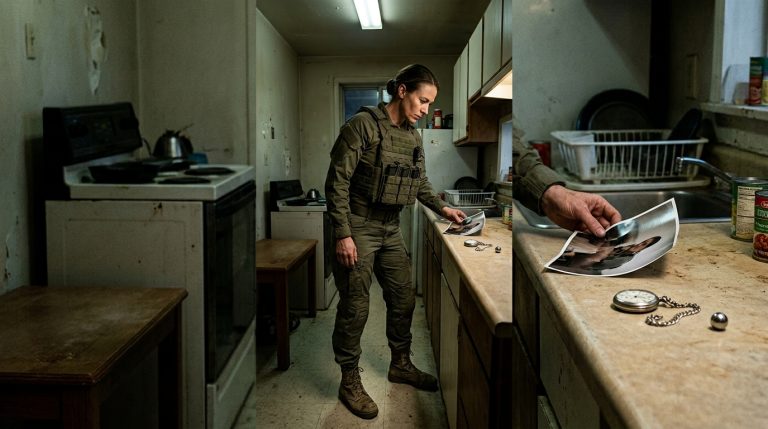
Rachel finally turned. In the shifting light, the polished facade he had seen in the mess hall was gone. Her eyes were rimmed with red, and there was a faint, jagged tremor in her left hand that she tried to mask by gripping the edge of a heavy, metal-topped desk. On the desk, an open file lay abandoned—a personnel printout with a signature line circled in red ink. It looked out of place, an anomaly in the clean, orderly room.
“Sound?” She let out a sharp, humorless laugh. “Nothing on this base is sound. We are an institution built on the backs of people who have learned that the safest way to exist is to be invisible.” She gestured toward the file on the desk. “You see that? That’s not a request for development. That’s a paper trail for the IG investigation. Mitchell isn’t just fixing culture; he’s purging the liability.”
Ethan glanced at the file. The header was standard, but the notations were cryptic—a list of names, most of them familiar, most of them associated with Kaine’s inner circle. The sight made his stomach tighten. “If they’re liabilities, maybe they deserve to be purged.”
“That’s the simplicity speaking,” Rachel snapped, the sharpness returning to her voice. She moved away from the window, her steps precise, calculated. “You talk about character like it’s a binary choice. It isn’t. It’s a series of survival decisions. I made mine. Kaine made his. You have the luxury of standing outside the machine, Ethan. Don’t confuse that with purity.”
She moved toward the exit, but paused as she passed him. The scent of her—faint, sterile, and slightly metallic, like ozone—lingered in the space between them. For a second, the antagonism felt less like a conflict between ranks and more like a shared, suffocating weight.
“What happened to your hands?” Ethan asked, the question slipping out before he could check it.
Rachel froze. She looked down at her fingers, still clutching the edge of her jacket. She didn’t offer a defense. She didn’t offer an excuse. She simply looked at him, and for a fleeting moment, the mask slipped entirely. Behind the ambition and the sharp, tactical mind, there was a raw, aching fear—the fear of someone who had invested eleven years into a persona that was suddenly being stripped away by a Navy SEAL with a dragon on her back.
“I’m learning to stop making the calculation,” she said, her voice barely a whisper. “But I haven’t figured out what to do with the emptiness that follows.”
She walked past him into the hallway, her boots clicking with a rhythmic, fading precision. Ethan stood alone in the common room. He walked over to the desk and looked down at the file. He wasn’t supposed to touch it. He wasn’t supposed to know it existed. But as he scanned the names, his heart sank. The list wasn’t just Kaine’s circle. It included people who had simply been in the wrong place at the wrong time—soldiers he ate lunch with, soldiers who had just been trying to keep their heads down.
The “Kintsugi” logic Ava had mentioned—finding beauty in brokenness—felt like a cruel mockery here. The system wasn’t just fixing the broken parts; it was grinding them into dust to ensure the “architecture” of the new regime was clean.
He realized then that he couldn’t just walk back to his bunk. He picked up the file. The paper felt heavy, like it was soaked in the sweat and indecision of everyone who had held it. He didn’t know where to take it, or who he could trust, but the silence in the common room was no longer just the absence of noise. It was an instruction.
He moved to the door and looked out into the hallway. The fluorescent lights flickered, a stuttering, rhythmic pulse that seemed to follow him. He began to walk, not toward his barracks, but toward the administration wing. If the truth was a contagion, he was going to make sure it reached the right people.
He didn’t know if he was being brave or simply reckless, but as he navigated the maze of corridors, he felt the steady, reassuring weight of the letter in his pocket. It was his anchor. And as long as he had it, he could keep walking, even when every instinct told him to hide. He turned the corner toward the command office and almost collided with Master Sergeant Holloway, who was standing in the shadows with his arms crossed, watching the hallway with the tired eyes of a man who had seen this exact pattern play out a dozen times before.
“The file, Private,” Holloway said, his voice deep and raspy. “You don’t want to be holding that when the lights come back up.”
CHAPTER 4: The Anchor of Instinct
Holloway’s presence in the corridor was a physical barrier, a wall of weathered muscle and nineteen years of accumulated silence. The fluorescent light buzzed overhead, a persistent, aggressive sound that seemed to sync with the frantic rhythm of Ethan’s pulse. Ethan looked down at the file in his hands, then back at the Master Sergeant.
“I didn’t steal it, Sergeant,” Ethan said, his voice steadying despite the tremor in his hands. “I found it. Left open on a common room desk. It’s a list of names, Holloway. Some of these people… they didn’t do anything but try to survive.”
Holloway didn’t move. He leaned back against the wall, his face half-hidden in the shadow of a protruding locker. “Survival is a complicated math, Private. You think you’re holding a document, but what you’re holding is a grenade with the pin pulled. You walk into that admin office with that, and you don’t just stop the purge. You become the target of it.”
Ethan felt the letter in his pocket—the folded, soft-edged paper from his grandmother—and the contrast was jarring. One piece of paper represented a life of quiet integrity; the other represented the brittle, rusting infrastructure of a system designed to crush it. He looked at Holloway’s eyes—they weren’t angry, they were tired. That exhaustion was worse than any threat.
“If I don’t walk into that office,” Ethan said, his voice lowering to match Holloway’s, “then I’m part of the machine. I’m the one laughing in the mess hall. I’m the one looking the other way.”
Holloway let out a short, sharp sigh. He pushed off the wall and stepped into the light, his uniform crisp but fraying at the collar. “You’re twenty-two. You think the truth is a shield. It’s not. It’s an exposure. If you want to do this, don’t do it as a kid with a file. Do it as a soldier who knows the rules of the game.”
He reached out and took the file from Ethan’s hands. For a heart-stopping second, Ethan thought he was going to destroy it, but Holloway merely flipped it open, scanning the names with an intensity that bordered on grief.
“The ones circled in red,” Holloway murmured, pointing to a name—Private First Class Dominguez. “They’ve already been flagged for ‘reassignment.’ That’s not a transfer, Brooks. That’s a burial. They’re being moved to units where their record can be shredded.”
The psychological phantom hit Ethan then—a sudden, dizzying flash of his grandmother’s kitchen in Tennessee, the scent of fresh bread, the sound of rain against the window, the feeling of absolute safety. It was a memory of a world that made sense, a world where right and wrong weren’t traded like currency. The comparison felt like a physical blow. He wasn’t in that kitchen. He was in a cold, silent hallway in North Carolina, deciding the fate of people who were just like him.
“We have to warn them,” Ethan said.
“We?” Holloway arched an eyebrow. “You’ve got a lot of ambition for a private. I like it. But this isn’t a war movie. We don’t have a plan. We have a piece of paper.”
“We have the truth,” Ethan countered, the phrase sounding small and inadequate in the vast, sterile hallway.
Holloway looked at him, his gaze lingering on Ethan’s chest, over the pocket where the letter was tucked. A slow, almost imperceptible nod followed. “Truth is the raw material, Private. It isn’t the finished product. You want to save them? Then we play the system. We don’t hand this to the admin office. We hand this to someone who can force the command’s hand.”
“Who?”
Holloway didn’t answer immediately. He looked down the long, empty stretch of the corridor toward the darkened command wing. “There’s a shift change at 0200. The duty officer is a man who owes me a favor from a deployment three years ago. We get this file into his terminal, it becomes a logged piece of evidence. Once it’s logged, Mitchell can’t make it disappear without a formal IG audit.”
“That’s risky,” Ethan said, the pragmatism of the statement feeling like a betrayal of his earlier idealism.
“Everything on this base is risky,” Holloway replied, handing the file back to Ethan. “You want to walk into the admin office and be a hero for five minutes before you’re processed out? Or do you want to actually win?”
Ethan took the file. The weight of it seemed to change; it wasn’t just paper anymore. It was a tactical objective. He realized that Ava Morgan’s words—about the four feet of system he could control—were the only map he had. He wasn’t fighting the whole institution. He was just fighting for the people in this file, for the four feet around him.
“0200,” Ethan said.
“Be at the supply entrance,” Holloway said. “And Brooks? Don’t look so nervous. You’re doing the work now.”
As Holloway walked away, disappearing into the shadows of the training bay, Ethan stood alone in the center of the humming corridor. The fluorescent light flickered overhead, casting him in alternating bands of brightness and darkness. He felt the cold iron of the file against his palm and the soft, paper edges of his grandmother’s letter in his pocket. He was no longer the private who had stood in the mess hall wondering why the air felt wrong. He was the private who knew exactly why, and for the first time, he was the one holding the match.
He didn’t head back to the barracks. He walked toward the dark, quiet heart of the base, his footsteps light and deliberate, his mind focused entirely on the 0200 deadline. The “Kintsugi” of his own resolve was complete; he was no longer whole, but he was stronger where the cracks had been.
He reached the supply entrance and checked his watch. He had two hours. He sat down on a crate, closed his eyes, and started the long, internal process of calculating the path ahead. He wasn’t waiting anymore. He was waiting to act.
CHAPTER 5: The Subterranean Threshold
The air in the supply entrance was stagnant, thick with the scent of cardboard and long-stored equipment, but it was abruptly sliced by the distant, jarring metallic slam of a blast door. Ethan froze. He pressed himself into the shadows between two industrial racks, the file held tight against his chest. Holloway had disappeared into the dark to scout the perimeter, leaving Ethan in the heavy, expectant silence of the base’s underbelly.
A rhythmic, sharp clack-clack of combat boots against concrete began to echo from the main hallway. It wasn’t the casual stroll of a night-watchman; it was the calculated, uniform tread of a roving security detail.
Ethan’s pulse hammered a frantic rhythm against his ribs. 01:45. He still had fifteen minutes before the shift change, but the sweep was early. He realized with a sinking heart that the command structure wasn’t just investigating; they were actively tightening the perimeter. If this team found him here, the file wouldn’t just be evidence—it would be a confession of insubordination.
He heard Holloway’s voice, a low, guttural murmur, coming from behind a stack of crates. “Change of plans, kid. They’re doing a full sweep of the administrative wing. The supply route is burned.”
Ethan crept toward the voice. Holloway was crouched by a narrow, recessed panel in the wall—a service tunnel entrance that had been bolted shut years ago. The Master Sergeant was already working the hinge with a tactical pry bar, his face glistening with cold sweat.
“We can’t go through the halls,” Holloway muttered, his muscles corded as he forced the rusted steel to give. “The service tunnels lead to the basement under the command office. It’s tight, it’s dirty, and if we get caught down there, there’s no official excuse. You ready?”
Ethan looked at the dark, yawning throat of the tunnel. It looked like a tomb, smelling of damp earth and ancient iron. He hesitated, the memory of his grandmother’s kitchen momentarily blinding him with the comfort of a world that didn’t require crawling through sewage to achieve justice. Then, he looked at the file. He remembered Dominguez’s cap turning in his hands.
“I’m ready,” Ethan said.
They scrambled into the tunnel just as the beam of a flashlight swept across the entrance they had just vacated. The silence of the supply room was shattered by the harsh, authoritative tone of a squad leader demanding a status check. Ethan felt the gravel crunch under his knees; the space was so low he had to hunch over, his shoulders scraping against the jagged, unpainted concrete above.
The crawl was agonizing. Every movement sent a shower of grit down his neck. The atmosphere was stifling, the air feeling thin and recycled. This wasn’t the heroic struggle he had imagined—there were no cameras, no applause, no sense of looming victory. There was only the brutal, claustrophobic reality of moving through the veins of an institution that was trying to digest him.
Holloway stopped abruptly. Ahead, the tunnel dipped into a small cistern, the floor slick with a thin layer of standing water. “The sub-basement is just through that grate,” he whispered. “But the security sensors are rigged to the power grid down here. If we touch the wrong cable, the entire wing goes into lockdown.”
Ethan felt the vibration of the machinery above them—the heavy, pulsing hum of the command wing’s servers. It was the sound of the system itself, an enormous, uncaring beast that governed their lives. He crawled forward, the water soaking into his fatigues, the freezing cold biting into his skin. He focused on the grate, the outline of the command office’s ventilation duct barely visible in the dark.
He realized the “Kintsugi” of the situation: they were forced to move through the filth to reach the light. The institutional perfection of the command office above was literally supported by the rot they were crawling through.
“I’ll take the lead,” Ethan whispered. He reached out to test the grate’s stability. His fingers brushed against a heavy, braided wire running along the wall. A low, ominous buzz vibrated through his hand.
“Don’t move,” Holloway warned, his voice a sharp, jagged edge in the dark.
Ethan froze. A red light, no bigger than a pinprick, pulsed to life on the wall beside his shoulder. A sensor. He had nearly triggered a silent alarm. The silence that followed was heavy, the kind that preceded a lightning strike. He could hear his own heartbeat, a frantic, irregular tempo that threatened to betray him. He looked at Holloway, whose face was a mask of grim, professional focus.
The security team above had stopped walking. The boots were moving again—closer. They were pacing back and forth directly above the vent. Ethan held his breath, his hand hovering inches from the electrified wire. He realized that the decoy secret—the idea that this was just a simple investigation—was fundamentally wrong. This wasn’t just an investigation; it was an active defense of a failing regime. The system knew they were being watched, and it was preparing to crush the observer.
He looked at the file in his left hand, the edges already beginning to soften from the dampness of the tunnel. He had to make a choice. He could retreat, leave the file here, and try to escape, or he could push through the grate, risk the sensor, and make the run for the terminal.
He caught Holloway’s eye. The Master Sergeant didn’t give him an order. He simply waited, his own hand steady, his own resolve absolute. It was the first time in Ethan’s career that a superior had treated him like an equal. He wouldn’t retreat.
He didn’t just push—he moved with the fluid, desperate precision of a man who had finally stopped calculating the cost of his own survival. He pressed his back against the tunnel wall, carefully sliding his arm over the wire, his movements slow and agonizingly deliberate. He felt the cold touch of the metal vent, the click of the latch, and the sudden rush of cool, filtered air from the office above. He was in.
He pulled himself up, the office floorboards creaking under his weight. He didn’t wait for Holloway. He crawled into the center of the room, the dim moonlight casting the desk into a stark, architectural silhouette. The terminal was right there, humming with an inviting, green light. He had made it. But as he turned to signal Holloway, the door to the office swung open.
The light flooded the room, blinding him. It wasn’t the security team. It was Colonel Mitchell. And he was holding a service pistol.
CHAPTER 6: The Architect of the Purge
The light in the office wasn’t yellow or flickering; it was a harsh, surgical white that seemed to strip away the shadows, leaving Ethan exposed on the polished hardwood. Colonel Mitchell stood in the doorway, his silhouette imposing, his posture a masterclass in controlled, cold authority. The service pistol in his hand wasn’t pointed at Ethan, but it rested at his side with a relaxed, lethal grace that spoke of a man who had long ago resolved the internal friction of his duties.
“Private Brooks,” Mitchell said. His voice wasn’t the roaring reprimand Ethan had expected; it was quiet, deliberate, and entirely devoid of heat. It was the voice of a man who was already finished with the encounter. “You have a remarkable talent for being in the wrong place at the right time.”
Ethan’s heart hammered against his ribs, a frantic, trapped bird, but his grip on the file tightened. He didn’t look at the gun. He looked at the Colonel’s eyes—the same eyes that had saluted Ava Morgan, the same eyes that had vowed to fix the culture of the base. They were flat, empty of the moral clarity he’d seen before.
“I’m not here for a tour, Colonel,” Ethan said, his voice surprising him with its steadiness. “I’m here because this file belongs in the system. Because the people named in here deserve an audit, not a disappearance.”
Mitchell didn’t flinch. He stepped into the room, the door clicking shut behind him with a finality that made Ethan’s skin crawl. “You think you understand the architecture, Private. You think this is about Kaine, or Pierce, or some petty power struggle in the mess hall. You’re looking at a single brick and claiming to understand the structural integrity of a skyscraper.”
“Then show me,” Ethan challenged, taking a half-step toward the terminal. “If this is about something bigger, if this is about the ‘integrity’ you talk about, then why are you trying to bury it? Why is the IG investigation only hitting the small players while the command structure stays clean?”
Mitchell stopped, his gaze drifting to the file. A flicker of something passed behind his eyes—not regret, but a deep, suffocating fatigue. “Because if you tear down the foundation, the roof caves in. We are in a transitional period, Brooks. The ‘Dragon Ghost’ initiative isn’t just an assessment; it’s a containment protocol. We are weeding out the rot so that the core—the command—can survive.”
“You’re not weeding out rot,” Ethan said, his voice rising, the adrenaline overriding the instinct to hide. “You’re replacing it. You’re just changing the people at the top so that the system can keep doing exactly what it was doing before. You’re not fixing the culture, Colonel. You’re just professionalizing the cruelty.”
Mitchell didn’t get angry. He sighed, a slow, hollow sound. He moved toward the terminal, his hand still tight on the weapon. Ethan braced himself, his muscles coiling to spring, but Mitchell didn’t aim the gun. He simply pulled up a chair and gestured to the screen.
“Look at the data, Ethan.”
Ethan blinked, the command throwing him off balance. He looked at the screen. The terminal was open to the IG portal, but it wasn’t a standard investigation report. It was a list—a list of every personnel transfer, every training rotation, and every disciplinary action at Fort Liberty for the last ten years. But the names were cross-referenced with something else: a series of codes, all pointing to a single, deep-classified project.
Project Kintsugi.
“The ‘Dragon Ghost’ didn’t come here to fix the mess hall,” Mitchell said, his voice dropping into a conspiratorial, lethal whisper. “She came here to see if the culture was resilient enough to support the next phase of the project. If we could silence the dissenters and manage the narrative, the project would proceed. If we couldn’t, we’d be dismantled.”
Ethan felt the floor beneath him shift, the reality of the base—the training, the discipline, the Friday nights—suddenly looking like a bizarre, elaborate stage play. “And you? Are you part of the project, or are you the one being assessed?”
“I’m the architect,” Mitchell said. “And you, Private, are the variable I didn’t account for.”
He stood up, his posture stiffening, the gun lifting toward Ethan’s chest. The white light of the office caught the barrel, reflecting a cold, uncaring spark. Ethan realized then that he had reached the end of the decoy. The fear of career destruction he had been carrying, the fear of exposure—it had been a childish fantasy. The truth was much simpler, much darker, and much more absolute: he wasn’t a hero in a system that needed fixing. He was a piece of evidence in a system that needed cleaning.
“I can’t let you file that,” Mitchell said.
Ethan stood frozen, the file in his hand feeling like a lead weight. He looked at the Colonel, then at the terminal, then at the dark, empty hallway beyond the door where Holloway was supposed to be waiting. He realized he was alone. But as he looked at the screen, at the list of names—at Dominguez, at the others—he saw something else.
A small, hidden directory file named ‘Witness Archive.’
It wasn’t a purge list. It was a list of everyone who had spoken up.
Ethan’s finger hovered over the keyboard. He didn’t need to file the evidence to the IG. He needed to upload it to the Archive. If he could get the data into the system, into the public record, it wouldn’t matter if Mitchell killed him. The rot would be visible.
“Don’t,” Mitchell warned, the safety on the pistol clicking off.
Ethan didn’t hesitate. He slammed his hand onto the keyboard, the code strings flickering across the screen in a blur of green and white.
“I already did,” Ethan whispered.
The screen flashed ‘Upload Complete.’ And then, the office went pitch black.
CHAPTER 7: The Blind Architect
The darkness was total. It felt heavy, a thick, velvet weight that pressed against Ethan’s eyes, making the afterimage of the green terminal screen burn like a scar in his vision. He stood frozen, his hand still hovering where the keyboard had been, the phantom glow of the Upload Complete notification ghosting through his retinas. He hadn’t heard Mitchell move. He hadn’t heard the Colonel react to the sudden blackout.
The silence was the most terrifying part. It was a perfect, pressurized vacuum.
“You think you’ve archived the truth, Private,” Mitchell’s voice came from the opposite side of the room, disembodied, calm, and terrifyingly close. “But you’ve only archived your own obsolescence.”
Ethan shifted his weight, his boots scraping against the hardwood. He reached out, his hands finding the edge of the mahogany desk. He expected a shot, a physical tackle, a scramble for dominance, but there was only the slow, methodical sound of Mitchell’s breathing. The Colonel wasn’t attacking; he was waiting.
“Why the lights?” Ethan asked, his voice sounding thin and ragged in the void. “Why go to these lengths for a list of names?”
“Because names are the only thing that keep this system running,” Mitchell replied. The sound of his footsteps was rhythmic—a steady, predatory pace that circled Ethan’s position. “You didn’t just upload a file, Ethan. You triggered a handshake protocol. The Archive isn’t a public server. It’s a dead-drop for the very people who built this. By ‘uploading’ the evidence, you just confirmed your status as a threat to the architecture.”
Ethan’s blood ran cold. The Kintsugi logic he had relied on—the idea that the truth would act as a light—seemed foolish now. He wasn’t a hero fixing a broken vase; he was an insect crawling inside the gears, and the machine was finally beginning to turn.
“Then do it,” Ethan said, the exhaustion of the last few hours finally eclipsing his fear. “If I’m a threat, stop me.”
Mitchell stopped circling. He was directly in front of Ethan now. Ethan could feel the heat radiating from him, the subtle shift of fabric as the Colonel adjusted his stance. There was no gun pressed to his chest, no movement toward violence. Instead, Mitchell reached out and placed a hand on the desk, right next to Ethan’s trembling fingers.
“The system doesn’t need to stop you, Ethan. It needs you to understand.” Mitchell flipped a switch on the side of the desk. A low, hum began to vibrate through the floorboards—the emergency power grid. The room didn’t flood with light, but a single, dim red emergency lamp pulsed to life, casting the office in a deep, bruised crimson.
Ethan gasped. The office wasn’t empty.
Holloway was there, slumped in the corner, his hands zip-tied, a piece of dark tape across his mouth. His eyes were wide, pleading with Ethan to stay down. Beside him, leaning against the now-sealed ventilation grate, was Ava Morgan.
She wasn’t holding a weapon. She was holding a tablet, her face perfectly composed, her gaze fixed on the terminal screen. She looked at Ethan—not with judgment, not with pity, but with a terrifying, professional indifference.
“You followed the path, Private,” she said, her voice matching the cold, analytical tone of the report Mitchell had shown him earlier. “You found the file, you found the partner, and you found the vulnerability. You’ve been the most effective variable in this assessment.”
Ethan’s legs buckled. He grabbed the edge of the desk to stay upright. The realization hit him with the force of a wrecking ball: the purge, the file, the service tunnels, the security sweep—it hadn’t been a defense of a failing system. It had been the final exam.
“This was the test?” Ethan whispered, the words tasting like ash. “All of it? The grievances, the threats, the ‘Project Kintsugi’?”
“Assessment requires a high-fidelity environment,” Ava said, stepping toward him. “We needed to know who would sacrifice their safety to force accountability. We needed to know who would break the rules to uphold the spirit of the institution. You didn’t just pass, Ethan. You exceeded the criteria.”
Mitchell walked over to Holloway and sliced the zip-ties on his wrists with a small, precise knife. Holloway stood up, rubbing his wrists, his face a mask of practiced, hardened indifference. He looked at Ethan—a look of profound, silent apology—before walking out of the room without a word.
Ethan was left with the two of them—the Architect and the Ghost. The betrayal wasn’t that the truth was hidden; it was that the system had manufactured the truth to see if he was capable of fighting for it. He felt the letter in his pocket, the soft, paper edges now feeling like a mockery. His grandmother’s words weren’t the map of a moral high ground. They were just part of the script.
“So, what happens now?” Ethan asked, his voice devoid of emotion. “Do I get a commendation? A promotion? A seat at the table with the other architects?”
Ava reached out and took the file from the desk, her fingers brushing Ethan’s. She didn’t look away. “You get to decide if you want to be a variable or a designer. The system needs people who can’t be bought, who can’t be bullied, and who are willing to crawl through the rot to reach the light. But you have to be willing to accept that the rot is part of the architecture.”
Ethan looked at the red light pulsing in the room, the color of blood on a white floor. He looked at the screen—the Archive—and realized it was empty. He hadn’t uploaded the truth. He had uploaded a ghost.
“I don’t want to design anything,” Ethan said, turning toward the door. “I just want to be a soldier.”
“A soldier is just a variable,” Ava said behind him. “And variables eventually get replaced.”
Ethan didn’t stop. He pushed past the red light, out into the corridor where the silence now felt like a shroud. He walked toward the barracks, the weight of the file gone, the weight of the knowledge replaced by something far more dangerous: the total, hollow freedom of a man who realized he had been playing the game the entire time, even when he thought he was winning it.
He didn’t look back at the office. He didn’t look at the sky. He just walked, his boots finding a rhythm that had nothing to do with orders and everything to do with the fact that he was finally, truly, awake.
CHAPTER 8: The Architecture of Dawn
The corridor was silent, save for the rhythmic, metallic ping-ping of cooling machinery echoing from the command wing. Ethan didn’t rush. He didn’t look back at the office, where the red light still pulsed like a warning in the belly of a dying machine. He walked with a heavy, deliberate stride, his boots feeling uncharacteristically solid on the concrete. He reached the end of the hallway and pushed the heavy exit door open, stepping out into the pre-dawn gray of the base.
The air was sharp—a clean, biting cold that tasted of dew and wet earth. Above, the sky was a bruised, indigo ribbon, shifting toward a pale, honest gold. For the first time in ten weeks, the institutional machinery was silent. The trucks weren’t idling; the voices weren’t raised in performative banter; the base was simply breathing.
Ethan leaned against the brick exterior of the barracks, his lungs pulling in the freezing air, feeling the ache of exhaustion settling into his bones. He reached into his pocket. The letter from his grandmother was still there, the paper now thin and frayed at the edges. He took it out, held it in the dim, early light, and finally unfolded it.
Don’t let anyone convince you that knowing the right thing and doing the right thing are two separate skills.
He read the words, and they no longer felt like a challenge or a map. They felt like a mirror. He wasn’t the variable. He wasn’t the designer. He was the soldier who had walked into the room, who had kept his eyes open, and who had survived the friction.
He didn’t need the command. He didn’t need the assessment. He looked at the barracks, the rows of windows reflecting the first, pale light of the sun. Inside, two hundred soldiers were sleeping—people who still believed the Friday night performance was the only way to exist. People who, like him, were waiting to be woken up.
He heard footsteps, soft and measured. He didn’t turn. He knew the cadence—the unhurried, purposeful rhythm of someone who had practiced the art of walking through worlds without leaving footprints.
Ava Morgan stopped beside him. She wasn’t wearing her uniform. She was dressed in civilian clothes, a dark coat pulled tight against the morning chill. She looked at the horizon, the same way he did—with the practiced, patient stillness of someone watching the world rotate.
“You didn’t go to the barracks,” she said.
“I’m not done yet,” Ethan replied.
“The assessment is over, Ethan. The report is written. Fort Liberty will be in the news cycle for a week, and then the systems will recalibrate. The rot will be removed, the architecture will be reinforced, and the machine will continue to run.” She paused, her gaze shifting to the training grounds. “That’s what accountability looks like. It’s not a revolution. It’s maintenance.”
“Then I’ll be the maintenance,” Ethan said, his voice quiet.
He watched the sun finally crest the horizon, the golden light washing over the base, turning the harsh concrete and steel into something soft and ordinary. The world wasn’t a game. It wasn’t a test. It was just a place that needed people who refused to stop being human when the room told them to perform.
Ava looked at him for a long, silent moment. She didn’t offer a smile, but the hard, analytical edge of her expression softened. She reached into her coat pocket, pulled out a small, metallic object, and pressed it into his hand. It was a pin—a simple, unadorned silver dragon, the mark of the assessment team.
“The variable,” she said.
She turned and began walking toward the main gate, her figure small and receding into the vast, open space of the base. Ethan watched her go, a sharp, profound sense of closure washing over him. He looked down at the pin in his palm, then at the letter in his hand. He folded them together, tucked them into his breast pocket, and felt the weight of them against his heart.
He turned toward the barracks. The first bugle call of the day sounded, a clear, ringing note that tore through the morning silence. It wasn’t a signal for performance. It was a signal for the start of the day.
Ethan walked into the building. He walked past the supply room, past the common room, and into the barracks. He saw the doors open, one by one. He saw the soldiers emerge, sleepy and confused, their faces blank. He didn’t look away. He didn’t assume the mask. He stood in the hallway, straight-backed and steady, and as they looked at him, he simply waited.
The architecture of leadership wasn’t built in the command office. It was built in the silence between people. It was built in the moments where you chose to stand instead of perform. It was built in the dawn, when the light hit the walls and you finally saw them for what they were.
He walked to his locker, opened it, and began to ready his gear. The work was long, the system was enormous, and he was just one man in a place that didn’t know how to be honest yet. But as he looked at the mirror on the inside of his locker door, he didn’t see a variable, and he didn’t see a designer.
He saw a soldier. And for the first time, that was enough.