The Iron Weight of Silence: How a Feared Outlaw Leader Traded a Lifetime of Violence for One Moment of Peace
CHAPTER 1: THE LEAKED IMAGE
The whiskey glass remained heavy and dry against Ray Dutton’s palm.
He didn’t blink as the screen flickered in the center of the scarred oak table. Six men sat around the perimeter of the room, breathing shallowly through teeth gritted against the sudden draft from the open garage door.
Marcus Cole was not in the room. That was the point.
“Look at it,” Ray said, his voice dropping into that flat, grating register that usually preceded a broken jaw. “Go on. Look at the man who signs your checks and settles your territory.”
The photograph was crisp. Too crisp. Taken from across a darkened street through the distorted glass of an all-night laundromat on Cedar Avenue. It showed three hundred pounds of leather, bone, and iron resting its skull against the shoulder of a woman in faded hospital scrubs.
One of the prospects near the corner swallowed hard, his Adam’s apple bobbing like a cork in rough water.
“That’s him,” the kid whispered. “That’s Iron Cole.”
“Was him,” Ray corrected, sliding the phone another inch across the wood with the tip of a scarred thumb. “Six months of it. Every Tuesday at three in the morning. While we’re holding the line against Bakersfield, while we’re dodging state troopers on the I-5 with cargo that keeps us fed, our president is taking a nap on a nurse’s blouse.”
The men shifted. The silence in the clubhouse wasn’t the reverent hush that usually greeted Marcus’s heavy boots on the threshold; it was the uneasy, calculating quiet of wolves smelling rot in the pack leader.
Ray leaned forward, planting his palms flat on the grain. His knuckles were gray from pressure.
“A man who goes soft doesn’t just lose his chair,” Ray muttered, his eyes sweeping the circle. “He loses ours. All of ours. And if Bakersfield finds out why our last sit-down ended with coffee instead of blood, they won’t just negotiate next time.”
No one argued. The photograph stayed on the table, humming with silent betrayal.
Ray reached out, pocketed the phone, and let the darkness settle back over the room. The trap was set, but the rat hadn’t realized the cage door was already locked from the outside.
CHAPTER 2: SHATTERED GLASS
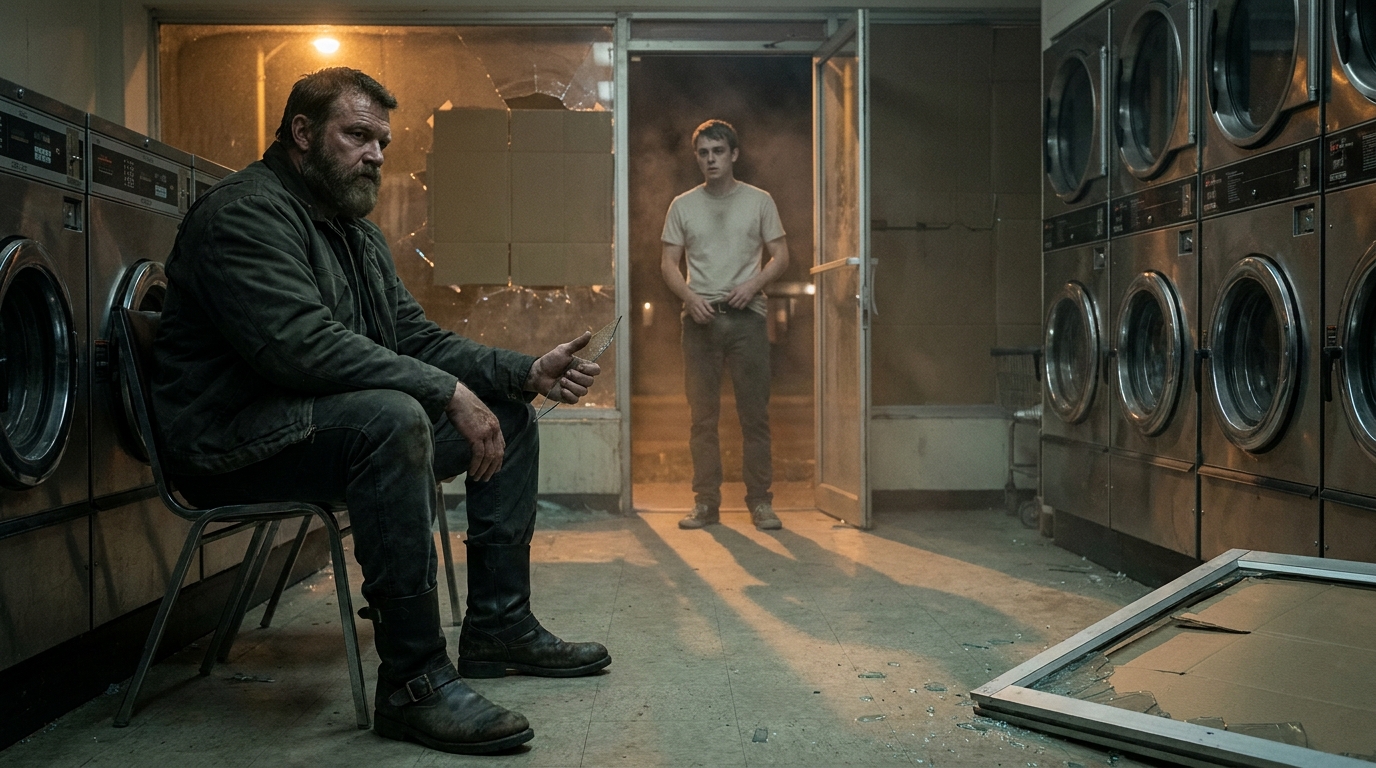
The wind coming off Cedar Avenue didn’t care about reputations or forty-year territorial claims. It whistled straight through the empty space where the front window used to be, stirring up a fine powder of safety glass that settled into the treads of Marcus’s boots.
He didn’t turn on the overhead fluorescents. He didn’t need to.
The amber glow of a streetlamp two blocks over cast long, skeletal shadows across the rows of silent washers. The folding table where Gloria spent her Tuesday nights sat crooked on its legs, one corner splintered where a heavy object had struck it.
Marcus walked to his usual plastic chair. It was still upright, though a thin dusting of glass covered the seat like gray frost.
He didn’t brush it off. He lowered his three-hundred-pound frame directly onto the grit, feeling the tiny points press through the heavy denim of his jeans without flinching.
Pain was a clean thing. It told you where the edges were.
A shadow shifted in the doorway behind him, accompanied by the wet, rhythmic chew of someone grinding tobacco.
“Boss didn’t think you’d come check on the laundry,” Danny Voss said.
The voice was young, thin, and carrying that particular brand of nervous bravado that comes from holding a weapon you’ve never had to fire in anger. Marcus didn’t turn his head. He kept his eyes locked on the empty drum of the commercial dryer across the room.
“Ray sent you to watch the ashes,” Marcus said. His voice was level, carrying the dull, grinding weight of unlubricated machinery.
“Ray’s just looking out for the chapter,” Danny muttered, shifting his weight from one boot to the other. “Things change, old man. A guy spends too much time hanging around nurses and washing machines, he forgets how the road works.”
Marcus reached down, his heavy fingers closing around a loose fragment of glass resting on the floor.
He didn’t squeeze it to bleed. He rolled the jagged edge back and forth against his scarred thumb, feeling the sharp resistance fade as the point dulled against his calluses.
“Tell Ray the glass is expensive,” Marcus said softly.
“What?”
“The window,” Marcus continued, still staring at the dead dryer. “Replacing tempered plate glass on Cedar Avenue runs about eight hundred dollars installed. Tell him I’ll be billing him for it.”
Danny let out a sharp, ugly bark of laughter. “You think you’re still writing the invoices? You’re done, Cole. The pictures are already making the rounds down in Bakersfield. Nobody’s paying your bills anymore.”
Marcus stood up.
The movement was slow, deliberate, and entirely devoid of the explosive speed that had once defined him, but it filled the room like a rising tide. He turned around, his broad shoulders blotting out what little light came through the cardboard patch on the front door.
Danny stopped chewing his tobacco. His hand drifted instinctively toward the heavy belt clip beneath his jacket.
“You’re holding your right shoulder high,” Marcus observed, his tone entirely conversational as he took a step forward. “Means you draw cross-body. Means if I move two feet to your left, you’re clearing leather three inches slower than you think you are.”
Danny froze, his fingers twitching against the fabric.
“Go home, Danny,” Marcus said, stopping just out of arm’s reach. “Tell Ray I’ll see him at the house on Thursday. And tell him to leave the windows intact next time. It’s bad for business.”
The younger man swallowed hard, his eyes darting toward the street before he turned and bolted into the dark, his boots clattering over the curb.
Marcus watched him go, then looked down at his thumb. A single bead of dark crimson welled up where the glass had finally found purchase.
CHAPTER 3: THE BLOODLESS HANDOVER
Marcus didn’t wipe the stain away. He let it sit there, a tiny mark of real-world friction right in the center of a room that had been scrubbed and polished to an unnatural military standard.
Ray stood on the opposite side of the breakfast bar, his arms folded tight across his chest, breathing through his nose with short, controlled puffs.
“You’re early,” Ray said.
“The traffic on Cedar was clear,” Marcus replied.
He pulled out a heavy oak chair and lowered himself into it without an invitation. The wood groaned under his bulk, a deep, protesting creak that filled the quiet house.
Ray’s eyes dropped briefly to the smear of blood on the counter before snapping back up to Marcus’s face.
“You think walking in here like nothing happened changes the board?” Ray asked, his voice tightening at the edges. “The boys are already talking. Pictures are down south. By tomorrow, Oakland’s going to be asking questions about why our president is taking naps on public furniture.”
Marcus reached into his jacket pocket, his movements slow and deliberate, and pulled out a heavy, scarred silver Zippo lighter.
He didn’t light anything. He just rolled the cold metal back and forth between his thumb and forefinger, the distinct clack-click echoing in the sterile kitchen like a slow-ticking clock.
“You want the chair, Ray,” Marcus said, his tone entirely level.
Ray stiffened, his jaw muscles working beneath his beard. “I want a chapter that doesn’t look like a joke to the rest of the coast. Yeah. I want the chair.”
“Then take it.”
The lighter stopped moving. Ray’s eyes narrowed into hard slits, searching the lines of Marcus’s weathered face for a trap that wasn’t there.
“It’s not that simple,” Ray snapped, dropping his arms to slap both palms flat against the counter. “You don’t just hand over a gavel like you’re passing salt at a diner. There’s a vote. There’s a process.”
“The process is over,” Marcus said, setting the Zippo down with a soft thud. “Call the inner circle for Sunday. Put my vest on the back of the seat. Tell them I retired.”
Ray stared at him, his chest rising and falling in sharp, jerky breaths.
This was supposed to be the moment of resistance. He had spent four months preparing the coup, building the narrative, collecting the evidence, waiting for Marcus to fight back so he could crush him with the weight of the room.
Instead, the man was simply walking out the back door and leaving the keys on the counter.
“What’s the catch?” Ray demanded, leaning across the gap, his face flushed with sudden, hot frustration. “What are you playing at?”
“No play,” Marcus said, standing up so slowly that the chair didn’t even scrape the floor. “The chair is yours. Keep the books clean, Ray. Or the state troopers won’t be the ones you have to answer to.”
Marcus turned his back on the kitchen island and walked toward the front door without looking back.
Ray stood alone under the yellow pendant light, staring at the small smear of blood on the wood, realizing with a cold jolt in his stomach that a fight given away left no room to win.
CHAPTER 4: STRIPPING THE ARMOR
The air inside the main hall smelled stale, thick with the scent of unwashed denim, burnt coffee, and thirty men holding their breath.
Marcus didn’t check the perimeter. He didn’t count the exits.
He walked straight down the center aisle toward the heavy oak table at the far end, his boots hitting the concrete floor with a slow, deliberate rhythm that echoed off the corrugated metal walls. Every eye in the room tracked him, not with the old, automatic deference, but with the twitchy curiosity of spectators watching a high-wire act without a net.
Ray Dutton was already standing by the president’s chair.
The heavy leather vest—the one Marcus had patched together piece by piece over twenty-six years of broken bones and interstate highways—lay folded neatly across the seat like a shroud.
Marcus stopped three feet from the table.
“You’re late,” Ray said, though his voice lacked its usual sharp edge, betraying a sudden, nervous weight as he looked down at the massive frame of the man standing before him.
“I’m right on time,” Marcus said.
He reached up, his thick fingers hooking into the heavy snaps of his own vest. The metal parted with three sharp clicks that sounded like small arms fire in the dead silence of the room.
He didn’t drop it on the floor. He lifted it off his shoulders, folded it square, and placed it right beside Ray’s folded leather on the oak surface.
“It’s yours,” Marcus said, his voice flat and unyielding. “The books are balanced. The Bakersfield line is closed. Run it how you want.”
A murmur rippled through the front row of prospects, quickly hushed by a sharp glare from the sergeant-at-arms.
Ray stared down at the two vests resting side by side, his mouth opening slightly as if he wanted to demand a speech, a final warning, or a fight to seal the transition.
“That’s it?” Ray muttered, leaning forward. “Twenty-six years and you just walk out the front door in a flannel shirt?”
“Twenty-six years is long enough to carry dead weight,” Marcus replied.
He turned his back on the table, the inner circle, and the only life he had ever known, walking toward the sunlight without looking back once.
CHAPTER 5: THE LEDGER OF TRUST
The replacement glass on the front window caught the amber streetlamps outside, casting a clean, distortion-free pane of light across the floor.
Marcus stepped through the door without his vest, his flannel shirt hanging loose over his belt. He didn’t head for his usual chair right away. He stopped by the folding table, watching the precise, unhurried movement of Gloria’s hands as she smoothed out the creases of a pale blue tunic.
“You’re early,” she said, not looking up.
“I don’t have a club meeting to sit through anymore,” Marcus replied.
Gloria paused, her fingers resting flat against the cotton. She turned her head slowly, her tired eyes scanning him from his boots up to his face, taking in the missing leather, the bare shoulders, the stark absence of twenty-six years of armor.
“You handed it over,” she said. It wasn’t a question.
“I did.” Marcus pulled out his plastic chair and sat down, the worn legs scraping softly against the linoleum. “Ray has the chair. The books are closed.”
Gloria reached out to the second white ceramic cup sitting beside her stack of laundry and pushed it across the table toward him.
“My neighbor, Mrs. Patterson, talked to me after the window broke,” Gloria said, her voice dropping into a quiet, steady register that required no defense. “She told me your real name. Told me what you ran, who you rode with, and what people said about you online.”
Marcus went completely still, his large hands resting flat on his knees.
“I looked you up,” Gloria continued, picking up another pair of scrubs. “Read the arrest records, the old newspaper clippings, the warnings. All of it.”
“And you stayed,” Marcus said, the words catching slightly in his throat.
“I stayed because the man I read about on a screen isn’t the man who sits in this chair every Tuesday,” Gloria said, looking straight into his eyes. “The internet tells stories to keep people afraid. But I trust the man who shows up.”
Marcus looked down at the coffee cup, feeling a long, cold knot in his chest finally loosen after thirty years of guarding every breath he took.
CHAPTER 6: THE FINAL THRESHOLD
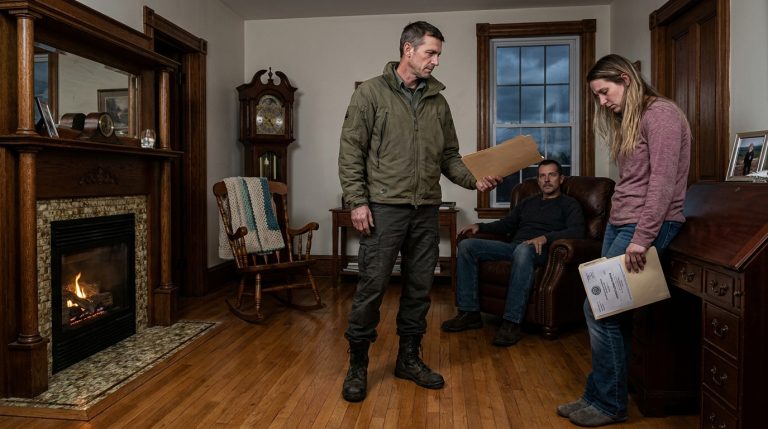
Ray didn’t open the envelope right away.
He stared at the stamped federal seal in the corner, his jaw working slowly as the blood drained from beneath his weathered skin. The clubhouse was empty outside, but the heavy silence inside the office felt suffocating.
“What is this?” Ray asked, his voice losing its usual sharp edge.
“The rest of the books,” Marcus said, sitting in the metal guest chair with his hands resting quietly on his knees. “The part you didn’t look at before you took the chair.”
Ray’s fingers trembled slightly as he hooked them under the flap and pulled out a stack of photocopied transcripts and bank routing numbers.
It didn’t take twenty years on the road to read federal indictments. The names were right there in black ink—contacts down in Bakersfield, interstate shipping logs, and wire transfers routed directly through accounts bearing Ray Dutton’s signature.
“I didn’t sign these,” Ray spat out, slamming his hand down on the desk. “This is a setup. You planted this before you walked out!”
“I haven’t touched those files in six months,” Marcus replied, his voice level and entirely unbothered by the sudden outburst. “You wanted the chair, Ray. You wanted the weight, the authority, and the control. You just forgot that whoever holds the seat answers to what’s underneath it.”
Ray leaped to his feet, knocking his chair back against the corrugated metal wall with a deafening crash.
“You’re going down with me!” Ray yelled, his face turning dark with blind panic as he reached toward his belt line. “You think you can just hand over a burning house and walk away clean?”
Marcus didn’t flinch. He didn’t reach for a weapon, because he didn’t have one.
He just sat there, three hundred pounds of solid, unyielding patience, watching the younger man unravel under the crushing weight of his own unearned ambition.
Before Ray could clear leather, the heavy outer door of the clubhouse shuddered under a series of loud, synchronized impacts.
“Federal agents! Open the door!”
Ray froze, his hand hovering over his belt, his eyes darting frantically between Marcus and the locked entrance.
Marcus stood up slowly, smoothing the front of his flannel shirt. He walked past Ray without another word, stepping over the fallen chair and out through the side exit into the bright California sunlight.
By Tuesday night, the Cedar Avenue laundromat was quiet again.
The replacement glass was spotless. The washing machines hummed their steady, rhythmic beat against the linoleum floor.
Marcus sat in his usual plastic chair, holding a white ceramic cup of hot coffee. Gloria stood beside the folding table, smoothing out a fresh pile of hospital scrubs while humming that slow, familiar gospel tune.
He didn’t have a patch, a title, or an empire anymore.
He just had a cup of coffee, a quiet room, and a woman who never asked him to be anything other than what he was.
Marcus took a slow sip, closed his eyes, and finally let the heavy armor fall away for good.