The Dusty Bench Rule: How a Hardware Clerk Broke a Captain’s Arrogance Without Firing a Single Shot
CHAPTER 1: THE SCRATCHED COUNTER
The bell above the Sierra Vista Hardware door didn’t ring; it rattled with a dry, metal-on-metal groan that meant the spring was losing its temper.
Tessa Rowan didn’t look up from the bin of galvanized washers.
She dropped three quarter-inch flat washers into a grease-stained paper bag, folded the top twice with a sharp crease of her thumb, and slid it across the scarred laminate counter.
“Three cents each, nine total,” she said. Her voice was flat, level, and entirely empty of performance.
The customer, a local rancher whose truck smelled permanently of diesel and old canvas, tossed a dime down and walked out without waiting for change.
Outside, the wind coming off the flats carried the faint, rhythmic pop of rifle fire from the base range three miles away.
It sounded like dry twigs snapping under a heavy boot.
Tessa ignored it.
She picked up a brass wire brush, her fingers wrapping around the worn wooden handle with the instinctive grip of someone who spent ten hours a day gripping tools instead of arguing with people.
The pale scar across her right knuckle caught the harsh fluorescent light overhead—a thin, silvery line where a bolt had bitten her skin twelve years ago and taught her that metal does not care about excuses.
The hardware store was dim, cool, and smelled of cedar shavings, cutting oil, and the faint, sweet dust of desert dry-wall.
Mr. Dale was out back inventorying a pallet of concrete anchors, his boots scraping rhythmically against the concrete floor.
He didn’t need to check on her, and she didn’t need him to.
They ran the place like a machine with all its teeth intact.
Through the front window, the heat shimmered off the asphalt of Route 90, distorting the passing pickup trucks into wavy gray smears.
Her phone sat on the shelf beside the register screen, face down.
She could feel its vibration through the wood—a dull, persistent thrum that had been cycling off and on for twenty minutes.
It was the community group chat, buzzing with chatter about the charity shoot, the visiting Marines, and the Captain who had taken over the line with a bullhorn and a gleaming new service rifle.
She didn’t need to pick it up to know what they were saying.
They were talking about the spectacle.
They were talking about the noise and the swagger.
Tessa laid the wire brush down, the bristles clicking softly against the laminate.
She reached into her back pocket, pulled out a small, scarred brass calibration gauge, and began rolling it between her thumb and index finger.
The cold metal grounded her, pushing back the dull ache of the morning’s early run along the dry riverbed.
The bell above the door didn’t rattle this time; it slammed wide open, hitting the cedar frame with a sharp crack that sent a cloud of dust motes dancing in the sunbeam.
A young man in a tan uniform shirt stepped inside, breathing hard, his face flushed pink from the desert glare.
It was Corporal Briggs.
He didn’t look like he was shopping for thread locker today.
He looked like a man who had just driven his truck into a ditch and didn’t want to admit it to the tow driver.
“Ms. Rowan,” he said, his voice tight, dropping sharply at the end of the sentence. “We have a situation at the range.”
Tessa didn’t stop rolling the brass gauge between her fingers.
She kept her eyes on the counter, her voice dropping into that low, even cadence that required no theater.
“If it’s pulling right as the barrel heats, Corporal, you don’t need a new shooter,” she said quietly, the brass cool against her skin. “You need a different mount.”
Briggs stopped three feet short of the counter, his boots grinding grit into the concrete.
His eyes darted to her hands, tracking the scar on her knuckle before snapping back to her face.
“The Captain says the rifles are fine,” Briggs muttered, his voice dropping to a hurried whisper. “He says the wind’s just playing tricks. But the mounts… they’re shaking loose on every third round. And he won’t let anyone touch them.”
Tessa stopped rolling the gauge.
She laid it flat on the counter, the metal clicking against the laminate like a dropped shell casing.
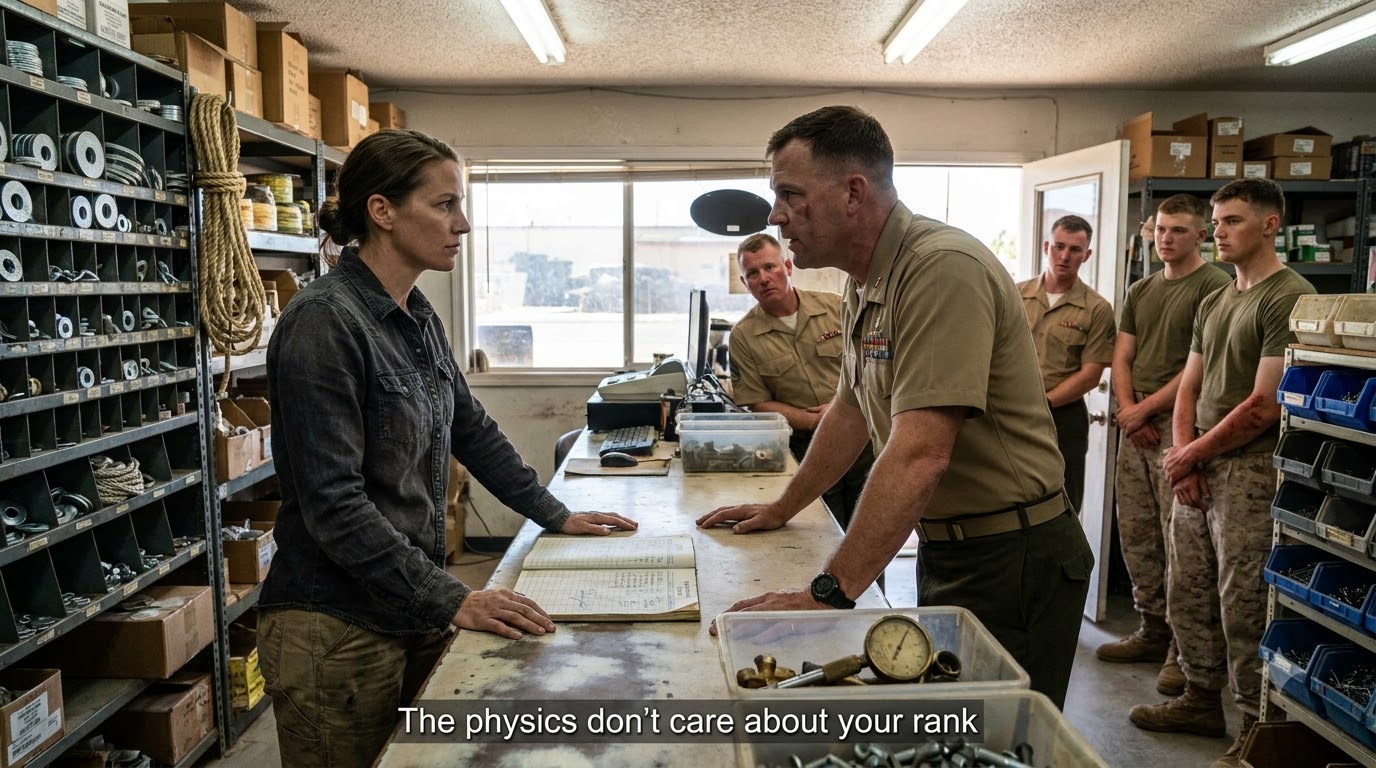
“He can call it wind all he wants,” she said, her gaze lifting to meet his with the dead weight of a closed door. “The physics don’t care about his rank.”
Briggs swallowed hard, his throat working visibly as the distant pop of the range echoed again through the open door.
“He wants more supplies,” Briggs said. “And he’s coming here.”
Tessa didn’t blink.
She reached out, picked up a grease-stained inventory ledger from beneath the counter, and laid it open with a slow, deliberate slap of paper against wood.
“Let him come,” she said.
CHAPTER 2: THE REJECTED WARNING
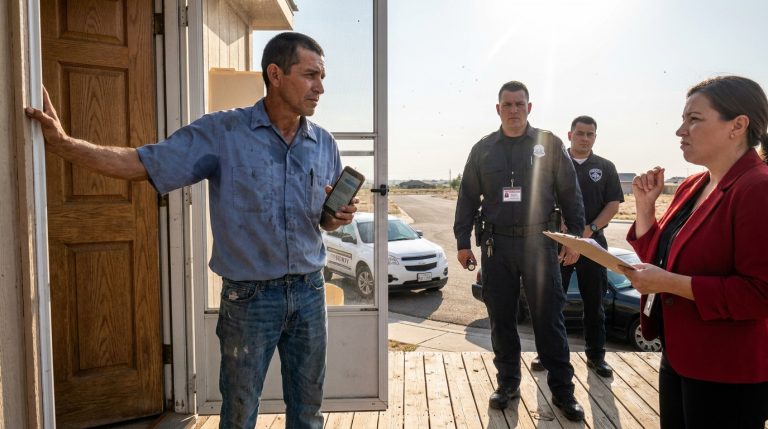
The door didn’t just open; it slammed back against the cedar frame with a violence that made the glass in the front display display cases rattle.
Captain Vance stepped into the store, bringing the dry, baking heat of the desert with him.
He was broad-shouldered, sharp-featured, and carried his uniform with the stiff, aggressive posture of a man who believed the world was an inspection he was perpetually passing while everyone else failed. Behind him hovered two younger Marines, their faces flushed, their forearms caked in red dust.
“You the one filling Corporal Briggs’ head with garbage about my hardware?” Vance’s voice was loud, deliberate, designed to occupy every cubic foot of the room.
Tessa didn’t move her hand from the brass gauge.
She looked at him across the counter—at the dark patches of sweat beneath his collar, the twitch in his left cheek, and the slight, over-torqued lean of his posture that tried to mask the fact that his team was failing publicly three miles down the road.
“The mounts you’re running on those M110s are commercial grade, Captain,” Tessa said. Her voice didn’t rise to meet his. It stayed down in the dirt, heavy and unmovable. “They’re rated for hunting scopes on cold barrels. You put fifty rounds of rapid fire through them in ninety-degree heat, the aluminum expands, the torque screws slip, and your impact point drifts six inches right.”
Vance let out a short, barking laugh that carried zero humor.
He took two steps forward, his boots leaving dry clay smears on the clean concrete floor. He planted both palms on the laminate counter, leaning down until he was squarely in her space.
“I don’t need a hardware clerk who handles broom handles for a living lecturing me on small arms ballistics,” he said, his tone dropping into a low, barbed weaponized insult. “You sell nails, lady. My men are Marines. If the shots are drifting, it’s the crosswind coming off the flats, not the gear.”
Corporal Briggs shifted uncomfortably by the door, his eyes darting toward the open inventory ledger on the glass case.
Tessa didn’t flinch.
She didn’t back up an inch. She simply raised her right hand, setting the brass gauge down with a tiny, metallic clink beside the open ledger. The pale scar across her right knuckle stood out stark and white against her tanned skin.
Vance’s eyes flicked down to the scar for a fraction of a second. A momentary flicker of hesitation crossed his face, instantly swallowed by a surge of defensive arrogance.
“We need three boxes of high-temp thread locker and four set-screws,” Vance barked, snapping his fingers toward the shelves behind her. “Now. I’m not wasting any more time listening to local stories.”
Tessa slowly closed the ledger.
The heavy paper slapped shut with the finality of a iron gate.
“I don’t have the thread locker,” she said, her gray-green eyes locking onto his. “And even if I did, slathering glue on a cracked, substandard bipod mount won’t fix a warped base, Captain. You’re trying to patch a structural failure with a Band-Aid because you’re too proud to admit you bought cheap gear.”
Vance’s jaw tightened until the muscle bulged against his skin.
He reached down, picked up the brass gauge from the counter without asking, and tossed it dismissively into a plastic bin of scrap fittings.
“Keep your advice,” Vance spat, turning on his heel toward the door. “We’ll run the match with what we have. And if I hear you spreading rumors about my unit’s equipment to the civilians again, I’ll have the base commander ban every employee in this shop from setting foot on base property.”
He shoved the door open, the bell groaning once before the door slammed shut behind the three uniforms.
Tessa stood in the silence of the store, the smell of hot dust and faint exhaust lingering in the air.
She didn’t reach into the scrap bin for her gauge.
Instead, her eyes drifted to the bottom line of the closed inventory ledger—where a handwritten receipt from three weeks ago bore the signature of Captain Vance, approving a cash purchase for six unrated commercial mounting brackets.
Beside the line item, a stamped serial number caught the fluorescent light.
It was a batch number that had been officially decommissioned and barred from military logistics five years ago.
CHAPTER 3: THE BROKEN LEDGER
Tessa pulled the brass ring down on the basement hatch behind the main counter.
The heavy oak door lifted with a low, scraping groan, unleashing the cool, damp smell of sub-floor concrete and fifty years of stored invoices. She stepped down the wooden risers, her boots making solid, measured thuds against the grain until her eyes leveled with the dark floorboards.
Mr. Dale was crouched near the far rack of plumbing elbows, a grease pencil tucked behind his ear. He didn’t look up when her shadow crossed the yellowed lightbulb hanging from the ceiling wire.
“Vance didn’t take the thread locker,” Dale said, his thumb smudging a line on a cardboard box.
“He doesn’t want fixes,” Tessa said, walking past the rows of steel shelving to the back corner where the store kept its master requisition archives. “He wants an excuse for why his men can’t hit a four-foot steel plate at three hundred yards.”
She pulled a heavy, metal-bound binder from the metal rack. The label on the spine read COMMERCIAL SPECIAL ORDERS – BASE ACCOUNTS.
The paper was crisp, dry, and smelled of cheap ink. She turned the pages slowly, her calloused fingers tracing the columns of order dates, part descriptions, and authorization signatures.
She wasn’t looking for a rifle manual. She was looking for the math.
Three weeks prior, six sets of low-clearance aluminum mounting rails had been picked up at the back loading dock. The requisition form listed them as emergency replacement parts for base maintenance, paid out of the local community fundraiser slush fund rather than the official military logistics channel.
The signature at the bottom was written in thick, blue ballpoint ink: Capt. E. Vance.
Tessa brought the page closer to the bare bulb. Below the signature, the manufacturer’s part code was listed in small, blocky text. It matched the cracked, defective batch number she had spotted in the register ledger upstairs.
She pulled her cell phone from her pocket and snapped a single, clear photo of the entry, ensuring the cash payout voucher and Vance’s signature were fully in frame.
“He didn’t just buy bad brackets,” Mr. Dale said from behind her, his voice low as he leaned his arm against a steel shelf. “He bypassed the military supply chain entirely. Commercial grade costs sixty dollars a unit. Military spec runs six hundred.”
“And the fundraiser raised five thousand for new precision mounts,” Tessa said, her voice dropping into a quiet, cold register. “He pocketed the difference, bought banned surplus scrap off our back rack, and expected his boys to blame the desert wind when the scopes drifted off target.”
“If you bring that paper to the range, he’ll tear it out of your hand and call it civilian interference,” Dale muttered, his brow furrowing. “You’re a clerk, Tess. He’s got eagles on his collar and a radio on his belt.”
Tessa closed the binder with a heavy, muffled thud that kicked up a faint cloud of grey dust into the stagnant air.
“He won’t get the chance to tear anything,” she said, her index finger resting firmly against the cold steel latch of the binder. “Because he’s coming back here when those mounts completely shear off on the afternoon heat cycle.”
CHAPTER 4: THE INVENTORY TRAP
The heavy boots took the stairs two at a time.
Captain Vance appeared at the foot of the wooden risers, his chest heaving, his face dark with sweat and sun-bake. The high-desert glare had scorched his collarbone red, and his right hand clutched a cracked aluminum rail block that had sheared clean off at the mounting screw.
“You’ve got military-spec steel rails in stock,” Vance said, his voice raw from barking orders down on the wind-blown flats. “Briggs said you have three units in the back cage.”
Tessa didn’t move her thumb off the cold binder latch.
She stayed grounded beside the steel shelving, looking at the sheared aluminum in his palm—the cheap, unrated pot-metal glowing dully under the basement bulb.
“We have them,” Tessa said, her voice dropping into a flat, level plane that offered zero friction to slide on. “Three hardened steel Picatinny bases. Rated for seventy foot-pounds of torque.”
“Bring them up,” Vance snapped, taking a step toward her. “The range officer suspended our relay. My team has twenty minutes before the command staff pulls our lane entirely.”
Mr. Dale stepped out from behind the rack of galvanized pipe, a pair of heavy iron calipers hanging loose in his right hand. He didn’t say a word, but his weight shifted squarely into the narrow aisle.
Tessa lifted her thumb off the binder.
She pulled a yellow commercial transfer voucher from the counter pad above, sliding it across the top of a wooden crate between them.
“Store policy on military-spec hardware, Captain,” Tessa said, her tone utterly devoid of heat. “Commercial sales require an original unit requisition form, signed by the logistics officer, matching the serial numbers on the parts being replaced.”
Vance’s jaw twitched. His eyes narrowed into slits as he stared at the yellow paper.
“I don’t have time for local paperwork, lady—”
“—Then you don’t have time for hardware,” Tessa interrupted quietly, her gray-green eyes unblinking. “Because if I hand you steel bases without matching your discarded inventory tags, our store audit flags an unverified cash exchange. Just like the one logged three weeks ago.”
The basement fell dead quiet except for the hum of the transformer overhead.
Vance froze. His fingers tightened around the sheared aluminum until his knuckles turned as white as salt.
“What are you talking about?” Vance whispered, the arrogance in his voice suddenly curdling into something sharp and defensive.
Tessa picked up the yellow voucher, folded it once across the middle, and held it out.
“I’m talking about serial number 88-B,” she said, her voice carrying the exact weight of a stone dropped down a dry well. “The banned surplus lot you bought for sixty bucks out of our bargain bin, while charging five thousand to the base charity fund.”
Vance didn’t take the paper.
He took one half-step back, his boot heel catching the bottom edge of the wooden stairs with a hollow crack.
“You’re out of your lane, clerk,” he spat, his voice trembling with a toxic mix of panic and authority. “You don’t touch base records. You don’t question my logistics.”
“I don’t need to touch your records,” Tessa said softly, stepping around the crate and leaving him standing at the bottom of the dark stairs. “I have ours.”
CHAPTER 5: THE CONFESSION OF RUST
Vance hit the top of the stairs three seconds later, his boots slamming into the floorboards with enough force to shake the hardware display racks.
“Hand over that log, clerk,” Vance said, his voice dropping into a harsh, dangerous rasp as he reached across the register counter, his hand clawing for the yellow paper. “You’re tampering with base property and making false accusations against a commissioned officer.”
Tessa didn’t pull her arm back.
She simply turned her wrist, sliding the folded voucher into the brass-rimmed slot of the register drawer and slapping the steel face shut with a heavy, metallic ring that cut through the room like a deadbolt falling into place.
“The log stays in the register, Captain,” Tessa said, her gray-green eyes locking onto his with the cold, unyielding density of scrap iron. “And the paperwork is already sitting on the regional inspector’s desk. Sent five minutes ago from the office terminal out back.”
Vance’s face went completely pale, the angry sunburn on his neck turning a mottled, ugly purple.
He lunged forward, slamming his open palm down on the laminate counter so hard the bell on the bell-stand jumped and clinked against the wood.
“You think you can play games with me?” Vance snarled, his chest pressing against the edge of the glass case. “I’ll have my Marines shut this store down by sunset! I’ll file a federal obstruction report against you and your boss—”
“—You won’t file anything,” Mr. Dale said, stepping up behind the counter with a heavy clipboard resting across his arm.
The retired mechanic didn’t raise his voice, but his thumb was hooked into his belt loop, his eyes fixed on the insignia pinned to Vance’s collar.
“Because Lieutenant Colonel Miller just pulled his sedan into the front gravel lot,” Dale added calmly. “And he brought the base armorer with him.”
Vance snapped his head toward the front glass windows.
Outside, a silver government sedan had come to a halt beside the hardware sign, its dust cloud blowing slowly across the hood. An older officer in a utility uniform stepped out, his cap tucked firmly under his left arm as his eyes swept over the building.
Vance took a jagged, shuddering breath, his fingers twitching against his trousers as he tried to pull his posture back into something resembling command.
“This is a misunderstanding,” Vance stammered, his arrogance collapsing into a frantic, cornered posture as he turned back to Tessa, his voice dropping to a desperate whisper. “Look… we can fix this right here. Give me the steel bases. I’ll pay double cash out of my own pocket. We clear the ledger, and nobody has to drag the base commander into local store records.”
Tessa picked up the wire brush from the counter, her fingers resting lightly on the worn wooden handle.
“The price of the bases isn’t double, Captain,” she said, her voice flat, quiet, and absolutely final. “It’s five thousand dollars. The exact amount missing from the charity fund.”
Vance’s mouth opened, but no sound came out.
The bell above the front door rattled as Lieutenant Colonel Miller pushed his way inside, the heavy thud of his dress boots signaling the arrival of an authority that didn’t take cash under the counter.
“Captain Vance,” Miller said, his voice echoing off the concrete walls like a hammer hitting an anvil. “Why is your team sitting off the firing line while you’re standing in a civilian hardware shop?”
Vance froze, his back rigid, his jaw clenched so tight the muscle twitched under his skin, but his eyes stayed fixed on the grease-stained counter between them—where the truth sat in black ink, waiting to be read.
CHAPTER 6: THE QUIET END OF THE ROAD
“I asked you a question, Captain,” Miller said, his voice coming through the room like iron grinding over stone.
Vance didn’t look at his commander. His jaw worked, a bead of sweat tracing down his earlobe and soaking into his collar.
“Sir—the civilian store clerk is attempting to sabotage our equipment logistics,” Vance barked, his voice rising into a sharp, desperate pitch as he swung his hand toward Tessa. “She’s withholding essential replacement bases for our precision rifles during an active training event. She’s refusing a direct government procurement request!”
Tessa didn’t raise her voice. She didn’t move away from the counter.
She simply unlocked the register drawer with a soft, mechanical click, pulled out the yellow commercial voucher, and laid it face-up on the glass case. Beside it, she placed the printed photograph of the basement archive ledger.
“Serial number 88-B,” Tessa said, her words plain, practical, and devoid of drama. “Six unrated aluminum rail blocks purchased three weeks ago with cash from our bargain bin. Signed by Captain Vance. The same hardware currently shearing apart under heat on lane four.”
Miller didn’t take two steps to reach the counter. He picked up the yellow slip, his eyes scanning the cash amount, the stock code, and the bold signature at the bottom.
His face didn’t go red with anger. It turned completely gray, settling into a cold, hard stone mask.
“Five thousand dollars was released from the rehabilitation fund for military-spec mounting brackets, Vance,” Miller said softly, his gaze lifting to fix directly on the junior officer’s sweating forehead. “Where is the rest of the allocation?”
Vance took a jagged step back, his hand darting to his belt before dropping uselessly to his side.
“The order was delayed, sir—I bought temporary commercial stock to keep the unit operational—I was going to reimburse the account—”
“—You bought banned, scrapped hardware for sixty dollars and pocketed forty-nine hundred out of a charity account meant for injured veterans,” Miller interrupted, his voice dropping into a deadly quiet that filled every corner of the room.
The armorer stepped forward from the doorway, taking the sheared piece of metal from Vance’s desk without a word, examining the cracked pot-metal, and giving Miller a single, decisive nod.
“Hand over your sidearm, Captain,” Miller said flatly. “You are relieved of command. Step outside to the staff vehicle.”
Vance’s mouth worked silently, his eyes darting frantically to Mr. Dale, to the armorer, and finally to Tessa.
He looked for an argument, a loophole, or an insult to grab onto, but he found only cold, unyielding silence—the kind of quiet that belongs to people who work with real tools and have zero patience for cheap lies.
He unbuckled his holster with trembling fingers, laid it on the edge of the display counter, and turned, his boots dragging through the dirt on his way out the door.
Miller looked at Tessa across the counter. He looked down at her right hand, where the pale scar ran across her knuckle, then at the grease beneath her thumbnail.
“Rowan,” Miller said quietly. “You could have brought this to the base guard at the gate.”
“I work here, Colonel,” Tessa replied, picking up her brass wire brush and holding it loosely. “And we don’t let broken hardware leave our counter.”
Miller nodded once, a brief, respectful gesture, then picked up the fraudulent receipt and walked out to the sedan.
By six o’clock, the desert wind had settled into a low, dry whisper that barely rustled the sun-faded sign outside Sierra Vista Hardware.
The range down the road was silent. The trucks had cleared out, the flags were down, and the desert heat was finally giving way to the cool purple chill of twilight.
Tessa took her paper cup of water, walked around the counter, and picked up the broom resting against the cedar frame.
She swept the red clay dust and dried mud left by Vance’s boots into a neat, small pile near the door, her movements steady, rhythmically unhurried, and completely untroubled by the world outside.
She swept the dust onto the metal pan, walked to the back door, and tossed it out into the desert dirt.
The sun dipped below the flats, turning the gravel gold, and Tessa Rowan put the broom back in its corner, locked the front register, and turned off the lights.