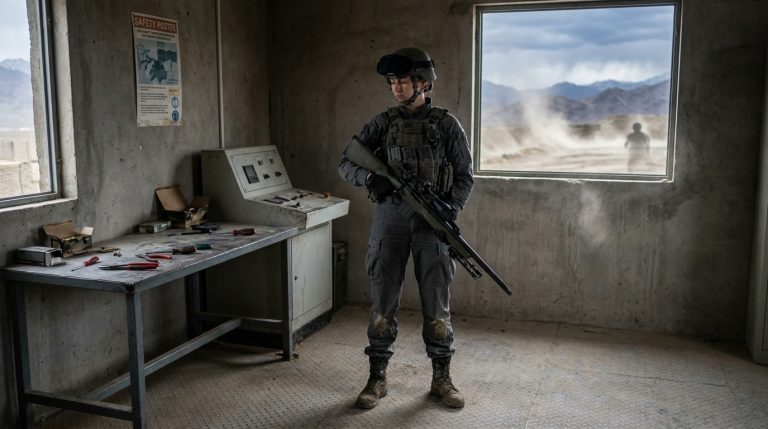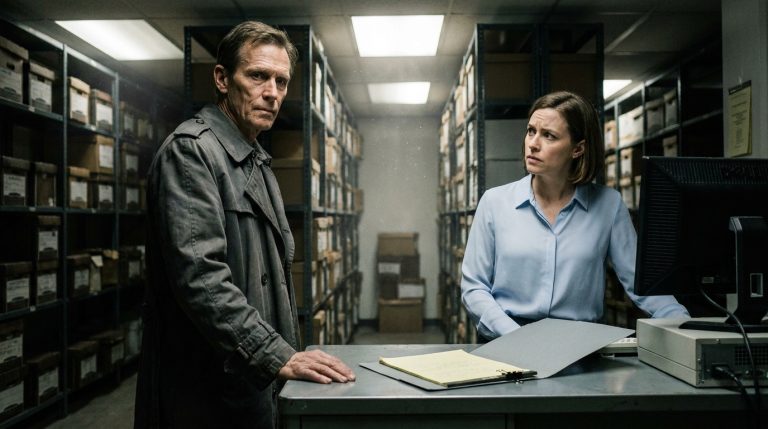
The Quiet Contractor They Mocked Saved Their Lives with Cold Precision
CHAPTER 1: THE IGNORED WARNING
The plastic key on the keyboard stuck every fourth stroke.
Riley Monroe pressed her thumb firmly against the edge of the board, forcing the keys back up with a dull click, her breath measured and slow. Behind her, near the doorway of the Tactical Operations Center, four young Rangers leaned against the metal doorframe, their laughter sharp and abrasive in the air-conditioned chill.
“She draws pretty maps, I’ll give her that,” Brad Nolan said, his voice carrying easily over the hum of the server racks. He flicked a thumb toward the glow of Riley’s monitor. “Desk-bound contractors always think a valley looks quiet on a screen.”
Curtis Hail didn’t look up from his mug. He just leaned back in his swivel chair, letting his silence validate the kid’s mouth. Across the narrow room, Veronica Shaw clicked her pen rhythmically—three short taps, a pause, three short taps—a constant, rhythmic irritation that filled the gaps between insults.
Riley didn’t turn around. She kept her eyes on the grid overlays, rolling a scratched brass casing—300 Win Mag, cold and heavy—across the knuckles of her left hand. Index, middle, ring, pinky. Flip. Back again.
“Valley’s clean, contractor,” one of the squad leaders muttered, stepping into the hallway. “Save the horror stories for someone who hasn’t carried a load.”
“The terrain bottlenecks at Grid 4-4,” Riley said. Her voice didn’t rise. It stayed flat, dry, grounded in the immediate room. “High walls on three sides. Mortar positions along the western rim are pre-registered. If you take a platoon down that dry creek bed, you won’t have a turning radius.”
Brad snorted, adjusting his plate carrier with a heavy clatter of plastic buckles. “Thanks for the lesson, ma’am. We’ll be sure to tell the local militia to ask for your permission before they shoot.”
They walked out, their boots heavy on the corrugated steel ramp outside. The door slammed, leaving only the hum of the monitors and the rhythmic clicking of Veronica’s pen.
“You push too hard on those reports, Riley,” Curtis said lazily, spinning his mug on the laminate desk. “Command doesn’t need panic. They need logistics moving.”
Riley rolled the brass casing into her palm and closed her fingers over it. The sharp edge of the primer pocket bit into her skin. She didn’t answer.
Three minutes later, the main radio speaker on the wall didn’t crackle—it exploded with static and raw human lungs.
“SOS! All stations, TOC, SOS! We are taking heavy fire at Grid 4-4! Multiple casualties!”
Curtis froze, his mug stopping mid-spin. Coffee sloshed over the rim, dark and hot against his knuckles.
“Rpgs from the western rim!” Captain Ridge’s voice cut through the static, clipped and ragged, the sound of small-arms fire hammering in the background like dry branches snapping. “They were waiting for us in the creek bed! We are surrounded!”
Veronica stopped clicking her pen. Her hand stayed frozen in mid-air, three inches above her desk. Brad’s sarcastic laugh from two minutes ago seemed to linger in the cold air of the room, turning sour and putrid.
Riley stood up. She didn’t rush. She didn’t knock her chair over. She simply slipped the brass casing into her left pocket, let her hands drop naturally to her sides, and walked toward the primary map display.
“Hostiles on the western rim,” Riley said softly to the silent room. Her voice was the only steady sound in the building. “Just like the report.”
CHAPTER 2: THE BLOCKED ARMORY
“Get the QRF on the ramp!” Colonel Avery Dalton’s voice slammed through the doorway before his boots even hit the floorboards.
He didn’t look at Curtis, and he didn’t look at the map. He looked at the chaos—Veronica frantically trying to pull up drone feeds that were coming up as gray static, Curtis wiping coffee off his desk with a trembling forearm.
“Air is grounded,” Curtis stammered, his voice thin, stripping away the smooth authority he usually wore like a pressed shirt. “The dust storm out of the west just closed the envelope. No Apaches. No medevac.”
“Then we drive,” Dalton barked. He turned to the doorway, shouting down the hall. “Turner! Get your squad in the trucks!”
Riley didn’t wait for permission. She let go of the brass casing, left the map display, and walked straight past Curtis. Her boots made no sound against the rubberized runner in the hall.
Behind her, Curtis was already on his feet, his voice rising in panicked self-defense. “We had no hard tactical signatures for an ambushing force that size, Colonel! The daily summary didn’t indicate heavy emplacements—”
“Shut up, Curtis,” Riley said softly as she passed him.
She didn’t look back to see his face flush red. She was already out the side door, stepping into the thick, furnace-like heat of the FOB courtyard.
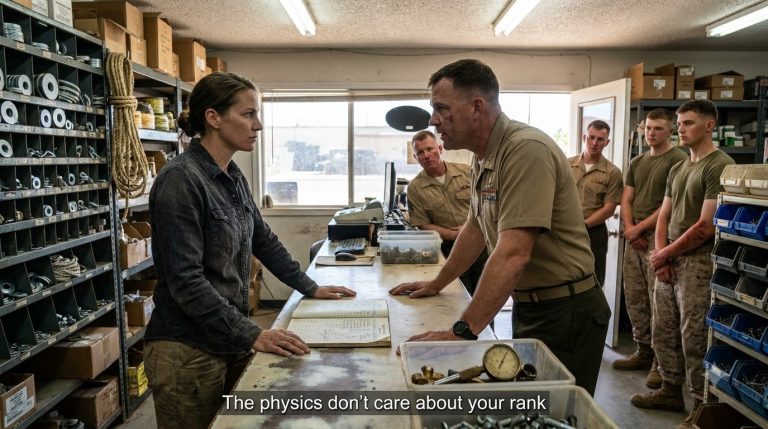
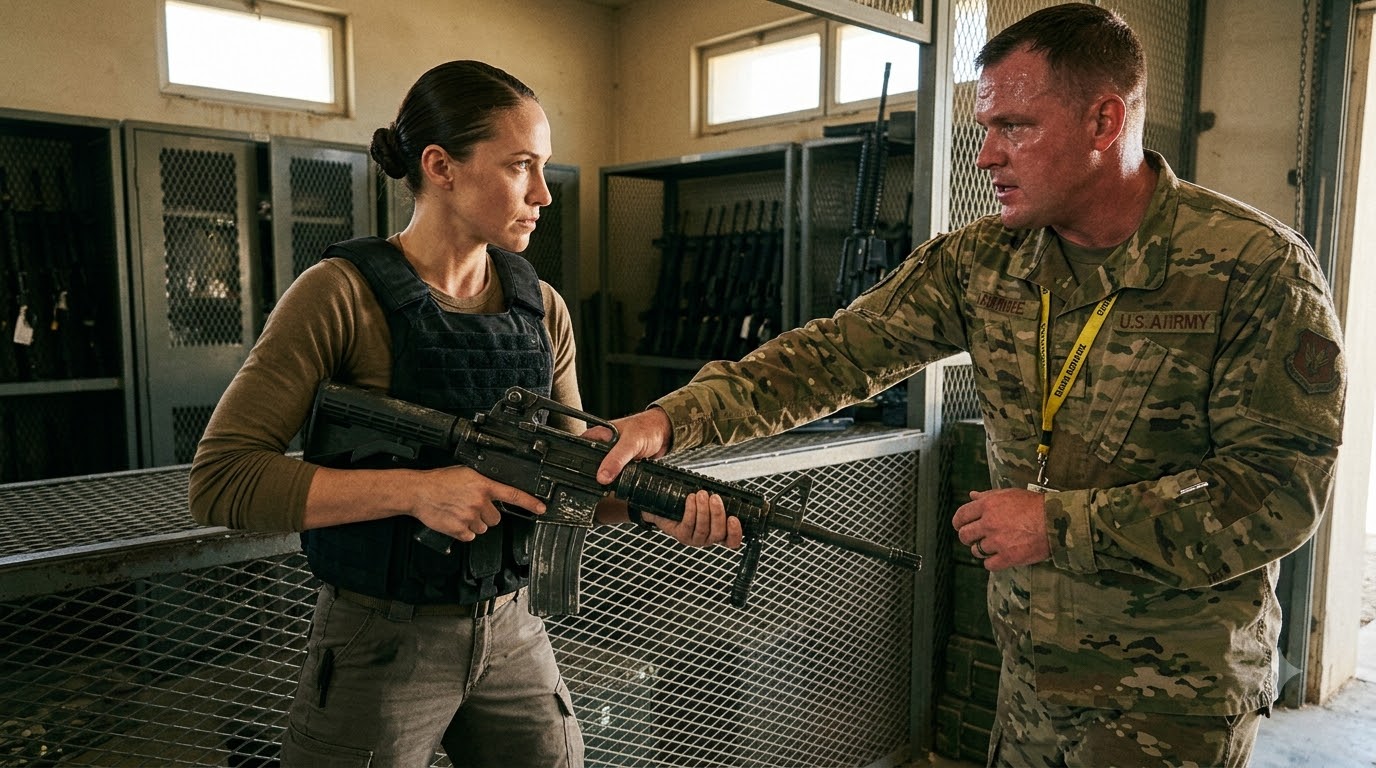
The armory sat at the far edge of the motor pool, a reinforced steel shelter baking under the afternoon sun. Master Sergeant Raymond Holt stood behind the heavy mesh counter inside, his graying arms folded over a clipboard.
“I need a precision setup,” Riley said, stopping at the counter. Plain, direct, no preamble. “Grid 4-4 is active. Platoon is pinned.”
Holt looked at her for two seconds. He didn’t ask for her contractor ID. He didn’t ask if she was cleared for field carry. He knew the way she stood, the total absence of wasted motion in her frame. He turned toward the reinforced cabinet in the back—the long-range cage where the specialized chassis and match-grade optics were stored under double lock.
“Hold on!”
Curtis burst through the armory door, breathing heavy, his yellow contractor lanyard swinging wildly against his chest. Sweat was already soaking the collar of his polo.
“Stand down, Holt,” Curtis ordered, catching his breath against the doorframe. He pointed a shaking finger at Riley. “She’s an analyst. She doesn’t have field status. If a contractor pulls a military asset from this cage without a cleared DA form, it comes off my operational budget and my neck!”
Holt stopped, his hand resting on the key ring at his belt. He looked from Curtis to Riley. “The platoon’s pinned in the bowl, Hail. You hear the net?”
“I know what’s on the net!” Curtis snapped, stepping up beside Riley, trying to use his height to crowd her space. “And I know the rules! The long-range systems are off-limits to non-uniformed personnel. End of discussion. I’m not authorizing the cage key.”
Riley didn’t argue. She didn’t raise her voice, and she didn’t waste breath explaining the math of blood loss. She didn’t need the precision rifle in the cage.
She reached straight across the mesh counter, grabbed a standard, battered M4 carbine resting in the rack of returned patrol weapons, and pulled it toward her.
“What do you think you’re doing?” Curtis demanded, reaching out to grab the barrel. “That’s property of—”
Riley didn’t hit him. She simply stepped forward, driving her shoulder into his chest with calculated, immovable mass. Curtis stumbled backward into a stack of empty ammo crates, his feet tangling as he let out a sharp, indignant wheeze.
She slapped a standard magazine into the magwell, pulled the charging handle back until it locked with a metallic clink, and checked the chamber in a single fluid second.
“Holt,” she said, her voice flat. “Three extra mags. Green-tip.”
Holt didn’t hesitate. He reached under the counter and slid three thirty-round magazines across the scuffed wood. “Take the rear truck, Monroe.”
“You can’t do this!” Curtis yelled from the floor, his face dark with embarrassment as he tried to regain his footing. “You’re a civilian contractor! I’ll have your clearance pulled before you hit the main gate!”
Riley grabbed the spare magazines, shoved them into her vest pockets, and slung the scuffed carbine over her shoulder. She turned her head just enough to catch Curtis’s eyes.
“If those men die in that valley,” she said, her tone as cold and level as a concrete slab, “your clearance won’t matter.”
She turned and walked out into the roaring exhaust of the QRF engines, leaving him standing in the dust of the armory floor.
CHAPTER 3: THE ASCENT THROUGH SAND
Sergeant Cole Turner slammed the rear door shut from the inside, his vest hitting the back seat with a heavy thump.
“You stay in the middle seat,” Turner barked, his thumb nervously flicking the safety selector on his weapon back and forth. “I don’t need a civilian getting in the way when we dismount.”
Riley didn’t answer. She braced her boots against the transmission hump as the truck hit the dry riverbed, the suspension slamming hard against its rubber stops. Dust crept in through the door seals, bitter and fine on her tongue.
Fifteen minutes of kidney-punching terrain collapsed into a sudden, screeching halt at the base of the ridge.
The moment the driver killed the engine, the sound of the valley hit them—a relentless, rhythmic pounding of automatic fire bouncing off stone walls, punctuated by the dull thud of localized explosions.
Turner lunged out the door first. “Move! We go up the gulley!”
Riley stepped onto the loose shale, the weight of the iron-sighted carbine balanced low against her waist. She didn’t follow Turner toward the gulley bottleneck. Her eyes scanned the sheer, jagged spine to the north—the angle that overlooked the entire western lip of the bowl.
“Hey! Contractor!” Turner yelled over his shoulder, his face flushed as he gestured wildly toward the lower ravine. “Where are you going? The squad’s down there!”
“They’re taking fire from above,” Riley called back, her voice level, unhurried, slipping under the roar of the wind. “If I go down there, I’m just another target in a box.”
“You don’t break formation!”
“I’m not in your formation, Sergeant.”
She turned her shoulder into the steep incline, driving her knees high, her fingers digging directly into the sharp edges of the exposed granite.
The climb was brutal, a sheer vertical wall of loose scree and dry shrubs that crumbled under her boots. Loose stones skittered down behind her, crashing into the gully below, but she kept her center of gravity low, breathing through her nose in steady, rhythmic cycles.
Halfway up the ridge, a sudden, blinding gust of wind hit the slope, whipping sand into her eyes and turning the slope into a sliding wall of dust.
Her left boot slipped. She dropped her weight instantly, planting her forearm flat against a shelf of rock, anchoring herself before momentum could pull her down.
She blinked hard through the sting of dust, wiping her eyelashes with the sleeve of her uniform. Ten yards above her, the crest of the ridge loomed against the haze.
Through the crackle of the radio on her shoulder, Captain Ridge’s voice cut through static, ragged and desperate. “They’re crawling down the eastern wall! We have no angle on them! Brooks, get back down!”
Riley didn’t pause to clear the dirt from her knees. She hauled herself over the top edge, rolling flat into the gravel behind a broken ledge of basalt.
The valley lay spread out below her like a butcher’s block.
Without a high-magnification optic, the world was a jagged haze of red earth and smoke. But she didn’t need six times magnification to read terrain geometry. She flipped the iron sight up on her carbine, resting the battered handguard on the rough rock.
Down in the dirt, forty yards out from the trapped squad, a single medic in a dust-covered helmet was crouched over a downed soldier, trying to drag him toward a rusted vehicle frame.
Behind her, emerging from the dust on the upper ridge, a figure leveled a rifle straight at her back.
Riley didn’t breathe. She lined up the small front post of her iron sight, centering the target in the tiny rear aperture, adjusting two inches left for the crosswind blowing up the gulley.
CHAPTER 4: THE BRASS AND THE DUST
The round struck clean. Fifty yards down the slope, the figure charging Dana Brooks pitched sideways into the scree, his weapon skittering harmlessly down the rock face.
On the radio, Captain Ridge’s voice cut through the static with raw, disbelieving panic. “Who took that shot? Who just saved Brooks?”
“Overwatch,” Riley said into her collar mic. She didn’t shout. Her voice was as cold and flat as a concrete floor. “Get your team behind the burned-out frame. I have the western lip.”
She rolled three feet to her right, gravel tearing through her sleeve, instantly breaking her silhouette against the skyline.
The wind howled across the ridge, driving red sand straight into her face. The dust storm was fully on them now, turning the sun into a pale yellow coin and choking visibility down to thirty feet.
Without a scope, every target was just a moving shadow against the red fog.
She racked another round manually when a casing stuck in the worn extractor. She forced her thumb against the forward assist, pushing the bolt home with a dull thunk.
Down in the ravine, Turner was screaming orders, his squad firing wildly into the upper rocks. “Where are they? I can’t see them!”
“Three o’clock, high ground!” Riley shouted back through the radio, her eye glued to the iron aperture. “Stop shooting at the ridge line! They’re in the dry drain below the mortar pit!”
She squeezed off two controlled bursts into the swirling dust. A figure carrying a launcher dropped back into the trench, the threat erased before he could level the tube at Turner’s lead vehicle.
“She’s right!” Ridge yelled over the net. “Shift fire to the drain! Move!”
Riley pushed herself off the ground, crouching low as she advanced along the top edge of the rock wall. Her boots stepped over abandoned gear and empty brass.
Then she saw it.
Halfway down the slope, half-buried in a cutout of sandbags, sat a heavy mortar tube. The crew had fled back into the ravine under her covering fire, leaving the weapon behind.
She scrambled down the loose slope, her hands sliding against hot stone until her boots hit the dirt shelf beside the mortar.
She reached down to tilt the tube, intent on spiking the firing pin. But as her gloved fingers scraped the dust off the baseplate, cold metal caught her eye.
Rivet-stamped directly to the side of the mounting bracket was a small, cracked ceramic plate.
It wasn’t military surplus. It carried a yellow bar-code layout and an eight-digit tracking ID—a civilian contractor asset tag.
She cleared the grit from the numbers with her thumb, the sharp edge of the ceramic digging through her glove. It was an inventory marker from FOB Raven Rock’s dark-storage bay.
The bay managed directly by Curtis Hail.
This wasn’t just a local militia ambush. The hardware pinning down Ridge’s platoon had been checked out of her own base’s supply logs.
“Monroe!” Turner’s voice boomed from thirty yards below as he cleared the lower gulley. He was breathing hard, his uniform soaked in sweat, eyes wide as he scrambled up toward her position with his carbine raised. “The ridge is clear! What the hell are you doing up here?”
Riley didn’t answer right away. She pulled a small multi-tool from her pocket, jammed the flathead driver under the edge of the ceramic tag, and popped the serial plate off the mortar frame with a sharp snap.
She slid the hot metal tag straight into her left pocket, next to her 300 Win Mag casing.
“Gather the platoon, Sergeant,” Riley said, standing up and dusting off her knees. “We’re going back to base.”
CHAPTER 5: THE CORNERING OF THE BUREAUCRAT
Riley pushed the door open.
The room went dead silent. Veronica froze with a stack of printouts held mid-air. Brad Nolan, sitting on the corner of the comms console, swallowed hard and pulled his boots off the desk.
Curtis Hail was standing by the central briefing table, a fresh styrofoam cup of coffee in his hand. The moment he saw her, his face hardened, his jaw tightening into that familiar, dismissive grimace.
“You’ve got a lot of nerve walking back in here, Monroe,” Curtis said, his voice rising, taking quick steps forward to block her path to the inner office. “I’m writing you up for insubordination, theft of government gear, and physical assault in the armory. You’re off this contract by nightfall.”
Riley didn’t stop walking until she was standing eighteen inches from his chest. She unslung the battered M4 carbine, set it down on the briefing table with a dry, metallic thud, and pulled her left hand out of her pocket.
She dropped the cracked ceramic asset tag onto the middle of Curtis’s paper briefing map.
Curtis blinked, his eyes darting down to the yellow bar-code and the stamped eight-digit tracking number. The color drained out of his cheeks so fast his ears turned red.
“Where did you get that?” he asked, his voice suddenly losing its rasp, dropping an octave into a defensive, tight whisper.
“Off the mortar tube that had Captain Ridge’s platoon pinned down in the creek bed,” Riley said.
Behind her, Colonel Avery Dalton stepped out of his side office, his boots loud on the linoleum. He didn’t say a word. He just stood in the doorway, his arms crossed over his chest, listening.
“This is ridiculous,” Curtis stammered, stepping back and waving a hand dismissively at the table. “That’s a scrap inventory plate! Equipment gets lost in transit all the time! You think because you went out there and played hero for an hour you can throw around wild accusations?”
“You didn’t lose it in transit, Curtis,” Riley said, her tone as calm as a frozen pond. “You marked Grid 4-4 as ‘low threat’ in the daily summary so no one would ask why three crates of dark-storage inventory went missing from Bay 4 last Tuesday.”
“That’s a lie!” Curtis yelled, pointing a finger directly at her nose, his hand shaking so hard a splash of dark coffee spilled over the lip of his cup onto his thumb. “Colonel, she’s trying to cover for her own protocol breach! She stole a weapon from the armory! She laid hands on me!”
“You suppressed my terrain report because if Ridge’s platoon stayed out of that valley, nobody would ever use those mortar tubes,” Riley continued, ignoring his raised finger entirely. “And nobody would ever check the serial numbers.”
“You have no proof of anything!” Curtis roared, his voice cracking as he looked past her to Dalton. “Colonel! She’s a washed-up contractor with a red-flagged file! Are you really going to listen to a woman who got kicked out of the Army for—”
“She didn’t get kicked out, Curtis,” Colonel Dalton interrupted, his voice dropping into the room like a iron anvil. He stepped up to the table, picked up the ceramic tag, and turned it over in his thumb. “She walked away after testifying against a logistics colonel in Bagram who was doing the exact same thing you just did.”
Curtis stopped breathing. His mouth stayed open for two seconds before he snapped it shut, his eyes darting toward the door as if calculating the distance to the motor pool.
“I’m calling corporate legal,” Curtis muttered, stepping sideways, his voice trembling with pure, desperate venom. “You don’t have the authority to hold me here. This is a private contract matter—”
“Sit down, Curtis,” Dalton said softly.
Curtis didn’t sit down. He took another step back, clutching his coffee cup like a shield, his knuckles white, his eyes wild with the sudden realization that the quiet woman in the corner had just dismantled his life without ever raising her voice.
CHAPTER 6: THE UNCOMFORTABLE SILENCE
“You don’t understand how these contracts work!” Curtis screamed, his voice cracking, high and shrill against the hum of the cooling fans. “I was managing shortfalls! The military underfunds local security logistics—I had to clear overhead! If you pin this on me, corporate will tie this base up in legal injunctions for six months! You won’t get food, fuel, or ammo!”
He spun toward Brad and Veronica, his eyes wide, bloodshot, begging for a lifeline. “Tell them! You both signed off on the dark-storage inventory sheets! If I go down, you go down with me for gross negligence!”
Veronica pulled her chair back so fast the plastic casters shrieked against the floorboards. She shoved her hands beneath her thighs and looked straight at the desk, her chin tucked tight to her chest. Brad swallowed hard, leaning so far away from Curtis he nearly slipped off the edge of the comms desk.
Neither of them spoke.
“You’re on your own, Curtis,” Colonel Dalton said softly.
Dalton didn’t raise his voice. He reached over, picked up the desk landline, and dialed four digits. “Military Police escort to the TOC. I have a civilian contractor supervisor being detained under federal supply chain fraud and treason mandates.”
Curtis’s jaw worked silently. The styrofoam cup finally crushed under his tightening grip, lukewarm coffee washing over his fingers and dripping onto his polished dress shoes. He didn’t even drop the plastic. He just stood there, shrinking into his wrinkled polo shirt as two armed MPs stepped through the door, grabbed his arms, and pulled him out into the dusty corridor without a word.
The heavy door clicked shut.
The room settled into an absolute, suffocating quiet.
Brad didn’t look up from his blank screen. Veronica’s hands remained clamped beneath her legs. Outside the window, the engines of the returning QRF Humvees slowly powered down, their low rumble fading into the desert silence.
Captain Ridge stepped through the doorway, his uniform torn at the shoulder, dust caked thick across his forehead and jaw. Behind him, Medic Dana Brooks hovered in the hall, her hands still stained with red clay, her eyes wide as she searched the room until they landed on Riley.
Ridge walked straight to the briefing table. He looked at the scuffed, iron-sighted M4 carbine lying beside the paper map, then looked at Riley.
“We were wrong about you,” Ridge said, his voice rough, stripped of all arrogance. He stood straight, bringing his right hand up to a sharp, silent salute. “Every one of us.”
Behind him, Dana Brooks nodded, her chin trembling slightly as she wiped a dust streak off her cheek.
Riley didn’t return the salute. She didn’t deliver a speech, and she didn’t smile. She reached down, picked up her worn carbine, and handed it across the table to Master Sergeant Holt, who had followed the squad inside.
“Needs a barrel scrub,” Riley said flatly. “Extracting claw sticks on green-tip brass.”
Holt took the weapon, holding it with both hands like a piece of iron history. “I’ll clean it myself, Staff Sergeant.”
Riley turned back to her desk in the corner.
She pulled out her black office chair, sat down, and set her sticky keyboard flat against the laminate blotter. She reached into her pocket, pulled out her scratched 300 Win Mag brass casing, and set it neatly beside her pen holder.
She pressed the sticky key on her keyboard—once, twice, three times—until the key popped up with a clean, crisp click.
She didn’t look at Ridge, she didn’t look at Dalton, and she didn’t look at the empty chair where Curtis used to sit.
She opened the daily intel log, aligned her notebook exactly two inches from the edge of the desk, and began typing her afternoon report in complete, unbroken peace.