A Surgical Silence: The Iron Wolf Protocol and the Midnight Reckoning in the Kunar Valley
CHAPTER 1: THE GHOST IN THE ROOM
The armory at the Forward Operating Base was a cavern of concrete and shadows, scented with the metallic tang of gun oil and the stale, lingering scent of jet fuel from the flight line. In the corner, Corporal Callahan—known to the command staff as Iron Wolf—knelt beside her Pelican case. She didn’t look up as the argument between Brennan and Stone reached a boiling point near the equipment lockers.
“We can’t just split the sector,” Brennan said, his voice dropping into that low, dangerous register of a man who had seen too many teammates buried in foreign soil. “If we have two primary snipers, we move as a single unit or we don’t move at all. You’re asking to leave a gap in our coverage the size of a mountain pass.”
“I’m asking for flexibility,” Stone countered, slamming his vest onto the bench. “The last op proved that the ‘standard’ way is a graveyard. Iron Wolf is a force multiplier, not a damn radio operator. Let her take the high ground independently.”
Callahan didn’t blink. She worked with the economy of a machine. Her M40 A6 lay in pieces before her, a skeleton of matte-black steel. She inspected the firing pin, the movement of her fingers rhythmic, detached. She wasn’t participating in the argument, yet she was absorbing every word, every shift in their weight, every flicker of annoyance in their eyes. She knew exactly why they were fighting: it wasn’t about tactics. It was about trust. They were trying to build a map for a landscape they couldn’t see yet.
She noticed a minute discrepancy in the equipment logs taped to the end of the locker row. A signature entry for the last night-vision recalibration was off by three minutes. A simple clerical error, or the sign of an operator rushing through a check? In this environment, a three-minute discrepancy could mean the difference between seeing a heat signature at a thousand meters and staring into a wall of absolute black.
She reached out, her finger tracing the scuff marks on the concrete floor near the exit. Mud. Dried, red-clay mud that hadn’t been picked up by the cleaning crews. The base was situated on grey shale and gravel. Red clay only existed on the lower valley floor, near the secondary supply depot—a place no one was supposed to have visited for the last forty-eight hours.
Callahan stood, the weight of the rifle assembly feeling like an extension of her own nervous system. She hadn’t been to the supply depot, and the rest of the team was still here, bickering over maps.
She turned, her gaze settling on the door. It wasn’t just the mud. It was the fact that a technician had left a terminal running in the logistics office, the screen displaying a set of coordinates that shouldn’t have been there. She walked past the arguing men, her footsteps silent, and glanced at the monitor. It was a weather report, but the data feed originated from a frequency she knew was reserved for local military command—a level of access that a standard logistics tech shouldn’t have.
She felt a cold, sharp spike of awareness at the base of her skull. Someone had been here. Someone who had brought the red clay of the valley floor into the sterile safety of the base, and who had been watching them, listening to them, perhaps even planning for them.
She reached for her radio, then stopped. If she spoke now, she would disrupt the team’s already fragile unity. She chose silence. She stepped out into the biting mountain air, the wind whipping her hair back, and looked toward the distant, jagged ridge of the Kunar. A single light flickered on the far peak—a signal, rhythmic and deliberate.
She was being watched. Not by an enemy combatant, but by someone who knew exactly how she worked. The game had already begun.
CHAPTER 2: ECHOES OF THE KUNAR
Callahan didn’t move. She remained in the shadow of the armory doorway, the cold air biting at her exposed skin, turning her breath into faint, ghost-like plumes. Her eyes remained locked on the rhythm of the light on the ridge. Long-short-long. Pause. It wasn’t a random electrical flare or a campfire reflection. It was a signal, a deliberate cadence meant to be seen, yet specifically designed to be ignored by anyone not looking for it.
She turned back into the armory, her movements silent, and knelt back at her workbench. She didn’t reassemble the M40 A6 immediately. Instead, she reached for the maintenance log she had noted earlier. She pulled a small UV pen from her tactical vest—a tool for verifying equipment serial numbers—and ran the light over the page where the entry was scribbled.
The handwriting was clean, military-standard, but there, pressed into the paper beneath the ink, were two sets of indentations. The first was the expected entry. The second, lighter and more deliberate, was a series of coordinates. They didn’t match the base; they matched the supply depot where she had found the red clay.
The sound of the argument behind her shifted. Stone had stopped shouting, and Brennan was now leaning against the lockers, his breathing heavy. They were decompressing, unaware that the very logistics of their existence had been compromised. Callahan felt a cold, familiar detachment settle over her. This was the “breathing” space of a mission—the moment before the transition from ghost to weapon. She had to decide whether to bring the team into this, or to use the discrepancy to bait the observer.
She reassembled the rifle, the internal components clicking together with a satisfying, metallic finality. She slid the bolt home, checked the headspace, and secured the Pelican case. The click of the latches was, as always, the sound of her world shrinking to a single, focused point.
She walked toward the arguing men.
“I’m going to the range for a final gear check,” she said. Her voice was flat, devoid of the irritation they were currently projecting.
Brennan looked up, his brow furrowed. He was still wound tight from the earlier debate. “The range is closed for maintenance, Callahan. You’ll have to wait for the morning shift.”
“I have clearance,” she replied, not breaking stride.
She bypassed the main hangar and headed toward the outdoor range. The wind was picking up, carrying the scent of incoming snow from the high peaks. She pushed open the heavy steel door to the range control building. The interior was dimly lit, smelling of ozone and floor wax.
She approached the firing line, but as she stepped into the booth, she felt a slight unevenness in the floor plating. She looked down. A small, brass casing lay in the groove—a piece of 7.62mm ammunition, but the primer strike was off-center. It was a failure, a misfire that should have been swept away. She picked it up. It was cold to the touch, and it hadn’t been fired in this range; the residue on it was a fine, grey powder, common to the lower valley, not the high-altitude climate of the base.
She slotted the casing into her pocket and readied her rifle. She didn’t set up on the static targets. She tilted her scope, observing the distant ridge line again. The light was gone.
She dry-fired once, twice, the trigger pull consistent, the balance of the rifle perfect. But as she prepared for the third, the entire range lighting flickered and died. An automated system alarm chirped—a mechanical failure in the target pulley mechanism.
She didn’t move. She didn’t reach for her flashlight. She stood in the absolute, crushing darkness, her senses expanding to fill the void. She felt the subtle shift in the air pressure, the faint vibration of a door latch clicking shut at the far end of the range. Someone was in here with her.
She didn’t rack the bolt. She didn’t give away her position. She stood perfectly still, a statue carved from the dark, waiting for the one sound that didn’t belong. The wind howled through the open range, and beneath it, the unmistakable, muffled scrape of a boot on shale.
She wasn’t being hunted. She was being tested. The test was simple: would she react, or would she observe? She closed her eyes, letting the phantom rhythm of the light on the ridge replay in her mind. Long-short-long. She wasn’t just a sniper; she was the piece on the board that was about to flip the game. She pivoted silently toward the noise, her hand moving to the hilt of her combat knife, not because she needed it, but because the weight of it provided the perfect counter-balance for the movement she was about to execute.
The figure in the dark stopped. The silence that followed was heavy, a suffocating layer of tension that seemed to stretch across the entire base. Callahan breathed out, a long, slow release, and shifted her weight, preparing to close the distance.
CHAPTER 3: THE SILENT DEPARTURE
Callahan did not break the rhythm of her breathing. The sound—that soft, rhythmic scrape of a boot on shale—was faint, but it pinned the intruder’s location to the area behind the storage crates stacked near the rear ventilation shaft. The intruder was disciplined, but they had made a mistake: they expected her to be a standard-issue soldier who relied on light and command protocols. They did not expect her to be a void.
She shifted her weight, the movement as fluid and soundless as a shadow sliding over stone. She didn’t reach for her sidearm. In the close quarters of the darkened range, a knife was superior—it didn’t hum with the mechanical rattle of a slide, and it didn’t leave a ballistic signature.
She felt the air move as the intruder shifted again. They were trying to flank her, circling toward the center of the range floor. Callahan stepped back, her boot finding the exact patch of concrete that didn’t creak, and waited. She counted the seconds in her head—the tempo of a long-range shooter’s pulse.
One. Two. Three.
The intruder moved. It was a fast, confident stride, the kind born of over-familiarity with the facility. As the figure passed the pillar where she had been standing, Callahan lunged. She didn’t strike to kill; she struck to neutralize. She pivoted, her forearm hooking the figure’s throat, driving them into the pillar with the brutal, calculated physics of a tactical takedown.
The intruder gasped, their hand flying up to catch her wrist. There was no shout, no desperate scramble. The figure was professional, their response measured. They tried to sweep her legs, but Callahan was already shifting her center of gravity, pinning the intruder’s arm behind their back.
She felt the texture of the intruder’s gear—high-grade ballistic weave, not standard issue. She pressed her knee into the small of their back, exerting just enough pressure to ensure compliance.
“You’re sloppy,” Callahan whispered, her voice a sharp, cutting edge in the dark.
The intruder went rigid. They didn’t struggle further. They knew the leverage she held; one slight adjustment of her arm would dislocate the shoulder.
“The light on the ridge,” Callahan continued, her eyes fixed on the outline of the intruder’s head in the faint ambient glow of the hallway light bleeding through the door. “That was your signal. Not mine.”
The intruder remained silent. Callahan reached out, her fingers finding the tactical patch on their shoulder. It was a standard unit identifier, but as she felt the embroidery, she realized it was slightly heavier than the others. She pulled it free. Underneath, stitched directly into the fabric of the vest, was a small, laser-etched marker—a symbol she hadn’t seen in years. It was the mark of a defunct training cell, a ghost group that had been disbanded before she was even recruited into the Iron Wolf program.
“You aren’t base security,” she stated. “And you aren’t here for the gear.”
The intruder grunted, a short, sharp sound of effort, and attempted to twist free. Callahan tightened her grip, the cold steel of her knife hilt pressing against the intruder’s collarbone. “If you move again, you won’t be walking out of this range. Who sent you?”
The intruder stopped. “They’re not sending anyone, Callahan. They’re waiting for you to realize you’re already behind schedule.”
The voice was muffled, strained, but it held a quality that made the blood in her veins turn to ice. It was a voice she hadn’t heard since her final certification—a voice that belonged to a ghost.
Before she could press the advantage, the intruder executed a brutal, forced release—a maneuver that required them to sacrifice a layer of skin on their own arm to slide free of her lock. They spun, a flash of motion in the dark, and lunged toward the ventilation shaft. Callahan reached out to grab them, but her hand closed on empty air.
A heavy, metallic thud echoed through the room as the shaft cover was slammed back into place. Callahan sprinted to the vent, pulling the heavy steel cover aside. The tunnel was empty, the air rushing through it cool and metallic. She shone her light down the corridor; there was nothing but the scuff of a single boot print and, sitting in the center of the floor, a small, black drive.
She picked it up. It was warm.
The intrusion hadn’t been an attempt to kill her; it had been a delivery. She stared at the drive, the weight of it suddenly feeling like an anchor in her palm. The team was still back at the briefing room, and the clock was still ticking toward a deployment they didn’t know was compromised.
She didn’t return to the armory. She exited through the rear range door, the cold air hitting her face with a sudden, violent intensity. The ridge line was dark now, the signal light gone. She stood on the edge of the shale slope, the drive pressed tightly into her pocket. The mission parameters had just shifted. She was no longer just the sniper on the team; she was the target of a game that had started long before she signed her first non-disclosure agreement.
She began the long walk back to the command center, her pace steady, her mind dissecting the intruder’s movements, their training, their voice. She needed to look at the data on the drive, but she couldn’t risk the base terminals. She would have to go off-grid, to use the secondary comms unit she had stashed in her own gear locker—a unit the command staff didn’t even know she possessed.
The base was quiet, the only sound the distant, rhythmic hum of the generators. She moved like a phantom between the shadows of the barracks, her eyes scanning the rooftops. Every shadow, every flicker of movement, was now a potential threat. The “dual sniper” integration she and Brennan had discussed was already obsolete. If she was going to survive what was coming, she would have to operate in the gray spaces—the places where the team’s loyalty to the mission would be tested against the truth she was about to uncover.
She reached her locker, the key sliding into the lock with a familiar, mechanical click. She didn’t open the door wide; she slipped in, pulled her kit, and vanished back into the night. The Kunar Valley was no longer just a theater of operations. It was a cage, and the bars were closing in.
CHAPTER 4: THE DECOYS TRAP
Callahan didn’t head straight back to the barracks. She circled the perimeter of the base, sticking to the deep shadows cast by the reinforced hangars. The air was frigid, smelling of dry dust and the ozone tang of the base’s perimeter fence. She needed to access the off-grid terminal, but to do that, she had to pass through the maintenance bay—the only place on base that wasn’t monitored by the primary signal loop she’d helped build.
As she moved, she felt the drive against her thigh. It was a digital shackle. She knew what it represented: a test. The intruder hadn’t just left her a clue; they had left her a burden. If she decoded it, she risked being tracked by the very systems she was supposed to protect. If she didn’t, she walked into the Kunar Valley blind, potentially leading the entire team into an ambush set by the ghost of her own past.
She slipped through the side entrance of the maintenance bay. The cavernous room was dark, filled with the skeletal frames of dismantled Humvees and the sharp scent of hydraulic fluid. She moved to her secondary locker—a hidden compartment behind a pallet of engine parts. She pulled the unit out, a handheld device that looked like a standard radio but functioned as a localized decryption deck.
She inserted the drive. The screen flickered, revealing a map of the Kunar Valley—the same one the team was currently using, but layered with live-time signal signatures that weren’t on the official satellite feed. She stared at the screen. The signatures weren’t coming from the expected insurgent hideouts. They were coming from the government-held sector of the valley, the high-altitude pass that the team was scheduled to traverse in six hours.
It was a setup. The “rogue intelligence” lead that the Commander was banking on was a magnet, designed to pull the SEALs into a kill-box that had been prepared weeks ago.
The sound of a heavy door opening echoed through the bay. Callahan didn’t jump. She didn’t look up. She deactivated the terminal in a single motion, sliding the drive and the device back into their hidden nook before turning toward the entrance.
Brennan walked in. He looked tired, the lines around his eyes etched deep by the strain of the briefing. He stopped when he saw her, his gaze sweeping the room with the practiced suspicion of an operator who lived in a world of constant threats.
“What are you doing here, Callahan?” he asked, his voice low.
“Equipment calibration,” she said, her tone steady. “The range gear was faulty.”
Brennan stepped closer, his eyes narrowing as he scanned the room. “The base is on lockdown until deployment. Nobody’s supposed to be in maintenance.”
“I was told to prepare for the long-range shift,” she said, using the tactical logic that governed their lives. “If I don’t confirm my optics, I’m useless to you in the pass.”
Brennan stayed silent for a long moment, studying her face. He was looking for the crack in her composure, the sign that she was hiding something behind that mask of perfect, detached professionalism. She didn’t give him anything. She was the ghost he had helped create, the asset he had fought to integrate.
“We leave in five hours,” he said, shifting his focus to the pallets. “Make sure you’re ready. The Commander is doubling down on the intel from the depot. He thinks this is the break we need.”
“Does he?” Callahan asked.
Brennan glanced back at her. “He does. He thinks we have the upper hand. He thinks if we move fast enough, we can secure the valley before the insurgent network can react.”
Callahan felt a surge of cold, analytical rage. The Commander was being fed the same lie she was currently looking at on that drive. She had to decide. If she told Brennan, she would be violating the chain of command, potentially forcing an abort that would have political repercussions. If she didn’t, she was complicit in the trap.
“We need to be careful, Brennan,” she said, her voice dropping into that register of quiet, lethal certainty. “The terrain in the pass is complex. If they are expecting us, they’ll control the high ground. If we take the route the intel suggests, we’re essentially marching into a narrow neck.”
Brennan paused, his hands resting on his rifle case. “I’ve been over the maps a dozen times, Callahan. There’s no other viable route that gets us into the target sector by first light.”
“There is,” she said. “It’s a goat path on the eastern ridge. It’s brutal, it’s slow, and it’s a logistical nightmare. But it keeps us out of the valley floor.”
Brennan looked at her, truly looking at her, for the first time since the briefing. “You’re suggesting we go off-route? The Commander will have our heads.”
“The Commander will have our lives if we take the primary route,” she corrected. “I’ve been tracking the wind patterns in that sector for three days. The primary route is a funnel. If you want to survive the Kunar, you don’t play the game they want you to play.”
Brennan weighed her words. He looked at the shadows, then back at the door. “I’ll talk to him. But don’t expect a warm welcome.”
“I don’t expect anything,” she said, and for the first time, the chill in her voice was absolute.
As Brennan walked out, Callahan stood in the silence of the maintenance bay. She had bought them a chance, but she had also revealed her own hand. Whoever was watching her from the ridge now knew she was deviating. The “decoy’s trap” was still active, but now, the variables had changed. She grabbed her rifle, her fingers gripping the cold steel with a strength that betrayed her own internal turmoil. The game hadn’t just started; it had evolved into a hunt, and she was no longer just the prey. She was the hunter, and the Kunar was about to become the site of a very personal, very lethal, tactical correction.
CHAPTER 5: THE UNMASKING
The transport jolted, the metallic scream of tires on shale tearing through the silence of the high-altitude pass. Callahan was thrown against the side of the vehicle, the impact rattling her teeth, but her hands were already on her rifle. Beside her, Brennan was a blur of motion, his own weapon rising in anticipation before the vehicle had even fully settled.
“Contact!” Stone roared from the front, his voice barely audible over the sudden, violent eruptive force of a remote-detonated charge somewhere in the valley floor behind them.
The vehicle swayed dangerously as a second blast hit the lead transport. Callahan checked the monitors. The signal signatures were identical to the ones she had decrypted on the black drive—precise, calculated, and aimed to isolate them from their extraction assets. They weren’t just under attack; they were being herded.
“Off-load! Now!” Brennan commanded.
Callahan hit the release, the side door of the transport sliding open to reveal a world of grey mist and blinding shale dust. She was out in a heartbeat, her boots finding purchase on the jagged incline of the eastern ridge—the very route she had insisted they take. The irony was a bitter, metallic taste in her mouth. She had wanted to avoid the kill-box, but the enemy knew her well enough to know she would choose the high ground.
She took a knee behind a boulder, her scope searching the ridgeline across the pass. The enemy was already there. She saw the flashes—rhythmic, tight, controlled bursts. She narrowed her eyes. There was a specific cadence to their fire. A slight, almost imperceptible hesitation before each secondary volley. It was a pattern she had drilled into her own students years ago.
She felt a phantom chill slide down her spine. The tactical habit wasn’t just similar; it was a mirror. The person commanding this ambush had been trained by the same instructor as she had.
“They’re anticipating our return fire,” Callahan shouted, her voice cutting through the chaotic pop of small-arms fire. “Brennan, they’re using our own SOPs against us. Break left, don’t retreat to the vehicle!”
“We’re pinned, Callahan!” Brennan fired, his shots precise, hitting the dust inches from a sniper’s position across the pass. “They’ve got the high ground and the corridor is locked!”
Callahan moved. She didn’t retreat; she scrambled up the slope, her hands finding purchase in the brutal, freezing rock. She needed a different angle. She found a shelf of basalt about twenty feet above their current position. She vaulted, her muscles screaming with the effort, and slammed her bipod into the dirt.
Through the glass, she saw a figure, standing apart from the other combatants, not firing, just watching. They were holding a field radio, their posture unnervingly familiar. Callahan felt her heart hammer against her ribs, not with fear, but with a sudden, devastating clarity. It was him. The mentor she hadn’t seen since the final evaluation of the Iron Wolf program.
She tracked him, her crosshairs centering on the radio in his hand. He wasn’t hiding. He was waiting.
She pressed the trigger, but a sudden, violent concussive wave from an incoming RPG forced her off-line. The rock she was perched on shattered, shards of basalt tearing into her combat vest, throwing her backward. She tumbled down the slope, the world spinning in a blur of grey, rock, and sky. She landed hard, the wind driven from her lungs, her rifle skittering away into the dark, churning mist.
She reached for her sidearm, her vision swimming. The ambushers were moving in, their fire now sporadic and surgical, a clear signal that they weren’t trying to kill—they were trying to capture.
“Callahan!” Brennan’s voice sounded muffled, as if he were underwater.
She pulled herself up, her hand closing around the grip of her pistol. She saw the mentor walking toward her through the smoke, his movements slow, deliberate, and terrifyingly calm. He wasn’t a rebel; he wasn’t a mercenary. He was an auditor, and she was the asset that had failed the test.
“You took the bait,” his voice drifted through the haze, devoid of emotion, yet carrying the weight of a decade of authority. “You thought you were breaking the pattern, Callahan. But you were just proving you were still a student of it.”
She steadied her aim, her finger trembling against the trigger. The black drive she had recovered was not just a map—it was the evidence of the organization’s total compromise. She realized then that there was no “rogue intelligence.” There was only the organization, testing its own reach, pruning the branches that showed too much autonomy.
She fired, but the mentor didn’t even flinch. He sidestepped, his movement so efficient it looked like a choreographed step in a dance. He reached out, his hand snapping around her wrist with the crushing force of a steel vice.
“The test isn’t to see if you can win, Iron Wolf,” he whispered into her ear as he disarmed her. “The test is to see if you can be replaced.”
He signaled to his men, and the ambushers swarmed in. Callahan struggled, her training fighting every instinct to go limp, but the overwhelming weight of their numbers pinned her to the shale. She felt the cold bite of plastic zip-ties locking her wrists. The world tilted as she was hauled to her feet.
As they dragged her toward the waiting transport, she looked back at Brennan. He was down, his weapon disabled, his expression a mixture of confusion and horror as he watched her being taken. She didn’t call out. She didn’t struggle further. She simply watched the mentor as he looked at his watch, his face as blank as a piece of sheet metal.
The ambush wasn’t just a failure of the mission; it was the total erasure of her professional existence. She was no longer a member of the SEAL team; she was an asset being decommissioned. The drive in her pocket was a target, and as they tossed her into the back of a blacked-out transport, she knew that the only way to survive was to stop being the student—and start being the ghost he had taught her to become.
CHAPTER 6: THE PREDATORS LOGIC
The interior of the transport was a tomb of recycled air and the bitter, chemical smell of cleaning agents. Callahan sat on a folding bench, her wrists still bound by the zip-ties. The vibration of the engine through the floorboards was a low-frequency hum that seemed to rattle her bones. Across from her, the mentor sat motionless, his silhouette barely visible in the dim, red emergency light. He wasn’t guarding her; he was waiting.
Callahan’s mind was a frantic machine, stripping away the shock and reassembling the tactical reality. The ambush had been too perfect. Every variable—the wind shift, the terrain choice, the timing of the RPG—had been a mirror of her own training manual. He wasn’t just testing her; he was demonstrating the obsolescence of her current identity.
She felt the sharp edge of the zip-tie against her skin. It was a standard industrial model—brittle if treated with the right temperature shift. She began to subtly flex her muscles, heating the plastic with the friction of her own body, waiting for the microscopic expansion that would allow her to snap the bond.
“You’re counting the revolutions of the engine,” the mentor said. His voice was a calm, dry rasp that cut through the low-frequency drone of the transport. “You’re looking for a weakness in the vehicle’s timing, a moment where the driver might be distracted by the climb.”
Callahan didn’t answer. She kept her breathing steady, her gaze fixed on a bolt on the opposite wall.
“You were always my best student, Callahan,” he continued, leaning forward. The red light caught the silver in his hair, sharpening the planes of his face. “But you had a flaw. You believed that the Iron Wolf designation was about protection. You thought it was about saving the village, or the hostages, or your teammates.”
“And what is it about?” she asked, her voice barely a whisper.
“It’s about the absolute necessity of the result,” he said. “The mission is an equation, Callahan. People are merely the variables that complicate the balance. You spent your career trying to solve the equation while keeping all the variables alive. That is not how an architect works.”
He reached into his jacket and produced the black drive she had recovered from the maintenance bay. He held it up, the small, plastic casing gleaming in the dim red light. “You thought this was a clue. You thought it was a path to the truth.”
He flipped it over. The casing was cracked. He had already opened it.
“This is the list of every asset who has demonstrated the same sentimental inefficiency you’ve shown,” he said. “Every person on this drive is being ‘pruned.’ You weren’t supposed to find it, but the fact that you did—and that you immediately shared it with Brennan—was the final confirmation.”
Callahan felt the heat of the zip-tie reaching its limit. She ignored the pain as the plastic bit into her skin. “Why tell me this? Why let me see the board?”
“Because you have one last choice,” he replied. He stood up, the movement fluid, his shadow swallowing the small space of the transport. “You can continue to believe in the lie of the SEAL team, in the morality of the mission, and be erased with the rest of these failures. Or, you can acknowledge that the system is broken, and accept the role you were actually built for.”
The transport lurched, the tires spinning on a patch of loose gravel. Callahan felt the zip-ties reach the breaking point. She didn’t hesitate. She threw her weight backward, the plastic snapping with a sharp, percussive crack.
She didn’t reach for the mentor. She reached for the lever near the floor, the emergency exit override.
“You think you’re in control,” she said, her voice rising to meet the roar of the vehicle. “But you’re still fighting the last war.”
She slammed her heel into the lever. The rear door of the transport groaned, the pneumatic seals failing as the pressure differential hit them. The rush of mountain air was a vacuum, pulling at the loose equipment, the dust, and the very air in the cabin.
The mentor lunged, his hand snapping toward her throat, but Callahan was already in motion. She didn’t fight him; she used the force of the cabin’s sudden decompression to launch herself toward the opening. She hit the edge of the frame, the jagged metal catching her gear, and she was ripped out into the dark.
She tumbled into the void, the mountain air a physical blow. She didn’t try to stop her fall. She curled into a ball, letting the momentum carry her into the thick, freezing fog that clung to the pass. She hit the shale of the mountain slope, the impact rolling her through the dark, the sharp edges of the rock tearing at her uniform.
She came to a stop in a narrow crevice, breathless and bleeding, the silence of the pass returning like a shroud. Far above, the transport continued its climb, its red taillights disappearing into the mist.
She was alive. She was alone. And she was off the grid. She looked down at her hands, the skin raw where the ties had cut her, and she felt the absence of the black drive. He had kept it. He had wanted her to see the list, to know the scope of the cull.
She sat up, the pain in her ribs a sharp, rhythmic reminder of her tactical status. She had no weapon, no comms, and no backup. But she had the one thing the mentor had failed to account for: she knew the terrain better than he did. She knew every goat path, every ridge-line, and every shadow in the Kunar.
She stood, her body shaking from the cold, and turned toward the east. She wasn’t going back to the base, and she wasn’t retreating to the extraction point. She was going to hunt. The mentor had wanted to see if she could be replaced—and she was going to prove that once you’ve been forged as a ghost, you don’t stay dead.
CHAPTER 7: THE FINAL ASCENT
The ascent was a slow, agonizing exercise in friction. Callahan’s fingers were numb, the skin of her fingertips raw and peeling from the shale she had scrambled over during her escape. Every muscle in her body screamed for rest, but the rhythm of her movement was automatic—a testament to the “reprogramming” the mentor so casually dismissed. She reached the lip of the ridge, the wind howling around her ears like a physical barrier, and pulled herself over the edge.
The stronghold was a relic of the Soviet era—a jagged scar of concrete and rebar embedded into the mountainside. It didn’t look like an operations center; it looked like a tomb. She stayed low, moving through the periphery, her silhouette lost against the grey, desolate sky. She had no weapon, but she had the environment. She knew how the wind funneled through the ventilation shafts, how the shadows stretched across the central courtyard at this altitude, and exactly where the security blind spots would be.
She slipped through a rusted service hatch, the metal groaning under her touch. The interior was lit by the dim, flickering orange of emergency lamps. She wasn’t surprised to find the halls empty. The mentor was too arrogant to surround himself with guards. He wanted this to be a conversation, a final verification of his own design.
She moved toward the central command hub, her steps silent on the cold concrete. As she passed a small, recessed storage room, a glint of light caught her eye—a metallic reflection from an open locker. She paused, checking the door behind her before slipping inside.
Inside the locker were thick, leather-bound files. She opened one, her pulse skipping. It was her own service record, dated from the day she joined the Corps. She flipped through the pages. There were photos of her training sessions, notes on her heart rate during stress tests, and even hand-written comments in the margin from the mentor himself, dating back to her first day in the program. He hadn’t just been her teacher; he had been the architect of her entire adult life. He had nurtured her skills, pushed her into the line of fire, and recorded every failure and victory as if she were a lab animal.
The weight of it wasn’t anger; it was a profound, hollow sickness. Everything she had believed to be a result of her own grit and discipline was merely a pre-determined outcome of his design. She closed the file, the sound of the paper folding a sharp crack in the silence. She didn’t have time for the truth to settle. She needed to reach him.
She moved to the command hub, her hand finding a discarded tactical blade from a nearby equipment rack—a crude, ugly weapon, but it would suffice. She emerged into the central hub, the room vast and echoing.
The mentor stood at the far end, looking out through a reinforced glass wall at the valley floor, his back turned to her. On the console beside him was the black drive, now slotted into a direct-link interface. The screens were glowing with live tactical feeds—the SEAL team’s current position, their comms traffic, their vulnerabilities.
“You’re late,” he said, not turning around. “I expected you to take the eastern ridge, but you were slowed by the decompression. An efficient tactical decision, even if it cost you your gear.”
Callahan stepped into the center of the room, her grip tight on the blade. “The mission is compromised. The team knows the route is a setup. They’re turning back, and I’m going to make sure you never walk out of this mountain.”
He turned slowly. His face was a map of cold, calculated indifference. “They aren’t turning back. Look at the feed.”
He gestured to the main screen. The SEAL team’s icons were moving, but they weren’t turning back. They were advancing—straight into the primary kill-box, exactly as the decoy intelligence had directed.
“They’re following the order,” he said. “Because you didn’t convince them, Callahan. They’re professionals. They trust the chain of command, even when it’s rotting from the inside. You failed to convince them because you are still playing the role of the teammate. And that is why you are a liability.”
“They aren’t variables,” Callahan said, her voice a low, dangerous snarl. “They’re my team.”
“They are irrelevant,” he countered, stepping toward her. He didn’t reach for a weapon. He stood with his hands at his sides, completely relaxed. “If you kill me, you are just validating the test. You are proving that the Iron Wolf is a lethal instrument that functions perfectly. You are proving me right.”
He paused, a flicker of something almost like pride touching his eyes. “But if you walk away, if you leave them to their fate and reclaim your own tactical independence, you prove that I have successfully created a successor who is truly beyond the control of the machine. The team will die, the mission will be logged as a failure, and you will become the only person on earth who understands that the only way to win is to stop playing.”
Callahan looked at the screen, then at the mentor. The air in the room felt heavy, charged with the static of the impending climax. She had been taught to choose the outcome, to solve the equation. But for the first time, she saw that the equation had no right answer. She could save the team and lose herself to his validation, or she could save herself and let the team be consumed by the fire he had set.
She shifted her stance, the blade steady in her hand. She wasn’t choosing the mission, and she wasn’t choosing his survival. She was choosing the only variable he hadn’t accounted for: herself. She stepped forward, the tactical exhaustion of the last few days falling away, replaced by the lethal, singular focus of a ghost. The game was over.
CHAPTER 8: THE BROKEN MIRROR
The mentor didn’t move. He watched her advance with the terrifying, serene patience of a man who had already accounted for every possible trajectory of her blade. As Callahan closed the distance, her muscles coiled for a killing blow, he simply stepped into her guard. It wasn’t a defensive maneuver; it was an invitation.
He caught her wrist mid-swing, the impact vibrating through her elbow, and twisted. The knife clattered to the floor, sliding across the polished concrete of the hub until it hit the base of the console. Callahan didn’t back down. She dropped her weight, driving her forehead into his nose. There was a sickening crunch—the sound of cartilage failing—and he stumbled backward, his composure finally fracturing.
Blood welled from his nostrils, painting his upper lip in a grotesque, dark smear. He touched his face, looking at the blood on his fingers with a dazed, almost fascinated expression.
“Inefficient,” he wheezed, his voice losing its iron-clad stability. “You are still driven by the impulse to destroy.”
“I’m not destroying you,” Callahan said, her chest heaving as she circled him, her eyes tracking every muscle twitch. “I’m correcting the error.”
She didn’t reach for the blade. She walked to the console, her movements deliberate, and ripped the black drive from its interface. She saw the screens flicker—the SEAL team’s icons stopped advancing. The signal loop collapsed. With the link severed, the decoy intelligence feed went black, leaving the mentor’s command hub blind to the real-time battlefield.
He tried to lunge for her, his movements erratic, the pain of his broken nose clearly throwing off his internal calibration. Callahan was faster. She sidestepped, caught his arm, and slammed him against the glass wall overlooking the valley. The reinforced panes shivered, a web of white stress lines spider-webbing across the view of the Kunar.
“Look at them,” she commanded, forcing his head toward the glass. “They aren’t fighting your war anymore. They’re coming home.”
He struggled, his fingernails clawing at her forearm, but she held him with the absolute, unyielding grip of the weapon he had created. “You think you’ve won? The organization doesn’t care about a lost asset, Callahan. They’ll hunt you across every border on this map. You are a ghost, and the world is already trying to forget your name.”
“Then let them forget,” she said, her voice a cold, quiet whisper. “Because I don’t need a name to finish the job.”
She released him, and he slumped against the glass, defeated not by her strength, but by the collapse of his own design. He had built her to be the ultimate instrument of cold, calculated precision—and in that moment, she had turned that precision back onto him. She walked to the center of the room and picked up the black drive. She didn’t destroy it. She slipped it into her pocket. It was the only leverage she had, a list of names that would ensure the “auditors” couldn’t prune her without exposing their own existence.
She turned her back on him, walking toward the exit.
“Callahan!” he shouted, his voice cracking. “What happens now?”
She didn’t stop. “The test is over.”
She emerged from the stronghold and into the biting chill of the mountain air. She moved down the ridge, her feet finding the familiar path through the shale. She reached the spot where she had fallen hours earlier—the site of her tactical failure. She reached into her pack and pulled out a small, metal wrench she had carried since her first day of service—a tool she used to tune the stock of her M40. It was bent from the fall, the frame twisted.
She knelt in the dirt, the wind howling around her, and began to work the metal back into place. It was a slow, agonizing process, the cold steel biting into her palms, but she didn’t stop until the frame was perfectly aligned. It was a small thing—a piece of repair in a world that had been shattered—but as the pieces clicked back together, she felt the last remnants of the mentor’s “reprogramming” evaporate.
She stood up, the rifle frame now solid and true. She wasn’t an Iron Wolf asset, and she wasn’t a SEAL team support unit. She was something else—something the organization had never accounted for. She walked down the ridge toward the extraction point, the distant hum of rotors announcing the arrival of the team. She saw their lights, two bright, hopeful stars cutting through the grey mist of the Kunar.
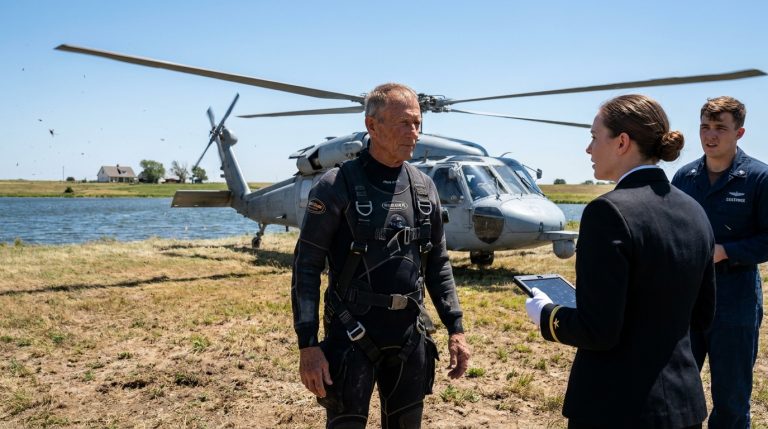
She reached the base of the ridge just as the helicopter flared to land. Brennan was the first one out, his face haggard, his eyes scanning the treeline. He saw her, and for a moment, he simply stood still, as if he couldn’t believe the shape in the mist was real.
He didn’t run. He walked toward her, his pace slow, his weapon lowered. He reached her and simply nodded, the gesture a silent acknowledgment of a threshold crossed. Callahan reached into her pocket, felt the drive, and then looked at the team gathering around the helicopter. They were safe. The mission was done.
She turned away from the helicopter for a second, looking back up at the mountain. The stronghold was dark, a silent tomb of concrete lost in the crags. She took a deep, steady breath of the thin, freezing air. She would disappear, just as she was meant to, but she would do it on her own terms. She walked toward the bird, her stride steady, the weight of her rifle now perfectly balanced, a tool of her own choosing in a world that no longer had a design for her. The war was far from over, but for the first time, she was the one holding the map.