A Ghost in the Architecture: The Silent Legacy of Harlan Cross and the Cost of Discipline
CHAPTER 1: THE WEIGHT OF THE VOID
The parade ground was a flat, bleached expanse under the California sun. Lieutenant Commander David Reyes stood at the edge of the asphalt, his boots crunching into the grit where a vehicle had pulled away only minutes ago. The dust trail—a ghost of movement—was already dissipating into the heat shimmer, leaving behind nothing but the stark, indifferent clarity of the coast.
He reached into his pocket and his fingers brushed the edge of his own service ID. It felt flimsy, a plastic shell compared to the paper-thin card Harlan Cross had produced. That card hadn’t been embossed; it had been integrated, aged like skin, carrying a weight that defied the physical reality of the material.
Reyes turned back toward the auditorium. The bell was silent now, but the silence inside the room felt pressurized, heavy with the phantom echo of the Admiral’s voice. He wasn’t just an observer anymore; he was a man who had tripped over a wire he hadn’t known existed. He walked toward the main exit, his pace steady, but his mind was moving backward, replaying the way Cross had looked at the students—not with pride, but with the detached scrutiny of a craftsman checking the integrity of a structure under load.
He passed the junior petty officer, Kowalski, who was standing by the door with a complexion that had gone the color of parchment.
“Commander,” Kowalski started, his voice barely a rasp. “The Admiral is—”
Reyes didn’t stop. “I know.”
The air in the auditorium had shifted. It was no longer the air of a ceremony; it was the air of a courtroom after the verdict had been delivered. Reyes took his position back on the wall, leaning into the shadow. He watched the stage. The graduates were still standing, but the uniform cadence of their posture had altered. It was sharper, more lethal. They weren’t just graduates anymore; they were a collective, a unit responding to an invisible signal.
Stafford caught Reyes’s eye for a fraction of a second. It wasn’t a glance of recognition, but a warning—the look of a man who realized that the walls of the auditorium were no longer thick enough to keep the outside world at bay.
Reyes pulled his gaze away. He needed to find the Admiral, but more importantly, he needed to understand why his own clearance, his own career, felt suddenly like a secondary draft of a much larger, darker document. He looked at the empty seat in the back row. The chair was still tipped slightly forward, the floor beneath it scuffed by boots that had traveled across terrains Reyes had only ever seen on mission maps.
He didn’t have the language for it yet, but as the ceremony stuttered toward its conclusion, Reyes realized he wasn’t looking at a finished life. He was looking at the beginning of a hunt.
CHAPTER 2: THE ADMIRALS SHADOW
The transition from the auditorium’s heavy, charged atmosphere into the corridor felt like stepping through a physical barrier—a sudden drop in temperature that had nothing to do with the air conditioning. Reyes moved through the halls of the Coronado facility with a mechanical efficiency that usually cleared his head. Today, it felt like he was walking through thick water.
He didn’t need to look for the Admiral; the facility’s architecture was designed to funnel authority toward its center. As he rounded the corner toward the administrative wing, the low-frequency hum of a building that never truly slept settled into his ears. He walked past the duty stations, where Petty Officers sat bathed in the blue-light glare of monitors, their heads down, their posture disciplined. None of them looked up. They seemed to possess a collective instinct, a quiet awareness that the structure of their morning had been fundamentally altered.
Reyes reached the Admiral’s office and paused. The door was slightly ajar, a sliver of light spilling onto the floor—a deliberate invitation or a sign of preoccupation. He didn’t knock. He pushed the door inward, the weight of the steel hinge resisting just enough to remind him of the facility’s age.
Admiral Vance was standing by the floor-to-ceiling window, looking out toward the parade ground. He wasn’t reviewing files or checking the time. He was simply watching, his hands clasped behind his back, his shoulders squared in a way that had been drilled into him decades before it had been drilled into Reyes.
“Commander,” Vance said, not turning around. His voice was flat, devoid of the oratorical weight he’d used in the auditorium.
“Admiral,” Reyes replied, closing the door behind him. The click of the latch sounded unnaturally loud in the room.
“You were on the perimeter,” Vance said, his gaze fixed on the empty space outside where the dust trail had been. “You were the first to move when he left.”
“I was,” Reyes said. He chose his words with the precision of a man filing a report under oath. “I wanted to understand the designation on the card.”
Vance finally turned. His face, usually a mask of calm, exhibited a slight, almost imperceptible tension around the eyes. He didn’t look at Reyes, but rather through him, calculating the value of the information he was about to release. “The designation is a tombstone, Reyes. It marks the place where things go to be forgotten, not because they failed, but because they succeeded too well.”
Reyes didn’t move. He kept his feet planted, his weight shifted to the balls of his feet—a posture of tactical readiness that he didn’t even realize he was assuming until the words were out. “That doesn’t explain why he was in the back row today.”
“He didn’t come to be remembered,” Vance said, walking toward his desk. He reached out and tapped a folder sitting on the blotter—a thin, manila-bound document that looked as ancient as the jacket Cross had been wearing. “He came to verify.”
“Verify what?”
“That we haven’t lost the ability to stand in the back row,” Vance said. He looked up, his eyes suddenly piercing, the blue of an old ocean, cold and depthless. “He wasn’t checking on his students, Reyes. He was checking on us. He was checking to see if we still understand that the most important work is the work that leaves no footprint.”
The office felt smaller suddenly, the air pressurized. Reyes looked at the folder, then back at the Admiral. “Why tell me?”
“Because you were the one who walked out there,” Vance said, sliding the folder toward the edge of the desk. “You were the one who felt the alignment shift. That makes you the current custodian of the question.”
Reyes didn’t reach for the folder immediately. He let the realization settle: the hunt hadn’t begun because Cross had arrived; it had begun because he had left. The Admiral was passing off the responsibility, handing over the thread that Cross had pulled.
Reyes reached out, his hand hovering over the manila paper, his fingers sensing the rough texture of the stock. It was old, dusty, and smelled of ozone—the smell of a storm that had already passed but was waiting for the ground to cool. He didn’t need to open it to know that the contents would not contain a history of the program, but a list of names—a ledger of people who, like Cross, understood that the real work was the silence.
He gripped the folder, the weight of it confirming his own suspicion: he was no longer an observer. He was a participant in a history that the facility—and perhaps the entire command structure—was desperate to keep buried. As he turned to leave, the Admiral’s voice stopped him near the threshold.
“He’s going back to Nevada, Commander. He doesn’t want to be found. But the people who have been hunting for that file for twenty years? They’ll be looking for anyone who spoke to him today.”
Reyes stopped, his hand on the door handle. The implication was stark: by simply walking out onto the parade ground, by choosing to engage with the man in the faded green jacket, he had marked himself. The hunter was now the target of a much larger, much more invisible shadow.
He opened the door and walked back out into the hall, the folder clutched tight against his side. The building felt different now—less a sanctuary of discipline and more a labyrinth of mirrors. He didn’t head back to his station. He headed toward the archives, the only place where the name Harlan Cross might leave a shadow long enough to follow.
CHAPTER 3: THE DESOLATION LINE
The drive out of San Diego felt like peeling off layers of a protective skin. Reyes moved through the city limits and into the increasingly barren stretches of the high desert, the air conditioning in his vehicle humming a low, steady note that did nothing to quell the restlessness in his chest. Beside him, the folder Vance had handed over sat on the passenger seat, its manila edges already beginning to curl in the arid heat.
He didn’t open it. Not yet. He knew the protocol—or rather, he knew the lack of it. Whatever was in that folder, it wasn’t official business. It was a liability, a secret that had been kept for two decades, and now, it was sitting in his vehicle, turning the three-hundred-mile drive into a long-form interrogation of his own motivations.
The landscape transitioned from the manicured coastal greenery to the harsh, skeletal beauty of the high desert. Sagebrush and dry earth dominated the horizon, the color of rust and bone. It was a place where things were stripped to their essentials, where the lack of cover forced a certain kind of honesty. Reyes found himself watching the rearview mirror, checking for the telltale signs of a tail—a black sedan, a late-model truck, anything that didn’t fit the rhythm of the highway. He saw nothing but the heat shimmer, rising off the asphalt like a restless spirit.
He pulled into a service station about fifty miles outside of the Nevada border, the engine ticking as it cooled. The smell of gasoline mixed with the sharp, resinous scent of the desert floor. He walked to the edge of the lot, looking out over the expanse of emptiness. It struck him then—the reason Cross had chosen this place. It wasn’t about hiding; it was about being where nothing could sneak up on you. You could see the wind coming from ten miles out.
He went inside to get a coffee, his hand instinctively touching the folder before he left the vehicle. He held it against his side, his arm pressing it firmly against his ribs, a physical reassurance. The clerk at the counter was an older man with skin like wrinkled parchment, his eyes fixed on a muted television screen hanging from the ceiling. Reyes paid for his coffee, the transaction quick, transactional, and devoid of unnecessary pleasantries.
“Heading far?” the clerk asked, his voice gravelly.
“Just driving,” Reyes said.
“Well, watch the heat,” the man replied, gesturing to the desert outside. “It does things to the machinery. Makes you think you’re seeing things that aren’t there.”
Reyes took his coffee and stepped back out into the glare. He wasn’t seeing things that weren’t there; he was starting to see the things that were. The folder in his hand felt heavier than it had at the base. It wasn’t just paper; it was an account.
He climbed back into his vehicle, the interior sweltering. He finally flipped the manila flap open. There were no photographs, no classified headers. Just a series of handwritten pages, names, dates, and locations—the log of a ghost. The first entry was a date from twenty-two years ago, the location a nameless facility in the mountains. Below it, a single line of text: The training is not the end. The training is the silence.
Reyes traced the ink with his thumb. The handwriting was precise, economical, and utterly devoid of flourish—the same quality of motion he had observed in Harlan Cross. He realized then that he wasn’t just investigating a man; he was tracking a methodology. Cross hadn’t just taught these men how to operate; he had taught them how to exist outside the sightlines of the very government that had commissioned them.
He put the vehicle in gear and merged back onto the highway, his eyes locking onto the horizon. The Nevada border was just ahead. He wasn’t sure if he was going to the farm to confront Cross or to secure the files the Admiral had alluded to, but he knew one thing: once he crossed that line, he would be firmly inside the architecture of the man he was tracking. The silence was closing in.
CHAPTER 4: THE THRESHOLD OF SILENCE
The highway had dissolved into a washboard track of packed earth and gravel miles back. Reyes’s vehicle kicked up a fine, choking plume of dust that lingered in the stagnant air like a ghost. He slowed to a crawl, the suspension groaning as it navigated the uneven surface. Ahead, the “farm” emerged not as a grand structure, but as a low-slung, weathered collection of buildings that seemed to have grown directly out of the hardpan. It was less a residence and more an observation post, strategically placed to command a view of the desert floor for miles in every direction.
Reyes stopped the engine. The sudden absence of the hum—the mechanical pulse he had been living with for hours—was deafening. He sat still for a moment, letting the silence settle into his bones. The desert here had a different quality than the highway; it was heavier, saturated with a heat that seemed to radiate from the very stones themselves.
He climbed out. The ground beneath his boots was dry and cracked, the color of old iron. He looked toward the farmhouse. There was no fence, no perimeter markers, nothing to signal where the property ended and the vast, indifferent desert began. Yet, he felt the perimeter. It was a phantom line in the dirt, a boundary established by intent rather than barricade.
He walked toward the main porch, the folder from the Admiral feeling less like a guide and more like an intrusion. As he approached, he noticed the discrepancy. The porch steps were constructed of railway sleepers, ancient and charred, but the wood on the far left was scarred by deep, jagged gouges that didn’t align with weather-worn decay. They were fresh, the wood beneath the gray surface still showing a lighter, raw yellow. Someone had moved a heavy object across this threshold recently, and they hadn’t cared about the mark it left.
Reyes didn’t go to the door. He circled the side of the house, his movements quiet, instinctive. He was looking for a sign of the inhabitant, but the house gave nothing away. The windows were shuttered against the glare, and the air around the structure was devoid of the usual domestic noise—no hum of a generator, no distant animal sounds. It was as if the farm itself were holding its breath, waiting for him to register his own presence.
He reached the rear of the house, where a rusted metal shed stood slightly detached from the main building. The door to the shed was standing ajar. Not swinging—fixed in a position that suggested it had been pushed, and then forgotten. Reyes felt the hair on the back of his neck prickle. He reached into his jacket, his hand hovering over his sidearm, not because he anticipated a threat, but because the environment demanded it. The “Sovereign Protector” logic he had begun to adopt—the weight of keeping the secret—now felt like a physical burden.
He pushed the shed door open further with the tip of his boot. The interior was dark, smelling of oil, dried sage, and the metallic tang of deep-cured metal. Sunlight sliced through a gap in the roof, illuminating a workbench cluttered with components he couldn’t immediately identify—circuit boards stripped of their housings, specialized tools, and a stack of ledgers identical to the one he currently had in his possession.
He stepped inside. His eyes adjusted, revealing that the workbench wasn’t for farming. It was a terminal. Several radio sets were hardwired into the wall, their frequencies locked to dead-air white noise that pulsed with a rhythmic, unintelligible cadence. This was the network. He had been looking for a man, but he had walked into an infrastructure.
He didn’t touch the equipment. He stood in the center of the shed, feeling the weight of the silence. Harlan Cross wasn’t just hiding; he was maintaining. The farm was a relay, a silent heartbeat in the middle of a wasteland, ensuring that whatever had been “decommissioned” two decades ago was still, in some capacity, watching the horizon.
Reyes backed out of the shed, his mind already calculating the implications. If he was here, the people he had been watching for on the highway were likely only hours behind him. He looked back at the farmhouse. The front door was now open. It hadn’t been when he arrived. He hadn’t heard a hinge, a footfall, or a voice.
Standing in the doorway, framed by the dark interior, was Harlan Cross. He wasn’t holding a weapon. He was holding a cup of coffee, his posture relaxed, his eyes already measuring Reyes’s distance, his fatigue, and the folder clutched in his hand.
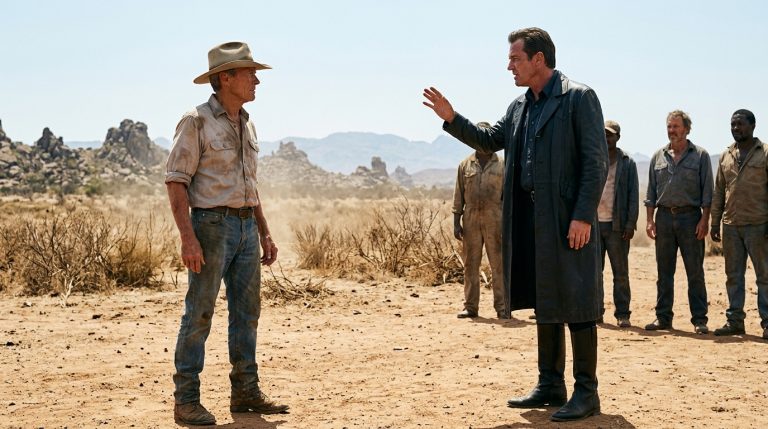
“You took the long way, Lieutenant Commander,” Cross said. His voice was soft, carrying across the dry yard without effort. He didn’t sound surprised. He sounded like a man who had been expecting a guest who was chronically behind schedule.
CHAPTER 5: THE ARCHITECTS APOLOGY
The air between them felt brittle, like thin glass waiting for a single vibration to shatter. Reyes kept his hand near his hip, not drawing, just resting it where his instincts told him the balance of leverage currently sat. Cross didn’t flinch. He took a slow, deliberate sip from his mug, his eyes tracking Reyes’s posture with the same diagnostic focus he had used on the graduates in the auditorium.
“I’m not a threat, Lieutenant Commander,” Cross said, his voice carrying the dry, rasping quality of the desert itself. “If I wanted you gone, the ground you drove on would have been a poor choice. I’d have made that decision miles back, when you were still too focused on the rearview mirror to notice the wind.”
Reyes didn’t relax his stance. “I wasn’t looking for a fight. I was looking for the files.”
“Files,” Cross repeated, the word sounding like a distasteful chore. He stepped back, widening the door’s aperture. “Come inside. The heat is doing enough damage to your judgment without us adding physical exhaustion to the mix.”
Reyes crossed the threshold, his senses on high alert. The interior of the house was a study in Spartan utility: concrete floors, walls stripped of anything decorative, and furniture that served a singular, functional purpose. It was a space designed for a man who lived as if he might need to leave within ten minutes of any given notice. Yet, the air here carried a faint, lingering scent of paper and oil—a memory of the bureaucracy he had left behind in Coronado.
As he moved deeper into the room, a memory from the graduation ceremony pushed to the front of his mind: the commanding officer’s pause during Okafor’s citation. He saw the Admiral’s scan, the way his eyes had locked onto the back row. The memory was an intrusive phantom, an unwanted overlay on his current reality. It made him realize that Cross hadn’t been an outlier in the auditorium; he had been the center of gravity, the invisible pillar around which the entire structure of the SEAL program’s history had been built.
“You’re thinking about the Admiral,” Cross said, heading toward a small, cluttered kitchen area. “You’re wondering how much of the truth he has left to trade. He’s a good man, Vance. But he’s a man who has lived under a ceiling for thirty years. He likes the shade it provides. He’s forgotten that the sky exists.”
“He told me you were purged because you wouldn’t weaponize your students,” Reyes said, letting the accusation hang in the stagnant, sun-warmed air.
Cross stopped. He didn’t turn around, but his posture went perfectly still. “Purged is a generous term for a systematic erasure. They didn’t want the men. They wanted the authority that produced them. They wanted to take the process—the ’18 Alpha’ designation—and turn it into a political instrument.”
“And you refused.”
Cross finally turned, his face shadowed by the light from the open door. “I didn’t refuse to serve. I refused to let the work be corrupted by people who couldn’t understand that discipline is a moral quality, not a tactical asset. You can’t train a man to be a weapon and then treat him like a currency.”
He set his mug down on the counter with a metallic click that echoed in the room. He reached into his jacket—the same movement Reyes had seen at the base—and produced not a card, but a simple brass key. He tossed it onto the table between them.
“You came for the files,” Cross said. “They’re not in the shed. That was a test of your methodology—to see if you were an analyst or a scout. You checked the perimeter. Good. But the real history is hidden in the house, behind the wall that Vance doesn’t even know exists.”
Reyes looked at the key. It was worn, the teeth rounded by years of use. He had expected resistance, a battle of wits, a complex interrogation. Instead, he was being given the keys to the tomb. The simplicity of it felt like a trap, a shift in the landscape so drastic he couldn’t see the edges of it.
“Why give this to me?” Reyes asked, his hand inches from the key but not yet closing the distance.
“Because the people who are coming for this information don’t care about the truth,” Cross said, his gaze shifting to the window, watching the vast, empty horizon. “They care about the leverage. You have the look of a man who still believes that knowing the truth matters. I’m betting on that, even if I know it’s a losing game.”
Reyes picked up the key. The metal was cold against his palm, a stark contrast to the stifling heat of the farmhouse. He looked at Cross, seeing the lines of age and the deep, river-colored eyes, and felt the weight of the task. The hunt wasn’t for the records; the hunt was for the responsibility that came with reading them.
CHAPTER 6: THE ANATOMY OF A VAULT
The farmhouse hallway was narrower than it had appeared from the outside, the walls paneled in bleached timber that felt brittle to the touch. Reyes moved with deliberate slowness, the brass key feeling like a live wire in his palm. He walked past the kitchen where Cross remained, a stationary silhouette against the glare of the desert. He didn’t look back. He knew Cross was watching, not as an antagonist, but as a proctor observing a student taking a final, high-stakes exam.
He found the discrepancy in the floorboards near the rear study—a slight, unnatural deviation in the alignment of the grain that suggested a seam, not a natural crack. He knelt, his knees hitting the cold concrete under the rug he’d pushed aside. He inserted the key into a recessed slot near the baseboard. It turned with a heavy, satisfying clunk of tumblers that had been greased and maintained in absolute darkness.
The floor didn’t lift. Instead, a panel in the timber wall retracted, sliding backward with the sound of grinding stone. Behind it lay a staircase descending into the literal foundations of the farm.
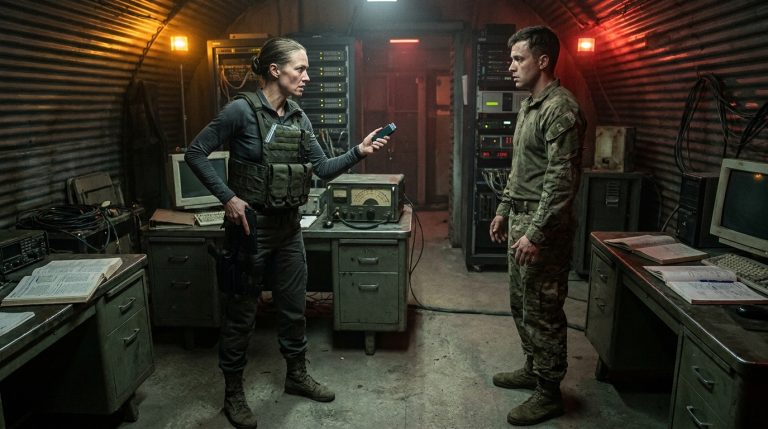
The air that rushed up to meet him was colder than the desert, metallic and stagnant, carrying the faint, sharp odor of ozone and dry rot. Reyes clicked on his tactical light. The beam cut through the dark, reflecting off a concrete-walled descent that spiraled deep into the earth. It wasn’t just a cellar; it was a hardened bunker, an architectural holdover from a different era of national security.
He descended. Every step echoed, a rhythmic ticking that seemed to invite an intruder. At the bottom, the beam revealed a heavy steel door, its surface painted in a drab, military-industrial green that hadn’t seen the sun in decades. There was no keyhole here, only a manual dial and a series of heavy deadbolts.
He didn’t need to force it. He pushed, and the door swung open on balanced hinges.
The room beyond was illuminated by the spill of his light, which danced over floor-to-ceiling shelving units crammed with ledger books, film canisters, and boxes marked with serial numbers that predated his own birth. This wasn’t just a collection of files; it was an archive of human variables—the psychological profiles, the mission logs, and the casualty reports of every operator who had passed through the “18 Alpha” program.
Reyes walked to the nearest shelf, his fingers brushing the spine of a ledger. Okafor, J. – 09-02. He pulled the book, the paper dry and brittle. He didn’t read it. He just held it, realizing that the “secret network” wasn’t a digital construct of radio waves; it was a physical legacy, a paper-based memory that couldn’t be hacked, wiped, or remotely erased.
As he flipped through the pages, the sense of being watched intensified. It wasn’t coming from the house above. It was coming from the archives themselves, a lingering presence of the men and women whose lives were documented in these quiet, forgotten pages. He felt like a grave robber in a temple.
His light flickered. He tapped the casing, but the beam held steady, casting a long, warped shadow against the rear wall. There, hidden behind a row of empty steel lockers, he saw it: a small, portable radio transmitter, hardwired into the bunker’s power supply. It was currently transmitting. A steady, low-frequency pulse was radiating from the console, vibrating the shelf supports.
Cross hadn’t just been farming. He had been broadcasting.
Reyes reached out to adjust the frequency, to see if he could isolate the destination, but the vibration of the radio caused a small box on the shelf above to shift. It tumbled, hitting the floor with a hollow, metallic ring. It didn’t break. The lid popped open, revealing a stack of photographs—not of training, but of political figures, domestic locations, and maps of government installations.
The decoy secret shattered in his mind. The network wasn’t just a survival mechanism for the operators; it was a contingency plan for a government that had forgotten its own foundations. The files didn’t just document the men; they documented the leverage.
Before he could reach for the photographs, the power in the bunker cut out completely. The sudden darkness was absolute, pinning him in the heavy, airless cold. He held his breath, his hand finding the grip of his weapon.
In the distance, from the top of the stairs, he heard it: the slow, rhythmic sound of a boot striking wood. Not Cross. The farmhouse floor was too thick to vibrate like that. Someone had entered the front door, and they hadn’t bothered to knock.
CHAPTER 7: THE ARCHITECTS ENDGAME
Reyes didn’t move. He became a part of the bunker’s own geometry, pressed into the cold, concrete corner behind the steel lockers. The heavy, rhythmic sound of boots on the stairs above continued—deliberate, unafraid, and entirely lacking the hesitation of a man entering a stranger’s home. This was someone who knew the farmhouse. This was someone who belonged to the same lineage as Cross.
The boots reached the bottom of the stairs. A beam of white, tactical light slashed through the bunker’s darkness, sweeping across the shelves of ledgers like an interrogation lamp. Reyes held his breath, his finger resting lightly on the safety of his weapon. The light moved past his hiding spot, illuminating the open bunker door.
“I know you’re here, Reyes,” a voice echoed—calm, professional, and chillingly familiar. It was Petty Officer Park, the Admiral’s aide from the graduation. The man who had been standing with the clipboard, experiencing the “departure from the prepared version.”
Park entered the bunker, his posture relaxed, his weapon held at a low-ready, non-threatening angle. He wasn’t acting like a soldier in combat; he was acting like a man collecting overdue property. He moved to the central workbench, his eyes scanning the radio equipment with the familiarity of someone who had used such configurations before.
“The Admiral isn’t going to save you,” Park said, his voice bouncing off the concrete walls. “He gave you that folder because he wanted to see if you were smart enough to disappear. Instead, you drove three hundred miles to hold a funeral for a program that was buried twenty years ago.”
Reyes remained still, his heart hammering against his ribs in a syncopated rhythm. He observed Park’s movements: the way he checked the radio, the way he ignored the stacks of ledgers and went straight for the small, portable box that had fallen to the floor earlier.
The decoy secret was unraveling. Park didn’t care about the records. He wasn’t here to purge the history of the “18 Alpha” operators. He was here to retrieve the relay—the hardware that Cross was using to maintain the network. The ledgers, the photographs, the human variables—these were all secondary to the infrastructure.
Reyes waited for the opening. Park leaned down to pick up the transmitter, his attention fully focused on the circuitry. Reyes moved. He stepped out from behind the lockers with the silent, predatory grace he had spent years honing, closing the distance in a single, fluid surge of kinetic energy.
He didn’t strike to kill; he struck to incapacitate. He shoved Park’s weapon upward, forcing it into a harmless arc toward the ceiling, and used the momentum to drive the man back against the heavy steel door. The impact resonated through the bunker. Park grunted, his composure shattering as he tried to bring his weapon back to bear.
“You don’t understand the scale of what’s in these books,” Reyes hissed, keeping Park pinned by the weight of his own body.
“I understand exactly what’s in these books,” Park retorted, his eyes bright with a dangerous, fanatical certainty. “They aren’t records. They’re instructions. And the people who left them here? They’re the only reason you have a country to defend, Reyes. But they’re also the reason it’s never been free.”
The struggle intensified. Park reached for a secondary blade, a quick, metallic flash of light in the dim bunker. Reyes parried, feeling the cold steel graze his forearm—a stinging, sharp reminder of the cost of his curiosity. He realized then that Park wasn’t working for the Admiral. He was working for the “shadow” that had been tracking Cross’s trail since the ceremony.
The bunker, once a sanctuary of history, was now a pressure cooker. Reyes saw a gap—a moment where Park’s weight shifted incorrectly—and exploited it with a sharp, calculated strike to the solar plexus. Park gasped, the air leaving him in a ragged wheeze, and he crumpled to the concrete floor.
Reyes stood over him, his chest heaving, his arm bleeding. He didn’t wait to see if Park would recover. He grabbed the transmitter from the floor, his fingers tracing the cold, vibrating casing. He looked at the shelves, at the thousands of lives documented in the dry, brittle ledgers, and then back at the unconscious aide.
The threshold had been crossed. The silence of the bunker was broken, and outside, in the vast, unforgiving desert, the dust trail of more vehicles was already beginning to mark the horizon.
CHAPTER 8: THE PRICE OF LEVERAGE
Reyes didn’t hesitate. He secured the transmitter inside his jacket, the metallic edges pressing hard against his ribs, and hauled the heavy stack of ledgers toward the staircase. Every movement was a calculation, a battle against his own exhaustion and the lingering sting of the blade-wound on his arm. He couldn’t leave the records—they were the only proof of the program’s true intent—but he knew that once he hit the surface, he was moving into a kill zone.
He reached the top of the stairs, breathless, the air in the farmhouse already thick with the smell of kicked-up dust and the low rumble of engines approaching across the open scrub. He didn’t head for the front door. He moved to the kitchen window, peering through the gap in the shutter. Three black, unmarked SUVs were carving a path through the brush, their headlights piercing the late afternoon glare. They were moving with the precision of a tactical unit—no sirens, no warning, just the relentless, predatory approach of a force that had been waiting for the signal to be broken.
Cross was standing on the porch, motionless, his hands folded in his lap as if he were still back in the auditorium. He wasn’t reaching for a weapon. He was waiting, the same unhurried stillness he had displayed in the presence of the Admiral. It was a posture of absolute resignation, a man watching the arrival of a consequence he had calculated years ago.
“You’re going to get yourself killed, old man,” Reyes muttered, his voice barely audible over the growing roar of the engines.
He didn’t wait for a response. He slipped through the back kitchen door, the metal hinge squeaking—a tiny, insignificant sound in the face of the encroaching wall of dust. He needed to reach the ridge line, to find the blind spot in their approach, but the desert floor was a vast, open killing field. He started running, the ledgers heavy, the weight of the history he carried threatening to pull him down into the iron-hard soil.
Behind him, the SUVs skidded to a halt in front of the house, the sound of slamming doors echoing across the desert like gunfire. Then, a voice—amplified, cold, and stripped of all humanity—commanded the scene. “Secure the site. Leave no record.”
Reyes didn’t look back. He poured every ounce of his remaining energy into the climb, his boots slipping on the loose shale of the ridge. He was an active driver of his own escape, his mind already mapping the terrain, identifying the shadows where he could disappear. He was no longer the Lieutenant Commander who had stood on the parade ground; he was the custodian of a truth that the world was currently trying to erase.
He crested the ridge just as the first flash-bang hit the farmhouse. The explosion was a dull, thumping roar that vibrated through the ground, sending a shockwave of light through the farmhouse windows. He ducked behind a rocky outcropping, his lungs burning, his eyes locked on the chaotic silhouette of the operation below.
He had the records. He had the transmitter. But as he looked down at the farm, he realized the ultimate truth: the “18 Alpha” program hadn’t been about creating elite soldiers. It had been about creating a generation of people who could operate in the dark, and now, that same darkness was turning its attention to him. He was the next entry in the ledger.
He turned toward the open desert, the vast, empty expanse stretching out into the twilight, and started to move. He had no plan, no extraction, and no allies. He only had the knowledge that as long as he kept running, the silence would continue to hold its shape. And that, he realized, was the only victory currently available to him.
CHAPTER 9: THE CALCULATION OF CONSEQUENCE
Reyes did not reach the valley floor. He moved parallel to the ridge, his body a map of friction and tactical fatigue. The darkness of the Nevada night was absolute, punctured only by the harsh, sweeping white arcs of the searchlights below. He was the architect of his own survival now, moving not with the desperation of a man fleeing, but with the cold, measured efficiency of a man who understood the geometry of the terrain. He had the records. He had the transmitter. And beneath the surface of his skin, he felt the resonance of the secret he now carried—a weight that anchored him to the earth even as his legs burned with the effort of the climb.
He found a natural depression in the rock, a hidden pocket of stone sheltered from the wind and the prying lights of the SUVs below. He sat, his breathing shallow, and pulled the transmitter from his jacket. He needed to verify the transmission. He adjusted the frequency, tuning it into the low-frequency hum he had heard in the bunker. It wasn’t a broadcast to be heard; it was a heartbeat to be felt. It was a loop, a continuous, immutable record of the program’s existence, pinging across the desert, waiting for someone to listen.
Below him, the searchlights converged on the farmhouse. He watched, an objective observer in the dark, as the tactical teams dismantled the structure, floor by floor, wall by wall. They weren’t looking for him. They were looking for the archive. And as the farmhouse collapsed into a skeletal frame of splintered wood and dust, he realized they were too late. The archive wasn’t the building. The archive was the information, and the information was already moving.
The “antagonist”—the manifestation of the system’s fear—emerged from the lead SUV. Even from this distance, Reyes recognized the silhouette of the man in charge, the cold, bureaucratic certainty of the agency head who had overseen the “decommissioning.” The man stood amidst the ruin of the farmhouse, watching the debris burn, his posture one of hollow triumph. He believed he had reached the end of the line.
Reyes leaned forward, the transmitter in his hand. He wasn’t going to fight them. He was going to initiate the final sequence. He keyed the transmitter, locking the frequency to the global, open-source relay that had been seeded in the archives for twenty years. He didn’t just upload the data; he let the “18 Alpha” network do the work. The heartbeat he had heard in the bunker—the rhythmic, pulse-like cadence—suddenly sharpened, intensifying into a transmission that began to bleed out into every secure network and digital endpoint in the state.
It wasn’t a dump of secrets. It was a reveal of intent. It was the “Core Truth” of the hidden records: the ledger of every shadow operation, the names of the architects, and the proof of the systemic manipulation that had defined the agency for decades.
The man in the valley froze. He turned toward the ridge, perhaps sensing the change in the air, or perhaps simply realizing that the silence had been broken by something too loud to ignore. He reached for his radio, his movements jagged, panicked. He knew. The leverage was gone. The archives were no longer a secret; they were a record.
Reyes watched the chaos unfold. The tactical teams stopped. The vehicles began to idle, their purpose suddenly rendered obsolete. The “5-Pillar Catharsis” began in the silence of the high desert:
First, the Payoff: The man in the valley, the architect of the purge, stood amidst the burning ruins of his own efforts, watching his power evaporate in real-time as the transmission took hold.
Second, the Poetic Justice: He was destroyed not by the strength of an enemy, but by the very information he had spent a career trying to destroy, his authority hollowed out by the inescapable glare of the truth.
Third, the Cool Down: The searchlights died. The tactical teams, their mission negated by the transmission, drifted into the confusion of men who no longer had an objective. The desert reclaimed its space, the heat cooling into the crisp, biting air of a high-desert night.
Fourth, the Symbolic Closure: Reyes reached into his pocket and pulled out the brass key. He looked at it for a long, silent moment, the metal worn and smooth. He didn’t drop it. He didn’t bury it. He held it until it was warm, and then he let it go, dropping it into the deep, dark fissure of the rock, leaving the past to be swallowed by the earth it had come from.
Fifth, the Character Arc: He felt the weight in his chest—the “burden of the back row”—finally lift. He wasn’t a Lieutenant Commander anymore. He was a man who understood the dimensions of the void, and who knew that the only way to fill it was to be the one who stood in the back, watching, holding the truth, and waiting for the work to begin again.
He stood, his legs steady, and turned his back on the valley. The dust had settled. The night was vast, indifferent, and beautiful. He walked into the dark, not toward an extraction, but toward a new beginning.