A Legacy of Silent Steel: How One Old Marine’s Promise Reshaped the Lives of the Forgotten
CHAPTER 1: The Weight of the Case
The 1994 Ford F-250 groaned as it rolled into the gravel lot, the sound of dried mud flaking off the wheel wells like old skin. Walt Hennessey climbed out, his left knee—that familiar, aching anchor of 1968—twinging with the high desert heat. He didn’t look at the other trucks. He didn’t look at the men unloading their sleek, modular rifles with the practiced, peacock-like precision of men who played soldier on weekends.
He only looked at the brown leather case on the passenger seat.
The seams were split, a jagged map of four decades of travel, of being hauled into the back of trucks and laid out on damp jungle floors and humid firing benches. He touched the leather. It was warm, softened by the same oils that had kept his M1 Carbine functioning through typhoons and dust storms that had long ago claimed lesser machines.
“Easy now,” he murmured, the habit of a lifetime.
He wasn’t here for the camaraderie. He wasn’t here for the tactical drills or the gear-talk. He was here because today was another marker on the long, winding road toward an anniversary he kept mostly to himself. He pulled the thermos from the passenger side—Marguerite’s thermos, a relic of a gas station in Reno from a year when the world felt both simpler and heavier.
He carried the case to bench 17. The shade was sparse here, flickering with the movement of a hawk circling overhead, but it was enough to keep the steel of the rifle from scorching his skin. He set it down, the leather making a soft, weary sound against the weathered wood of the bench.
A group of younger men, clustered four benches down, were making enough noise for a platoon. They moved in a flurry of flat dark earth finishes, optics that cost more than Walt’s truck, and plate carriers that stood rigid against the sage-brush wind. One of them, a man with a beard that seemed to be trying too hard, caught sight of the brown leather case.
He laughed. It was a sharp, biting sound, designed to travel.
“Hey, pops!” the man called out, his voice tinged with that specific, patronizing cadence of the uninformed. “You sure you didn’t take a wrong turn at the antique shop? We’re shooting lead here, not history.”
Walt didn’t turn. He placed his hands flat on the bench, fingers feeling the grain of the wood, the quiet stability of the earth beneath his feet. He could hear them—the camera being raised, the snickering that followed, the way they stood taller because they had an audience. He felt the notch in the front sight of the rifle inside that case, a small, jagged souvenir from Iwo Jima that his father had carried, that his brother had carried, that he had carried into the gray, misty silence of a place that didn’t officially exist.
They saw an old man with a limp and a piece of scrap wood. They didn’t see the promise.
“You need help with that thing?” the bearded man added, his friends crowding in, hungry for the content they’d upload later. “I think there’s a range in town that deals in flintlocks, if you’re struggling with the loading.”
Walt finally turned, his gaze slow, steady, and utterly devoid of the reaction they wanted. His eyes were clear, holding a vast, distant depth that made the bearded man pause, just for a fraction of a second, before the man smirked again, doubling down on the mockery. Walt didn’t care about the optics or the gear or the social media engagement. He cared about the trigger break, the drift of the wind, and the man he was going to see in his thoughts once the first round rang true.
“I’m fine,” Walt said, his voice a low rasp.
The silence that followed wasn’t quiet. It was expectant. And Walt began to open the case, his fingers moving with the slow, precise grace of a man who had never needed to hurry.
CHAPTER 2: The Echo of Iron
The laughter died in the throat of the man with the beard, choked off by the sheer absence of reaction from the man at bench 17. Walt didn’t look up; he didn’t offer a comeback or a witticism. He simply let the man’s words hang in the air, a loud, synthetic intrusion that sounded increasingly foolish against the backdrop of the high desert.
Walt turned his attention back to the brown leather case. The action of his M1 Carbine was a clean, mechanical promise of reliability. He slid the bolt back, the metal clicking with a familiar, precise snap that seemed to slice through the surrounding noise. He didn’t care about the bearded man—Cantrell, he heard one of the others call him—or the phone that Tyler was hovering just out of reach.
Cantrell shifted, his weight moving from his heels to his toes in a display of performative aggression. He wanted to be the alpha of this dusty stretch of land, but he lacked the internal gravity to hold the room. He sensed it, too—a flicker of doubt crossing his face when he realized he hadn’t landed a blow. The frustration made him lean in, his plate carrier clattering as he moved closer.
“I’m just saying, Gramps,” Cantrell muttered, his voice losing some of its stage-managed projection. “We’re running drills here. High-speed, high-stakes. You’re holding up the line with that… relic.”
Walt didn’t look up, but he stopped his movements for a fraction of a second. He was thinking of the notch in the front sight, the tiny, scarred piece of history that had seen the ash of Iwo Jima and the freezing, bitter mud of a place that didn’t appear on most maps. He looked at the bearded man’s gear—the multi-colored foregrips, the expensive optics that looked like they had never seen a scratch, let alone a combat zone. It was a costume. A vibrant, expensive, hollow costume.
“The line is wide enough for all of us,” Walt said, his voice the sound of dry leaves on stone. He continued to set the carbine on the rolled towel he’d brought from home.
The movement was slow, deliberate. He adjusted his position, his left knee protesting with a sharp stab of heat that he acknowledged only as a reminder of the terrain he’d walked in 1968. He had learned, a long time ago, that reacting to pain or noise was a form of surrender. You didn’t give the world the satisfaction of seeing you flinch.
“Hey, Goose,” Cantrell called out to one of his friends, still trying to regain the initiative. “Maybe we should show the old timer how the modern gear works, huh? Maybe he’s just never seen a real optic.”
The young man called Goose hovered, looking toward the father at bench 11. The father had gone quiet, his twelve-year-old son watching Walt with an intensity that made the boy look almost grown. The shift in the atmosphere was subtle—a softening of the edges, a withdrawal of the support the group had been banking on. The arrogance of the tactical bros was no longer a show; it was a nuisance.
Walt ignored the challenge entirely. He reached into his denim shirt pocket and pulled out the 15-round magazine. It felt cold against his palm, a solid, reassuring weight. He clicked it into the receiver, the sound a low, resonant metallic note that seemed to carry further than it should have.
He looked down the iron sights. The orange steel plate at 200 yards was a bright, defiant target against the muted browns and grays of the desert. He didn’t see a target, though. He saw the distance he had covered while dragging a dying man through the jungle, the way he had braced this same rifle against his shoulder while his breath hitched in his throat, and the absolute necessity of every single shot he had ever fired in the service of that promise.
“You’re making a mistake, son,” Walt said, not to Cantrell, but to the air in front of him.
He didn’t look back at the bearded man, but he could feel the man’s presence—a static charge of ego and insecurity. Walt’s focus narrowed. He blocked out the sound of the wind, the rustle of the sage, and the nervous shifting of the men behind him. He inhaled, the air thin and tasting of dust and sage, and settled his breathing into the rhythm that had served him for over half a century.
He wasn’t fighting for the beer. He wasn’t fighting for a win. He was simply existing in the space between the present and the past, a bridge built of steel and memory.
The first shot was an exhale. The report of the .30 carbine was sharp, a whip-crack that seemed to announce itself with a different frequency than the heavy, guttural barks of the AR-15s. Walt barely felt the recoil; it was a part of him, a gentle nudge against his cheek that told him everything was exactly where it needed to be.
Downrange, the orange plate swung. A clean, bell-like ring drifted back through the heat—a sound of absolute, unmistakable connection.
The bearded man behind him blinked. The camera phone in Tyler’s hand wobbled. Walt didn’t wait for the sound to die down before he worked the bolt, his movements fluid, economic, and devoid of the wasted energy the others displayed.
He looked back toward the horizon. The promise was still there, echoing in the desert.
CHAPTER 3: The Cold Coffee
The ring of the orange steel target hung in the heat long after Walt had lowered the carbine. It wasn’t a loud sound, but it carried a finality that made the air feel thin. Walt didn’t move. He stood on the firing line, his posture as rigid and unyielding as the iron sights he’d just aligned. He was listening to the wind, a low whistle through the dry sagebrush, and the distant, frantic scuffling of the group at bench 13.
Cantrell looked like he’d been struck. His face, usually set in a mask of practiced, rugged confidence, had gone slack. He looked from the vibrating target back to Walt, then down at his own $3,400 rifle, which suddenly seemed like an overly complicated, unnecessary weight in his hands. The silence was absolute. It was the kind of silence that happens when a bubble of manufactured importance is pricked by reality.
Walt began the familiar, methodical process of clearing his weapon. He hit the magazine release, his thumb catching the metal rectangle with the ease of a man who had done it forty thousand times. He caught the mag in his left palm, checked the chamber, and let the bolt slide forward with a dull, heavy clack.
“You’re done, then?”
The voice came from behind him. It was Marcus, the quiet one, the only one of the group who had actually worn a uniform. He had stepped away from the cluster of benches, his hands hanging loosely at his sides. He wasn’t sneering. He was looking at Walt’s carbine with a mixture of confusion and dawning recognition.
Walt didn’t turn around immediately. He placed the rifle back into the towel-lined case. He could feel the eyes of every person on the line. The father at bench 11 was watching with an expression of profound, quiet awe; his son, the boy of twelve, hadn’t moved an inch, his attention riveted on the old man’s hands.
“I’m done for the morning,” Walt said.
He didn’t offer any explanation. He didn’t gloat, didn’t claim skill, didn’t bother to address the bet. To Walt, the bet hadn’t existed; there had only been the target and the promise. He sat back down on the folding chair he’d retrieved, his knee sending a jolt of protest up his thigh, and reached for the thermos. The metal lid unscrewed with a rasp of dry grit. He poured a small amount of coffee—black, cold, and tasting of the memories he kept tucked away—into the cap.
Cantrell started to pace, the bravado returning in jagged, nervous fits. “I mean, it’s a hell of a shot, don’t get me wrong,” he said, too loudly, trying to reclaim the attention of his peers. “But that’s an old zero, right? You probably practiced on that same range for years. It’s muscle memory, not real-time adaptability.”
Walt took a sip of the coffee. It was bitter, just the way Marguerite liked it. He watched a hawk shadow dance across the dirt patch between his feet and the firing line. He wasn’t listening to the justifications; he was listening to the sounds of the range—the distant pop of a .22, the erratic chatter of a group of teenagers down at the pistol pits, the rhythmic sigh of the desert wind.
“Everything is adaptability,” Walt said, his voice barely rising above the wind.
Marcus took another step forward, closing the distance between them. “What unit were you with?” he asked, his tone stripped of the posturing the others used. It was the shorthand of the initiated.
Walt looked at him. He saw the way Marcus carried himself, the slight hitch in the rhythm of his walk, the way his gaze didn’t flit around but held steady. It was the look of a man who had seen the world through a lens of fire and had come back trying to find the same focus in the mundane.
“Doesn’t matter,” Walt replied.
“It does to me,” Marcus said. He gestured toward the leather case. “That rifle. That’s a specific piece of history. I’ve read about those, but I’ve never seen one held like that.”
Walt closed the thermos and set it back on the bench. He saw Cantrell hovering, waiting for an opening to insert his ego back into the conversation, but Walt wasn’t interested in providing one. He was thinking about the letter in his dresser, the one folded beneath a flag. He was thinking about the captain who had died in the mud of a place that didn’t exist, and the way the world was moving on without knowing the price that had been paid for its silence.
“It’s not about the rifle, son,” Walt said to Marcus. “It’s about what you’re willing to carry when nobody else is looking.”
He stood up, his knee locked in place for a moment before he moved. He didn’t acknowledge the cameras. He didn’t acknowledge the phones. He picked up his gear, the leather case feeling like the heavy, necessary anchor of his existence, and began the slow, measured walk toward his mud-colored truck. He felt the weight of the day pressing in on him—the physical ache of the morning, the encroaching memories of the valley, and the quiet, persistent certainty that the time to settle the debt was running out.
He reached the F-250 and slid the case onto the bench seat. He didn’t look back at the range. He didn’t care that he was leaving a vacuum behind him, one that the men at bench 13 were already starting to fill with nervous, defensive speculation. He was already thinking about the next day. Four days left. Four more mornings of heat and dust and the steady, ringing sound of steel.
The promise was the only thing that made the world make sense. As he turned the ignition key, the engine sputtered, then caught, a mechanical heartbeat that sounded like home. He didn’t need their recognition. He didn’t need their applause. He had the weight of the rifle, the ache in his knee, and the memory of a voice that had told him he mattered, back when he was young enough to believe it. He shifted into gear and pulled away, the tires kicking up a fine, pale cloud of dust that hung in the air long after he was gone.
CHAPTER 4: The Ripple Effect
The drive back to the house was a blur of high desert scrub and the shimmering heat of a Saturday afternoon that felt heavier than the day before. Walt kept his eyes on the road, his hands light on the wheel, though his mind was miles away, anchored in the recurring rhythm of the carbine’s action. When he finally pulled into his driveway, the house sat quiet, the wooden siding weathered to a soft, silver-gray that matched the patina of his rifle.
He expected silence. He expected the usual routine of disassembling the M1, cleaning the barrel until the steel shone, and settling into the armchair to watch the shadows lengthen across the carpet. But as he stepped onto the porch, he felt a strange, jarring vibration in the air.
He didn’t have a computer. He didn’t have a television that connected to anything other than the local weather. But he had a phone. And that phone, a flip-top relic that sat on the kitchen counter, was buzzing.
It was a persistent, insectile sound. Walt approached the counter slowly, his knee joint snapping with a familiar, sharp pop. He hadn’t expected a call from his daughter until the following Tuesday. He picked up the device. The screen, cracked in the corner, displayed a string of missed call notifications—all from the same unknown number.
The house, once a sanctuary of controlled, quiet habits, felt suddenly pressurized. The air inside smelled of dust and old books, but there was a new, artificial tension, a static charge that seemed to emanate from the phone itself. He set the device down. He wasn’t a man who feared the world, but he knew the weight of a disruption.
He moved to the dining table and sat. He placed the leather rifle case in front of him. Before he could even open it, a knock sounded at the front door. It wasn’t the tentative, hesitant knock of a neighbor. It was firm, rhythmic, and carried the practiced authority of a man who belonged to an organization that dealt in schedules and precision.
Walt didn’t stand immediately. He looked at the door, then at the case. He knew who it was. The general—Halverson—had mentioned he might stop by, though Walt hadn’t expected it so soon.
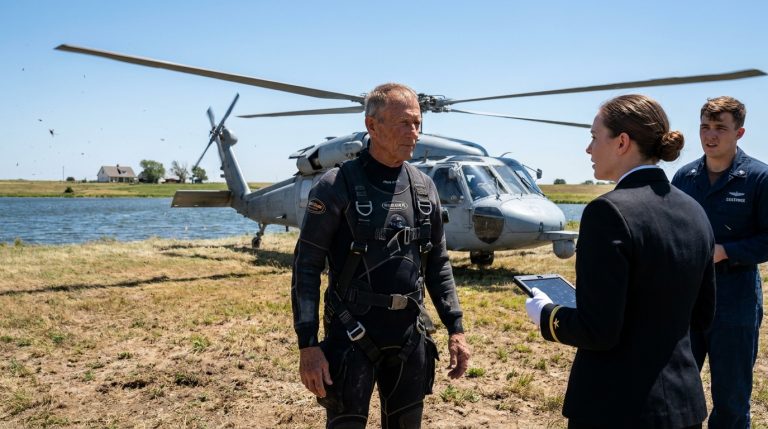
He opened the door. Standing on his porch, framed by the harsh, unfiltered light of the afternoon, was a man in service alphas. He wasn’t the General, but a younger Marine, his posture impeccable, his eyes scanning the space with a disciplined, tactical awareness that felt entirely out of place on a quiet porch in Carson City.
“Master Sergeant Hennessey?” the Marine asked, his voice steady.
“I’m Walt,” he replied, keeping his hand on the doorframe.
“General Halverson requested that I deliver these.” The Marine held out a manila envelope, sealed with a heavy, wax-stamped emblem. “He said you would know what this is.”
Walt took the envelope. It was thick, heavier than a simple letter. He didn’t break the seal. He looked at the Marine, noticing the slight bead of sweat on the man’s upper lip—not from exertion, but from the gravity of the task he’d been given. This wasn’t just a courier; this was a man who knew the importance of what he was handing over.
“Thank you,” Walt said.
“Sir, there’s one more thing,” the Marine continued, shifting his weight. “The video. It’s… it’s trending, sir. It’s hit millions of views since this morning. The General wanted you to know that the response has been overwhelming. People are asking questions that we haven’t answered yet.”
Walt nodded, his expression remaining as neutral as a stone face carved by wind. He had anticipated the ripple, though he hadn’t expected the scale of the wake. “Questions don’t change the truth of what happened.”
“No, sir. But they change what the public expects us to do about it.”
The Marine saluted—sharp, precise, and held a second too long—before turning on his heel and walking back to the waiting vehicle. Walt closed the door and leaned against it for a long moment, the envelope a dead weight in his hand. The silence of the house came rushing back, but it wasn’t the same silence. It was a space that was slowly filling with the ghosts of a history he had spent fifty-five years burying.
He walked to the kitchen and set the envelope next to the buzzing phone. He didn’t open it. Instead, he turned to the counter, pulled out a cloth, and began the ritual. He took the M1 carbine from the case, the wood warm against his palms. He started with the bolt, his fingers moving in the dark, intuitive way of a man who could assemble the weapon blindfolded.
The clinking of metal against metal, the hiss of oil, the soft friction of the cleaning patch—these were the things that anchored him. He worked with a meticulous focus, letting the geometry of the machine override the intrusion of the morning. Every movement was a deliberate act of protection. He was cleaning the rifle, yes, but he was also cleaning the history, scrubbing away the digital noise, the general’s anxiety, and the questions of a world that suddenly, violently, wanted to know his name.
But as he pulled the patch through the bore, he caught his reflection in the kitchen window. The man staring back wasn’t the young Marine in the elephant grass; he was a relic of that time, a ghost still walking. He realized, with a sudden, sinking clarity, that he wasn’t going to be allowed to finish the week in peace. The promise wasn’t just his anymore. The world had claimed a stake in it, and it was coming to collect.
He stopped, his hand resting on the receiver. The house was too quiet. The air felt heavy with the scent of gun oil and the lingering, metallic tang of the steel plates. He had two days left before the anniversary. Two days to finish the count, to complete the cycle. But the ripple he’d started at the range was no longer a wave; it was a tide, and it was heading straight for his porch.
CHAPTER 5: The Salute in the Dust
Walt didn’t move for a long time. He stood in the narrow hallway of his home, the envelope in his hand feeling less like paper and more like an indictment. The house, which had been his quiet refuge for decades, now seemed to shrink around him. The air was thick with the scent of old gun oil and something else—the faint, lingering smell of the general’s expensive cologne, a scent that belonged to office buildings and airports, not to a house that had been built on the simple, honest sweat of a man who didn’t want anything from the world but silence.
He walked into the kitchen, the floorboards creaking under his weight, the sound a familiar, mournful note. He laid the envelope on the kitchen table, next to the thermos and the still-buzzing phone. He didn’t open it. He didn’t need to. He knew what was inside—a formal recognition of a debt he hadn’t wanted to be repaid.
He moved to the window and looked out at the street. A black SUV, the same one from the parking lot, sat idling at the curb. The Marine who had delivered the letter was leaning against the fender, checking his watch. It was a scene of disciplined, calculated waiting. They were waiting for him to emerge, to engage, to validate their presence.
Walt went to the living room and sat in his armchair. It was a sturdy, wing-backed piece, upholstered in a faded, threadbare velvet that held the shape of his body like a mold. He stared at the fireplace, at the mantle where he kept the photos of Marguerite. Her face, frozen in time at twenty-two, was the only thing in the room that didn’t feel like it was watching him.
The phone on the kitchen counter finally went silent. The reprieve was brief. Three seconds later, it started again.
He reached for the M1 carbine, which he had left on the dining table. He didn’t pick it up to clean it this time; he held it. He felt the cold, hard reality of the steel, the weight of the wood that had been warmed by the hands of his father, his brother, and finally, himself. It was a tactile, grounding connection to a world that had been earned in fire, not in digital streams or public press releases.
The front door opened. He hadn’t heard a knock, but he heard the sound of keys—the spare key he kept under the planter. General Halverson walked in, closing the door behind him with a soft, respectful click. He wasn’t in his service uniform; he wore civilian clothes, a tan windbreaker and slacks, but his bearing was unmistakable. He carried himself with the heavy, unhurried grace of a man who had made a lifetime of hard decisions.
Halverson paused in the hallway, looking around the room. He didn’t speak. He didn’t offer a platitude. He walked to the living room, his gaze resting on the rifle, then on Walt. He took off his sunglasses and tucked them into his shirt pocket.
“The public interest isn’t going away, Walt,” Halverson said, his voice quiet. He didn’t look like a three-star general; he looked like a son who had finally found the man he’d been searching for.
“I never asked for the public interest,” Walt replied.
“I know. But you’re not just a private citizen anymore. You’re a narrative.” Halverson moved to the fireplace and stood, leaning against the mantle. “The Commandant is pushing for an expedited timeline. They want the ceremony in the East Room, fully televised. They want to frame this as the ultimate redemption of a forgotten hero.”
Walt felt a flash of something sharp and cold—a warning, an instinctual recoil. Redemption wasn’t something you were given; it was something you lived, in the quiet, empty spaces between the moments that the history books bothered to record.
“They don’t know the story,” Walt said.
“They know what I told them,” Halverson admitted, looking at the photos of Marguerite. “But I didn’t tell them everything. I didn’t tell them about the night in the valley. I didn’t tell them that you did what you did not because of the mission, but because he was my father.”
The air in the room seemed to go still. Walt looked at the General—the man who was the living, breathing result of the choices Walt had made in the dark, suffocating heat of that valley.
“If you tell them,” Walt warned, his voice a low, gravelly rasp, “you destroy the only thing that makes the truth matter.”
Halverson leaned forward, his expression softening into something raw and deeply pained. “I’m not looking to destroy anything, Walt. I’m trying to make sure that for once, the right thing happens to the right man. You’ve been carrying this for fifty-five years. Don’t you think it’s time to set it down?”
“I set it down every morning when I clean the rifle,” Walt said. He stood up, the movement difficult and slow, and held the M1 out toward the general. “This is the promise, Robert. Not the medal, not the speech, not the TV cameras. This.”
Halverson took the rifle, his hands hovering over the wood with a reverence that was almost tactile. He traced the notch in the front sight, his eyes fixed on the small, imperfect mark. The room was silent, the only sound the faint, steady ticking of a wall clock in the hallway—the sound of time, moving forward, leaving the past behind.
“I’ll protect it,” Halverson whispered.
“No,” Walt corrected him. “You’ll carry it. There’s a difference.”
Outside, the idling SUV coughed, a sudden, jarring sound that broke the spell. Walt felt the fatigue settling into his bones, a profound, soul-deep exhaustion that he had been holding back for days. The escalation was peaking; the world was leaning in, pressing against the windows of his house, demanding to be let in. He knew, with a sudden, sinking certainty, that he wouldn’t be able to stay in this room for much longer. The cycle was coming to a close, and the truth, for all its weight, was finally beginning to surface, rising from the deep, dark places he had held it for more than half a century.
CHAPTER 6: The Unburdening
The transition was subtle. One moment, the house felt besieged by the expectations of the outside world, and the next, it was simply his home again. General Halverson had left, the SUV’s engine dying out at the curb, leaving behind a silence so deep it felt like a physical weight. Walt sat in his wing-backed chair, the M1 carbine resting in its case at his feet, the envelope with the wax-stamped seal sitting on the dining table—a dormant volcano of public recognition.
He didn’t open the envelope. He knew that whatever formal commendations or logistics were inside, they were secondary to the reality of the morning. He had passed the rifle to Robert, and in that passing, he had felt the tension in his own shoulders finally begin to fray and unravel. The debt hadn’t just been settled; it had been integrated into the legacy of the man who had survived because of it.
Walt pushed himself up. His knee felt lighter, or perhaps he was simply no longer fighting the pain. He walked to the window. The black SUV was turning the corner, disappearing into the suburban landscape of Carson City. The street was empty. The world had gone back to its business, oblivious to the fact that a half-century of history had just reached its quiet, resolute end in a living room that smelled of gun oil and time.
He moved to the kitchen. The thermos stood on the counter, washed and inverted on a clean towel. He picked it up. He remembered Marguerite’s hands, the way she had held this same thermos at a gas station in Reno thirty-seven years ago. He hadn’t realized until this very second that he had been waiting for the debt to be paid so he could finally, fully, return to the memory of her.
He didn’t need the general, or the medal, or the ceremony in the East Room to validate the existence of that memory. He had the silence. He had the rifle, which was now a legacy rather than a burden. He had the internal compass that had led him through the Ashau Valley and back to this peaceful, dusty life.
He took the envelope from the dining table. He didn’t tear it open. Instead, he placed it inside the desk drawer where he kept his tax papers and his old maps—a place for things that were important, but no longer urgent.
The house felt different. The light filtering through the blinds was softer, less demanding. He walked to the hallway and stopped before the mirror. He looked at the man he had seen earlier—the ghost, the relic. But the eyes were different now. The distant, hardened stare that had served him in the elephant grass was receding, replaced by a quiet, steady warmth. He was just Walt.
He stepped onto the porch. The sun was dipping low, painting the desert in hues of burnt orange and deep, bruised purple. It was the same light he had seen on the range, the same light that had hit the orange steel plate and made it sing. He felt a sudden, sharp, and entirely welcome wave of exhaustion.
He didn’t need to do anything else. No more targets. No more promises.
He sat in the porch rocker and watched the horizon. He thought of his father, of Patrick, and of Captain Halverson. He imagined them as they had been in the photos, their faces caught in the bloom of their youth, before the weight of the war had carved them into soldiers. He felt a sense of peace that went deeper than anything he had felt in decades. It was a completion—a rounding off of a circle that had started in the cold, gray dawn of 1968.
He reached down to the floor of the porch and found a small, smooth stone he’d been meaning to set in the garden bed. He held it for a moment, the cool texture a contrast to the fading warmth of the day. He tapped it once against the wood of the porch, a soft, rhythmic sound, and set it in place.
It was a small act, but it was his.
His daughter, Sarah, would be arriving in the morning. He would tell her about the general, and the rifle, and the medal that was coming. He would tell her that he was ready to sit back and watch the garden grow. He would tell her that he had finally finished what he’d started.
As the first stars began to prick the velvet sky, Walt leaned back, closed his eyes, and let the rhythm of the desert swallow the noise of the day. He was a man who had carried the world on his shoulders for fifty-five years, and for the first time, he could finally feel the weight sliding away, leaving behind nothing but the quiet, enduring grace of a promise kept. The silence was no longer a void; it was a sanctuary. And in that sanctuary, he finally, truly, came home.