A Fractured Command: Captain Cross Faces the Impossible Choice Between Protocol and the Colonel’s Final Breath
CHAPTER 1: THE FREQUENCY OF SILENCE
The static was a physical weight, pressing against the eardrums like deep water. Hadley Cross stared at the handset, her knuckles white. The finality of the silence was worse than the gunfire. It was surgical.
She stood in the command post, the air thick with the smell of ozone and burnt coffee. Around her, the shift change was moments away, but the room felt like it had been vacuum-sealed. Outside, the desert night was a pitch-black void, save for the flickering amber lights of the perimeter watchtowers. She could hear the hum of the cooling fans, the rhythmic tap of a subordinate’s boot against the metal floor, and the distant, grinding sound of a generator. Everything was normal. Everything was wrong.
Hadley set the handset down on the metal desk. It clattered—a hollow, biting sound. She looked at the frequency dial. It wasn’t just set to the tactical net; it had been forcibly shifted to a dormant frequency, one she hadn’t touched in months. A breadcrumb. Or a warning.
She stepped away from the console, her boots silent on the corrugated steel flooring. Her mind moved with the cold, mechanical precision of a slide rule. If the Colonel was taken, they were either dead or already being moved. The “textbook” response was a pipe dream—a slow, bureaucratic gears-grinding process that would take four hours to even authorize a drone scan. By then, the propaganda video would be editing in the dark.
She didn’t need authorization. She needed a way out.
She reached into her vest, her fingers brushing against the cold, familiar steel of her sidearm. The weight of it was grounding. She glanced toward the door, where the sentry was currently occupied with a heated debate about a broken heater.
Then, she noticed it.
On the far corner of the desk, tucked beneath a stack of mission logs, lay a small, black object—a digital drive that shouldn’t have been there. It wasn’t military issue. It was sleek, modern, and bore the faint, metallic scent of ozone. She moved closer, her heart hammering a steady, controlled rhythm against her ribs. As she reached out, the radio flickered to life again, not with voices, but with that same, haunting, rhythmic clicking. It was a sequence.
It was a location. And it was forty miles closer than the last known position of the convoy.
She grabbed the drive, her palm sweating against the casing. Someone had left this for her. And as she looked at the door, she realized the guard had stopped talking. The room had gone perfectly, terrifyingly still. The shadow of a man fell across the doorway—someone who shouldn’t have been on duty for another three hours.
CHAPTER 2: THE UNINVITED OBSERVER
The silence in the command post was no longer empty; it was pressurized, vibrating with the weight of the shadow in the doorway. Hadley didn’t turn immediately. Her fingers curled around the digital drive, the sharp edges of the casing digging into her palm. She focused on her breathing—slow, measured, tactical.
“Captain,” a voice rasped from the gloom. It wasn’t the rhythmic clicking of the radio. It was Sergeant Miller, the man who should have been at the motor pool.
Hadley pivoted, her movement fluid, training taking the reins before her thoughts could catch up. Miller stood just inside the frame, his uniform disheveled, the reflective piping on his vest catching the dull, flickering light of the monitors. He wasn’t reaching for his weapon, but his eyes were darting across the room, tracking everything—the radio, the scattered logs, and finally, her hand.
“The radio, Captain,” Miller said, his gaze fixed on the device. “The shift supervisor mentioned a dead line. Thought I’d check the circuit breakers.”
The lie was too smooth, too practiced. It was a jagged edge in the smooth veneer of the base’s night-time operations. Hadley felt a familiar, cold prickle at the back of her neck—a phantom sensation she usually associated with incoming mortar fire. The psychological phantom of the Colonel’s voice echoed in her mind: When the perimeter is compromised, don’t look for the enemy at the gate. Look for the man holding the key.
“Circuit breakers are in the hallway, Miller,” Hadley said, her voice a calm, low-frequency blade. She didn’t move her hand from her vest. “You’re off-post.”
“I am,” Miller conceded, taking a single, heavy step into the room. He didn’t look like a man here to fix a power issue. His posture was rigid, his hands slightly away from his body in an alert stance. “But I heard the call, too. Everyone did, in the comms block. We’re waiting for orders. You seem to be doing something else.”
Hadley’s mind calculated the distance between them: six feet. In a confined space with a mountain of steel desks and consoles, it was a tactical disadvantage. She needed to know if he was a player or a pawn.
“The orders are being written by men who weren’t listening to the last ten seconds of that transmission,” she replied, her eyes narrowing. She watched the way his pupils dilated—a micro-expression of suppressed stress. “If you’re here to help, pick up a terminal. If you’re here to watch, you’re in the way.”
Miller shifted his weight, his eyes sliding once more toward the drive. The tension in the room thickened, transforming the air into something heavy and suffocating. Outside, a gust of wind rattled the corrugated steel walls of the command post, a sound like dry bones rubbing together.
“The Colonel is gone, Captain,” Miller said, his voice dropping into a register that felt dangerously personal. “Some things are better left lost. Especially with what he was carrying.”
Hadley felt the blood freeze in her veins. He knew. It wasn’t just the capture; it was the payload—the logistics, the secrets, the reason the radio had been cut off so surgically. The realization hit her with the force of a physical blow. The decoy wasn’t just the capture; it was the attempt to make her look for a rescue, while Miller—or whoever sent him—was here to confirm if she had the evidence.
She had to move. Not out the door, but deeper into the belly of the base. She couldn’t afford a confrontation here, not with the security protocols locking down everything in three minutes. She had to use the layout, the shadows, the very architecture of the place that they both knew so well.
“Stand down, Sergeant,” she commanded, stepping toward the console.
Miller stepped forward to cut her off. The dance had begun.
Hadley dropped her shoulder, feigning a reach for the terminal, but instead, she kicked the power cable for the primary array. The room plunged into absolute, crushing darkness. The sudden lack of visual feedback was a calculated move—she had memorized the layout of every desk, every chair, every pillar in this room for years. Miller, however, would be momentarily blinded by the abrupt transition.
She moved with the silence of a ghost, sliding behind the server rack as the emergency lights groaned to life with a dull, sickly red glow. She wasn’t running; she was hunting the exit, her eyes fixed on the ventilation duct behind the command chair. It was a narrow, claustrophobic route, but it was the only way to bypass the hallway sensors.
Behind her, she heard the scrape of a boot on steel. Miller was fast, but he was loud. He was reacting, not leading. As she reached the vent, she caught a glimpse of his silhouette against the red emergency strobes. He was drawing his sidearm, but his aim was hesitant. He didn’t want to kill her; he needed to talk to her. He needed to know if she had the drive.
She pulled the vent grate loose, the metal shrieking in the silence, and slipped into the dark, cramped shaft. As she pulled the grate back into place, she heard Miller’s heavy boots stop directly beneath her.
“Cross!” he hissed, his voice bouncing off the metal walls. “You have no idea what you’re holding. You think you’re saving him? You’re signing your own death warrant!”
Hadley didn’t answer. She crawled forward, the sharp edges of the vent cutting into her knees. Ahead, the duct led to the maintenance tunnel—a forgotten artery of the base that led toward the perimeter fence. She wasn’t saving the Colonel anymore. She was saving the truth, whatever it was, before the people who wanted it buried found it in her pockets.
The weight of the drive in her vest felt like lead. She had the map. She had the drive. Now, she had a target on her back.
CHAPTER 3: THE FORGOTTEN ARTERY
The crawlspace was a tomb of dust and forgotten infrastructure. Hadley pressed her chest against the cold, galvanized steel of the duct, her movements restricted to a slow, methodical shuffle. Every exhale felt loud, a thunderclap in the confined, sound-dampened space. She was moving through the base’s nervous system—a labyrinth of electrical conduits, ventilation shafts, and sewage lines that ran parallel to the operational hallways.
Behind her, the faint, distorted echoes of Miller’s voice died out, replaced by the persistent, mechanical hum of the base’s climate control. He was still out there, prowling the command post, likely alerting the shift commander that Captain Cross had gone rogue. She had minutes, perhaps seconds, before the entire sector was put on lockdown.
She reached a junction point where the main air vent split into two. To the left, the shaft narrowed, dipping down toward the motor pool; to the right, it ascended toward the communications relay. She hesitated, her hand hovering over the junction wall.
If Miller was right—if she had no idea what she was holding—then the drive wasn’t just a mission log. She pulled it from her vest pocket, the small device catching the faint, filtered light of the red emergency strobes bleeding through the cracks in the duct. It was warm to the touch.
She didn’t plug it into the portable reader she carried. That would be an amateur mistake; the device could be booby-trapped with a remote-wipe trigger or a tracking signal. Instead, she felt the casing. There was a tiny, tactile indentation near the USB port—a marking that looked like a serial number, but upon closer inspection, was a sequence of pin-pricks. A signature. It was the mark of the Colonel’s personal logistics officer, a man who had supposedly died in the same ambush that captured the Colonel.
The air in the shaft felt thin, recycled, and tainted with the smell of scorched plastic. Hadley’s perception wavered. Was she losing her grip on the environment, or was the base itself shifting? The rhythmic thumping of the ventilation fans sounded like a dying heart. She leaned her head back, closing her eyes for a split second, and the darkness flared with the image of the Colonel—the way he had looked at her during the last briefing, his eyes distant, his hand hovering over his sidearm as if he were waiting for an excuse to pull it.
She shook the thought away. Paranoia was a luxury she couldn’t afford.
She chose the right path—the way toward the relay. If she could access a terminal that wasn’t on the main grid, she could check the digital signature against the historical logs of the logistics officer. If the signature was real, it meant the Colonel’s “capture” had been planned weeks in advance, and the officer had been the architect.
The crawl was agonizing. Her elbows ached, and the vibration of the base through the steel sheeting began to rattle her teeth. She encountered a bottleneck—a cluster of fiber-optic cables that forced her to slide on her stomach, chin-down, face pressed against the cold metal. She moved with a calculated, predatory grace, pausing every few inches to listen.
The sound of a heavy door slamming echoed through the shaft. It was followed by the staccato rhythm of combat boots—three sets of them. The security team.
“She’s not in the command suite,” a voice boomed, distorted by the ventilation duct’s acoustics. It was the Shift Supervisor. “Lock down the north sector. Check the maintenance access points.”
Hadley froze. She was directly above the main hallway. If she moved, the vibration would give her away. She held her breath, watching through the slats of the grate as the legs of the security team paced beneath her. They were searching for a ghost, but she was the ghost that knew the haunting grounds better than they did.
She noticed a physical discrepancy: the duct floor beneath her was bowed. It wasn’t just old; it was sabotaged. A series of clean, circular holes had been drilled into the support beams, weakening the structure. This wasn’t wear and tear. Someone had been preparing this route for a long time.
She reached the exit point—a narrow grate looking out over the back of the comms relay room. It was empty, save for a single terminal glowing in the dark. She needed to reach that terminal, but to do so, she had to drop into the room, bypass the motion sensors, and extract the data before the security team doubled back.
She wasn’t just a soldier anymore. She was a trespasser in her own home.
She reached for the screws holding the grate in place, her fingers moving with the mechanical precision of a safe-cracker. Each turn of the screw was a gamble against the silence. She was operating on pure, distilled pragmatism. If she reached that terminal, she might find the proof that the Colonel was already lost. If she didn’t, she was just another casualty in a war that had ceased to make sense.
The grate popped loose. She eased it into the shaft, letting it rest on the support cables. She hung by her hands for a moment, suspended in the dark, watching the room below. The terminal’s screen pulsed with a steady, blue light, a beacon in the shadow.
She dropped, landing in a perfect crouch, her boots barely making a sound on the linoleum floor. The room was cold, sterile, and smelled of ozone. She approached the terminal, her pulse a frantic drumbeat in her ears.
The console wasn’t locked. It was waiting.
As she plugged in the drive, the screen flickered, and a single, unencrypted file appeared: LOGISTICS_MANIFEST_FINAL_PHASE.
She clicked it, and the screen flooded with red text. It wasn’t a mission plan. It was a countdown.
CHAPTER 4: THE THRESHOLD OF DECEPTION
Hadley stared at the red text. LOGISTICS_MANIFEST_FINAL_PHASE: 00:42:12.
It wasn’t a mission profile. It was a digital dead-man’s switch. If the drive wasn’t synchronized with the main server by the end of the countdown, the data—whatever it contained—would be wiped, and a secondary signal would be broadcast. She touched the keyboard, her fingers hovering. The air in the comms room felt stagnant, heavy with the scent of ionizing radiation and burnt circuitry.
Outside, the heavy boots of the security team thudded against the floor. They were closer now. She could hear the distinct metallic click of a rifle bolt being drawn back. They weren’t just looking for her; they were clearing the room.
She turned her attention back to the screen. Below the countdown, a series of sub-folders appeared: ASSET_ORIGIN, COORDINATES_PRIMARY, PROTOCOL_ABORT. The folder ASSET_ORIGIN caught her eye. It was small, barely a few kilobytes, but it was password-protected by an algorithm that didn’t match anything in her current clearance level. It was an older, more elegant encryption—the kind the Colonel’s old unit used before they were folded into the coalition.
She didn’t try to crack it. Instead, she searched for a mirror file. If the manifest existed on this terminal, there had to be a local copy in the cache. She began digging into the system’s temp files, her movements rapid and practiced. The terminal chirped—a sharp, digital sound that grated against the silence of the room. A second signal was coming through, a low-frequency hum that wasn’t part of the base’s standard comms-check. It was coming from the wall behind the terminal.
She leaned down, pressing her ear against the cool, vibration-slicked steel. A rhythmic tapping. It was the same cadence as the radio signal she had heard in the command post. She hadn’t found the source; she had followed it to the origin.
Behind the wall was a hidden conduit—a secondary, unauthorized encryption line that bypassed the base’s firewalls entirely. This wasn’t a military relay. It was a private line, owned by someone with the power to move mountains, or to bury them.
Hadley grabbed a multi-tool from her kit, her hands steady despite the adrenaline surging through her veins. She pried at the decorative paneling covering the wall. It groaned, resisting, then gave way with a sickening, splintering sound. Behind the wood was a bank of high-density fiber-optic switches, blinking in an intricate, chaotic dance of light.
She tapped her portable reader into the line, her heart hammering against her ribs like a trapped bird. She wasn’t just downloading data; she was eavesdropping on a conversation between the past and the present.
The screen blinked. TRANSCRIPT_FILE_0902.
She opened it. The text was raw, unrefined.
“The target is positioned. The capture will be staged. Ensure the asset is removed before the cleanup crew arrives.”
Hadley read the line three times. The “capture” wasn’t a loss; it was a transition. The Colonel wasn’t a victim; he was the package. And the “cleanup crew” wasn’t the enemy—it was the team that would be sent to “rescue” him, a team designed to ensure that the Colonel never spoke again.
The weight of the realization was sudden and crushing. The entire operation—the radio call, the ambush, the desperate scramble she was currently undertaking—was a pre-recorded sequence, and she was the only variable that wasn’t supposed to be there.
She reached for the exit. She had to leave, but as she pulled her hand away, the screen flickered. A new message appeared: TRACE_INITIALIZED. LOCATION: COMMS_RELAY_4.
The security team stopped moving. The silence that followed was absolute, the kind that preceded a storm. They knew she was here. They had let her follow the breadcrumbs right into the trap.
Hadley stood up, her sidearm drawn. She didn’t head for the door; she headed for the vent. She had to get back into the arteries of the base before the room turned into a kill zone. As she scrambled toward the opening, the door at the far end of the room began to glow with the harsh, white light of a breaching torch.
She shoved the drive into her pocket and dove into the vent just as the door was kicked off its hinges. The roar of the breach-team flooded the room, but she was already moving, her body coiled like a spring. She crawled into the pitch-black, feeling the sharp edges of the vent biting into her skin, moving toward the motor pool. She wasn’t just hiding anymore. She was running toward the only place where she could actually change the outcome: the hangar bay, where the tactical transport was waiting for a flight that would never be authorized.
She was going to pull the Colonel out of the fire, not for the mission, but for the answer.
CHAPTER 5: THE HANGAR GATE
Hadley’s movements were agonizingly slow. The vent system was a claustrophobic cage of serrated metal, and every shift of her weight sent a reverberating thrum through the base’s backbone. Above her, she could hear the tactical comms chatter—the security team was coordinating, their voices crisp and professional, devoid of the doubt that should accompany a hunt for a captain of her standing. They weren’t looking for a traitor; they were cleaning up a malfunction.
She reached a ninety-degree turn, her knees scraping against the rivets. Ahead, a faint, flickering light indicated the ventilation exhaust for the main hangar bay. Below that vent, the heavy, ground-level machinery of the transport maintenance area churned with a low, rhythmic thrumming.
A sudden, jarring alarm shrieked through the ducts—the high-pitched, melodic whine of a fire-suppression override. The maintenance doors in the lower levels began to hiss shut, heavy steel sliding against steel. A butterfly detour. The security team was sealing the base, sector by sector. If she didn’t hit the hangar floor in the next sixty seconds, she would be trapped in the vents until they flushed the system with Halon gas.
Hadley didn’t hesitate. She kicked the exhaust grate. It held fast, a stubborn piece of industrial engineering. She pulled her combat knife, jammed the blade into the locking mechanism, and twisted with every ounce of leverage her cramped muscles could provide. The metal groaned, then sheared away. She didn’t drop; she squeezed, sliding out through the narrow opening and landing on the hard, epoxy-coated floor of the hangar maintenance catwalk.
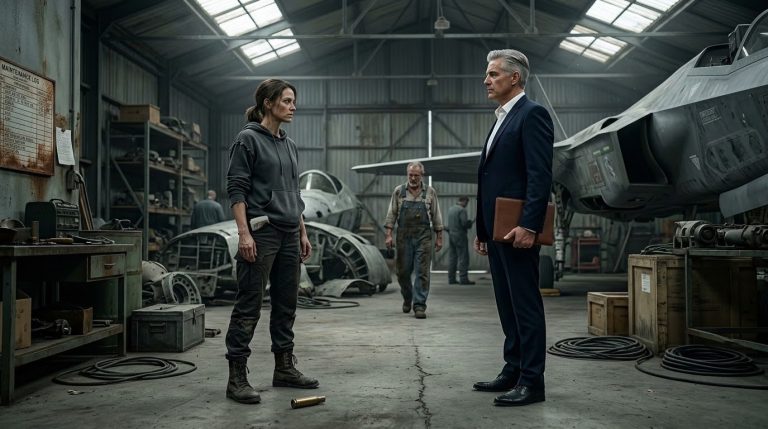
She was ten feet above the hangar floor. Below her, the massive transport aircraft sat like a slumbering beast, its belly exposed for servicing. Mechanics were scrambling, pulling tools, their movements frantic. She saw the transport pilot, a man she had shared a coffee with only hours before, standing near the cockpit ladder, his face pale, staring at the closed hangar doors.
She stayed in the shadows of the catwalk, her pulse a frantic, irregular rhythm in her ears. She had to get to that ship, but the security team was already pouring into the hangar from the personnel airlocks. They were armed, their rifles raised, moving in a practiced sweep. They weren’t checking the equipment; they were checking the shadows.
Hadley moved along the catwalk, her eyes fixed on the maintenance crane that hung over the transport. It was a long drop, and the landing would be anything but quiet, but it was the only way to get to the pilot before the lockdown cycle completed. She gripped the crane’s steel cable, her gloves slick with sweat, and let herself slide.
The friction was a burning sting against her palms, but she controlled the descent, dropping down onto the top of the transport’s fuselage. The metal surface was cold and slick with hydraulic fluid. She flattened herself against the hull, listening.
“Sector Four clear,” a voice crackled from a radio nearby.
She crawled toward the cockpit window. The pilot looked up, his eyes widening as he saw her shadow silhouetted against the hangar lights. He didn’t scream. He simply looked at the door, then back at her, his expression a mixture of fear and sudden, sharp clarity. He knew something was wrong. He had been waiting for a flight that wasn’t on the official manifest.
Hadley tapped on the glass. He reached for the manual release, but before he could pull it, the hangar’s massive main lights flickered and died, replaced by the deep, crimson glow of the security lockdown. The hangar doors began to grind open—not for a flight, but for an arrival.
Two tactical SUVs screeched onto the hangar floor, their headlights cutting through the gloom like twin searchlights. A team of men in unmarked black gear disembarked. They weren’t base security. They moved with a colder, more precise efficiency, fanning out toward the transport.
Hadley pulled the digital drive from her pocket, looking at it one last time. If this was the key to the Colonel’s defection, then the men stepping out of those SUVs were the ones who had authorized it—and they had come to close the books on everyone involved.
She wasn’t just a captain on the run; she was the only witness to a liquidation. She pulled her sidearm, not to fight, but to provide the pilot the cover he needed to override the hangar’s manual lock.
“Start the engines,” she whispered, her voice barely audible over the grinding of the hangar doors.
The pilot looked at the command console, then back at her. He nodded. The roar of the auxiliary power unit began to build, a low, ominous vibration that shook the entire frame of the transport. The men in black paused, their weapons swiveling toward the cockpit.
The hangar floor was turning into a battlefield. Hadley raised her weapon, her target not the men, but the hangar’s main fire-suppression valve directly above their heads. If she couldn’t outfight them, she would bury them in a wall of industrial foam.
The tension was a physical pressure, a vacuum waiting to be filled. She pulled the trigger.
CHAPTER 6: THE WEIGHT OF SILENCE
The hangar erupted in a deafening, pressurized roar. A thick, opaque cloud of fire-retardant foam cascaded from the ceiling, burying the tactical team in a white, suffocating blanket. The men in black, trained for precision, were suddenly blind, their coordinated movements turning into frantic, stumbling flails.
Hadley didn’t wait for the dust to settle. She vaulted from the catwalk, the ten-foot drop jarring her spine, and landed behind a heavy steel equipment crate. The taste of chemical foam was bitter, clinging to her tongue like salt. Through the swirling white haze, she could hear the metallic clatter of weapons being dropped and the muffled, angry shouts of the men who had been inches away from capturing her.
She moved with the silence of a predator, her sidearm held close to her chest. The transport was already beginning its start-up sequence; the whine of the turbines was rising, shaking the hangar floor. She had to reach the boarding ladder before the pilot engaged the throttle.
She saw a shadow move to her left—a tactical operative, his visor fogged with foam, sweeping his rifle in a panicked arc. Hadley didn’t engage. She stayed low, pressing her back against the cool, vibrating fuselage of the transport. She watched him—the way he held his weapon, the specific tactical light mounted on the rail. It was a configuration used by an elite black-ops unit that didn’t technically exist on the base’s roster.
The psychological phantom hit her then: the memory of the Colonel’s voice from three months ago, telling her that “the most dangerous threats are the ones that have been scrubbed from the ledgers.” He had been warning her, but his eyes hadn’t been focused on the enemy. He had been looking at the logistics manifest he was currently holding—the same manifest she had just downloaded.
The realization was a cold, sharp edge in her gut. The defection wasn’t a betrayal; it was an escape. The Colonel wasn’t being captured; he was trying to leave before the people in black finished the job they had started on the rest of his unit.
She reached the ladder, her boots scraping on the metal. The pilot was watching the hangar entrance, his hands trembling on the controls. He saw her and pushed the ladder override, the heavy steel bars descending with a screech that cut through the engine roar.
“Get in!” he shouted over the rising whine of the turbines.
As she stepped onto the ladder, a shot rang out—a sharp, high-velocity crack that sent a spark dancing off the fuselage inches from her head. She didn’t look back. She scrambled up the ladder, her lungs burning, and tumbled into the cockpit. The door slammed shut behind her, sealing them into a pressurized, humming capsule of relative safety.
“They’re not security,” she gasped, checking the chamber of her sidearm. “They’re a kill squad.”
The pilot didn’t look at her. His eyes were fixed on the hangar control panel. “I know. I wasn’t waiting for the Colonel, Captain. I was waiting for the proof. Do you have it?”
The question hung in the air, heavy and sharp. She had the drive, but she also had the reality—the truth that everyone on the ground was expendable. She reached into her pocket and held the drive up, the small piece of metal glinting in the cockpit’s red-lit instrument glow.
“I have the manifest,” she said, her voice dropping into a low, controlled register. “And I have the origin. Whoever sent these men is sitting in the command center right now, watching us.”
“Then we don’t go to the rendezvous,” the pilot said, his hand hitting the throttle. The transport lurched, the tires spinning on the slick hangar floor before gaining traction. “We go to the signal origin.”
The transport began to taxi, the massive nose swinging toward the yawning mouth of the hangar doors. Outside, the tactical SUVs were recovering, their headlights cutting through the thinning foam. They were moving to intercept, their weapons raised.
“We’re not going to make it through the gate,” Hadley observed, her voice devoid of panic, purely clinical. She looked at the hangar wall—the secondary structural support she had noticed in the crawlspace.
“We don’t need the gate,” she added. “There’s a maintenance bulkhead in the northwest corner. It’s rusted, weak. If we hit it with the landing gear extended, we can punch through to the desert floor.”
The pilot looked at her, a flicker of grim admiration in his eyes. “That’ll shear the gear. We won’t be able to land if we take off.”
“We don’t need to land,” Hadley replied, watching the SUVs close the distance. “We just need to get out.”
The transport accelerated, the engine’s scream reaching a fever pitch. The hangar wall loomed, a solid barrier of reinforced steel and concrete. Hadley braced herself against the cockpit bulkhead, her gaze fixed on the approaching wall. The tactical squad was firing now, the bullets pinging off the fuselage like hail, but the plane was already moving too fast.
The impact was a sudden, violent lurch that threw her against the console. The sound of tearing metal and concrete was deafening, a visceral, grinding destruction. The transport shuddered, the nose dropping as the landing gear collapsed, and then, for a heartbeat, there was nothing but the scream of metal on stone.
They were through. The desert night rushed in, a blast of cold, clean air that felt like a salvation. The transport skidded across the tarmac, sparks spraying like fireworks into the darkness, before finally coming to a halt on the edge of the runway.
Hadley pushed the cockpit door open, the silence of the desert rushing in to replace the chaos of the hangar. The engine was smoking, the undercarriage ruined, but they were outside the perimeter. She stood up, her legs shaky, and looked back at the base. It was a dark, silent shadow against the horizon, but for the first time, she could see the truth behind the curtain. The war was a closed loop, and they were the only ones who had managed to step outside of it.
CHAPTER 7: THE CALCULATED RISK
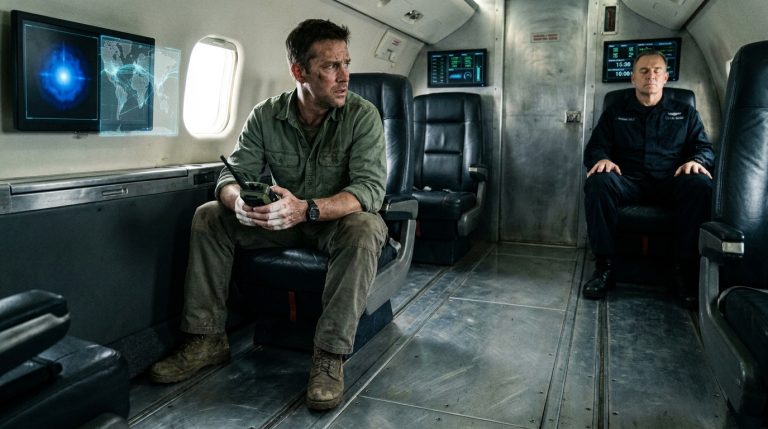
The desert floor was a jagged, obsidian blur through the cockpit window. The transport was fighting its own physics, the shredded remains of the landing gear creating a sickening, asymmetrical drag that pulled the nose toward the dark horizon. Hadley felt the vibration in her teeth—a low-frequency shudder that told her the hydraulics were bleeding out.
“Hydraulic pressure is failing!” the pilot shouted, his hands dancing over the manual overrides. “I’ve got no elevator control. If we don’t stabilize, we’re going to spiral into the ridge.”
Hadley looked at the instrument panel. The navigation lights were flickering—a rhythmic, hypnotic pulse that mirrored her own heartbeat. She reached over, her fingers brushing past the pilot’s hands to grab the manual trim wheel. It was stiff, rusted by years of neglect, but it was the only way to counteract the drag.
“Hold the throttle at sixty percent,” she commanded, her voice steady against the howling wind outside. “If you push it higher, the wing will buckle. We have to glide it down to the basin.”
She hauled on the trim wheel, her muscles screaming with the effort. Every movement was a negotiation with the laws of gravity. They weren’t just flying a machine; they were nursing a broken bird through a gauntlet of mountain passes that felt like they were closing in to crush them.
The cockpit was freezing. The ruptured fuselage allowed the sub-zero night air to howl into the cabin, turning the electronics’ heat into a distant memory. Hadley’s breath misted on the glass, a ghostly shroud that momentarily obscured the terrain. She wiped it away with the back of her glove, her eyes scanning the dark for the signal origin.
They were close. The map on the terminal had indicated an old relay station tucked into the lee of the high ridge, a place that didn’t exist on any coalition charts. If the Colonel was being moved—or if he had arranged his own extraction—this was where the handoff would happen.
“I see something,” the pilot murmured, tilting the wing just enough to see the glow of a landing strip—a narrow, improvised path marked by chemical lights.
It was a trap, or a desperate hope. She didn’t know which, but they didn’t have the fuel to be picky.
“Take the approach,” she said, her hands still locked on the trim. “But stay off the main path. Come in from the ridge side. If they’re waiting for us, they’ll be looking for a standard landing.”
The plane dipped, the wings groaning under the pressure of the turn. The landing strip expanded in their view—a lonely, desolate stretch of earth surrounded by jagged peaks. As they descended, Hadley saw the silhouette of a heavy truck parked near the relay station. It was the same model as the ones in the hangar.
“They’re here,” she said, her grip tightening on the wheel.
The pilot gritted his teeth, the muscles in his jaw standing out like cords. “If we hit the ground, we’re sitting ducks.”
“We don’t hit the ground,” Hadley replied, her eyes narrowing. She saw the truck’s lights flicker—a signal? No, it was a strobe. A countdown.
She realized the truth with a jolt of ice in her blood. The Colonel wasn’t being held by enemies; he was meeting them. The logistics manifest she had stolen wasn’t the target; it was the payment. And if they arrived, they were walking into the middle of a transaction they were never meant to see.
The plane kissed the dirt, the impact jarring the entire frame. The remaining landing gear screamed, metal gouging the earth, before the transport finally slewed to a halt, nose-down in the dust. The silence that followed was heavy, broken only by the ticking of the cooling engines.
Hadley didn’t wait for the pilot. She shoved her door open and slid down the side of the fuselage, her boots hitting the hard-packed dirt of the basin. The air was thin and smelled of dry earth and old oil. She took a breath, drawing her sidearm, and moved toward the truck.
She felt the weight of the drive in her pocket—the truth about to be revealed, or buried deeper. She was fifty yards from the truck when a figure stepped out from the darkness of the relay station. He was wearing an officer’s coat, the insignia polished and sharp in the moonlight. He wasn’t a captor.
It was the Colonel.
He didn’t look like a man who had been through an ordeal. He looked like a man who had been waiting for a delivery. He looked at her, then at the burning, wrecked transport, and his face remained a mask of calm, calculated indifference.
“Captain Cross,” he said, his voice carrying clearly across the distance. “I was beginning to think you had taken the long way around.”
The realization hit her with the force of a physical impact. The ambush, the capture, the kill squad—it had all been a play, and she had been the lead actor, moving the pieces exactly where he needed them to go. She had brought the proof, but she had also brought the reason for them to be silenced.
She stood frozen, the desert wind whipping at her coat, looking at the man she had risked everything to save. He was the architect. And she was standing in the center of his design, her weapon pointed at a man who was already untouchable.