The Price of Silence: How an Everyman Matriarch Dismantled Her Entitled Family’s Betrayal
CHAPTER 1: THE COLD RAIN
The rain on Peachtree Road didn’t pour so much as it hung in the air, thick and freezing, coating my windshield in a oily smear that the wiper blades barely moved.
My knuckles were white against the vinyl steering wheel of the ’08 Buick. In the passenger seat sat the empty Tupperware container, still faint with the smell of nutmeg and roasted yam. I hadn’t cried when I set the tray down behind the chafing dishes of raw oysters. I wasn’t crying now.
The house on Fayetteville Road was dark when I pulled into the driveway.
The porch light was off—Jamal had promised to replace the sensor three weeks ago, but the burnt-out glass bulb still sat cold in its brass fixture. I killed the engine. The silence inside the cabin hit me hard, heavy with the smell of damp wool and old upholstery.
I unlocked the front door, the key biting rough into the brass cylinder the way it had every evening since 1987.
Inside, the hall smelled of dry cedar and cold air. I didn’t turn on the overhead light. I didn’t need to. I knew every inch of these floorboards, including the long plank past the coat rack that groaned if you put more than fifty pounds on it.
I set my purse on the kitchen counter and reached for the recipe card box by the stove.
David’s handwriting was still there on the index card, blue ink faded to gray where his thumb had pressed against the corner while he washed dishes thirty years ago. I smoothed the card against the Formica. My hands were steady. Cold, but steady.
Then I saw the leather satchel sitting on the edge of the dining room sideboard.
Malik had left it behind when he brought the wine cases in earlier that morning. It was a heavy, brown thing with nickel hardware, unzipped just enough to expose a stack of white printer paper.
I didn’t hesitate. I walked over, unbuckled the strap, and pulled the top file into the faint amber light of the streetlamp outside the window.
The top page was a formal legal draft. Petition for Involuntary Guardianship and Conservatorship.
Right beneath it sat the second document: a Georgia Limited Warranty Deed for the house on Fayetteville Road.
I scrolled my thumb down to the bottom of page two, right to the line marked Grantor. My name was typed there in stiff, capital letters. Above it, written in blue ballpoint, was a signature that looked like mine at a distance.
I brought the paper closer to my face.
The letter G was wide open at the top, sweeping back into a loose, lazy loop. I haven’t left a G open since third grade. David used to laugh at how tight I looped my letters, telling me I wrote like an elementary school teacher trying to save ink.
This signature wasn’t mine. It was a careful, patient copy made by someone who knew what my hand looked like on a birthday card, but didn’t know the habit of it.
Beneath the deed lay a single blue manila folder bearing a red warning stamp from a downtown commercial lender.
I didn’t open the blue folder. I didn’t need to. The signature on the deed told me everything I needed to know about why my chair had been placed by the kitchen trash can tonight.
I folded the document once, crisp and sharp, and slipped it into the front pocket of my African print dress.
CHAPTER 2: THE PAPER TRAIL
The house didn’t offer any comfort.
It wasn’t supposed to. When a man leaves this earth after thirty-eight years of marriage, the silence he leaves behind isn’t empty—it’s heavy, sitting on the furniture like a layer of dust that no rag can touch.
I walked into the small back den off the kitchen.
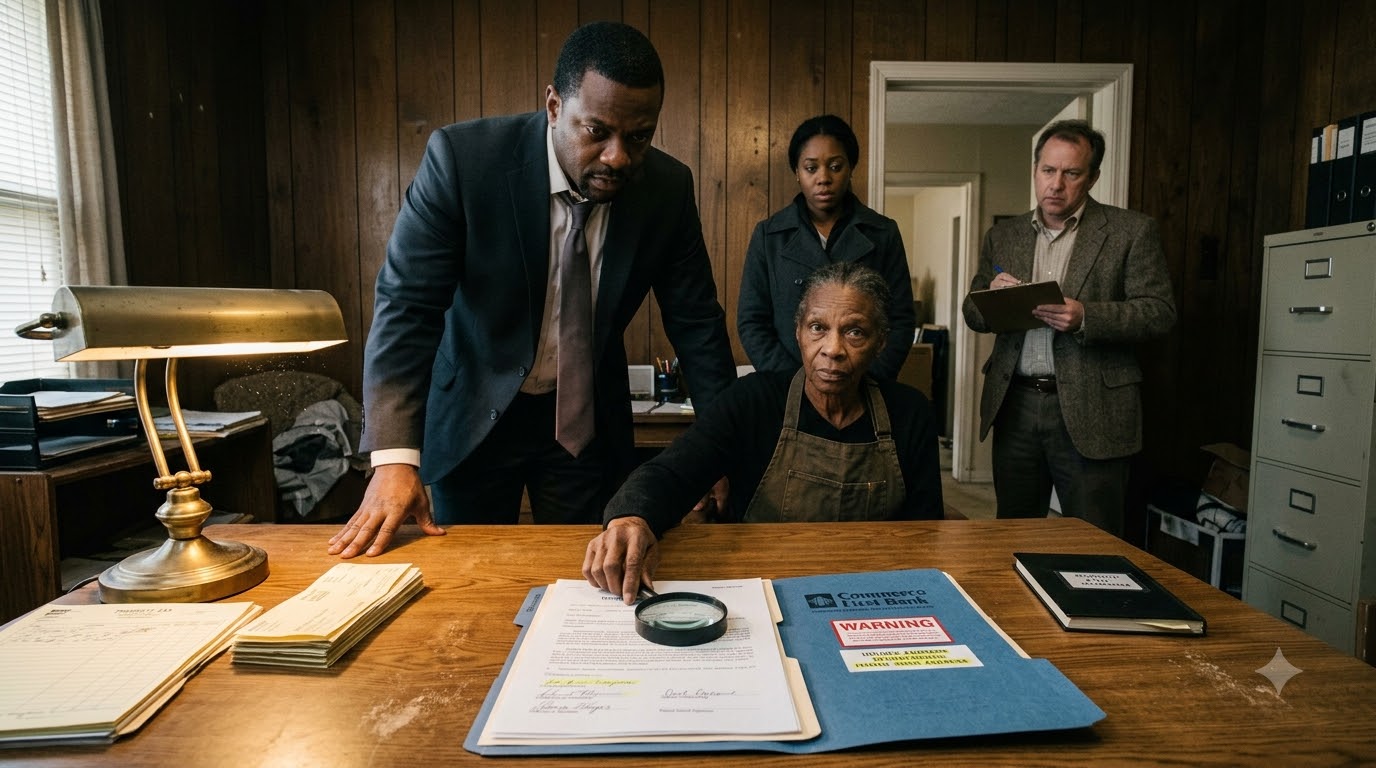
David’s green banker’s lamp sat on the oak desk, its brass base dull from lack of polish. I clicked the chain switch. The warm, green-tinted light flooded the blotter, illuminating a stack of unopened utility bills and a small black ledger where I tracked the quarterly property taxes.
I pulled the deed from my dress pocket and laid it beside the black ledger.
Without Robert Whitfield to call—his heart had given out three winters back, taking his forty years of legal sense with him to the graveyard—I had nobody to run to. No lawyer waiting with a fresh pot of coffee. No pre-arranged trust sitting in a fireproof vault.
Just me, a green lamp, and a forged signature on a sheet of twenty-pound bond paper.
I opened the top drawer of the desk and pulled out a magnifying glass David used for reading the small print on seed packets.
I brought the lens over my name on the deed. The ink was dark blue, standard ballpoint, but the line wasn’t smooth. Under the glass, you could see the tiny micro-shakes where the pen had paused at the loops—the hesitant, deliberate dragging of a hand trying to trace a pattern instead of writing a name.
My real signature didn’t hesitate.
I pulled a blank notepad from the drawer, picked up a blue Pilot pen, and wrote my name three times across the lined paper. Gloria Hayes. The G came down tight, the loop locking firmly into the base line, closed like a sealed envelope.
I set the notepad right beside the deed.
Then I reached back into Malik’s satchel on the dining sideboard and brought the blue manila folder to the desk.
The red warning stamp on the cover was from Commerce First Bank: Notice of Default & Immediate Liquidation Assessment. Inside was a commercial loan agreement under an LLC called Brooks Capital Ventures.
The balance due sat in bold black numbers: $142,000.
Attached to the back of the assessment was a real estate schedule, listing potential collateral to satisfy the debt. Highlighted in yellow marker was my address: 412 Fayetteville Road, Decatur, GA.
Malik wasn’t just trying to put me in a home.
He was drowning in a commercial default, and he had convinced my daughter that putting me away was the only way to save the family from financial embarrassment. He’d built a lie, wrapped it in my daughter’s corporate ambition, and used her keys to get into my house.
The front porch floorboard gave a low, wet creak outside.
I didn’t turn off the green lamp. I didn’t hide the papers.
I slowly folded my glasses, set the magnifying glass on top of the forged deed, and waited as the brass doorknob began to turn.
CHAPTER 3: THE GATHERING STORM
The front door swung inward with a heavy scrape against the damp weatherstripping.
Keesha stepped into the foyer first, her gray wool coat dark at the shoulders from the mist. Behind her came Malik, adjusting his silk tie with one hand while carrying a black leather portfolio under his arm. A third man—short, wearing a rumpled tweed jacket and holding a clip board—followed them quietly into the hallway.
“Mama?” Keesha’s voice carried that sharp, practiced pitch she used on junior associates. “I saw the desk light from the driveway. We need to talk about some administrative details.”
She walked into the den without knocking, stopping short when her eyes hit the green banker’s lamp.
“You’re up late,” she said. Her gaze flicked to the blue manila folder sitting directly under my left palm. A tiny muscle near her eyelid twitched—just once, quick and involuntary. “I brought Dr. Vance. He’s a specialist in senior living transitions. We just want to do a quick evaluation so we can finalize the Decatur paperwork.”
Malik slid into the room behind her, broad-shouldered and smiling, though his knuckles were white where he gripped his portfolio.
“It’s for your own good, Gloria,” Malik said, stepping closer to the edge of the desk. “You’ve been misplacing things. Said the same story twice at Thanksgiving. We just want to make sure you’re protected before these property taxes get out of hand.”
I didn’t move my hands off the desk. I looked at the man in the tweed jacket.
“Dr. Vance,” I said, my voice low and dry as wood shavings. “Are you aware that the document my daughter wants you to sign off on is backed by a forged property deed?”
The doctor stopped mid-stride, his pen hovering two inches above his clipboard.
Keesha’s face went stiff. “Mama, don’t start this. You’re confused. You walked out of my house tonight without saying a word to anyone—”
“—I walked out because I heard Malik behind the coat closet door,” I interrupted, tapping my index finger against the edge of the forged warranty deed. “And I walked out because my daughter put a church folding chair by the trash can for her mother while she served raw oysters on granite.”
Malik took a sharp step forward, his voice dropping an octave into a low, aggressive rumble. “Now look here, Gloria. We’re trying to handle this respectfully, but the petition is already drafted. You don’t have a lawyer sitting in this room, and you don’t have the legal standing to block a competency filing.”
He leaned over the desk, placing both palms flat on the oak to loom over me.
“You sign the voluntary transfer tonight, or we file the petition in probate court at nine o’clock tomorrow morning.”
I didn’t pull back from his weight. I reached out with my right hand, picked up the magnifying glass, and set it squarely on top of the blue bank default notice.
“You’ve got ninety minutes before the bank opens, Malik,” I said, looking him dead in the eye. “Let’s see who files first.”
CHAPTER 4: THE TACTICAL PIVOT
“You think a paper with a bank stamp scares me?” Malik’s voice didn’t shake, but his breath smelled of cold oysters and gin. “That’s an internal commercial ledger. It means nothing in probate court.”
I didn’t answer him. I picked up the blue Pilot pen and drew two sharp parallel lines across a sheet of scrap notepad paper.
“Dr. Vance,” I called out, not looking away from Malik. “Come here for a second.”
The doctor hesitated, his eyes shifting from Keesha’s pale face to the heavy silence in the room. He took three reluctant steps to the edge of the desk, his pen still clipped to his clipboard.
I pointed the tip of my Pilot pen at the forged warranty deed, then at the lined paper.
“Look at the letter G on this deed,” I said, keeping my tone plain, like a schoolteacher pointing out a spelling error on a blackboard. “Whoever tried tracing my signature didn’t know I’ve closed my loops since 1964. You see that gap at the top? That’s a hesitating hand trying to draw a line instead of write a name.”
Dr. Vance leaned down, adjusting his wire-rimmed spectacles. He looked at the deed under the green lamp, then at the notepad where I’d signed my real name three times.
“That’s…” Vance swallowed hard, his throat clicking in the quiet room. “That’s a clear mechanical discrepancy in the stroke order.”
“It’s a fake,” I said flatly. “And the man standing over this desk used my daughter’s corporate login at real estate firm downtown to draft it, because his commercial loan under Brooks Capital Ventures defaulted on Tuesday.”
Keesha snapped her head toward Malik. “What is she talking about? Malik, what default?”
Malik didn’t turn to look at her. His jaw muscles tightened, a single bead of sweat breaking through his hairline despite the chill coming through the window frame.
“She’s rambling, Keesha,” he barked, his voice rising too fast. “She’s pulling numbers out of thin air because she knows she’s cornered—”
“—Page four of your own folder, Malik,” I cut in, sliding the blue folder two inches across the desk. “Line seven. The collateral guarantee lists 412 Fayetteville Road. My house. The house David and I paid off in 2011.”
Keesha reached over his shoulder and snatched the blue folder before he could grab it. Her eyes darted across the printed rows of numbers, her dark eyebrows pulling tight into a hard, furious line.
“You told me this was a tax restructuring,” she whispered, her voice dropping into a razor-thin tremor. “You told me we were putting Mama’s estate into a protective trust.”
“Keesha, shut up and let me handle this,” Malik snapped, turning his body to block her view of the desk.
Dr. Vance quietly unclipped his pen, clicked it shut, and pulled his clipboard under his arm.
“I won’t be party to a contested filing involving disputed signatures,” Vance said, his voice clipped and flat. “Good night, Mr. Brooks. Mrs. Hayes.”
He turned on his heel and walked out down the hallway, the front door closing behind him with a soft, definitive latch.
Malik stood alone at the desk, his chest rising and falling fast, his eyes dark with an unhinged, desperate anger as he realized his leverage had just walked out into the rain.
CHAPTER 5: THE COLLAPSE
“You think you’re smart, Gloria?” Malik’s voice cracked, the smooth polish stripping away to reveal the raw, jagged panic underneath. “You think you can just stand there in your church dress and ruin five years of work?”
He grabbed the edge of the desk, lifting it an inch before slamming it back down. The green banker’s lamp rattled against the wood.
“You don’t own anything without us!” he shouted, stepping into my personal space until I could smell the sweat soaked into his collar. “Keesha pays for your lifestyle! We keep you relevant! You’re an old woman sitting in an empty house living on memories!”
Keesha stepped between us, shoving her hand against Malik’s chest.
“Get your hands off my mother, Malik,” she said, her voice shaking violently as she clutched the blue loan default folder against her ribs. “Get out of this house.”
“Out?” Malik laughed, a shrill, hysterical bark as he whipped around to face her. “I used my credit line to back your firm’s commercial lease! If I go down, your name is on those corporate filings, Keesha! You signed off on the regional audit!”
Keesha went dead quiet, her skin turning the color of wet newsprint under the yellow hallway bulb.
I didn’t raise my voice. I didn’t reach for a phone or call for help. I reached out, picked up David’s smudged recipe card from the desk blotter, and tucked it neatly into the front drawer.
“Malik,” I said, my voice steady as concrete. “You have thirty seconds to get off my property before I walk out to the driveway and hand this forged deed to the Decatur city officer sitting at the corner of Ponce de Leon.”
“You’re bluffing,” he sneered, his hands twitching at his sides as he looked for leverage that was no longer there. “You wouldn’t embarrass Keesha like that.”
“Try me,” I said, taking two deliberate steps toward the front door. “I raised two children on a mechanic’s pension and thirty years of common sense. I am not afraid of a man who forged a woman’s name because he couldn’t pay his own rent.”
Malik stood frozen for three long seconds, his chest heaving, his face contorted in sheer, impotent fury.
Then he snatched his leather portfolio off the chair, kicked the brass umbrella stand in the foyer, and slammed the front door so hard the glass pane rattled in its frame.
Outside, his sports car engine roared to life, tires spinning wet rubber against the Fayetteville Road driveway before speeding away into the dark.
Keesha stood in the middle of the hallway, her shoulders slumped, her expensive heels resting on the worn oak floorboards where her father used to stand every evening.
She looked at me, her eyes wet and red, holding the blue folder like a broken piece of glass.
“Mama,” she whispered, her voice sounding like a child’s. “I didn’t know.”
“You didn’t ask,” I said softly, standing tall in my doorway. “And that’s why you’re going to leave now, too.”
CHAPTER 6: THE DUSTY HORIZON
The cold Atlanta air hit my chest as I clicked the deadbolt into place.
Inside, the house was completely quiet. No jazz playing through high-end speakers. No voices talking over each other in the dining room. Just the steady, rhythmic ticking of the crooked black clock above the refrigerator and the low hum of the hot water heater down the hall.
I walked into the kitchen, poured the cold coffee down the drain, and set the pot in the sink.
In the morning, before six o’clock, I woke up without an alarm.
The rain had stopped. Thin amber light filtered through the kitchen window, catching the three small house plants on the sill—brown at the edges, leaning toward the glass, but standing firm in their pots.
I sat down at the head of the dining table—David’s chair. My chair.
The forged warranty deed sat in the center of the dark oak blotter, folded once down the middle. Beside it lay the notepad with my real signature written three times in dark blue ink, the loops tight, neat, and sealed shut.
There were no lawsuits to file, no dramatic courtroom speeches to deliver.
I took the forged deed, tore it down the center fold, and ripped it twice more until the pieces fit neatly in the palm of my hand. I dropped the scraps into the metal wastebasket under the desk.
At seven o’clock, I reached into the recipe box, pulled out David’s smudged card, and set it on the counter beside a fresh pot of coffee.
I took a sip with real cream and one sugar, watching the morning light move across the floorboards.
The house on Fayetteville Road was mine. The quiet was mine. And for the first time in five years, nobody in this world was ever going to make me invisible again.