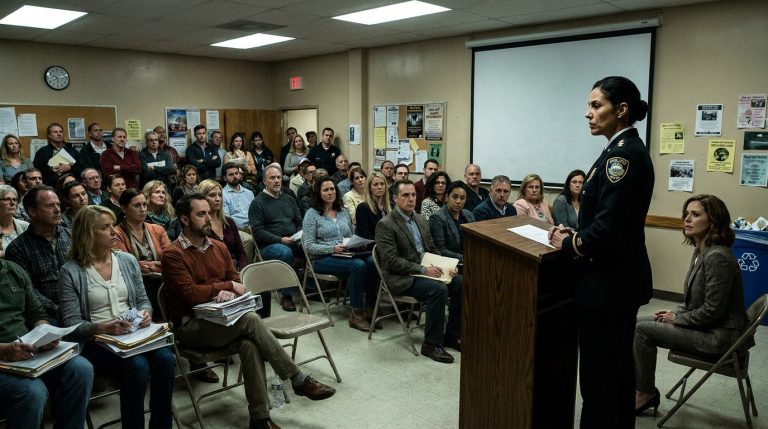
A Ghost in the Wire: Gunnery Sergeant Higgins Confronts the Frozen Architecture of Modern Military Protocol
CHAPTER 1: THE GATEKEEPER’S BARRIER
The air at the gate was thick enough to chew, smelling of wet asphalt and the ozone of high-voltage security. Gene Higgins felt the weight of the air, not as heat, but as resistance. When the scanner spat out the error—a stark, crimson ‘ACCESS DENIED: NULL-GHOST’—the silence that followed wasn’t just a lull in conversation. It was a structural failure.
Corporal Davis stared at the screen. His eyes, clear and empty as a polished marble, flickered from the device to Gene’s forearm. The tattoo—the snarling wolverine, the downward-pointing k-bar—looked darker, more aggressive against her paper-thin skin than it had in the morning light.
“Ma’am,” Davis began, his voice flat, stripped of the polite cadence he’d used seconds ago. He kept his hand near his belt, not in a defensive posture, but with the calculated stillness of a predator waiting for a mistake. “This system doesn’t make errors. ‘Null-Ghost’ is a protocol flag. It means you’re either an unverified ghost in the database or an active security breach.”
Gene didn’t step back. She didn’t blink. She watched the way his pupils dilated, measuring the distance between his radio and his sidearm. She’d spent forty years teaching herself to look for the ‘tell’ in a soldier’s stance—the micro-tremor in the index finger, the shift in weight to the balls of the feet. Davis was terrified, and that made him dangerous.
“Check the name again, Corporal,” Gene said, her voice dropping into a register that had once silenced an entire platoon of raw recruits. It wasn’t loud, but it possessed a weight that seemed to bend the humid air around them. “And don’t look at the screen. Look at the credentials. I am here for Platoon 30041.”
“I’ve checked the name, ma’am.” Davis didn’t look up. He was staring at the tattoo again, his lip curling in a mix of condescension and genuine, deep-seated confusion. “There’s no Higgins listed as an authorized sponsor for this platoon. And this ink… it’s not a unit identifier I recognize. It’s a violation of the uniform code, even for a civilian guest.”
He reached for his radio, his movements deliberate. “Control, this is Gate One. I have an unauthorized civilian, potential stolen valor, code ‘Null-Ghost’ status. Requesting immediate support.”
Gene felt the shift in the atmosphere—the way the guards in the distance stopped their pacing, the way the queue of families suddenly became very small, very far away. The world had narrowed down to the strip of pavement between her and the corporal. She noticed a glint of metal on his vest—a sharp, angular edge that caught the sun. It was an objective fact, a piece of physics in a world that was rapidly losing its logic.
She looked past him, toward the parade deck where she knew her grandson was standing in perfect, rhythmic alignment with his peers. She remembered the specific, jagged sensation of the needle when that tattoo was inked, the smell of cordite and wet ferns, and the promise she’d made to a boy from Ohio who never made it home.
The radio crackled. A voice, cold and sterile, replied, “Copy, Gate One. Contain the asset. Do not let the visitor leave the perimeter.”
Gene’s hand curled into a fist, the knuckles white. The word ‘asset’ hit her like a physical impact. They weren’t just checking her ID anymore. They were isolating her, and the cold, mechanical efficiency of the process told her this wasn’t an accident. She had been erased from the system, and now, the system was trying to decide if she was real at all.
She felt a movement to her left—a shadow elongating across the concrete. A new guard, older, his eyes narrowed as he focused on the ink on her arm. He didn’t look like a soldier; he looked like an executioner. The information gap in her mind widened—why now? Why today? As the second guard stepped into her personal space, the air temperature seemed to drop ten degrees, and Gene realized the true purpose of the ‘Null-Ghost’ flag. It wasn’t meant to keep her out. It was meant to ensure she could never leave.
CHAPTER 2: THE CHAIN OF COMMANDS CALCULATION
The air in the staging area was not just humid; it was ionized. As the second guard—a staff sergeant with a face like a slab of granite—closed the distance, the ambient sound of the depot changed. The distant, rhythmic marching of recruits, once a comforting pulse, was replaced by a high-pitched electronic whine emanating from the scanner. Gene didn’t look at the guards. She kept her eyes locked on the terminal screen, watching the cursor blink in a hypnotic, rhythmic pattern that didn’t match any standard operating system she had ever seen.
“Ma’am, you’re making this difficult,” the staff sergeant said. His voice was lower than Davis’s, layered with a professional, practiced neutrality that felt more dangerous. He stood just outside her reach, his body angled to cut off any path to the exit. “Whatever this flag is, it’s tripping a high-side security alert. I don’t know who you are, but you are not on the guest list.”
Gene felt a phantom chill trace her spine—a sudden, sharp memory of a briefing room in 1969, the smell of damp paper and stale coffee, and a general telling her that her name would be removed from the record for her own “protection.” The scanner’s hum deepened, a low vibration that traveled through her boots and up into her joints. She realized with a jolt of cold clarity that this wasn’t just a guard checking an ID. The scanner was pulling data from a deep-storage server, likely an old, air-gapped system that only triggered when a specific, long-dead file was queried.
“I am Jean Higgins,” she said, her voice steady, pulling on the anchor of her own identity to ground herself against the disorientation. She didn’t offer her rank. The title ‘Gunnery Sergeant’ felt like a weapon she wasn’t allowed to draw in this environment. “I have a grandson graduating today. You can call the command suite, or you can continue to waste your time and the depot’s resources.”
“We’ve already called the command suite,” the staff sergeant replied, his gaze flickering briefly to the tattoo on her arm. He didn’t look at it with the confusion of a youth; he looked at it with a dawning, guarded recognition. “They’re not interested in a phone call. They’re sending a detail to escort you to a holding area until the ceremony is concluded.”
Gene felt the muscles in her neck tighten. A holding area. The phrase was a euphemism for a quiet, windowless room where she would be kept until the political optics of the day were safe. She shifted her weight, feeling the familiar, ground-level friction of the concrete beneath her. She was a master of the landscape, and she knew exactly how to navigate this small, sterile cage. She took a half-step forward, not toward the guard, but toward the desk, forcing him to shift his own stance to maintain the tactical advantage.
“You’re making a tactical error,” Gene said, her tone dropping into the cold, clinical rhythm of a briefing. “You’re treating a legacy error as an active threat. If you move me now, you create a log entry that you won’t be able to scrub. Is that the kind of career record you want to leave behind?”
The staff sergeant blinked. He hadn’t expected the analytical counter-move. For a split second, the professional mask slipped, revealing a flicker of uncertainty. He looked at Corporal Davis, who was standing a few feet away, his hands trembling slightly as he clutched the radio.
“Sergeant, we have the clearance code,” Davis whispered, his voice rising in panic. “The system says she’s a risk.”
“The system is a machine, Corporal,” Gene interrupted, her voice cutting through his panic like a blade. She looked at the staff sergeant, reading the micro-tensions in his jaw. He was a creature of the chain of command, a man who lived and died by orders. But he was also an NCO, and NCOs respected competence. “Look at the terminal. Look at the source code identifier in the corner. If you process me as a ‘Null-Ghost’ without verifying the origin of the flag, you’re violating the foundational protocol of the Marine Corps: verify before you act. Are you a Marine, or are you a user of this terminal?”
The staff sergeant looked at the screen. The flickering fluorescent light cast long, sharp shadows across his face, highlighting the exhaustion in his eyes. He reached out a hand, his fingers hesitating inches from the keyboard. Gene held her breath. This was the pivot point. If he tapped the wrong key, he would trigger a lockout that would turn this entire staging area into a secure vault.
“Who are you, really?” he asked, his voice barely audible over the hum of the scanner.
“I am a guest who was invited to see her grandson graduate,” Gene replied, keeping her gaze locked on his. “And I am a woman who has earned the right to stand on that parade deck. If you want to play ‘security risk,’ go ahead. But if you want to perform your duty, you will pick up that radio, demand a direct line to the Sergeant Major, and tell him the name Jean Higgins is currently being held at Gate One.”
The air in the room seemed to compress. The staff sergeant’s finger hovered over the terminal, then slowly, deliberately, he pulled it back. He didn’t look at the screen again. He turned his back on the terminal and picked up his radio.
“Gate One to Command,” he said, his voice clipped and formal. “We have a situation. We are holding a party… she claims to be Jean Higgins. Requesting immediate verification from the Sergeant Major’s office.”
The response on the other end was a chaotic blur of static and voices. Gene stood silent, her heart rate perfectly controlled, her internal geography mapping the exits and the positions of the guards. She wasn’t just a grandmother anymore; she was a variable that had just rewritten the equation of their morning. The staff sergeant turned back to her, his expression unreadable.
“They’re coming down,” he said, his voice flat. “But don’t think this is over. Whatever you’re involved in, it’s bigger than this gate.”
“I know,” Gene whispered, looking past him to the sliver of the parade deck visible through the gate’s opening. The sun was beginning to break through the haze, casting long, sharp shadows that cut across the field, marking the exact spots where the future Marines stood. “It’s been bigger than this gate for forty years.”
She waited, her posture perfectly relaxed, her mind already calculating the fallout of the coming encounter. She could feel the vibration of the heavy command vehicles in the distance, a low-frequency rumble that heralded not just the arrival of the brass, but the beginning of a truth that had been buried for too long. The game had moved from the shadows into the light, and for the first time in four decades, the Ghost of the Highlands was ready to be seen.
CHAPTER 3: THE DIGITIZED DECEPTION
The staff sergeant didn’t move far from the console, his eyes glued to the screen. Gene stayed in the small, designated square of the staging area, her weight distributed evenly, her hands relaxed at her sides. She watched the way he tapped at the glass screen of his tablet, his movements sharp and impatient. Every time he pressed a key, the terminal emitted a soft, high-frequency chirp, like a bird trapped behind steel.
“You’re watching, aren’t you?” the staff sergeant murmured without looking up. It wasn’t a question; it was a realization.
“I’m waiting,” Gene corrected. Her voice didn’t waver. “And I’m watching you make the same mistake my generation made when we trusted the paperwork more than the person standing in front of us.”
He stopped typing. He looked at her, and for a fleeting second, the professional armor cracked. “This isn’t just a standard security check, ma’am. I’ve been a Marine for twelve years. I know what an ID check looks like. This… the encryption coming back from the central server… it’s not local. It’s coming from a tier-one facility.” He paused, his gaze dropping to the screen. “It’s deleting things. Every time I hit ‘verify,’ another file in your sub-directory vanishes.”
Gene leaned forward, just enough to see the screen over his shoulder. He was right. A small, blue-and-white icon labeled ‘Service Record’ was flickering with a jagged, scarlet border—an ‘Archival Restricted’ stamp. Below it, a line of text that should have been static was scrolling rapidly, disappearing into the digital ether: [ACCESS_DENIED_EXCISION_IN_PROGRESS].
She felt a cold, familiar knot tighten in her stomach. This wasn’t a glitch. It was an active purge. Someone, somewhere in the command chain, had flagged her presence not as a security breach, but as an opportunity to finish a job that had been left hanging for decades. They were going to wipe her military history before she ever made it to the parade deck.
“Don’t stop it,” Gene said, her voice a low, warning rasp. She moved closer, stepping into the staff sergeant’s peripheral vision. “If you try to override a tier-one purge, you’ll be flagged as an accessory. Step back.”
“I can’t just let it happen!” he countered, his face flushing with the agitation of a man who realized he was being used. “This is your history. It’s the history of the Corps.”
“My history is etched in bone and ink, not in a server room,” Gene said, her gaze fixed on the screen. She watched as her Navy Cross citation—the one she had earned in the AA Valley—was dragged into the digital trash heap. It stung, a sharp, physical pain that mirrored the shrapnel wounds she still carried under her skin, but she held her ground. “If they want to bury me, let them try. But make sure you keep the terminal open. If they’re erasing, they’re logging. Capture the path of the purge.”
The staff sergeant looked at her, his eyes wide, finally seeing the predator-prey dynamic for what it was. She wasn’t an old woman being bullied; she was a soldier who had spent her entire career being hunted, and she knew exactly how to make the hunter reveal their position. He turned back to the screen, his fingers moving with frantic, calculated precision. He didn’t try to stop the deletion; he initiated a hidden, mirror-log script that diverted the purge traffic to a local, air-gapped drive on his own handheld unit.
“You’re playing a dangerous game,” he whispered, his voice shaking slightly. “If they catch me doing this—”
“If they catch you, it’s because you were looking for the truth,” Gene said. “That’s what a Marine does.”
The hum of the terminal rose in pitch until it was almost painful. Suddenly, the screen went black. The ‘Null-Ghost’ light above the gate flashed a blinding, continuous red, then extinguished. The gate didn’t open. Instead, a series of heavy, electromagnetic locks engaged, the sound of metal slamming into metal echoing through the small staging area. The silence that followed was absolute.
“We’ve been isolated,” the staff sergeant said, his voice now devoid of professional pretense, replaced by raw, tactical focus. He looked at the locked gate, then at the entrance to the command suite in the distance. “They’ve locked the sector.”
Gene felt the shift in the atmosphere. The security protocol had escalated from ‘verify’ to ‘containment’. They had wiped her record, but they had also trapped themselves in the same room. She scanned the room—the concrete floor, the heavy steel-reinforced desk, the high, reinforced windows that allowed only a sliver of natural light to touch the floor.
“They haven’t just locked the sector,” Gene said, her voice cooling into the sharp, precise tone of a recon lead. “They’ve provided us with a closed environment. Sergeant, look at the internal routing. If they’ve purged the record, they need a confirmation signal to close the incident file. They think they’ve won. They think the ‘Null-Ghost’ has been neutralized.”
“How do we use that?” he asked, already checking the weapon at his side, his demeanor shifting from guard to ally.
“We don’t try to break out,” Gene said, stepping toward the center of the room. She looked at the terminal. “We send a signal back. A ghost-ping. We use their own purge-path to open a line to the Sergeant Major’s private terminal. If he’s still in the command suite, he’ll see the incoming packet. He’ll see that the purge wasn’t a system error, but an active, manual override.”
She looked at him, her eyes chips of blue flint. “You wanted to know who I was, Sergeant? I’m the woman who makes sure the record stays clean. Now, help me reach the man who still believes in the institution.”
The air between them was electric with the weight of the moment. The staff sergeant didn’t hesitate. He pulled the terminal cables and began to strip them, his hands steady, his focus absolute. Outside, the sound of heavy boots echoed on the pavement—the sound of an arrival that would decide whether they were soldiers or ghosts.
CHAPTER 4: THE CONFRONTATION ON THE PARADE DECK
The sound of the high-pitched alarm was absolute, cutting through the heavy, stagnant air of the staging area like a serrated blade. The staff sergeant shoved his handheld unit into his vest, his face pale under the rhythmic, pulsing red glare of the emergency strobe.
“They know,” he said, his voice stripped of all but the most basic, tactical necessity. “The drive isn’t just archiving; it’s broadcasting our node location. They didn’t just want to erase the file, Sergeant. They wanted to draw us out.”
Gene didn’t panic. She watched the heavy gate—the one they had been trying to get through—begin to shutter downwards, a solid wall of steel sealing them inside the staging area. The sound of the grinding gears was deafening, a physical reminder of the trap closing around them. She could see the black government vehicles now, pulling into the perimeter, their headlights cutting through the swirling dust and strobe-light red.
“They aren’t coming to talk,” Gene said, stepping toward the only exit that remained—a narrow, restricted-access maintenance door usually reserved for janitorial staff. “They’re coming to secure the narrative.”
“If we leave through that, we’re technically abandoning our post,” the staff sergeant said, but his boots were already moving, matching her pace with instinctive, soldierly rhythm. “That’s a court-martial offense.”
“If we stay here, we’re a footnote in a classified purge file,” Gene shot back, her eyes scanning the exterior through a crack in the door. The staging area was already being cordoned off by a group of tactical-response MPs. They moved with the silent, terrifying efficiency of men who had been told they were handling a high-level containment breach. “You choose, Sergeant. A court-martial, or a memory that ceases to exist.”
He didn’t answer. He kicked the maintenance door, his shoulder driving it open with a metallic groan. They stepped out into the blinding, unfiltered light of the South Carolina afternoon. The sudden brightness was a physical blow, forcing Gene to blink against the glare. The parade deck stretched out before them, a vast, open expanse of concrete, its stillness shattered by the low, ominous thrum of the approaching command vehicles.
They moved along the perimeter, staying in the deep, sharp-edged shadows of the barracks. Gene’s heart beat in a steady, controlled rhythm—the same rhythm she had kept while traversing the jungle, while carrying the weight of wounded men, while standing her ground against a tide of orders meant to silence her. Every footfall was a calculation, every shadow a shield.
“Look,” the staff sergeant hissed, pointing toward the reviewing stand.
Colonel Vance was there, standing with Sergeant Major Alvarez. But they weren’t alone. A group of men in dark, non-military suits stood with them, their posture rigid, their presence at odds with the clean lines and crisp uniforms of the Marines. They were the architects of the ‘Null-Ghost’ flag, the men who turned service into a spreadsheet and erased history with a keystroke.
Gene watched as one of them—a man with a sharp, angular face and eyes that didn’t seem to focus on anything in the physical world—gestured toward the staging area where they had just been. He was holding a tablet that glowed with the same, sinister red light as the terminal had, the light of an active erasure in progress.
“They’re not just scrubbing the file,” Gene realized, the truth hitting her with a cold, hollow weight. “They’re verifying the deletion of the person. They think they can finalize the file by removing the subject.”
She felt a surge of cold, razor-sharp resolve. This wasn’t about the tattoo, or the service record, or the graduation ceremony. This was about the fact that she was a living, breathing contradiction to the narrative they had spent decades writing. And they were going to do everything in their power to make sure that contradiction was resolved.
“We need to get to the Colonel,” Gene said, her voice low. “Not the Sergeant Major, not the MPs. Vance. He’s the only one who still recognizes the weight of a uniform.”
“How?” the staff sergeant asked, his gaze darting between the MPs and the men in suits. “We’re already flagged. Any move we make will trigger a lethal-response lockdown.”
“We don’t move like soldiers,” Gene said, her eyes shifting to the swirling crowd of families near the reviewing stand. “We move like ghosts.”
She didn’t wait for him to agree. She stepped out of the shadow and into the flow of the crowd, her bright red jacket a sudden, vivid splash of color against the drab, uniform-gray of the military background. She became exactly what they expected her to be: an elderly woman, perhaps a little lost, a little confused, shuffling toward the grandstands.
It was a performance of the highest order—the kind of tactical camouflage that only the truly dangerous ever mastered. She could feel the gaze of the MPs scanning the crowd, their eyes sliding over her, dismissing her as nothing more than a civilian distraction. She felt the staff sergeant fall in behind her, his posture hunched, his hands hidden in his pockets, his entire being radiating the discomfort of a man who didn’t want to be noticed.
As they neared the reviewing stand, Gene could see the Colonel’s face. He was staring at the staging area, his expression one of profound, dawning anger. He saw the red strobe light. He saw the suits. And then, he saw her.
For a heartbeat, their eyes locked. Gene didn’t look like a grandmother. She looked like the Gunnery Sergeant who had stood on that same parade deck forty years ago, the woman who had demanded respect not with words, but with a presence that could stop a war. The Colonel’s eyes widened, a flicker of shock passing through him before he regained his command composure.
He didn’t acknowledge her. He turned back to the man in the suit, his shoulders squaring, his voice ringing out across the deck. “This is my depot,” the Colonel said, his tone low but carrying the weight of a thunderclap. “And every soul on it is under my command, whether they’re on the rolls or not.”
Gene took a final step toward the stand, the adrenaline humming in her veins. The endgame had begun, and for the first time in her life, she wasn’t going to disappear.
CHAPTER 5: THE UNVEILING
The transition from the shadow of the barracks into the glare of the parade deck was a shock to the senses. The air felt thinner here, charged with the rhythmic, synchronized thud of hundreds of boots striking the concrete—a heartbeat of the institution she had once belonged to. Gene walked with a steady, measured gait, the staff sergeant trailing half a step behind her, his presence a silent wall against the prying eyes of the MPs.
The crowd near the reviewing stand shifted. People sensed the friction; they saw the juxtaposition of the woman in the faded red jacket and the suit-clad men standing like vultures beside the Colonel. As Gene approached the stairs of the reviewing stand, the man with the sharp, angular face stepped down, blocking her path. His eyes were cold, devoid of the respect a Marine—even a retired one—would naturally accord another.
“Gunnery Sergeant Higgins,” the man said, his voice a low, modulated drone. He didn’t offer a hand. He didn’t even acknowledge the staff sergeant. “You are currently in a restricted area. This is a private graduation ceremony. You need to leave, now.”
Gene didn’t stop. She closed the distance until she was inches from him, forcing him to tilt his head back to maintain eye contact. “I am here for my grandson, and I am here for the record,” she said, her voice cutting through the ambient noise of the ceremony. She reached into her pocket and pulled out the small, battered memory drive the staff sergeant had filled. “I believe you’re looking for this.”
The man’s expression didn’t change, but his pupils contracted—a sign of the hunter recognizing the prey had turned. “That drive is stolen property. You are in possession of classified information. Give it to me, or I will have the military police take you into custody.”
Behind him, Colonel Vance finally moved. He descended the stairs, his face a mask of iron-clad resolve. The Sergeant Major followed, his hand resting instinctively near his belt. The Colonel stopped between Gene and the man in the suit, his height and presence dwarfing the civilian.
“The Gunnery Sergeant is my guest,” the Colonel said, his voice resonant and dangerously calm. “And you, sir, are on my base. You seem to have forgotten that the Depot Commander has final authority over all security protocols, including your little ‘Null-Ghost’ audit.”
“Colonel, you don’t understand the scope of this,” the man countered, his voice losing its modulated chill, rising into a sharper, more frantic register. “This woman represents a liability that the Department of Defense has been mitigating since 1969. She was never officially attached to Force Recon. She never existed in the combat logs. If you allow her to present this ‘evidence,’ you are facilitating the collapse of a fifty-year-old operational narrative.”
The crowd around them seemed to fall into a sudden, suffocating silence. Even the boots on the parade deck seemed to stutter. Gene felt a wave of dizziness—the V-4 variance, the world around her turning into a distorted, droning hum. She focused on the Colonel’s shoulder patch, using the solid, embroidered image to ground her reality.
“She didn’t exist?” the Colonel asked, his voice now a low, predatory growl. He looked at Gene, then back at the man. “I have read the redacted file. I have seen the Navy Cross citation. The only thing that didn’t exist was the courage to acknowledge what she actually did.”
Gene stepped around the Colonel, her movements fluid and unhurried. She approached the podium, the microphone feeding back with a shrill, piercing squeal that turned every head on the parade deck. She looked out at the thousands of people—the families, the Marines, the recruits—and then down at her grandson, Michael, standing in the front rank of India Company. His face was pale, his eyes wide as he looked up at her.
“I am Jean Higgins,” she began, her voice steady, broadcast across the entire deck. “I am a Marine. I served in the shadows because that is where the mission required me to be. And for forty years, I have allowed the record to remain incomplete because I believed that the institution was greater than the individual.”
She looked at the man in the suit, who was reaching for his phone, his face twisted in a silent, furious snarl.
“But today, I saw a young Marine be humiliated by a security protocol that was designed to protect the truth, but is used to destroy it,” Gene continued. She held the drive up, the small piece of plastic catching the sunlight. “This is not just my history. This is the history of every Marine who fought when the world was told they weren’t there. If you want to erase me, you’ll have to erase the truth as well.”
The man in the suit moved toward her, his hand darting into his jacket, but the staff sergeant moved faster. He stepped in, his hand gripping the man’s wrist with the vice-like strength of a trained combatant. The Sergeant Major stepped in from the other side, his presence a solid, immovable block.
“I believe you’re finished here,” the Sergeant Major said, his voice flat and final. “Colonel, what are your orders?”
“Escort this man and his associates to the gate,” the Colonel commanded, his gaze fixed on Gene. “And ensure they do not leave the premises until the Inspector General arrives to audit their ‘Null-Ghost’ software.”
Gene lowered the drive. The droning in her ears subsided, replaced by the sound of the wind, the distant hum of the crowd, and the steady, rhythmic breathing of the men and women standing in formation. She had done it. The secret was out, not as a whisper in a dark room, but as a public record etched into the consciousness of the entire Depot. She looked at Michael, and for the first time, she saw not confusion, but a profound, shimmering pride. She had given him a legacy that couldn’t be scrubbed.
CHAPTER 6: THE FINAL ECHO
The parade deck was cooling now, the late-afternoon sun stretching the shadows of the barracks into long, dark fingers across the concrete. The standoff had vanished, leaving only the residue of a quiet, inevitable victory. The men in suits were gone, escorted to the periphery of the base where the weight of federal accountability would soon replace their administrative arrogance. Colonel Vance stood at the edge of the reviewing stand, his posture rigid as he watched the final formation of recruits begin their dismissal.
Gene stood beside him, her hands still steady, though the adrenaline of the last hour was beginning to recede, leaving behind the dull, familiar ache of old wounds. The air felt cleaner, stripped of the static-heavy interference that had defined her morning. She looked down at the parade deck. The recruits were moving, their disciplined lines breaking into the scattered, chaotic joy of newly graduated Marines.
“They won’t stop with a single IG audit, Jean,” the Colonel said, his voice low, directed not at the crowd, but at the horizon. “They have layers of bureaucratic shielding that would take years to peel back. But you’ve made it impossible for them to continue the purge without public scrutiny. You’ve turned their silence into a spotlight.”
Gene nodded slowly. She didn’t seek the glory of the win. “It wasn’t about winning, Colonel. It was about making sure that the cost of erasure became too high for them to pay.”
She looked up as her grandson, Michael, approached the reviewing stand. He moved with a new, hesitant grace, his eyes fixed on her with a mixture of reverence and fear that she knew would take years to settle into normal family affection. He stopped at the bottom of the steps, standing at a perfect, rigid position of attention.
“Gunnery Sergeant,” he said, his voice thick with unspent emotion. He didn’t use the term ‘Grandma’. He used the rank that had been stolen from the records, the rank that he had just seen proven in the face of institutional rot.
Gene stepped down the stairs, her movements slow, deliberate. She stopped in front of him and reached out, her fingers finding the collar of his uniform. The brass was cold, sharp-edged—the tangible, physical reality of the Marine he had just become. She adjusted it, a small, maternal correction that carried the weight of a generational passing of the torch.
“You look like a Marine, Michael,” she said, her voice soft, the hardness of the last few hours melting away. “Now, remember what I told you. The uniform doesn’t make the man. The character you carry beneath it does.”
She reached into her pocket, pulling out the small, jagged piece of metal—a memento she had kept for decades, a piece of shrapnel removed from her own body after the extraction in the AA Valley. She pressed it into his palm, closing his fingers over it. It was the physical object she had carried as a reminder of the price of the mission, and now, it was his to hold.
“This is the cost,” she whispered. “And the reward is what you see out there. The pride of the people who rely on you, and the knowledge that you never abandoned your post, no matter how many people told you that you weren’t there.”
The denouement began with a profound, atmospheric settling. The parade deck, once a place of tension and confrontation, became a quiet, hallowed space. The Colonel stepped back, giving them the privacy that had been denied to them all day. Nearby, the staff sergeant stood watch, his presence no longer that of a guard, but of a witness. He looked at Gene and gave a single, respectful nod—a silent acknowledgement of the ghost who had walked into the light.
Gene walked with Michael to the edge of the parade deck. The noise of the crowd had faded into a low, rhythmic hum. She looked at the horizon, where the heat haze shimmered over the distant tree line—the place where the jungle of her memories lived, now forever separated from the reality of the present.
“What happens now?” Michael asked, his eyes scanning the horizon.
“Now,” Gene said, a small, genuine smile touching her lips, “you go home. You take your leave, you see your parents, and you tell them that you did your job. And I? I go back to the life I built in the gray areas, knowing that for the first time in forty years, the record matches the reality.”
She turned, her movements light, almost buoyant. She felt the heavy, stifling weight of the last four decades lifting, replaced by the simple, profound peace of a debt finally paid. As she walked toward the main gate, the sun dipped behind the barracks, casting a final, golden light across the parade deck. The tattoo on her arm—the wolverine and the k-bar—seemed to settle into her skin, no longer a mark of a secret war, but a testament to a life lived in service to an ideal that even the deepest purge couldn’t touch.
She didn’t look back. She didn’t need to. The legacy was secure, the ghost had finished her tour, and for the first time since the jungle, the air was entirely, beautifully her own.