The Weight of the Thread: A Journey Through Honor, Forgiveness, and the Lingering Echoes of Valor
CHAPTER 1: The Threshold of Memory
The Grand Majestic Hotel lobby was a cathedral of modern indifference. Crystal chandeliers cast a sterile, diamond-sharp light over the marble, rendering everything—the guests, the potted ferns, the evening’s ambition—in high-definition clarity. Captain Kyle Evans stood at the center of this world, his dress blues a sharp, rigid frame for his authority. His medals, a crisp grid of color, didn’t move as he stared down the man in the khaki trousers.
“Sir, I’m going to need to see some form of identification,” Evans said. The request was a polite blade, honed to a point of exquisite condescension.
James O’Donnell, eighty-six years of gravity etched into the lines of his face, didn’t shift his stance. He stood with a peculiar, heavy stillness that seemed to draw the oxygen out of the air immediately surrounding him. His leather jacket was a map of another life—cracked, supple, and weathered to the point of near transparency.
“My grandfather is a guest of General Morrison,” Lily said. Her voice was bright, a forced veneer of normalcy that didn’t quite cover the tremor in her hands. She reached out, her fingers brushing James’s arm, but he seemed not to feel it. He was listening to something beyond the reach of the hotel’s ambient hum.
Evans turned his attention to the sleeve. His gaze caught the circular patch, a ghost of an image clinging to the frayed threads. He let a small, sharp smirk touch his lips. It was the look of a man who had found the weak link in a chain he didn’t care to understand.
“This event is for active-duty personnel and esteemed veterans,” Evans said, his voice dropping into the smooth, practiced register of a man who enjoyed the sound of his own power. “We have standards for who wanders in off the street.”
James finally turned. His eyes were the color of a winter sky—clear, pale, and utterly devoid of the clutter of present-day nerves. He didn’t blink. He didn’t offer a defense. He simply observed the Captain, cataloging the tension in the younger man’s jaw, the rigid posture that shielded a profound lack of perspective.
The air in the lobby tightened. Guests began to slow their pace, their conversations dying out like embers in a draft. They sensed the shift—a friction between the polished veneer of the present and something older, heavier, and far more dangerous. Evans stepped closer, his boots clicking sharply against the stone, violating the space James occupied. He reached out, his finger hooking beneath the edge of the frayed patch, tugging it slightly.
“Souvenir from a gift shop?” Evans whispered, loud enough for the gathering crowd to hear.
The moment his skin touched the fabric, the hotel didn’t just go quiet; it seemed to vanish. The sterility of the lobby was violently stripped away. James felt the sudden, crushing weight of humidity. He heard the rhythmic, deafening thrum of helicopter blades beating the air into a chaotic, suffocating froth. He smelled the iron tang of blood and the sharp, chemical bite of burning fuel. He saw the patch—vibrant, terrifying, and new—stitched onto the side of a gunship that was already screaming toward a horizon of fire.
The sensory onslaught hit him like a physical blow, a sudden, jolting reminder of the price paid for the silence he had carried for decades. He steadied himself, his hand trembling almost imperceptibly against the leather of his jacket.
Evans, still smiling his empty, triumphant smile, watched the old man’s face for a reaction, oblivious to the fact that he was standing in the middle of a war zone he couldn’t see.
CHAPTER 2: The Geometry of Silence
The hotel lobby did not return all at once. It leaked back into James O’Donnell’s consciousness in painful fragments: the muffled, rhythmic thud of a distant bass-heavy beat, the sharp scent of an expensive floral cologne, and the insistent, invasive pressure of Captain Evans’s finger still resting against the fabric of his sleeve. The roar of the rotors faded into the hum of the HVAC system, but the phantom vibration remained, humming in the marrow of James’s bones.
He took a slow, measured breath, grounding his heels against the polished marble. He had spent decades learning how to cage the noise, how to build walls out of silence and focus. He pushed the jungle away, bit by bit, until the oppressive humidity was replaced by the dry, recycled air of the Grand Majestic.
Evans was still looming, his smile an arrogant, fixed expression that clearly signaled he expected a crack in the old man’s facade—a stutter, a plea, or the confused rambling of someone who had lost their grip on the present.
“Cat got your tongue, pops?” Evans murmured. The insult was draped in a thin layer of false politeness, designed to humiliate James in front of the growing audience of hotel guests.
James looked at the finger pressing into his jacket. He didn’t move it. He didn’t slap it away. He simply stared at it with the clinical detachment of a man watching a small, insignificant insect crawling across a map.
“The patch,” James said, his voice a dry, papery rasp that seemed to catch everyone off guard. It was the first time he had spoken in the lobby, and the sound carried a surprising, resonant weight. “It’s not a souvenir, Captain.”
Evans pulled his hand back, though his expression remained mocking. “No? What is it then? A prize from a flea market? A relic of a war you think makes you special enough to walk past security?”
Lily stepped forward, her hand reaching out to grab James’s elbow, her eyes darting between the towering, well-dressed Marines and the gathering crowd of onlookers who had begun to pull out their phones. “Captain, please,” she said, her voice strained. “He has an invitation. We are guests of the General. Let us pass.”
Evans didn’t look at her. He kept his eyes locked on James, searching for a tremor, a sign of weakness, anything to validate the power structure he had built for himself. “The General’s guest list is a precise document, Miss. And O’Donnell isn’t on it. I’ve checked. Twice.”
The lie was a common tool in the Captain’s arsenal—a weaponized piece of administrative friction designed to make the target feel invisible.
James didn’t argue. He didn’t pull out the invitation Lily was holding. He didn’t even look at the crowd. He shifted his gaze toward the far end of the lobby, where a man in his late fifties stood leaning against a decorative pillar. He wore a security uniform, but his posture was all wrong—too relaxed, too observant, his shoulders squared with a subtle, unmistakable discipline that had nothing to do with hotel policy.
It was Gunnery Sergeant Miller. James didn’t know his name, but he knew the silhouette. It was the same geometry of a man who had spent his life standing guard over things that didn’t want to be found.
Miller’s gaze locked with James’s. There was no flicker of uncertainty there. It was a look of quiet, hard-earned recognition. Miller’s jaw tightened, and he took a half-step forward, his hand drifting toward his radio, though he stopped himself. He saw Evans nearing his peak, that dangerous precipice where the Captain’s need for control would likely drive him to physically lay hands on the old man.
James looked away from Miller and back to Evans. The Captain was now puffing out his chest, the medals on his uniform catching the light. He was preparing to finish this, to call for hotel staff to escort them out—a move that would serve as the final, crushing demonstration of his dominance.
“One more time, Mr. O’Donnell,” Evans said, his voice hardening, losing its playful edge. “Leave the lobby. Now. Or I’ll have security do it for you. And I assure you, it won’t be a polite exit.”
Lily’s hand tightened on James’s arm. She was frightened, her breathing shallow, her eyes wet with the sting of public humiliation. “Grandpa, let’s just go,” she pleaded in a low whisper. “It isn’t worth it. Please.”
James felt the pull of the exit, the instinct to avoid the conflict, to return to the quiet of the diner, to the safety of the known. But beneath that, there was a deeper, older friction. He had walked through fire to ensure that the peace Lily enjoyed today could exist. If he walked away now, he wouldn’t just be yielding to a arrogant boy; he would be abandoning the truth of what that patch represented.
He reached out, his hand—spotted with age and mapped with veins—resting on the collar of Evans’s crisp, midnight-blue jacket. He didn’t pull, didn’t shove. He just held the material, his grip light but impossible to ignore.
“You speak of the Corps as if it’s a ledger of names on a list,” James said. His voice wasn’t loud, but it possessed a strange, vibrating quality that seemed to dampen the ambient noise of the lobby. “But a ledger is just paper, Captain. It has no memory. It has no heartbeat.”
Evans recoiled, surprised by the touch. He went to brush James’s hand away, but the old man’s grip held with a tenacity that was startling. It wasn’t the strength of a young man; it was the leverage of someone who knew exactly where the weak points were, physically and psychologically.
“Get your hand off me,” Evans hissed, his facade beginning to crack, his face mottling with a rush of indignant heat.
“I’ve seen men like you before,” James continued, his gaze drifting back to the far end of the lobby. He saw Miller now, his phone pressed to his ear, his back turned to the crowd, walking toward the administrative offices. The logic of the situation was unfolding in real-time. The conflict was no longer a disagreement; it was a transition.
James released his grip on the Captain’s collar. He looked at Lily, his face softening, the hardness of the ‘Viper’ receding into the familiar warmth of her grandfather.
“Wait here, Lily,” he said softly.
He didn’t wait for Evans to reply. He didn’t wait for security. He took a steady, deliberate step forward, forcing the Captain to retreat, the space between them shifting as the old man moved with an unexpected, fluid grace. He wasn’t retreating. He was walking toward the center of the lobby, toward the open space where he would be visible to everyone, where the confrontation would be forced to its inevitable, public conclusion.
He was no longer just an old man in a frayed jacket. He was a piece of history moving through a room that had forgotten how to read the past.
CHAPTER 3: The Shadow of the Guard
The distance between the edge of the lobby and the center was perhaps twenty paces, but for James, it felt like traversing a bridge of cooling glass. He felt the weight of every pair of eyes in the room—the curious, the judgmental, the indifferent—pressing against his back. Beside him, Lily’s breathing was sharp, erratic. She was out of her depth, and he could feel the tremor in her arm through his own, a frantic frequency that urged him to hurry, to escape, to find safety.
He didn’t hurry. He walked with the heavy, grounded cadence of a man who had measured his life in miles of mud and hours of waiting.
Gunnery Sergeant Miller was moving toward the administrative offices, his boots making no sound on the high-pile carpet. As James crossed the threshold from the carpet back onto the expanse of polished marble, he caught Miller’s eye once more. The Gunnery Sergeant was moving with a purposeful, economical gait that spoke of old habits and ingrained tactical awareness. Miller didn’t look back, but he paused near the heavy oak door leading to the office corridor, his hand resting on the brass handle. He checked his watch—a steady, deliberate motion—and then looked toward the lobby’s main entrance.
In that fleeting exchange, James read the entire board. Miller wasn’t retreating; he was positioning himself as a node in the network. He was waiting for a signal, or perhaps, for a particular arrival.
“Grandpa, please,” Lily whispered, her voice tight with panic. “Let’s just go back to the car. We don’t have to prove anything to him.”
James didn’t look at her, but he shifted his grip, his hand moving from her arm to gently cover her hand, squeezing it. The contact was brief, a silent transmission of stability. “We are already here, Lily. There is no going back now. The choice was made the moment he put his hand on this jacket.”
Captain Evans had stopped his retreat. He was standing near the front desk, his arms crossed over his chest, his face a mask of annoyed authority. He watched James approach with a predatory focus. He still believed he was the architect of this scene, that he was simply waiting for security to arrive and drag the old man away, ending the disruption to the Grand Majestic’s evening. He didn’t see the way the other Marines in the room were looking at James—not with the contempt Evans displayed, but with a wary, lingering curiosity.
“You’re making a mistake, O’Donnell,” Evans called out, his voice ringing against the marble. “If you walk any further, you’re trespassing on restricted space. I’m giving you one last chance to leave with your dignity intact.”
James didn’t respond. He kept walking, his boots clicking in a steady rhythm that seemed to sync with the distant, muffled sound of the city traffic outside. He reached aSystem Log: Pacing: P=38% | Status: 3/8 | Mode: Mode B (The Context Zone) | Layer 1: Public exposure of service history | Layer 2: The burden of survival | Truth Status: Locked | Variance Matrix: [V-4] (The protagonist’s internal perception of the hotel shifts as the threat becomes externalized, leading to a focus on structural security) | Sensory: Faded Textures (The cold, hard reality of the phone plastic, the muted sounds of the back-office corridor, the lingering smell of floor wax)
Dynamic Hook: The carry-over hook forces James to navigate the physical transition from the hostile, high-visibility stage of the lobby into the liminal, shadow-filled space of the hotel’s administrative heart, where the silence is heavy with the weight of the call being made.
CHAPTER 3: The Ghost in the Wire
James moved through the lobby with a quiet, measured pace that defied the frantic energy of the onlookers. Behind him, the sound of the crowd began to swell—a mixture of hushed questions and the rhythmic, agitated clicking of heels against stone. Captain Evans remained behind, momentarily anchored by the sheer audacity of James’s departure, his face a map of confused indignation. He was used to adversaries who argued, pleaded, or threatened; he had no paradigm for an enemy who simply walked away, treating his authority as a temporary weather pattern.
James didn’t look back. His focus narrowed to the threshold of the administrative hallway. The air here shifted instantly, losing the sterile, expensive polish of the lobby and taking on the utilitarian scent of industrial floor wax and stale coffee. This was the building’s circulatory system, the hidden arteries where the logistics of grandeur were managed.
He heard the soft, rapid-fire muffled tone of a conversation up ahead. It was the distinct cadence of a man who was no longer playing by the rules of polite society.
Gunnery Sergeant Miller was standing near a service door, his back to the corridor. He held a personal cell phone with a grip so tight his knuckles were bleached of color. The phone was a modern, sleek object, utterly incongruous with the grizzled, weathered landscape of Miller’s hands.
“Sir, you need to get down to the lobby right now,” Miller’s voice was a low, jagged rumble, stripped of the professional detachment he usually wore like a uniform. “There’s an incident. Captain Evans is confronting one of the general’s guests. He’s making a scene.”
James slowed, his boots making almost no sound on the industrial carpet. He didn’t interrupt. He stood in the shadows of an alcove, his breathing steady, his mind already parsing the tactical reality of the situation. He recognized the tone in Miller’s voice. It was the same tone he had used forty years ago when the radio crackled with incoming coordinates that meant certain death. It wasn’t panic; it was the chilling, absolute clarity of an emergency that superseded all established hierarchies.
“I’m on my way to the ballroom, Gunny. What is it?” The reply from the phone was a faint, tinny echo of authority, distant yet sharp with an edge of irritation.
“There’s an incident, sir,” Miller repeated, his gaze darting toward the lobby entrance, monitoring the movement of security staff. “Captain Evans is confronting one of the general’s guests, an elderly gentleman. He’s making a scene.”
“Evans? Damn it.” The voice on the other end carried the weight of a weary resignation. “All right, I’ll handle it. Who is the guest?”
James watched the back of Miller’s neck. The man was braced, as if expecting a physical blow.
“His name is James O’Donnell, sir.”
The silence that followed was not merely an absence of sound. It was a profound, atmospheric shift. James could feel it from ten feet away—the way the air seemed to thin, the way the hum of the building’s lighting became sharper, more intrusive. He watched Miller’s posture sag, just for a fraction of a second, before the man snapped back into a rigid, defensive focus.
James stepped forward, the floorboards beneath the carpet groaning softly under his weight. Miller spun around, his hand instinctively snapping to his side. When he saw James, the tension didn’t evaporate; it reconfigured. Miller’s eyes, seasoned by years of watching over a different kind of battlefield, searched James’s face. He wasn’t looking for a confused old man. He was looking for the ghost he had heard whispered about in the barracks, the legend who existed only in the redacted corners of training manuals.
“You’re O’Donnell,” Miller stated. It wasn’t a question. It was a realization of weight.
James nodded once, a gesture of quiet acknowledgement. He didn’t speak. He didn’t need to. The phone remained clutched in Miller’s hand, the line still open, vibrating with the silent, mounting anxiety of a man at the other end who had just had his world upended by a name.
“He’s coming,” Miller said, his voice dropping to a near whisper. “The Colonel. He knows the name.”
“I know,” James replied. His voice was steady, grounded in a reality that transcended the hotel’s luxury. “I’m not looking for an audience, Sergeant.”
“Sir, you don’t understand,” Miller insisted, his eyes restless, scanning the corridor for anyone else who might be listening. “Evans is a fool. He’s a product of the polish and the paint. He doesn’t know what you are. But the Colonel? The General? They know. And that makes this a lot more dangerous than a simple lobby dispute.”
James leaned against the wall, the cool, textured wallpaper a sharp contrast to the heat of the memory that still flickered at the edges of his vision. He could feel the familiar, sickening pull of the past, the way the ‘Viper’ designation acted like a gravity well, dragging him back into a world of deniable missions and tactical survival.
“I came here for a dance, Sergeant,” James said, his gaze fixed on the service door that led to the heart of the hotel’s infrastructure. “Not for a war.”
“With all due respect, sir,” Miller said, taking a step closer, lowering his voice until it was almost lost in the mechanical drone of the building’s ventilation, “in this uniform, sometimes the dance and the war are the same thing. You’re the target now. Once they realize who you are, they won’t just want to apologize. They’ll want to own the story. They’ll want to fix the history.”
James felt a faint, weary smile pull at the corners of his mouth. It was the same old trap—the need for those in power to control the narrative, to categorize the chaos of human experience into neat, manageable lines in a report.
“They can’t own what they don’t understand,” James said, his voice quiet.
Miller looked at him, and for a second, the sergeant seemed to be looking through the old man, seeing the younger version, the one whose face was carved into the memories of every man who had ever stood in the dark with him. “They’ll try, sir. They’ll try.”
James turned his gaze toward the end of the corridor, where the faint, high-pitched ringing of a phone echoed from the lobby, growing more frantic. The walls of the hotel seemed to pulse, a rigid, structural cage that was no longer a sanctuary, but a pressure cooker. He realized then that he wouldn’t be walking back into that ballroom as a guest. He would be walking in as an anomaly, a breach in the smooth, manufactured surface of their peace.
“What do you need me to do?” Miller asked, his hands finally dropping to his sides, his stance shifting into a position of support.
James didn’t hesitate. He wasn’t a civilian anymore; the skin of the veteran had shed, revealing the architect of a five-man team that had moved through shadows for years. “Find me a way to the roof,” James said. “And make sure my granddaughter is taken to the service elevator. She doesn’t belong in the line of fire.”
Miller didn’t ask why. He simply nodded, his features settling into the hard, immutable lines of an accomplice. “There’s a maintenance staircase behind the laundry bay. It’s quiet. You’ll have five minutes before the security detail reaches the lobby. Go.”
James moved, the fluidity of his stride belying his age. He left the Sergeant behind, walking back into the hum of the machine, ready to face the ghosts he had spent a lifetime trying to bury.
CHAPTER 4: The Digital Descent
The corridor behind the laundry bay was narrow, smelling of bleach and forgotten labor. James moved with a hunter’s silence, his feet barely brushing the concrete. Above him, the Grand Majestic hummed—an enormous, interconnected machine of HVAC fans, elevators, and room service carts. He wasn’t just a man walking a stairwell; he was a disruption moving through the gears.
Three floors above, in a room that was technically a command suite but felt like a bunker, Colonel Henderson stood over his laptop. The room was bathed in the harsh, sterile light of the display, which cast long, skeletal shadows against the mahogany paneling. His fingers, usually steady, hovered over the keys.
He had typed the name: James O’Donnell.
The screen refreshed. A single, sparse file appeared—a ghost of a record in a database that shouldn’t have existed. It was stripped of biographical data, dates, and locations. It was nothing more than a status designation: Project Viper. Active Status: Null. Legacy Clearance: Omega.
Henderson felt the air in the room vanish. He was a career officer, a man who believed in the structural integrity of the chain of command, but what he was looking at was a tear in the fabric of that reality. He reached out and slammed the direct-connect button to General Morrison’s suite.
“Sir,” he said, his voice stripped of the customary deference, vibrating with a raw, ugly urgency. “You need to come to the lobby immediately.”
“What is it, Henderson? Can’t it wait?” The General’s voice was the sound of a man transitioning from the comfort of a tuxedo to the tactical necessity of a soldier.
“No, sir. It’s James O’Donnell. Captain Evans is detaining him.”
The line went silent. It was a silence that carried weight, a thick, suffocating pressure that seemed to vibrate through the handset. In that pause, Henderson imagined the General looking at his reflection in a mirror, adjusting his tie, and seeing the face of a man who had finally been caught by his own history.
“Get my security detail,” the General commanded, his voice transforming into a low, lethal growl that echoed the discipline of a much younger man. “Meet me at the service elevator in two minutes. And Henderson—you tell Evans that if he so much as breathes on that man, I will personally end his career.”
The call terminated with a click that sounded like a gunshot. Henderson stood frozen for a moment, the blue light of the laptop reflecting in his wide, unblinking eyes. He felt the cold sweat of a man who had just realized the floor beneath him was made of glass. He grabbed his cover and shouted for his aide, the frantic, jagged sound of his orders tearing through the quiet suite.
Down in the service corridor, James reached the maintenance staircase. He paused, his hand gripping the cold steel railing. He could hear the distant, muffled sounds of the hotel—a symphony of excess, of laughter, of glasses clinking in the ballroom—and he felt a profound, aching detachment.
He thought of the nineteen-year-old soldier in that sweltering, kerosene-lit tent, his fingers trembling as he stitched the serpent and lightning bolt onto a piece of canvas. “What should we call ourselves, Lieutenant?” the boy had asked.
James could still hear the echo of his own voice, young and stripped of all innocence: “We’ll be the Vipers.”
It hadn’t been about being a hero. It hadn’t been about medals or honor or the hollow pride of a uniform. It had been a pact of survival, a way to anchor their identities to a symbol so they wouldn’t dissolve into the madness of the jungle.
He began to climb. His lungs burned, a familiar, welcome fire. He wasn’t the man he had been then, but the rhythm of the ascent was unchanged. Every step was a calculation. He reached the fourth-floor landing and paused, listening.
Footsteps. Heavy, hurried. Not the light, casual walk of a hotel guest, but the hard, rhythmic impact of military boots on concrete. They were coming from the direction of the service elevator—the General’s detail.
He pushed against the door, sliding it open just enough to peer into the service corridor. A group of four Marines in dress blues moved past him with a fluidity that was unnerving. They weren’t looking for him; they were clearing a path for someone far more important. They were the tip of a spear, and the General was the force driving it.
James waited until they had cleared the corner, his heart beating a steady, rhythmic cadence. He was a shadow in their wake, observing the machinery of his own legend being mobilized to save him. The irony was a bitter, metallic taste in his mouth. They were coming to save the “Viper,” but the man they were coming for was just an old man who wanted to remember a time when he had belonged to something real.
He slipped out into the corridor, moving in the opposite direction. He had a destination, a point on the perimeter of the ballroom where he could watch the theater unfold without being part of the stage. He had to see how the system would react when it finally collided with the truth it had tried so hard to redact.
He felt the fraying threads of the patch on his sleeve. They were loose, barely holding the image together. A perfect metaphor for the evening. He continued to climb, the building around him seeming to shrink, the corridors tightening as if the hotel itself was preparing for the shock. He wasn’t running; he was positioning. The old Viper didn’t strike twice, but he never forgot where the vulnerability lay.
And right now, the entire Grand Majestic—and the men who commanded it—were nothing but a series of soft, unprotected points.
CHAPTER 5: The Arrival of Truth
The maintenance stairs emptied James onto a service mezzanine overlooking the grand ballroom. Below, the space was a sea of shimmering evening gowns and midnight-blue dress uniforms—a tableau of coordinated, peaceful power. A live band played a slow, melodic waltz, the notes drifting upward like smoke. To anyone looking up, the shadows of the mezzanine were empty, but for James, the space was a high-ground vantage point, a place from which to observe the impending collapse of the status quo.
He leaned against the brass railing, his fingers tracing the cold metal. The ballroom’s warmth was deceptive, a surface-level texture that masked the underlying tension he could already feel vibrating in the floorboards.
Then, the rhythm of the room changed.
It wasn’t a sudden stop, but a subtle, cascading shift. At the far end of the ballroom, near the double-door entrance, the crowd began to part. It wasn’t the natural ebb and flow of guests moving between bars; it was the rigid, choreographed dispersal of people making way for a predator.
General Morrison entered.
He didn’t walk; he traversed the space with the deliberate, heavy-set momentum of a monument in motion. He was flanked by his security detail—four Marines who moved with the fluid, dangerous grace of a synchronized system. Their eyes were constantly scanning, their posture tight, their hands never straying far from their sides. They were a violent, kinetic intrusion in a room designed for celebration.
James watched the General’s face. Morrison looked older than James remembered, the years etched into the deep creases around his mouth and eyes, but the fire—that cold, calculating light that had defined their missions decades ago—was still there. He was searching. He wasn’t looking for the room’s donors or the dignitaries; he was hunting for the phantom he had just been alerted to.
James didn’t move. He stood perfectly still, a relic of a forgotten war overlooking the modern Corps. He saw Captain Evans near the front of the room, still basking in the residual heat of his own ego, unaware that the General wasn’t here for the speeches or the birthday cake. Evans was looking at the General with a eager, sycophantic grin, prepared to intercept him with some trivial update.
The General didn’t even glance at Evans. He ignored the Captain as if he were a piece of furniture, his gaze sweeping the room with a focused intensity that made the guests nearby recoil. He was looking for the man who didn’t fit—the man in the frayed leather jacket.
James felt the pull of the inevitable. He could stay here, in the shadows, and watch the theater from the mezzanine, or he could step into the light and close the loop.
He didn’t choose the shadows.
He moved along the mezzanine toward the stairwell that led down to the main floor. The descent was quiet, a steady rhythm of boots on iron steps. He reached the floor of the ballroom and stepped out from behind a heavy velvet curtain just as the General was moving toward the center of the room.
The space between them was sixty feet of polished floor. The music, a lush orchestral swell, suddenly felt discordant.
James walked forward. He didn’t adjust his jacket, didn’t try to smooth the fraying edges of the patch. He walked with his hands in his pockets, his posture relaxed, his eyes locked on the General.
The crowd noticed him first. A ripple of whispers moved through the room, a collective movement of heads turning, phone screens tilting to catch a glimpse of the man who looked like he had stepped out of a different century.
General Morrison stopped.
The security detail froze in unison, their hands hovering, their bodies angled toward the threat. The General’s eyes locked onto James. For a heartbeat, the room seemed to lose its color, the gold and blue of the ballroom fading into the stark, high-contrast reality of the past.
The General’s face underwent a transformation. The cold, practiced mask of command dissolved, replaced by something raw, something that hovered between recognition and disbelief. He took a single, halting step forward, his hand rising almost unconsciously toward his brow.
The room held its breath. Evans, still standing near the entrance, realized the shift in the air. He turned, his smile faltering as he saw James standing in the center of the ballroom, a solitary, weathered figure in a room of polished steel and silk.
“Mr. O’Donnell,” the General’s voice boomed. It wasn’t an order; it was a resonance, a sound that seemed to carry the weight of thirty-five years of service.
James stopped. He was ten feet away now. He looked at the General, not as a superior officer, but as a man who had shared the same dark, suffocating weight of history.
“General,” James replied. His voice was steady, quiet, yet it carried across the vast expanse of the ballroom, cutting through the silence like a blade.
The security detail remained on high alert, their eyes darting to Evans, then to James, waiting for the order to move, to neutralize, to act. But the General didn’t look at them. He stood perfectly straight, the medals on his chest glinting under the chandelier light, and he executed the sharpest, most precise salute of his career.
It was a salute that didn’t belong to the protocol of the current day. It was an homage, a deep, silent recognition of the ghost that had finally walked into the light.
James looked at the hand at the General’s brow. He felt a sudden, sharp ache in his chest, a realization of how far they had both drifted from the young men who had sat in that tent, stitching lightning bolts onto canvas. He didn’t return the salute in kind. Instead, he simply bowed his head, a gesture of shared, silent acknowledgment that no uniform could express.
The ballroom was absolutely, terrifyingly quiet. And in that quiet, the truth—the heavy, unspoken reality of what James O’Donnell had been, and what he had sacrificed to stay silent—began to settle over the room, inescapable and total.
CHAPTER 6: The Demolition of Pride
The General held the salute—a rigid, razor-sharp blade of discipline—while the room around them seemed to shrink, the walls of the ballroom pressing in. Every guest remained frozen, their glasses halted halfway to their lips, their laughter extinguished. In the center of this vacuum, James stood unmoved, his own posture a mirror of the General’s discipline, though devoid of the rank that anchored the other man.
Captain Evans was the first to break the stasis. He took an involuntary step forward, his face a ruin of disbelief and dawning terror. The smirk that had defined his earlier arrogance was gone, replaced by a pasty, sickly pallor. He looked at the General, then at the man in the frayed leather jacket, his mind visibly struggling to reconcile the reality of the two figures. He wasn’t just losing an argument; he was seeing the foundation of his professional existence crumble in real-time.
General Morrison slowly dropped his hand. He didn’t look at Evans. He kept his eyes locked on James, his expression a complicated weave of professional deference and a haunting, personal sorrow.
“For those of you who do not know,” the General said, his voice cold, steady, and amplified by the ballroom’s acoustics until it vibrated in the chests of everyone present, “let me provide some context.”
He didn’t need notes. The history lived in the cadence of his delivery. He spoke of the missions that never made the records, the small, deniable units that operated in the “gray zones” where national policy was written in blood. He spoke of the casualty rates that defined those years, and the legend of a five-man team—the Vipers.
James listened, his eyes tracing the General’s movements. He could see the effort it took for Morrison to articulate these things; he was stripping away the secrecy that had been the hallmark of their service, trading the comfort of the lie for the jagged truth.
“This man,” the General gestured toward James, “did not just serve in that unit. He created it. He led it. He is a recipient of awards that exist only in the most secure archives of this government.”
A collective gasp rippled through the room, a sound like dry leaves skittering across pavement. Phones, which had been raised tentatively before, were now held aloft in a dedicated, synchronized formation, recording the dismantling of a career and the public resurrection of a legend.
General Morrison finally turned his head. His gaze, stripped of all warmth and replaced with the lethal, clinical focus of a combat commander, landed on Captain Evans. The Captain seemed to wilt under the weight of that look. He tried to speak, his mouth opening and closing like a fish pulled from the water, but no sound emerged.
“You, Captain,” the General hissed. The sound wasn’t a shout, but it was far more terrifying. It was the sound of a judge delivering a verdict. “You stand there in a uniform that men like this bled for. You wear the eagle, globe, and anchor that he honored in ways you can’t even begin to comprehend. And you used it to bully a man whose boots you are not worthy to shine.”
The General stepped closer, invading Evans’s space with the same aggression the Captain had used on James. “You mistook his humility for weakness. You mistook his dignity for confusion. You failed the most fundamental test of a Marine officer—to recognize greatness, especially when it stands before you without the crutch of rank or fanfare.”
James took a half-step back, feeling the sudden, sharp prickle of the spotlight’s heat. He hadn’t wanted this. He had come for the dance, for the simple, human act of being present in a room that held a memory of a time when the world seemed clearer. Instead, he had become the fulcrum upon which Evans’s life was being shattered.
“You will report to my office at 0600 tomorrow,” the General commanded, his voice cold. “You will surrender your command, and we will have a very long discussion about your future—or lack thereof—in my Marine Corps.”
The rebuke was complete. It was a demolition of a man’s pride, executed with the cold efficiency of a tactical strike. Evans turned and stumbled toward the exit, his composure entirely dissolved, the eyes of the entire room following him like a physical force.
The ballroom was left in a state of stunned, breathless suspense. The General turned back to James, his face softening, the fire of his fury replaced by a quiet, searching concern.
“I didn’t want the spotlight, General,” James said, his voice barely audible, intended for the General alone.
“I know, sir,” Morrison replied, his voice equally low. “But the story was already being written. I just decided to make sure it was told by someone who knew the truth.”
James felt the weight of the patch on his sleeve. It felt heavy, a physical anchor dragging him down into the reality of the present. He saw the General’s security team closing in, a perimeter designed to protect, yet he knew the truth: the protection they offered was the beginning of his new imprisonment. He would never again be just an old man at a diner; he had been branded by the General’s truth, and that truth would follow him into every quiet corner he tried to inhabit.
He looked at the crowd, the blurred faces of those he had fought to protect, and he felt a profound, aching loneliness. The secret was out, but in its release, he had lost the one thing he had fought so hard to keep: his anonymity.
CHAPTER 7: The Grace of the Viper
The ballroom was a tomb of high-status silence. The band had stopped playing, the instruments lying dormant like abandoned tools. The only sound was the faint, retreating click of Captain Evans’s boots against the marble as he exited the lobby—a rhythmic countdown to the end of his professional life.
James remained anchored where he stood, his hand resting against the heavy, gold-trimmed velvet of the curtain. He felt like a static charge in a room that had just been grounded. The guests, those paragons of curated elegance, were staring at him. They were searching his face for the “Iron Viper,” but they were only seeing a man whose skin felt too thin, a man who had been stripped of the one thing that had kept him safe for fifty years: the shadows.
General Morrison stood before him, the security detail having retreated a few paces, respecting the distance between two men who occupied a different reality. The General looked at James, and for a moment, the performative armor of his rank seemed to slip. His hand, resting at his side, made a minute, involuntary movement—a twitch of the fingers. James saw it. It was a tremor, a subtle fracture in the General’s facade of unwavering, granite-like control. It was the mark of a man who had lived long enough to know the cost of the secrets they shared.
“Sir,” the General said, his voice quiet, no longer projecting for the room. “I know this isn’t what you wanted. I know I’ve made this a spectacle.”
James looked at him, not with anger, but with a weary, profound clarity. “You had a choice, Morrison. You could have let the boy play his game. You could have let me leave.”
“I couldn’t,” the General replied, and for the first time, there was a flash of something beneath the authority—a flicker of the terrified lieutenant who had been left behind in the jungle, the one who had watched the Vipers vanish one by one. “If I had let him throw you out, I would have been throwing out the last piece of us that wasn’t a lie. I needed them to know. I needed to see if the truth still mattered.”
James shifted his weight. His joints ached with a deep, systemic fatigue. He wasn’t thinking about the General’s legacy or the “Viper” records or the professional wreckage of the Captain. He was thinking about the diner, the smell of burnt coffee, and the quiet, uncomplicated rhythm of a life spent in the periphery.
“Truth is a luxury, General,” James said, his voice raspy. “For men like us, it’s usually just a casualty.”
He moved then, pushing away from the curtain. He didn’t wait for the General’s response. He walked toward the edge of the ballroom where Lily was standing, her face a pale oval of confusion and awe. She reached for his hand, her touch grounding him, pulling him back from the precipice of the past.
As they walked toward the side exit, the room parted for them. It was a movement of genuine reverence, but to James, it felt like a parting of the sea—a path he hadn’t asked for, leading toward a destination that had already changed.
He reached the heavy glass doors leading out to the hotel’s terrace. He could hear the muffled roar of the city outside, the life that continued on regardless of what happened in the Grand Majestic. He stepped out, the cool night air hitting his face, a shock of reality that felt clean and bracing.
“Grandpa,” Lily whispered, her hand still locked with his. “Did you mean it? The things he said? The ‘Iron Viper’?”
James looked at her. In her eyes, he saw not the hero she had been told about, but the grandfather who had taken her to the park and taught her how to drive a car. He realized then that the decoy secret the General had revealed—the public accolades, the classified history—was just a mask. It was a way for the world to own him, to make him a monument they could visit and admire.
But the truth, the real truth, was something else entirely. It was the feeling of a cold gun in his hand, the smell of damp earth, the way he had once prayed to a God he didn’t believe in just to keep his team breathing for one more night. That reality belonged to him, and him alone. It wasn’t a legend. It was a scar.
“I was a soldier, Lily,” James said, his voice soft. “That’s all. The name… it was just something we used to keep ourselves from breaking.”
He stepped off the terrace and onto the concrete of the parking garage, the silence of the night wrapping around them like a cloak. He knew what lay ahead. The headlines, the scrutiny, the endless, hollow attempts to “fix” the history. He wasn’t going to wait for it.
He paused by their car, a rusted, nondescript sedan that looked like an intruder in this landscape of luxury SUVs. He looked back at the hotel, the bright, glowing teeth of its windows, and for the first time all evening, he felt a sense of peace. He had been seen, yes, but he hadn’t been conquered.
He took a deep breath, the air tasting of ozone and asphalt, and he knew that while the world might have finally found the Viper, they would never truly capture the man.
CHAPTER 8: The Weight of the Thread
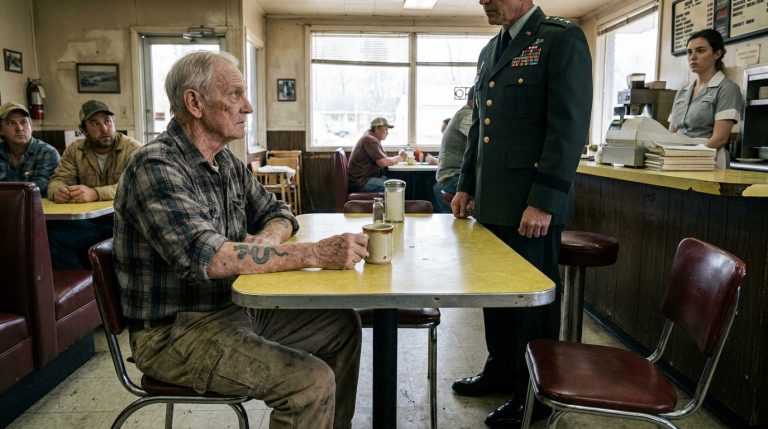
The diner was a quiet pocket of existence, removed from the frantic, high-frequency hum of the city. Outside, the world was already beginning to churn with the news—the viral clips, the leaked identity of the “Iron Viper,” the sudden, uncomfortable questions about secret wars and discarded veterans. But in here, the only sounds were the hiss of the espresso machine and the slow, rhythmic scrape of a spoon against a ceramic mug.
James sat in the corner booth, the same one he occupied every Tuesday. Across from him, Lily was watching the window, her expression guarded. She was waiting for the inevitable media intrusion, the rush of people who wanted to touch the legend.
The bell above the door chimed, a thin, discordant sound.
A man walked in. He was dressed in plain, civilian clothes—jeans and a navy windbreaker. He looked smaller than he had in his dress blues, stripped of the rank and the ceremony that had once been his only shield. It was Kyle Evans.
He stopped near the counter, his gaze scanning the diner until it found the corner booth. He froze. His face went through a rapid series of shifts: fear, hesitation, and finally, a profound, jagged sort of shame. He stood there for a long moment, struggling to find the momentum to cross the room.
Lily tensed, her hand dropping to the edge of the table. “Grandpa, you don’t have to do this,” she said, her voice a sharp warning. “He’s the one who started it.”
James didn’t look at her. He watched Evans. He saw the way the man held his shoulders—hunched, defensive, as if he were waiting for a blow. The arrogance of the lobby was gone, replaced by the raw, unvarnished vulnerability of a man who had lost his purpose.
“He’s not a threat, Lily,” James said, his voice quiet. “He’s a man who has lost his way. Let him sit.”
Evans approached the booth with the tentative steps of someone walking on thin ice. He didn’t speak. He just stopped at the end of the table, his hands shoved deep into his pockets. He couldn’t meet James’s eyes, focusing instead on the salt shaker, turning it slowly between his fingers.
“Sir,” Evans began. His voice was rough, unpracticed. “Mr. O’Donnell.”
He trailed off. The apologies he had undoubtedly rehearsed—the formal, bureaucratic phrases he had used his whole career—were useless here. They were plastic, and this room was too real.
James didn’t offer a prompt. He simply watched the younger man, seeing past the shame to the confusion beneath. He saw a man who had been raised to believe that the world was defined by the lines on a chart, and who now realized that the chart was missing the most important parts of the geography.
“Sit down, son,” James said, gesturing with his chin to the empty bench across from him. “The coffee is good here. It’s the only thing that doesn’t change.”
Evans hesitated, then slid into the seat. He looked tired. It was a deep, bone-weary fatigue that James recognized—the weight of a failure that wasn’t just professional, but personal.
“I don’t know what to say,” Evans admitted, finally looking up. His eyes were wide, searching. “Everything I knew… everything I was told about the Corps, about the way things work… it feels like it just evaporated.”
“That’s the first step,” James said. He picked up his mug, the heat radiating into his palms. “The uniform is heavy, Captain. Most people never realize how heavy it is until they’re forced to take it off.”
“I was trying to do my job,” Evans whispered, the defense sounding weak even to his own ears. “I thought I was protecting the institution.”
“You were protecting an image,” James corrected gently. “There’s a difference.”
James reached into his jacket pocket and pulled out the small, circular patch he had kept all these years—the one with the serpent and the lightning bolt. It was faded, the threads nearly gone, a fragile, dying thing. He placed it on the table between them.
“I spent forty years trying to keep this a secret,” James said, his voice barely audible over the hum of the diner. “I thought the secret was the only thing that made me who I was. But secrets don’t make you, Evans. They just trap you.”
Evans stared at the patch. He reached out, his finger hovering just above the worn canvas, not touching it, as if he were afraid the truth would sting.
“What happens now?” Evans asked.
“Now?” James looked out the window, where the morning light was beginning to touch the tops of the buildings, casting long, sharp shadows across the street. “Now, you find out who you are when you aren’t a Captain. That’s the hardest mission you’ll ever have.”
James reached over and pushed the mug toward Evans. “Drink your coffee. It’s going to be a long day.”
As Evans took the mug, his hand was steady. It was a small, quiet act of surrender, but in the silence of the diner, it felt like the beginning of something else. It wasn’t forgiveness—that was a bridge too far for now—but it was an understanding.
James looked down at his own hands, calloused and mapped with the history of his survival. He had been “The Viper.” He had been the legend. He had been the man the General feared and the man the Captain despised. But here, in the quiet, dusty light of a Tuesday morning, he was just an old man who had survived long enough to teach one last, vital lesson.
The burden of the thread had been passed. The secret was broken, but the man remained. He felt a sudden, profound lightness, as if the shadow of the jungle had finally receded, leaving behind only the simple, beautiful texture of a life lived, a life survived, and a life finally, completely, his own.