A Fragile Peace In The Shadow Of The Fallen: The High Price Of A Buried Truth
CHAPTER 1: The Weight of Iron
The Tidelands Park breeze didn’t smell like the ocean anymore. It smelled like iron and old, dry rot.
John McIntyre didn’t turn around when the dog first let out that low, vibration-heavy growl. He didn’t have to. He knew that sound—it was the same frequency Titan had emitted before a night jump over the Hindu Kush. He kept his hand steady on the tongs, the burger hissing on the grate, while his peripheral vision locked onto the target.
Ten yards away, a seven-year-old girl stood near the seawall. She was small, blonde, and utterly unremarkable to the casual observer. But it was the dog that held John’s attention. Titan was a statue of coiled muscle, his gaze fixed on the picnic table where the five of them stood. His tail, usually a weapon of balance and intent, was stiff, vibrating with a frantic, agonizing confusion.
“Mac,” Chris Miller whispered. The voice was a ghost of a sound, barely audible over the distant drone of naval helicopters circling North Island.
John didn’t look at him. He kept his focus on the charcoal, on the fire, on the illusion of a normal Saturday. “I see him.”
But he didn’t see him. He saw a dog, and he saw a girl with green eyes—eyes that cut through the haze of the afternoon like shards of broken glass. The memory of the Gulf of Aden was a rusted anchor in John’s chest. He remembered the water, the fire, and the way the world had swallowed David Hayes whole.
“Look at the girl’s hand,” Aaron Davis muttered, his voice tight.
John glanced down. The girl’s hand was gripping the leather leash so hard the knuckles were white—a grip born of necessity, not comfort. She was staring directly at Chris, her head tilted with the precise, curious motion of a bird surveying a strange landscape. She wasn’t looking at the burgers or the families; she was looking at the sleeve of Chris’s flannel shirt, which had bunched up to reveal the edge of a dark, intricate mark on his skin.
The tattoo. The compass.
John’s heart gave a sickening, heavy thud against his ribs. The math didn’t work. The timeline was a broken clock. They had walked into that dingy parlor in Djibouti three days after the mission, three days after they had been told David was dead. If the girl knew that ink, it meant the ink existed before the mission. It meant the mission was a lie, a carefully constructed stage set for a tragedy that never should have happened.
“She’s coming over,” Ben Foster warned, his tone flat, entirely drained of emotion.
John looked up. The girl was walking toward the eucalyptus shade, her stride slow and rhythmic, followed by the silent, predatory shadow of the German Shepherd. Every muscle in John’s body shifted into a defensive posture. He didn’t reach for a weapon—he didn’t have one—but he stood with the hard, rigid geometry of a man who was already evaluating every escape route in the park.
As the girl stopped three feet away, the air between them turned freezing. She looked at Chris, her eyes wide and unnervingly steady. She raised a tiny, trembling finger and pointed directly at his forearm.
“My father had that,” she whispered. The silence that followed wasn’t just quiet; it was the absolute, suffocating stillness of a graveyard. John felt the cold sweat begin to prickle along the back of his neck, the realization hitting him with the force of an artillery shell: the ghost they had been running from for two years wasn’t a memory. It was something waiting in the dark, and it had just found them.
CHAPTER 2: The Descent
The silence was a physical weight, thick and suffocating. John watched the girl’s finger, his eyes tracking the minute tremor in her hand. It was a gesture of profound innocence, yet it shredded the thin, fragile shroud of normalcy they had spent two years weaving around themselves.
“My dad,” she repeated. The sound of her voice didn’t belong in the park. It belonged in a briefing room, or an interrogation cell. It was too clear, too absolute.
John’s vision flickered. For a heartbeat, the sunlight hitting the manicured grass of Tidelands Park warped. The smell of charcoal was replaced by the stinging, acrid bite of burning aviation fuel. He saw the fire-ravaged deck of the chopper, the screaming wind over the Gulf of Aden, and David Hayes standing on the precipice of a burning hell, his hand pushing John toward the water. The psychological phantom hit with a nauseating jolt—the feeling of the ocean’s cold grip on his throat. He blinked, the phantom receding, leaving behind a sharp, acidic taste on his tongue. He was back in the park, but the world was no longer stable.
“Sweetheart,” Chris Miller stammered. His voice was a jagged rasp, the sound of a man who had forgotten how to speak to civilians. He looked like he was about to collapse.
John acted. He didn’t think; he pivoted, his body moving with the cold, efficient economy of a machine. He reached out and grabbed Chris’s shoulder, his fingers digging into the muscle with enough pressure to force the sniper back into the present.
“Check the perimeter,” John muttered, the command low and barely a vibration in the air.
He didn’t wait for a response. He turned his gaze toward the picnic blanket where the girl’s mother, Sarah, was standing. The woman’s face was hidden behind oversized sunglasses, but the way her shoulders had hunched told him everything he needed to know. She wasn’t just a bystander. She was the epicenter of the blast that was about to go off.
“Mac,” Aaron Davis hissed, stepping into John’s field of vision. “We’ve got eyes. Look at the maintenance shed.”
John didn’t move his head, but his eyes tracked the movement. Two men in nondescript windbreakers were walking past the park’s maintenance facility. They weren’t tourists. They moved with the same rhythmic, heavy-booted gait that John saw when he looked in the mirror every morning. They weren’t looking at the kids playing on the slides; they were scanning the tables, their focus locked on the SEALs.
“Compromised,” John breathed.
The park, a moment ago a sanctuary of weekend peace, transformed into a kill box. The space between the picnic table and the seawall suddenly felt like miles. John’s mind stripped away the trees, the grills, and the laughing families, leaving only the tactical reality: three exits, four potential choke points, and an unknown number of hostiles closing in.
He looked back at the girl, Chloe. She was still staring at Chris, her green eyes reflecting a wisdom that no seven-year-old should possess. She didn’t look afraid. She looked expectant.
“Sarah,” John said, his voice dropping into the gravelly register of his old command. He walked toward the woman, ignoring the stares of the nearby civilians. “We need to leave. Now. Don’t look back, don’t run, just walk to the gray SUV in the third row. Keep your hand on your daughter.”
Sarah froze. The sunglasses slipped, revealing eyes swollen with a two-year-old grief that had suddenly turned into sharp, piercing terror. She didn’t ask questions. The way John stood—shoulders squared, head slightly lowered, his entire posture radiating a latent, restrained violence—told her that the lie was dead.
“Who are you?” she whispered, the question shaking.
“We were his brothers,” John said, his tone devoid of warmth. It was a statement of fact, not an offer of comfort. “And if you want to stay alive, you move when I tell you to.”
Titan, the German Shepherd, seemed to understand the shift in the atmosphere. The dog moved with a low, slinking fluidity, placing himself between the men in the windbreakers and the girl. He didn’t bark. He just stood there, a hundred pounds of obsidian muscle, his ears locked onto the approaching threats.
The wind off the bay carried the faint, rhythmic chop of a helicopter—the same sound that had haunted them for twenty-four months. John glanced at the sky. It was too close, too loud. They weren’t just being watched; they were being hunted. The descent from the illusion of peace into the grinding reality of the survival cycle had begun.
“Ben, get the gear,” John ordered, his voice crisp. “Chris, watch the girl. We move on my mark.”
As John turned, he caught a glimpse of his own reflection in the side mirror of a parked car. The man staring back wasn’t the civilian who flipped burgers and attended community barbecues. He was a relic, a rusted piece of hardware that had suddenly been pulled back into the assembly line. He felt the weight of the invisible gear he hadn’t worn in years, the tactical muscle memory rising to the surface like sludge in a drained lake. They were going to have to disappear again, and this time, there would be no going back.
CHAPTER 3: The Safe House Siege
John gripped the door handle of the gray SUV, the metal cool and unyielding against his palm. He didn’t look at the sky, but he felt the presence of the helicopter rotor’s pulse in his teeth—a rhythmic, thumping reminder that the geography of the park had just been reduced to a narrow corridor of escape.
“Sarah, in the back. Now,” John barked, his voice cutting through the rising panic of the park.
He didn’t wait for her to process the fear. He reached out, his hand wrapping around the back of her hoodie, and guided her toward the open door. Chloe followed, her expression eerily blank, her small hand never leaving Titan’s collar. The dog jumped into the footwell without needing a command, his eyes tracking the perimeter with a calm, predatory focus that made the hair on John’s neck stand up.
As soon as the doors slammed shut, John leaned into the driver’s side, his eyes locking with Aaron’s. Aaron was already in the driver’s seat, the engine humming to life with a low, guttural growl that betrayed the vehicle’s modified internal components.
“They’re moving,” Aaron said, his gaze fixed on the side-view mirror. “Two of them. They didn’t reach for badges, Mac. They reached for hardware.”
John watched the men in the windbreakers. They weren’t running. They were moving with a calibrated, measured intensity, cutting through the grass in a tactical formation that left no room for error. One of them touched an earpiece; the other was watching the SUV with the predatory patience of a shark following a wounded boat.
“Go,” John said. “Slow. Keep it looking like a civilian departure until we hit the arterial.”
The SUV eased away from the curb. The tires crunched over a patch of loose gravel, the sound amplified by the sudden, deadening silence inside the cabin. Chloe was pressed against the glass, her gaze fixed on the park, watching the men who were watching them. Titan shifted, a low, guttural rumble vibrating through the floorboards—the sound of a predator sensing another of its kind.
“They’re not feds,” Chris said from the backseat, his voice dropping into a low, jagged whisper. He was already checking the chamber of a concealed weapon tucked into the lumbar support. “Feds would have boxed us in. Those guys are waiting for the extraction team to seal the grid.”
John didn’t answer. He was calculating the geometry of their environment. Coronado was a peninsula; it was a trap designed by nature, made worse by the presence of the base. He looked at the dash clock. Every second they spent in traffic was a second they were giving away their position. He turned his attention to Sarah. She was huddled against the window, her breath coming in ragged, shallow hitches.
“We need a place to go dark,” John said, his eyes meeting hers in the rearview mirror. “Somewhere they won’t expect, where we can pull the pins on our own digital trail.”
“There’s a rental,” Sarah murmured, her voice trembling. “A secure garage in Chula Vista. David kept the key in the lining of his old gear bag. He told me to go there if the world ever turned upside down.”
John felt a chill crawl down his spine. Even now, two years after the ‘accident,’ David was still pulling the strings from the grave. The existence of a hidden stash, a backup, a fail-safe—it confirmed that this wasn’t just a mission; it was a long, slow-burning war.
“Chula Vista is the move,” John decided. He looked at the men around him. They were rusted, worn, and exhausted, yet the moment the situation demanded it, they had locked back into the rhythm of the unit. There was no discussion, no debate. There was only the objective.
As they merged onto the boulevard, John glanced back one last time. A black sedan had pulled out from behind the maintenance shed, sliding into the lane behind them with the smooth, oily movement of a predator. The game had shifted from pursuit to a high-stakes, real-time tactical extraction. He looked at his hands—calloused, scarred, and trembling with the old, familiar hunger for control. He wasn’t just a man in a car anymore; he was a component of a larger machine, and the machine had just realized it was being hunted.
“Keep your eyes on the road, Aaron,” John commanded, the edge in his voice sharpening. “We aren’t driving to a safe house. We’re driving to the center of the storm.”
CHAPTER 4: The Culvert Run
The intersection at the base of the Chula Vista approach was a mess of shattered glass and steaming radiators. An eighteen-wheeler had jackknifed across the center lane, its load of industrial piping spilling like discarded ribs across the asphalt. Aaron slammed the brakes, the SUV skidding to a halt just inches from the tangled metal.
“Detour,” Aaron grunted, his knuckles white against the wheel. “Grid’s locked.”
John twisted in his seat, his gaze sweeping the horizon. Behind them, the black sedan had disappeared from view, but the silence felt like a held breath—the kind that precedes an ambush. The air was thick with the acrid stench of hot brake fluid and the low, pulsating roar of a news helicopter circling overhead.
“The culvert,” John said, his voice hard. “The drainage basin under the construction site. It’s the only way to bypass the blockade without hitting the main arterial.”
“That’s a death trap, Mac,” Ben said from the back, his hands already on his gear. “We don’t know the stability of those pipes.”
“We don’t have a choice,” John countered. He turned to look at Sarah. She was clutching Chloe’s hand, her eyes wide, staring at the chaos on the road. “Sarah, you know this area. The drainage access—is it still gated?”
“It should be,” she replied, her voice steadying. “But the city stopped maintaining the lock after the heavy rains last spring. It’s rusted through.”
“Then we make it work.”
Aaron pulled the SUV onto the shoulder, the tires crunching over debris as he navigated toward the fenced-in perimeter of a stalled construction site. The gate stood like a crooked sentinel, partially buried under a mound of red clay. Aaron didn’t stop. He pushed the SUV forward, the heavy steel brush guard groaning as it slammed into the gate, the rusted hinges shrieking before snapping with a sound like a gunshot.
They descended into the darkness of the culvert. The temperature plummeted, and the air grew heavy with the smell of damp earth and stagnant, oily water. The headlights cut through the gloom, illuminating long, ribbed tunnels of corrugated steel that stretched into the bowels of the city.
“Stay close,” John commanded, stepping out of the vehicle and into the mud. He moved to the rear, helping Sarah and Chloe out. Titan emerged from the floorboards, his posture low, his ears twitching at the rhythmic drip of water against the tunnel walls. The dog didn’t need a signal; he took point, his nose brushing the damp concrete as he sniffed for foreign scents.
As they moved deeper into the tunnel, the world above them became a muffled, distant memory. Every footfall on the wet concrete sounded like a thunderclap. John’s senses were heightened, tuned to the frequency of the hunt. He noticed the slight shifts in the air current—the way the draft pulled toward the center of the pipe, indicating a secondary opening or a vertical shaft ahead.
“Wait,” he whispered, holding up a hand.
The team froze.
From somewhere far ahead, there was a sound—a metallic clink. It wasn’t the sound of settling pipes or shifting earth. It was the distinct, rhythmic tap of a magnetic boot against steel.
Chris moved up beside him, his sidearm raised. “Echo,” he muttered. “Sounds like two, maybe three people. They’re inside the perimeter.”
John’s stomach tightened. The realization hit him with the weight of cold lead: the wet team hadn’t just followed them; they had anticipated the route. They had been waiting for the bottleneck. The betrayal wasn’t just limited to the command structure—someone had provided them with the maps.
“They’re pinning us,” John whispered, his eyes scanning the narrow, curved walls of the culvert. There was no room for a flanking maneuver. It was a straight line, a tube of death. “Aaron, kill the lights. We go dark.”
The sudden blackness was absolute, a heavy, velvet void that seemed to press against their eyes. John stood in the center of the tunnel, his heart hammering against his ribs, his hand hovering over the grip of his weapon. He felt the brush of Titan’s fur against his leg—a grounding, primal presence in the heart of the darkness.
“They’re not calling for backup,” Chris whispered, his voice barely audible. “They’re holding their position. They want us to push into the kill zone.”
“No,” John said, a grim, jagged smile touching his lips. He reached into his pocket and pulled out his tactical light, adjusting the focus to a pin-prick beam. “We don’t push. We create our own exit.”
He gestured for the team to move laterally, toward a maintenance crawlspace he’d spotted on the site schematics back in the safe house. It was a narrow, vertical shaft—a chimney of rusted iron rungs leading to the surface. It was a desperate, high-risk climb, but it was the only way to bypass the men waiting in the darkness.
“Sarah, you first,” John said, his voice a low, steady anchor. “Chloe on your back. Titan, you follow.”
He stood at the base of the shaft, looking up into the abyss of the tunnel. He could hear the men ahead moving now, the sound of their gear clattering as they tightened their formation. The trap was closing, but John was already outside the geometry of their planning. They were fighting for more than just survival; they were fighting for the ghost of a man who had sacrificed his life to keep them all in the shadows. He looked at his brothers—tired, dirty, and dangerous—and knew that whatever was waiting at the top, they wouldn’t stop until they reached the end of the map.
CHAPTER 5: The Sonora Crossing
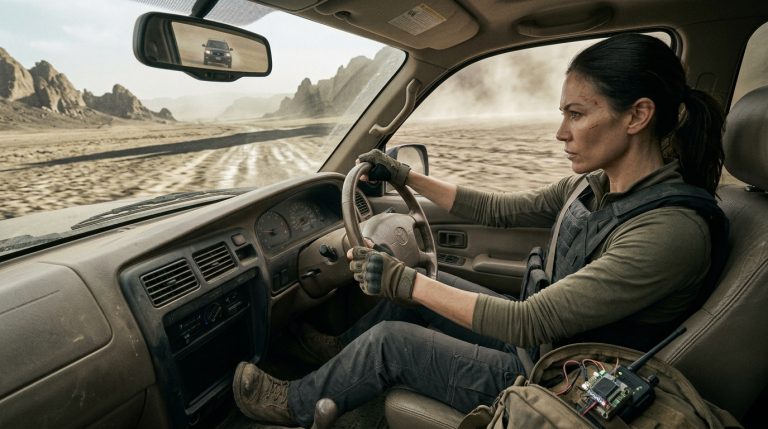
The surface was a wasteland of bleached stone and rusted scrub, shimmering under a sun that seemed to bleach the color from the world. John hauled himself over the edge of the iron rungs, his boots finding purchase on the loose, sliding shale of the desert floor. His lungs burned, the air dry and devoid of moisture, tasting faintly of ozone and pulverized dust.
Behind him, Chris and Aaron followed, their movements heavy and labored. Sarah emerged, her face streaked with dirt, Chloe clinging to her neck like a frightened barnacle. Titan was last, the dog scrabbling against the iron before finding his footing on the scree. He didn’t shake off the culvert’s grime; he stood still, his ears pinned back, his eyes searching the horizon with a desperate, primal intensity.
“Move,” John rasped. His throat felt like he’d swallowed glass.
They weren’t in the clear. The culvert had been a gamble, but the desert was an unforgiving referee. John scanned the serrated peaks of the surrounding range, his vision swimming in the heat haze. His perception, dulled by the extreme physical toll of the climb, flickered. A dark, elongated shadow near a jagged rock formation caught his eye—a movement, subtle and feline. He brought his sidearm up, his finger tightening on the trigger, his heart hammering against his ribs in a chaotic rhythm.
“Target, three o’clock,” John hissed.
Aaron slammed his shoulder into John, forcing the barrel downward just as a rock skittered down the slope. It was a coyote, lanky and sun-scorched, slinking away from the intrusion.
“Easy, Mac,” Aaron muttered, his voice taut. “It’s just heat playing tricks. You’re redlining.”
John exhaled, the adrenaline leaving him as quickly as it had arrived, leaving behind a hollow, shivering exhaustion. “Right. Keep the pace. The vehicle is a mile out.”
The trek was a brutal, real-time exercise in endurance. Every step was a negotiation with the terrain—shifting sand, razor-edged rock, and the unrelenting, punishing heat. They moved in a staggered line, shields of silence around them. John watched Sarah. She didn’t complain, didn’t falter. She carried her daughter with a resolve that mirrored the men around her, a quiet, hardened strength that had been forged in the crucible of her grief.
They reached the Chevrolet Suburban, hidden beneath a camouflaged netting in a dry ravine. It was a metal tomb, baking in the sun, but it was their only bridge to the coordinates. As they scrambled inside, the interior felt like a furnace. Aaron cranked the engine, the starter motor whining in protest before the engine roared into life.
“We have to hit the coordinates before nightfall,” Ben said from the back, his fingers already working the offline GPS. “If we’re spotted out here, we’re sitting ducks.”
“We’re already spotted,” John said, staring at the rearview mirror.
A dust plume, distant and thin, was rising on the horizon—a signature of speed, of engines pushed beyond standard limits. It was the pursuit. They had tracked the culvert exit, or perhaps they had simply tracked the heat signature of the Suburban. The distance was closing.
“They’re not trying to intercept,” Chris realized, his voice cold. “They’re herding us.”
The realization settled over the vehicle like a shroud. The mercenaries didn’t need to kill them in the open desert. They just needed to drive them toward the coordinates, toward a pre-selected extraction point or a secondary kill zone. David Hayes had promised them a refuge, but every mile they drove felt more like they were walking into a waiting snare.
John looked at the map, then at his brothers. They were battered, low on ammunition, and running on nothing but the residual fuel of their past. The ‘Sovereign Protector’ lens was no longer a metaphor; it was the only thing standing between the family and the void.
“Aaron,” John said, his eyes locking on the horizon. “When we get to the three-mile mark, take the ravine through the box canyon. Don’t look back. Don’t stop. If they try to box us in, we hit the dust.”
The drive became a blur of friction and motion. The road, if it could be called that, was a rhythmic, bone-jarring sequence of impacts. John watched the speedometer climb, the needle vibrating in the red. He gripped the door frame, feeling the chassis flex under the strain. They were deep in the Sonora now, the landscape a brutal, desaturated masterpiece of gray and ochre.
As the sun began to dip, casting long, skeletal shadows across the scrub, the box canyon loomed ahead—a narrow throat of stone that promised either a path to David or a final, silent grave. John felt the weight of the Zippo in his pocket, a cold, metallic comfort. They were close. But as the canyon walls rose to swallow them, John realized that the true test wasn’t the distance they had covered, but the truth they were carrying toward the end of the line.
CHAPTER 6: The Warehouse Reunion
The Suburban lurched to a final, bone-jarring halt in the lee of the mine’s rusted corrugated skeleton. The silence that rushed in to fill the space left by the engine was absolute—a heavy, suffocating blanket of desert air that seemed to press against the ears. John opened his door, his boots finding the parched, cracked earth of the Sonora basin. He didn’t move immediately. He stood still, the metal of the Suburban still pinging as it contracted in the cooling evening air.
“This is it,” Aaron whispered, his hand resting on the stock of his rifle.
John looked up at the looming structure. The mine was a ruin of industry, a graveyard of iron and ambition that had been swallowed by the desert. But there was something wrong. He caught a scent on the wind—wood smoke. It was faint, nearly masked by the smell of ozone and sagebrush, but it was there. And then, he saw the faint flicker of a shadow behind a jagged panel of corrugated steel.
Titan, who had been huddled in the footwell, surged forward. The dog didn’t growl; he moved with the single-minded focus of a hound closing on a scent he had carried in his memory for two years. He bolted toward the heavy, chained warehouse doors, his claws tearing into the dirt.
“Titan, wait!” John barked, but it was too late.
The dog hit the doors, his body a blur of muscle and black fur. Instead of the expected thud of an impact, the heavy steel door groaned—a slow, agonizing shriek of rusted hinges—and swung inward just enough to admit the animal.
John moved, his brothers falling into step behind him, a wedge of ghosts in the desert twilight. They entered the warehouse not as invaders, but as men stepping into a long-overdue reckoning. The interior was a cavernous, shadowed void, lit only by the low, pulsating glow of a portable generator.
As his eyes adjusted, John stopped. His hand tightened on the grip of his rifle, but the weapon felt suddenly, impossibly heavy. The warehouse wasn’t a ruin. It was a hub. Walls that had once housed heavy silver-processing machinery were now plastered with maps, satellite photographs, and complex webs of red thread—a sprawling, intricate record of every move they had made, every safe house they had used, and every contact they had tentatively established since the Gulf of Aden.
And in the center of the room, standing beside a small, makeshift camp of blankets and gear, was a man.
He was thinner than John remembered, his face hidden behind a thick, ragged beard, his hair long and unkempt. But the eyes—those piercing, predatory, unmistakable green eyes—were unchanged. David Hayes stood with his hands loosely at his sides, his gaze moving over each of them with a haunting, quiet intensity.
Titan was already there, his head buried in David’s chest, the dog’s tail thumping a frantic, joyous rhythm against the dirt floor. David didn’t look at the dog, though; he was looking at John, at Chris, at Aaron. He was looking at the wreckage of the team he had left behind.
“You got old, Mac,” David rasped. His voice was a thin, gravelly blade of sound that cut through the silence.
John felt the floor shift beneath him. He didn’t speak. He couldn’t. He watched David reach down, his hand resting on Titan’s neck, a small, sad smile touching the corner of his lips. There was no grand speech. There was no explanation of how he had cheated death or why he had stayed away while they rotted in the guilt of his ‘passing.’ There was only the brutal, physical reality of his presence.
“Why?” Chris whispered, his voice cracking. “Why leave us in the dark?”
David didn’t answer immediately. He turned, gesturing toward the wall of maps—the dossiers on Grisham, the bank records, the schematics of their own lives tracked and analyzed. “Because,” David said, his voice hardening, “if I had brought you in, you would have died. Every move you made, every attempt to find out what happened, was a signal to Grisham’s network. I had to become the distraction. I had to make sure the target was on my back, not yours.”
John looked at the maps, the red lines tracing their movements back to the very day they had left the Gulf. He saw the photos of Sarah, of Chloe, taken from afar—not by an enemy, but by David. He had been watching them. He had been the invisible shield they hadn’t known they were holding.
“You weren’t running away,” John realized, the weight of the realization crashing down on him. “You were building a kill box.”
David walked toward them, his movements slow and deliberate. He stopped in front of John, his gaze dropping to the Zippo lighter John now held. “I didn’t lead you here because I wanted to be found,” David said, his eyes turning to iron. “I brought you here because the trap is set. Grisham’s people are on the way. They think they’re finishing the job, but they’re just walking into the final sequence.”
The tension in the room wasn’t just about the impending arrival of the strike team; it was about the two years of silence, the two years of grief, and the sudden, jagged need to repair the bond that had been shattered in the water. John looked at his brothers. He saw the same reflection of his own confusion and sudden, violent clarity. They had spent two years mourning a ghost, only to find the ghost had been the only one keeping the world from burning.
“Then let’s finish it,” John said, his voice finally finding its edge.
David nodded, a flicker of the old commander surfacing for a fraction of a second. “Gear up. We have ten minutes before they hit the perimeter.”
As they began to distribute the munitions hidden throughout the warehouse, John felt the shift. The rust, the doubt, the uncertainty—it was falling away, replaced by the lethal, cold rhythm of a team reunited in the shadow of a final war. The desert outside grew darker, the stars cold points of light above the canyon, and in the heart of the ruin, the pack was finally whole, waiting for the storm that would settle the debt.
CHAPTER 7: The Final Gambit
The warehouse was a cathedral of shadows. David Hayes moved with a fluid, lethal grace, placing the final incendiary charge along the support beam of the warehouse’s internal structure. Every movement was practiced, the muscle memory of a decade of special operations overriding the fatigue of his two-year exile. He didn’t look at the team; he didn’t have to. John, Chris, Aaron, and Ben had already fanned out, their positions dictated by a silent, shared language that required no radio chatter.
“Perimeter sensors are cold,” Ben whispered, his voice sharp with a sudden, icy alarm. He knelt by a small tactical display, his fingers dancing across the keys. “They’re not using the main road anymore. They’ve bypassed the outer sensors. They’re already in the canyon.”
John stood near the heavy steel doors, his finger hovering over the detonator for the interior mines. The air in the room had grown heavy, the scent of cordite and dry dust coating his tongue. Outside, the night air was suddenly cut by the rhythmic, heavy thump of two Little Bird helicopters banking hard into the canyon. They didn’t signal. They didn’t demand surrender. They simply descended, their rotors kicking up a blinding, chaotic swirl of grit and moonlight.
“They’re not coming to talk,” Aaron said, racking the charging handle of his rifle.
“They’re coming to bury us,” David corrected, his eyes fixed on the warehouse doors. He held a satellite phone in his hand, his thumb hovering over the screen. “Wait for the breach. Let them commit. If we trigger too early, Clayton pulls the plug and they turn the choppers on the Suburban.”
The silence returned, but it was thinner now, stretched taut like a wire about to snap. John watched the shadows at the base of the doors. Twelve silhouettes materialized against the glare of the helicopter’s searchlight, moving with the terrifying, synchronized precision of a professional wet team. They were silhouettes of death—armored, suppressed, and utterly devoid of hesitation.
The lead breacher planted the C4. The rhythmic ticking of a remote timer began to bleed into the silence.
John took a breath, his lungs burning. He looked at his brothers. Chris was focused on the high ground, his scope sweeping the rafters. Aaron was positioned to sweep the floor. Ben was guarding Sarah and Chloe in the reinforced storage room at the rear of the warehouse. Titan stood at the edge of the shadows, his hackles raised, his teeth bared in a silent snarl of protective rage.
The charge detonated.
The doors exploded inward in a spectacular, beautiful scream of torn steel. The warehouse was instantly flooded with a blinding, white-hot glare.
“Breach! Breach! Breach!”
The PMC team poured in, weapons raised, their green lasers cutting through the swirling cloud of dust and shrapnel. They moved toward the center of the room, toward the decoy—the Zippo lighter, sitting solitary and inviting on a crate. It was the bait.
“Now,” David whispered.
The detonation of the internal claymores wasn’t a sound; it was a physical blow that buckled the floor and shattered the light. The warehouse erupted in a synchronized, violent pulse of directed kinetic energy. The mercenaries were caught in the eye of a storm that shredded the center of the room, the shockwave tossing them aside like dolls.
Chaos was the only language left. The mercenaries, panicked and disorganized by the unexpected resistance, returned fire into the rafters, their bullets shredding the corrugated steel skin of the warehouse. John stepped from the shadows, his movements predatory and cold. He didn’t fight with anger; he fought with the surgical, detached precision of a man dismantling a machine.
“Target identified! Rear right flank!” someone screamed over the radio, but their voice was cut short by the sharp, rhythmic snap of Chris’s suppressed rifle from the catwalk.
The firefight was a blur of tactical exchanges. David was everywhere—a ghost in the smoke, moving from position to position, his fire focused and devastating. John tracked the remaining mercenaries, his own weapon dancing from threat to threat. They were dismantling the strike team systematically, cornering them into the kill zone David had constructed.
But then, the radio on the floor—the one dropped by the lead breacher—cracked open with a smooth, terrifyingly calm voice.
“Hayes. You’re playing with fire. Do you really think a few sticks of C4 are going to hold off the entire Blackwood deployment?” It was Clayton. He was watching from the choppers, safe in the air, his tone mocking. “I have the thermal grid locked on the Suburban. You pull the trigger on us, and I turn your wife and child into ash.”
John stopped, his rifle leveled at a fallen mercenary. He felt the cold iron of the warehouse floor beneath his boots. He looked at David.
David’s face remained a mask of stone. He didn’t blink. He held the satellite phone up, his thumb firmly on the send command for the encryption key. “Clayton,” David said, his voice ringing clearly through the warehouse’s acoustics. “Look at the feed. Not the thermal. The tactical link.”
David’s thumb depressed the screen. “You aren’t the hunter anymore. You’re the liability.”
John watched as the PMC’s fire slowed. The mercenaries in the warehouse weren’t firing; they were looking at their own HUDs, their own communications arrays. A massive, cascading failure of encrypted data began to flood their systems. Their links to the helicopters, their GPS, their secure channels—all of it turned to static.
“It’s over, Dick,” David whispered into the phone. “The committee is watching.”
John didn’t wait for Clayton’s reply. He kicked the door of the storage room open. Sarah was there, her hand clutched around Chloe’s, her eyes wide with terror.
“Stay low,” John ordered, his voice finally, for the first time in two years, carrying the weight of a man who had done his job. They were moving into the final phase. The trap had been sprung, the decoy was shattered, and now, only the truth remained to be dealt with.
CHAPTER 8: The Dusty Denouement
The dust in the warehouse was still settling, a fine, ghostly powder that coated everything in a layer of desert gray. Clayton lay motionless near the center of the kill zone, his tactical gear torn, his hands zip-tied by Aaron with the practiced efficiency of a man who had done this a thousand times. There was no defiance left in the director. He stared at the ceiling, his breathing shallow, the reality of his political annihilation sinking in as the distant sound of approaching sirens—actual federal law enforcement, not PMCs—rippled through the canyon.
David stood near the edge of the light, the MK-18 slung across his chest. He looked exhausted, the weight of the last two years finally pulling at the corners of his eyes. He didn’t look like a hero; he looked like a man who had been hollowed out and then filled back up with something heavier, something permanent.
John walked over to him, stopping a few feet away. He reached into his pocket and pulled out the Zippo lighter, the one they had recovered in Coronado, the one that had been the anchor for their search. He held it out, the brushed steel catching the harsh, flickering light of the generator.
“You dropped this,” John said. It was a simple, pragmatic statement, but in the silence, it carried the weight of everything they hadn’t said.
David took it, his fingers brushing against John’s calloused palm. He clicked the lid open—a sharp, familiar sound—and the flint sparked, a tiny, defiant tongue of flame erupting into the room. He closed it, the metal snap echoing like a period at the end of a long, run-on sentence.
“I didn’t drop it,” David said softly. “I planted it. I knew you’d find it. I knew you were the only ones who wouldn’t stop looking.”
John looked toward the back of the warehouse, where Sarah was sitting on a crate, holding Chloe. The girl was asleep now, her head resting on her mother’s shoulder. Titan was curled at their feet, his vigil finally relaxed, his eyes closed in the quiet heat. They were a tableau of resilience—broken, scarred, but intact.
The Payoff was visceral. Seeing Clayton dragged out in cuffs by the very people he had tried to circumvent was a form of justice that felt stripped of its glamour. There was no parade, no medal, no acknowledgment of the war they had fought in the dark. There was only the cold, hard fact that the mole was gone and the threat to David’s family had been neutralized. The system—the sprawling, corrupt bureaucracy that had tried to erase them—was now forced to acknowledge the evidence David had spent two years carving out of the shadows.
“What happens now?” John asked, his voice steady.
“Now?” David looked at the warehouse, at the maps, at the remnants of his two-year war. “We go dark. For real this time. Grisham is headed for Leavenworth, and the committee has the drive. We have no reason to be ghosts anymore, but we can’t ever be who we were.”
The cool-down of the desert night began to push through the shattered doors, a refreshing, dry breeze that carried the scent of sage and distance. The adrenaline that had fueled their movement since Coronado was bleeding out, leaving behind a profound, bone-deep weariness. It was the exhaustion of a mission accomplished, the weight of a heavy pack finally discarded.
David turned to the crate where he had kept his gear. He picked up a small, rusted iron tool—a broken piece of the warehouse’s original silver-processing machinery he had been tinkering with during his long nights of surveillance. He turned it over in his hands, his thumbs tracing the rough, irregular edge. With a steady hand, he began to file down a sharp, jagged burr on the metal, his movements rhythmic and patient. It was a small, pointless task, but it grounded him. It was a symbolic repair, the fixing of a minor, broken thing after the monumental, irreversible destruction of the last few years.
“You coming with us?” Chris asked, leaning against a support beam, his own shoulders slumping as the tension finally broke.
David looked at Sarah, then back at his brothers. He didn’t answer with words. He reached out and placed a hand on John’s shoulder—a firm, grounding contact that reminded them of the life they had shared, the blood they had spilled, and the silence they had kept.
“I’m going home,” David said. “Whatever that looks like now.”
They walked out of the warehouse together, a ragged line of men stepping into the vast, indifferent expanse of the Sonora night. There were no cheers. There was no fanfare. Just the crunch of gravel under their boots and the quiet, collective exhale of a team that had finished its final watch. The desert stretched out before them, an endless, silver-lit road. They had started this journey in a park, chasing a ghost, and they were ending it by walking into a life that was finally their own to define.
The ghost was gone. The team was whole. And in the quiet, empty expanse of the desert, for the first time in two years, the shadows weren’t a place where they had to fight—they were simply a place where they could rest.