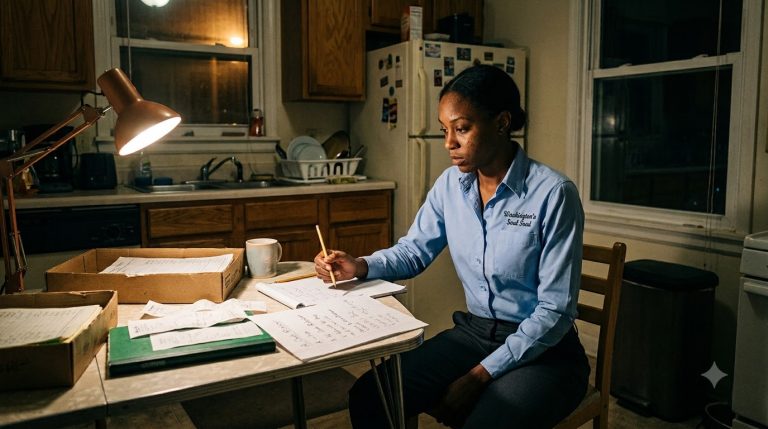
The Caterer’s Final Receipt: A Self-Made Man’s Silent Masterpiece of Cold Vindication
CHAPTER 1: THE KITCHEN TIMER
The silver pocket watch in Noel’s palm had three distinct scratches across the casing, each one earned in a kitchen that didn’t know his real name. He turned the winding stem three times until the internal spring gave its characteristic, resistant click. Below the second-story window of the Germantown apartment, the first delivery trucks of the morning were hitting the potholes on Poplar Avenue, their diesel engines rattling the old window weights in their frames. The coffee in his ceramic mug was black, strong, and completely unadorned.
His phone vibrated against the laminate counter with a short, sharp buzz that didn’t slide the device an inch.
“Mr. Bridges,” Devin’s voice came through the speaker with the low, flat tone of a line cook who had worked three consecutive double shifts without losing his edge. “The Levine reservation just cleared the digital system for Saturday night. Table four. The corner booth under the north glass.”
Noel didn’t lift the mug to his mouth. He looked down at the legal pad beside his coffee, where the neat rows of numbers from the NKB corporate account sat perfectly parallel to the red margin line. “Did Diane leave a note in the preference field, Devin?”
“She did,” Devin said, the sound of a stainless-steel whisk scraping a prep table cutting through the background audio. “It says ‘Helena’s fresh start.’ She requested the vintage Bollinger on ice before arrival. Eight seats. One designated for an E. Hargrove.”
Noel’s thumb moved across the scratched casing of the pocket watch, feeling the small indentation where the silver had worn thin near the hinge. For six years, holiday dinners had followed the exact same script, with Diane Levine raising a glass to thank the ‘caterer’ for bringing the salad or arranging the delivery platters, her smile fixed with the precise charity of a woman tipping a parking attendant.
“Run the service exactly as requested,” Noel said, his voice dropping into the quiet cadence he used when a sauce was ten seconds from breaking on the line. “Tell the cellar to pull the Bollinger. Don’t touch the table configuration.”
“Understood, boss,” Devin said, and the line went dead without the standard pleasantries of the hospitality industry.
Noel set the phone face down on the counter. He walked to the small iron safe tucked into the corner of the pantry, his khakis rustling softly in the stillness of the room. When the heavy door swung open on its oiled hinges, he didn’t reach for the deeds or the corporate stock certificates that represented the eleven rooftops currently bearing the NKB tax identifier across three states. He reached for the original blue folder from 2015.
The prenuptial agreement was only nine pages long. The staple in the top left corner had begun to show a faint ring of rust against the bond paper, a tiny orange circle that looked like a drop of dried chicory coffee. He flipped to page seven, where Helena’s signature sat in round, fluid script right above the neat block letters of a lawyer whose billable hours had been paid by a family that assumed Noel’s Civic was a sign of low credit rather than deliberate preference.
The language under Section Four was absolute. NKB Hospitality Group, including all subsequent acquisitions funded by separate corporate draws, remained entirely outside the marital estate.
He closed the folder, the heavy paper making a dry, snapping sound in the empty kitchen. He didn’t feel the heat that usually came with a kitchen fire or a ruined order. There was only the cool, calculated weight of a man who knew exactly how many minutes a tough cut of meat needed on the back of the stove before the bone let go.
The digital clock on the stove shifted to 5:42. He picked up his pen and began to cross-reference the last fourteen months of statements from the joint checking account, his hand moving with the steady, unhurried rhythm of an everyman balancing a monthly grocery budget.
CHAPTER 2: THE MORTGAGED HORIZON
The cold texture of the legal pad under Noel’s right forearm felt like the slate top of a prep table before the burners were lit. His fingers traced the edge of the printed bank statements, where three separate electronic transfers from the joint checking account sat highlighted in yellow ink. The money had moved quietly, always on the second Tuesday of the month, slipping into an out-of-state routing number that his accountant had flagged four hours ago.
Noel pulled the desktop monitor closer, the hum of the hard drive the only sound in the small Germantown office. The public record filings for Central Gardens were open on the screen.
Elliot Hargrove’s name was stamped in formal block text across the top of a deed dated three years prior. The historic property on Harrison Avenue looked grand in the attached appraisal photos—all wrap-around porches and leaded glass windows—but the secondary lien summary told a different story. An eighty percent mortgage held by a secondary lender in Nashville, coupled with a rolling credit line that had been tapped to its absolute limit three weeks ago.
The man wasn’t an investor; he was an expensive storefront with the lights left on.
Noel reached into his pocket and pulled out the heavy silver watch, turning it slowly between his thumb and forefinger. He thought about the small, greasy residue he had noticed on the inside of Helena’s diamond band when she left it by the bathroom sink that morning. It wasn’t standard jewelry cleaner. It had the distinct, chemical smell of commercial paraffin wax—the exact grade used by high-end estate management firms to polish antique display cases before a private sale.
The puzzle pieces didn’t slide together with a click; they ground against one another like ungreased gears.
A public real estate notification popped up on the bottom corner of his screen, a routine alert from the Midtown commercial registry where NKB Holdings kept its tracking flags active. A new intent-to-purchase agreement had been logged for a boutique storefront three blocks from Henley’s. The filing lacked a corporate signature, but the primary financial guarantor line carried a familiar social security sequence—his own, cross-referenced with a forged marital authorization form that bore Helena’s fluid handwriting.
She hadn’t just been spending the liquid cash from the household account. She was using his clean corporate history to anchor a lease she thought he would never see.
Noel didn’t call the bank. He didn’t lock the credit lines. He simply took his pen and drew a single, heavy black line through Elliot Hargrove’s name on the legal pad, pressing hard enough to indent the three clean sheets of paper beneath it.
“Patient hands,” he muttered to the empty room, his voice dry and devoid of heat.
He stood up, the leather of his chair creaking once in the silence. The blue prenuptial folder went back into the safe, followed by the printouts of the forged lease agreement. He didn’t need a lawyer to tell him what happens to a structure built on a foundation of sand when the tide comes in; he had watched enough kitchens flood to know exactly where the water would rise first.
He grabbed his jacket from the hook behind the door, the keys to the Civic heavy in his pocket. The Levine family had chosen Saturday night for their little performance, believing they were walking into a room full of strangers where they held the script. They didn’t know the stage belonged to the man they called the cook.
The office door clicked shut behind him, the lock catching with a solid, metallic thud that echoed down the stairwell.

CHAPTER 3: THE BLOODLINE FIRE
The worn wooden steps of Ida Mae’s front porch on Parkway North creaked under Noel’s work shoes with a heavy, familiar lower-register groan. The green door opened before his hand even reached the brass latch, releasing the thick, deep aroma of slow-simmered red beans and seasoned iron that had anchored this block for fifty-four years.
Ida Mae stood in the frame at eighty-one years old, her floral apron tied in a precise double knot at her waist. She didn’t look at his clothes or his expression; she simply stepped aside and pointed a wrinkled finger toward the oilcloth-covered table where a condensation-beaded glass of sweet tea was already waiting.
“You’ve got that kitchen look in your eye,” she said, her voice carrying the flat, unvarnished cadence of the Delta. “The one where you’re trying to watch three burners at once instead of letting the iron do the work.”
Noel sat down, the chair legs scraping against the linoleum flooring that had worn down to the gray backing near the sink. He took a slow sip of the tea, the sugar cut sharp with lemon, letting the cold glass settle against his knuckles. “The Levine family placed a reservation for Saturday at Henley’s, Grandma. They called it Helena’s fresh start.”
Ida Mae moved to the stove, her hand grabbing the thick rag she used to handle the heavy cast-iron skillet on the back burner. She shifted the pan two inches to the left, the seasoned metal scraping against the grates with a dry, heavy ring.
“I knew that girl thought she was lowering herself when she walked through my front door six years ago,” she said, her back remaining straight as she stared down at the black iron surface. “I watched her eyes move over my things like she was pricing a yard sale.”
Noel looked down at the table pattern, tracing a small tear in the oilcloth where the white mesh showed through. The silence in the room wasn’t the empty quiet of his empty Midtown house; it was the dense, weighted stillness of a kitchen that had seen forty winters of hard work.
“They think they’re clearing me out of the ledger,” Noel said, his thumb brushing the scratched casing of the pocket watch in his pocket. “They brought a man named Hargrove to sit in my house and explain the terms.”
“Patient hands make a perfect dish, Noel,” Ida Mae said, turning around slowly to look him clean in the face, her dark eyes clear and absolute behind her wire-rimmed spectacles. “But a person who is already on the way somewhere else always burns something on the way out. You let them carry their own fire.”
Noel stood up, the tea glass empty on the table. He didn’t offer a dramatic promise or a declaration of revenge; he simply leaned down and kissed the lined skin of her cheek, feeling the dry warmth of a life spent over the heat of a stove. The progression was set, the ingredients were prepped, and the timer was running down to the final minute.
CHAPTER 4: THE MADISON TRAP
The double-glass front entrance of Henley’s on Madison Avenue as Noel pulls the handle let in a sharp gust of the damp October night. Inside, the dining room moved with the rhythmic, low murmur of a full Saturday service, the smell of seared rosemary and oak charcoal hanging perfectly in the air.
At the far end of the room, under the expansive north glass, table four was completely occupied. Diane Levine sat dead center, her silver hair lacquered into place, talking rapidly while her daughter Helena stared down at a glass of sparkling wine. Next to her sat Elliot Hargrove, adjusting the cuffs of a crisp blazer with a small, nervous twitch of his left wrist.
Noel walked toward the station pass, his dark jacket catching the dim perimeter lighting. Devin Mills didn’t stop slicing the roasted lamb carcass, but his knife hand dropped lower by a fraction of an inch to clear Noel’s line of sight.
“The bottle’s dry, Mr. Bridges,” Devin said, his voice cutting under the hiss of the dish station. “Diane already complained twice about the temperature of the room. She told the floor manager that a simple caterer shouldn’t have this much trouble with the thermostat.”
Noel pulled the gold-stemmed pocket watch from his vest, winding it once until the spring bit back. “Let her complain, Devin. Serve the main course exactly when the ticket clocks twenty minutes.”
He turned on his heel and walked straight toward the corner booth, his boots hitting the polished oak boards with absolute stability. Diane noticed him first, her smile instantly hardening into the practiced charity she usually saved for service workers who forgot the extra napkins.
“Ah, Noel, you finally made it,” Diane said, her voice carrying across the adjacent tables as she gestured vaguely toward the empty chair at the exposed end of the layout. “Sit down, please. We’ve already started, but we kept a spot for you to listen.”
Helena didn’t look up, her fingers nervously twisting the large diamond band on her left hand, her knuckles tight. Hargrove cleared his throat, leaning forward onto the white linen with both forearms, his expensive watch catching the overhead accent light.
“We thought it was best to handle this in a neutral setting, Noel,” Hargrove said, his tone dripping with the unearned authority of a man backed by a family trust he couldn’t actually touch. “Given your line of work, we figured a dining room would keep you comfortable while we discuss the legal separation layout.”
Noel pulled out the heavy wooden chair, sitting down slowly without breaking eye contact with the man across from him. He reached into his inner pocket, his hand brushing past the legal pad notes, directly touching the cold, rolled copies of the Madison Avenue property deeds he had printed himself.
“A neutral setting,” Noel repeated, his voice dropping the temperature at the table instantly.
Diane chuckled, a sharp, clicking sound that had zero warmth in it. “Let’s not make a scene, Noel. You’re a hardworking man, but Helena needs a life that matches her expectations, and the paperwork we have ready will ensure your departure from our family is quiet and orderly.”
Noel didn’t flinch. He laid his large, calloused hands flat on the pristine linen, right next to Hargrove’s silver bread plate. The countdown was over, and the entitlement in the room had just stepped directly into the path of the iron.
CHAPTER 5: THE UNASSISTED RECEIPT
Noel’s fingers pressing the heavy stack of property deeds directly onto the table surface made a dull, weighted thud against the stiff white linen. The high-gloss glaze on the paper caught the amber glare of the candle lamps.
Diane’s eyes dropped to the top page, her smile freezing mid-breath as her penciled eyebrows slammed together. Elliot Hargrove leaned forward, reaching out a hand with expensive, manicured fingernails to drag the bundle closer.
“What is this nonsense?” Diane said, her voice rising into a sharp, thin pitch that pierced the quiet hum of the surrounding section. “Noel, we didn’t invite you here to review your commercial kitchen leasing options.”
Noel didn’t lift his hands from the table. He slid the top document an inch to the left, exposing the corporate title of NKB Holdings LLC, directly followed by the original 2017 warranty deed for 1140 Madison Avenue.
“You wanted a goodbye dinner,” Noel said, his voice entirely flat, carrying the cold, quiet stillness of a professional kitchen after the main line shuts down. “I wanted to make sure you understood who is paying for the champagne.”
Hargrove flipped the page, his thumb smudging the edge of the paper. His face drained of its ruddy color, a small muscle in his jaw jumping violently as his eyes locked onto the liability section. “This is the corporate portfolio for NKB Hospitality. The entire eleven-unit infrastructure.”
Helena leaned closer, her breath catching audibly in her throat as she stared at the highlighted guarantor line under the new Midtown commercial lease—the one she had signed using Noel’s credit history, now legally locked inside an entity he entirely owned.
“The prenuptial agreement you signed in 2015 excludes every square inch of this building, Helena,” Noel said, looking directly at his wife, whose fingers were now trembling against the stem of her glass. “The separate accounts are clean. The corporate draw is locked.”
Diane slammed both palms onto the table, the silver forks rattling against her bread plate. “This is a trick! You’re a tradesman, Noel. A caterer! You don’t own a Midtown block, and you certainly don’t dictate terms to my daughter!”
Noel reached into his pocket and pulled out the heavy silver watch, letting it rest on the linen between them, its steady, internal mechanical tick cutting through the sudden, suffocating silence of the booth.
“The building is mine,” Noel said, his eyes shifting to Hargrove, whose expensive jacket now looked loose across his shoulders. “And the intent-to-purchase lease Helena signed for your new firm requires a primary corporate release from NKB Holdings. Which I will not sign.”
Hargrove pulled his hands back from the documents as if the paper had gone white-hot, his eyes darting toward the exit. The entitlement that had filled the corner booth five minutes ago was gone, replaced by the raw, grinding friction of an undeniable trap snapping shut.
CHAPTER 6: THE NEW NORMAL
The quiet pass of the Estelle community kitchen as Noel pours coffee into a heavy ceramic mug let the rich aroma settle over the stainless-steel counter. Outside the front window, the early morning light of a late May Saturday was warming the brick storefronts down Parkway North, completely undisturbed by the frantic legal filings that had dominated the preceding five months.
The final decree from January sat filed away in his office safe, the prenuptial exclusion holding exactly as designed, leaving the entire eleven-property network entirely untouched by the Levine family’s designs.
Helena had taken a consulting position requiring immediate, continuous travel out of state after Hargrove’s asset limitations made the historic house on Harrison Avenue untenable. The corporate umbrella she had tried to exploit had collapsed under its own internal weight, leaving her name entirely removed from the local registry without a single shouting match or public scene.
Devin Mills walked through the back inventory door, dropping a crate of fresh collard greens onto the prep table with a dull, solid thud.
“The morning delivery is short two cases of onions, Noel,” Devin said, wiping his brow with the back of his sleeve, his voice carrying the calm, steady rhythm of a professional kitchen running on proper time. “I told the driver we wouldn’t accept the invoice until he brought the rest from the depot.”
Noel took a slow sip of the coffee, the heavy ceramic warming his palm. “Good call, Devin. Never sign for a dish until all the ingredients are on the line.”
He looked down at the iron skillet resting on the back burner of the Estelle’s main stove—the duplicate seasoned piece he had sourced specifically to anchor this neighborhood project. The cooking classes were scheduled for ten o’clock, and the neighborhood tables were already wiped down, waiting for the first families to sit down for the weekly community meal.
Noel walked out to the front porch, the cool morning air carrying the faint scent of wet grass and distant diesel traffic. He pulled the silver pocket watch from his vest pocket, turned the stem two times until the spring clicked into place, and tucked it back into his pocket.
The city was waking up, the neighborhood was quiet, and the work in front of him belonged entirely to his own hands.