The Quiet Hand at the Top: How One Woman Remade a Billion-Dollar Lobby Without Raising Her Voice
CHAPTER 1: THE COLD ARRIVAL
The front wheels crunched through packed slush, leaving two dark tracks across the immaculate granite of the foyer.
Irene kept her gloved hands locked on the rubber rims, pushing through the bite of the morning air.
Ahead of her, a heavy chrome advertising sign blocked the bottom of the access ramp entirely.
Wealth has an address, the elegant black lettering announced to anyone walking past.
Irene paused, her shoulders aching from the twelve blocks she had already wheeled herself through.
A man in an expensive camel coat stepped right over her front caster without breaking his stride, his gaze fixed on his phone.
Her internal monologue remained dry and pragmatic, devoid of panic or theatrical rage.
She wasn’t a soldier or a victim; she was simply a woman dealing with an unnecessary logistical obstruction.
Reaching out, she gripped the cold metal base of the sign and dragged it an inch to the left, letting the squeak echo against the soaring waterfall wall.
The revolving doors spun continuously, swallowing designer coats while ignoring the scuffed wheels at the side entrance.
Inside the security perimeter, Candace Pruitt aligned the stems of her white orchids with absolute precision behind the high mahogany desk.
The digital clock on the reception console ticked toward nine o’clock, marking the exact moment the daily filtering of human beings began.
Irene rolled past the security turnstiles, her tires emitting a faint, rhythmic chirp against the polished floor that instantly drew the eyes of nearby junior associates.
She did not flinch under the weight of their stares, keeping her chin level and her gaze fixed on the thirty-floor elevator bank.
The air inside smelled of expensive espresso and chlorinated water from the lobby feature, masking a deeper, institutional stagnation.
Her scarred leather folder rested securely against her hip, carrying the signed documents that quietly shifted the power of a multibillion-dollar firm into her hands.
She reached the massive front desk, where the polished wood rose so high it nearly obscured her face from view.
Candace did not look up immediately, letting the silence stretch out as a deliberate psychological penalty for unauthorized arrivals.
When the receptionist finally leaned forward, her expression settled into a mask of polished condescension.
Sweetheart, the charity office is two blocks down, Candace said, pitching her voice just loud enough for the espresso bar to catch every syllable.
Irene let her hands rest quietly on her lap, feeling the chill of the morning slowly fade beneath the indoor heating.
She looked past the receptionist’s manicured fingers to the small red light of the ceiling camera blinking steadily above them.
The trap was set, the variables were accounted for, and the first true test of the building’s character had officially begun.
CHAPTER 2: THE IRON DESK
The silence between the front desk and the wheelchair stretched across the open marble floor like a drawn blade.
Candace Pruitt did not drop her gaze, leaning her hips against the high mahogany counter to project an absolute barrier of institutional authority.
Sweetheart, the charity office is two blocks down, she repeated, letting a thin, performative sigh escape her lips for the benefit of the watching espresso bar.
Irene kept her posture rigid, her gloved fingers resting motionless on the rubber wheels while the lobby air circulated the faint scent of roasting coffee and artificial orchids.
She did not raise her voice or indulge in theatrical frustration, knowing that anger was a depreciating asset in a room built entirely on intimidation.
My meeting is on the thirtieth floor at nine-thirty, Irene said, her tone level and devoid of pleading.
A collective murmur drifted from a cluster of young associates near the elevator banks, quickly silenced by a sharp wave of Candace’s manicured hand.
We don’t take walk-ins, and we certainly don’t entertain whatever performance this is supposed to be, Candace snapped, tapping a long acrylic nail against the visitor terminal screen without looking down.
The security camera mounted high on the wall above them blinked its tiny red light, recording every calculated insult and deliberate obstruction.
Dennis Holloway shifted his weight near the security console, his hand brushing the radio on his shoulder as he watched the standoff settle into a grinding stalemate.
The chrome sign remained pushed slightly out of place beside the access ramp, its elegant lettering a silent monument to the building’s casual cruelty.
Irene reached down, her shoulders burning slightly from the morning’s push, and adjusted the fold of her thrift-store blazer with slow, deliberate precision.
She didn’t need to shout or flash a bank statement; the friction of the receptionist’s unearned arrogance was already doing the work for her.
Check the visitor list under Whitfield, Irene said quietly, sliding the cream card forward another inch across the polished wood.
Candace laughed, a sharp, dismissive sound that bounced off the soaring glass panels toward the indoor waterfall.
Honey, I’m not typing one letter for you, because this lobby is for clients, not beggars on wheels.
CHAPTER 3: THE SCATTERED PAGES
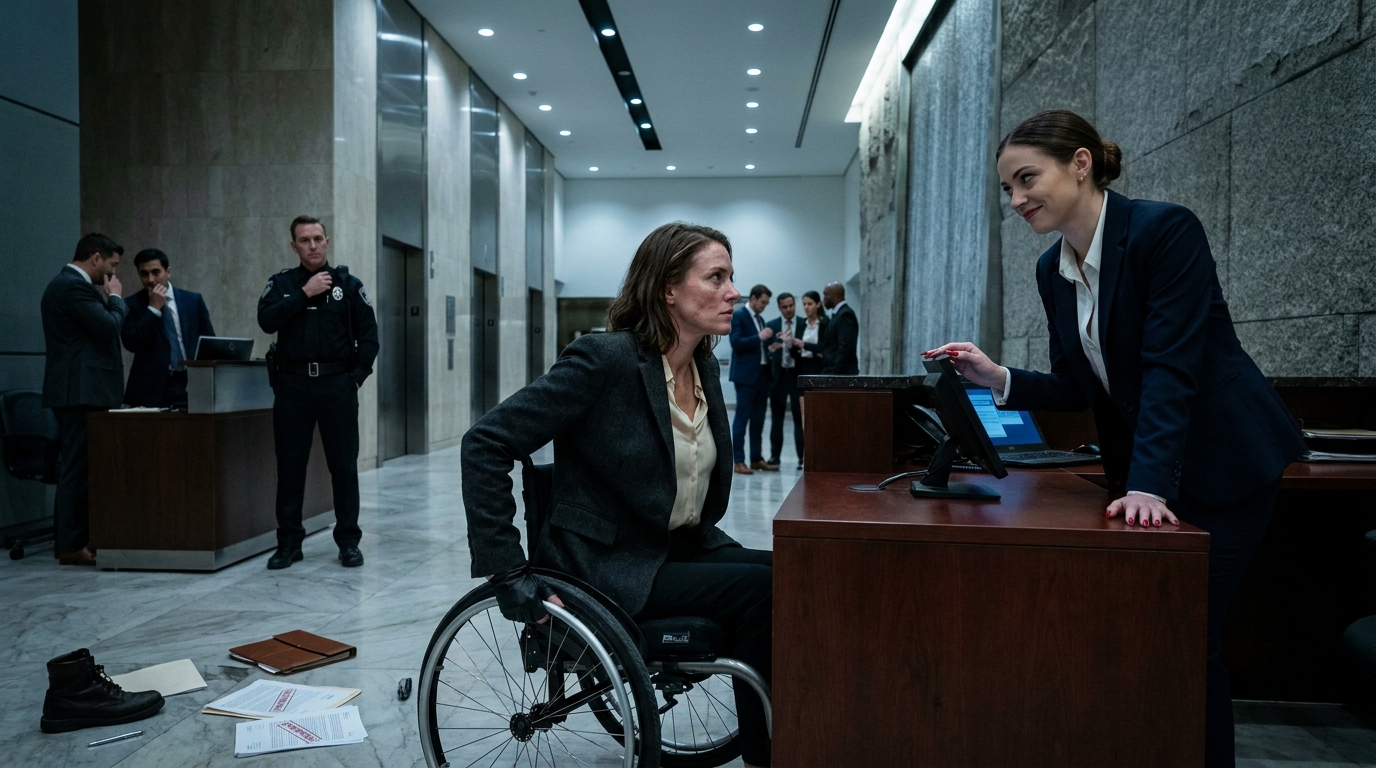
Candace shifted her weight, a tight smile pulling at the corners of her mouth as she reached out and snatched the leather folder directly from the wheelchair’s armrest.
Let’s see what’s really in here, she announced to the lobby, shaking the folder upside down with deliberate theatricality.
Heavy cream pages and embossed documents burst loose, scattering across the gleaming white marble like a flock of startled birds.
A silver pen rolled against the toe of Dennis Holloway’s heavy boot while several loose sheets slid beneath the leather waiting sofas.
Irene did not flinch, her gaze fixed entirely on the receptionist’s gloved hands as the confidential share transfer agreement landed face-up near a passing associate’s shoe.
The man in the camel coat glanced down at the bold type marked confidential, stepped directly over the paper without breaking stride, and continued toward the elevators.
Candace tossed the empty leather folio back onto the counter with a hollow thud.
Junk mail and printouts—just like I said, she declared, turning back to face the small crowd gathering near the espresso bar.
Irene kept her face completely neutral, knowing that every exaggerated gesture was feeding a digital record that could never be erased.
She placed both hands on the rubber rims of her wheels, locking her core to manage the physical strain of what came next.
She had to lean far over the side of the chair to reach the nearest fallen page, her shoulders screaming from the earlier push through the snow.
Reach, strain, grip—the repetitive physical tax of a world built entirely for standing bodies.
Not a single witness moved to help her gather the scattered documents, paralyzed by the unspoken social gravity of the front desk’s rule.
Except for Tasha Cole, who dropped her wiping rag across the espresso bar and crossed the open floor in seconds to kneel on the cold marble.
Touch one page and you’re fired today, Candace snapped, her voice cracking across the lobby with the sharp authority of a raised ruler.
Tasha froze with two cream sheets gripped tightly in her fingers, her rent due in three days and her college credits hanging in the balance.
It’s all right, put them down, Irene said softly, her voice steady enough to cut through the tension.
Tasha released the papers onto the floor within reach, whispering a brief warning about the chairman’s assistant before retreating behind the bar.
Candace raised her phone, holding it sideways to capture every inch of the struggle with a bright, performative smirk.
Smile for the camera, sweetheart—your little scam is going straight into the employee training manual.
CHAPTER 4: THE SILENT COLLECTION
Dennis Holloway shifted his weight from boot to boot, his tactical radio hissing quietly against his graying collar as the crowd around the reception desk held its collective breath.
Ma’am, I’m going to need you to leave the building now, Dennis muttered, his fingers hovering hesitantly over the push handles of the wheelchair.
Don’t touch my chair—nobody pushes my chair, Irene warned, her voice dropping into a register so flat and cold that the security guard’s hands immediately froze in place.
Candace stepped directly into the gap, holding her mobile device high like a weapon as she dialed three digits with her thumb hovering over the green button of the screen.
Last chance, sweetheart—roll out on your own or go out with a police escort for criminal trespassing, Candace sneered, framing the wheelchair tightly in her digital viewfinder.
A silver-haired woman sitting on the distant leather sofa finally shook her head, muttering loudly enough to pierce the silence, For heaven’s sake, she isn’t bothering anyone.
Candace ignored the interjection entirely, turning her attention back to her captive audience with the practiced grin of a stage performer enjoying a hostile review.
Irene looked up at the flashing recording light, cataloging every detail of the petty tyranny unfolding before her with the clinical detachment of a veteran investor.
You will remember this morning for a very long time, Irene said softly, her words carrying an ominous weight that made the receptionist’s smile stutter for a single heartbeat.
Out, now—Dennis, get her moving or I press this button and do it the hard way, Candace barked, stepping closer as her impatience flared into overt aggression.
Dennis let out a long, exhausted breath, his moral hesitation colliding hard with the grim reality of his monthly mortgage payments and his six-year pension vesting date.
He reached behind the wheelchair again, his fingers closing around the cold metal handles just as the elevator bank down the hall emitted a sharp, resonant chime.
The heavy walnut doors slid open with a pneumatic hiss, and a breathless man in a tailored suit began sprinting across the open expanse of the marble floor.
CHAPTER 5: THE GLASS SHATTERS
Get your hands off that chair—stop!
Graham’s voice cracked across the expansive marble floor, cutting through the ambient murmur of the lobby like a shattered bottle.
Dennis froze instantly, his fingers locked onto the rubber push handles while his posture stiffened in genuine shock.
She owns fifty-one percent of us—get back!
Graham’s chest heaved beneath his tailored suit jacket as he dragged in frantic lungfuls of air, his face pale as wet paper.
Candace blinked rapidly behind the high mahogany counter, her phone slipping from her fingers to shatter against the floor with a hollow plastic snap.
The entire lobby plunged into an absolute, suffocating silence, broken only by the steady, mocking murmur of the indoor waterfall.
Fifty-one percent—not a guest, not an auditor, but the controlling majority owner of Meridian Capital.
Graham dropped his gaze to the floor, noticing a single cream-colored page resting near his polished oxford shoes.
He bent down with trembling hands, retrieved the share transfer agreement as if it were fragile glass, and held it upright like an unblemished relic.
Ms. Whitfield, I am so deeply sorry—we had no idea you were coming in early and—
Graham cut himself off mid-sentence, realizing the utter absurdity of offering excuses for a corporate execution.
There’s no version of this where that sentence helps, Irene replied calmly, her hands resting motionless on her lap.
No, ma’am, there really isn’t, Graham whispered, stepping back to clear a direct line of sight between the wheelchair and the reception desk.
Every head in the room pivoted simultaneously toward Candace, who had shrunk behind her immaculate white orchids as if the wood were melting away.
I didn’t know—nobody told me who you were, the receptionist stammered, her high-pitched voice echoing off the forty-foot glass ceiling.
That’s the problem, Irene said quietly, rolling forward one deliberate inch to let the truth settle over the room.
You didn’t need to know who I was; you just needed to treat a human being with basic decency.
Graham turned his head slowly toward the desk, his eyes hardening as he recalled the security camera feeds he had reviewed on his sprint down from the executive suite.
I watched all four camera angles on my way down here, Candace—every single frame.
The receptionist opened her mouth to speak, but no sound came out, her professional mask completely dissolved into raw panic.
Dennis quietly stepped away from the rear of the wheelchair, letting his hands drop to his sides as the weight of his inaction settled onto his shoulders.
Ma’am, I should have made that single phone call, Dennis muttered, staring down at the marble floor with quiet remorse.
You should have, Irene agreed, her tone measured and immovable.
But you asked nicely, and you told the truth when it mattered—both things will be remembered.
By the espresso bar, Tasha Cole let out a single, sharp breath that sounded remarkably like vindication, keeping her eyes fixed on the unfolding reckoning.
Graham checked his watch, cleared his throat with professional urgency, and bowed his head slightly toward the majority shareholder.
The board is upstairs waiting for you, Ms. Whitfield—and they are extremely eager to meet their new boss.
I imagine they are, Irene said, turning her chair toward the walnut-paneled elevators while the crowd parted before her like water.
CHAPTER 6: THE WIDENED DOOR
The boardroom wall screen flickered to life, projecting four distinct security angles of the front desk onto polished wood panels.
Fourteen high-ranking directors sat in absolute silence, watching their own corporate culture unravel frame by frame in cold, unedited high definition.
They watched the chrome sign block the wheelchair access ramp.
They listened to the exact audio of a receptionist dismissing the majority owner as a beggar.
Nobody spoke, and several board members looked down at their polished conference tables as the bitter reality of institutional rot settled over the room.
Irene kept her hands folded neatly in her lap, allowing the silent footage to deliver the only argument that mattered.
We follow process even for people who don’t, Irene told the board, her voice steady and immovable as she outlined the terms of the formal internal review.
Downstairs, the consequences began immediately, moving through the Meridian offices not with the flash of anger, but with the quiet weight of administrative law.
Candace Pruitt was terminated for cause following a review of her multi-year history of selective gatekeeping, her severance and reputation collapsing under the weight of her own recorded words.
Dennis Holloway retained his position, marked forever as the guard who should have made a single phone call but possessed the courage to tell the complete truth.
The two million dollar First Impressions Initiative launched before the summer was out, redesigning the marble lobby from the ground up.
The new front desk curved low on one side like an open hand, completely eliminating the towering mahogany barrier that once hid human dignity from view.
Outside, the access ramp was widened, heated against the winter ice, and cleared permanently of all advertising obstructions.
Six months later, on another freezing Monday morning, snow blew off Lake Michigan and dusted the glass doors of the tower entrance.
Joelle sat behind the curved wing of the new reception desk, her welcoming smile offering immediate warmth to a shivering visitor leaning on a worn wooden cane.
Upstairs in her corner office, Irene watched the lobby security feed on her monitor, her eyes drifting briefly to the framed visitor card mounted permanently on the wall.
The loud noises of viral clips and corporate shock had long since faded into the background, leaving behind the only metric that truly mattered.
The doors were wider, the counters were lower, and the common sense of ordinary human respect had finally reclaimed the floor.