He carried the weight of a forgotten war in a tool that held the truth of metal
CHAPTER 1: THE HEAT ON THE TARMAC
The glare off the concrete wasn’t just light; it was a physical weight, thick with the sharp, sour breath of unburnt JP-8 fuel. Kyle Peterson’s knuckles were raw, stained a dark, greasy grey from three hours of tearing through the primary avionics bay of Viper07. The radio in his breast pocket hummed with intermittent static, each click a needle from the command tower where the foreign delegates were already taking their seats. The wing commander’s voice had stopped being angry ten minutes ago; now it was just cold, a low, rhythmic monotone that signaled the end of careers.
“Sir, I am speaking to you,” Kyle said, his voice dropping into that dangerous, sharp register born of absolute exhaustion and impending ruin. He crossed his arms, his uniform shirt sticking to his shoulder blades in long, salt-rimmed streaks.
The old man didn’t look up. He didn’t even flinch at the tone. He stood in the white-hot center of the flight line like an old post left in the tide. His windbreaker was a faded, non-regulation khaki, the cuffs frayed into tiny pale nests of thread that caught the midday breeze. His eyes—a clouded, pale blue that looked like water left too long in an zinc bucket—were fixed entirely on the open maintenance panel of the F-16.
“Kyle, just leave the local be,” another technician muttered, wiping a line of grey sweat from his forehead with the back of a stiff, oil-hardened glove. “Security’s already looping the outer fence. He must’ve drifted past the secondary gate while the supply trucks were clearing through.”
“He’s within twenty feet of a live airframe during a Class-A readiness window,” Kyle snapped, his frustration boiling into the open. He took a long, heavy step forward, his boot heels clicking against the heat-bubbled sealant between the concrete slabs. “Sir, look at me. This isn’t a museum display. This is a restricted operational line. You need to turn around and walk back to the white line by the grass right now.”
Arthur Vance slowly shifted his weight. His old work shoes, dull and thick-soled, made no sound on the tarmac. He didn’t look at the young technician’s face; instead, his gaze traced the long, clean rivet line along the jet’s intake, his hand resting loose at his side. His fingers were thick, knotted at the joints like old pine roots, covered in pale, thin scars that had gone white decades before Kyle was born.
A heavy silence settled between them, broken only by the low, high-pitched whine of the diagnostic cart twenty yards away. The digital display on the cart’s monitor flickered in the glare, repeating the same four letters over and over: ERR_SYS_INIT.
Kyle reached out, his fingers wrapping around the dry fabric of Arthur’s sleeve, intending to steer the old man toward the security lane. “I’m not asking again, Pops. Your time’s up.”
Underneath the faded khaki fabric, the old man’s arm felt like cured hickory—unyielding, completely steady, and heavy with a stillness that made Kyle’s hand instantly freeze.
CHAPTER 2: SHADOWS OF DA NANG
The heat did not drop; it lingered in the weave of the frayed khaki sleeve where Kyle’s fingers remained clamped. For a split second, the flight line vanished behind a low, rhythmic thrumming that didn’t belong to the flight line’s digital diagnostic carts. The sun-bleached concrete beneath Arthur Vance’s old shoes seemed to lose its blinding glare, softening into the oil-slicked, red-dirt mud of Da Nang, 1972. The smell of burning JP-4 fuel—sweeter, dirtier than the modern propellant—flooded his throat so sharply he almost coughed. He could feel the heavy, wet weight of the South China Sea hanging in the air, the kind of humidity that made a green flight suit stick to a man’s ribs like a wet sheet before he even reached the maintenance bay. In that memory, his fingers weren’t stiff with eighty years of life; they were nimble, black with hydraulic fluid, working by the yellow beam of a cracked flash-lamp inside the dark belly of a shattered F-4 Phantom while the mortar pits three miles out thudded their steady, terrifying bassline into the floorboards.
The memory snapped back into the present with the sharp click of a radio relay somewhere on Kyle’s vest. The young technician’s hand didn’t move, but the sudden rigidity in Kyle’s shoulders showed he had felt it—that strange, unyielding density in the old man’s arm that didn’t match the stooped frame or the worn windbreaker.
“I said,” Kyle repeated, though the sharp edge of his voice dipped slightly, caught in a momentary hesitation as he looked down at his own fingers against the khaki cloth, “the show’s over, old-timer. We’re going to the terminal gate.”
Arthur didn’t pull away. He slowly turned his head, his cloudy blue eyes moving from the sleek, slate-grey fuselage of Viper07 down to Kyle’s grease-smeared name tag. The name Kyle was stamped into a strip of dull black plastic, the edges slightly melted from some long-forgotten contact with a hot soldering iron. Arthur looked at that small, human imperfection with a mild, patient curiosity.
“The wind is coming around from the east,” Arthur said. His voice was thin, like old parchment being unrolled in a dry room, but it carried an even, rhythmic weight that didn’t ask for permission to be heard. “When the east wind hits the hangar doors at Fort Worth during the early testing, we used to say the airframe could feel the change before the barometers did. The block thirty series doesn’t like a rapid drop in ambient pressure after a high-altitude soak. It makes the seals gather.”
Kyle’s brow furrowed, his fingers loosening their grip on Arthur’s arm but not dropping entirely. “What are you talking about? Fort Worth? Look, I don’t care what kind of planes you used to look at through the fence. This bird is dead on the line, and if I don’t have the diagnostic log cleared in twelve minutes, the whole wing gets a red mark from the command staff. You’re interfering with military hardware.”
“The hardware isn’t the problem,” Arthur murmured softly. He didn’t raise his voice to counter Kyle’s rising panic. Instead, his left hand moved with a deliberate, unhurried precision toward the deep pocket of his windbreaker.
The movement was so small, so entirely lacking in aggression, that Kyle didn’t immediately reach for his belt or signal the secondary technicians who were still hovering by the avionics cart. Arthur’s fingers closed around the dark, oil-softened leather pouch. The pouch had no snaps or shiny brass fasteners; it was held together by a simple strip of weathered rawhide that had been wrapped around the center three times and tucked under itself. The leather was dark, nearly black near the edges where thirty years of finger-oil and graphite lubricant had soaked into the grain, turning the surface as smooth as river stone.
The other technicians had stopped moving. The younger boy with the greasy glove let his arms drop to his sides, his eyes shifting from the flickering diagnostic screen to the small, leather object in the old man’s hand. The flight line seemed to contract around them, the vast expanse of the concrete base shrinking down to the narrow space between the landing gear strut and the three men.
“Is that a wallet?” Kyle asked, his voice tightening as he looked at the pouch. He let his hand drop completely from Arthur’s sleeve, stepping back a half-inch to re-establish his stance. “If that’s your ID, let me see it. Don’t go pulling out anything else.”
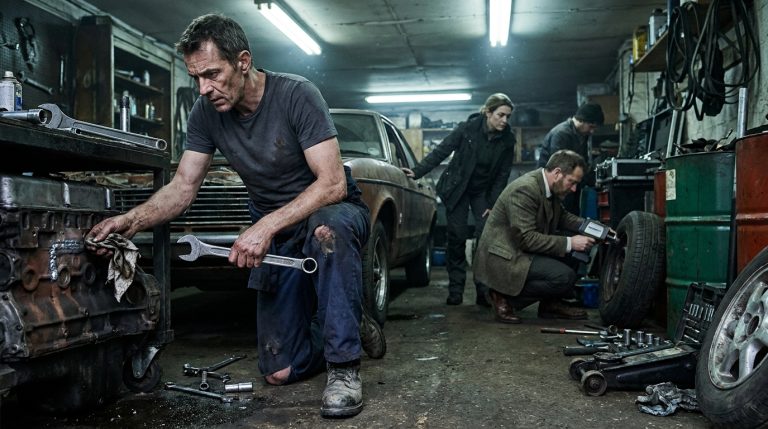
Arthur didn’t answer with words. He held the pouch in the palm of his hand, feeling the familiar, heavy balance of the tool steel inside. The weight was comforting—a solid, unchangeable truth in a world that had become increasingly filled with digital screens and invisible electronic faults that no one could see with their eyes. He began to unroll the rawhide strip, his movements smooth and practiced, the work of a man who had opened the same kit ten thousand times in the dark, in the rain, and in the freezing cold of northern testing ranges.
The blue felt liner inside the pouch was thin now, worn down to the grey backing threads in the shape of the instruments it protected. There were only four items left in the loops: a short, heavy brass scribe with a tip ground down to a needle point, a small inspection mirror with a tarnished silver back, a slide rule made of yellowed ivory-grain plastic with a hairline scratch through the center scale, and the angled spanner wrench. The steel of the wrench was dark, covered in a dull, grey-blue patina that only comes from decades of contact with mineral oil and industrial cleansers. It didn’t shine in the midday sun; it absorbed the glare, turning the white light into a soft, leaden shadow.
Kyle looked down at the open pouch, his jaw tightening as a brief, incredulous laugh escaped his throat. “You’re kidding me. You walked onto an active flight line with a bag of junk from a scrap pile? What do you think you’re going to do with that, old man? The fly-by-wire system on this aircraft runs on triple-redundant digital buses. You can’t fix a logic gate with a rusty bicycle tool.”
The younger technicians behind Kyle didn’t laugh this time. They shifted their feet, their eyes fixed on the strange, custom shape of the spanner wrench. It wasn’t a standard tool; the head was offset at an odd, thirty-seven-degree angle, and the handle was short, thickened at the base to fit into the palm of a hand that needed to apply leverage in a space no wider than three inches.
Arthur didn’t look offended by the word junk. He merely slid his thumb along the smooth, dark handle of the wrench, feeling the tiny, hand-stamped letters near the hinge: VANCE_04.
“The logic gates are waiting for something they can’t feel,” Arthur said, his voice remaining low and steady against the dry heat. “They are listening to the wires. But the wires only tell you what the valve is doing after it has already failed to move.”
Behind them, near the secondary intake of the neighboring aircraft, Master Sergeant Reyes stopped his own work. He didn’t look at the jet anymore. He was looking at the way the old man held the pouch—not like a tourist showing off a souvenir, but like an old surgeon picking up a scalpel he had used to save a hundred lives.
CHAPTER 3: THE CALL TO THE VAULT
Master Sergeant Reyes lowered his wrench. The metallic clink of the tool dropping onto his rubber-lined parts tray was swallowed instantly by the vast, dry emptiness of the flight line. For thirty years, Reyes had read the subtle body language of men under pressure, separating the blusterers from the true craftsmen by a single metric: how still they could stand when everything went wrong. On the tarmac, young Kyle Peterson was a bird flailing its wings in a cage, his skin flushing a dark, blotched crimson under the heat and the silent weight of the uncooperative jet. But the old man—Arthur Vance—possessed the absolute, unhurried density of an iron anchor dropped into deep silt.
Reyes didn’t call out. He shifted his weight away from his assigned airframe, his heavy leather boots dragging softly over the expansion joints in the concrete. As he stepped closer to the perimeter of Kyle’s diagnostic circle, his eyes didn’t fix on the faded windbreaker or the thin, white hair blowing in the exhaust-warmed breeze. He looked at the way Arthur’s thumb moved across the leaden patina of the angled tool handle. It was an old technician’s gesture—checking the seat, feeling for the slight ridge where metal met calloused skin.
“Reyes,” Kyle barked, not looking back, his eyes still glued to the open pouch in Arthur’s hand. “Get on the net. Tell security we have an undocumented civilian who crossed the primary line. He’s carrying uninspected hardware into the safety bubble.”
Reyes didn’t reach for his belt radio. He stopped five feet away, his chest rising and falling beneath his stained work vest. The heat shimmer between them made the sleek nose of Viper07 look as though it were underwater, liquid and shifting. “Kyle,” Reyes said, his voice a low, gravel-grated murmur that carried no anger, only the heavy authority of three decades on the line. “Take your hand off his sleeve.”
“I already did,” Kyle snapped, his jaw tightening as he gestured aggressively toward the digital cart’s error messages. “Look at the board, Sergeant. The main bus is dead. We’re getting an initialization failure across the entire primary logic loop. The delegation’s plane is already over the outer marker, and this guy is standing here talking about the east wind and Fort Worth like he’s picking berries.”
Reyes didn’t argue. He looked down at the hand-stamped letters near the wrench’s hinge—VANCE_04—and felt a cold, sudden current prickle down the back of his neck, completely independent of the blistering heat. The old stories from the late eighties came rushing back, the ones told by the leather-skinned crew chiefs in the back rooms of the depot over cold thermoses of coffee. Stories about a man who didn’t look at blue-prints because he had drawn the lines himself; a man who could lay a bare palm against an unpressurized fuselage and tell you within three pounds where the secondary hydraulic valve was binding.
Arthur Vance looked up then. His pale, water-blue eyes met Reyes’s gaze. There was no plea for help in the old man’s face, no confusion. There was only a shared, silent recognition—the quiet understanding that exists between two people who know that steel does not lie, even when the software does.
“The Block 30s,” Arthur said softly, his voice barely lifting above the low rumble of the distant taxiways. “They widened the tolerance on the return lines to save weight in the rear block. But they kept the original actuator sleeve. If you don’t drain the accumulator after a cold flight, the digital sensor thinks the gate is shorted because the voltage stays high. It locks the brain out.”
Kyle let out a harsh, dry breath, his face tightening with a mix of exhaustion and professional insult. “The manual says it’s a short, old man. We swapped the entire digital control unit. The box is brand new out of the crate. Are you saying the technical orders are wrong?”
Arthur didn’t look at Kyle. He slowly wrapped the rawhide strip back around the leather pouch, securing the small steel tools against the soft felt. “The book only knows what we told it to say when the sun was shining,” he murmured.
Reyes pulled his cell phone from his internal pocket. His hand, usually perfectly steady when safety-wiring a main turbine hub, had a slight, distinct tremor against the plastic casing. He didn’t dial the security desk. He scrolled past the local flight line numbers, past the maintenance control room, until he found a direct, unlisted line that he hadn’t called since the winter inspections of 2021—the private desk of the Maintenance Group Commander, Colonel Davidson.
“What are you doing?” Kyle asked, his voice rising an octave as he saw Reyes turn his back to the aircraft. “Reyes, I’m the team lead on this line. Call the gate.”
Reyes ignored him. He pressed the phone to his ear, his eyes remaining fixed on the frayed hem of Arthur Vance’s windbreaker as the line clicked twice through the base exchange.
“Davidson’s office,” a young captain’s voice answered, crisp and distant over the static of the local network.
“Sir, this is Master Sergeant Reyes on the primary flight line,” Reyes said. He kept his voice low, dropping it down into his chest so the younger airmen hovering around the diagnostic cart couldn’t catch the words. “Put me through to the Colonel. Right now.”
“Sergeant, the Colonel is in the middle of the wing-level readiness briefing with Colonel Matthews. Viper07 is still showing red on the grid, and they’re—”
“Tell him Arthur Vance is standing on my tarmac,” Reyes interrupted. His voice didn’t shake, but it had the hard, flat density of an iron bar dropping onto wood. “Tell him the guy who wrote the three-series maintenance manual is looking at the dead bird’s landing gear right now.”
There was a sudden, absolute silence on the other end of the line. The small, rhythmic clicking of office typewriters and distant radio traffic in the background of the commander’s office seemed to vanish instantly, replaced by a cold, heavy void.
“Hold,” the captain said, his tone dropping all military formality within a single microsecond.
Reyes stood perfectly still in the white glare, the phone pressed hard against his ear, watching Kyle turn back to the diagnostic screen with a frantic, blind frustration. Arthur Vance didn’t move. He simply stood by the silent predator of the jet, his hand resting on the small leather pouch, waiting for the world to catch up to the truth of the metal.
CHAPTER 4: THE CONVOYS ARRIVAL
The dead line on the phone didn’t have time to hum. Before Master Sergeant Reyes could even lower the device from his ear, a distant screech of heavy rubber tearing across asphalt split the dry tarmac air. From the eastern access lane near the primary hangar banks, three pairs of high-intensity halogen lights cut through the heat shimmer. It wasn’t the leisurely, single-vehicle pace of a routine line check. This was a hard, aggressive formation—two dark, heavy security trucks pinning a low, black staff car between their bumpers, moving with the kind of calculated velocity that ignored the standard fifteen-mile-per-hour flight line restriction.
“What is that?” Kyle Peterson demanded, his hand freezing over the diagnostic cart’s keyboard. He shielded his eyes against the sudden glare, his fingers casting long, trembling shadows across the liquid-crystal display. “Reyes, did you call security? Why are they coming in hot?”
Reyes tucked his phone away into his pocket, his face hardening as the wind suddenly shifted. A sharp, hot gust blew across the open maintenance bay, carrying a fine spray of parched desert dust that rattled against the glass of the diagnostic cart’s monitor like handfuls of dry rice. The sand coated the greasy smudges Kyle had left on the display, instantly dry-locking the surface with a thin, rough patina. Arthur Vance didn’t blink. He simply turned his shoulder slightly into the wind, protecting the unrolled leather pouch with the thickness of his frayed windbreaker.
The convoy didn’t slow down as it neared the safety perimeter of Viper07. The lead truck drifted slightly, its tires spitting a short spray of gray gravel off the shoulder as it swung around to form a physical wall between Kyle’s crew and the rest of the open line. The black staff car slammed to a halt in the center of the pocket, its shocks bouncing twice against the heavy concrete slabs. Before the wheels had even stopped spinning, the front passenger door was thrown open with a violent, metallic crack.
Colonel Matthews descended into the white glare. He wasn’t wearing his standard office blouse; his green flight suit was zipped to the throat, the white-bordered fabric of his full-bird eagle insignias glinting sharply on his shoulders. His face was the color of old brick, his jaw muscles clamped so tightly that the skin around his ears looked white and pulled. Behind him, the Maintenance Group Commander and the base command chief rolled out of the secondary vehicles, their boots hitting the ground in an unbroken, rhythmic staccato that felt like small mortar impacts on the tarmac.
“Peterson,” Matthews said. His voice wasn’t a shout. It was a low, flat roar that somehow cut beneath the distant whine of the taxiing tankers two miles away. He strode across the distance between the staff car and the jet, his eyes locked onto Kyle’s hand, which had drifted back toward the old man’s sleeve as if to point him out to the incoming security team.
Kyle stood paralyzed, his heels coming together in a clumsy, half-hearted attention posture that lacked any real structure. “Sir, Airman First Class Peterson, line lead. We have a non-cleared civilian who has breached the primary safety buffer. He’s carrying an unidentified pouch of tools and—”
“Get your hand away from that man,” Matthews said. He stopped precisely two feet from Kyle, his chest expanding as he drew in the dust-choked air. The intensity radiating from the colonel’s face was so absolute that Kyle actually flinched, his shoulder dropping an inch as if he had been physically shoved by the weight of the words.
Kyle snatched his fingers back, his face draining of its dark, heat-flushed color until his skin matched the dull, chalky white of the diagnostic cart’s plastic casing. “Sir, the aircraft is—”
“Shut your mouth, Airman,” Matthews cut him off, his voice dropping into a register that made the younger technicians behind the cart drop their heads toward the concrete. “You will not speak another syllable on this line until you are given explicit permission. Do you understand me?”
“Yes, sir,” Kyle whispered, his voice cracking against the dry dust in his throat.
Colonel Matthews didn’t look at him again. He turned his entire body toward Arthur Vance, his posture shifting from a tense, predatory crouch into a rigid, textbook position of formal ceremony. His right hand came up to his brow, his fingers aligned perfectly along the edge of his flight cap, the palm turned slightly inward in a salute that was so sharp, so heavy with institutional weight, it seemed to pull the silence of the entire base down into the small circle around the jet’s nose gear.
Arthur Vance didn’t move his feet. He looked at the crisp fabric of the colonel’s sleeve, then up at the face of the man holding the salute. For a long, unhurried moment, the only sound was the clicking of the cooling metal inside the security trucks and the small, steady hiss of sand blowing against the aircraft’s landing gear strut.
“Mr. Vance,” Colonel Matthews said, his voice dropping the harshness of command, replaced by a deep, vibrating resonance that carried clear across the tarmac to where Master Sergeant Reyes stood waiting. “It has been too long, sir. The wing is at your disposal.”
Arthur slowly let his right hand settle over the leather rawhide of his pouch, his thumb pressing into the soft, greasy grain. A faint, tired smile touched the corners of his cloudy blue eyes, though he didn’t return the military gesture. He had left that world behind four decades ago, but the metal—the metal was still exactly where he had left it.
CHAPTER 5: THE LINEAGE OF THE VIPER
The colonel lowered his hand, but the rigid gravity of the salute remained anchored in the space between his chest and Arthur Vance’s weathered windbreaker. Nobody breathed. The fine desert grit that had settled onto the diagnostic cart’s monitor pooled in the tight corners of the plastic housing, completely unmoving. Kyle Peterson looked as though the concrete had dropped a foot beneath his boots; his hands hung loose at his seams, his fingers twitching in rhythm with the low, high-pitched hum of the dead aircraft.
Colonel Matthews didn’t offer a gentle transition. He turned his head slowly, his eyes sweeping across the small circle of young, uniformed technicians until his gaze landed like a physical blow on Kyle’s gray-stained name tag.
“For the benefit of those who are too young or too profoundly ignorant to recognize the ground they are standing on,” Matthews began, his voice dropping into a hard, resonant cadence that carried across the entire width of the flight line without the aid of a loudspeaker, “I suggest you look very closely at the man you just threatened to remove in cuffs. This is Mr. Arthur Vance.”
The name hung in the white-hot glare of the tarmac, completely empty to the younger airmen, but Master Sergeant Reyes simply closed his eyes for a single second, letting out a slow, validation-filled breath through his teeth.
“Thirty-five years ago,” Matthews continued, taking a slow, heavy step toward the nose wheel of Viper07, his polished boots clicking rhythmically against the heat-softened sealant, “before the first production block of the F-16 airframe ever touched an active runway, Mr. Vance was sitting in a clean room in Fort Worth with a slide rule in his pocket. He was a lead design engineer for the original YF-16 prototype. The very maintenance manual you boys have been blindly flipping through for three hours? The three-series technical orders on the fly-by-wire mechanics? He personally drafted three chapters of that text. He holds two of the core utility patents on the signal routing system that is currently baffling your diagnostic computer.”
Kyle’s face didn’t just lose color; it took on the dull, greenish-gray tint of a wet zinc sheet. He tried to swallow, but the parched desert wind had turned the dust in his throat to stone. His eyes darted to the unrolled leather pouch in Arthur’s hands, then back to the sharp, white-eagle insignias on the colonel’s shoulders.
“During the winter of ninety-one,” Matthews said, his voice dropping an octave as he stopped directly beside the aircraft’s primary diagnostic port, “a systemic software conflict locked out an entire forward-deployed squadron in the Gulf. Twenty-four aircraft went dark on the grid while the operational commanders were still scheduling committee meetings in Washington. This man didn’t wait for a protocol waiver. He packed a single case of custom instruments, climbed into the back of a canvas-backed transport, and flew directly into a tactical zone. He spent thirty-six hours straight inside a sand-choked hangar with nothing but a flashlight and his own hands. Every single bird was back on the morning launch schedule. He didn’t ask for a commendation ribbon, and he didn’t wait for a formal thank-you. He simply signed the logbook and went home.”
A sudden, sharp snap echoed from the diagnostic cart. The liquid-crystal monitor, which had been frozen on the ERR_SYS_INIT loop for hours, suddenly pulsed. A jagged spike of fresh data rippled across the baseline, a rhythmic pattern of numbers—VOLT_HIGH_4.2—flickering in a cold, electric blue against the sand-dusted glass. It was a physical discrepancy, a new symptom that completely contradicted the team’s theory of a dead electronic bus. The digital cart was reading a live, throbbing pulse from a system it had just declared entirely dead.
Arthur Vance looked at the screen, his clouded blue eyes tracking the rhythmic blue line with an even, unsurprised patience. He didn’t point or call out the change. He merely shifted his grip on the angled spanner wrench, his thumb resting over the hand-stamped letters near the hinge.
“He is not a contractor,” Matthews concluded, his eyes boring into Kyle until the young technician’s shoulders rolled inward with a crushing weight of professional shame. “He is not an intruder. He is a living piece of this aircraft’s fundamental lineage. He has forgotten more about the structural nerves of this airframe than your entire generation will ever be required to learn.”
The colonel stepped back, his face returning to that cold, arctic mask that signaled an immediate transition from history to operational correction. He looked at Kyle’s raw, grease-stained knuckles, then down at the rubber-lined parts tray where the replaced electronic components were piled like discarded scrap.
“Airman Peterson,” Matthews said, his voice deceptively soft, a thin wire of steel stretched to the breaking point. “What is your current system status?”
Kyle’s mouth opened, but no sound came out for three full seconds. The wind rustled the frayed edges of Arthur’s windbreaker, a soft, dry whisper that was the only moving thing left on the line. “Sir,” Kyle finally stammered, his chin shaking as he forced the words past his teeth. “The… the digital cart is showing an isolated voltage spike on the secondary bus. But the main control box is new. We thought… we assumed it was a terminal short in the trunk.”
“You assumed,” Matthews repeated, the word tasting like poison in the hot air. “You faced a problem that exceeded the boundaries of your digital display, and instead of looking at the machine, you chose to target your own inadequacy at a man whose boots you are not qualified to clean.”
Arthur Vance slowly raised his head. He didn’t look at the colonel’s chest full of ribbons or the security trucks blocking the escape lanes. He looked at Kyle, his gaze completely devoid of vindication or anger. It was the heavy, tired look of an old teacher who recognized that the boy wasn’t malicious—just terrified of the dark inside the machine.
“Colonel,” Arthur said, his thin voice cutting through the heavy tension with a calm, unhurried density. “The boy isn’t looking at the sky. He’s just looking at the glass. That’s how they taught him to see.”
CHAPTER 6: THE TAP ON THE NERVES
Arthur’s words seemed to filter the white glare out of the air, leaving only the raw, metallic reality of the grounded fighter jet. He did not wait for Colonel Matthews to answer or for Kyle Peterson to recover his posture. With a movement that was completely fluid despite the heavy, stiff set of his shoulders, Arthur turned back to the unrolled felt of his pouch. His old, oil-darkened fingers bypassed the slide rule and the mirror, sinking directly onto the short handle of the angled spanner wrench.
He pulled it from its loop. The tool didn’t catch the light; its matte patina, built from decades of graphite and sweat, absorbed the reflection of the sun entirely. He held it out toward Kyle, the handle balanced perfectly over his wrinkled palm, pointing directly at the young airman’s trembling chest.
“Take it, son,” Arthur said. The parchment-dry quality of his voice was gone, replaced by the calm, immovable clarity of a man laying down a baseline measurement. “The machine doesn’t care about your rank, and it surely doesn’t care about your pride. It only cares about the truth of the block.”
Kyle looked down at the dark steel wrench. His fingers shook so violently that his grease-stained sleeve rattled against his wrist watch. Under the frozen, razor-sharp gaze of the wing commander and the entire senior command staff, he reached out, his thumb catching the pitted metal of the hinge. The weight of the tool was surprising—far heavier than the lightweight aluminum alloys used in the modern diagnostic kits. It felt primitive, dense, and unyielding.
“Where… where do I put it, sir?” Kyle whispered, his arrogance entirely sandblasted away, leaving only the raw, vulnerable instinct of a student who had suddenly realized he was blind.
Arthur didn’t pull away or step in front of him. He simply raised a slightly shaky hand, his index finger tracing a path through the heat-warmed air toward the lower edge of the port-side landing gear bay. “You were all digging around in the brain,” the old man murmured, his cloudy blue eyes following the internal layout that only he could see through the slate-gray skin of the fuselage. “But the brain is just a listener. The problem isn’t in the logic; it’s in the nerves. Right down there, behind the emergency auxiliary block. There’s a small secondary bypass valve that returns the fluid to the reservoir after a cold soak at thirty thousand feet. The Block 30s have an unmapped tolerance lag. The valve gets sticky. It stays closed, holding four hundred pounds of trapped head pressure in the line, and the electronic transducers lock the system out because they think the whole system is burning up.”
Kyle didn’t argue. He lowered himself onto the concrete, his knees striking the hard expansion joint with a dull, scraping thud that he didn’t seem to feel. He crawled under the shadow of the intake trunk, his uniform shirt scraping against the bottom of the fuselage as he forced himself into the narrow, dark gap near the structural strut. The smell of cold titanium and dry grease was thick in the pocket.
“Reyes,” Kyle’s voice came out muffled from beneath the airframe, hollowed by the metal surrounding him. “Bring the hand-lamp. I can’t see the index marks.”
Master Sergeant Reyes didn’t wait for the colonel’s nod. He stepped forward in an instant, his heavy boots crossing the concrete in three long strides. He knelt beside Kyle, clicking the yellow beam of a heavy-duty shop light into the dark recess. The light exposed a jungle of woven stainless-steel lines, thick bundles of Teflon-coated wiring harnesses, and deep in the corner, a small, anodized block that had turned a dull, heat-darkened violet.
“I see it,” Kyle breathed. His hand, slick with fresh sweat, slid the angled head of Arthur’s wrench over the small, octagonal fitting on the actuator housing. The tool fit perfectly—the thirty-seven-degree angle allowing the handle to clear the primary fuel line by less than a quarter-inch. There wasn’t room to turn it. There wasn’t room to swing a standard hammer.
“Don’t turn it,” Arthur’s voice drifted down from the daylight outside, steady and unhurried. “Just give the housing a small tap with the heel of the handle. Just enough to remind the seal what it was designed to do.”
Kyle held his breath. The entire flight line seemed to go completely silent, the distant rumble of the base vanishing until the only sound left in the world was the shallow, rapid respiration of the young airman wedged beneath sixteen million dollars of dead iron. He drew his hand back three inches, his knuckles hitting the cold frame of the intake, and then brought the heavy steel base of the wrench forward.
Tap.
The metallic contact was small, a sharp, clean click that vibrated through the metal structure of the landing gear.
For two seconds, nothing happened. The gray skin of the aircraft remained inert, the diagnostic cart’s monitor continuing its rhythmic, electric-blue pulse of high voltage.
Then, deep within the dark belly of the auxiliary block, a sharp, violent hiss of trapped pressure broke the silence. It was followed instantly by the heavy, mechanical click-clack of a internal solenoid seating itself into its groove.
High above them, inside the open canopy, a series of green advisory lights flickered on the glare-shield. A low, sweet hum began to build in the center of the fuselage as the primary switching relays closed. Then, the calm, digitized female voice of the aircraft’s voice-warning system echoed through the external speakers, clear and perfectly modulated against the desert wind:
“Main power online. Systems nominal.”
The diagnostic cart’s screen suddenly wiped itself clean of the error codes, the text disappearing to reveal a single, solid green line: SYS_READY_A. The dead predator had its pulse back.
CHAPTER 7: THE SANDBLASTED PRIDE
The vibration traveled directly from the aluminum underbelly through Kyle Peterson’s palms, sinking into the bones of his wrists like an electric hum. He stayed on his knees, his forehead centimeters from the dark violet bypass block, watching a thin, green line of hydraulic fluid sweat past the newly seated valve. Above him, the steady, rhythmic repetition of the automated voice—Systems nominal—sounded distorted through the fog of his own inner panic. For a brief, terrifying second, the green glow reflecting off the landing gear strut blurred in his eyes, shifting into a jagged crimson line that looked like a permanent failure marker. He blinked hard, the dry desert grit grinding beneath his eyelids until the phantom red cleared, leaving only the cold, unyielding reality of a working aircraft.
“Get up, Airman,” Master Sergeant Reyes said softly, his voice dropping right next to Kyle’s ear. He clicked off the shop lamp, dropping the pocket back into darkness.
Kyle backed out from beneath the fuselage, his movements clumsy, his uniform shirt catching on the small drain petcocks until he broke into the open daylight. The glare hit him like a physical hand. He stood up slowly, the dark steel of Arthur Vance’s spanner wrench still clutched in his right hand. His fingers had gone white around the handle, his skin pressed so tightly into the metal grain that the stamped marks near the hinge left a deep, grey indentation in his palm.
Colonel Matthews had already shifted his position. He stood by the front bumper of the black staff car, his arms crossed over his flight suit, watching the main dashboard panels inside the cockpit complete their initialization sweep. The digital diagnostic cart, completely ignored now by the remaining technicians, hummed a low, empty tune as its screens mirrored the aircraft’s internal health logs.
“The aircraft will clear for the readiness window,” Matthews said, his voice flattening into an official tone that carried no personal warmth. He didn’t look at Kyle; his eyes remained fixed on the canopy rail. “The Operations Group will execute the launch on schedule. The foreign delegation will see exactly what this wing is capable of delivering.”
Kyle stepped forward, his boots dragging through the loose dust on the edge of the line. He held the angled wrench out before him, his arm extended like a broken piece of machinery, offering the dark steel back to the old man. “Sir,” he said, his throat so dry the word came out as a thin rasp. “Your tool.”
Arthur Vance didn’t take the wrench immediately. He looked at Kyle’s face—at the dark, greasy smear that ran from the young man’s temple down to his collarbone, and the deep, hollow look of absolute professional displacement in his eyes. The old man reached out slowly, his thick, root-knotted fingers wrapping not around the steel, but around Kyle’s raw knuckles, gently pressing the tool back into the airman’s palm.
“Keep the seat, son,” Arthur said softly, his thin voice holding that patient, unhurried weight. “The steel knows the path now. It doesn’t need to sit in an empty pouch.”
“Airman Peterson,” Colonel Matthews interrupted, his boots cutting through the dust as he turned his full attention back to the line lead. “You and your secondary crew are relieved from this airframe effective immediately. You will hand over your line passes to Master Sergeant Reyes before the first launch cleaving.”
Kyle’s chin dropped an inch, his chest tightening beneath his vest. “Sir?”
“Tomorrow morning at zero-eight-hundred,” Matthews said, each word dropping with the weight of an iron bar, “you will report to the historical archives vault at the remediation depot. You are assigned to a seven-day technical seminar. Your duties will consist entirely of manually clearing the paper logs and structural schematics for every block thirty airframe currently registered in this theater.”
The colonel stepped closer, his shadow falling completely over Kyle’s face until the young man was standing entirely in the cold. “The first module of that seminar will cover the material lineage of the fly-by-wire hydraulic loops. And you will sit in the front row, Peterson, because the lead instructor for that block is the man whose presence you deemed an inconvenience to your afternoon schedule. You will learn how to look at the metal before you are ever permitted to touch a digital keyboard again.”
Kyle didn’t look up to meet the colonel’s eyes. He couldn’t. The public execution of his pride was complete, performed in front of the very technicians he had been mocking less than twenty minutes prior. He turned his head slightly, his gaze falling onto the faded khaki sleeve of Arthur Vance’s windbreaker, noting the tiny, frayed nests of thread at the cuff that he had targeted during his first approach. They looked different now; they looked like the weathered, durable seams of an old canvas shelter that had survived a hundred storms while the modern plastic tents tore to ribbons in the first wind.
“Yes, sir,” Kyle whispered. He slowly let his hand sink into his pocket, his fingers closing around the dark, oil-cool handle of the angled spanner wrench, feeling the stamped letters VANCE_04 press into his skin like a permanent brand.
Arthur Vance unrolled his pouch one final time, carefully slotting the ivory slide rule and the small inspection mirror into their respective loops before tying the rawhide strip around the center. He didn’t look at the colonel’s command staff or the security trucks that were already clearing the access lane for the staff car’s departure. He looked toward the eastern horizon, where the first two Vipers of the morning wing were already taxiing toward the main runway, their jet nozzles spitting long, liquid waves of heat into the pale blue sky.
CHAPTER 8: THE TWO CUPS OF COFFEE
The heavy oak door of the base library closed with a soft, padded click that completely shut out the distant rumble of the flight line. For seven days, the real-time transition from the active tarmac to the climate-controlled silence of the historical archives had felt like stepping from a furnace into an underground vault. Kyle Peterson’s uniform was crisp, clean of the grey lithium grease that had stained his wrists three weeks ago, but his fingers still moved with a new, unhurried caution. In his right hand, he carried two simple paper cups of black coffee from the hallway kiosk, the thin cardboard hulls radiating a gentle, fragrant warmth against his calloused palms.
His boots made no sound on the thin carpet as he navigated past the tall stacks of technical orders and outdated tactical field manuals. He didn’t look at the digital terminals near the front desk. Instead, his eyes scanned the low, faded armchairs in the history annex, where the tall arched windows let in a long, dusty beam of afternoon sun.
Arthur Vance sat precisely where the logbook said he would be. An open binder of original blueprints for the early YF-16 assembly specs rested across his knees, the thin, translucent vellum sheets catching the amber light. His stooped shoulders were relaxed inside the same plain khaki windbreaker, the frayed thread nests at the cuffs trailing softly over the edges of the technical drawings.
Kyle stopped three feet from the edge of the old man’s chair. His chest tightened slightly, but it wasn’t the frantic, career-ending panic of the tarmac anymore; it was a quiet, earned humility that had taken root beneath his ribs during his hours in the archives.
“Mr. Vance,” Kyle said, his voice dropping into a low, respectful register that didn’t disturb the dust motes floating in the sunbeam.
The old man slowly raised his head. His cloudy blue eyes held the reflection of the library windows for a moment before focusing on Kyle’s face. There was no cold vindication in his expression, no lingering memory of the arrogance that had faced him down on the concrete. He simply gave a brief, forgiving nod, his thumb tracing the smooth leather edge of the pouch that sat closed on the small table beside his chair.
“Sit down, son,” Arthur said softly, his parchment-dry voice carrying the same rhythmic weight that had cut through the wing commander’s fury. He carefully turned a page of the vellum schematics, his fingers lingering on a hand-drawn diagram of the secondary hydraulic actuator housing.
Kyle slid into the empty, worn armchair opposite him, placing one of the hot paper cups on the wooden side table between them. He leaned forward, his hands resting flat on his knees, his eyes dropping to the blue ink of the blueprint.
“I wanted to bring you this,” Kyle murmured, gesturing to the coffee. “And… I needed to say it clearly, sir. There wasn’t any excuse for how I acted on the line. I was looking at the boards instead of the bird. I thought because the software was new, the history didn’t matter.”
Arthur looked at the small wisps of steam rising from the paper cup, then reached out with a slow, deliberate hand to wrap his knotted fingers around the cardboard. The warmth seemed to ease the stiff set of his joints.
“The software is just an echo, son,” Arthur said, his eyes returning to the technical drawing where the hand-penciled notes from 1974 were still visible in the margins. “We spent four years trying to make a machine that could fly on the ragged edge of instability, something that could outrun its own shadow if the pilot asked it to. But we didn’t build it out of numbers. We built it out of aluminum, seals, and fluid. If you don’t understand how the metal catches the wind, the digital display is just showing you a picture of a ghost.”
Kyle reached into his lower pocket. His fingers closed around the short, heavy handle of the angled spanner wrench that Arthur had left with him. He laid it flat on the wood between them, the matte, leaden patina of the steel catching the soft amber glare of the window. The tool looked small here, away from the immense bulk of the F-16, but its structural weight was undeniable—a permanent anchor of physical law.
“I cleared the manual logs for the block thirty series yesterday,” Kyle said softly, a small, genuine smile touching the corners of his mouth. “I found your initials on the revision sheets for the accumulator returns. Nineteen-eighty-seven.”
Arthur’s eyes softened, a fleeting shadow of a past hangar—perhaps in Da Nang, perhaps in Fort Worth—passing across his face before settling back into the quiet peace of the annex. He didn’t pick up the tool. He reached down to the open binder on his lap, his thumb lightly pressing against a tiny crease in the vellum, smoothing the paper back into its original alignment until the drawn lines met perfectly without a single skip.
“The metal always remembers where it started,” the old man murmured, taking a slow, quiet sip of the coffee as the sun began to dip below the outer runway fences outside. “And if you stand still long enough, it’ll tell you exactly how to fix it.”
Kyle nodded, his shoulders dropping their last trace of defensive tension. He picked up his own cup, the faded texture of the cardboard smooth against his skin, and looked out the window toward the clear blue horizon where the sky was finally still.