The weight of a secret is the only burden that never grows lighter with the years
CHAPTER 1: THE WEIGHT OF GOLD
“Excuse me, sir. Is there a problem here?”
The voice did not belong to the marble and crystal of the Grand Majestic Hotel lobby. It was too sharp, clipped with the synthetic urgency of a peacetime garrison. James O’Donnell did not turn his head immediately. Under the soft, yellow glare of the tiered chandeliers, the sound of the captain’s voice didn’t register as a threat; it registered as a vibration in his lower jaw, much like the rhythmic thrumming of a twin-engine transport idling on a wet tarmac.
Beside him, Lily’s fingers tightened on the sleeve of his leather jacket. The hide was stiff, creased with forty years of salt air and neat’s-foot oil, the brass zipper teeth caught halfway up the chest in a permanent, stubborn lock.
“No, Captain, no problem at all,” Lily said. Her voice had the bright, defensive shield of youth, but James could feel the slight tremor through the wool of her sweater. “We’re just checking in. My grandfather was invited to the ball tonight.”
James finally shifted his weight, his old khakis rustling against the polished stone floor. Before him stood three figures in midnight blue, their trousers striped with scarlet blood-lines so crisp they looked poured from a mold. The officer in the center, a captain whose name tag read EVANS, possessed the immaculate stillness of a man who had spent his entire life inside buildings with air conditioning. His medals were a perfect, unyielding block of color, smelling faintly of silver polish and starch.
Evans did not look at James’s eyes. His gaze drifted downward, settling on the left sleeve of the leather jacket where a circular piece of faded twill was hand-stitched into the hide. The thread was rotting, graying loops pulled loose by decades of friction. The emblem itself—a coiled thing wrapped around a jagged line—was nearly lost to the grease and the fade of time.
A faint, dry smirk touched the corner of the captain’s mouth. “Invited? This is the Marine Corps birthday ball, miss. It’s for active duty personnel, esteemed veterans, and their registered guests. We need to keep the entrance clear.”
James watched the captain’s lips move. The pale blue of James’s own eyes didn’t reflect the light; they seemed to drink it in, flat and heavy like the surface of a deep-water pond before a storm. He felt the familiar weight of the lobby—the smell of expensive perfumes, the expensive heat rising from the floor vents, the soft clinking of champagne flutes twenty yards away near the ballroom doors. It was a thin veneer. Everything here was thin.
“Sir, I’m going to need to see some form of identification. And your invitation,” Evans demanded, his posture hardening into a formal roadblock. Behind him, his two junior escorts shifted their weight, their boots squeaking against the marble.
Lily’s hands fumbled with the clasp of her purse, her breath catching. “I have it right here. His name is James O’Donnell. He was a guest of General Morrison.”
Evans took the heavy, cream-colored card she offered. He didn’t look at the embossed seal. His eyes stayed on James, searching for the slouch of old age, the standard confusion that allowed the young to feel merciful. “O’Donnell,” the captain murmured, his voice smooth as glass, his thumb running over the card’s edge. “I don’t recall that name from the general’s list.”
The lie was delivered with a clean, professional efficiency. Around them, the lobby was beginning to clot. A couple in evening wear paused by the grand piano, the woman’s silk dress whispering against the floor as she turned to watch. The air in the room grew small, pressurized by the sudden, public silence.
Evans took a half-step forward, entering the space where the smell of James’s old leather met the crisp, chemical scent of his own dry-cleaned wool. He reached out, his index finger extended, and tapped the frayed patch on James’s sleeve with three rhythmic, patronizing clicks. “What is this thing even supposed to be? A souvenir from a gift shop?”
The touch was light, but beneath the rotted thread, the memory didn’t come as a thought—it came as a physical temperature. For a micro-second, the smell of hotel wax vanished, replaced by the choking, alkaline stench of burning hydraulic fluid and the wet, green rot of the Asho valley floor. A low hum vibration started in the soles of James’s feet, the ghost-beat of a rotor blade chewing through air so thick with moisture it looked like gray wool.
James didn’t move. His hand remained resting on the edge of the mahogany check-in desk, his thumb steady against the wood, waiting for the young man to finish using his mouth.
CHAPTER 2: THE SILENT SIGNAL
The three rhythmic, plastic clicks of Captain Evans’s fingernail against the faded twill serpent did not produce a flinch from James O’Donnell, but forty feet away, near the shadow of a fluted granite pillar, Gunnery Sergeant Miller felt the skin across his knuckles go tight.
From this distance, the lobby of the Grand Majestic Hotel looked less like a sanctuary of hospitality and more like an arena of slow glass. The light from the crystal chandeliers fell in flat, expensive sheets across the marble, catching the edge of Evans’s spit-shined low-quarters and the silver glint of his ribbons. Miller leaned back against the stone, his spine absorbing the chill of the masonry. He had spent thirty years learning how to read the posture of men who lived by the book, and Evans was a perfect specimen—all straight lines, unblemished wool, and the fragile, dangerous authority of someone who had never had to wash another man’s blood out of his cuffs.
But it wasn’t the captain that kept Miller’s hands dead still in his pockets. It was the old man.
James O’Donnell hadn’t shifted an inch. His weight remained anchored through his worn khakis, his hand loose and heavy on the polished mahogany of the reception desk. To an amateur like Evans, the silence looked like the slow, thickened marrow of eighty-six years, the gentle drift of senility. But Miller had seen that specific stillness before. He had seen it on Paris Island in the early seventies, carried by the broken-nosed line-keepers who had come back from the Delta with nothing but a permanent squint and a refusal to explain themselves. It was the quiet of a mountain that had already been shell-shattered; you couldn’t threaten it with an unread invitation list.
Lily’s breath was a small, ragged hitch in the middle of the lobby’s pressurized air. She was still holding the cream-colored card, her knuckles turning the color of raw lard against the leather of her purse.
“Captain,” Miller said, his voice dropping into the low, gravelly register he used when a private was about to drop a live ordnance. He didn’t shout. He didn’t have to; the acoustics of the Grand Majestic were designed to carry whispers, and the small crowd of civilians in evening gowns had already gone soft as wool, listening.
He took four measured steps out of the shadow of the pillar, his civilian suit jacket shifting over his broad shoulders. He felt the weight of his retirement like a dry throat. “Everything all right here? The general is expecting Mr. O’Donnell.”
Evans didn’t turn his entire body—just his chin, his eyes sliding over Miller with the precise, icy measurement of an officer looking at a civilian contractor who had forgotten his badge. “I have this under control, Sergeant. Return to your post.”
The use of the old rank wasn’t an accident. It was a tactical check, a small iron bar dropped between them to remind Miller that even in a civilian suit, his retirement papers didn’t erase the ledger. Evans turned back to James, his shoulder blade cutting off Miller’s line of sight to Lily’s face.
Miller didn’t argue. A modern officer on a power trip was a machine that fed on friction; give him a fight, and he would lock the old man out of the building just to prove the seals worked. Instead, Miller let his gaze drop to the desk counter. Next to the guest ledger lay a heavy manila envelope addressed to the base command, its corner marked with a faint, greasy smudge—the distinctive print of dark lithium grease used on heavy equipment transaxles. It didn’t belong in a five-star lobby. It belonged in a maintenance bay. Layer 1 was already spinning its gears; the administrative filter wasn’t about missing names, it was about a leak.
Miller gave James a single, brief nod—a silent transmission between two men who knew what a perimeter looked like—and turned on his heel. His leather-soled shoes made no sound on the runner as he cleared the carpeted transition into the security alcove behind the administrative offices.
The air back here smelled of cold toner and old carpet. Miller didn’t waste time with the house phone. He pulled his personal cell from his breast pocket, his thumb clearing the screen with two quick swipes. He had one number saved under an old cipher from his time at the division headquarters—a direct line to the colonel’s aide that bypassed the standard switchboard.
The phone rang twice, a short, digital chirping that sounded thin against the heavy masonry of the building.
“Colonel Henderson.” The voice was dry, surrounded by the faint background clatter of ice in lowball glasses and the distant hum of a brass section tuning up on the ballroom floor above.
“Colonel, this is Gunny Miller at the Grand Majestic,” Miller said, keeping his shoulder pressed against the doorframe to watch the lobby through the tinted glass pane. “Sir, you need to get down to the lobby right now. We’ve got an obstruction.”
“I’m on my way to the ballroom, Gunny. What is it?” A note of dry, bureaucratic irritation entered Henderson’s tone. “The reception line is already forming.”
“There’s an incident, sir. Captain Evans is detaining one of the general’s personal guests at the front desk. He’s turning it into a public detail.”
“Evans? Damn it.” A heavy sigh came through the receiver, followed by the distinct rustle of a dress jacket being pulled straight. “All right, I’ll handle it before the general shifts his flag downstream. Who is the guest?”
Miller took a long, slow breath, his eyes locking onto the faded leather sleeve of the old man visible through the glass. “His name is James O’Donnell, sir.”
The line didn’t go dead, but the sound of the brass section vanished as if someone had slammed a vault door. The silence that followed was heavy, cold, and total. Miller could hear the faint, high-pitched whistle of the cellular connection, and then, a sharp, dry intake of air from the top floor of the hotel.
Up in the temporary command suite, Colonel Henderson stood by the oak desk, his fingers frozen over his cap. The name didn’t belong in the 2026 directory. It belonged in the dead-records section of the archives at Quantico, inside a drawer that required two separate keys and an authorization code that changed every ninety days.
“Gunny,” Henderson’s voice was no longer dry. It had gone flat, stripped of its social warmth, every syllable hard as a copper jacket. “Did you say James O’Donnell?”
“Yes, sir. That’s the name on the card.”
“Is he wearing the jacket, Miller?”
“Yes, sir. Frayed patch on the left sleeve. Coiled snake.”
Henderson hung up without saying goodbye. He didn’t use the elevator; he took the concrete stairs three at a time, his medals clinking like small silver teeth against his chest as he dropped toward the general’s private suite on the third floor. The administrative protocol about security leaks was still live on his tablet, but the name O’Donnell didn’t just break the protocol—it tore the bottom out of it.
Back in the lobby, Evans was still waiting for the old man to break. He had shifted his stance, his hand resting on the polished gold buckle of his officer’s belt, his eyes flicking to the small circle of onlookers who had gathered near the elevators. He had the crowd now; he had the venue. All that remained was the final, clean ejection.
“Look, old man,” Evans whispered, his voice dropping into that transactional, menacing register that left no paper trail. “This has gone on long enough. You’ve had your fun. You want to play soldier? Fine. Every real warrior has a call sign. What was yours, huh? Let me guess—pops? Old-timer?”
Lily’s face went white, her jaw opening to release a scream that had been building since they crossed the threshold, but James’s hand moved.
It was a small movement—just two fingers rising off the mahogany counter—but it caught Lily’s forearm with the solid, unyielding pressure of an old vise. James turned his head. For the first time since the encounter began, the pale, faded blue of his eyes fixed directly on Evans’s pupils. The distant look, the drift of eighty-six years of memory, was gone. The eyes were suddenly clear, flat, and cold as river stone.
When he spoke, the rasp was gone. The voice was thin, but it had the heavy, grinding iron of a tank tread catching on gravel.
“My call sign,” James said, the words falling into the silent lobby like lead fishing weights, “was Iron Viper.”
Behind the glass, Miller watched the captain’s smile freeze, the lines around Evans’s mouth locking into place as the grand double doors behind them began to rattle against their brass latches.
CHAPTER 3: THE CRYPT VAULT
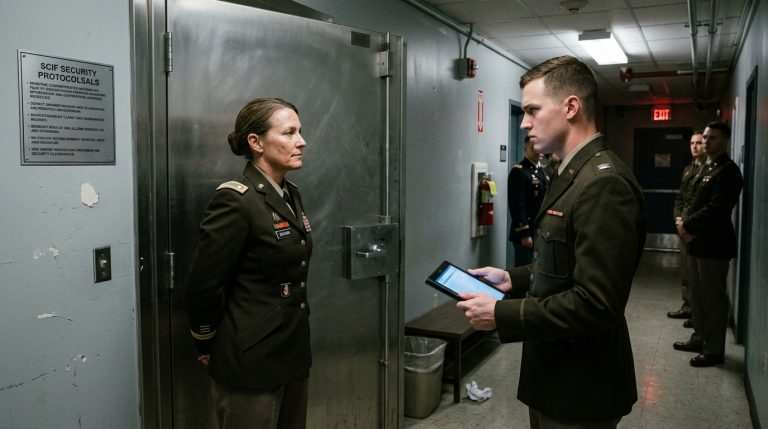
The brass latches of the grand double doors vibrated with a dull, metallic hum that traveled up through the stone framing of the hotel, a shudder that Colonel Henderson felt through the thin soles of his uniform shoes before he even reached the third-floor landing.
He didn’t pause to look down at the lobby floor. The weight of his dress jacket, stiff with forty pounds of protocol and institutional history, pressed against his collarbones as he lunged past the brass-handled fire doors of the administrative corridor. His breath was a rhythmic, dry rasp in the narrow concrete enclosure. The air in the back hallways always smelled different from the lobby—less like expensive freesia and French wax, more like stale ozone from the industrial chillers and the gray dust that collected behind electrical panels.
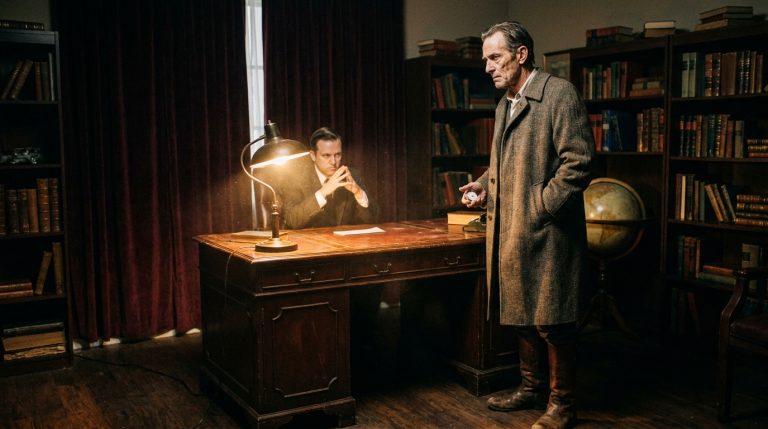
When he kicked open the heavy oak door to the temporary command suite, his aid, a young lieutenant named Aris, didn’t look up immediately. Aris was hunched over a field-grade terminal, his face washed in the flat, pale blue glare of an active encryption matrix. On the desk lay three separate internal affairs briefs regarding a suspected operational leak within the base logistics system—the decoy decoy layer that had kept Evans sniffing around the guest logs like a guard dog at a fence line.
“Shut it down,” Henderson said. He didn’t raise his voice, but the tone made the lieutenant’s fingers freeze mid-stroke over the mechanical keyboard.
“Sir? The security audit on the Grand Majestic’s registry is still—”
“I said close the ledger, Aris. Pull up the deep-storage crypt. Tier-One archives. Code-word authorization: Echo-Viper-Six-Zero.”
The lieutenant’s shoulders stiffened. He knew the format of code-words; they weren’t used for modern logistics leaks or administrative discrepancies. They were the dead-hand phrases of a military that existed prior to satellite reconnaissance and digital rosters. Aris reached for the terminal’s secondary interface, his palm flat against the biometric scanner until a small green line pulsed across his skin.
The screen flickered, the modern blue interface dissolving into a stark, unformatted terminal grid. A single name line emerged from the black background, surrounded by rows of heavy, solid black redaction blocks that looked like small ink scars across the glass.
O’DONNELL, JAMES M. — L/COL (RET)
DESIGNATION: PROJECT VIPER — OPERATIONAL LEAD
Henderson leaned over the desk, his hand pressing into the varnished oak until the wood groaned slightly. His eyes didn’t look at the list of citations—the three Silver Stars or the Navy Cross that had been processed through a classified courier service out of the West Wing in 1971. He looked at the few unredacted lines near the bottom of the log, where the names of the five-man asset team were supposed to be.
There was only one name visible beneath O’Donnell’s. The others had been scrubbed with a deep-tier algorithmic erasure that left no trace of the original keystrokes. But the last line remained clear, a tiny fragment of history left behind because of a clerical filing dependency sixty years old.
EVANS, ROBERT L. — CPL — UNIT: ASSET TEAM WHISKEY (VIPER)
STATUS: REPATRIATED / MEDICAL DISCHARGE
Henderson felt a drop of sweat break from his hairline, tracking slowly down the valley behind his ear until it caught on the stiff gold thread of his collar rank. Robert L. Evans. The captain’s grandfather. The man whose portrait hung in the main corridor of the base headquarters, framed as a pioneer of modern tactical logistics—a clean, flawless legacy built on an honorable discharge from the early days of the Vietnam conflict.
“Sir,” Aris whispered, his eyes widening as his thumb scrolled through the cross-referenced service ledger. “The logistics audit… the reason Captain Evans was checking the guest registries tonight. He wasn’t tracking an information leak. He was looking for the origin of a pension discrepancy filed from an unvouched account. He thought someone was using an old asset profile to pull funds from the base reserve.”
“He didn’t know,” Henderson muttered, his teeth clicking together as he straightened his spine. “The boy thinks he’s hunting an administrative ghost. He doesn’t realize his own family’s ink is on the ledger.”
The terminal screen pulsed once, a tiny red dot appearing in the upper corner as the main house line from the general’s suite overrode the local security loop. Henderson didn’t wait for the chime. He snatched the handset off its cradle before the bell could strike.
“Morrison,” the voice through the receiver was a low, gravelly vibration, stripped of the standard ceremonial warmth expected of a two-star general on the night of the Corps’ birthday. “Henderson, tell me Evans hasn’t initiated a formal removal.”
“He’s in the main lobby now, General. He’s processing the old man under the modern registry protocol. He thinks it’s an unvouched identity.”
“Get my detail down there,” Morrison commanded, the sound of a heavy leather belt being cinched tight visible through the phone’s microphone. “Tell the sergeant major to bring the formal colors from the ballroom alcove. Not the parade staff—the iron-bound colors.”
“Sir, the file,” Henderson looked back at the screen, where the name Robert Evans seemed to shrink under the flat glass glare. “The captain’s grandfather was the one who—”
“I know who his grandfather was, Colonel. James O’Donnell carried that boy’s shame across three ridges in the Asho Valley so the family could have a clean wall to hang their pictures on. If Kyle Evans breaks that old man’s silence tonight, he won’t just destroy his own career—he’ll dig up a grave that’s been green for sixty years. Tell Evans to keep his hands off him. I’m moving now.”
The line clicked shut. Henderson dropped the handset, his eyes meeting the lieutenant’s. Aris was still looking at the redacted lines, his young face pale with the dawning realization that the history they taught at the academy was merely the portion the ink had permitted them to see.
“Leave the terminal live,” Henderson said, adjusting the gold braid on his shoulder with a sharp, downward jerk. “And get the colors. We’re going down to the floor.”
He didn’t look back at the room as he cleared the doorway, his boots striking the concrete of the service stairs with the heavy, unhurried rhythm of an officer who knew that the perimeter had already been breached.
CHAPTER 4: THE THUNDER AND THE IRON
The two syllables—Iron Viper—did not leave James’s mouth with the volume of a shout, but they fell into the Grand Majestic lobby with the clean, heavy finality of a grease-gun bolt slipping into battery.
Captain Evans’s hand, still hovering near the frayed edge of the old leather sleeve, went stiff. The cruel, patronizing smile on his lips didn’t slide off; it locked into place, turning into a rigid, chalky caricature as the brass-bound double doors behind him didn’t just swing—they were thrown clear to the walls by two junior officers who stood at absolute attention before the threshold could even clear.
The cold air from the urban street rushed over the marble, carrying the distinct, sharp scent of exhaust and wet gravel that cut cleanly through the hotel’s expensive French wax. Then came the boots. It wasn’t the scattered, uneven shuffling of civilians; it was a rhythmic, iron-shod strike that hit the stone in perfect unison, four pairs of dress low-quarters tracking a pace that had been measured by metronomes.
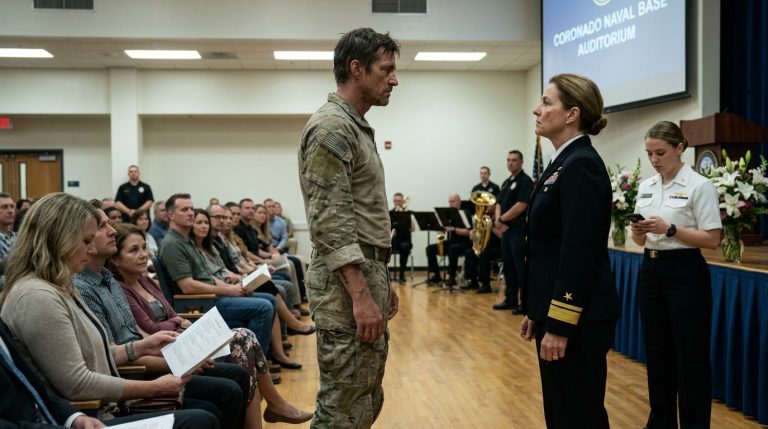
General Morrison did not look at the crowd that had curdled along the walls. His two-star insignia caught the overhead glare of the chandeliers, throwing small, needle-sharp beams of gold light across the pale columns as he advanced. His dress blues were a solid wall of midnight wool, his chest an absolute fortress of enamel and silver ribbons that represented thirty-five years of unyielding institutional memory. To his left, the sergeant major moved like a block of gray granite pulled from a quarry, his hands curved slightly at his sides near the iron-bound staff of the command colors.
Evans froze. The color didn’t just drain from his cheeks; it seemed to sink beneath his skin, leaving a sickly, pasty gray along his jawline. His shoulder blades dropped out of their rigid, regulatory posture, his spine bowing just enough to show the sudden, catastrophic loss of structural velocity. His mind, trained strictly on the predictable gears of peacetime administration and guest lists, was completely unable to process the arrival of the base commander through a service entrance at 1900 hours.
Morrison didn’t blink. He didn’t look at Evans. He didn’t look at the reception desk or the heavy manila envelope that contained the internal affairs log. His eyes, burning with a flat, predatory focus that stripped the luxury from the room, were anchored to the old man in the faded leather jacket.
He halted precisely three feet away. The rhythmic clicking of his heels ceased with a single, dry snap that echoed off the high ceiling. For the space of one long breath, the general looked at the loose gray loops of thread on James’s sleeve, his face remaining entirely unreadable. Then, his arm came up.
It was not the standard, casual gesture offered to a junior officer on a parade ground. His hand was a rigid blade at his brow, his fingers pressed against the black visor of his cover with a force that made the gold piping tremble. It was the deep, historical acknowledgment a warrior offers only to a living ledger.
“Mr. O’Donnell,” Morrison’s voice boomed, the low, gravelly vibration filling the alcoves and stopping the movement of every glass within forty yards. “It is an absolute honor, sir.”
James didn’t execute a return salute. He couldn’t; his shoulder had been set wrong after a mortar fragment took the meat out of his collarbone in ’72. Instead, he gave a slow, tired inclination of his head—the quiet nod of a man who had long since buried the need for ceremony under the damp earth of a different continent. Lily’s fingers relaxed their grip on his arm, her breath finally escaping in a long, shuddering sigh against the wool of her sleeve.
Only then did the general drop his blade. He turned his head two inches, his eyes sliding over the petrified form of Captain Evans like a surveyor looking at a cracked foundation.
“For those of you who do not know,” Morrison said, his voice dropping into the cold, rhythmic cadence of a lecture at the war college, though his eyes never left the captain’s pupils. “Let me provide the context that our modern registry seems to lack. During a conflict this nation has spent forty years trying to scrub from the public record, there were profiles that never entered the database. Clandestine assets. Men who operated three ridgelines beyond the extraction parameters, whose casualty rates were calculated at one hundred percent before they even cleared the tarmac.”
He took a step closer to Evans, the gold braid on his shoulder brushing against the captain’s pristine cloth. “They didn’t carry IDs, Captain. They didn’t have registered names on the general’s guest list. They had legends. And the individual who created the five-man cell known as the Vipers—the man who personally brought home the remnants of that unit through seventy miles of hostile canopy—stands right in front of you.”
Evans’s jaw worked silently, a small muscle twitching near his ear as his hands began to tremble against the gold buckle of his belt.
“You wear that eagle, globe, and anchor,” Morrison hissed, his voice dropping to a low, razor-focused rasp that was far more terrifying than a shout. “A uniform that men like James O’Donnell paid for in blood while your own lineage was still figuring out how to sign a voucher. You used that rank to humiliate a man whose boots you are not structurally fit to grease. You mistook his silence for the confusion of old age.”
The general stepped into Evans’s personal space, his chest nearly touching the captain’s immaculate ribbons. “You will report to my quarters at 0600 tomorrow. You will surrender your command directory to Colonel Henderson, and we will have a very direct conversation about your future—or the complete lack thereof—in this command. Dismissed.”
The rebuke was total, a clean administrative bisection that left the captain standing like a hollow shell on the marble floor. But before Evans could turn his broken frame toward the doors, James reached out, his wrinkled, liver-spotted hand catching the stiff wool of the general’s sleeve with a gentle, slowing pressure.
“General,” James said, his quiet voice cutting through the ice of the room. “Let the boy be. We were all young once. The uniform is heavy… sometimes it takes a man a few miles to learn how to carry it without tipping over.”
The captain didn’t look at James. He couldn’t face the flat, blue clarity of those eyes. He simply turned, his boots dragging against the stone as he moved toward the exit, his two junior escorts following behind him like shadows that had lost their sun.
CHAPTER 5: THE SANCTUARY OF WORN VINYL
The small brass bell suspended above the diner’s heavy frame doors didn’t ring with the clinical, sharp vibration of the Grand Majestic’s latches. It gave a dull, tinny jingle that dissolved instantly into the familiar, warm atmosphere of the room—a space thick with the scent of griddled bacon fat, burnt coffee grounds, and the slow hum of an old commercial refrigerator working against the morning heat.
James O’Donnell sat perfectly still in the corner booth, his left hand wrapped around the smooth, hot curvature of a thick white porcelain mug. His fingers, scarred by grease and ancient shrapnel, felt the heat leaking through the glaze, a steady, localized warmth that counteracted the early air conditioning. Beside him, Lily was using her spoon to trace quiet, circular tracks through the foam of her tea, her shoulders dropped into an easy posture she hadn’t managed since the night of the ball.
The leather jacket hung over the back of the pine bench, its stiff hide creased, the circular twill patch catching the flat, unglamorous sunlight through the front window. From this angle, the coiled serpent looked less like a weapon and more like what it truly was—a patch of old string held together by sixty years of stubborn friction.
Then the bell jingled again.
A young man in a civilian cotton jacket and dark denim stood near the cash register, his frame blocking the light from the door. He wasn’t in uniform. He didn’t have the midnight blue wool or the pristine row of silver medals to hold his spine straight, but the posture was impossible to disguise. He held his chin tilted back just enough to reveal the tight, pale line of his jaw, his hands shoved deep into his pockets as his eyes scanned the vinyl booths with a quiet, hesitant measurement.
It was Kyle Evans. Without the gold piping and the polished cover, his face looked younger, stripped of the synthetic authority that had filled the hotel lobby weeks prior. There was a gray smudge of engine oil under his left thumbnail—a detail James noticed immediately. The boy had been reassigned to the logistics repair terminal downstream, working the grease-lines.
Lily’s silver spoon made a sharp, metallic click against the side of her cup as she tensed, her eyes locking onto Evans with an immediate, protective sharpness. She went to shift her weight, her knuckles tightening on the edge of the laminate table, but James’s index finger merely tapped the porcelain rim of his mug twice. The sound was soft, but it carried the same unyielding weight that had stopped a general in his tracks. Lily stopped. She sank back against the vinyl, her breath escaping in a quiet, guarded exhale.
Evans didn’t advance immediately. He stood by the napkin dispenser for three long seconds, his fingers twisting inside his pockets, his gaze fixed on the salt shaker at an empty table. When he finally moved, his shoes made a soft, rubbery scuff against the linoleum. He halted at the edge of the booth, his broad shoulders dropping an inch as he finally forced his eyes up to meet James’s flat, blue gaze.
“Sir,” Evans began, his voice dry, lacking the clipped cadence of the garrison line. It was rough, catching in his throat like silt. “Mr. O’Donnell. I… I didn’t come here to cause a disruption.”
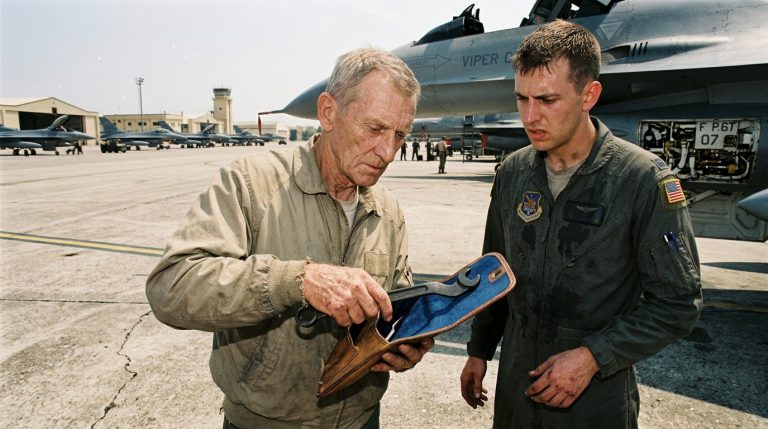
James didn’t say anything. He didn’t ask for the apology that had clearly been written and rewritten inside the boy’s head during the long shifts at the motor pool. He simply looked at the young man’s face, tracking the line of his nose, the specific, slight asymmetry of his brow. It was the exact facial geometry of Corporal Robert Evans, the boy who had dropped his radio in the mud forty miles past the fence line in ’71, his hands shaking so violently he couldn’t clear the battery latch while the mortar fins were whistling through the canopy.
James had spent sixty years keeping that boy’s name clean on the records. He had taken the operational blame for the lost frequency line, allowing Robert to take a medical discharge with a full pension and an unblemished sheet, ensuring that the lineage that followed would have a pristine, gilded wall to hang their portraits on. And now the grandson was standing here, smelling of the same lithium grease that had stained the Asho valley floor.
The ultimate truth was a heavy, silent anchor between them. James had no intention of lifting it. To tell the boy would be to break the very vessel he had spent his life protecting; the silence wasn’t a punishment—it was the shelter.
“Sit down, son,” James said. His voice was thin, a gravelly rasp that didn’t rise above the sizzle of the egg station across the room, but it held the room steady. “The coffee is good here.”
Evans hesitated, his chin twitching as he looked at the empty vinyl bench opposite the old man. Then, slowly, with a deliberate, unhurried motion that lacked any of his former military swagger, he pulled his hands from his pockets and slid into the booth. His knees knocked against the pine frame under the table, a small, human clumsiness that seemed to settle the remaining air in the room.
“I’m working the third echelon maintenance pool now,” Evans murmured, his eyes dropping back to the white laminate. “The general… he has me rewriting the foundational asset registries for the division archives. I’m going through the old logbooks. By hand.”
James took a slow, deliberate sip from his mug, the porcelain clinking softly against his teeth. “Good work,” the old man said, his flat blue eyes watching the steam rise between them. “Teaches a man how the pieces fit together. You learn the weight of the bolt before you try to fire the gun.”
Evans looked up then, his eyes searching James’s face for a trace of malice, a sliver of dark vindication, but he found nothing but the faded, flat surface of an old pond. The shared burden was safe. The ink on the ledger would stay dry.
James reached across the table, his hand heavy and steady as he turned the extra coffee cup upright, exposing the clean white interior to the sunlight. He pushed the pot toward the young man, his old fingers catching the light, showing the small, silver scar where an old wire had taken a piece of his skin sixty years ago.
“Tell me about your modern trucks,” James said softly, his back settling against the worn vinyl of the corner booth as the diner bell jingled again behind them, welcoming the rest of the world back inside. “I hear the transaxles are different now.”